

Estúdio HAA! Threads a Timber Refuge Through the Forest Canopy of São Bento do Sapucaí
A linear pavilion in the Brazilian highlands dissolves its walls into the surrounding Mata Atlântica through glass, timber, and raw concrete.


The Mantiqueira Mountains of São Paulo state are not short on weekend retreats, but most of them hunker down against the landscape rather than threading through it. Mirzé Refuge, designed by Estúdio HAA! under the lead of architect Homã Alvico, does the opposite. It stretches itself into a long, narrow bar that slips between existing trees, using the forest canopy as both ceiling and context. Completed in 2023 in São Bento do Sapucaí, the house treats its site not as a clearing to be dominated but as a corridor to be occupied.
What makes the project genuinely interesting is how it resolves the tension between enclosure and exposure. The building is almost entirely glazed along its long elevations, yet it never feels like a fishbowl. Deep eaves, charred timber cladding, and a lifted central roof volume create layered thresholds that modulate light and privacy without closing anything off. It is a house that gives you the forest without asking you to pretend you are sleeping outside.
A Linear Logic
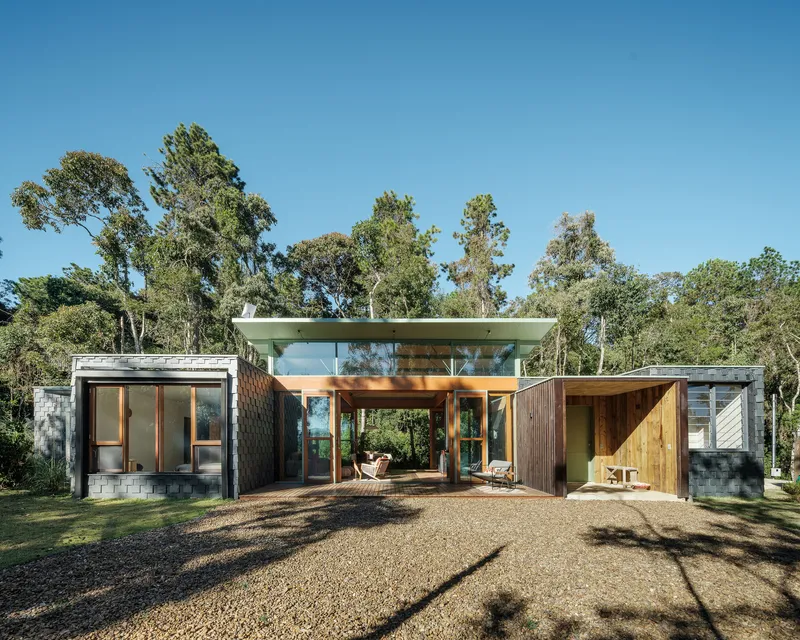
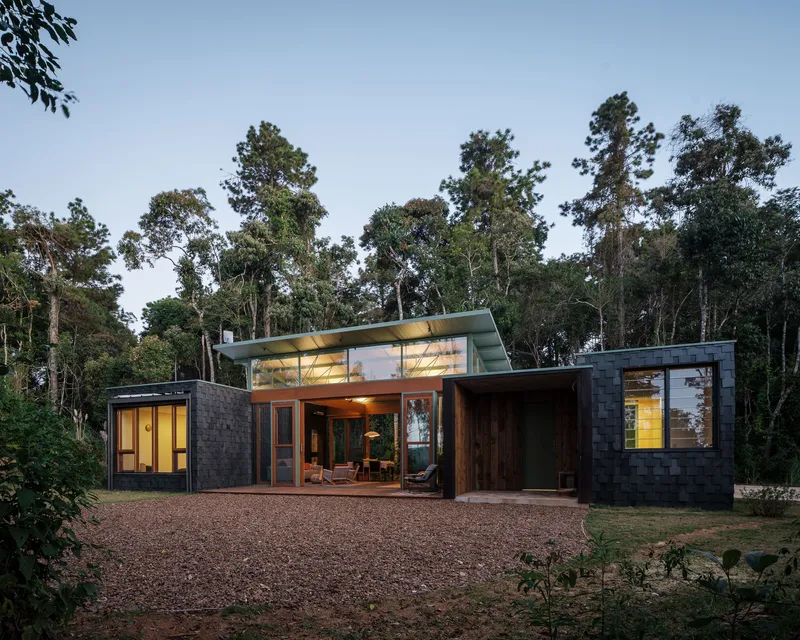
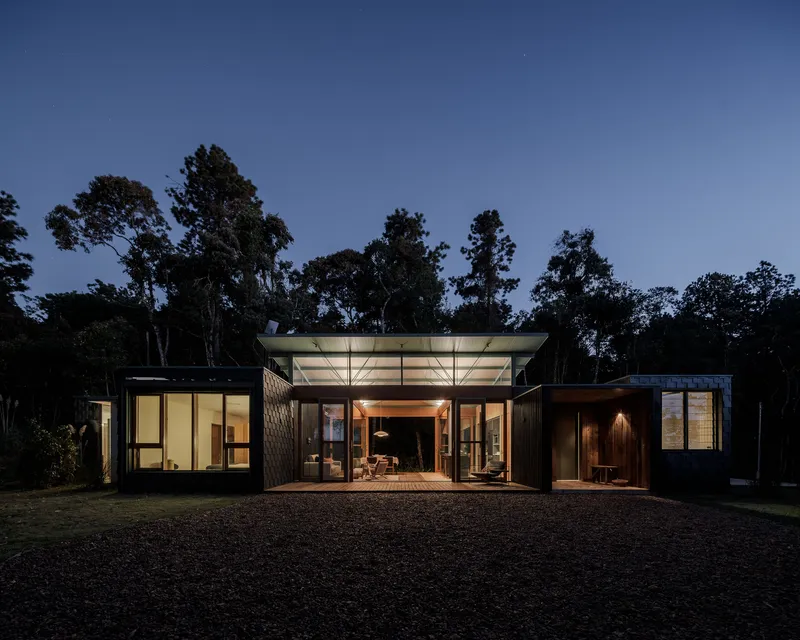
The plan is emphatically linear. Rooms stack end to end along a single axis, stretching from the entry vestibule through living spaces to service areas at the far end. This is not a house that organizes itself around a central courtyard or a dramatic double-height void; it is a house that organizes itself around a path. You move through it the way you move through the forest itself: forward, with the view changing incrementally.
From the front, the linked pavilions read as a disciplined composition of timber cladding and gravel forecourt. From the side, the single-story silhouette almost disappears beneath the tree line. At night, the glazed walls turn the entire volume into a lantern, its warm interior glow set against silhouetted trunks and a sky full of stars.
Structure as Ornament
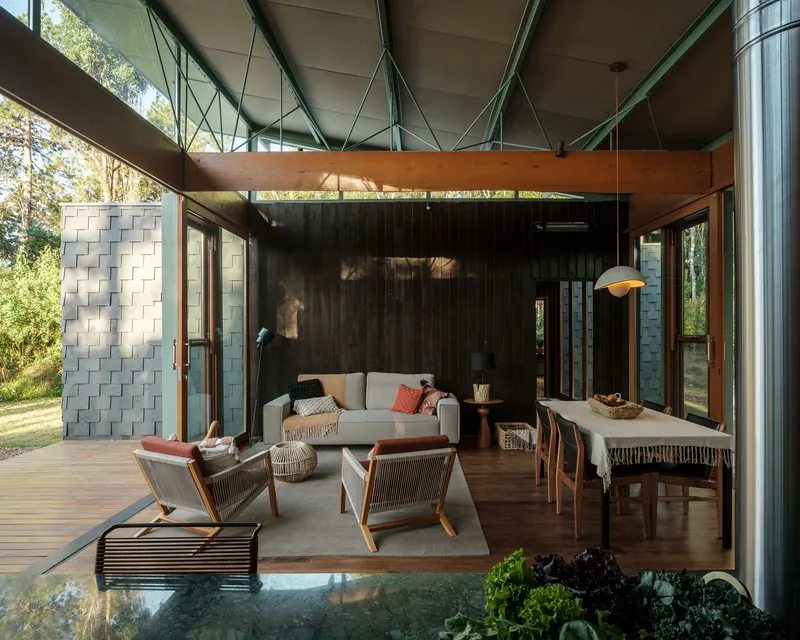
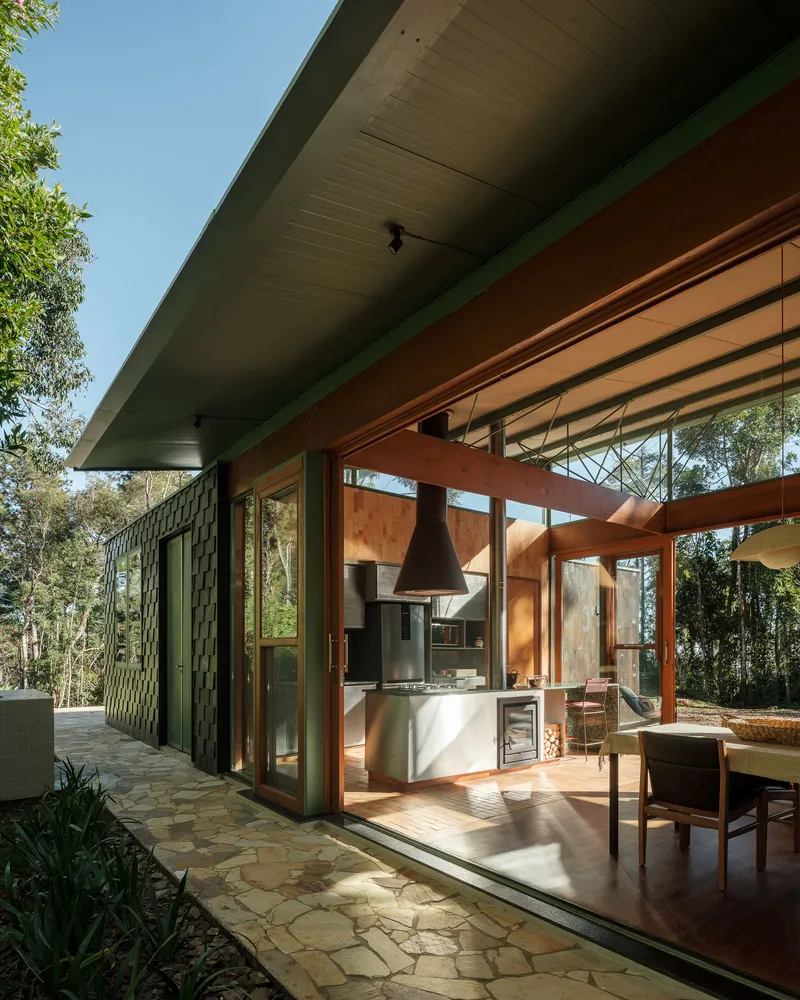
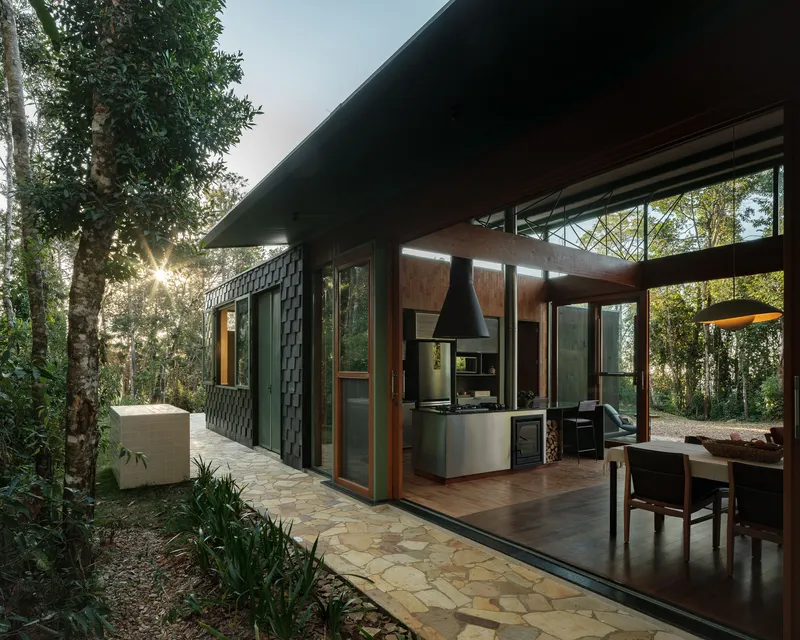
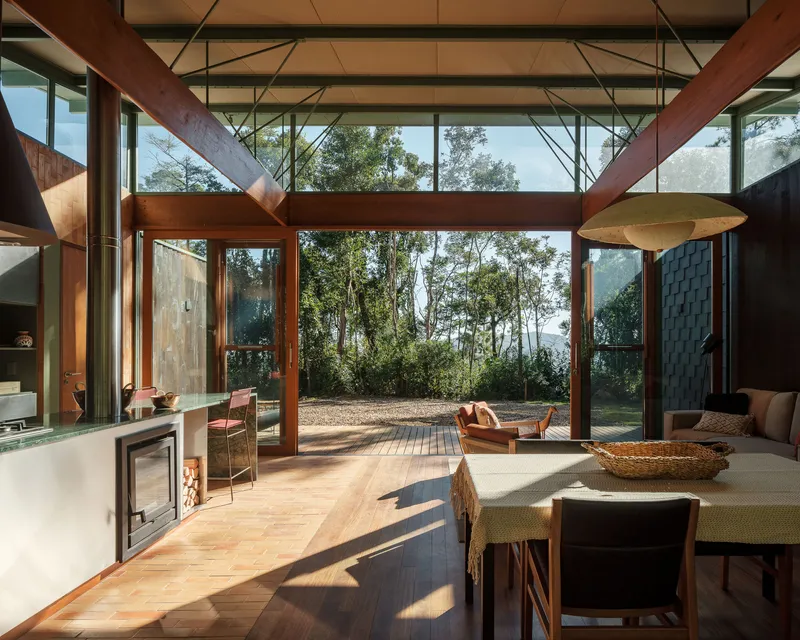
The construction system is the decoration. Exposed timber beams run the length of the roof, supported by steel tension rods that give the ceiling an honest, almost industrial clarity. Concrete is left raw wherever it appears, with board-formed surfaces that record the grain of the formwork. Green-trimmed steel overhangs add a deliberate color note that reads as playful rather than precious.
The covered terrace is the best demonstration of this approach. Stone paving, deep eaves, and heavy timber framing come together under a single gesture that is simultaneously structure, shade device, and spatial threshold. It is the kind of detail that rewards close looking: nothing is clad, nothing is hidden, and nothing is arbitrary.
Material Palette: Timber, Concrete, Stone
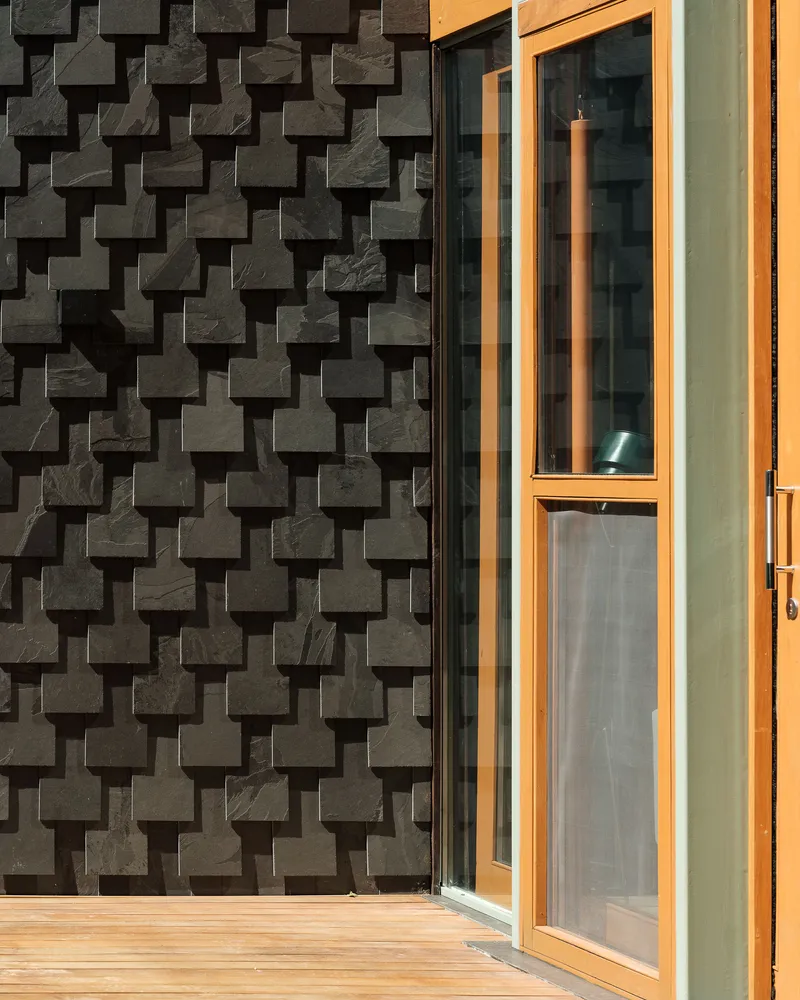
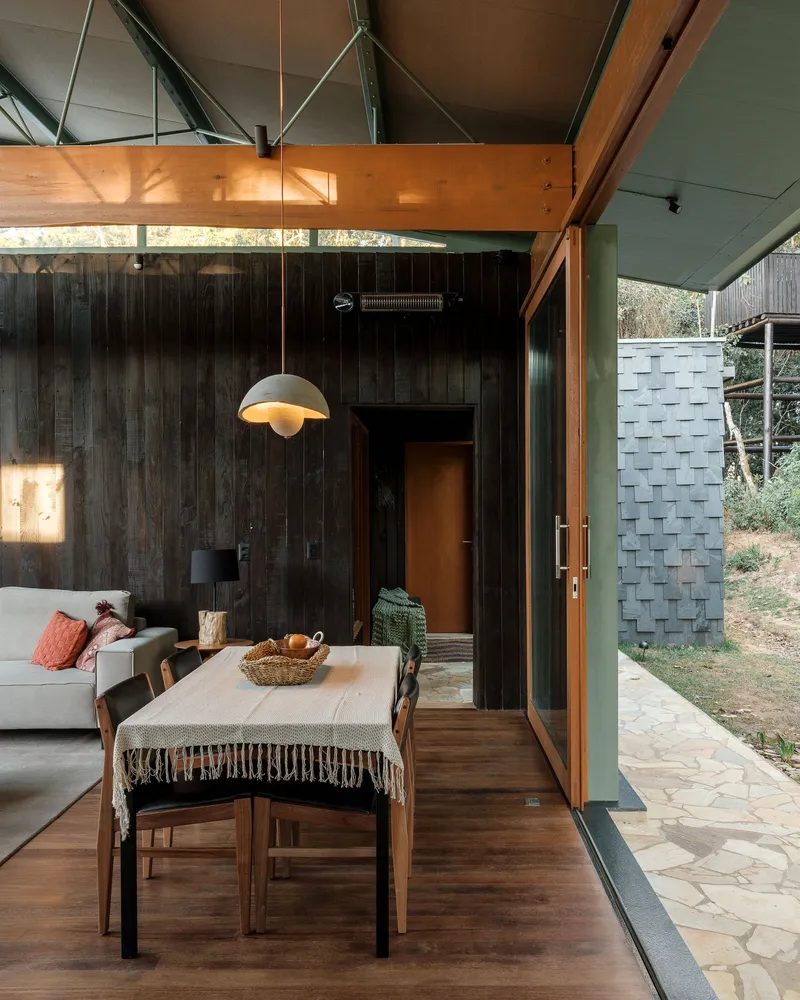
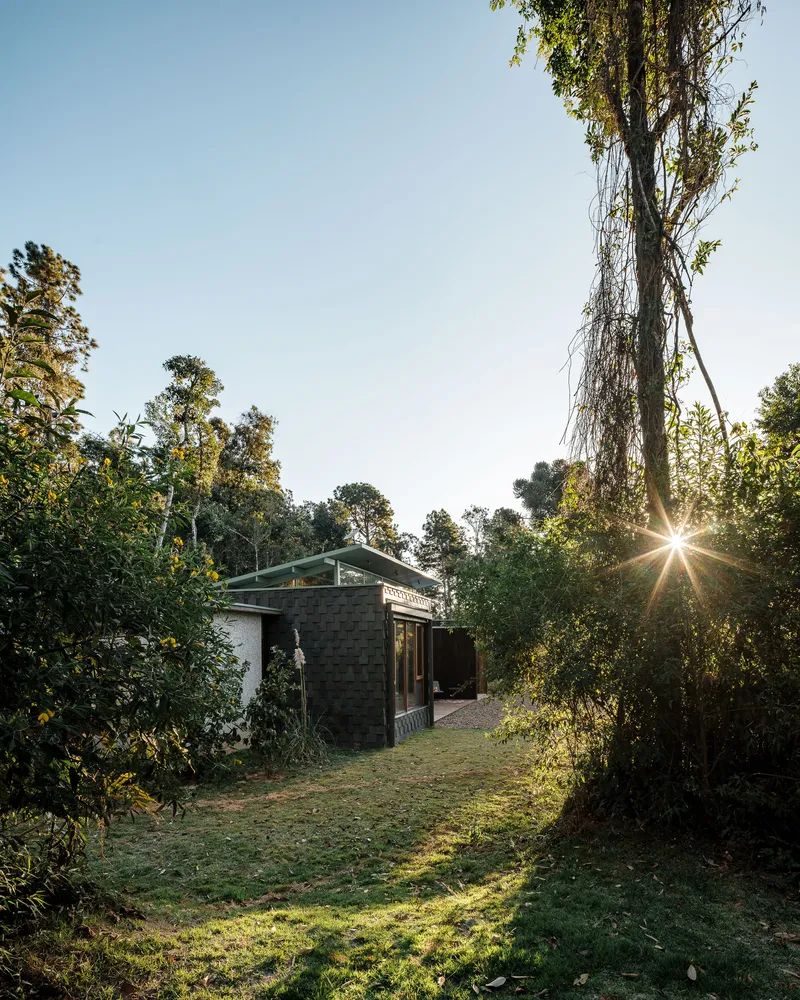
The material strategy is restrained but varied enough to keep things interesting. Basket-weave patterned concrete blocks form exterior walls that filter light and provide texture without the weight of solid masonry. Charred timber panels line the dining wall, their dark surface absorbing light and creating an intimate counterpoint to the glazed openings opposite. A gabled pavilion in the distance, built from the same concrete blocks, anchors the composition at sunset.
Every material earns its place. The plywood utility walls, the green-veined stone of the kitchen island, the terrazzo backsplash in the bathroom: these are not finishes applied over structure but choices that define space. The palette stays within earthy tones, letting the forest provide the green.
Living Inside the Canopy
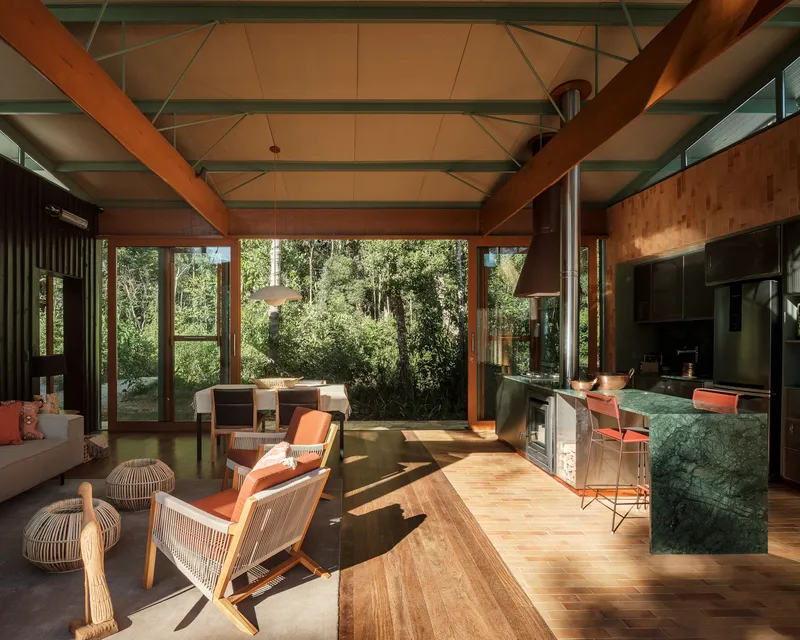
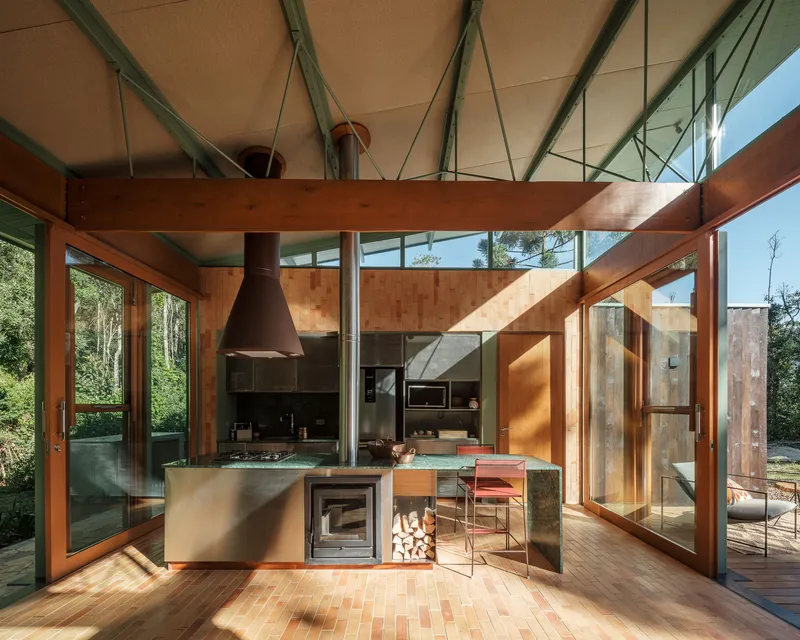
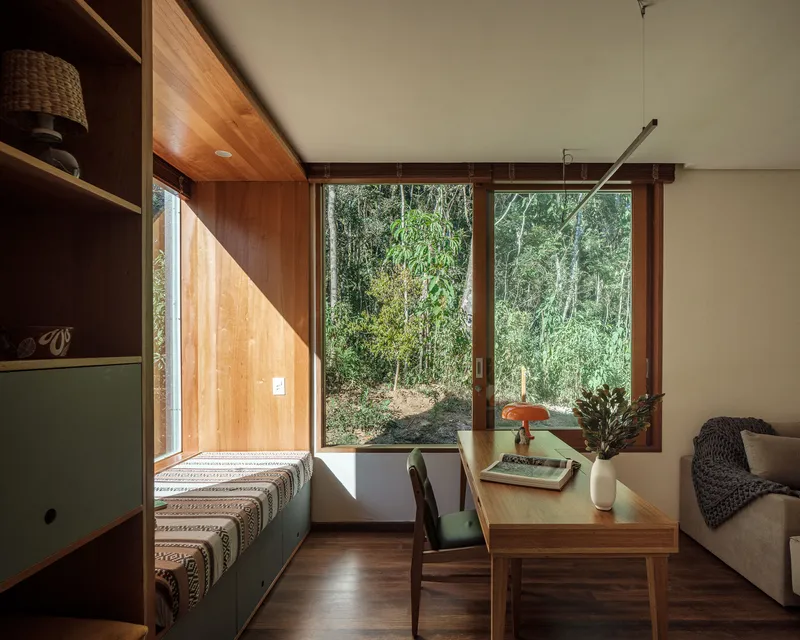
The open kitchen and living areas are where the house delivers on its promise. Steel-framed islands, timber beams overhead, and floor-to-ceiling glass walls on both sides place you squarely inside the tree canopy. Morning light enters from one side, afternoon light from the other. The bamboo grove visible from the corner windows filters both, casting moving patterns across built-in seating and timber wall surfaces.
There is a deliberate informality here. Dried herbs hang from dark vertical planks. A pendant light over the dining table sits low enough to feel domestic rather than designed. The architecture does the heavy lifting so the interior can relax.
Thresholds and Transitions

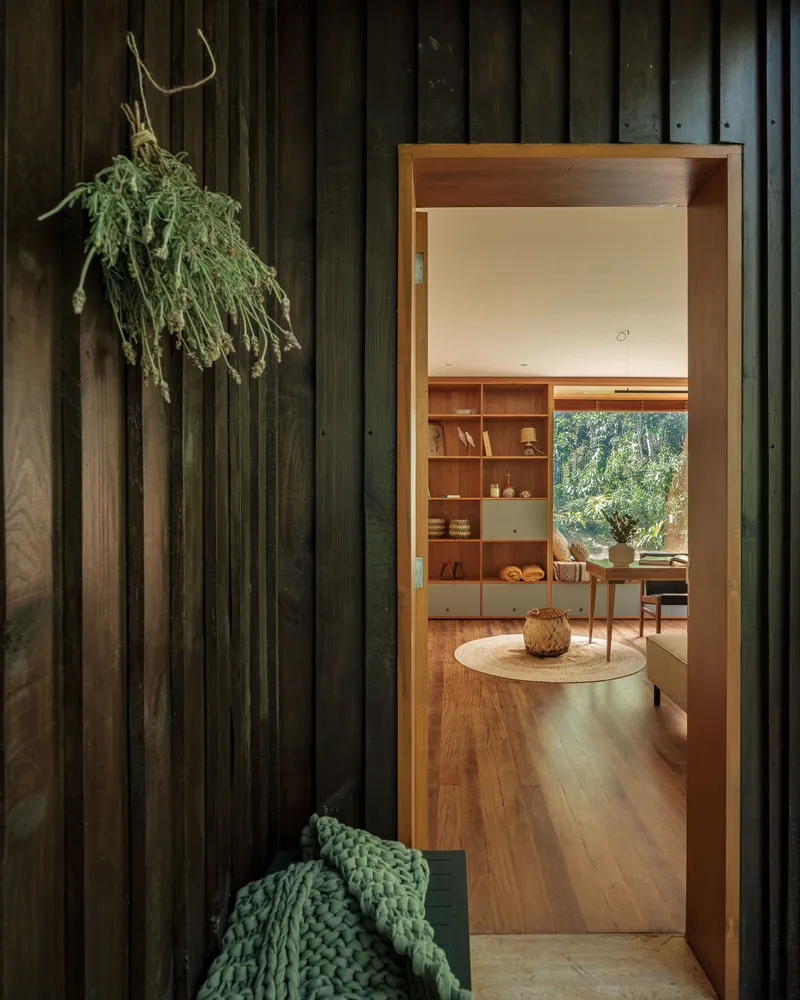
The transitions between inside and outside are where Estúdio HAA! shows real discipline. A timber-clad entry vestibule with a sliding glass door mediates between the gravel approach and the bedroom beyond. A doorway framed in timber opens into a living room lined with built-in shelving, its darkened planks creating a sense of depth. The deck extends outward, catching afternoon sun and dissolving the building edge into the forest floor.
These are not simply doors and windows. They are choreographed moments that slow you down, reorient your gaze, and remind you where you are. The architecture is at its best in these in-between zones, where the precision of the structure meets the looseness of the landscape.
Private Rooms, Public Views
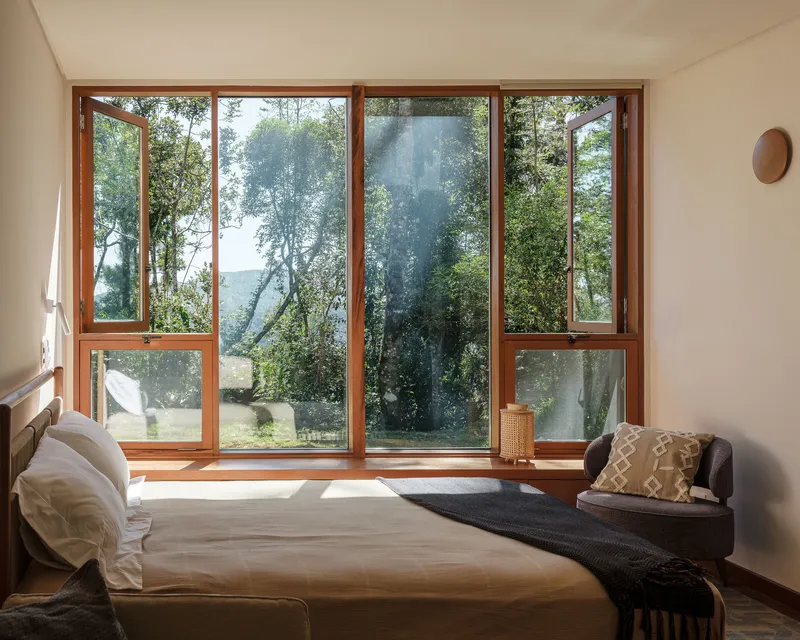
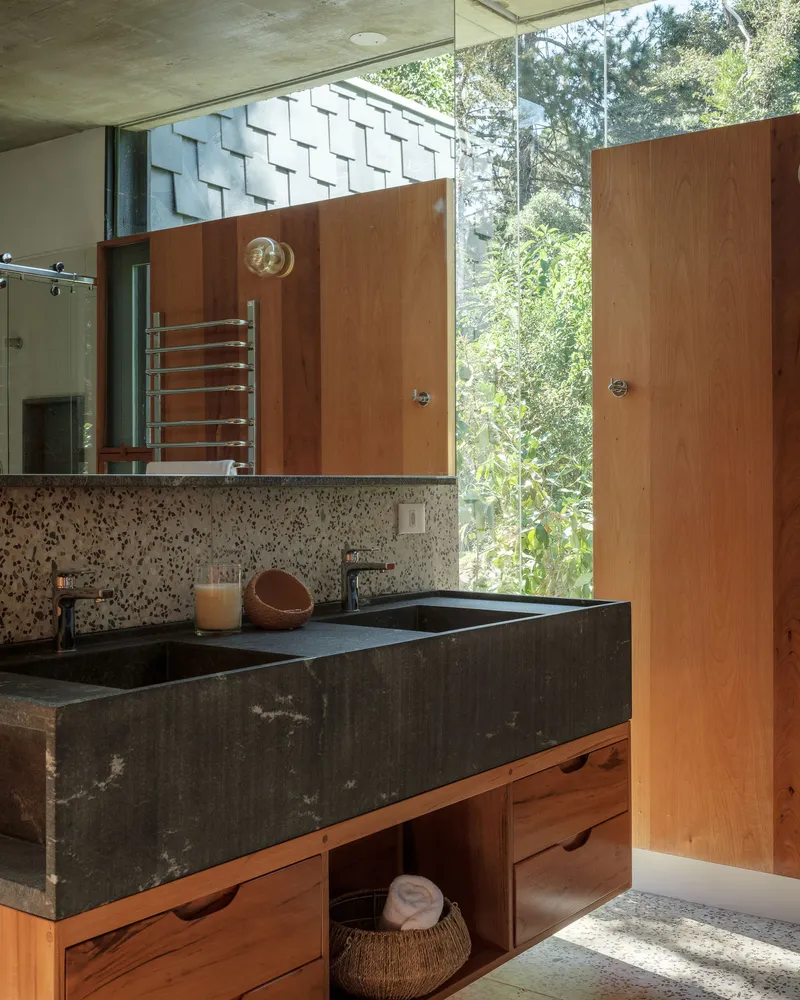
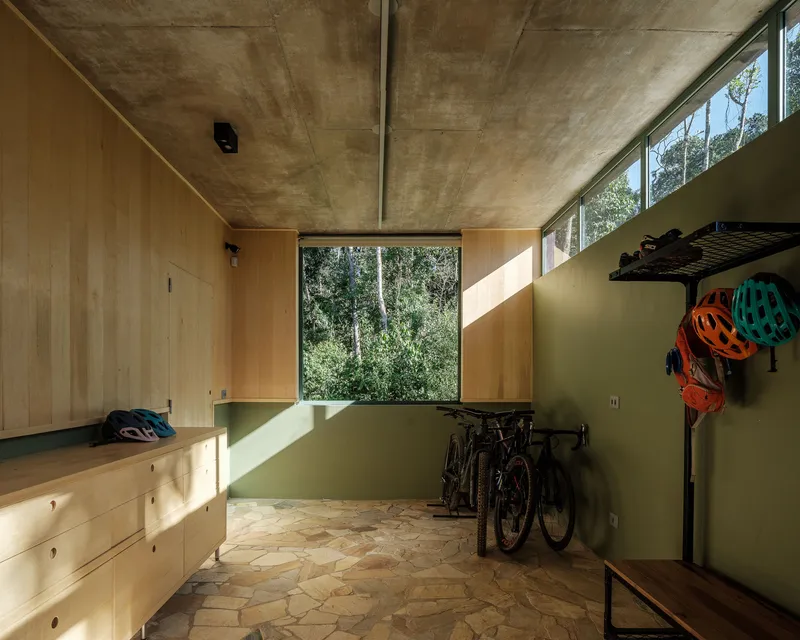
Even the private rooms refuse to close themselves off. The bedroom opens through full-height glazed doors to a wall of trees. The bathroom pairs a black stone sink and timber cabinetry with a terrazzo backsplash that catches indirect light from above. The utility room, lined in plywood, uses a clerestory window to frame a single view of the canopy overhead.
These rooms work because they are small and specific. The house does not try to make every space feel grand. The bedrooms are bedrooms, the bathroom is a bathroom, and each one uses its single view as a luxury rather than a trick.
The Rear Elevation and the Forest Edge
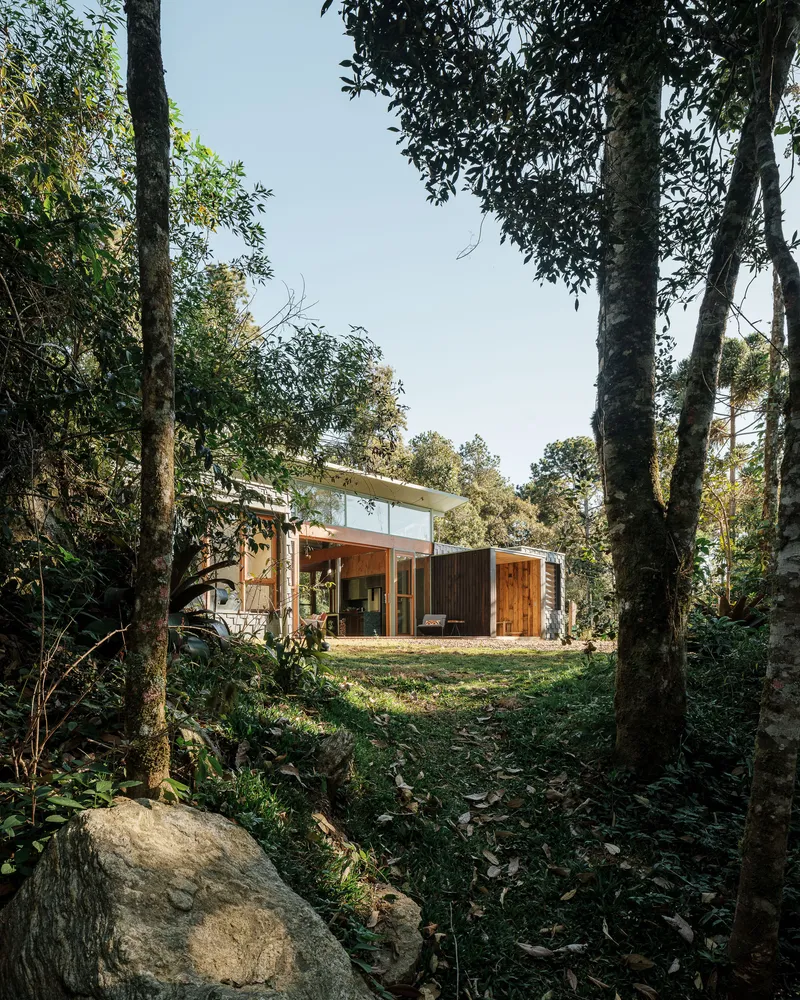
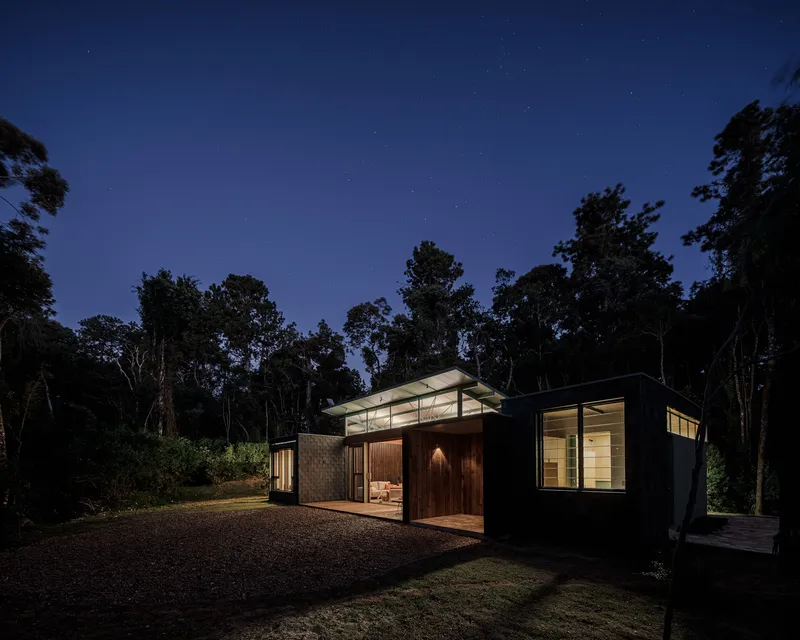
The rear elevation is arguably the project's strongest face. Timber and concrete volumes sit in dappled sunlight beneath native trees, their proportions reading as fragments of a larger system rather than a single monolithic form. The pavilion roof lifts at the center, flanked by lower glazed wings, creating a silhouette that echoes the ridgeline of the mountains beyond.
At night, this elevation becomes something else entirely. The starlit sky above, the dark tree trunks in silhouette, and the warm glow of the interior form a composition that is impossible to stage and difficult to photograph badly. Pedro Kok's images capture the quality without overselling it.
Plans and Drawings
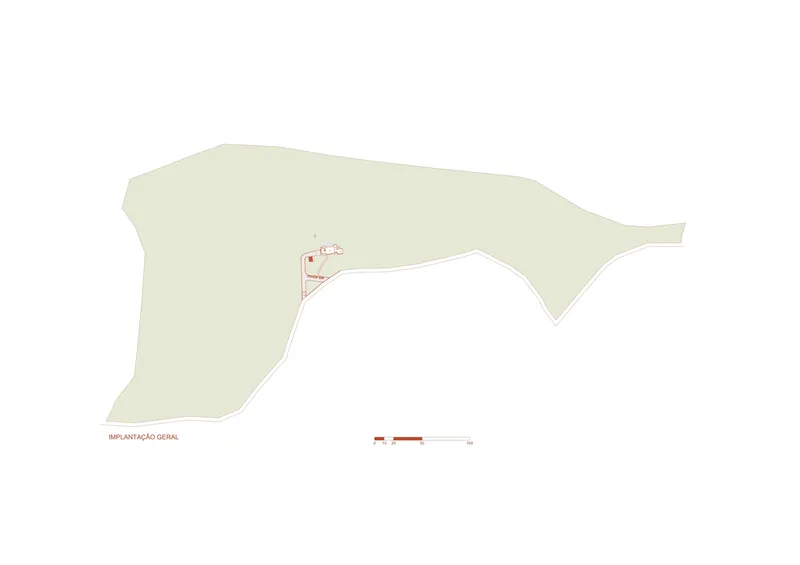


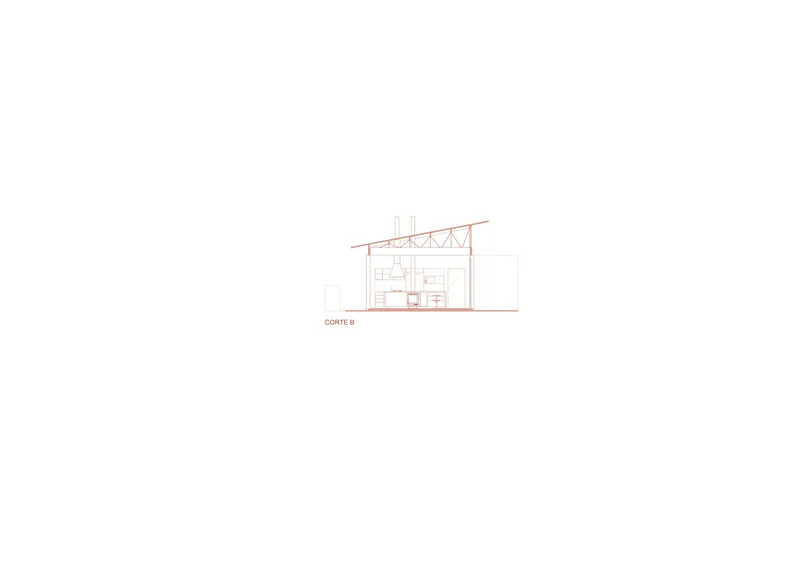
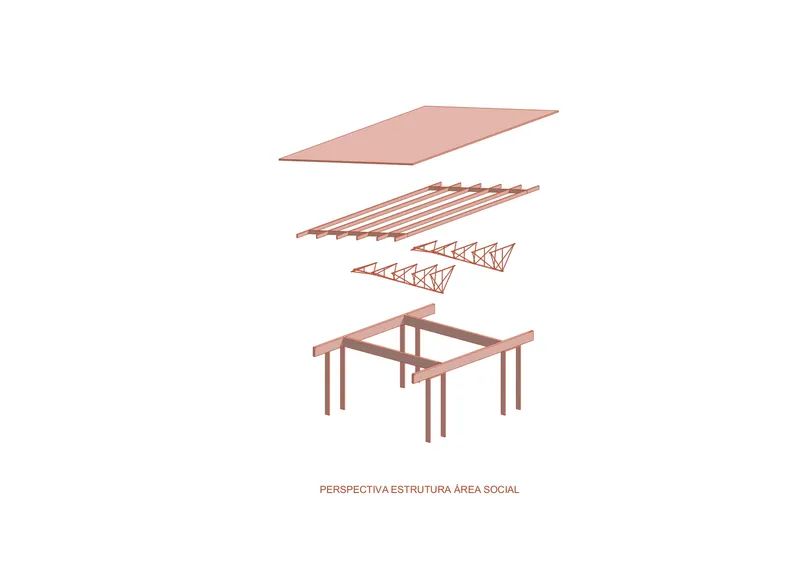
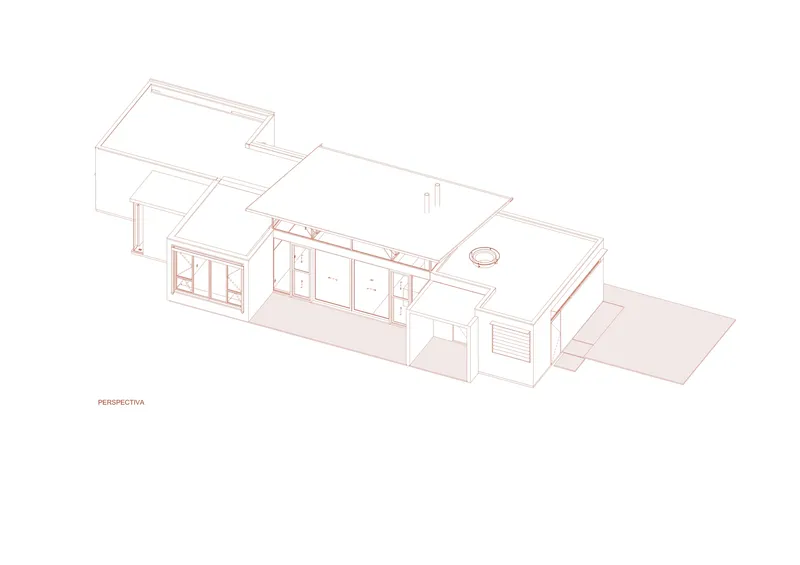
The drawings confirm what the photographs suggest. The site plans show a building that does not impose a geometric order on the property but instead follows the logic of the slope and the tree positions, its curving access drive tracing the contour of the land. The floor plan reveals the strict linearity: rooms march in sequence, each one a discrete volume connected by the continuous roof.
The sections are especially revealing. The central volume lifts its roof above the flanking spaces, introducing a triangulated truss system that provides both structural span and visual rhythm. Vertical chimneys punctuate the roofline. The exploded axonometric lays bare the construction hierarchy: roof plane, beam grid, trusses, and column foundations, each layer legible and independent. This is a house that could be drawn with a ruler and understood at a glance, and that clarity is its greatest strength.
Why This Project Matters
Mirzé Refuge belongs to a growing category of Brazilian residential work that takes the Mata Atlântica seriously as a design partner rather than a backdrop. Estúdio HAA! has not built a platform from which to admire the view; they have built a corridor that participates in the forest. The linear plan, the honest materials, and the calibrated thresholds all serve the same idea: that a house in the mountains should feel like an extension of the walk that brought you there.
In a region where weekend retreats tend toward either rustic nostalgia or glossy minimalism, this project finds a productive middle ground. It is precise without being cold, warm without being sentimental, and open without being exposed. That balance is harder to achieve than it looks, and it is the reason the house succeeds where so many others simply perform.
Mirzé Refuge by Estúdio HAA!, lead architect Homã Alvico. São Bento do Sapucaí, Brazil. Completed 2023. Photography by Pedro Kok.
About the Studio
Share Your Own Work on uni.xyz
If projects like this are the kind of work you want to make, uni.xyz is a place to publish your own, find collaborators, and enter design competitions.


Popular Articles
Popular articles from the community


GROUP A Strips a 1969 Rotterdam Harbor Headquarters to Its Frame and Wraps It in Timber Louvers
In Rotterdam's M4H harbor district, Ferro Offices reuses a 1969 frame, adds one timber storey and reaches BREEAM-NL Outstanding.

Architekt Andreas Gruber Scatters 23 Dark Timber Chalets Across a South Tyrolean Forest Edge
In Molini di Tures, Amonti Chalets breaks a resort into a hamlet of gabled timber houses, with parking, storage and services pushed into the slope.

David Ortega Stacks a Two-Story Mexico City Penthouse Around a Steel Stair and a Pergola-Shaded Roof Terrace
In Colonia Roma, a 300 m² penthouse uses oak joinery, a planted steel stair and a slatted roof pergola to make a new-build apartment feel like a house.

Jaramillo Van Sluys Arquitectura and Urbanismo Turn a Demolished Registry Lot in Quito into an Orchard Plaza
In Quito's Centro Histórico, a 2,800 m² plaza exposes the San Agustín convent wall and redraws its lost Augustinian orchard in volcanic stone.

Similar Reads
You might also enjoy these articles


LAVA Architecten Gives Vocational Education a Sawtooth-Roofed Face on a Mechelen School Campus
In Mechelen, Belgium, a 2,053 m² STEM school on a 6×6 m grid turns workshops and classrooms into rooms that can be rearranged as teaching changes.

KEMA Studio Turns a Derelict Marvila Attic into a 60 m² Lighthouse Apartment Above Lisbon
In Lisbon's Marvila district, a rebuilt roof, four skylights and two plywood volumes turn an unlivable attic into a bright home facing the Tagus.

Pixel Gardens: One Repeated Module Stacked Into a Terraced Social Housing Tower for Famagusta
Salem Bader's shortlisted housing tower builds a vertical neighbourhood from one repeated module, offsetting units to carve terraces, light and air.

Bao Huynh Watercolor Atelier: A Serene Art Retreat in Hội An
Bao Huynh Watercolor Atelier in Hội An blends multifunctional art spaces, sustainable design, local materials, and family-friendly living in a serene environment.


Comments (0)
Please login or sign up to add comments
No comments yet. Be the first to comment!