
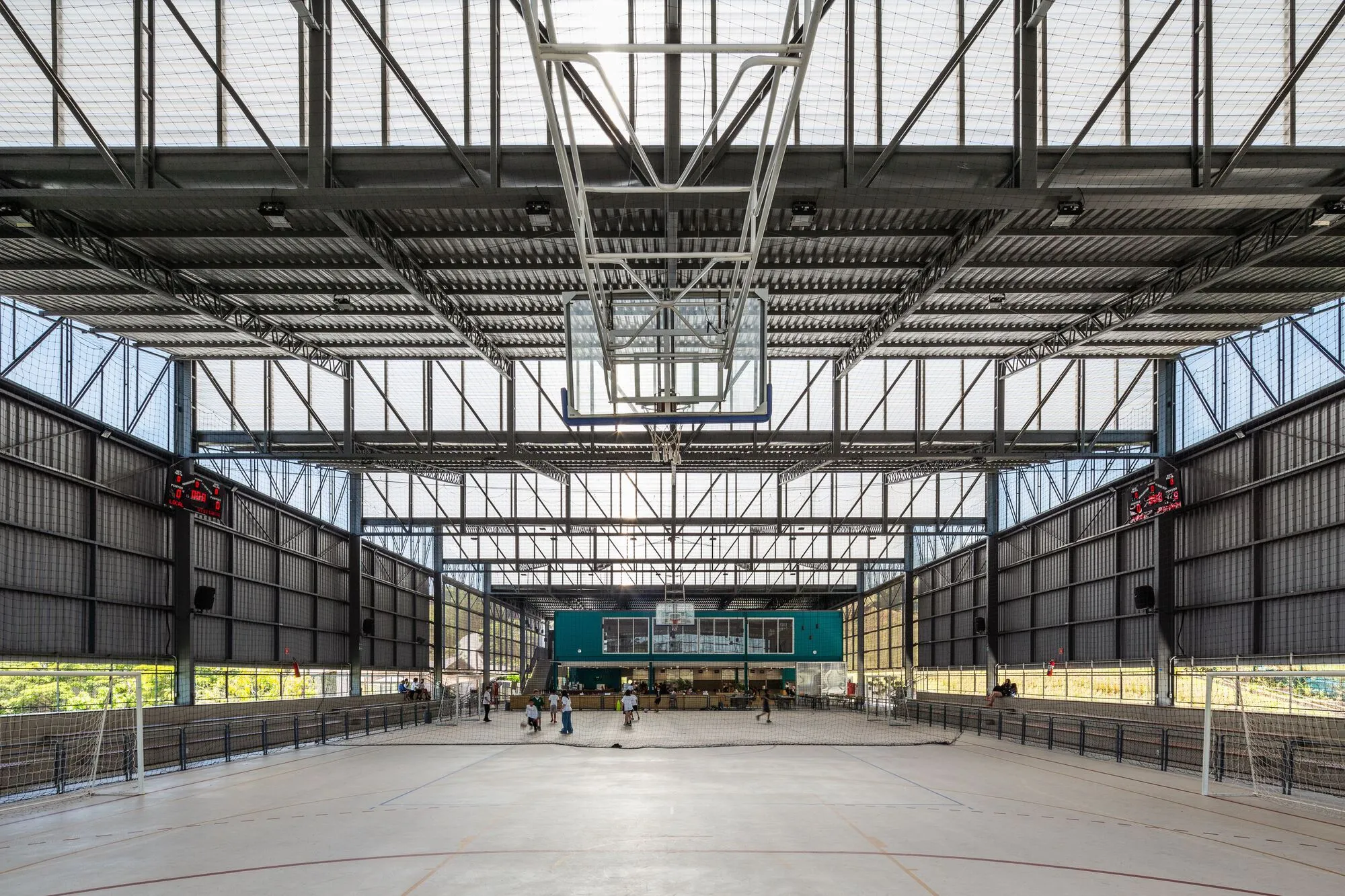
Estúdio Trópico Shelters a School Arena Under 2,100 Square Meters of Sawtooth Roof in São Paulo
A steel shed structure in Santana de Parnaíba wraps a sports court, refectory, and arts classrooms inside a climate-responsive envelope.


School buildings in the tropics face a basic contradiction: they need large, open volumes for gathering and play, but those same volumes become unbearable without careful environmental control. At Escola Castanheiras in Santana de Parnaíba, on the outskirts of São Paulo's Alphaville district, Estúdio Trópico resolves this tension with a single decisive move. A 2,100-square-meter roof in a sawtooth profile covers a multi-sport court, an open courtyard, and a two-story block of classrooms and dining facilities, all arranged beneath steel trusses that channel daylight and ventilation with almost mechanical precision.
What makes this project worth studying is not its size but how its section works. The shed format, with south-facing zenithal openings, pulls indirect light deep into the covered court while drawing hot air out through polycarbonate louvers. The building replaces a soccer field and a small volleyball court that previously occupied the site, part of a five-year master plan developed by Andrade Morettin Arquitetos Associados. Estúdio Trópico took that master plan and gave it a single roof, one that treats structure, enclosure, and climate strategy as one problem rather than three.
A Roof That Does the Heavy Lifting

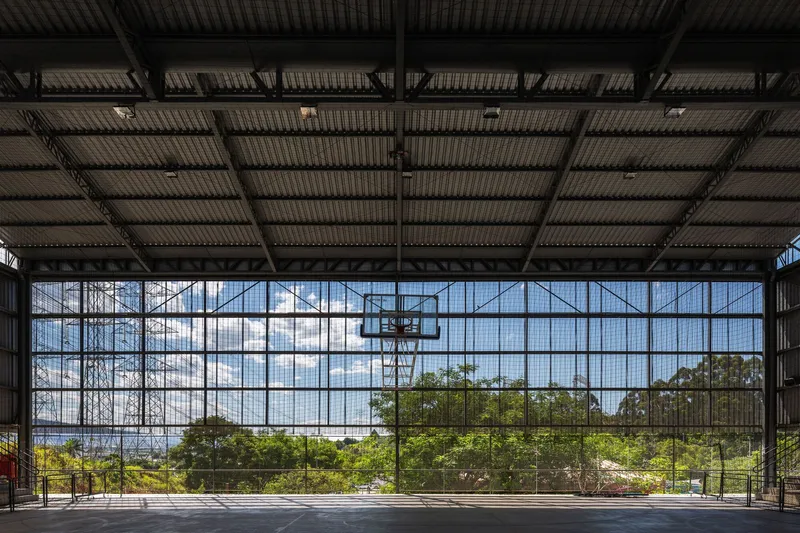
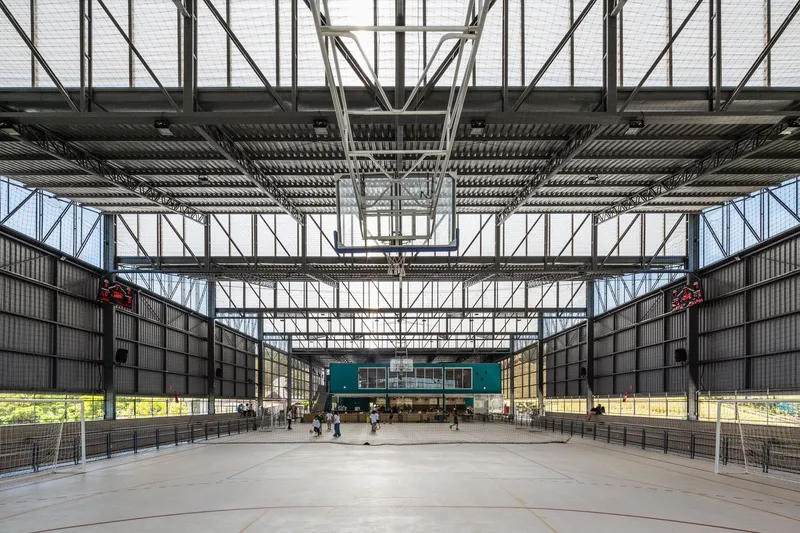
The steel truss roof is the building's primary architectural gesture. Originally conceived in glued laminated timber, the structure was ultimately executed in steel, with columns reduced to a remarkably slender 455 by 153 millimeters. That thinness matters: it allows the covered court to read as an open-air space rather than an interior, with the trusses floating above the action rather than boxing it in. Chain-link mesh and full-height glazing complete the perimeter, dissolving the boundary between the court and the surrounding landscape.
The sawtooth sections are not decorative. Each one orients its opening southward, pulling in diffused light while blocking direct solar gain. Thermal roofing panels, 20 centimeters thick, handle heat rejection overhead. The result is a court that can host basketball games, graduation ceremonies, and student presentations without the glare or heat buildup that plague conventional gymnasiums in this climate.
The Turquoise Box: Program Stacked Tight


Nested beneath the roof canopy, a two-story block finished in turquoise steel cladding concentrates the building's enclosed program. The ground floor houses bathrooms, a refectory, and a kitchen engineered to serve 700 daily meals. The upper floor holds art, music, and theater classrooms. It is a compact, efficiently planned volume, and the decision to stack these functions frees the rest of the footprint for the court and courtyard.
The cantilevered upper volume, elevated on columns, creates covered outdoor dining below. This move is pragmatic rather than heroic: it keeps students shaded during meal times and opens sight lines from the refectory to the playing fields beyond. The color choice gives the block its own identity within the larger shed, marking it as a distinct piece of architecture rather than an infill partition.
Dining and Gathering Under the Canopy
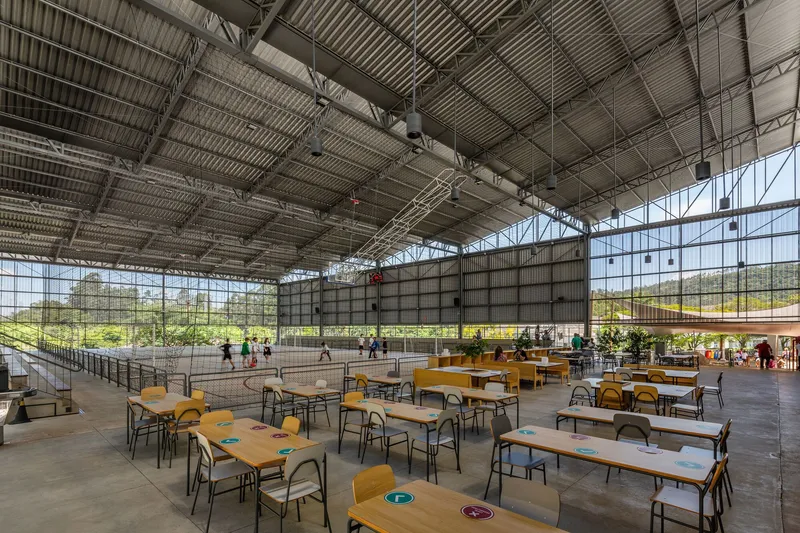

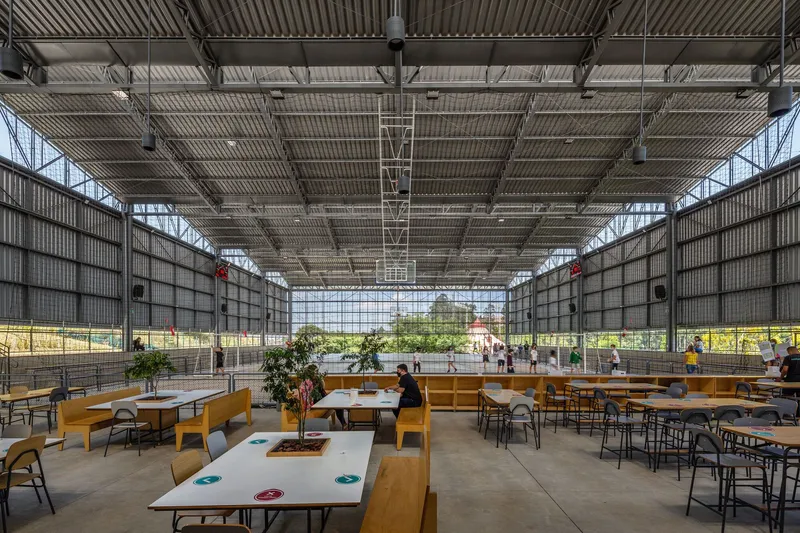
The refectory and adjacent seating zones demonstrate how a school building can be designed around daily rituals, not just program diagrams. Light wood benches and tables sit beneath the exposed corrugated roof, framed by teal steel columns and translucent mesh screens. The curtain wall facing the playing fields lets diners watch activity outside, collapsing the boundary between eating and socializing. There is no sealed cafeteria here; the space breathes.
Environmental comfort consultants CA2 Consultores Ambientais Associados worked on the project, and their input shows in the passive strategies at play in these communal zones. Air conditioning is reserved for the enclosed classrooms upstairs. Down here, ventilation through the shed openings and the open perimeter keeps the air moving without mechanical assistance.
Landscape and Site Integration
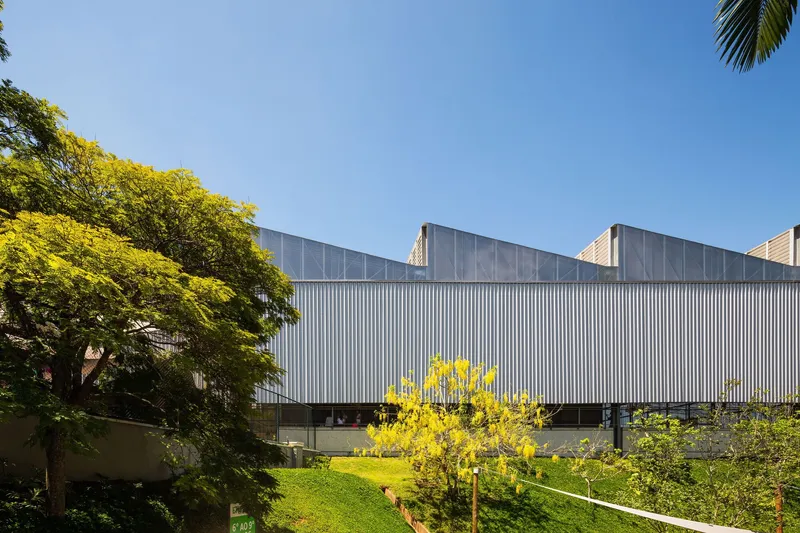

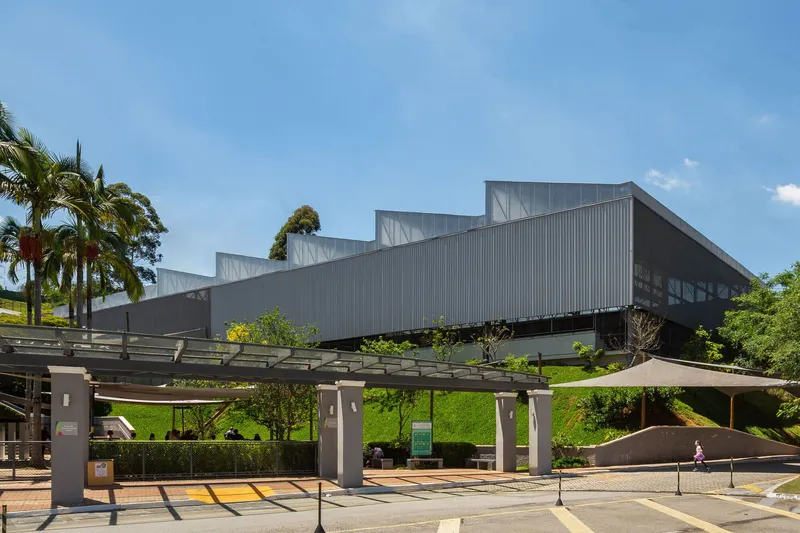
The school sits in a large green area, and Estúdio Trópico took pains to minimize disruption. The building is implanted on existing plateaus, avoiding major earthworks and allowing construction to proceed without shutting down school operations. Corrugated metal cladding rises from grassy slopes dotted with palm trees and flowering shrubs, giving the arena an almost industrial presence softened by its lush surroundings.
Stepped rooflines echo the topography, and planted slopes mediate between the building's hard edges and the softer landscape. The approach from the lawn side, looking up at the vertical metal facade above flowering trees, reads less like a school gymnasium and more like a cultural building that has settled comfortably into its terrain.
The Court in Action


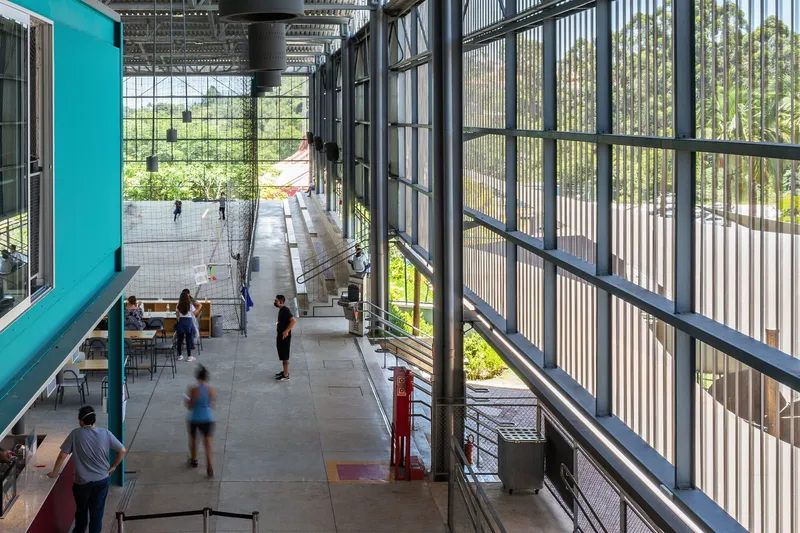
A sports court is only as good as its use, and the images of players in motion beneath the diagonal mesh and glazed walls confirm that the Arena works as intended. The full-height openings frame the tree canopy outside, making the court feel expansive even under a roof. This is a recurring quality of the project: enclosure without confinement.
Outside the main volume, a courtyard with triangular fabric shade sails on timber poles extends the gathering space into the open air. The circulation corridor along the corrugated facade doubles as a social promenade, with students and staff moving between court, classrooms, and refectory under a continuous structural framework. The architecture encourages movement and encounter rather than routing people through isolated corridors.
Facade and Enclosure

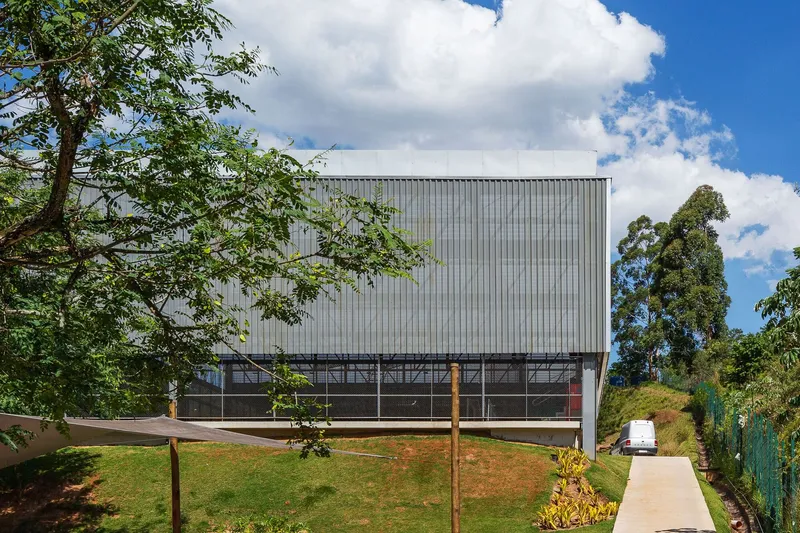

From the exterior, the Arena presents itself as a series of corrugated metal planes punctuated by horizontal glazed bands. The vertical cladding gives the building a taut, monolithic quality, while the glass strips reveal just enough of the interior to signal that something active is happening inside. The palette is restrained: metal, glass, polycarbonate. There is no ornament, but there is rhythm in the panel joints and the stepping of the roofline.
Polycarbonate alveolar panels handle the shed enclosures, admitting light while controlling heat. These translucent sections are the building's most visible concession to climate, and they work overtime: during the day, they glow from the outside, marking the ventilation zones in the facade. At night, they would reverse the effect, broadcasting interior light outward. The material logic is consistent from macro to micro.
Plans and Drawings
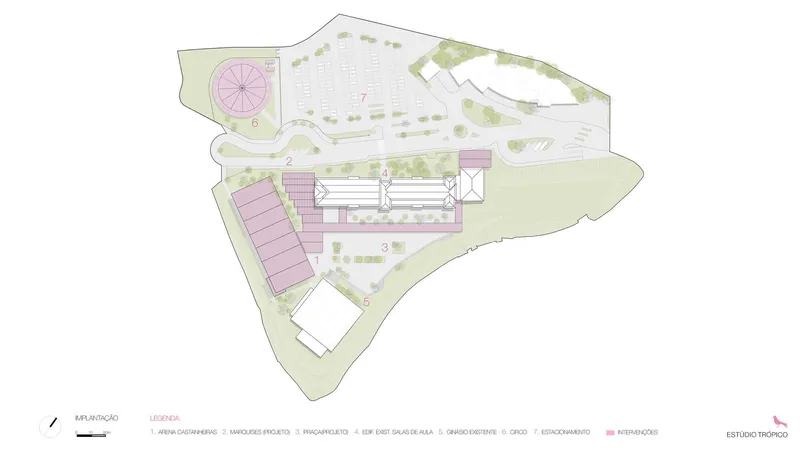
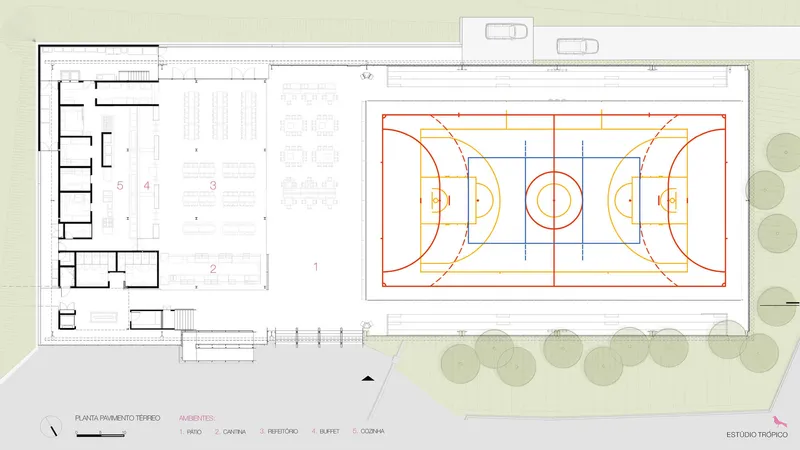
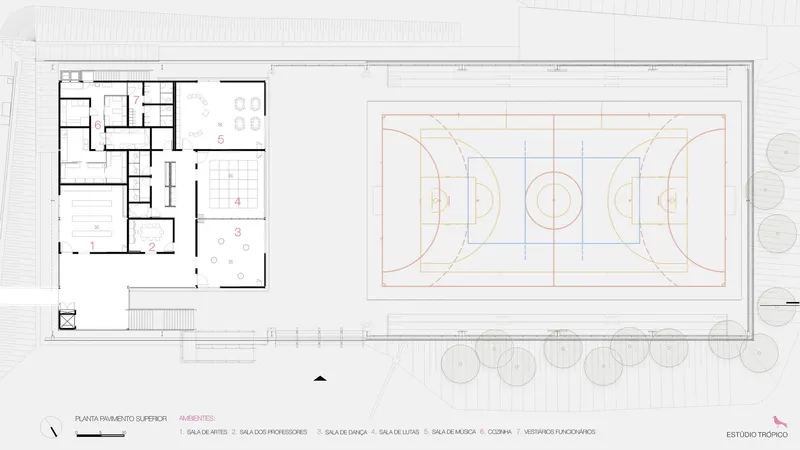

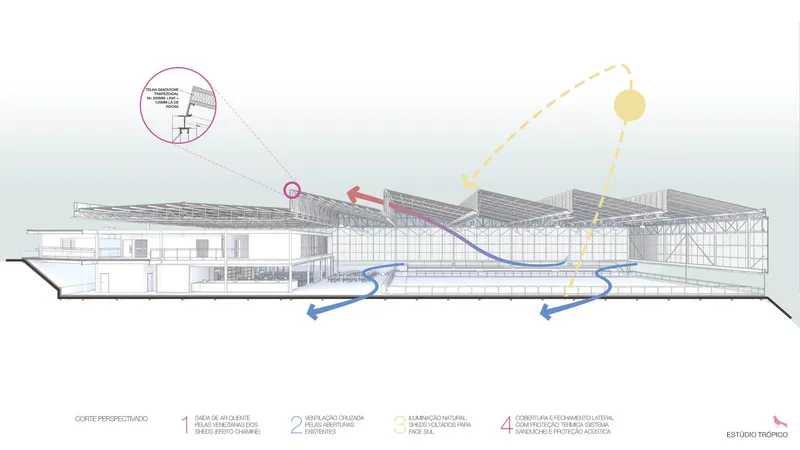

The site plan reveals the building's position within the school campus, tucked against an irregular boundary and surrounded by landscape zones that buffer it from adjacent uses. The ground and upper floor plans show a clear organizational logic: the basketball court runs the full length of the building with support rooms, refectory, and classrooms packed along one edge. The upper level flanks the court with enclosed rooms, maintaining visual connection to the open volume below.
The section drawings are where the design argument becomes most legible. The longitudinal section reveals the exposed truss roof spanning the full court width, while the annotated environmental section tracks solar orientation and natural ventilation flow through the sawtooth profile. Colored arrows trace hot air exiting through the south-facing openings and cool air entering from below, confirming that the roof's geometry is not merely formal. The final section shows the sawtooth elements in profile against a sloping grade, with a row of trees reinforcing the building's dialogue with its topography.
Why This Project Matters
Castanheiras Arena belongs to a lineage of Brazilian buildings that treat structure and climate as inseparable design problems. The sawtooth section is not an invention, but its execution here, with slender steel columns, polycarbonate louvers, and 20-centimeter thermal panels, demonstrates how a familiar typology can be refined to perform at a high level. Estúdio Trópico's willingness to let the roof do the architectural work, rather than relying on surface treatments or formal gymnastics, produces a building that is both legible and technically rigorous.
For school architecture specifically, the project offers a useful model. By stacking enclosed program into a compact two-story block and leaving the rest of the footprint open, the design maximizes flexibility without sacrificing comfort. The refectory, the court, and the classrooms all share a single roof but maintain distinct spatial identities. That balance between unity and differentiation is hard to achieve, and it is what elevates this project from competent infrastructure to genuine architecture.
Castanheiras Arena in Santana de Parnaíba, designed by Estúdio Trópico, with a master plan by Andrade Morettin Arquitetos Associados. Located in Santana de Parnaíba, Brazil. 2,700 m². Completed in 2020. Photographs by André Scarpa.
About the Studio
Share Your Own Work on uni.xyz
If projects like this are the kind of work you want to make, uni.xyz is a place to publish your own, find collaborators, and enter design competitions.




Popular Articles
Popular articles from the community


The Ocean Hive: Sustainable Architecture for a Self-Sufficient Civilization at Sea
The Ocean Hive imagines sustainable architecture at sea, where modular habitats, algae, wave power and ocean waste sustain a growing colony.

The Earth Pod: 3D Printed Homes for Resilient Refugee Communities
The Earth Pod reimagines refugee housing through 3D printed homes made from clay, combining resilience, self-sufficiency, and rapid shelter.
AL-JANNAH: Sustainable Architecture and Permaculture for Afghan Widows
AL-JANNAH uses sustainable architecture and permaculture to create resilient oasis of housing, learning, work and renewal for Afghan widows.

The Musturak Paradise: Senior Living Architecture for a Connected Future in Temara, Morocco
The Musturak Paradise reimagines senior living architecture in Temara via private homes, social spaces, culture, community, and shared care.
Similar Reads
You might also enjoy these articles

Bao Huynh Watercolor Atelier: A Serene Art Retreat in Hội An
Bao Huynh Watercolor Atelier in Hội An blends multifunctional art spaces, sustainable design, local materials, and family-friendly living in a serene environment.

Atelier Macri Concept Store Interior Design by CASE-REAL
Atelier Macri store features a "ko" counter, walnut wood details, cork displays, blending retail, gallery, and seamless customer experiences.

Manuel Vargas Izquierdo Stadium and High-Performance Sports Center: Architectural Excellence in Jalpa de Méndez
The Manuel Vargas Izquierdo Stadium blends sustainable design, inclusive sports facilities, and cultural-inspired architecture, revitalizing Jalpa de Méndez’s public spaces.

KAKR Buluh Awar Hall: Revitalizing Community and Ecology Through Bamboo Architecture
Community built bamboo hall revitalizes Buluh Awar village, empowering youth, restoring ecology, celebrating vernacular craftsmanship through sustainable architecture and culture.


Explore Sports Architecture Competitions
Discover active competitions in this discipline



Challenge to design a barrier free sports center


Challenge to design an outdoor ice-rink and park


Challenge to design public laboratory
Comments (0)
Please login or sign up to add comments
No comments yet. Be the first to comment!