
Estudio Well Interiorismo Converts a Santiago Heritage House into a Vegan Restaurant with Italian Flair
In Barrio Italia, adobe walls, frescoed arches, and primary color accents turn a domestic relic into a neighborhood dining room.


Barrio Italia is one of Santiago de Chile's most culturally loaded neighborhoods, a grid of old houses that have been gradually colonized by galleries, cafés, and design studios. The architecture rarely changes from the outside. The best interventions here understand that the street facade is communal property, a fragment of collective memory that belongs to the block as much as the owner. Estudio Well Interiorismo, led by Carolina Montebruno, took that principle literally when converting an existing house into Verde Sazón, a 344-square-meter vegan restaurant that reads as a modest stucco dwelling from the sidewalk and unfolds into something far more theatrical once you step through the arched doorway.
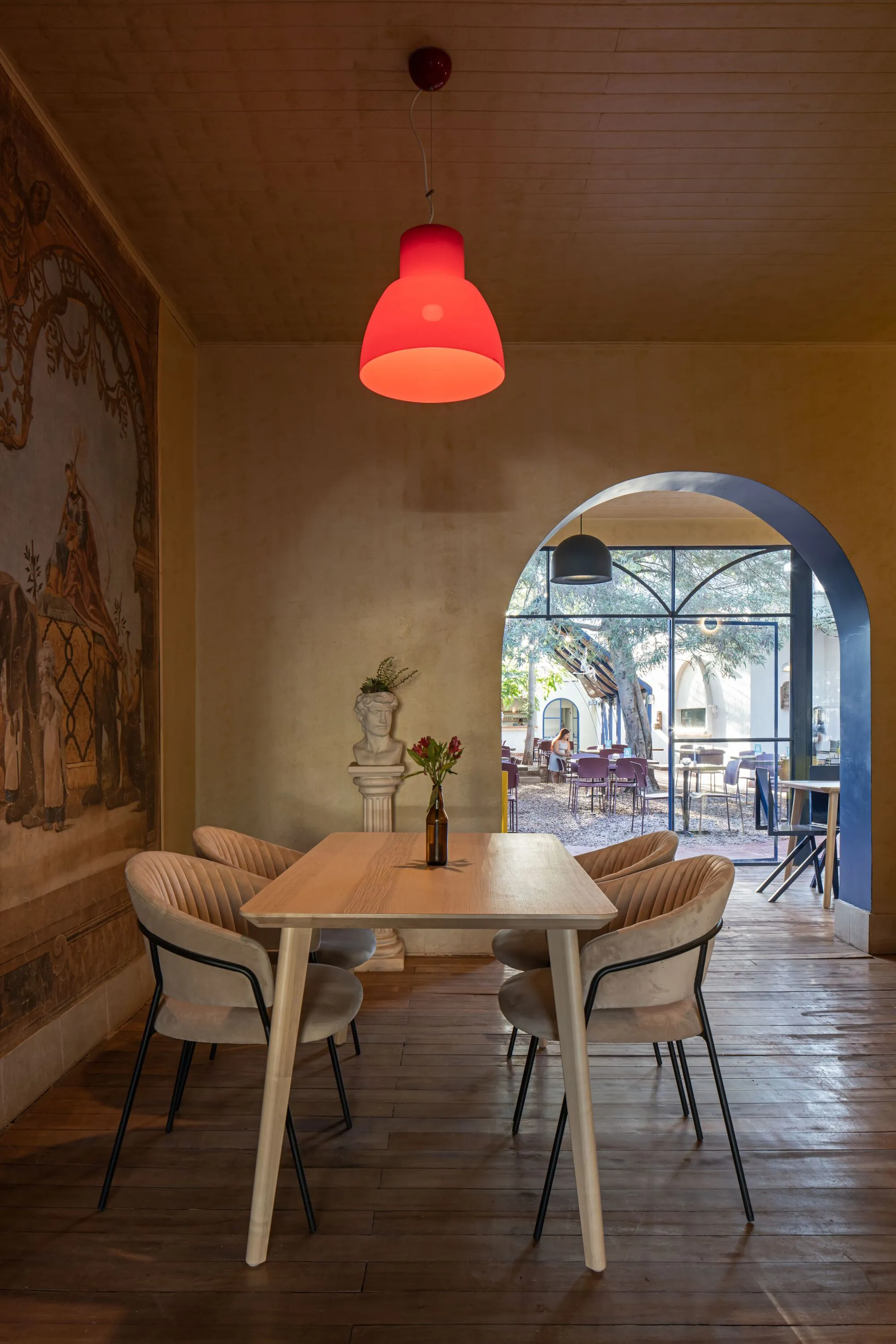
What makes the project worth studying is its tonal range. Montebruno cites four guiding concepts: wisdom, natural, friendly, and authentic. Those could be hollow adjectives, but here they translate into concrete spatial decisions. Adobe walls are left exposed or painted in flat white. Arches are cut through partition walls to create sightlines that borrow from Italian neoclassical interiors. Frescoed murals appear and fade on surfaces as though they were always there. Primary colors, blue steel frames, red pendants, yellow door surrounds, are deployed sparingly, one accent per room, so that each space has a distinct identity without the palette ever becoming chaotic.
Street Presence and the Art of Restraint
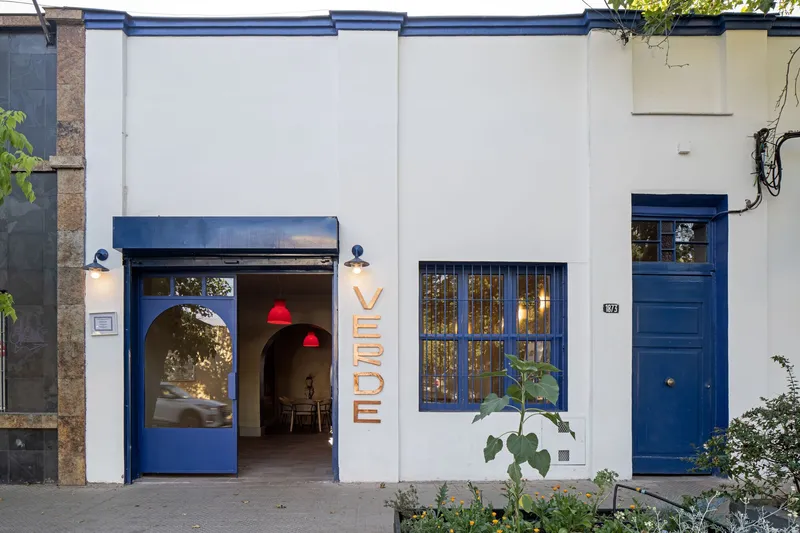

The street facade is white stucco punctuated by blue-painted steel frames, an arched entry, and little else. Vegetation is allowed to spill over but not dominate. At twilight the effect is almost monastic: the building glows from within, the blue frames catching the last of the daylight. Walk through the arched corridor and the restraint begins to soften. Red pendant lights hang from a vaulted passage, and the blue steel frames return as glazed doors that separate interior zones from the central courtyard. The corridor acts as a decompression chamber between the public street and the private dining rooms, a threshold that signals a shift in register without any abrupt material change.
Courtyard as Organizing Center

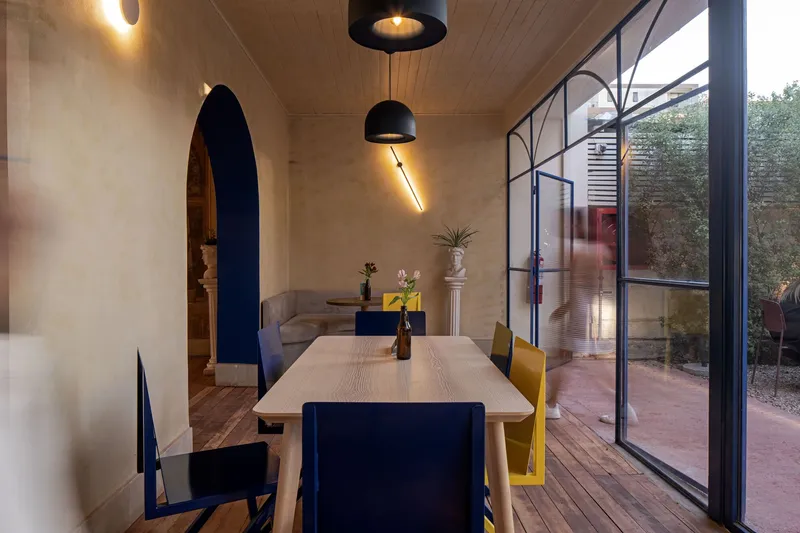
The courtyard tree, preserved from the original house, is the gravitational center of the plan. A pitched timber canopy shelters outdoor dining beneath its branches, while interior rooms frame views back toward the greenery through arched openings and glazed walls. The timber plank ceiling of the main dining room extends the canopy language indoors, blurring the line between covered terrace and enclosed room. Landscape designer Maria Ines Correa Amunategui integrated vegetation with deliberate restraint, reinforcing the connection between the new program and the heritage environment without turning the courtyard into a botanical set piece.
The 600-square-meter plot gives the restaurant room to breathe. Rather than filling every available square meter with seats, Montebruno distributes dining across indoor rooms of varying scale, the courtyard, and transitional zones in between. The result feels more like a house where you happen to eat than a restaurant that borrows domestic tropes.
Arches, Murals, and a Neoclassical Undertone


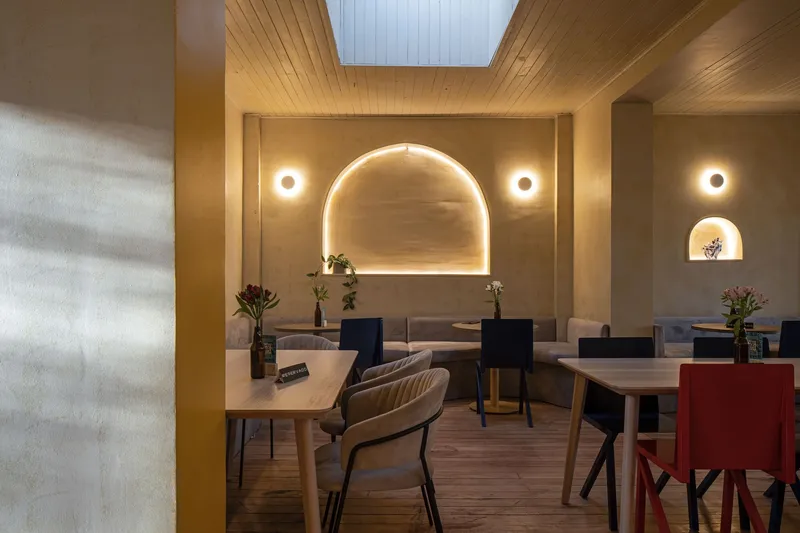
The arched openings do most of the heavy architectural lifting. Cut through existing adobe and brick walls, they frame views from one dining room to the next, creating a layered depth that rewards movement. In one alcove, a faded fresco mural covers the wall behind a simple timber table, the painting deliberately aged to suggest that the house has always harbored some form of Italian cultural life. Backlit arched niches flanked by circular wall sconces repeat the motif in more refined terms, turning structural necessity into decorative rhythm.
Montebruno describes the interior vocabulary as classical Italian architecture filtered through a modern minimalist lens. The claim holds up. Pillars, murals, and sculptures appear throughout, but they are arranged with enough negative space around them that no room feels cluttered. Clean lines absorb the historical references rather than competing with them.
Color as Wayfinding
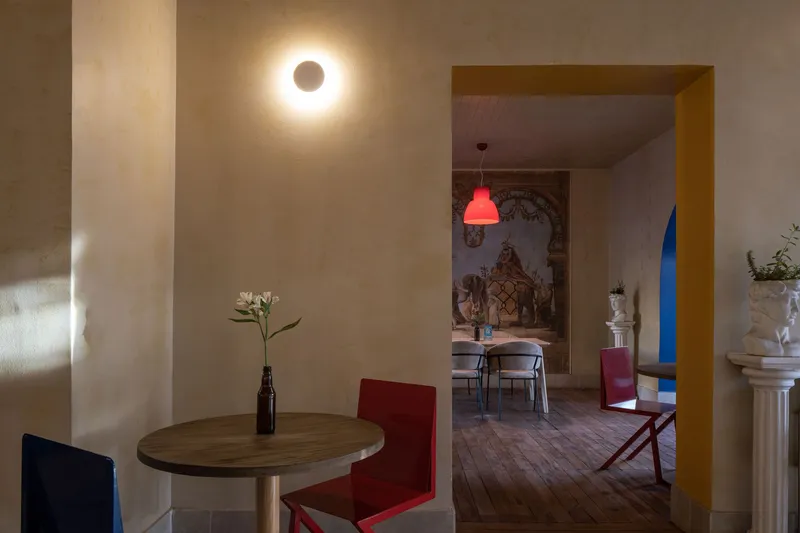

The yellow-framed doorway connecting two dining spaces is perhaps the project's most instructive detail. Against a palette that is otherwise white, stone, and timber, the saturated frame acts as a beacon. You know where you are in the plan because each room owns a single color. Blue steel at the entrance. Red pendants in the corridor. Yellow at the interior threshold. The discipline is key: if every surface were painted, the effect would collapse into whimsy. Because the color is concentrated in frames, fixtures, and furniture, it reads as intentional rather than decorative.
A diagonal wall-mounted light fixture and a yellow side table in the curved banquette area show the same logic at a smaller scale. Each object carries chromatic weight precisely because its surroundings are neutral. The interiors were furnished through a roster of Chilean manufacturers, including Anka taller, Estudio Varo, and Wolf Nordico, suggesting a conscious effort to keep the supply chain local.
Service and Material Texture
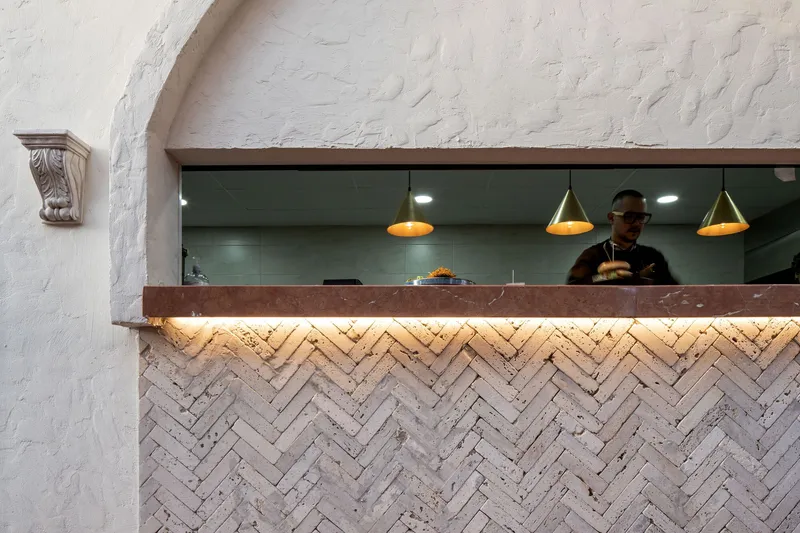
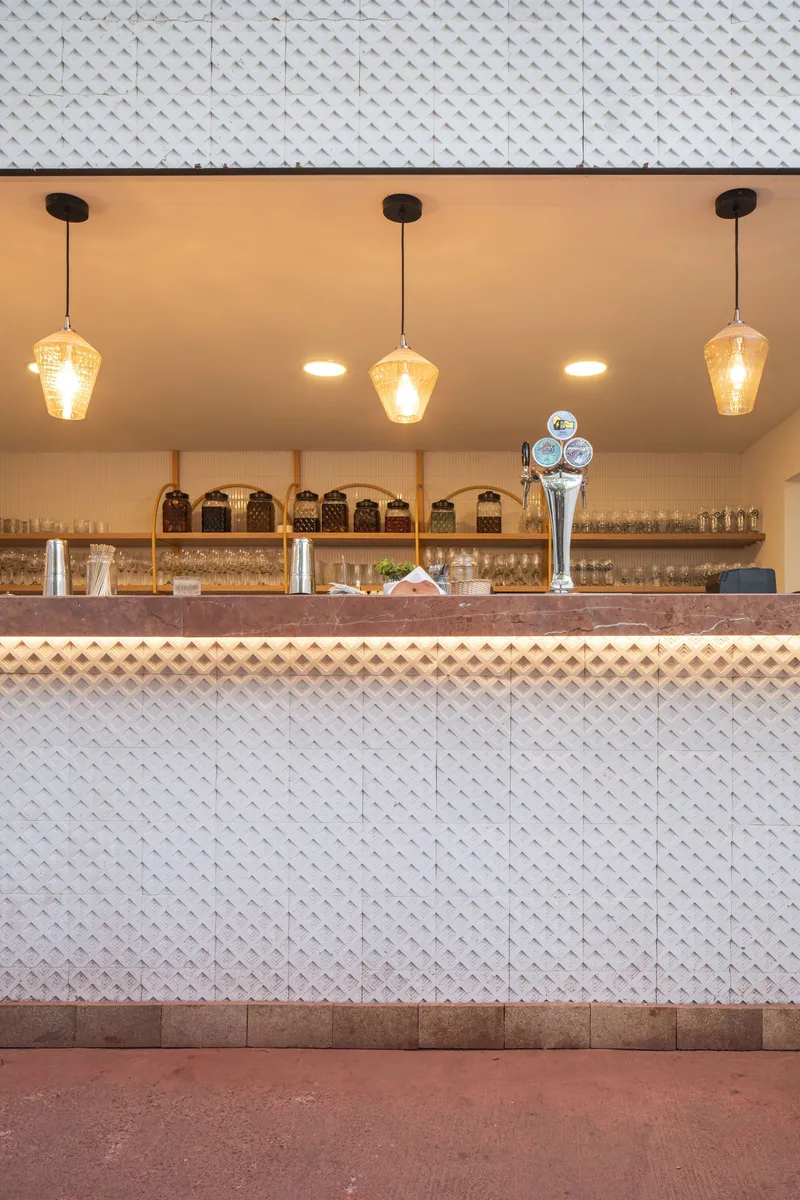
The service counter sits beneath a painted brick vault, its herringbone brick base grounding the space in a material language that predates the restaurant. A backlit stone countertop catches the eye without competing with the vault above. Across the plan, the bar counter takes a different approach: white diamond-patterned tile cladding, three amber pendants, and a clean horizontal line that feels more contemporary than anything else in the building. The juxtaposition is deliberate. Where the food is prepared, heritage materials dominate. Where drinks are served, the mood lightens.
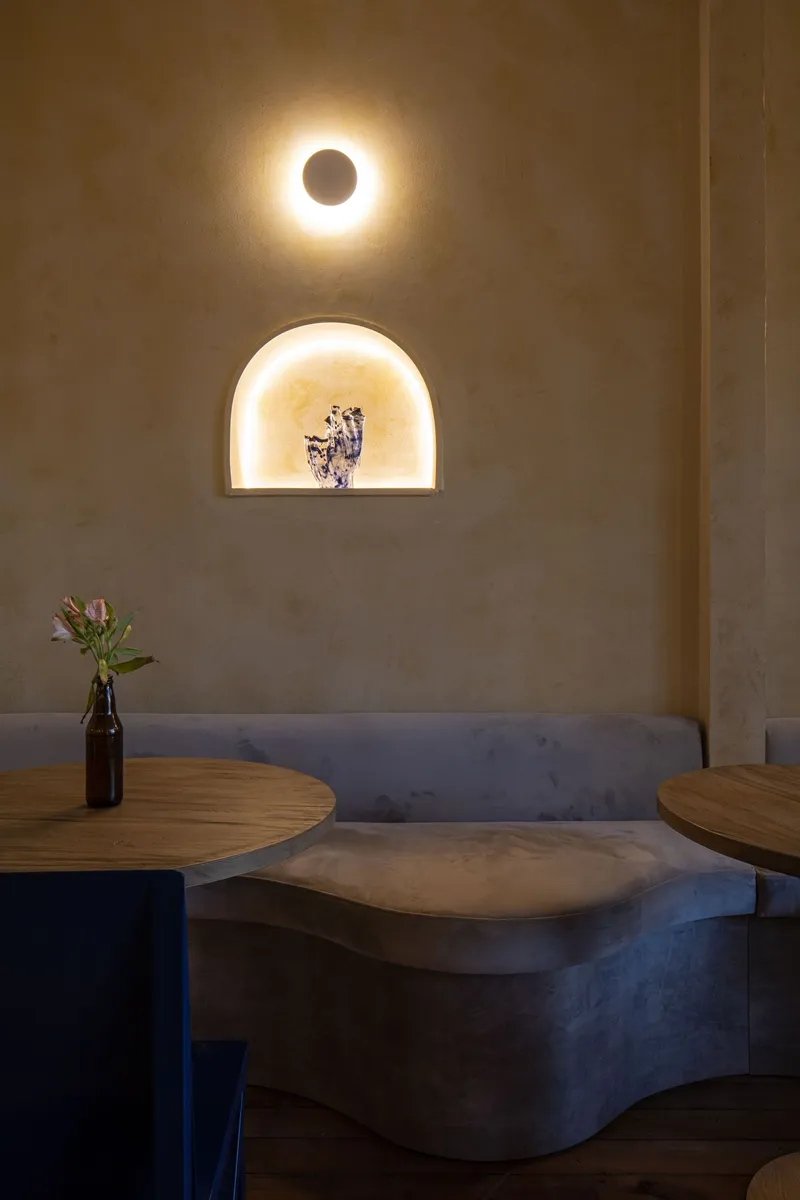
Curved concrete banquettes with arched wall niches lit from within offer the most intimate seating in the house. The concrete surface is left smooth but unpolished, warm enough to sit against, cool enough to register as architecture rather than furniture. These alcoves are where the project's domestic origins are most palpable: the scale is a living room, the light is a bedside lamp, and the arch overhead recalls a hearth.
Plans and Drawings

The floor plan drawings show the existing layout alongside the proposed intervention, making the design logic legible. The central courtyard tree anchors both versions, confirming its role as the spatial constant around which everything else was reorganized. A spiral stair appears in the new plan, suggesting a vertical extension that the photographs do not fully reveal. What the drawings make clear is the extent of wall removal and arch insertion: the original house was a series of closed rooms, and the restaurant version opens them to one another through carefully positioned apertures while preserving the perimeter walls that define the street edge.
Why This Project Matters
Verde Sazón is a case study in how to occupy a heritage structure without erasing it. The temptation in Barrio Italia is either to gut the house entirely or to treat it as a museum piece. Montebruno does neither. She keeps the adobe walls, the courtyard tree, and the street facade largely intact, then populates the interior with a series of spatial events, arches, murals, color-coded thresholds, that are legibly new but tonally sympathetic. The result is a restaurant that feels as though it grew from its context rather than being dropped into it.
For a vegan restaurant, the project also makes an implicit argument about the relationship between ethical consumption and spatial character. The materials are honest: brick, adobe, stone, timber. The furniture is locally sourced. The landscape is restrained. Nothing is excessive, and nothing is performative. The architecture serves the same values as the menu, and that alignment gives the project a coherence that most restaurant interiors, regardless of cuisine, struggle to achieve.
Verde Sazón Restaurant, designed by Estudio Well Interiorismo, lead architect Carolina Montebruno. Located in Providencia (Barrio Italia), Santiago, Chile. 344 m², completed 2022. Photography by Nicolas Saieh.
About the Studio
Share Your Own Work on uni.xyz
If projects like this are the kind of work you want to make, uni.xyz is a place to publish your own, find collaborators, and enter design competitions.



Popular Articles
Popular articles from the community


Riyadh For All: Intergenerational Urban Design for Active Aging in Rabat
Riyadh For All reimagines urban design in Rabat with intergenerational co-living, adaptive courtyards, and Moroccan cultural exchange today.

The Ocean Hive: Sustainable Architecture for a Self-Sufficient Civilization at Sea
The Ocean Hive imagines sustainable architecture at sea, where modular habitats, algae, wave power and ocean waste sustain a growing colony.

The Musturak Paradise: Senior Living Architecture for a Connected Future in Temara, Morocco
The Musturak Paradise reimagines senior living architecture in Temara via private homes, social spaces, culture, community, and shared care.

The Earth Pod: 3D Printed Homes for Resilient Refugee Communities
The Earth Pod reimagines refugee housing through 3D printed homes made from clay, combining resilience, self-sufficiency, and rapid shelter.


Similar Reads
You might also enjoy these articles

Bao Huynh Watercolor Atelier: A Serene Art Retreat in Hội An
Bao Huynh Watercolor Atelier in Hội An blends multifunctional art spaces, sustainable design, local materials, and family-friendly living in a serene environment.

Atelier Macri Concept Store Interior Design by CASE-REAL
Atelier Macri store features a "ko" counter, walnut wood details, cork displays, blending retail, gallery, and seamless customer experiences.

Manuel Vargas Izquierdo Stadium and High-Performance Sports Center: Architectural Excellence in Jalpa de Méndez
The Manuel Vargas Izquierdo Stadium blends sustainable design, inclusive sports facilities, and cultural-inspired architecture, revitalizing Jalpa de Méndez’s public spaces.

KAKR Buluh Awar Hall: Revitalizing Community and Ecology Through Bamboo Architecture
Community built bamboo hall revitalizes Buluh Awar village, empowering youth, restoring ecology, celebrating vernacular craftsmanship through sustainable architecture and culture.


Comments (0)
Please login or sign up to add comments
No comments yet. Be the first to comment!