
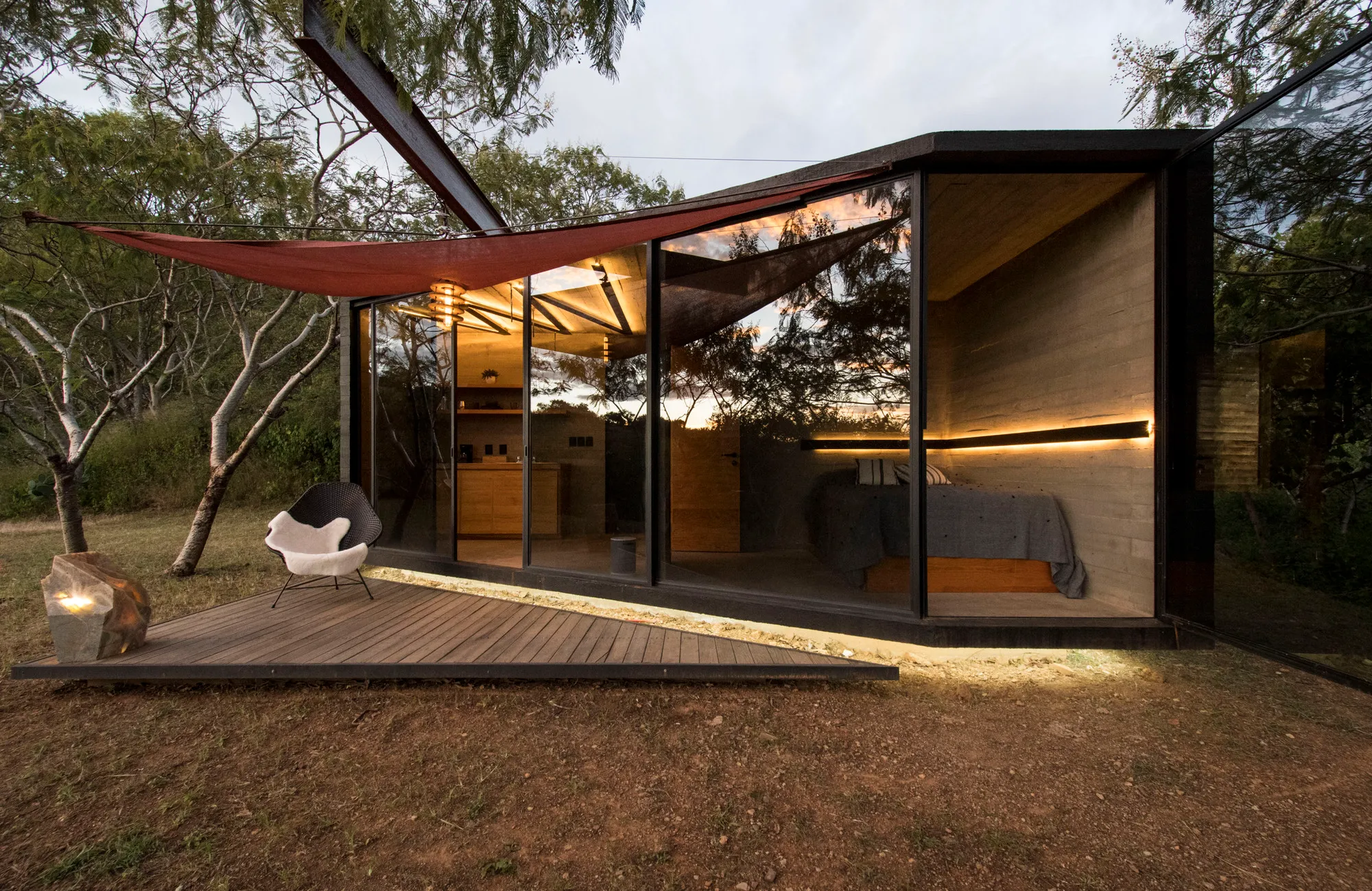
ET.co Carves a Black Concrete Cabin into the Oaxacan Mountainside
At just 30 square meters, Bungalow H is a hermetic retreat on the slopes of San Andrés Huayápam that opens fully toward the valley below.


There is a particular discipline required to design a building this small and make it feel inevitable rather than cute. ET.co, led by architect Omar López Bautista, manages exactly that with Bungalow H, a 30 square meter retreat perched on a natural terrace in the mountains north of Oaxaca city. The cabin is severe in its geometry, coated in black concrete that absorbs into the scrubby hillside rather than competing with it, and yet the single glazed facade opens the entire interior to a panoramic view of the valley. It is a building that knows what it wants to be and refuses to be anything else.
What makes Bungalow H worth studying is not its size but its posture. Three sides are sealed, offering privacy and thermal mass. The fourth is almost entirely glass, oriented toward the city below. The structure sits a few centimeters above ground on a foundation smaller than its footprint, a detail that gives the volume a subtle hovering quality, particularly at night when perimeter lighting washes the base. The building was designed to be, in the architect's words, something you could "deplant" without scarring the site. That reversibility is not a gimmick; it reflects a genuine reckoning with what it means to build on pristine land.
A Dark Volume in a Light Landscape


From above, the cabin reads as a compact dark slab tucked into dense scrubland, its red fabric canopy the only note of color. The aerial perspective reveals how little the intervention disturbs: free space is left around the structure on all sides, preserving root zones and drainage patterns. The black coating, which might seem aggressive in an urban context, actually softens the building's presence here. Against the pale bark of winter trees and the dry ochre ground, the cabin recedes rather than announces itself.
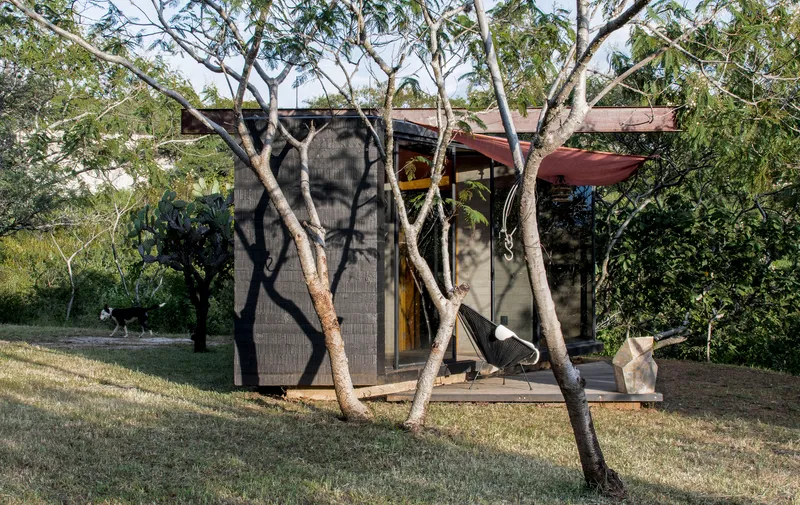
The rear facade is almost entirely opaque, punctuated only by perforated metal screens that admit air and slivers of light. Leaning paperbark trees press against the board-formed concrete walls, and the interplay of natural shadow and rough texture gives this elevation a quality closer to land art than residential architecture. It is the closed fist of the building, holding back so the glazed side can give everything.
One Wall of Glass, One View of Everything
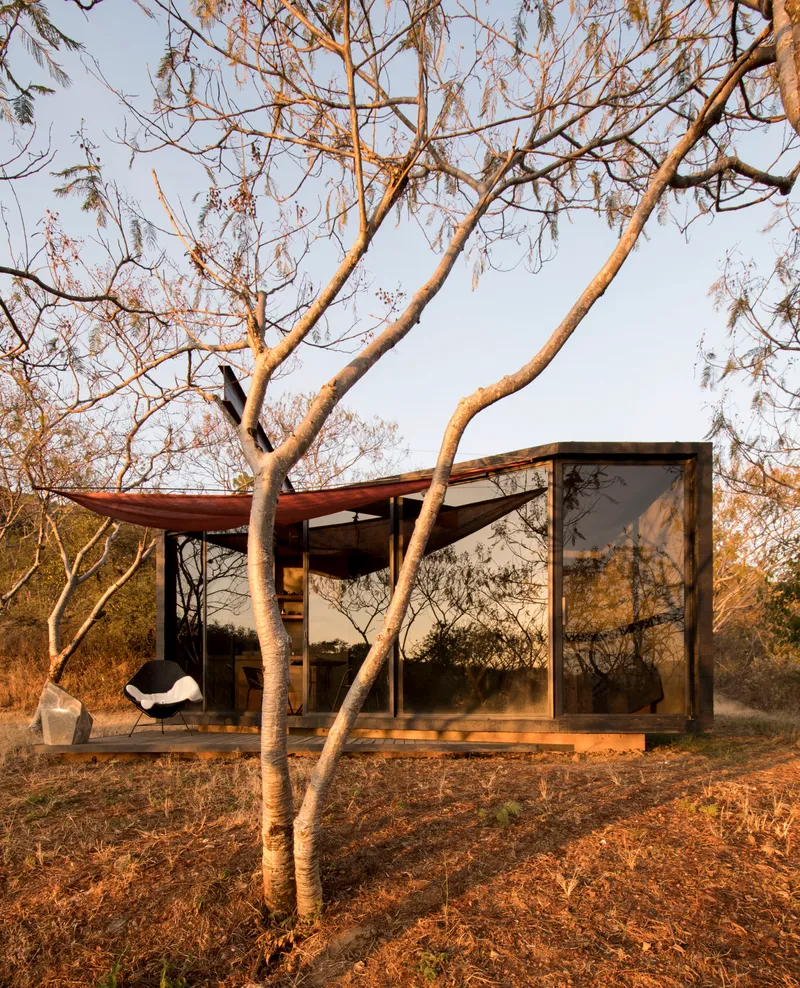


The front facade is where the cabin's formal severity pays off. A cantilevered roof extends over a timber deck, and floor-to-ceiling sliding glass panels dissolve the boundary between interior and terrace. A tensioned fabric canopy suspended above the deck filters sunlight and creates a layered threshold between the dark interior volume and the bright Oaxacan landscape. The proportions are careful: the overhang is deep enough to shade the glass in summer but not so deep that it cuts the valley view when seated inside.
At dusk, the cabin becomes a lantern. The warm interior light spills across the deck and into the surrounding trees, and the floating base reads most clearly in this condition. The diagonal cut at the front of the volume, visible in section, pushes the ceiling line upward toward the view and creates a subtle sense of expansion in a space that is, by any measure, very tight.
Living in 30 Square Meters


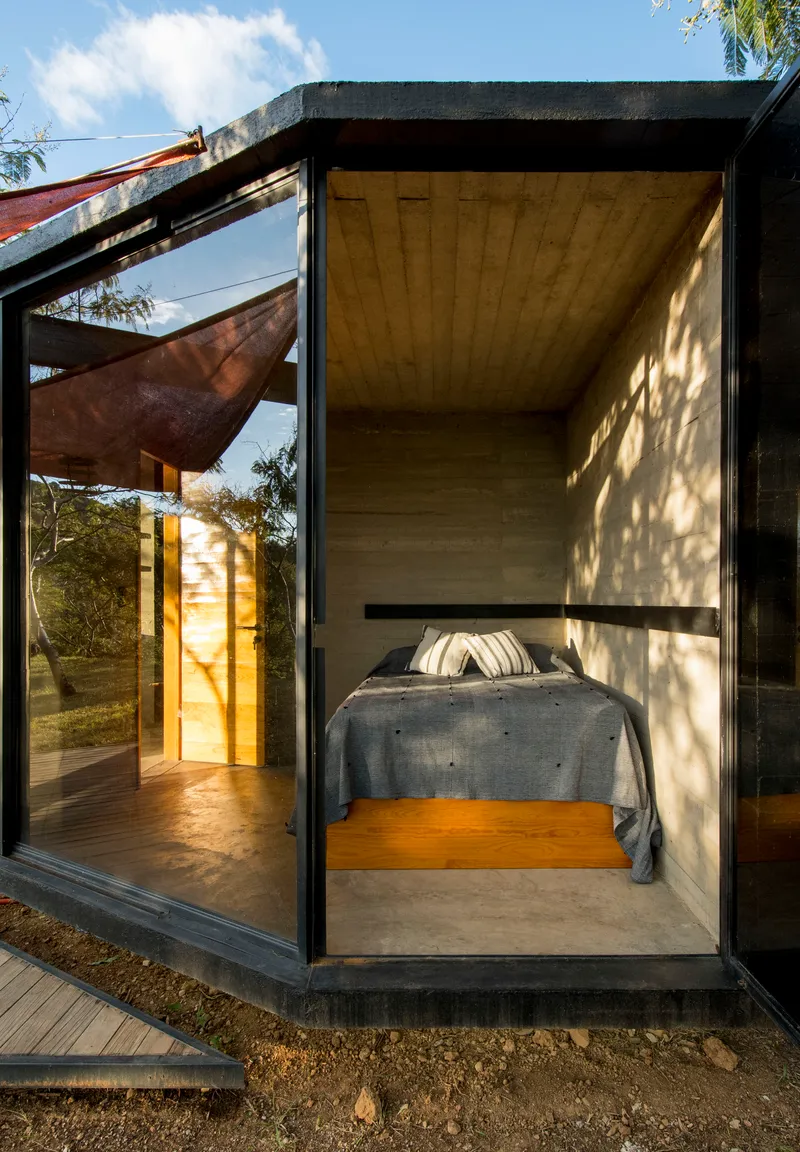
Inside, the spatial economy is rigorous but never cramped. The sleeping alcove sits behind a concrete partition, its glass sliding doors casting dappled tree shadows across the walls in the afternoon. The bed faces the landscape, which is the correct decision in a building this focused. A compact kitchen with timber cabinetry occupies the adjacent zone, lit by triangular suspended fixtures designed by Jesús Ortiz of Habitus Hexis. The board-formed concrete walls give every surface a grain and warmth that polished concrete would not.
The program is intentionally minimal: a room for sleeping, a corner for cooking, a bathroom, and a spiral stair that presumably accesses a roof terrace or mechanical level. There is no living room, no dining table, no workspace. The deck is the living room. The valley is the view from the dining table. ET.co understood that at this scale, the only honest move is subtraction.
Texture, Shadow, and Material Honesty
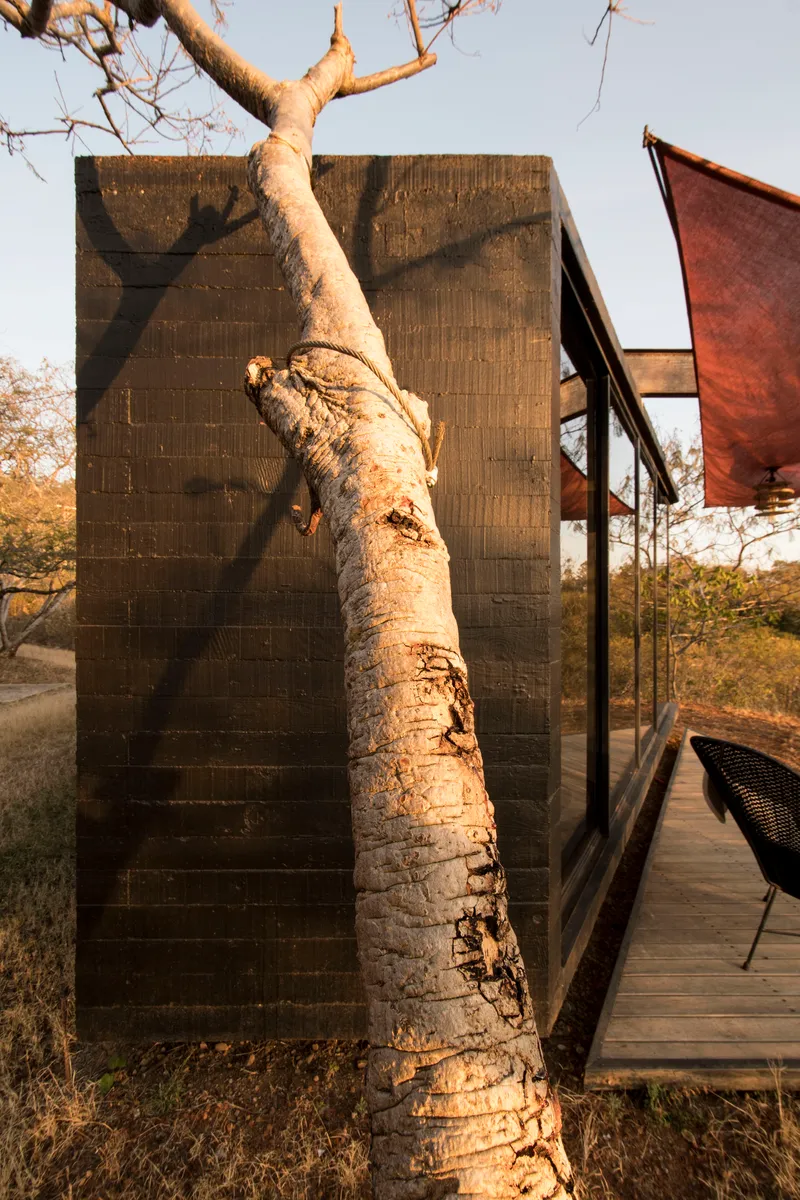


Some of the strongest images of Bungalow H are not of the building itself but of light acting on its surfaces. A bare tree trunk leans against the board-formed wall, casting long afternoon shadows that become part of the architecture. In the concrete corridor, timber doors sit flush in their frames while tree shadows slide across the floor. These moments are not accidental; they result from the decision to use raw, textured materials on every surface and to position the building among existing trees rather than clearing a pad.
The open glass doors in image two reveal the full section of the interior: the spiral stair, the concrete walls with their horizontal formwork lines, the transition from dark interior to bright deck. Structure here is architecture. There is no finish applied over the concrete, no drywall, no suspended ceiling. What was poured is what you see, and the construction by Alfredo Cruz and structural engineering by Miguel Ángel Torres deserve credit for making that legibility possible.
Night Presence


The lighting design by Samantha Sigüenza Betancourt transforms the cabin after dark. Viewed from inside, the floor-to-ceiling glass becomes a frame for the twilight landscape, and the warm recessed lighting washes the concrete ceiling without creating glare. From outside, the timber deck glows under the canopy, and the perimeter base lighting lifts the volume off the ground. The building acquires a second character at night: less hermetic, more inviting, its single open face becoming a signal in the dark hillside.
Plans and Drawings
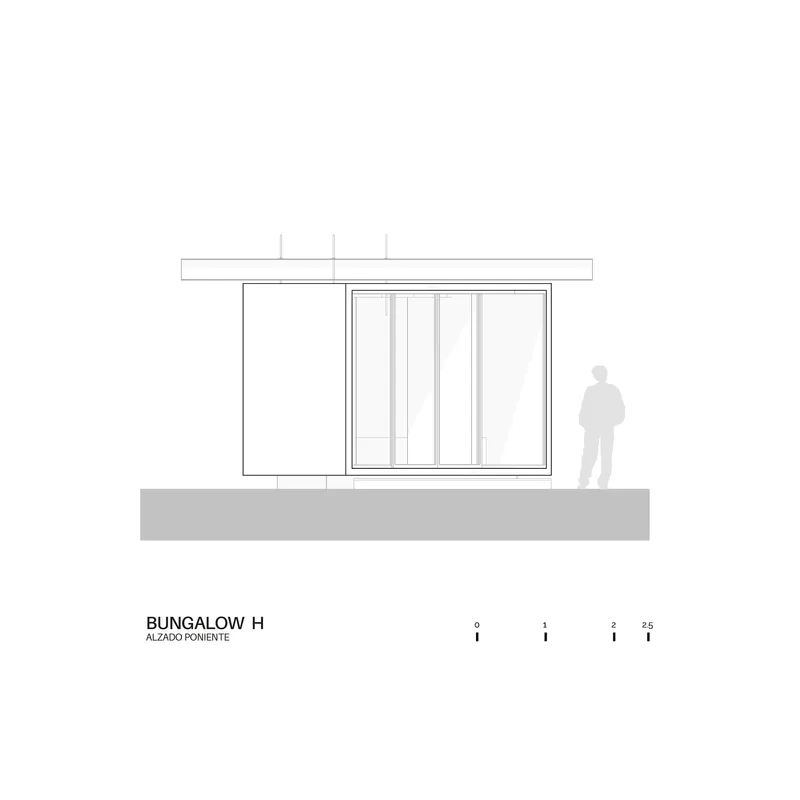

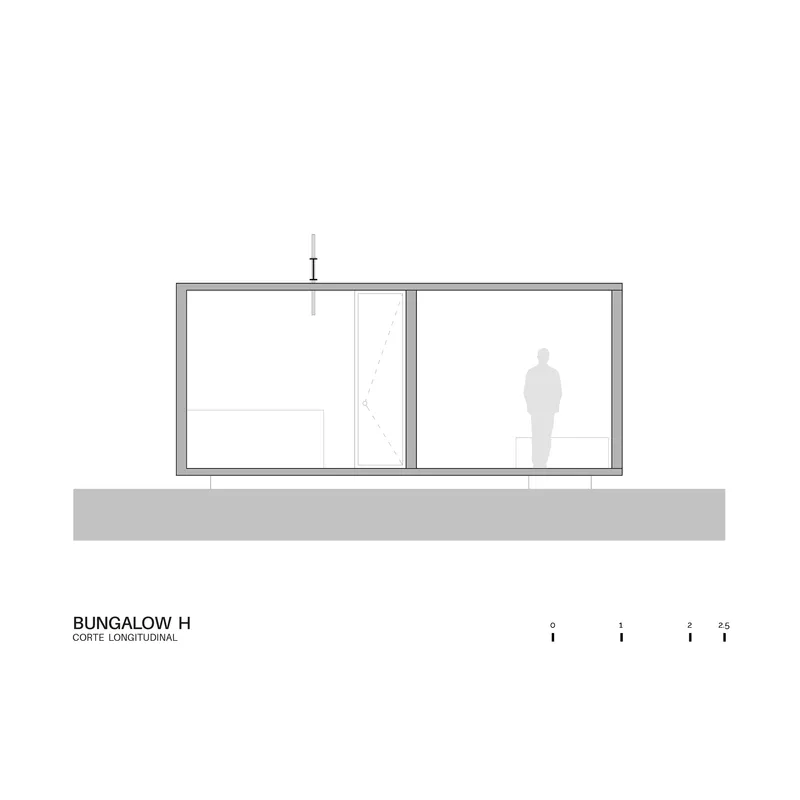

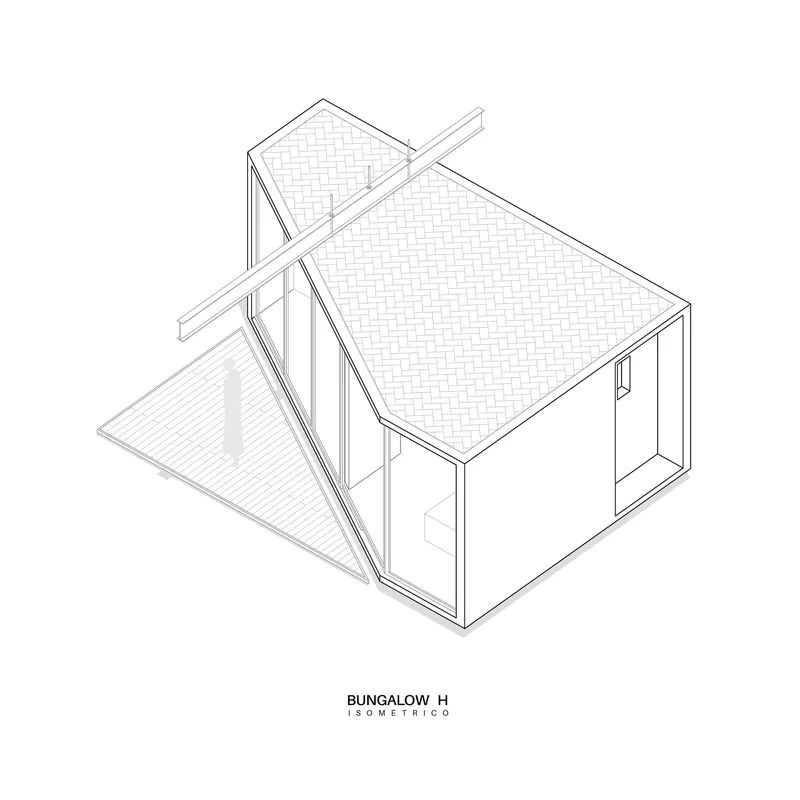


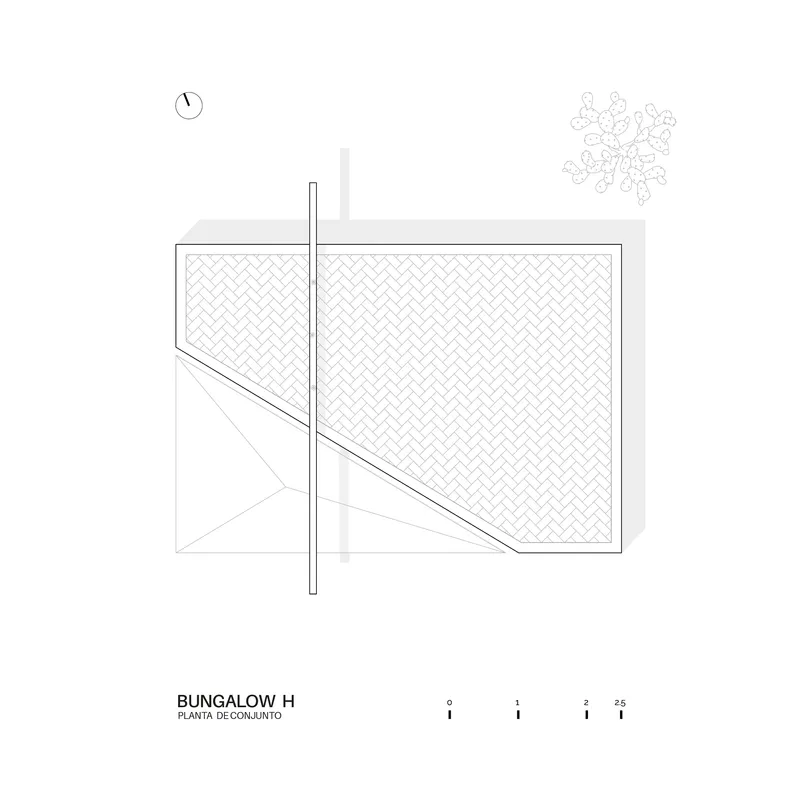
The drawings confirm what the photographs suggest: the plan is organized on a diagonal, with the deck angling away from the enclosed volume to maximize the view corridor toward the valley. The floor plan shows the bathroom, bedroom, and spiral staircase packed into a tight angled layout, while the exploded isometric separates the building into its constituent layers: foundation, deck, interior partitions, and a herringbone-patterned roof. The section drawing reveals the modest interior height and the way the sleeping area is partitioned from the main volume without closing it off entirely.
The two isometric views are particularly instructive. They show two gabled volumes connected by the deck and crossing beams, a composition that reads as simple from any single angle but reveals its geometric complexity in three dimensions. The herringbone roof pattern is a surprising formal move in a project otherwise committed to austerity, introducing a crafted detail at the one surface you rarely see from ground level.
Why This Project Matters
Bungalow H is a reminder that constraint is a design tool, not a limitation. At 30 square meters, the building cannot rely on spatial variety or programmatic complexity to hold interest. It has to be right in its proportions, its orientation, its material choices, and its relationship to the ground. ET.co got all of those things right. The black concrete box that seals on three sides and opens on one is not a new idea, but the execution here, on a sloped Oaxacan site twenty minutes from the city, gives the formula a specificity that elevates it.
The project also raises a question worth sitting with: what does it mean to design a building that can be removed without trace? ET.co's strategy of elevating the foundation, leaving free space around the perimeter, and minimizing site disturbance treats the land as something borrowed. In a region where development pressure on mountain communities is real, that posture carries ethical weight beyond its formal elegance. Bungalow H is small, but the ideas inside it are not.
Bungalow H by ET.co (Omar López Bautista), San Andrés Huayápam, Oaxaca, Mexico. 30 m², completed 2022. Photography by Marcos Rojas Sosa and Omar López Bautista.
About the Studio
Share Your Own Work on uni.xyz
If projects like this are the kind of work you want to make, uni.xyz is a place to publish your own, find collaborators, and enter design competitions.


Popular Articles
Popular articles from the community

EW PARK: Sustainable Architecture Reimagines the Future of Urban Parking
EW PARK reimagines city parking as a modular wooden tower combining automation, solar energy, electric mobility, and adaptable urban design.

Hill & Cross Opera: Sculptural Opera House Architecture Shaped by Tallinn’s Landscape and Identity
Hill & Cross Opera reimagines opera house architecture in Tallinn through its sculptural hill, civic plaza, glass wave and a luminous cross.

Conexión: Biophilic Design Reimagines High-Rise Living in Hong Kong
Conexión reimagines high-rise living in Hong Kong through biophilic design, green facades, shared spaces, daylight, water and nature within.

Co-life: Sustainable Architecture for Age-Friendly Community Living
Co-life reimagines sustainable architecture for seniors through courtyards, rammed earth, shared gardens, and spaces designed for belonging.

Similar Reads
You might also enjoy these articles

Bao Huynh Watercolor Atelier: A Serene Art Retreat in Hội An
Bao Huynh Watercolor Atelier in Hội An blends multifunctional art spaces, sustainable design, local materials, and family-friendly living in a serene environment.

Atelier Macri Concept Store Interior Design by CASE-REAL
Atelier Macri store features a "ko" counter, walnut wood details, cork displays, blending retail, gallery, and seamless customer experiences.

Manuel Vargas Izquierdo Stadium and High-Performance Sports Center: Architectural Excellence in Jalpa de Méndez
The Manuel Vargas Izquierdo Stadium blends sustainable design, inclusive sports facilities, and cultural-inspired architecture, revitalizing Jalpa de Méndez’s public spaces.
KAKR Buluh Awar Hall: Revitalizing Community and Ecology Through Bamboo Architecture
Community built bamboo hall revitalizes Buluh Awar village, empowering youth, restoring ecology, celebrating vernacular craftsmanship through sustainable architecture and culture.



Comments (0)
Please login or sign up to add comments
No comments yet. Be the first to comment!