

Everyday X Governance: A Mumbai Ward Office Where a Public Ramp Replaces the Bureaucratic Corridor
Smriti Bhaya's thesis near Andheri Station turns a 6-metre slope into an amphitheater and threads civic life through a ward office on a continuous ramp.


Most citizens meet their local government at a counter, through a window, at the end of a queue. The architecture of the ward office tells them exactly where they stand: outside, below, waiting. Everyday X Governance starts from the premise that this spatial hierarchy is not incidental to bureaucracy but one of its instruments, and that changing the building can change the relationship. The project's answer is direct. If governance is meant to belong to the public, its building should behave like a piece of the street.
Developed as a thesis by Smriti Bhaya, the proposal rethinks civic architecture at the ward level, the scale at which Mumbai's residents actually encounter the municipal state. The primary intervention sits on a 45m x 45m contoured site near Andheri Station, surrounded by residential buildings, markets, educational institutions, a hospital and a bus depot. It is one of the city's most heterogeneous neighbourhoods, and Bhaya treats that mix as the brief rather than the backdrop. The ward office stops being an isolated administrative block and becomes an extension of the public realm around it, part administrative centre, part cultural institution, part public square.
A Six-Metre Slope Becomes the Building's Front Door
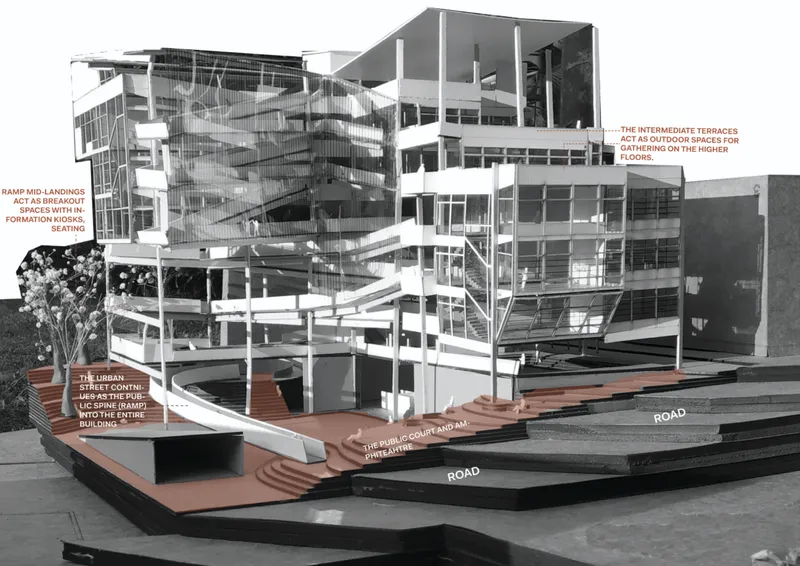
The physical model reveals the project's first and most consequential decision: there is no boundary wall and no single ceremonial entry. The site falls nearly six metres across its width, a condition that would usually be resolved with a plinth and a flight of steps that lift the institution above the street. Bhaya does the opposite. The sloped road frontage is absorbed into the site and the ground plane is landscaped as an open amphitheater, so the stepped terraces visible at the base of the model read as seating as much as landform.
This matters because thresholds carry political meaning. A gate filters people, while an amphitheater invites them to linger. Meetings and gatherings can spill out onto the steps, and passers-by from the station or market can watch civic life without committing to entering a government building. Above this porous base, the glazed multistory block keeps its internal workings visible, and the ramp spiralling around it hints at the circulation strategy that defines the rest of the design.
The Indian Street, Folded Upward Into a Public Spine
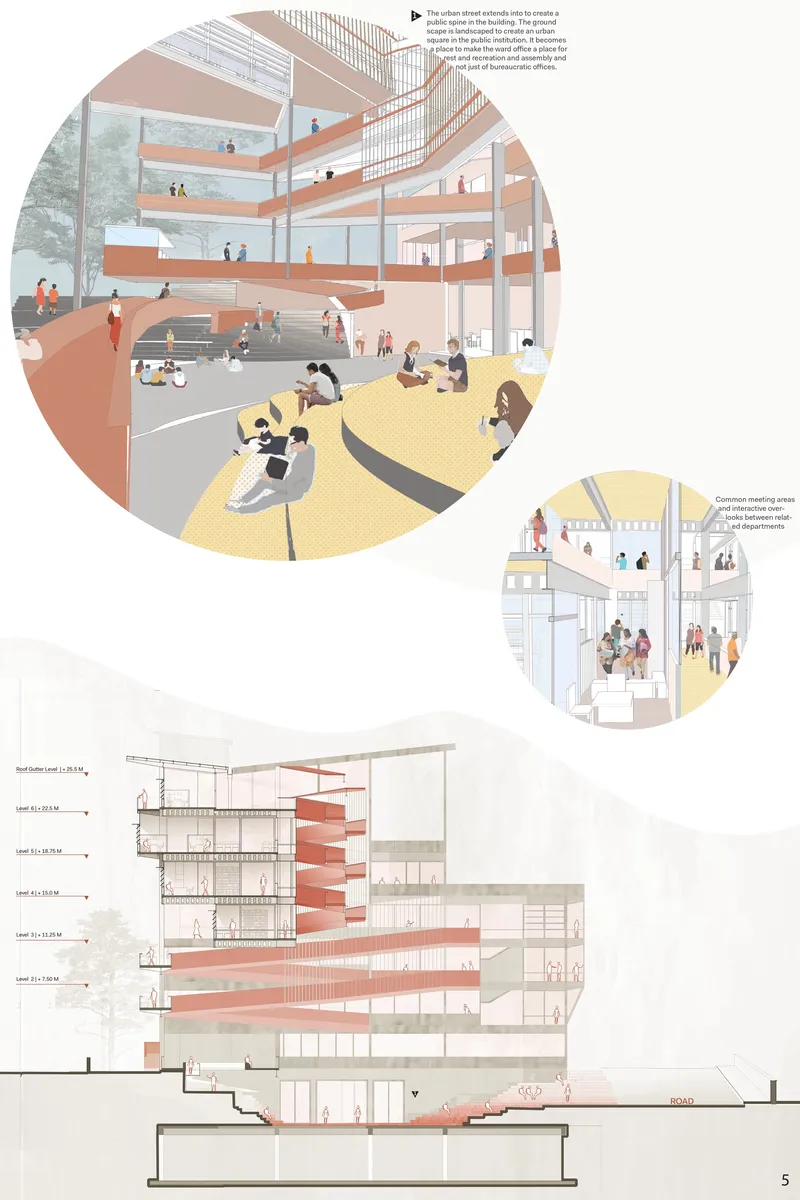
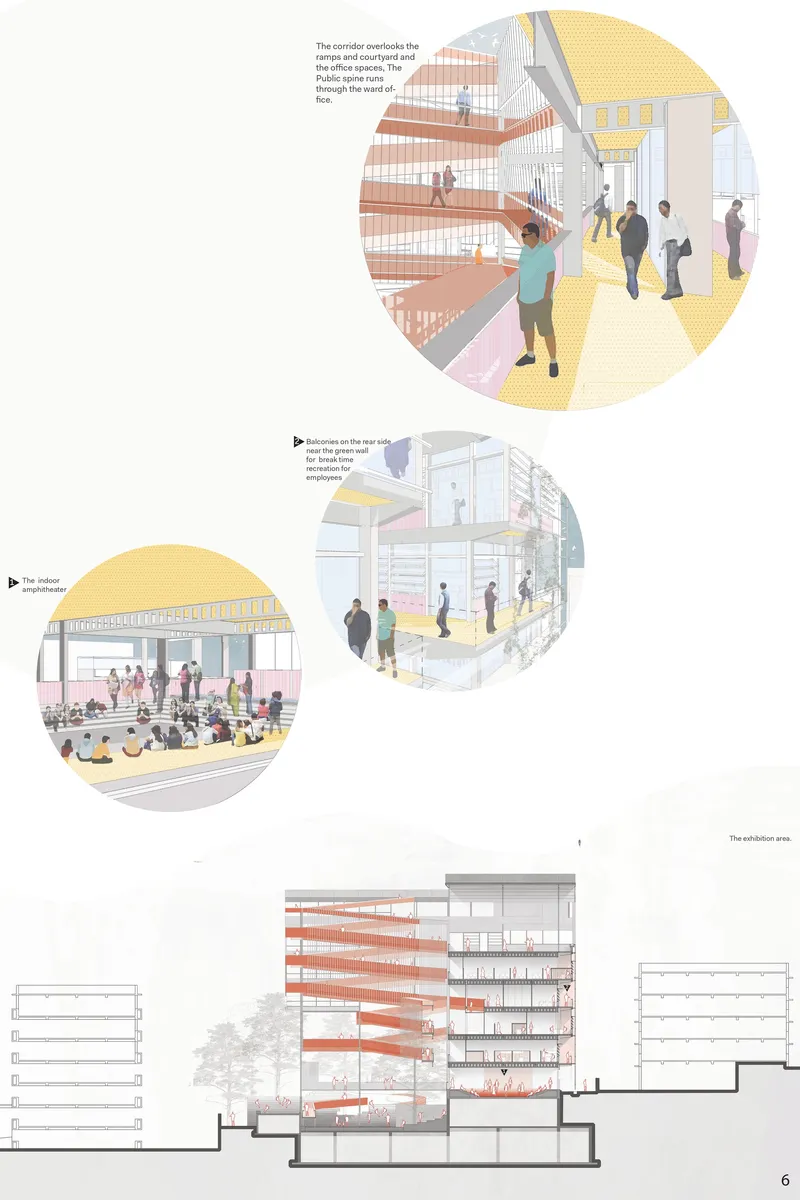
The sections make the central idea legible. A continuous public ramp, drawn in red, winds upward through the building and connects every level. Bhaya calls it a public spine, and the reference point is the Indian street: a multifunctional space where commerce, rest, gathering and negotiation all overlap. Rather than sorting visitors into lifts and corridors that lead to closed doors, the ramp keeps them moving through the institution in full view of courtyards and workspaces. The rendered interiors show ramps meeting seating steps, balconies overlooking an amphitheater, and corridors that open onto shared volumes instead of sealing them off.
The ramp's pauses are where the strategy becomes programme. Mid-landings act as informal breakout spaces with seating and information kiosks, and intermediate terraces work as outdoor rooms for collective activities. By displacing certain administrative functions outward, the building frees space for this civic layer. A citizen climbing the building passes through governance rather than around it, and that constant visual and physical contact with institutional processes is the project's quiet argument for transparency. The circulation does more than move people; it shapes how they experience the institution, and it treats every visitor as a participant rather than a supplicant.
Governance Leaves the Ward Office and Enters the School Yard
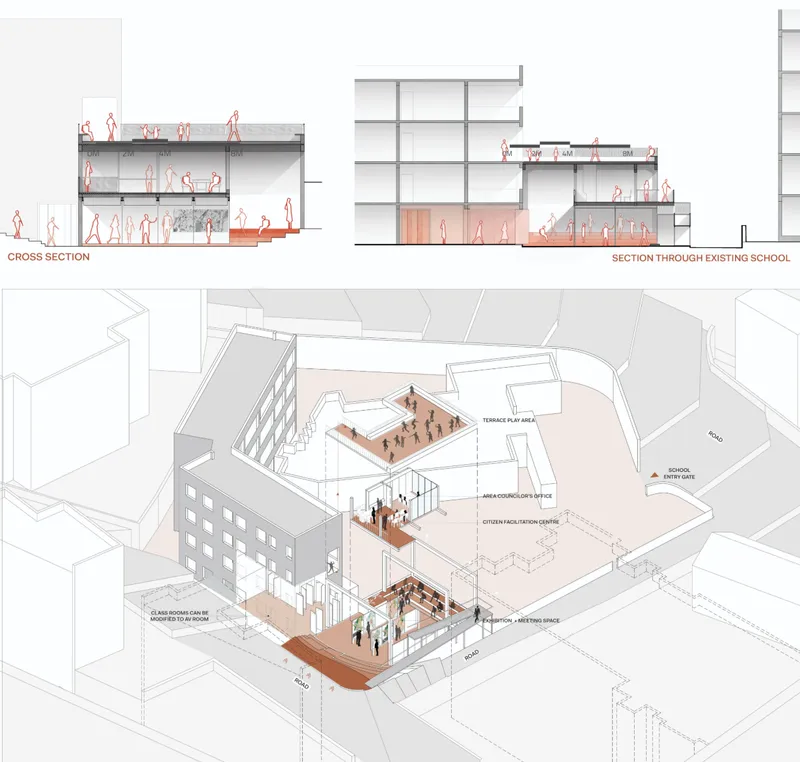
The thesis does not stop at a single building. It is structured around three scales of intervention, and this drawing shows how the logic travels. A school annex combines a terrace play area with office and exhibition space, placing a fragment of civic administration inside an institution that families already visit every day. The cross sections above the axonometric show how these functions stack without displacing the annex's primary use.
This is the most strategically interesting move in the project. Decentralisation here is spatial, not just procedural: governance is distributed into the places where daily life already happens, so participation no longer requires a special trip to a distant office. An exhibition of ward proposals beside a playground reaches people who would never attend a formal consultation, and that kind of incidental encounter is exactly what top-down planning tends to miss.
A Timber-Screened Pavilion at the Scale of the Footpath
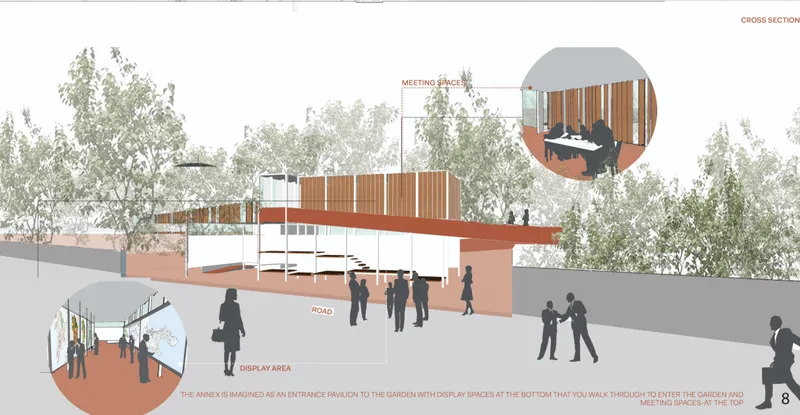
The smallest intervention is also the most approachable. Rendered in section, an entrance pavilion with timber screens and a red roof sits at street level under a canopy of trees, with silhouetted pedestrians walking past rather than through a gate. The screens filter rather than block, and the red roof ties the pavilion visually to the red ramp of the main building, giving the network a recognisable identity across the ward.
At this scale, governance shrinks to the size of a bus shelter or a kiosk. It sits where information dissemination, which the thesis identifies as fragmented, can happen in passing. The figures in the drawing are not visitors to an institution; they are simply people on their way somewhere, and the architecture meets them there.
Why This Project Matters
Civic architecture in fast-growing cities rarely gets this kind of attention. Ward offices tend to be designed as containers for files and desks, and the public experience is an afterthought. Bhaya's thesis insists that the form of a governance building is itself a site of intervention, that ramps, landings, terraces and open ground can either reinforce hierarchy or make room for dialogue. The decision to treat a difficult six-metre slope as a public amphitheater rather than a problem to be levelled shows a designer reading the site and the politics together.
What lifts the project beyond a single well-planned building is its multi-scalar ambition. By pairing a flagship ward office with a school annex and street-level pavilions, Everyday X Governance sketches a network rather than a monument, one where civic engagement is embedded in daily routines across Andheri. Whether or not municipal processes would bend to match the architecture, the proposal makes a persuasive case that the building should at least stop working against the citizens it serves.
View the Full Project
About the Designers
Designer: Smriti Bhaya
Enter a Design Competition on uni.xyz
uni.xyz runs architecture and design competitions year-round that reward proposals with spatial conviction and real site intelligence.
Project credits: Everyday X Governance by Smriti Bhaya.


Popular Articles
Popular articles from the community


graciastudio Turns a Viewless Tijuana Lot Inward Around a Courtyard of Concrete, Timber and Trees
In Tijuana, Jorge Gracia's GA2 House stacks a timber-clad private floor over exposed concrete and replaces a missing view with a planted interior patio.


Aquadapt: An Underwater Habitat That Rewrites Its Rooms by the Hour
Curved modules ring the seabed while one shell shifts from breakfast room to cinema, farm and football pitch as residents' needs change.

Singing Woman: An Opera House That Performs Before the Curtain Rises
Ovidiu Cristian Pavel's conceptual opera house translates Estonia's choral identity into a sculpted waterfront landmark facing the Baltic Sea.

ETEH Reworks the Shared Spaces of São Domingos School in Brazil Around Timber, Color and Hanging Plants
At São Domingos School in Brazil, 436 m² of hall, refectory and library are recast with timber joinery, a yellow and blue code and trailing greenery.

Similar Reads
You might also enjoy these articles
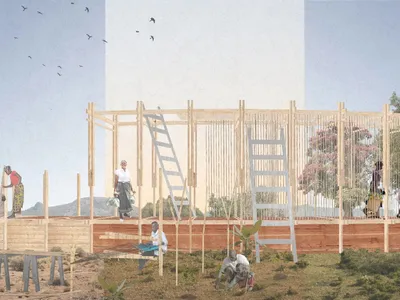
Healing Façade: A Modular Chapel System That Restores Ethiopia's Sacred Forests
Winner of the Eco-Chapel competition, this circular timber façade collects water from air to rebuild soil and reforest degraded Ethiopian landscapes.
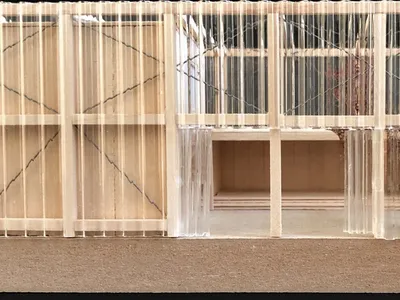
Kaffeebühnen: Where Coffee Shop Architecture Becomes a Civic Stage in Vienna
A linear sequence of timber boxes, transparent shells, and open yards turns the Viennese café tradition into a public performance space.
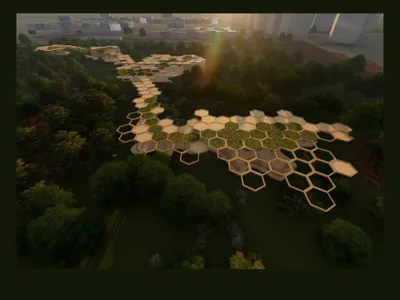
Eco Chapel: A Modular Forest Pavilion That Grows Like the Landscape It Protects
Hexagonal timber modules weave through existing trees, turning a chapel into a living system for prayer, education, and reforestation.


Urban Forest: A Vertical Ecosystem for 5,000 Workers in Singapore's Changi Business Park
Radially stacked pods and layered green decks turn a 7-acre plot into 47 acres of ecological workspace projected for 2040.

Explore Civic Architecture Competitions
Discover active competitions in this discipline

Challenge to design public laboratory

Challenge to design luxury tourism on rails

VR headsets Storefront design competition

Designing a staircase for a client
Comments (0)
Please login or sign up to add comments
No comments yet. Be the first to comment!