
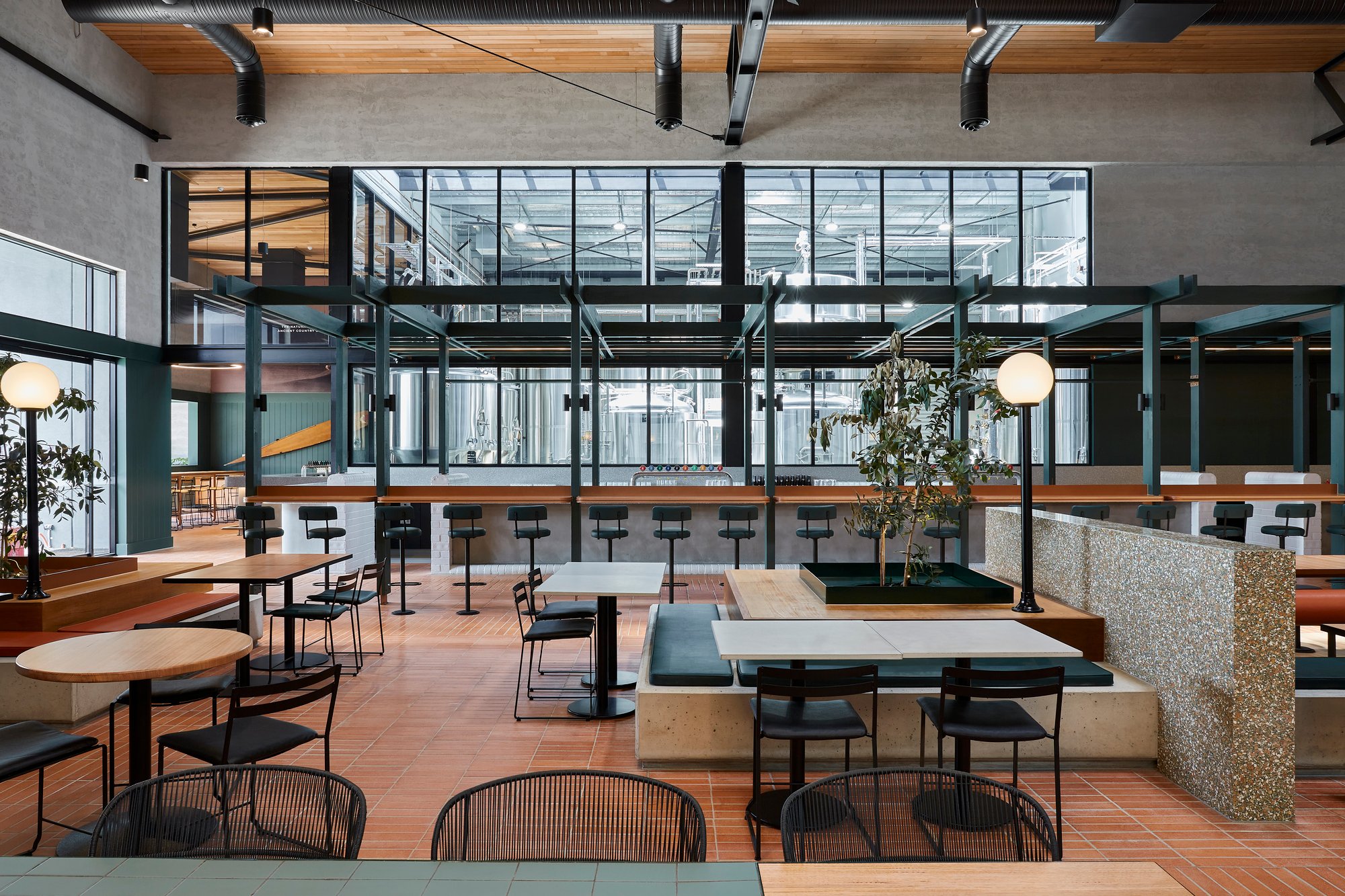
Ewert Leaf Converts a Former Quiksilver Warehouse into a 422-Seat Brewery in Torquay
Sou'West Brewery repurposes a mid-1990s surf brand headquarters on Victoria's coast into a layered, material-rich beer hall.

A building born to house Quiksilver's Australian operations in the mid-1990s sits at the edge of one of Victoria's most storied surf towns. Two decades later, Ewert Leaf has stripped the warehouse back to its structural bones and rebuilt it as Sou'West Brewery, a 1,495-square-meter venue in Torquay that seats 422 across a beer hall, tasting pavilion, open-air terrace, and kids' play area. The conversion is a lesson in reading what a building already wants to be and then adding only what it needs.
What makes Sou'West interesting is not that it converted a warehouse into a brewery. That genre is well-worn. What sets it apart is the careful calibration of scale. Ewert Leaf removed the upper-level slab to unlock a six-meter-high interior, then introduced a 12-meter skylight, suspended canopies, and a dense matrix of furniture types to compress and release space at a human register. The result is a venue that feels both monumental and intimate, depending on where you sit.
The Warehouse Shell as Protagonist
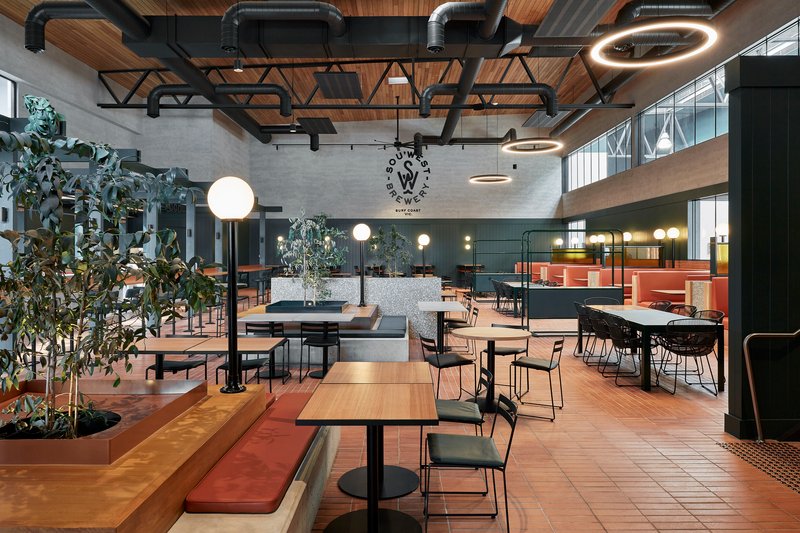
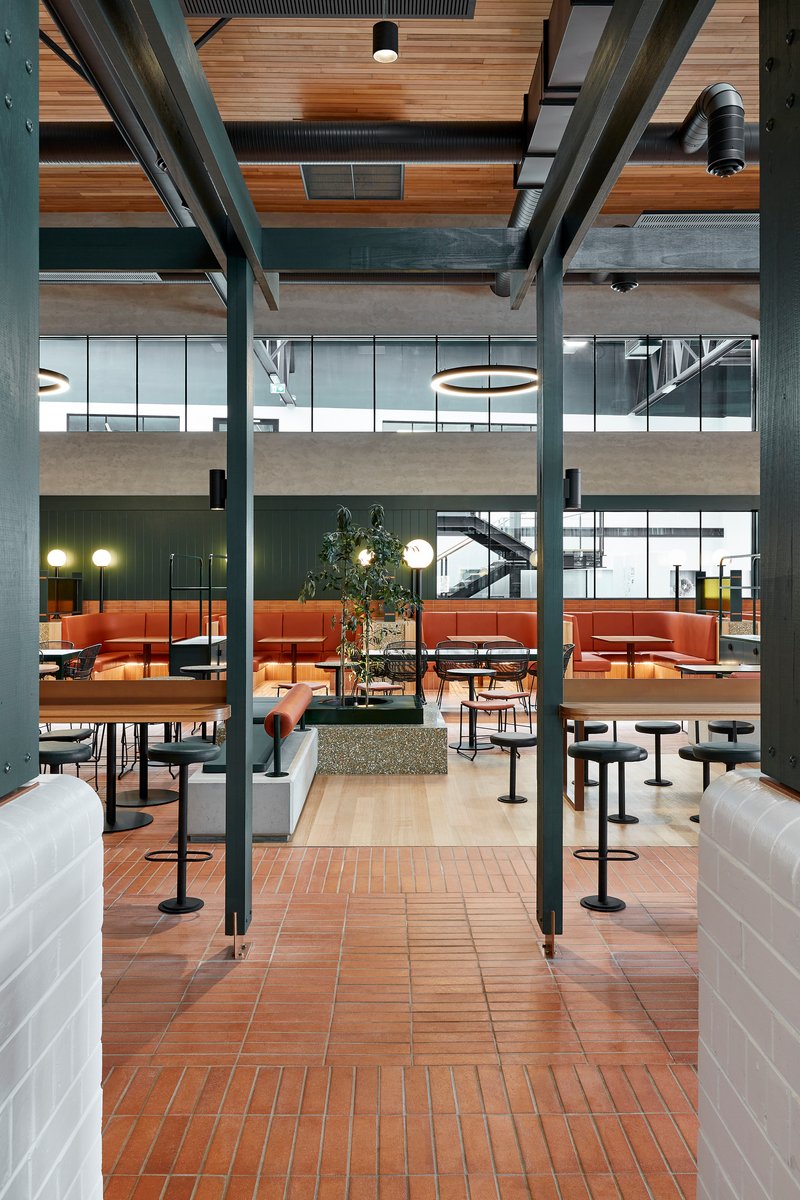
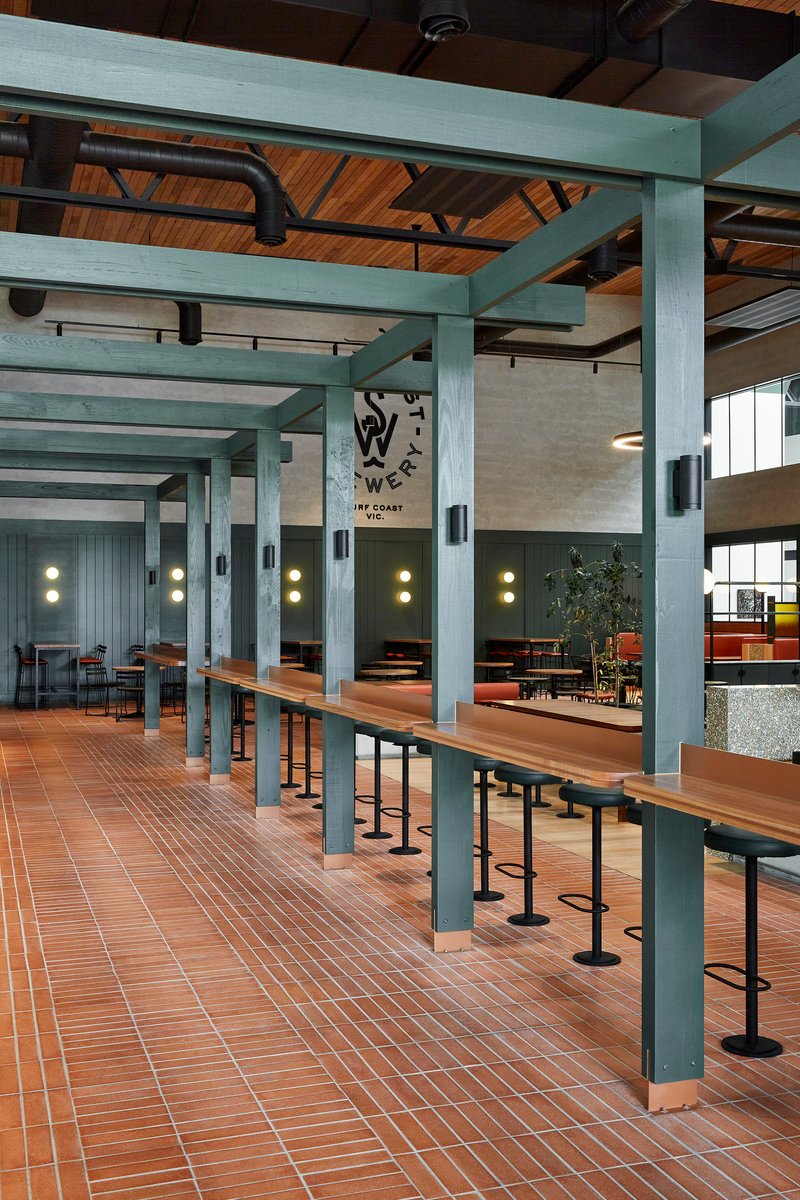
Ewert Leaf's primary move was to celebrate the warehouse rather than conceal it. Exposed black steel trusses and blue-painted beams run overhead while timber ceiling slats bring warmth to the industrial frame. The decision to remove the upper slab was decisive: it turned a low, compartmentalized floor plate into a double-height volume threaded with daylight from above. Services, including HVAC ducts and conduit, are left visible and integrated as part of the composition rather than hidden behind bulkheads.
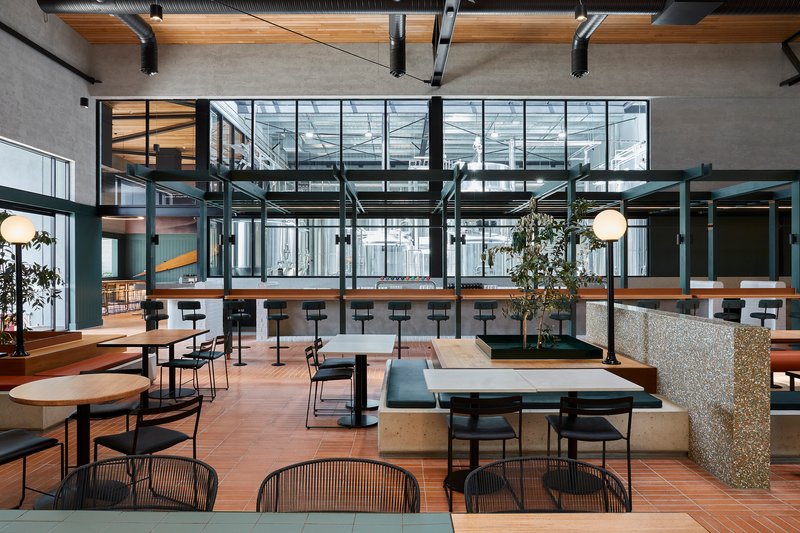
The building's original steel structure becomes the visual armature that ties every zone together. Long communal tables run beneath the beams, and potted trees punctuate the floor, their canopies reaching upward into the tall void. The proportions recall a market hall more than a pub, which is precisely the point: the brewery wants to be a gathering place for a community, not a dark room for drinking.
Terracotta, Terrazzo, and the Material Palette
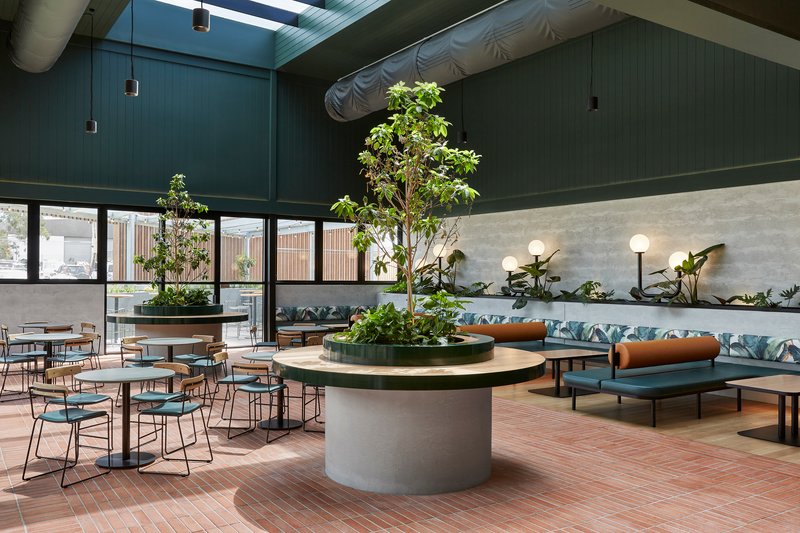
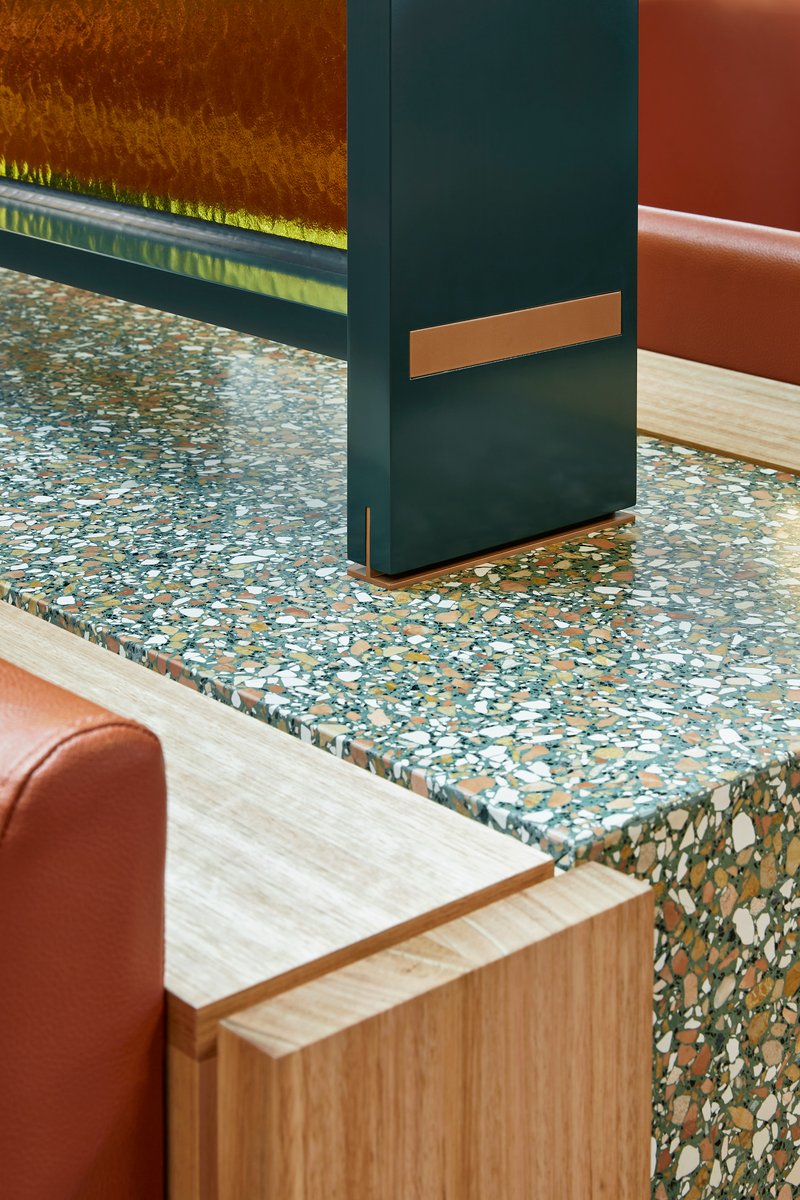
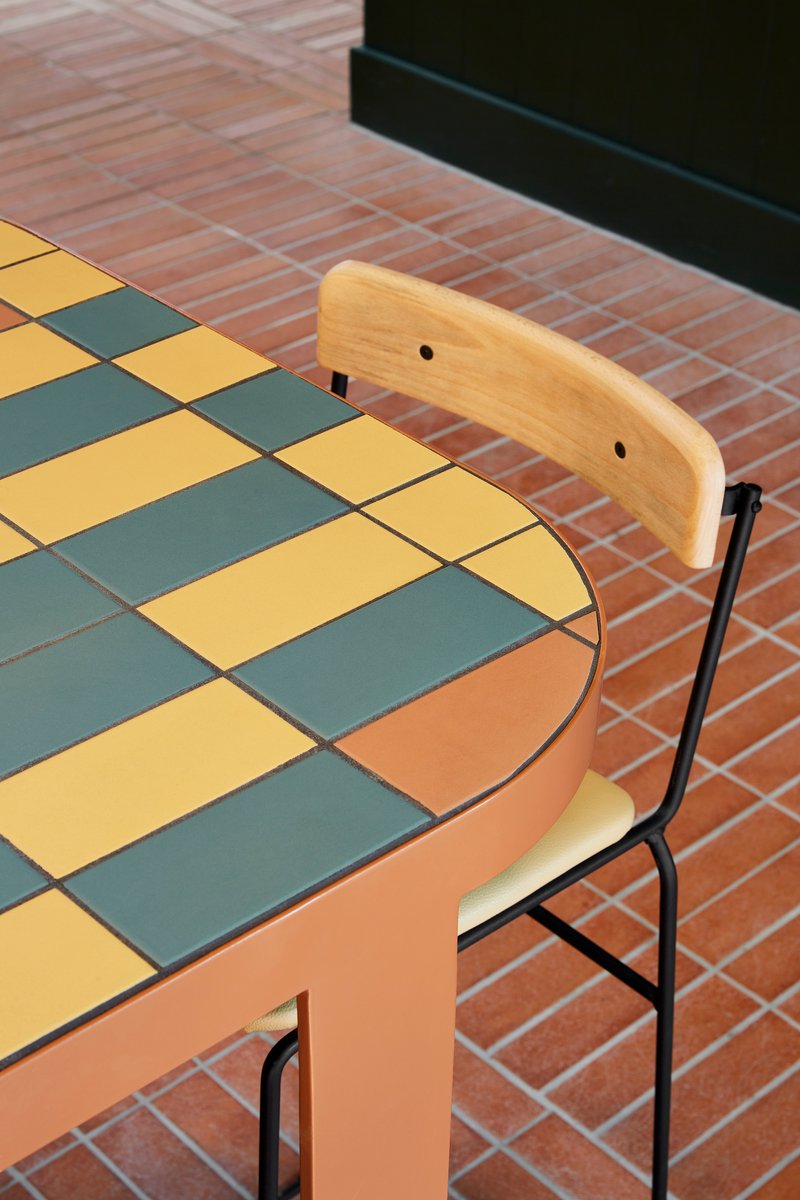
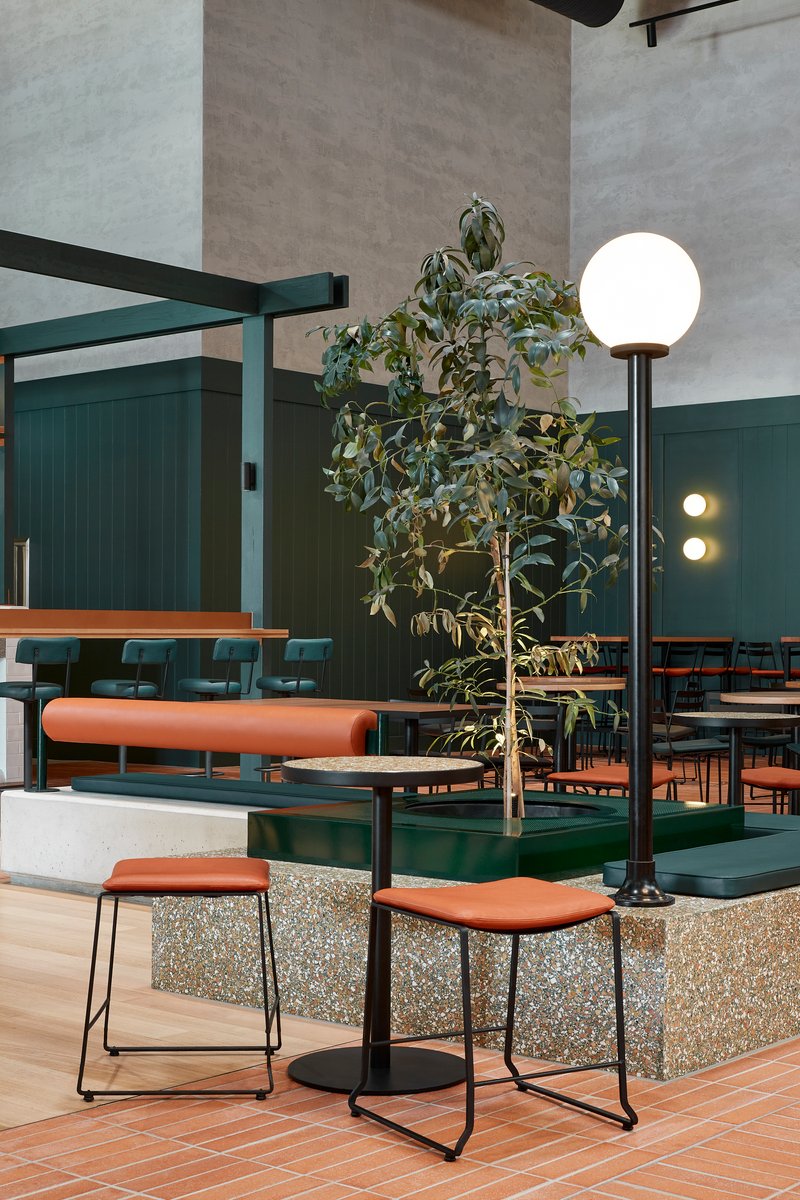
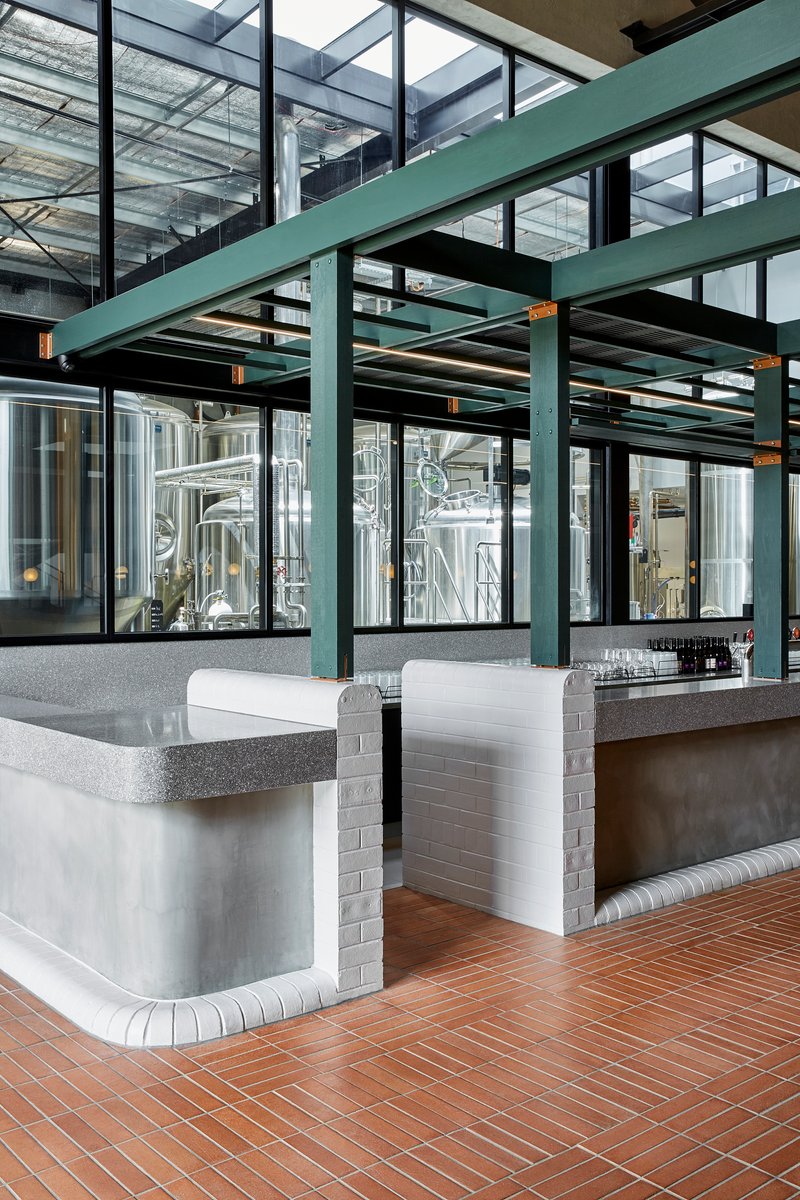
The floor is the project's quiet hero. Italian-made Arrotato da Crudo terracotta tiles by Cotto Manetti, selected for their commercial durability, are laid in directional patterns that give grain and rhythm to a vast floor area. In places the terracotta gives way to herringbone brick, terrazzo plinths, and checkered tabletops in yellow and grey. The variety of floor finishes acts as a wayfinding device: you read the ground to understand where one zone ends and another begins.
Terrazzo appears at countertops, column bases, and raised platforms, always meeting other materials with clean, considered junctions. A bronze accent strip at a column detail captures the level of care in the joinery. Ewert Leaf drew parallels between the rawness of the site and the rugged coast outside, and the material palette delivers on that idea without resorting to driftwood clichés. The textures are warm and earthy but never nostalgic.
Brewing on Display
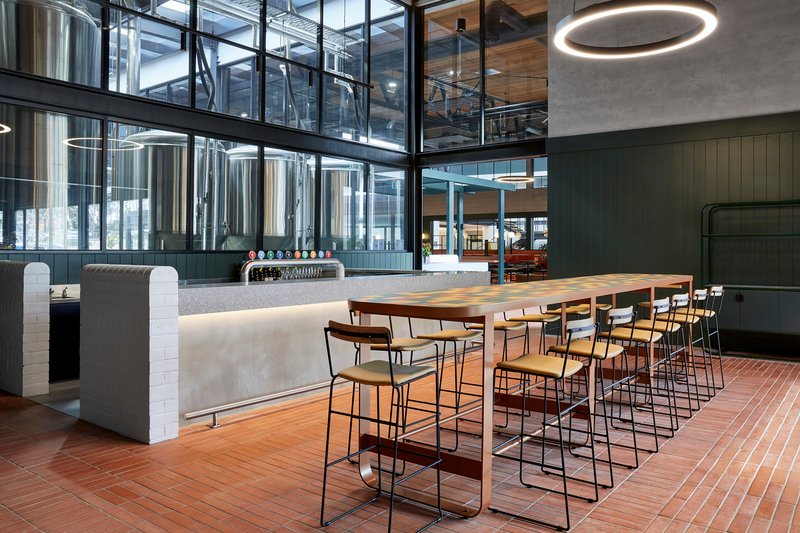
A purpose-built extension houses the brewery equipment: grain mills, tanks, and fermenters, all encased in extensive glazing so patrons can watch the production process from the bar. The stainless steel vessels behind glass become a kind of stage set, reflecting light and adding a cool, industrial counterpoint to the warm timber and terracotta of the dining areas. It is a straightforward move, but it earns its place by anchoring the venue's identity. You know, without question, that beer is made here.
High-top tables and stools line the glazed partition, creating a casual tasting zone where the boundary between consumption and production dissolves. Raised terrazzo platforms with bar stools and potted trees frame the approach, giving the brewery core a sense of ceremony without over-designing the threshold.
Seating as Spatial Architecture
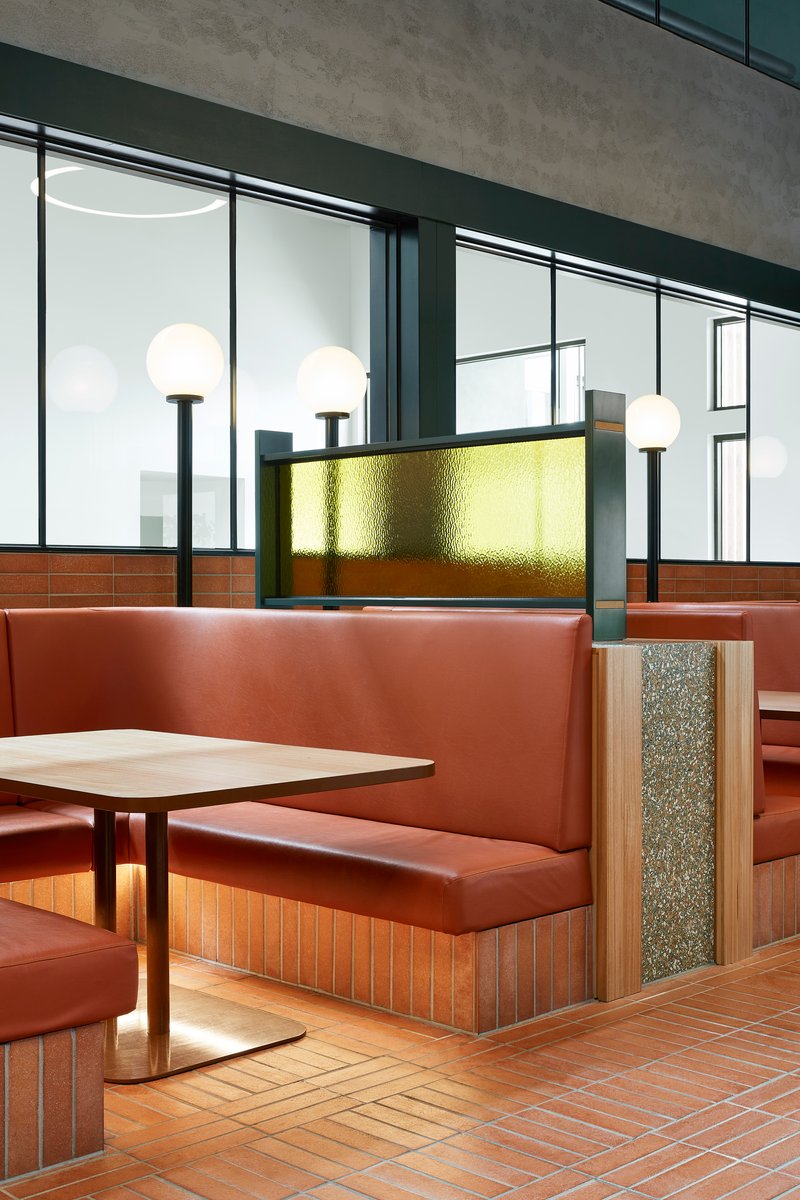
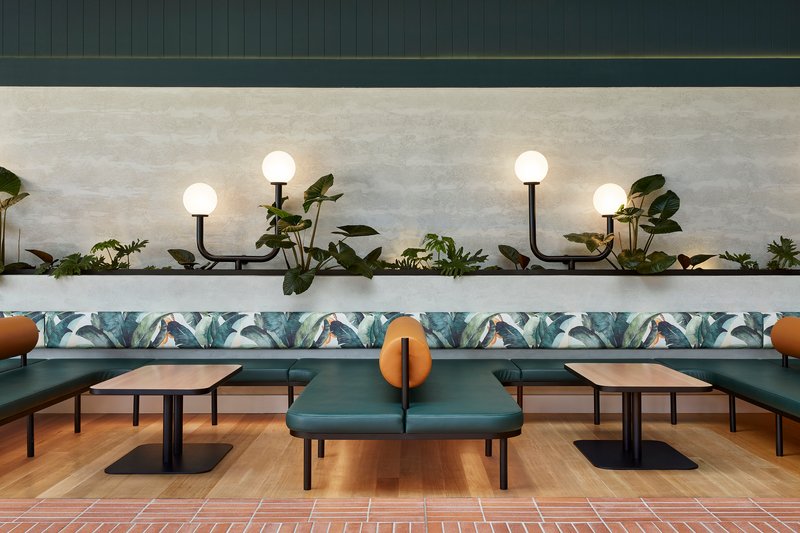
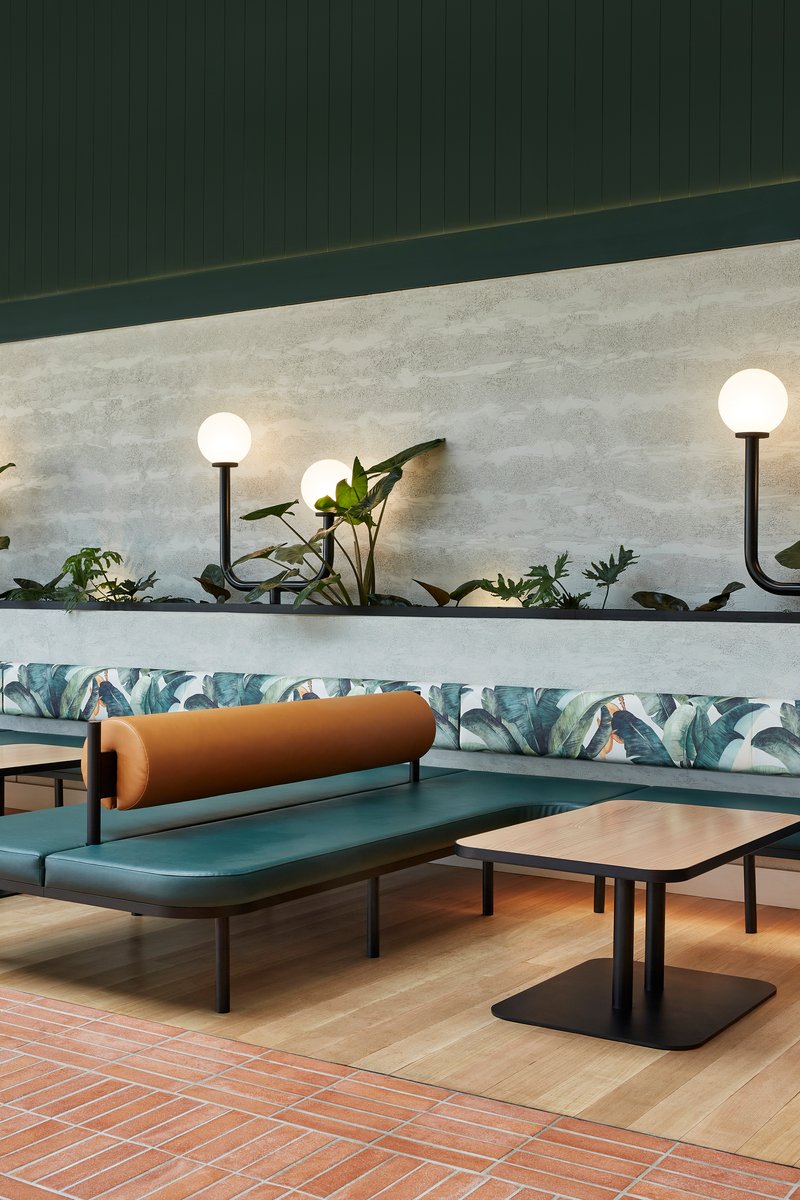
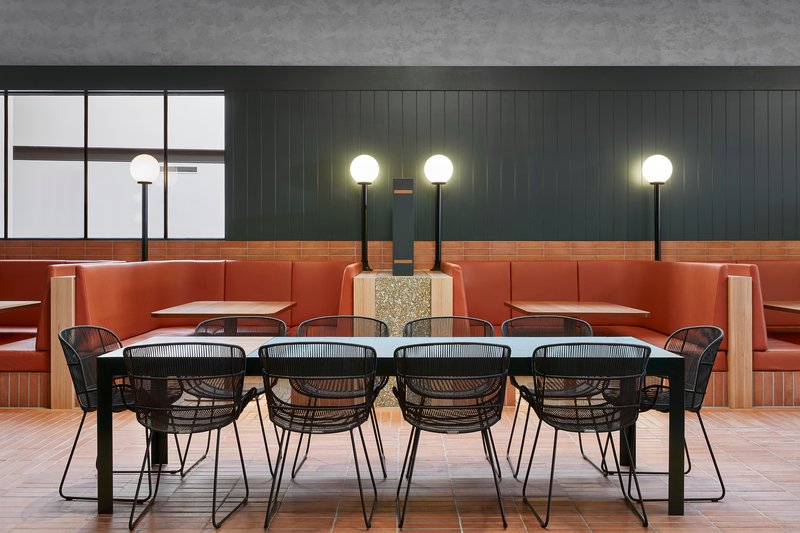
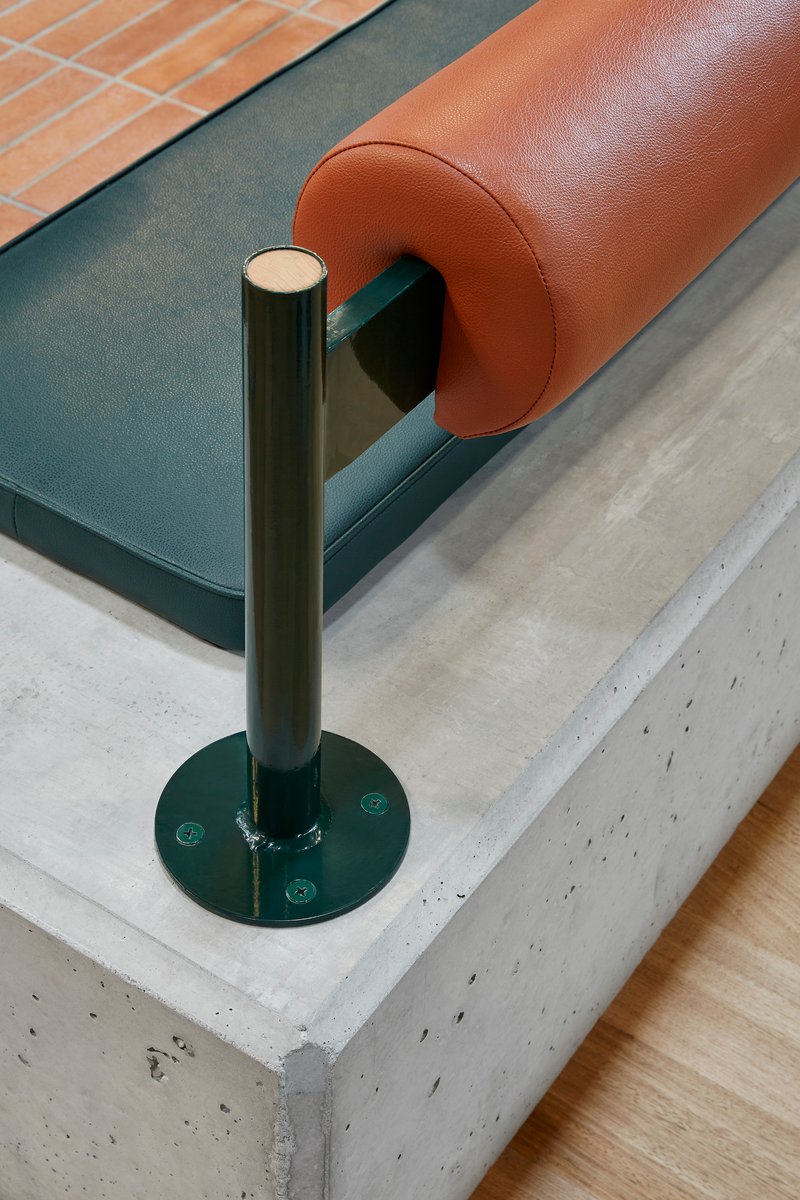
Fitting 422 seats into a single venue without making it feel like a cafeteria requires discipline. Ewert Leaf deployed an inventory of seating types: banquettes, booths, plinths, high benches, communal tables, and planters that act as room dividers. Bolster-style booth backrests with powder-coated frames and timber end capping create enclosure at the body scale, while suspended canopies overhead compress the six-meter ceiling to a more intimate register.
The upholstery deserves a note. Palm-print fabric on selected banquettes is a playful nod to the building's surf-wear origins, executed with enough restraint that it reads as wit rather than theme-park decoration. Teal panels, botanical prints, and globe sconces layer texture and color into the booths, making each seating cluster feel like a distinct room within the larger hall.
The Mezzanine and Vertical Play
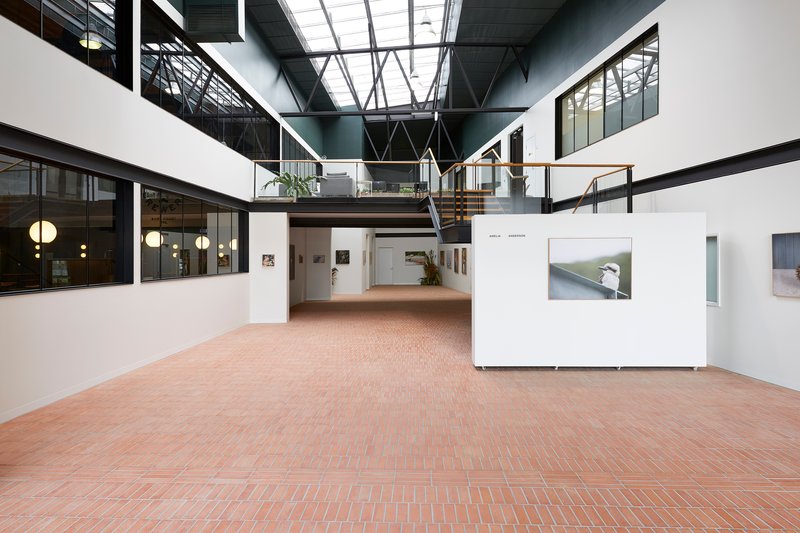
A steel-frame mezzanine walkway reintroduces a second level to the double-height volume, this time as a lightweight insertion rather than a solid slab. The mezzanine offers elevated views back into the beer hall and creates shaded zones beneath its deck for banquette seating with terrazzo counters and white tiled bases. The relationship between upper and lower levels is porous: you are always aware of the full height of the space, even when seated below the mezzanine edge.
Skylights above the mezzanine flood the atrium with natural light, reducing the venue's dependence on artificial lighting during the day and giving the interior a quality more common in galleries or atriums than in hospitality spaces.
Facade and Exterior Presence
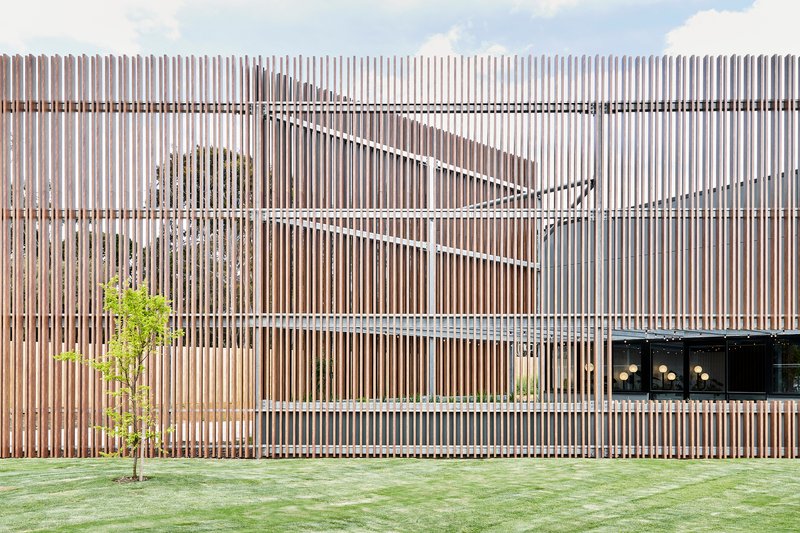
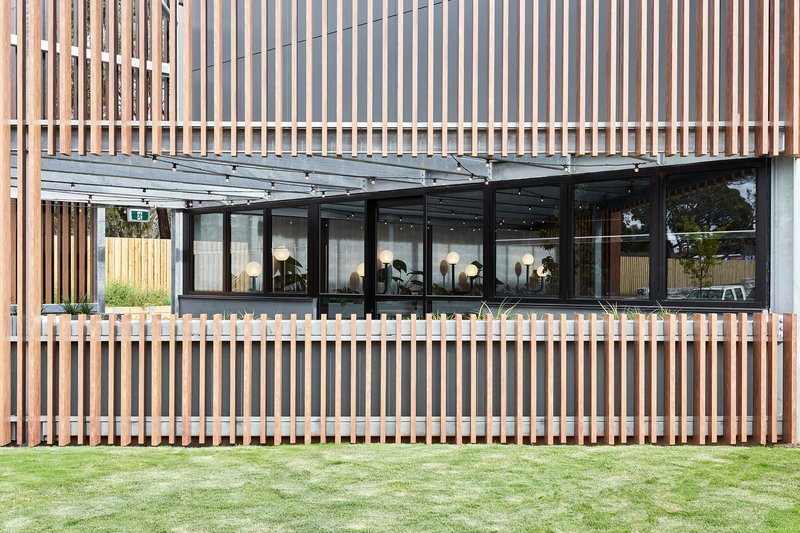
The street-facing facade wraps in vertical timber slats with triangular cutout patterns that filter light and give the building a civic presence scaled to the pedestrian. Bespoke streetlamps, proportioned to human height rather than highway standards, line the approach and signal that this is a place to slow down. The timber screen obscures the warehouse volume behind it, creating a threshold between the car park and the interior world.
At dusk, the glazed sections of the facade glow, and the communal tables visible from outside broadcast activity into the street. The design starts low at human scale and works upward to the six-meter envelope, a gradient that eases the transition from sidewalk to beer hall.
Details and Amenities
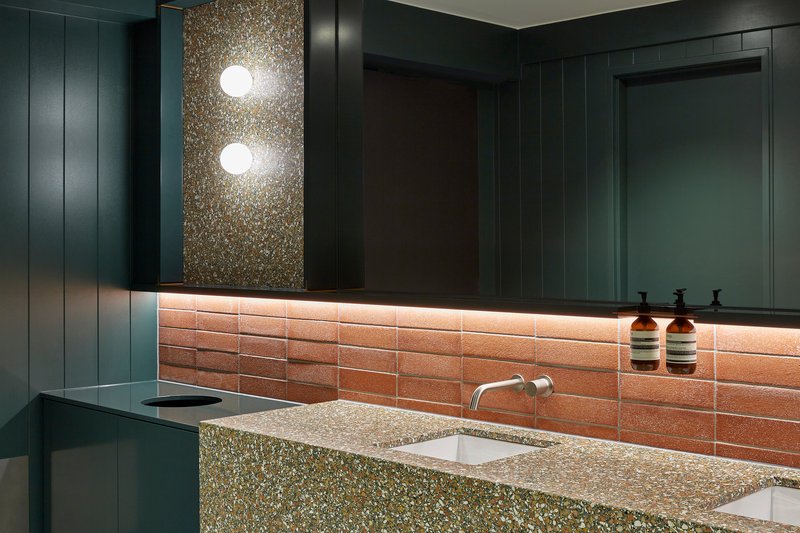
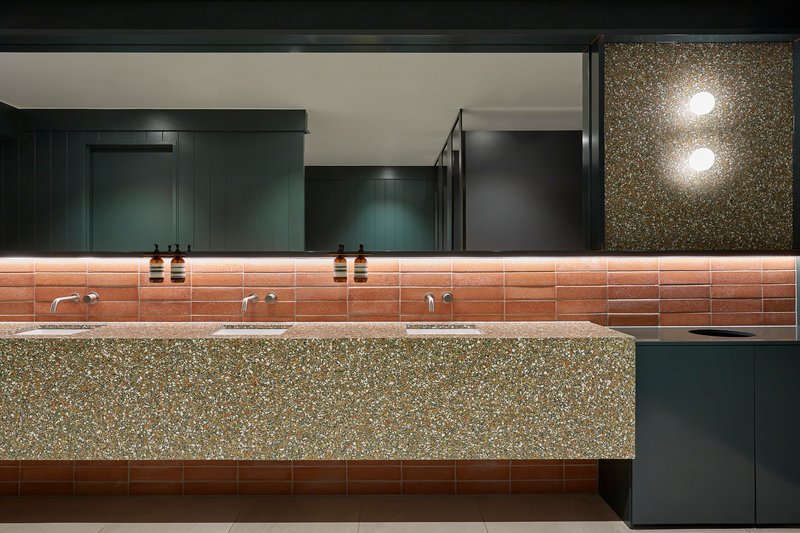
The bathrooms are given the same material commitment as the main hall. Terrazzo countertops sit above terracotta subway tile backsplashes, and dark green cabinetry adds a domestic note. Linear lighting and dark paneled walls make these rooms feel considered rather than afterthought. It is a small thing, but it signals the caliber of the fit-out throughout.
A close-up of a tubular steel armrest anchored to a concrete plinth base reveals the structural honesty that runs through the project. Expressed joints in glass screens and canopies reference the warehouse vernacular, keeping every connection legible. Nothing is hidden that doesn't need to be.
Plans and Drawings
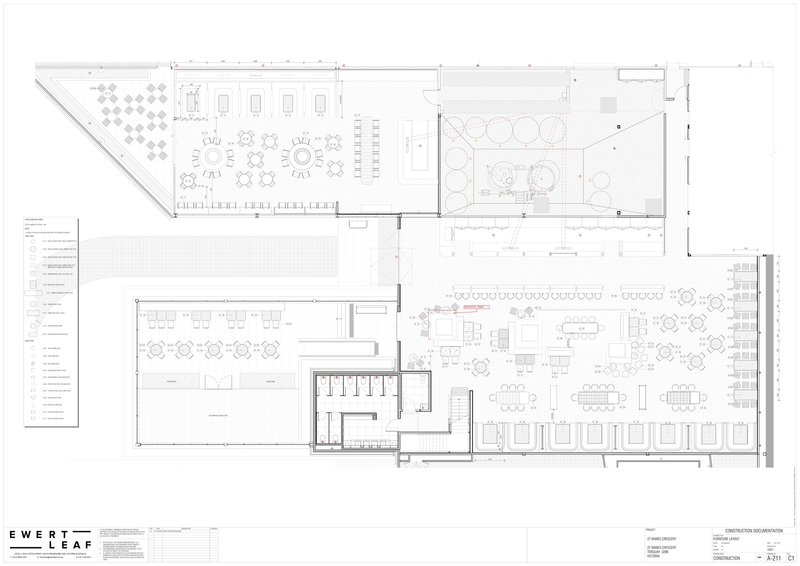
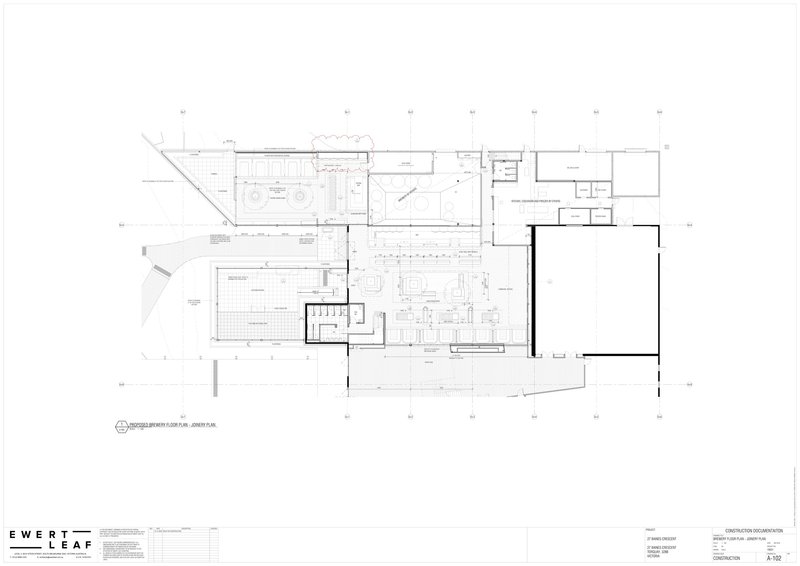
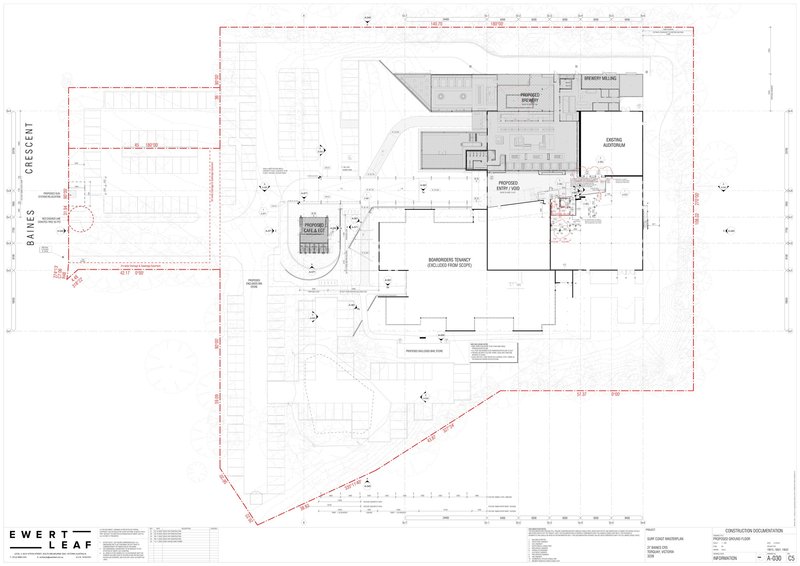
The floor plans reveal the logic behind the spatial layering. The irregular building footprint, a product of the original warehouse geometry and the brewery extension, is subdivided into identifiable zones through furniture arrangement and floor finish changes rather than walls. Circular seating arrangements, a dedicated outdoor terrace, and service areas tucked to the perimeter keep the central volume free and legible. The site plan confirms the extent of civil and landscaping works required to meet local planning requirements, including car parking and new planting along the street edge.
Why This Project Matters
Sou'West Brewery demonstrates that adaptive reuse in hospitality does not require gutting a building's character to impose a new identity. Ewert Leaf worked with the warehouse's proportions, structure, and industrial grain, amplifying them with a material palette that connects the interior to the coastal landscape outside. The removal of the upper slab was a bold structural decision, and the 12-meter skylight that replaced it transformed the spatial experience from utilitarian to generous.
More broadly, the project shows how furniture, planting, and floor finishes can do the work of walls. In a 422-seat venue, the risk of institutional blandness is real. Ewert Leaf avoids it not through spectacle but through accumulation: layered materials, varied seating types, and a clear hierarchy of intimate, communal, and monumental scales. The result is a brewery that feels like a small town, which, for a surf community gathering place, is exactly right.
Sou'West Brewery by Ewert Leaf. Torquay, Australia. 1,495 m². Completed 2021. Photography by Jenah Piwanski.
About the Studio
Share Your Own Work on uni.xyz
If projects like this are the kind of work you want to make, uni.xyz is a place to publish your own, find collaborators, and enter design competitions.



Popular Articles
Popular articles from the community

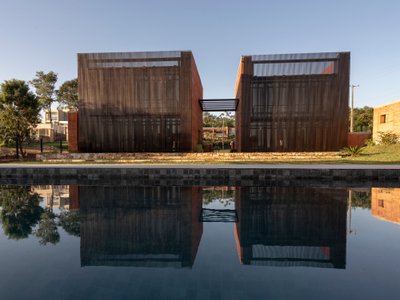
BAUEN Builds Two Rammed Earth Volumes in Paraguay Inspired by the Ovenbird's Nest
In San Bernardino, a house of compacted earth channels the instinct of a constructive bird to shelter life from the Paraguayan summer.
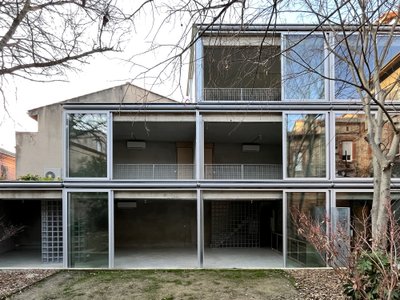
BAST Slots a Four-Story Glass House into a Narrow Gap Between Toulouse Townhouses
In the dense Bonnefoy district, a stepped infill building merges home and office while preserving a majestic hackberry tree.
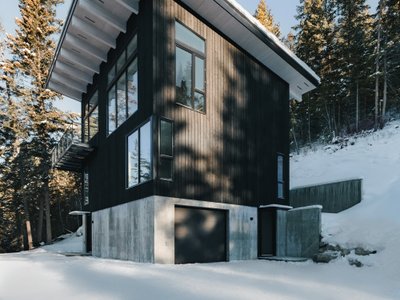
Twobytwo Architecture Studio Towers a Blackened Ski Cabin Above the Trees in Golden, BC
A compact three-storey lookout in the Kootenay mountains trades square footage for 14-foot ceilings and Columbia River Valley views.
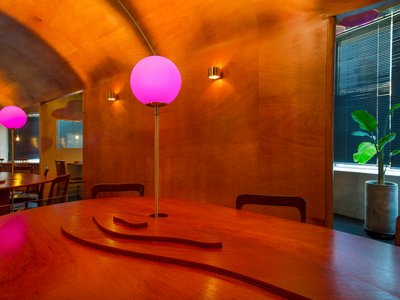
Indiesalon Carves a Plywood Cave into a Seoul Bistro's Second Floor
Munhwa Bistro's second Seongsu branch wraps diners in a laminated timber vault laced with colored light and mirror illusions.

Similar Reads
You might also enjoy these articles

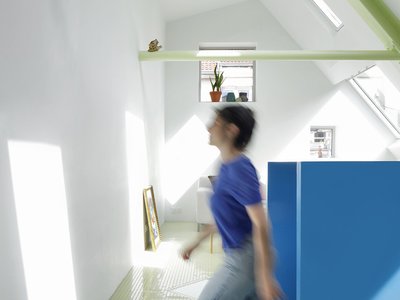
127af Flips a Tiny Bagnolet Rowhouse Upside Down with a Handcrafted Roof Extension
A 55-square-meter terraced house on the edge of Paris gains a luminous upper living floor through lightweight timber and steel.
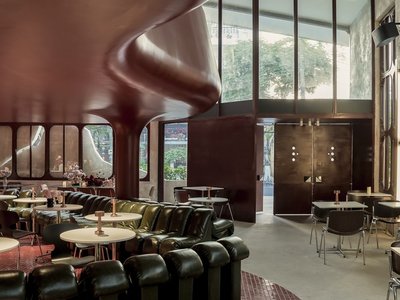
1.61 Design Workshop Wraps a 600-Square-Meter Café in Vietnam in Sculptural Burgundy Drama
Reden Café & Bistro pairs a helical staircase, mosaic floors, and deep red interiors to rethink Vietnamese hospitality space.

The Unbound Brain: A School Shaped by Cognitive Architecture
Cylindrical learning pods radiate like neurons from a central cortex, turning the floor plan into a spatial model of human thought.
Revival Vernacular Architecture: Rammed Earth Settlements for the Sahara
A modular desert community in Mauritania that fuses passive cooling techniques with earthen construction and local craftsmanship.






Comments (0)
Please login or sign up to add comments
No comments yet. Be the first to comment!