
A Victorian Outbuilding Reborn as a Collector's Pavilion
Neiheiser Argyros transforms a modest London garden building into a luminous retreat for art, blending Victorian bones with industrial precision.


Most Victorian garden outbuildings end up as storage sheds or demolition candidates. The Exeter Road Pavilion makes a quiet argument that these overlooked structures, with their existing footprints and weathered character, can become something altogether more considered. Designed by Neiheiser Argyros for an art collector in northwest London, the project takes a 90 m² outbuilding and rethinks it not as a renovation in the conventional sense but as a tectonic recomposition: new materials layered over old logic, industrial lightness grafted onto domestic scale.
What makes the project genuinely interesting is the tension between permanence and translucency. The original brick walls and pitched tile roof anchor the building in its Victorian context, while the new interventions, ribbed polycarbonate canopies, exposed steel, corrugated metal cladding, seem to hover alongside and above. It is a pavilion in the truest sense: a structure as much about framing the garden and filtering light as about enclosing space.
Garden Object
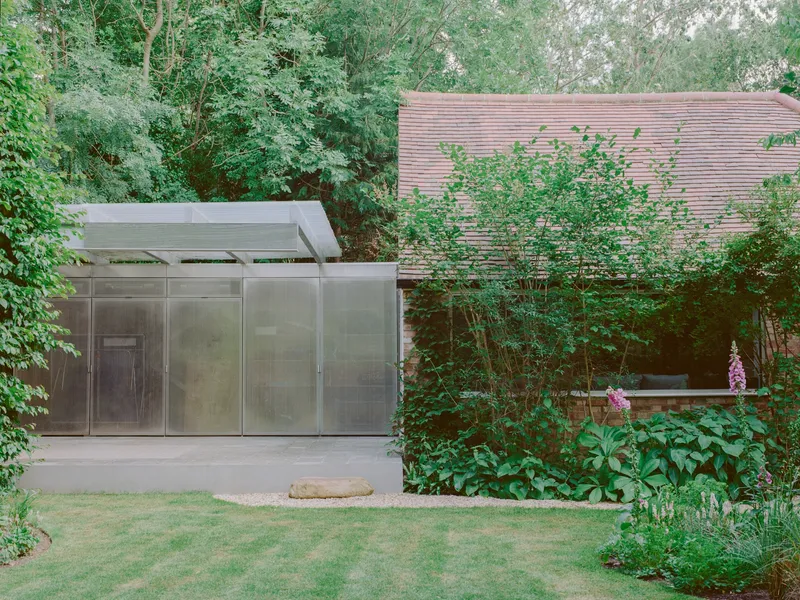
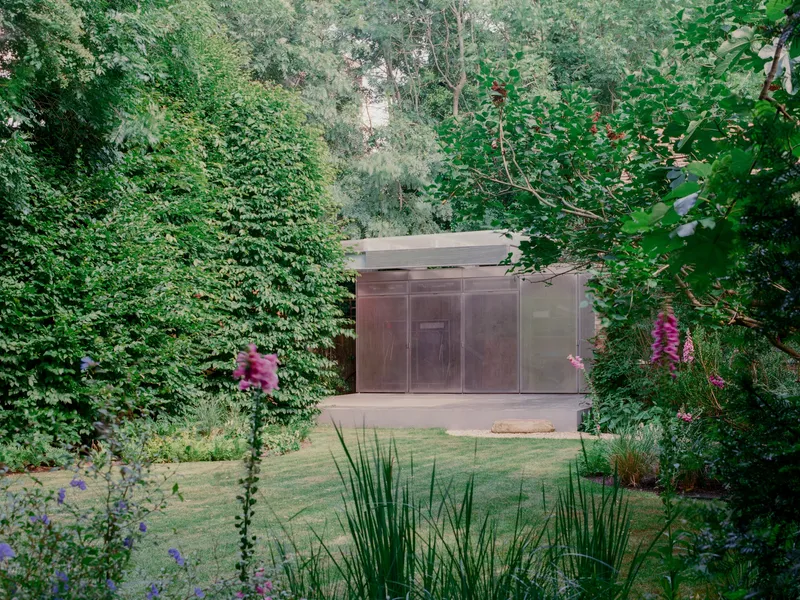
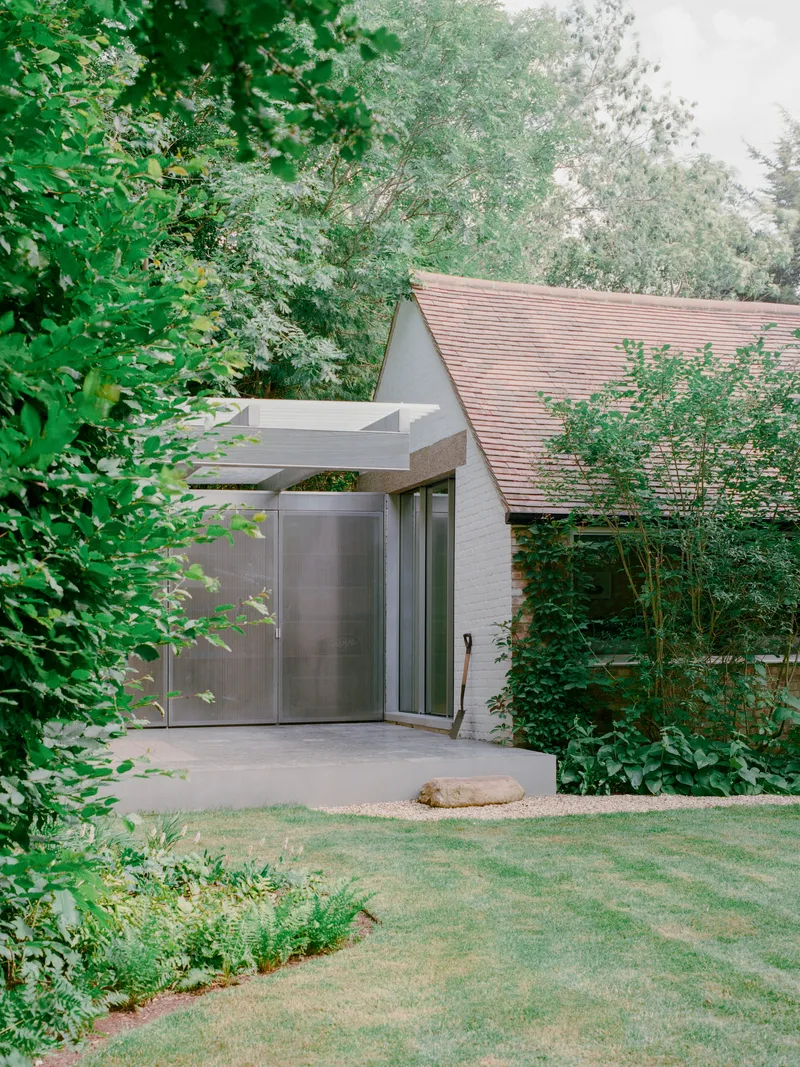
Seen from the garden, the pavilion reads as a cluster of volumes rather than a single building. A translucent metal-clad box sits beside horizontal timber slats; foxgloves and ornamental grasses push up against the facade as if trying to reclaim it. The white brick entry wing with its cantilevered canopy and the original pitched tile roof peek out behind, establishing a dialogue between the Victorian inheritance and the new work.
The landscaping is not incidental. Planting beds, gravel paths, and the striped lawn create a layered approach sequence that softens the building's industrial edges. Rather than sitting on its plot, the pavilion grows from it.
Threshold and Canopy
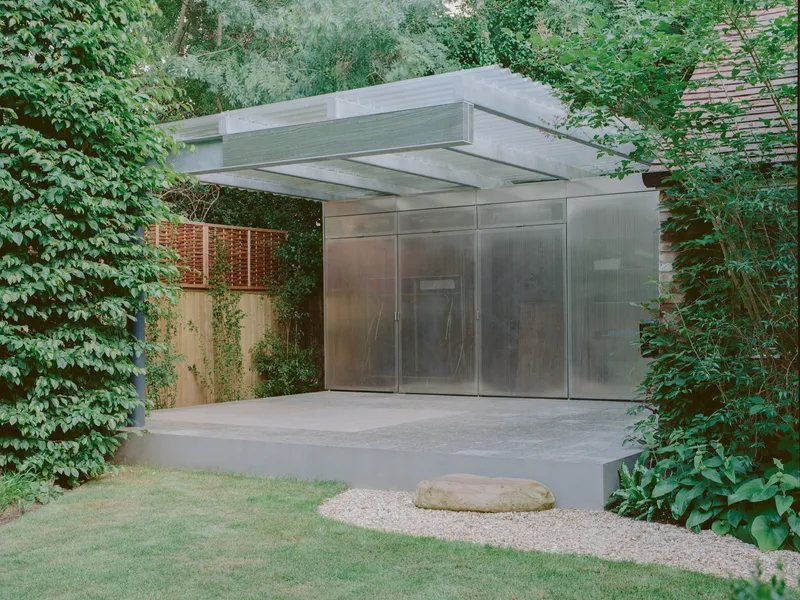
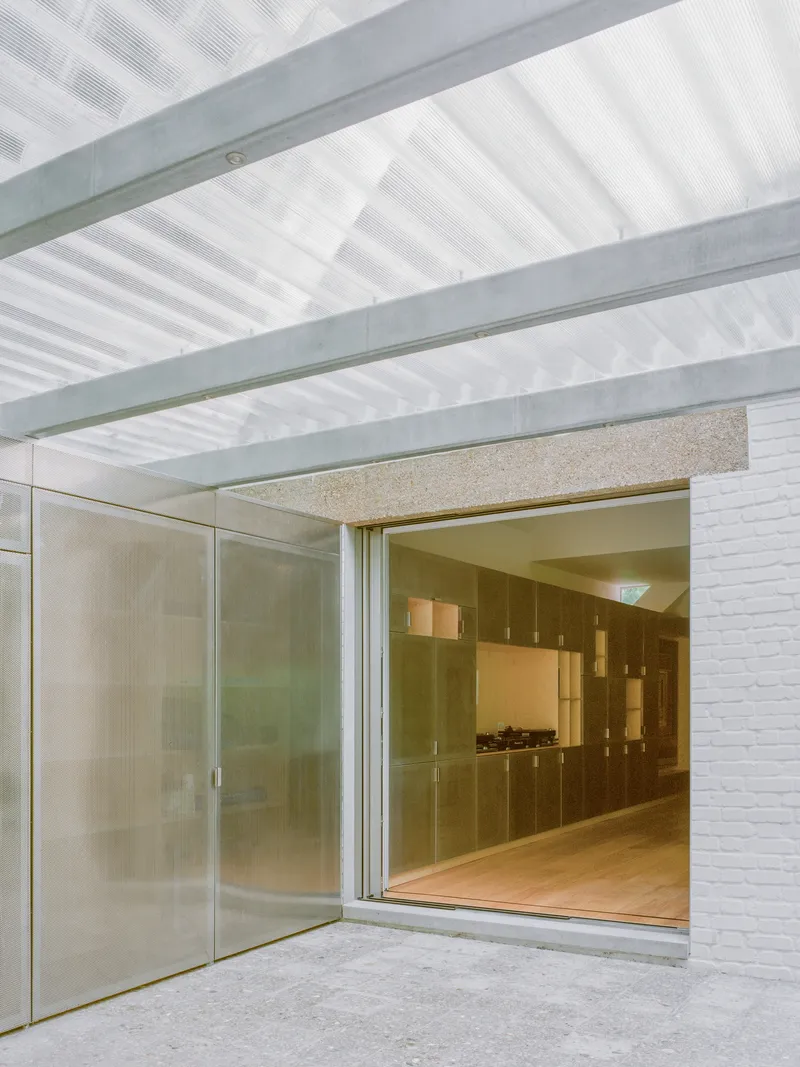
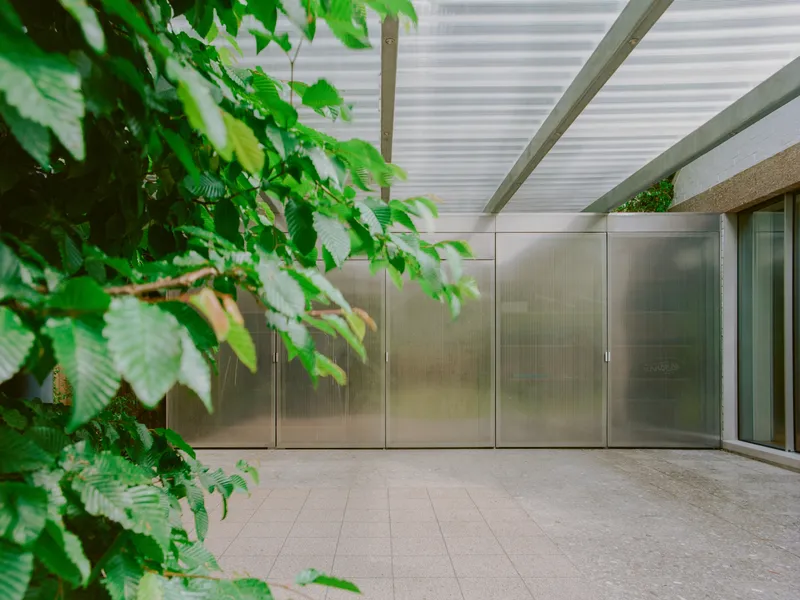
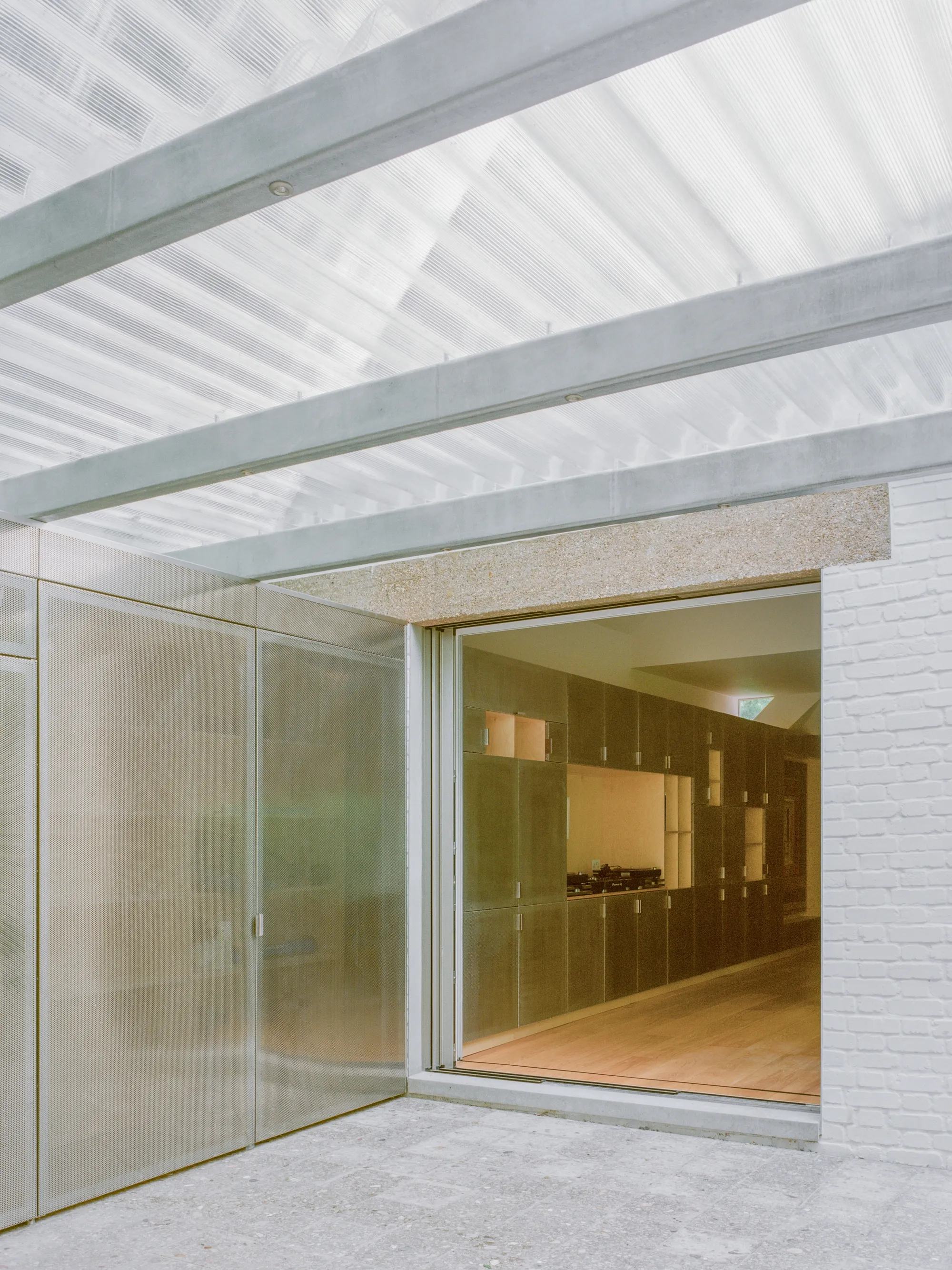
The approach to the pavilion is choreographed with real care. A gravel path leads to a concrete porch, then under a cantilevered canopy of exposed steel beams and corrugated polycarbonate. The ceiling glows with diffused daylight, turning the entry into a luminous compression zone before the interior opens up. A stainless steel cabinet wall along one side gives the threshold a gallery-like precision, its reflective surface bouncing light and greenery back at you.
The covered terrace is generous enough to function as an outdoor room, not merely a passage. A branch overhanging the canopy edge filters light into dappled patterns. It is one of those details that cannot be designed, only invited, and the architects were smart enough to leave room for it.
The Canopy as Structural Proposition
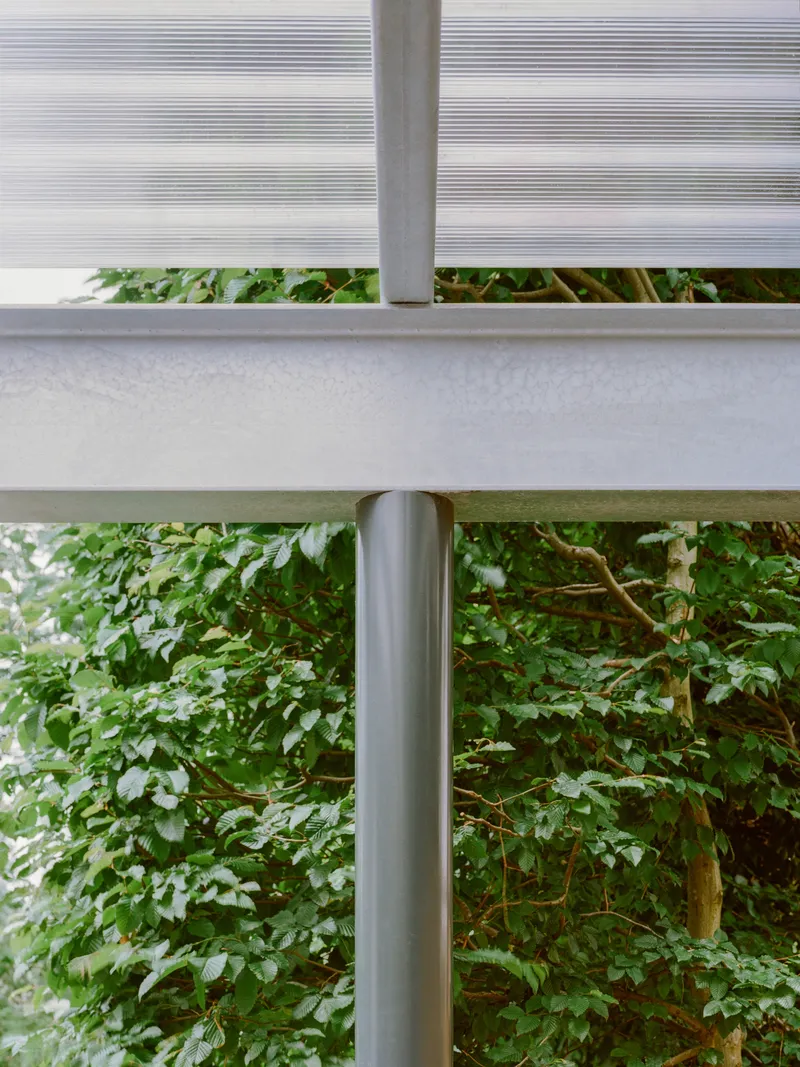
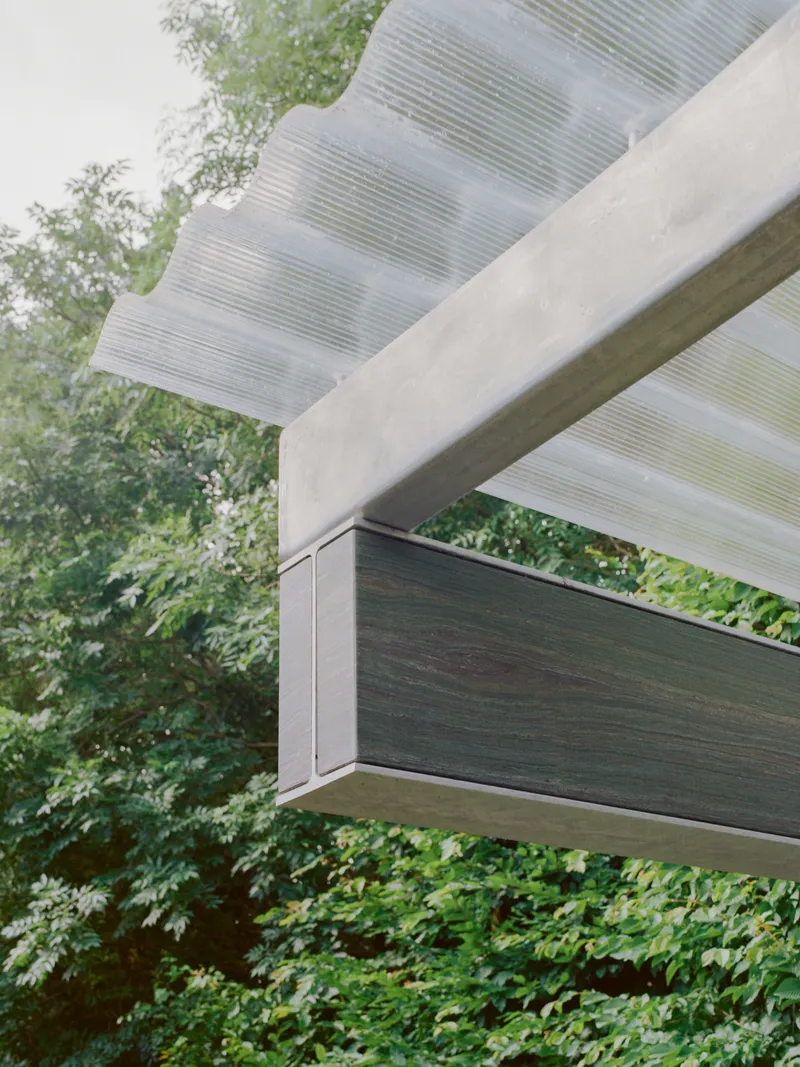
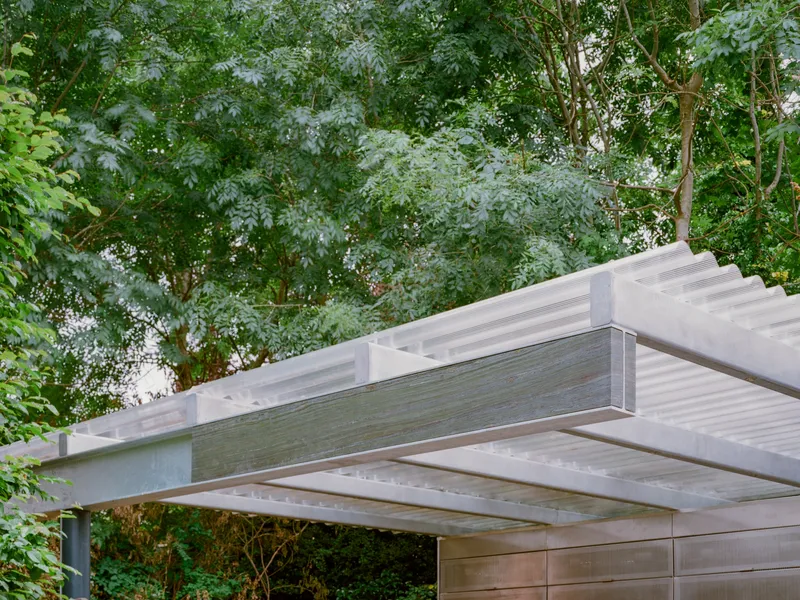
Look closely at the canopy and you begin to appreciate its structural ambition relative to the building's modest size. Ribbed polycarbonate panels span between timber beams and steel columns, creating a roof that is simultaneously sheltering and ethereal. The detail where the canopy meets a concrete beam and steel column above the foliage is particularly refined: each material does a distinct job, and no connection is hidden.
The cantilevered beam corner, with its dark timber fascia wrapping the edge, gives the canopy a graphic sharpness when viewed from below. Surrounded by mature trees, the structure reads almost like a Japanese engawa extended into an English garden. The ribbed soffit catches raking light beautifully, turning the underside of the roof into a surface worth looking at.
Interior and Opening
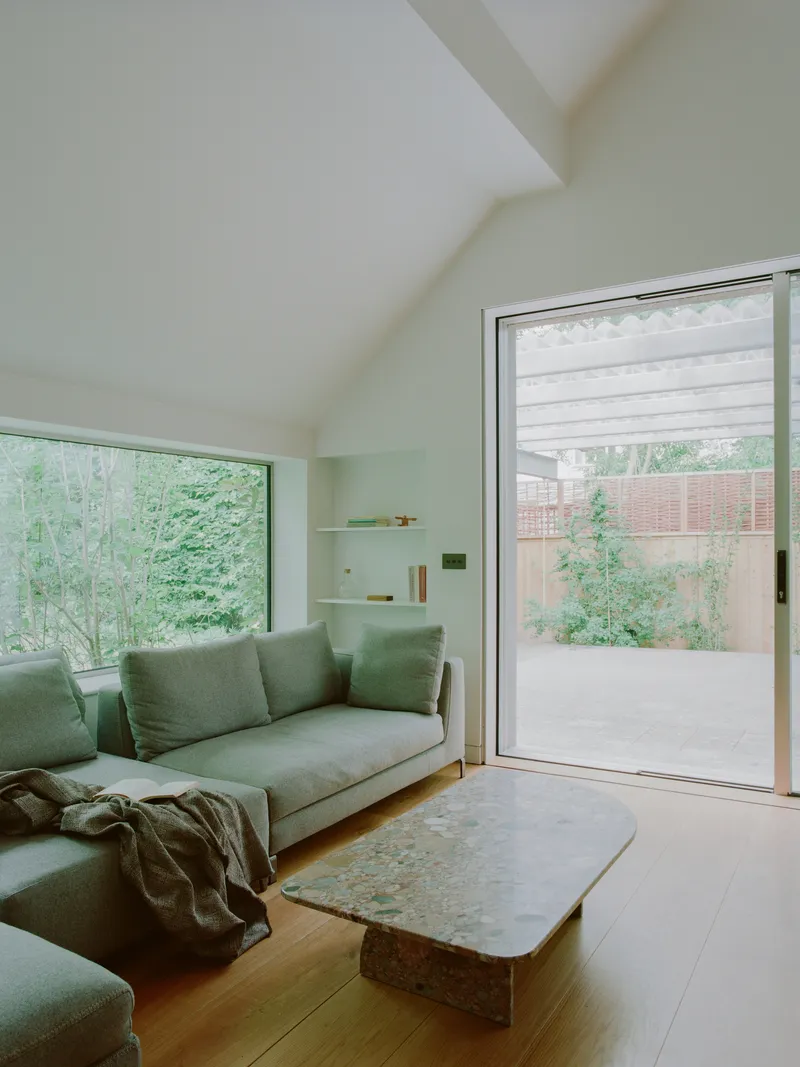
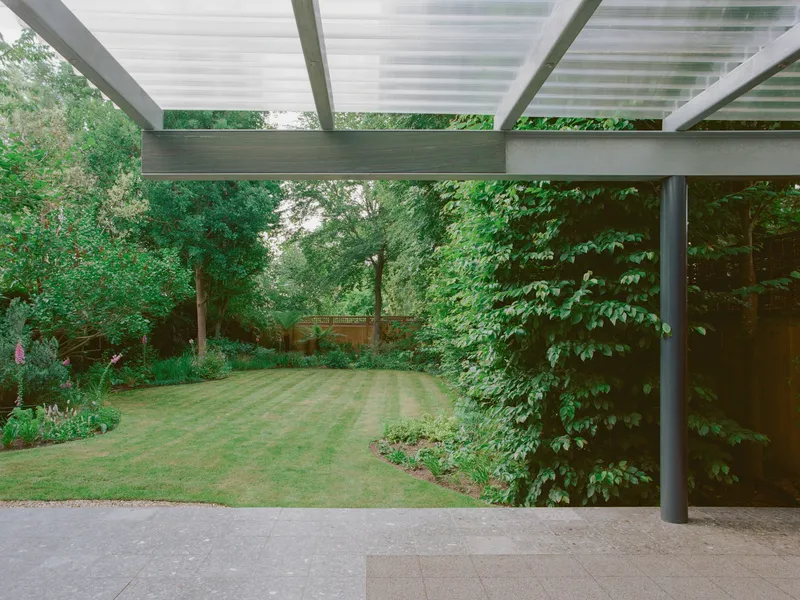
The living room, with its vaulted ceiling and large sliding glass doors, is the spatial payoff. It opens fully onto the concrete terrace and garden, collapsing the boundary between interior and landscape. The vault overhead adds vertical generosity to a room that is otherwise compact, and the proportions feel calibrated to the collector's need for wall space. Art wants calm, uncluttered surfaces, and the room delivers.
Standing beneath the canopy and looking across the striped lawn toward the wooded boundary, you get the sense that the project is less about the building itself than about establishing a series of views. The architecture becomes a frame: for the garden, for the sky, for whatever the collector hangs on the walls.
Terrace and Ground Plane
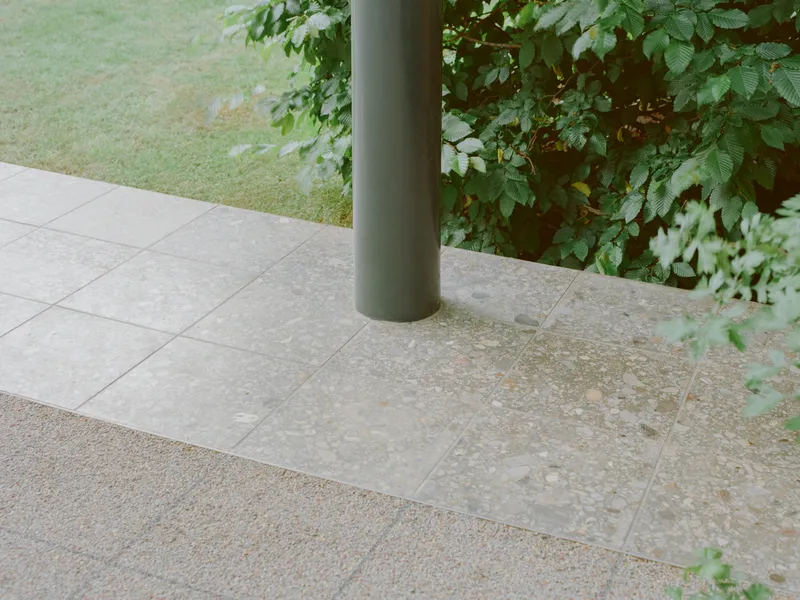
The paved terrace uses large-format stone tiles with a gravel edge bordering the lawn, a simple move that gives the ground plane a sense of order without over-designing it. A cylindrical column punctuates the space, its geometry a deliberate counterpoint to the rectilinear grid of the paving. These are small decisions, but they accumulate into an atmosphere of considered restraint.
Plans and Drawings
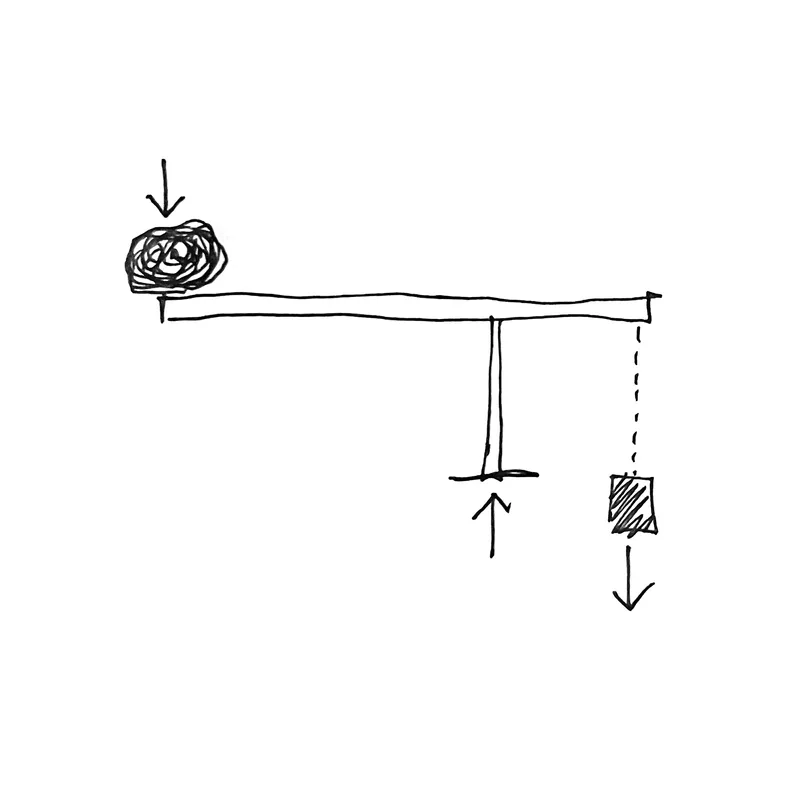
The sketch diagram showing load and counterweight forces on the cantilevered beam is a welcome piece of honesty. It reveals the structural thinking behind what might otherwise look like a purely aesthetic decision. The cantilever is not a gesture; it is an engineered balance of forces, and showing that process respects the reader's intelligence.
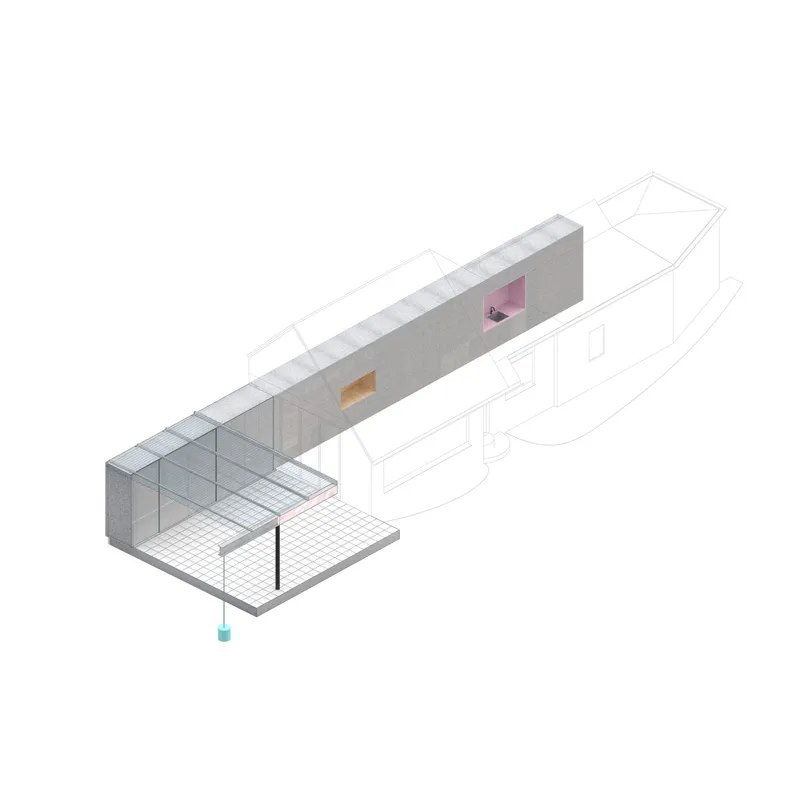
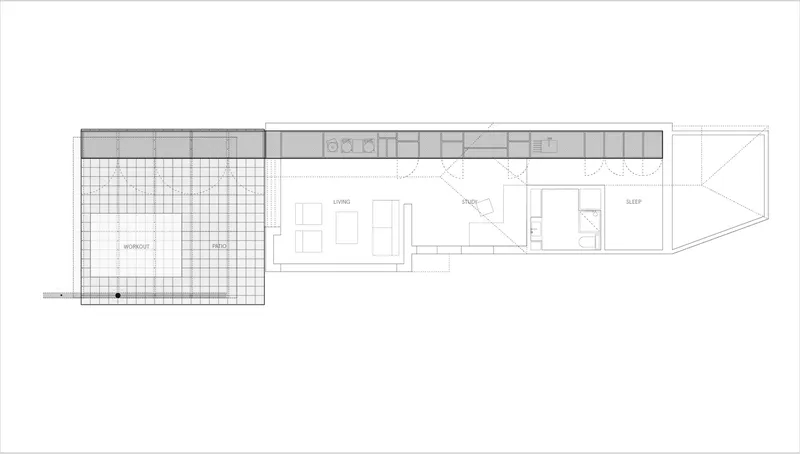
The axonometric and floor plan confirm what the photographs suggest: this is a resolutely linear building organized around a glazed courtyard. The gridded courtyard and tiled floor extending outward blur the line between interior and exterior, while the narrow plan ensures that every room has access to daylight from at least two sides. At 90 m², nothing is wasted.
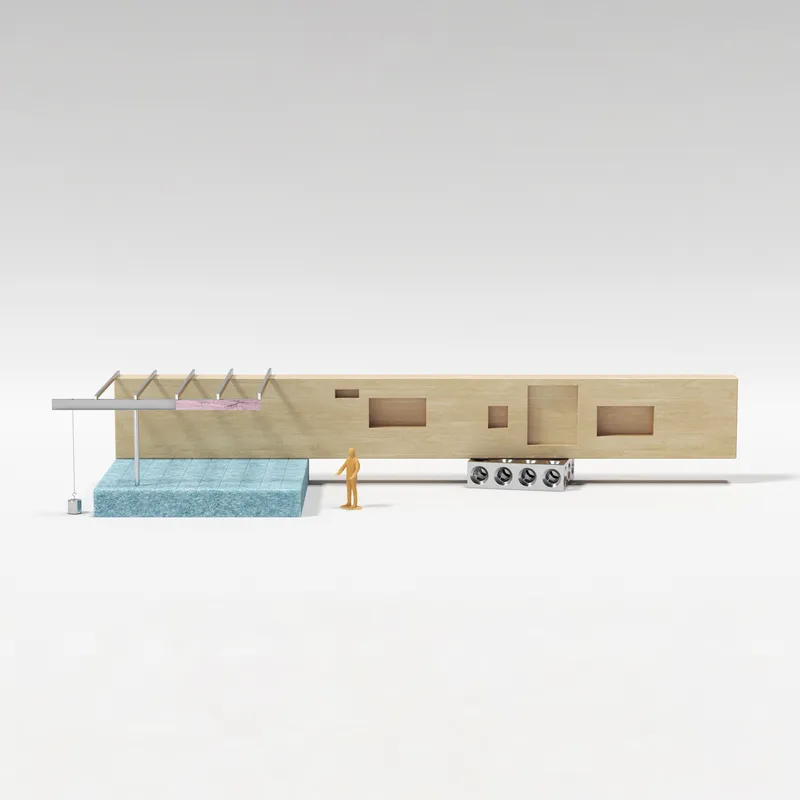
The physical model, with its elongated timber facade, rectangular openings, and cantilevered canopy over a pool, hints at the project's early ambitions. Comparing it to the built result, you can trace a consistent formal language: long horizontal proportions, deep overhangs, and a material palette that favors texture over ornament.
Why This Project Matters
London's residential fabric is full of garden buildings waiting for a second life. The Exeter Road Pavilion offers a model for how to give them one without erasing their history or inflating their ambition beyond what the site can support. Neiheiser Argyros understood that 90 square metres does not need to shout; it needs to be precise. Every material, every connection, every opening earns its place.
More broadly, the project demonstrates that adaptive reuse at the domestic scale can be architecturally rigorous without being fussy. The polycarbonate, the exposed steel, the gravel and concrete are not luxury materials, but they are deployed with a level of care that elevates the whole. For a collector who presumably values the relationship between objects and the spaces that hold them, this building gets the balance right.
Exeter Road Pavilion by Neiheiser Argyros, London, United Kingdom. 90 m². Completed 2025. Photography by Lorenzo Zandri.
About the Studio
Share Your Own Work on uni.xyz
If projects like this are the kind of work you want to make, uni.xyz is a place to publish your own, find collaborators, and enter design competitions.




Popular Articles
Popular articles from the community


Riyadh For All: Intergenerational Urban Design for Active Aging in Rabat
Riyadh For All reimagines urban design in Rabat with intergenerational co-living, adaptive courtyards, and Moroccan cultural exchange today.

Co-Life: Senior Housing Design That Reconnects Older Adults With the City
Co-Life reimagines senior housing design through healing gardens, shared streets, workshops, and a sustainable community across generations.

Lunar Spiral: Space Architecture Shaped by the Mathematics of the Universe
Lunar Spiral reimagines space architecture through Fibonacci geometry, lunar regolith, levitating habitats, and self-sustaining Moon living.

Conexión: Biophilic Design Reimagines High-Rise Living in Hong Kong
Conexión reimagines high-rise living in Hong Kong through biophilic design, green facades, shared spaces, daylight, water and nature within.


Similar Reads
You might also enjoy these articles

Bao Huynh Watercolor Atelier: A Serene Art Retreat in Hội An
Bao Huynh Watercolor Atelier in Hội An blends multifunctional art spaces, sustainable design, local materials, and family-friendly living in a serene environment.

Atelier Macri Concept Store Interior Design by CASE-REAL
Atelier Macri store features a "ko" counter, walnut wood details, cork displays, blending retail, gallery, and seamless customer experiences.

Manuel Vargas Izquierdo Stadium and High-Performance Sports Center: Architectural Excellence in Jalpa de Méndez
The Manuel Vargas Izquierdo Stadium blends sustainable design, inclusive sports facilities, and cultural-inspired architecture, revitalizing Jalpa de Méndez’s public spaces.

KAKR Buluh Awar Hall: Revitalizing Community and Ecology Through Bamboo Architecture
Community built bamboo hall revitalizes Buluh Awar village, empowering youth, restoring ecology, celebrating vernacular craftsmanship through sustainable architecture and culture.


Explore Interior Design Competitions
Discover active competitions in this discipline



Challenge to design a portable theatre


Challenge to design a portable music platform


Challenge to design an open learning module for the elderly


Challenge to design luxury tourism on rails
Comments (0)
Please login or sign up to add comments
No comments yet. Be the first to comment!