

Exit Music: Reimagining Death as Civic Infrastructure in New Delhi
A funerary landscape in Vikram Nagar proposes that remembrance, ritual, and ecology can heal the urban fractures modern cities refuse to confront.


Cities have always hidden their dead. Crematoriums get pushed to the periphery, cemeteries become isolated black spots in the urban fabric, and mourning is treated as something best kept out of sight. Exit Music refuses this bargain. The project proposes a civic-scale funerary landscape in Vikram Nagar, I.T.O., New Delhi, where death is not an endpoint to be concealed but a transformative urban force capable of healing spatial, social, and ecological disjunctions.
Designed by Kabir Sahni, this shortlisted entry in the UnIATA '18 competition operates as a contemporary memento mori for the ordinary citizen. The thesis asks a pointed question: why is architectural commemoration reserved for martyrs and heroes while everyday lives fade anonymously? Through three built volumes organized around a central Light Well, the project embeds funerary architecture directly into the city, offering spaces for reflection, closure, and collective healing across religious and cultural boundaries.
Three Towers and a Shared Ground Plane
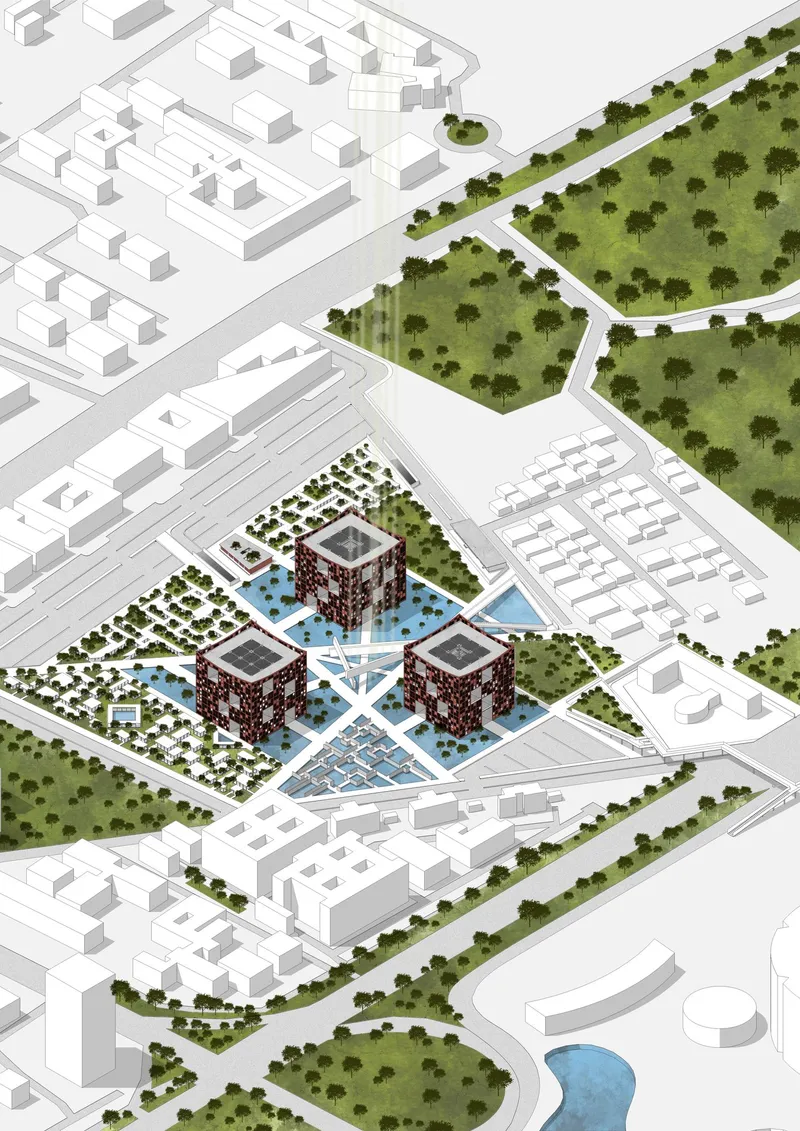
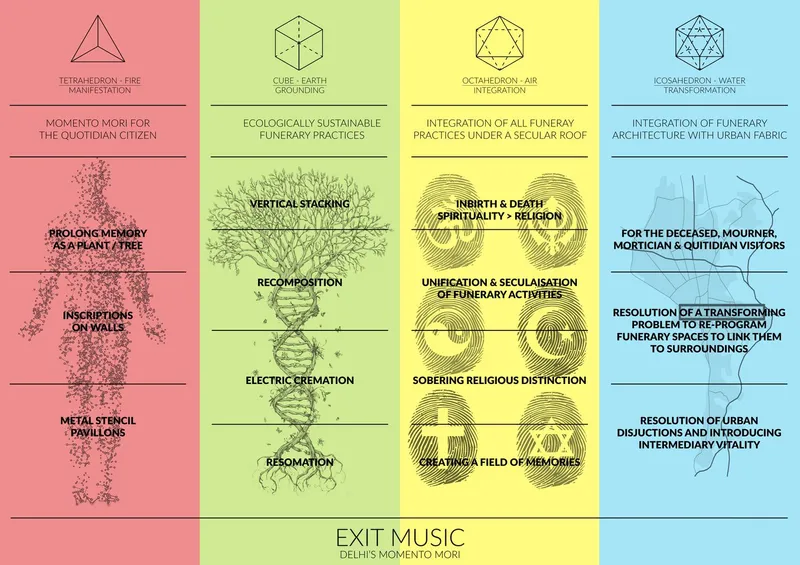
The axonometric rendering reveals the project's core spatial move: three primary tower volumes arranged around diagonal pedestrian pathways, water features, and landscaped green spaces within an existing cemetery precinct. The masterplan negotiates between past, present, and future urban conditions, dissolving the rigid boundary between the funerary realm and everyday city life. Pathways, reflective water bodies, gardens, and transitional thresholds create an intermediary urban landscape that is neither isolated nor intrusive, allowing the living and the dead to coexist within a shared spatial continuum.
The conceptual framework driving this arrangement draws from the spiritual geometries of four primary elements. The tetrahedron (fire) governs manifestation and the inscription of memory. The cube (earth) grounds ecologically sustainable funerary practices like vertical stacking, recomposition, and electric cremation. The octahedron (air) enables the secular unification of diverse funerary rituals under one architectural system. The icosahedron (water) integrates the funerary program with its urban surroundings, using water as both spiritual cleanser and climatic moderator. These are not decorative metaphors; they guide site organization, volumetric form, and circulation.
The Light Well as Ceremonial Axis
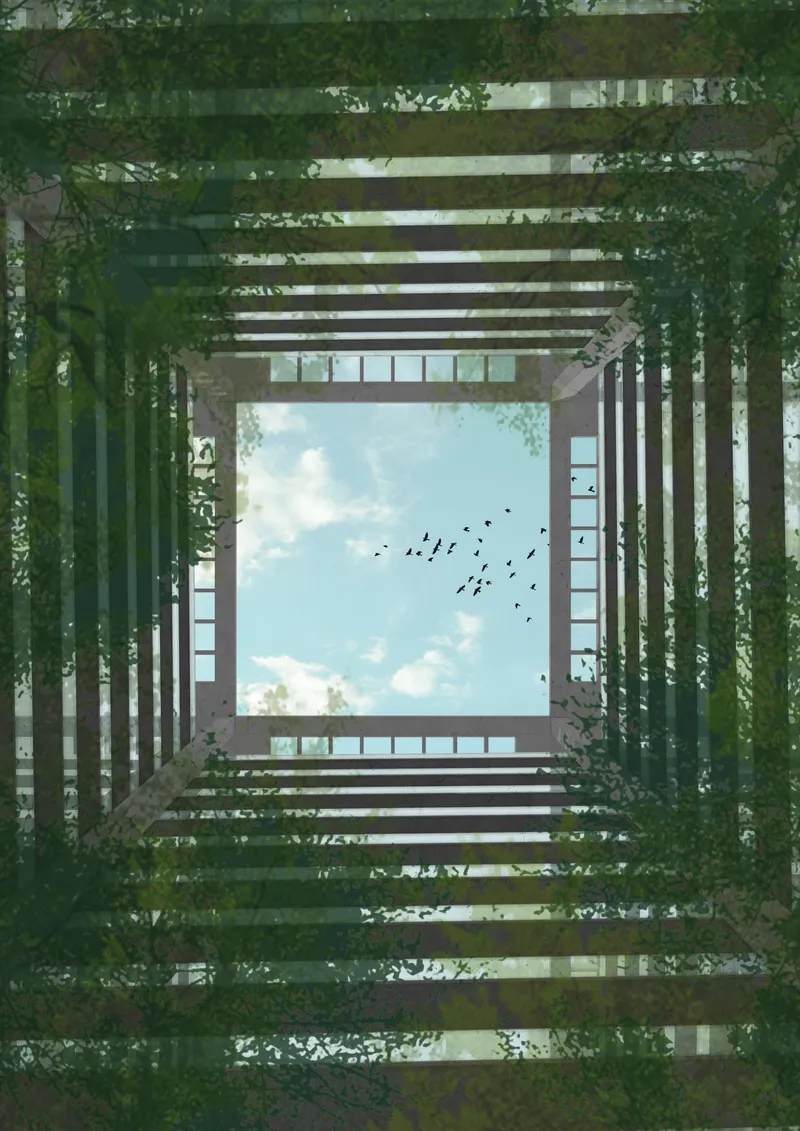
At the heart of the composition lies the Light Well, a vertical void connecting ground and sky that embodies all five classical elements: earth, water, air, fire, and ether. Viewed from below, the square courtyard opening is framed by layered horizontal beams and dense foliage, with birds passing overhead. Intersecting slabs, reflective water bodies, and beams of natural light transform this space into a ceremonial axis. By day, it mediates light, air, and movement. By night, it emits light outward, marking presence rather than absence. The Light Well functions simultaneously as a spiritual anchor and an urban landmark, visible proof that the city has not erased its relationship with mortality.
Programmatic Stacking and the Journey of Mourning
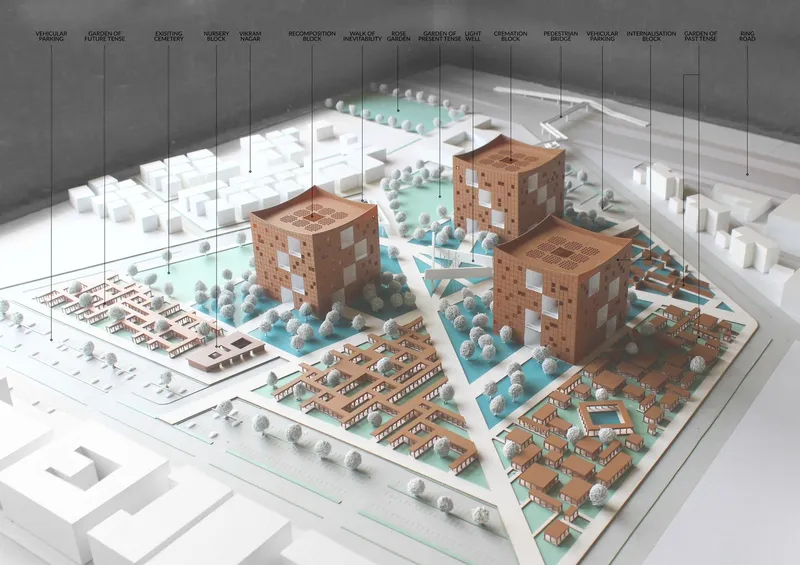
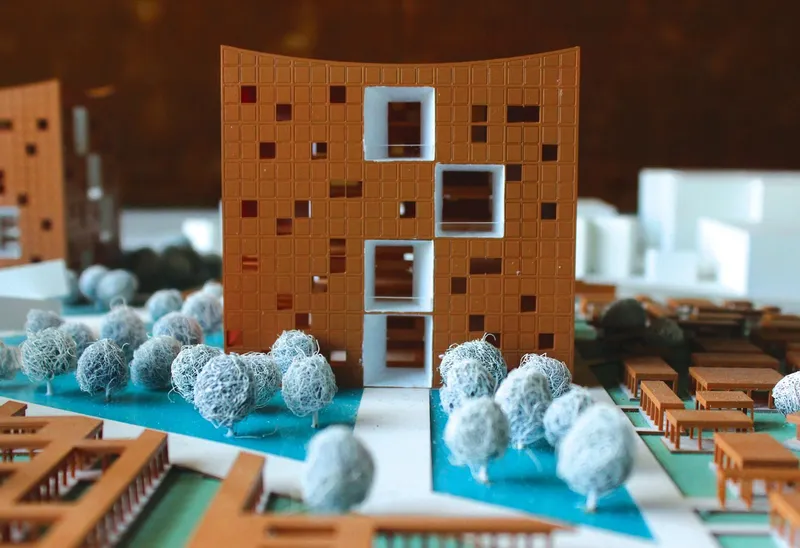
The physical model makes the project's vertical logic legible. Three chequered towers rise above a low-rise precinct organized along diagonal pedestrian routes, with trees and transitional landscapes softening the threshold between public life and private grief. Each block is vertically organized to mirror the emotional arc of mourning: lower levels house arrival, mortuary, cleansing, and registration spaces; middle levels contain ritual halls, faith spaces, cremation chambers, recomposition areas, and resomation facilities; upper levels provide sitting areas and contemplation space.
The facade detail reveals pixelated terracotta panels and stacked white window openings, a material strategy that lends the towers a textured, almost woven quality. The terracotta registers warmth and earthiness while the regular fenestration rhythm suggests an institutional dignity appropriate to the building's civic purpose. The checkerboard patterning at the model scale hints at how this materiality would read at an urban distance: recognizable, distinct from surrounding commercial or residential fabric, yet not monumental in the exclusionary sense.
A Folded Memorial in the Public Plaza
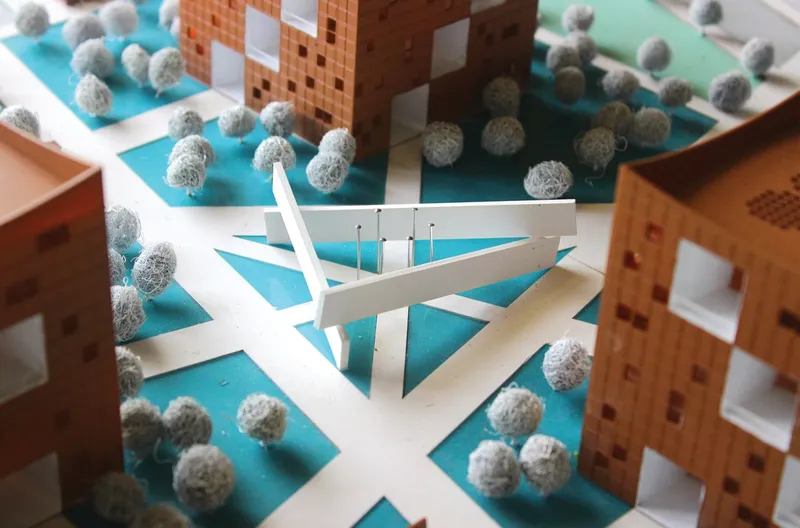
A close-up of the physical model reveals a white folded memorial structure set within the plaza, surrounded by a blue ground plane representing water and textured model trees. This element crystallizes the project's ambition to make remembrance publicly accessible. Placed at ground level rather than behind walls or gates, the memorial invites engagement from passersby, not just those arriving with a body to cremate or a grave to visit. The folded geometry echoes the elemental framework while creating sheltered pockets for individual contemplation within a collective space.
Why This Project Matters
Exit Music is significant because it tackles a genuine architectural blind spot with conceptual rigor and spatial specificity. Death is among the most universal human experiences, yet contemporary urbanism treats its infrastructure as a liability to be minimized and marginalized. By siting a funerary landscape within an existing cemetery precinct at I.T.O. and programming it for secular use across religious traditions, the project directly confronts the fragmentation and intolerance that often define how Indian cities manage death.
What gives the project weight beyond its thesis framing is the clarity of its organizational logic. The elemental geometries are not applied symbolism but genuine spatial generators. The vertical stacking reflects a real emotional sequence. The Light Well is not a gesture but a working environmental and ceremonial device. Kabir Sahni's work suggests that architecture's role in processing death need not be somber retreat or ornamental monumentality. It can be active civic infrastructure, woven into the daily life of a city that, like all cities, will never stop producing the dead.
View the Full Project
About the Designers
Designer: Kabir Sahni
Enter a Design Competition on uni.xyz
uni.xyz runs architecture and design competitions year-round that reward proposals with spatial conviction and real site intelligence.
Project credits: Exit Music, Delhi’s Urban Memento Mori by Kabir Sahni UnIATA ’18 (uni.xyz).




Popular Articles
Popular articles from the community


Hill & Cross Opera: Sculptural Opera House Architecture Shaped by Tallinn’s Landscape and Identity
Hill & Cross Opera reimagines opera house architecture in Tallinn through its sculptural hill, civic plaza, glass wave and a luminous cross.

AL-JANNAH: Sustainable Architecture and Permaculture for Afghan Widows
AL-JANNAH uses sustainable architecture and permaculture to create resilient oasis of housing, learning, work and renewal for Afghan widows.

Co-Life: Senior Housing Design That Reconnects Older Adults With the City
Co-Life reimagines senior housing design through healing gardens, shared streets, workshops, and a sustainable community across generations.

The Ocean Hive: Sustainable Architecture for a Self-Sufficient Civilization at Sea
The Ocean Hive imagines sustainable architecture at sea, where modular habitats, algae, wave power and ocean waste sustain a growing colony.

Similar Reads
You might also enjoy these articles

The Musturak Paradise: Senior Living Architecture for a Connected Future in Temara, Morocco
The Musturak Paradise reimagines senior living architecture in Temara via private homes, social spaces, culture, community, and shared care.

The Leaf Center: Cultural Center Architecture for Social Integration in Amsterdam
Cultural center architecture becomes a bridge at The Leaf Center, connecting international students with Amsterdam through art and exchange.

Conexión: Biophilic Design Reimagines High-Rise Living in Hong Kong
Conexión reimagines high-rise living in Hong Kong through biophilic design, green facades, shared spaces, daylight, water and nature within.

Wander to Wonder: Modular Playground Design for Children in Kutupalong Refugee Camp
Wander to Wonder uses modular playground design to create flexible, imaginative play spaces for children in Kutupalong refugee camp.
Explore Funerary Architecture Competitions
Discover active competitions in this discipline



Challenge to reimagine the Iron Throne


Photograph architecture without architects


Illustrate the lost glory of Angkor Wat - Render Challenge


Design challenge to reuse E-waste
Comments (0)
Please login or sign up to add comments
No comments yet. Be the first to comment!