
Explore the Carbon-Capturing Power of Trees with Walkable Data Visualization
Step into a Forest of Information and Discover the Environmental Benefits of Trees


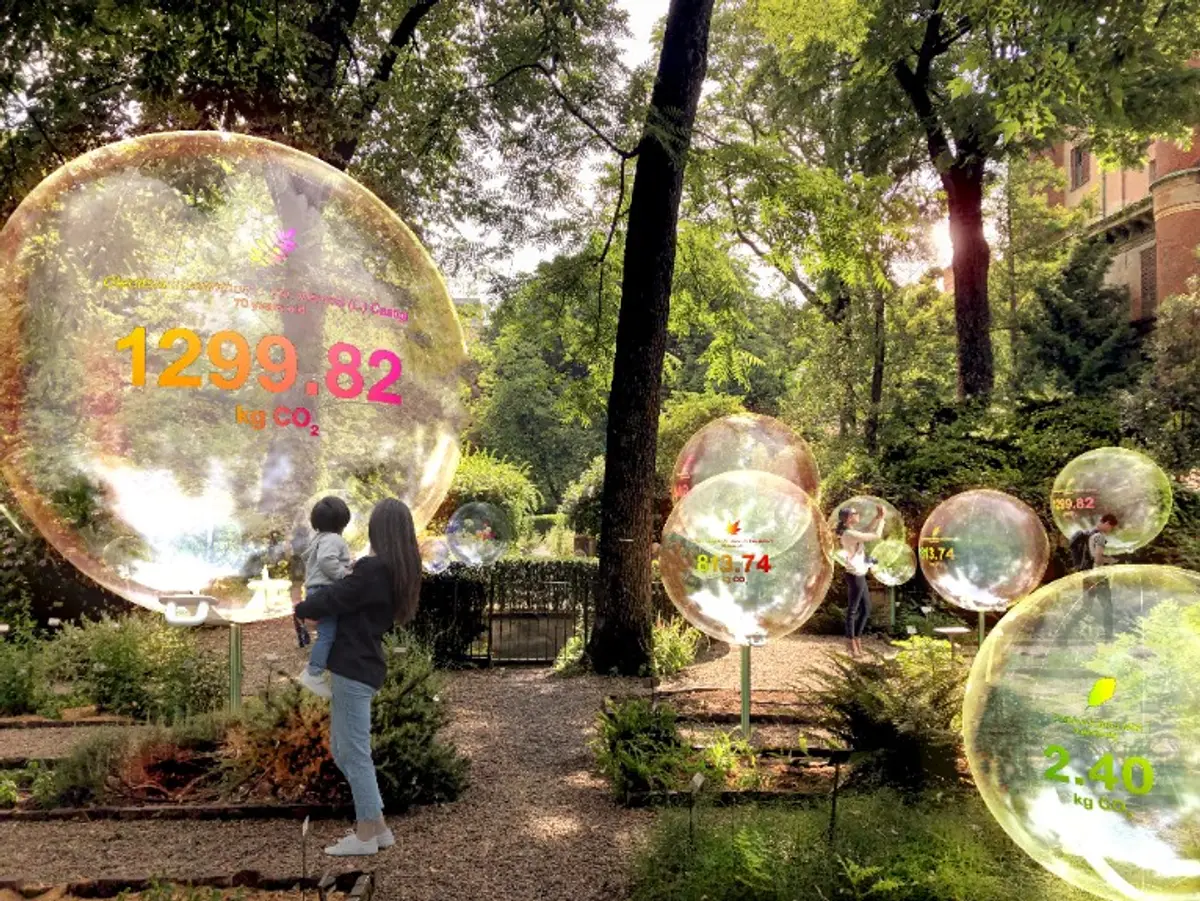
Eni, the energy company, and Carlo Ratti Associati, an international design and innovation office, have unveiled “Natural Capital,” a project that showcases the important role that trees play in producing oxygen. The installation, located in Milan’s Brera Botanical Garden, is one of the largest data visualizations ever produced. The aim is to highlight how much CO2 each individual tree species can capture and store, emphasising the importance of promoting forestry protection rather than deforestation. The project opened to the public during the Milan Design Week 2021 as part of INTERNI’s “Creative Connections” exhibition, from 4 to 12 September 2021.
The installation covers a 500-square-metre garden and comprises a series of floating bubbles of varying sizes that are nestled amongst the vegetation. Each bubble represents the amount of carbon dioxide that the corresponding trees can capture and store during their lifecycle. At the entrance to the garden is a giant sphere that represents the amount of CO2 produced on average by the human body each year. The contrast between the sphere and the floating bubbles suspended among the branches highlights the fundamental role that plants play in guaranteeing the planet's health and limiting global warming.
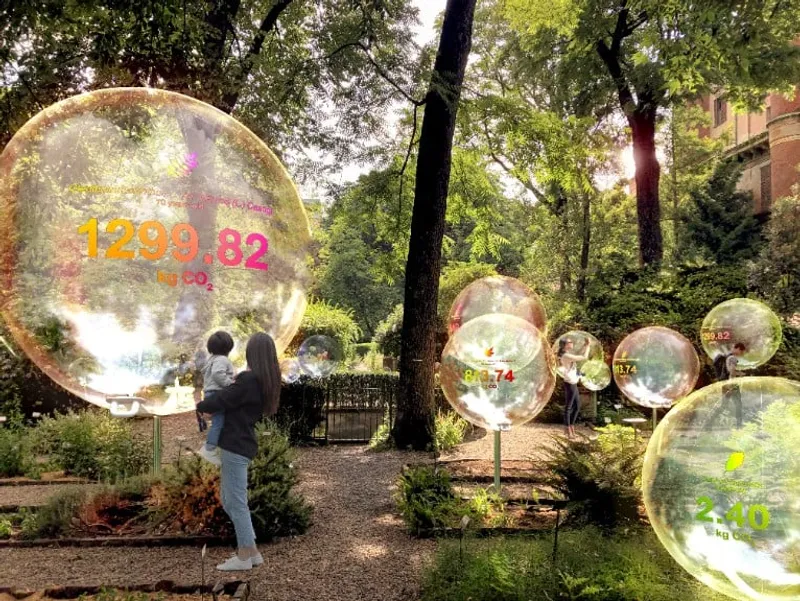
The design of “Natural Capital” experiments with a new medium, turning data visualization into a tangible, spatial experience. This project brings the natural and artificial worlds closer together, highlighting the symbiosis between humans and nature. Professor Carlo Ratti, founding partner at CRA and professor at the Massachusetts Institute of Technology, explains: “We are all aware of the positive role that plants and forests play in absorbing CO2. But how can we better elucidate this connection?”
The ecosystem services have been estimated by professor Alessio Fini of the Department of Agricultural and Environmental Sciences at the University of Milan. The calculations were based on data from previous research projects, including QUALIVIVA, funded by Mipaaf, SmartUrban, funded by Regione Toscana, and LIFE URBANGREEN, funded by the EU. Fini's team calculated ecosystem services from dozens of species growing in Milan’s Orto Botanico. Estimated ecosystem services included the amount of CO2 sequestered annually by plants, as well as the total amount of CO2 stored by each plant over its whole lifespan. For example, the persimmon (Diospyros kaki) in the Orto Botanico stores about 1400 kg CO2 as woody biomass and can sequester about 61 kg CO2 per year, while the bog pine (Pinus mugo) sequesters less than 1 kg CO2 per year.
Eni's commitment to protecting and conserving forests is one of the pillars of its decarbonisation strategy towards a sustainable world. Several initiatives led by the company follow the UN-designed REDD+ (Reducing Emissions from Deforestation and forest Degradation) scheme, supporting the development of local communities by promoting economic and social activities. “Natural Capital” advances the ongoing collaboration between CRA and Eni, whose objective is to explore new circular economy and sustainability paradigms.
“Natural Capital” follows other projects between CRA and Eni, including the prize-winning Circular Garden at Milan Design Week 2019, produced in collaboration with INTERNI. This project used one kilometre of mushroom mycelium as a recyclable building material to form a series of catenary arches interspersed among vegetation. In the same year, CRA and Eni presented Feel the Peel, a prototype of an orange squeezing machine that makes 3D-printed bioplastic drinking cups out of orange peels.
The importance of “Natural Capital” lies in its ability to connect the public with the natural world, while emphasising the importance of protecting and preserving forests. The installation provides a spatial experience.
CREDITS
Natural Capital
A project by CRA-Carlo Ratti Associati for Eni
Part of “INTERNI Creative Connections” exhibition
Creative Lead: Italo Rota
Scientific research: Alessio Fini (Università di Milano). Results have been obtained from projects SmartUrban, Qualiviva, and LIFE URBANGREEN
CRA Team: Carlo Ratti, Antonio Atripaldi (Project Manager), Saverio Panata, Luca Giacolini, Chiara Borghi, Matteo Zerbi, Nicola Scaramuzza, Serena Giardina, Alessandro Tassinari, Aurora Maggio, Irem Ceri, Oliver Kazimir
Renderings by CRA graphic team: Gary di Silvio, Pasquale Milieri, Gianluca Zimbardi
Where: Brera Botanical Garden of the University of Milan, Italy


Popular Articles
Popular articles from the community


The Amber Palace Opera: A Geological Fiction Surfaces on Tallinn's Baltic Waterfront
Pierre Brillard reimagines a Baltic legend as a public landscape, opera house, and waterfront promenade rooted in Tallinn's coastal identity.


LT2A and OPEN Architectes Thread a Brick and Glass High School Through a Wooded Belgian Campus
In Braine-l'Alleud, a 3,000 m² wing for Collège Cardinal Mercier pairs pale brick with a glazed colonnade, deferring to a small chapel and a dense wood.

Aquadapt: An Underwater Habitat That Rewrites Its Rooms by the Hour
Curved modules ring the seabed while one shell shifts from breakfast room to cinema, farm and football pitch as residents' needs change.

ETEH Reworks the Shared Spaces of São Domingos School in Brazil Around Timber, Color and Hanging Plants
At São Domingos School in Brazil, 436 m² of hall, refectory and library are recast with timber joinery, a yellow and blue code and trailing greenery.

Similar Reads
You might also enjoy these articles

Rede Arquitetos Turns Circulation into Civic Space at the Educar II SESC School in Fortaleza
In Fortaleza, Brazil, Educar II SESC-CE trades a signature form for mesh screens, yellow thresholds and courtyard walkways built for equatorial heat.
116 Rokeby Building, Collingwood
Sustainable Collingwood office building featuring double-skin façade, natural ventilation, rooftop amenities, and carbon-neutral design focused on wellbeing and longevity.
Contemporary Apartment Renovation in Spain: RV House by BIAN Opens Up to the Sea
A minimalist 1930s apartment in Santander is transformed into a flexible, sea-facing home through contemporary Spanish renovation.
3 Marías House: A Contemporary Mediterranean Courtyard Retreat by Bajet Giramé + Burckhardt
Mediterranean courtyard home blending traditional architecture with modern design, terracotta flooring, flexible interiors, sustainable climate strategies, and garden integration.

Explore Vertical Forest Competitions
Discover active competitions in this discipline


Challenge to reimagine the Iron Throne

Photograph architecture without architects

Illustrate the lost glory of Angkor Wat - Render Challenge

Design challenge to reuse E-waste
Comments (0)
Please login or sign up to add comments
No comments yet. Be the first to comment!