
Fabric Reimagines the Gold Miner's Hut as a 46 m² Retreat in New Zealand's Subtropical Bush
Perched on deep piles in the corrosive coastal forest of Punakaiki, a CLT cabin channels mining heritage through a modern skylit form.


The West Coast of New Zealand's South Island is a place that resists polite architecture. Sea spray corrodes metal within seasons, subtropical bush reclaims clearings in months, and the ground under the forest canopy is rarely flat or stable. When Fabric, led by Mitchell Coll, set out to build a 46 m² short-stay cabin near Punakaiki, the constraints were less about program and more about survival: how does a building sit lightly on difficult terrain, hold up against a corrosive atmosphere, and still feel like a deliberate, warm place to spend a night?
The answer turns out to be part historical homage, part engineering puzzle. Biv Punakaiki takes its formal cues from the chimneys of gold miners' huts that once dotted this coast, extruding the chimney profile into a steep-pitched, skylit volume clad in aluminum. The cabin is the first in a planned series of accommodation structures, and it reads as a proof of concept for how prefabricated cross-laminated timber, bored concrete piles, and careful passive design can produce something genuinely hospitable in one of the country's least forgiving climates.
A Chimney in the Canopy
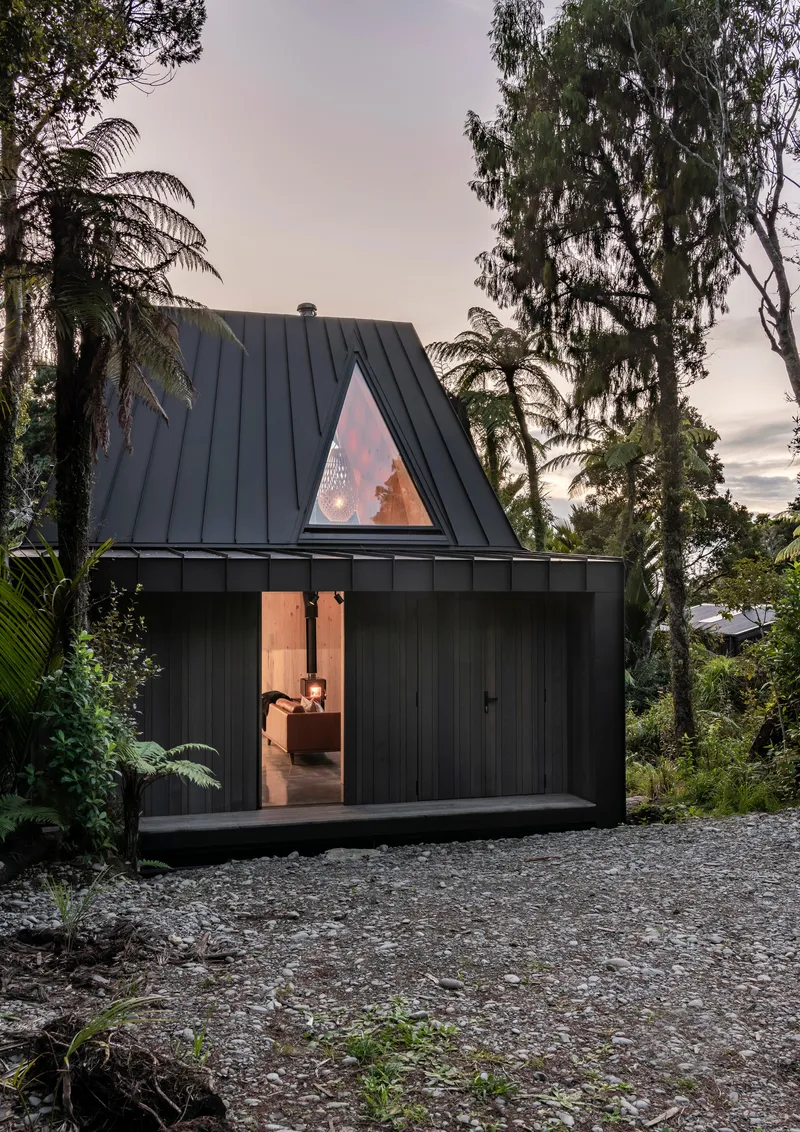
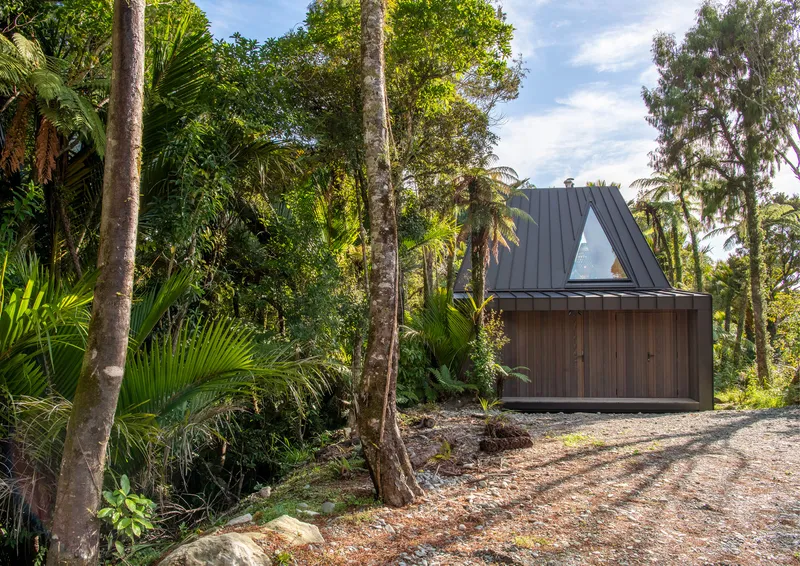
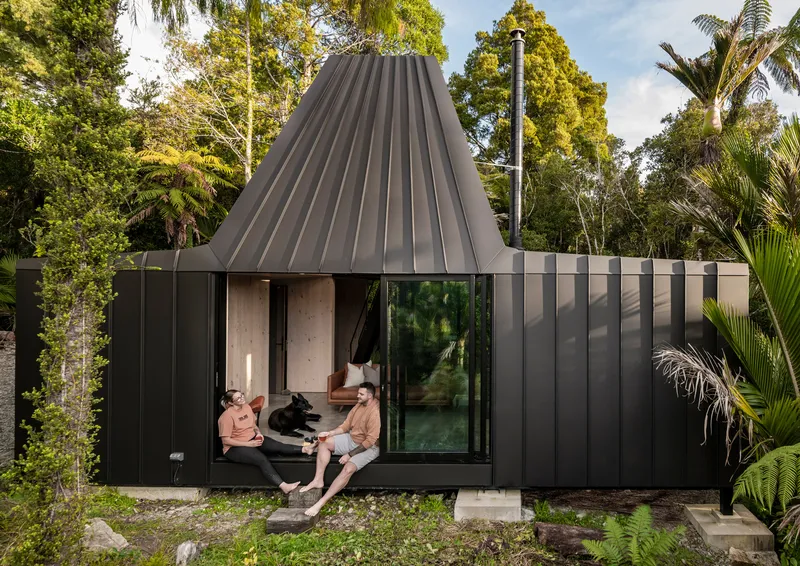
The building's silhouette is its most arresting quality. A steep-pitched black metal roof rises to a narrow peak, punctuated by a triangular window that glows at dusk like the top of a smokestack. The form is a direct reinterpretation of the chimney profiles found on historic miners' huts scattered along the coast. Fabric took this single motif and turned it into the organizing geometry of the entire cabin, producing a section that is simultaneously compact at the floor and expansive at the ceiling.
Seen through the palms and subtropical canopy, the cabin registers as a dark, faceted object, more mineral than botanical. The aluminum cladding was custom folded to follow the building's angular form with minimal visible joints, reinforcing the sense of a single monolithic shape rather than a collection of panels. It is corrugion-resistant by necessity; the nearby ocean ensures that anything less would degrade quickly.
Timber Within, Steel Beneath
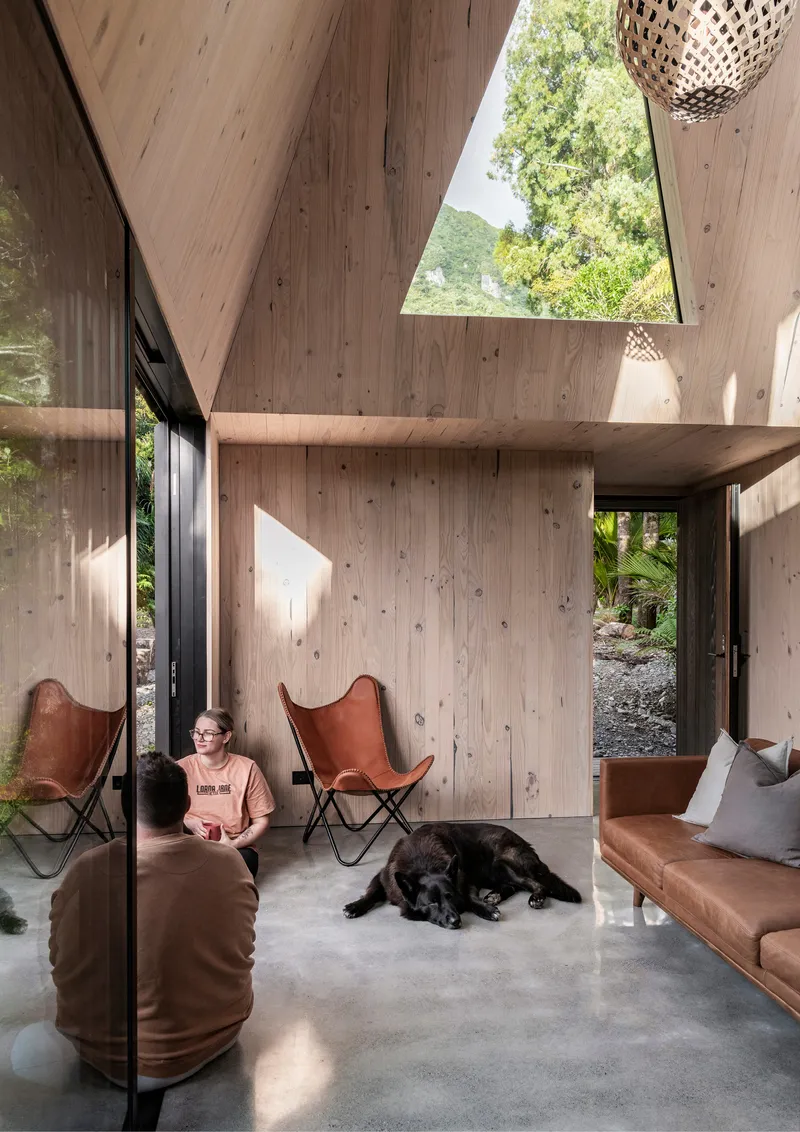
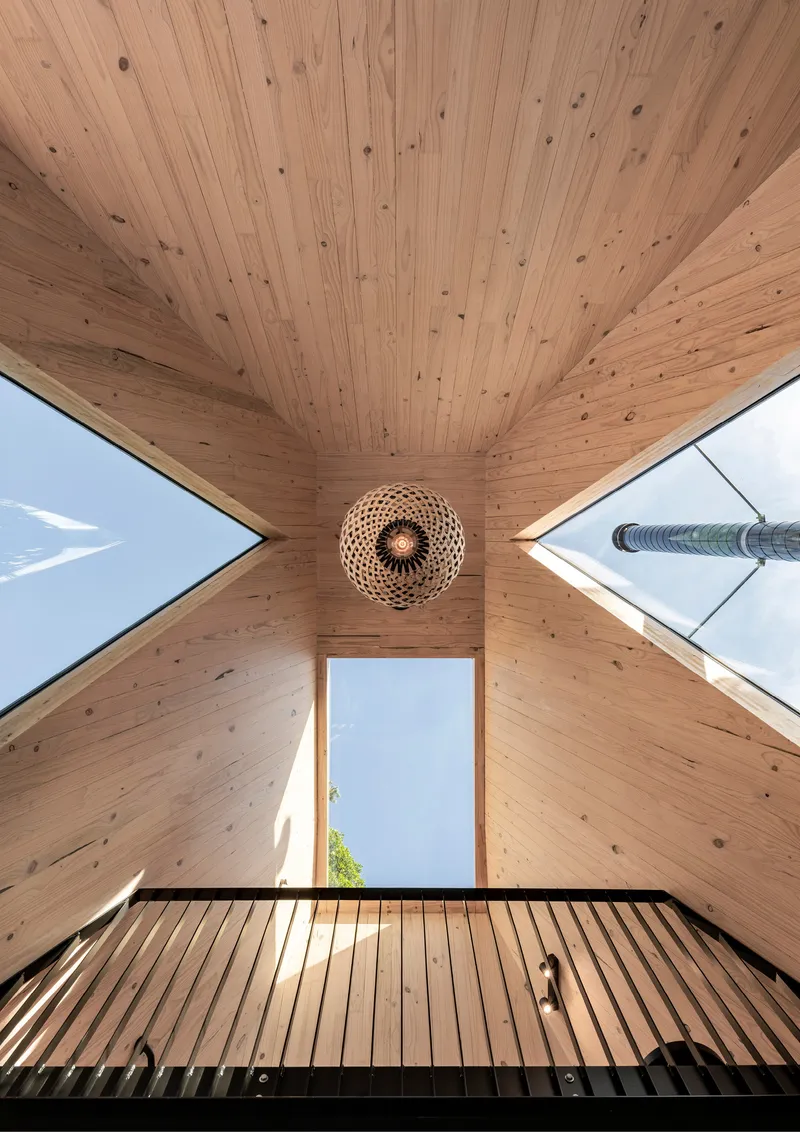
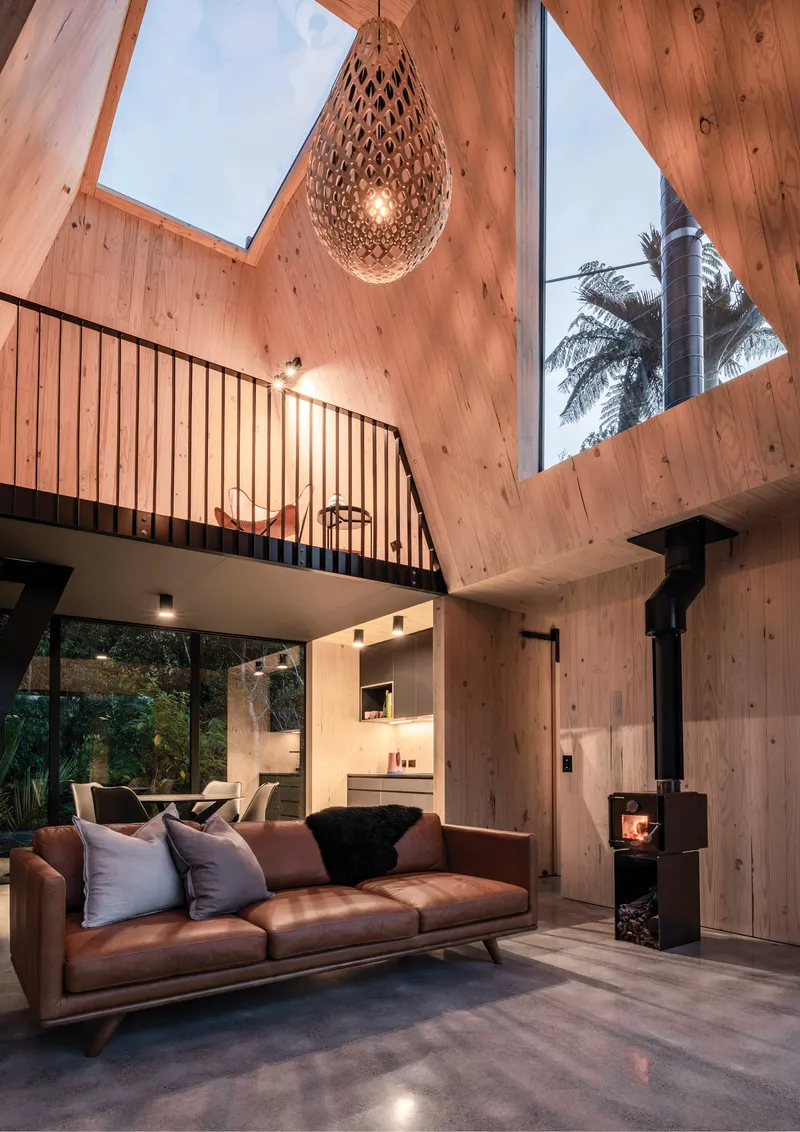
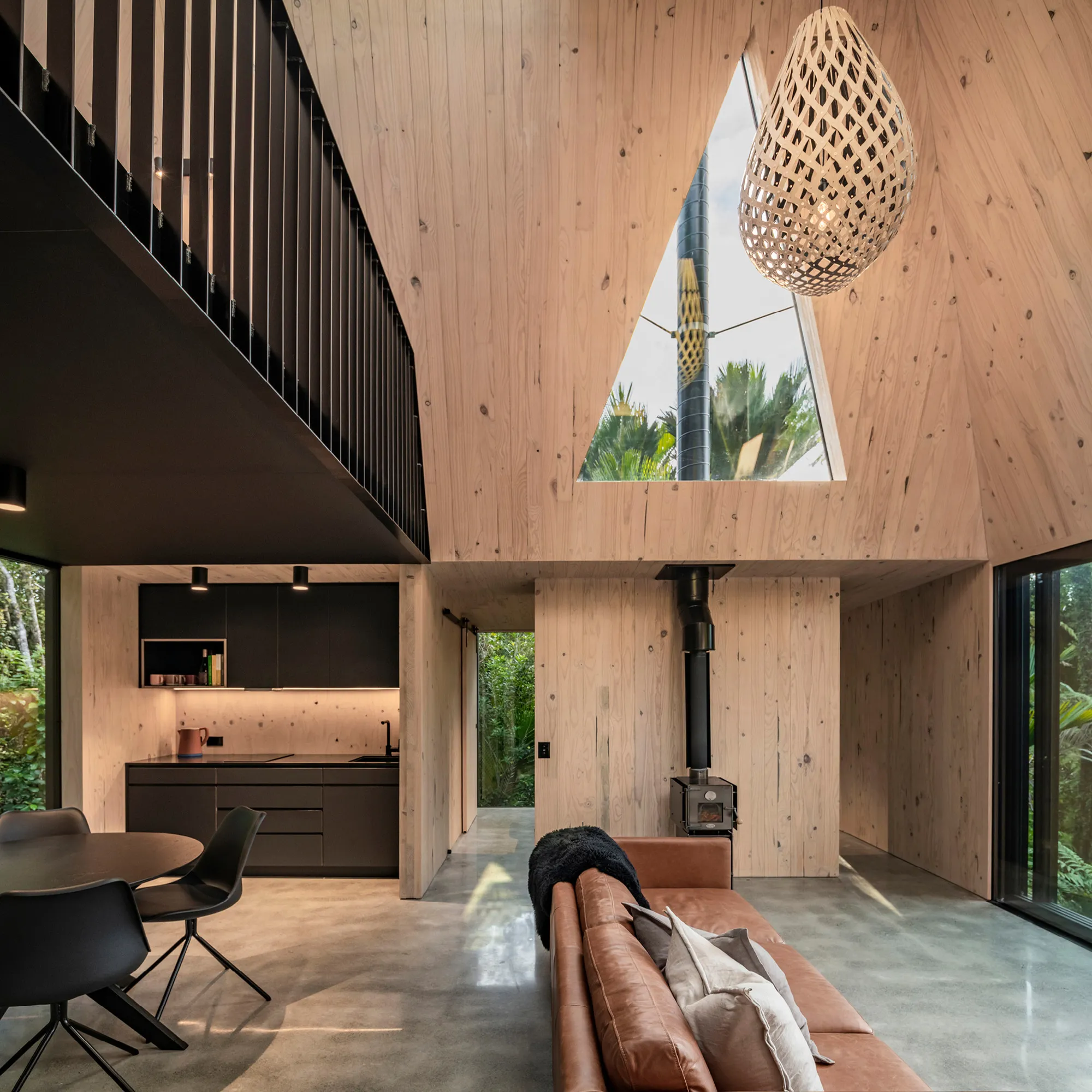
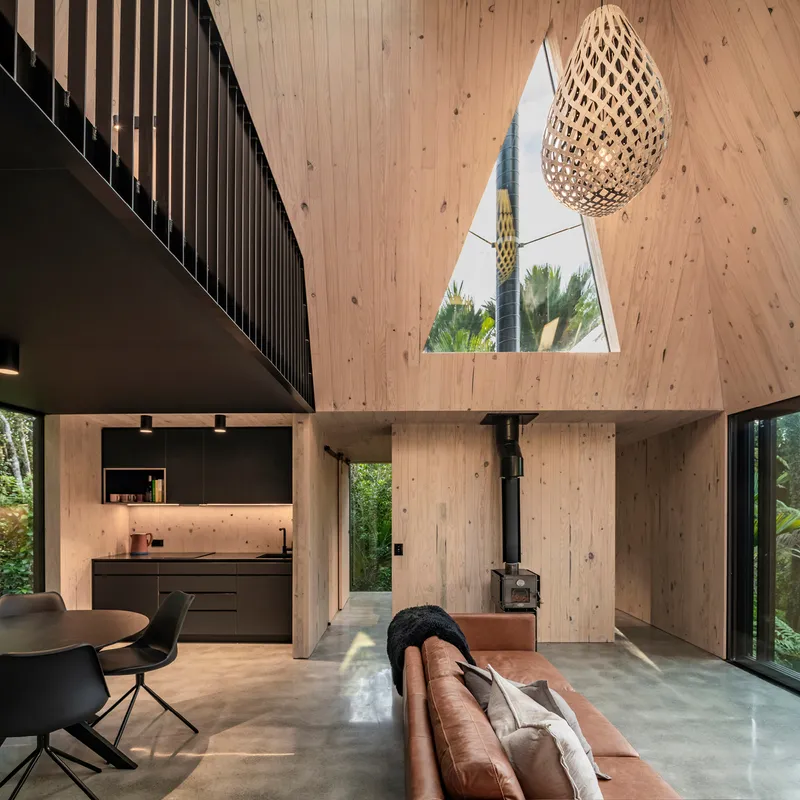
Step inside and the entire palette inverts. Where the exterior is dark metal, the interior is warm timber from floor to peak. Cross-laminated timber panels form both the wall and roof structure, left exposed to create continuous plywood surfaces that amplify the peaked geometry into something almost chapel-like. The triangular skylights pull light deep into the double-height volume, and at the apex a woven pendant hangs like a lantern, reinforcing the vertical reading of the space.
The CLT was chosen for three reasons: it could be prefabricated off-site and trucked into a location with difficult access, it provides excellent thermal performance without additional insulation layers, and it carries negative embodied carbon. Most of the structural connections had to be concealed within the timber to maintain the minimalist detailing, meaning bespoke joinery was developed for nearly every junction. Below, the polished concrete floor sits on a grid of steel beams and steel posts, which land on 5-meter-deep bored concrete piles. The whole building is elevated above the sloping ground, minimizing its footprint on a challenging, shifting site.
The Mezzanine and the Vertical Section
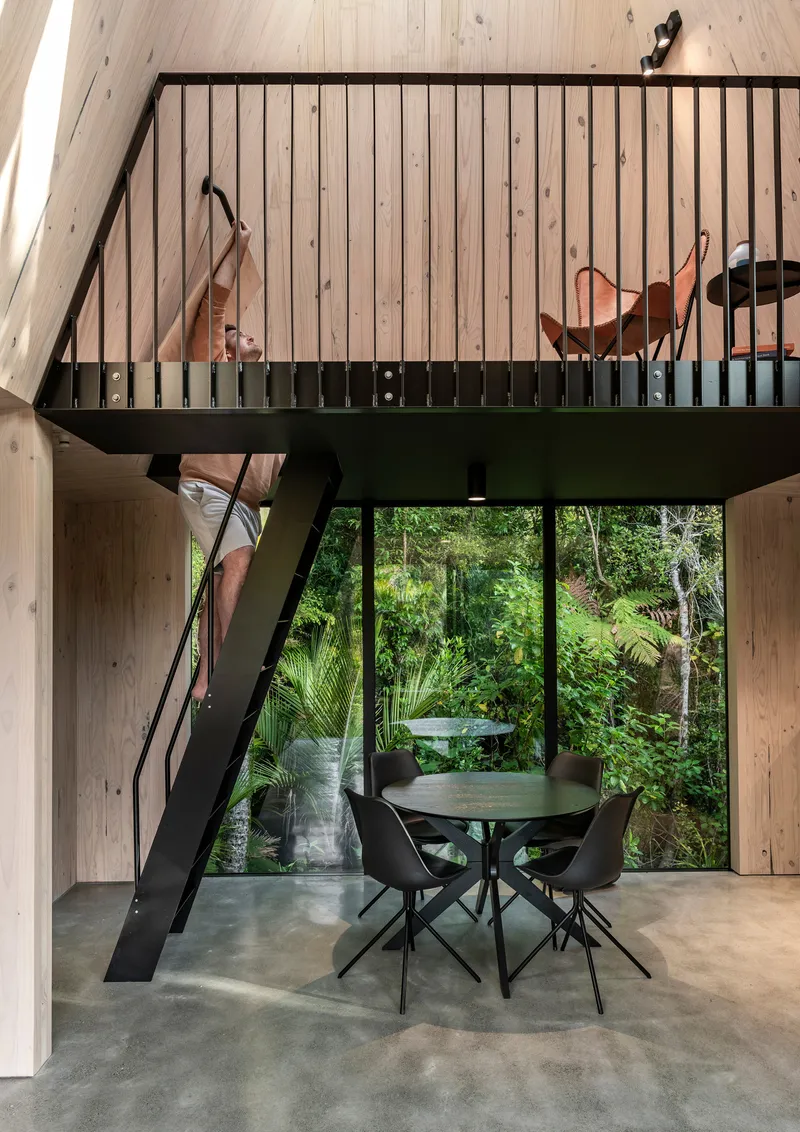
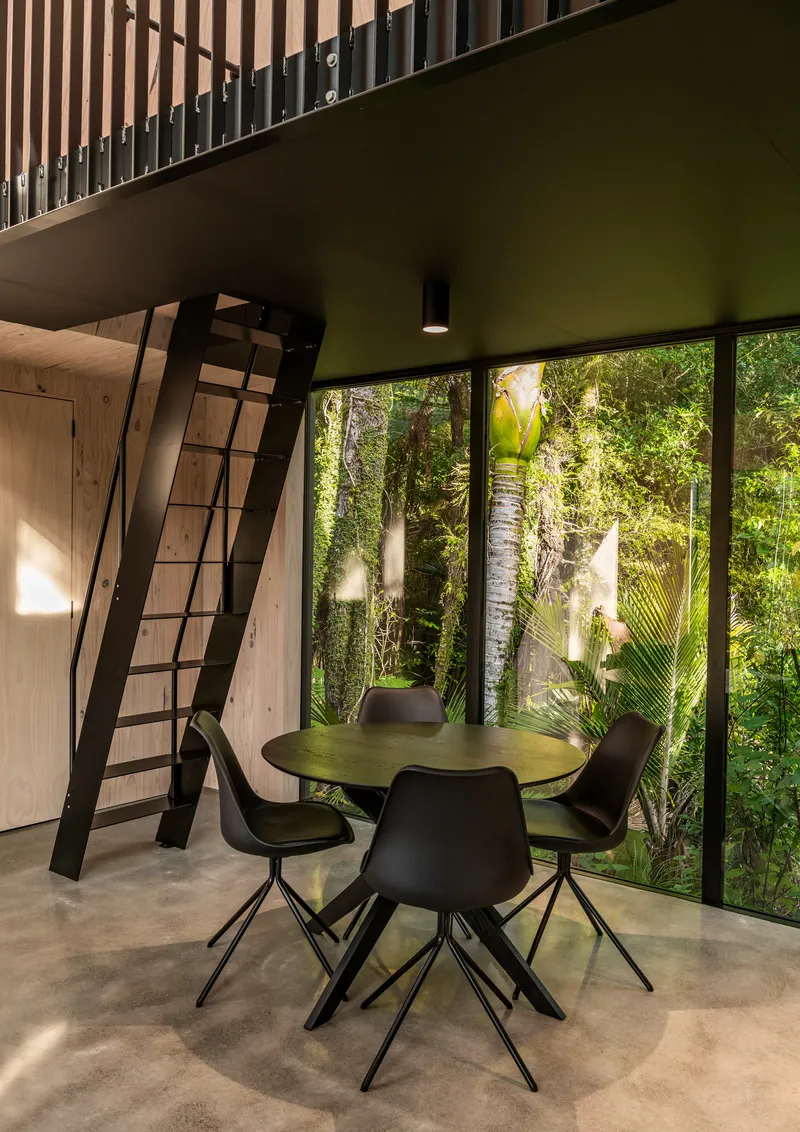
In 46 square meters, the mezzanine does most of the heavy lifting. Accessed by a ship ladder, the steel platform with vertical balusters overlooks the dining area and the full-height glazed wall beyond. It functions as a sleeping loft, a reading perch, and, thanks to the angled glazing above, a place to watch rain hit the canopy or stargaze at night. This dual-level arrangement gives the cabin a spatial generosity that its modest footprint does not suggest.
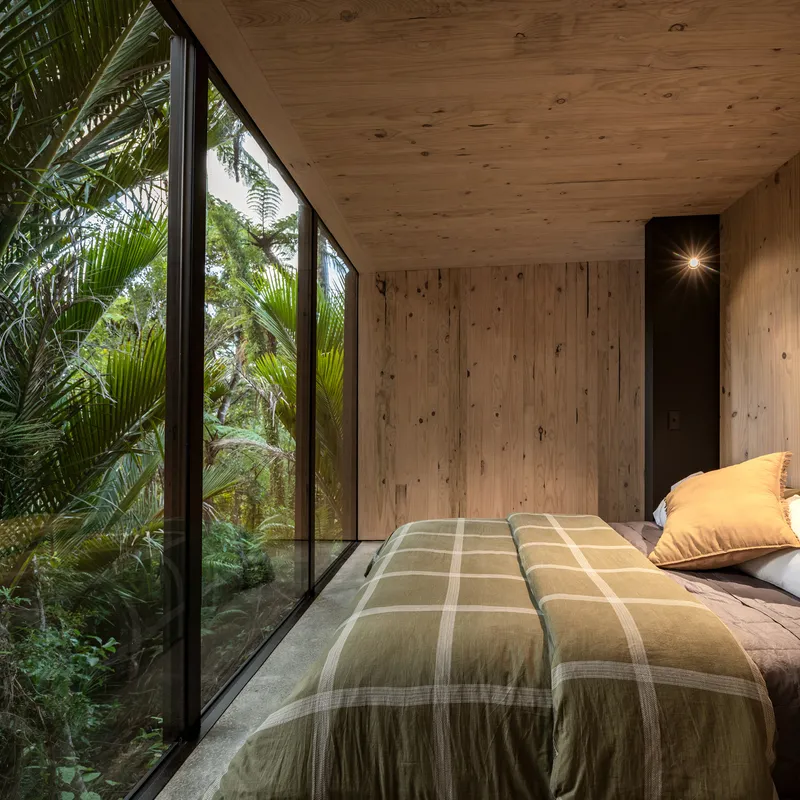
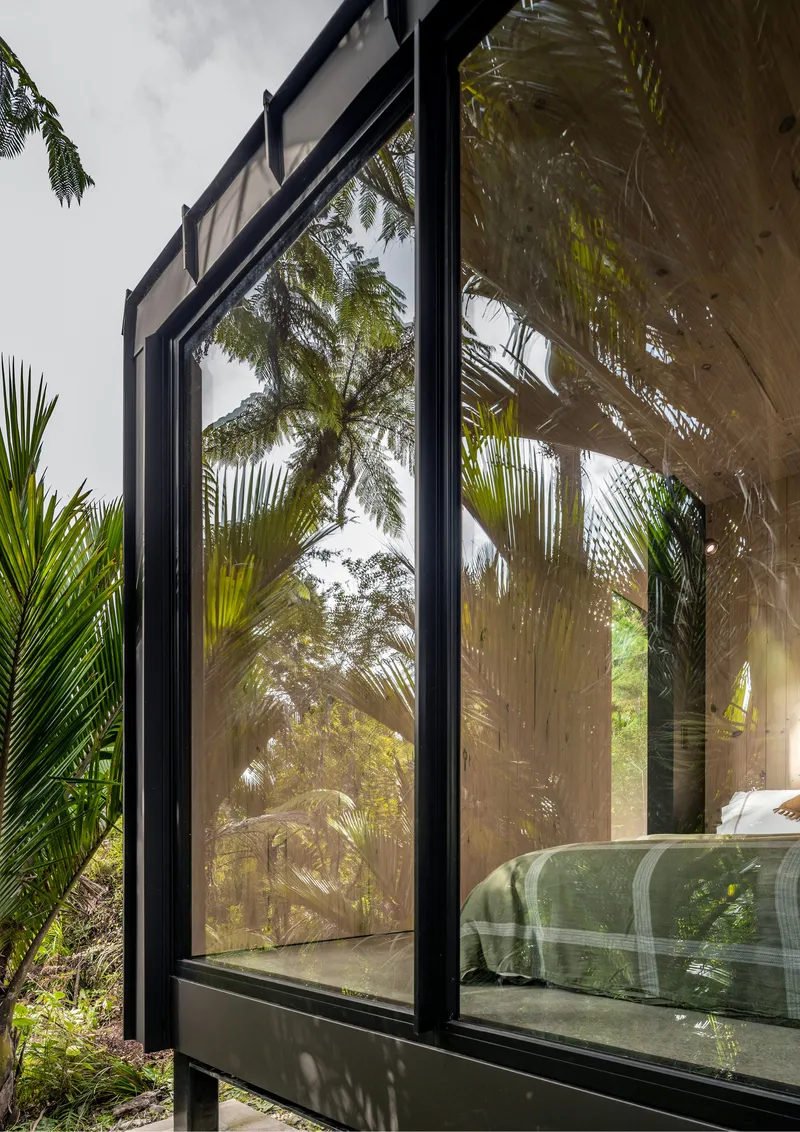
The sleeping area nestles against the pitched roof, with angled windows that frame palm fronds at close range. The deliberate proximity of the bush, kept as tight to the building as possible, means light filters through foliage before entering the cabin, casting green-tinted shadows on the timber walls. It is a room that feels suspended in the canopy rather than placed next to it.
Living with Underlit Calm
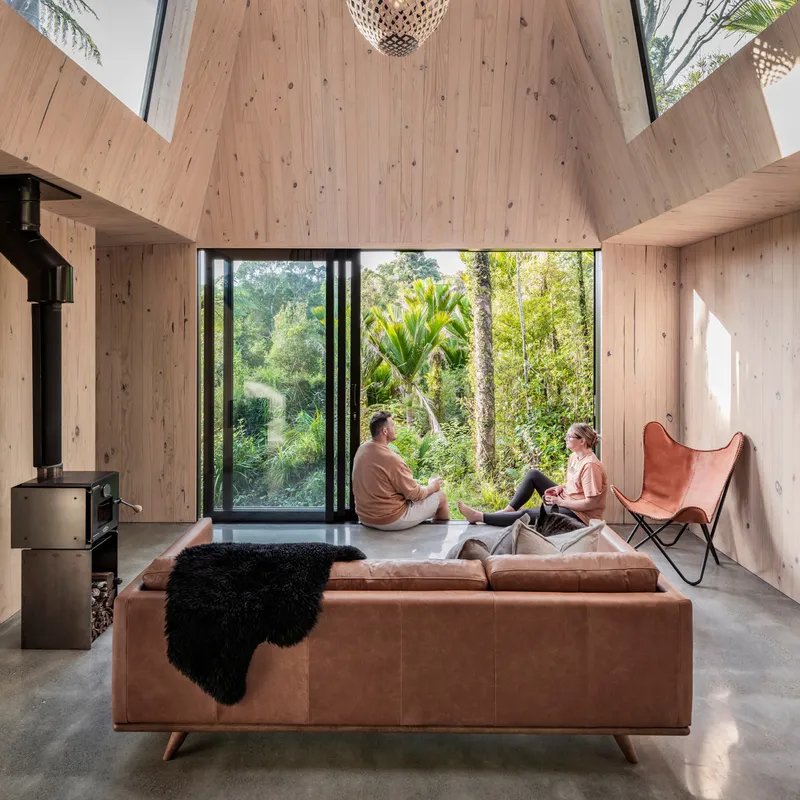
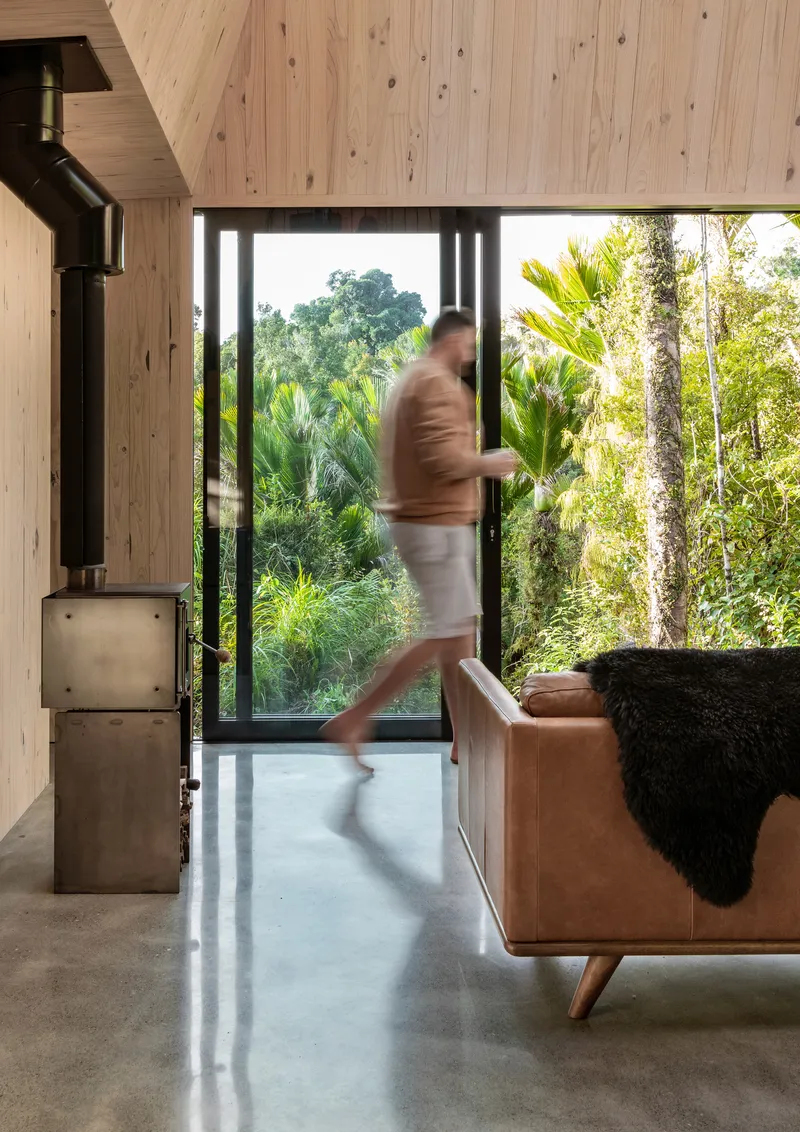
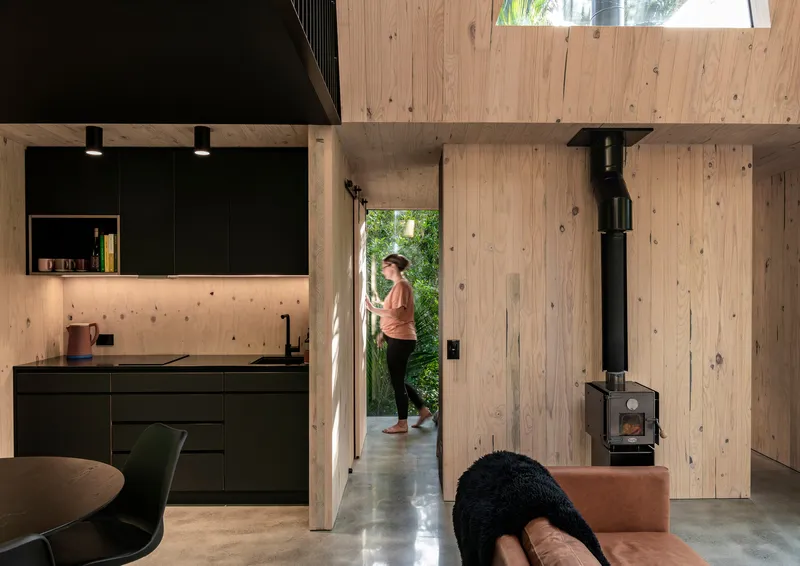
Fabric deliberately kept the interiors underlit. The reasoning is straightforward: in a retreat meant for rest, excess illumination works against the purpose. At night, the woodstove becomes the primary light source, drawing focus to the central fire and letting the perimeter fade. During the day, the full-height glazing admits enough natural light to read or cook by, but the deep eaves and surrounding bush prevent the cabin from ever feeling overexposed.
The open-plan ground floor flows from kitchen to living area to a covered outdoor threshold where firewood is stacked beneath the eaves. The concrete floor's thermal mass absorbs heat during sunny hours and releases it slowly, while the highly insulated CLT envelope maintains a stable internal temperature with little or no active heating. In a region that receives over two meters of annual rainfall, this passive strategy is as much about moisture management as warmth.
Threshold and Deck
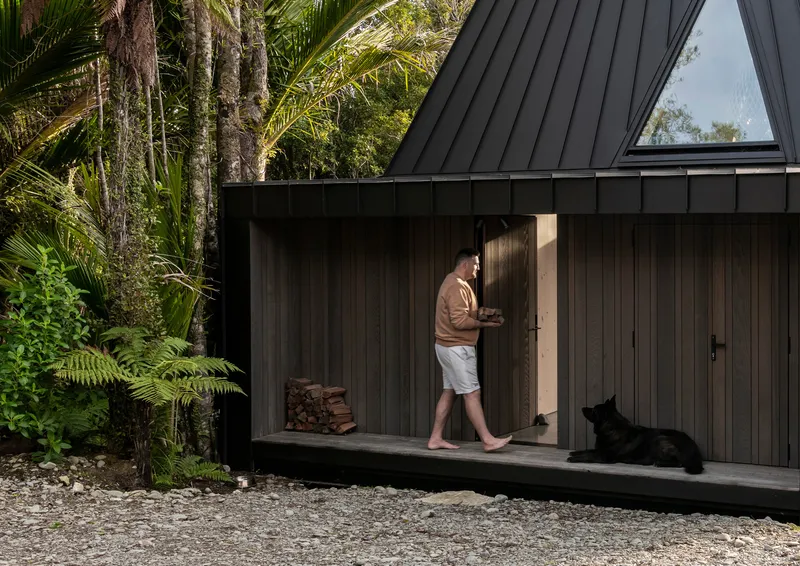
The transition from interior to exterior is handled with characteristic restraint. A covered deck with timber cladding extends the living space without formalizing it into a terrace. Stacked firewood sits against the wall, a dog rests on the warm concrete, and the forest begins at arm's length. There is no formal landscaping; the bush simply comes to the building's edge and stops. It is an aesthetic of simple living borrowed from the miners who preceded this cabin by a century and a half.
Black-framed glazing reflects the surrounding palms when viewed from outside, making the cabin appear to absorb its context. From within, the same glazing dissolves, framing the bush as a series of layered green planes. The detailing throughout is minimalist enough to blur the line between inside and out, which is exactly the point.
Material Detail and Finish
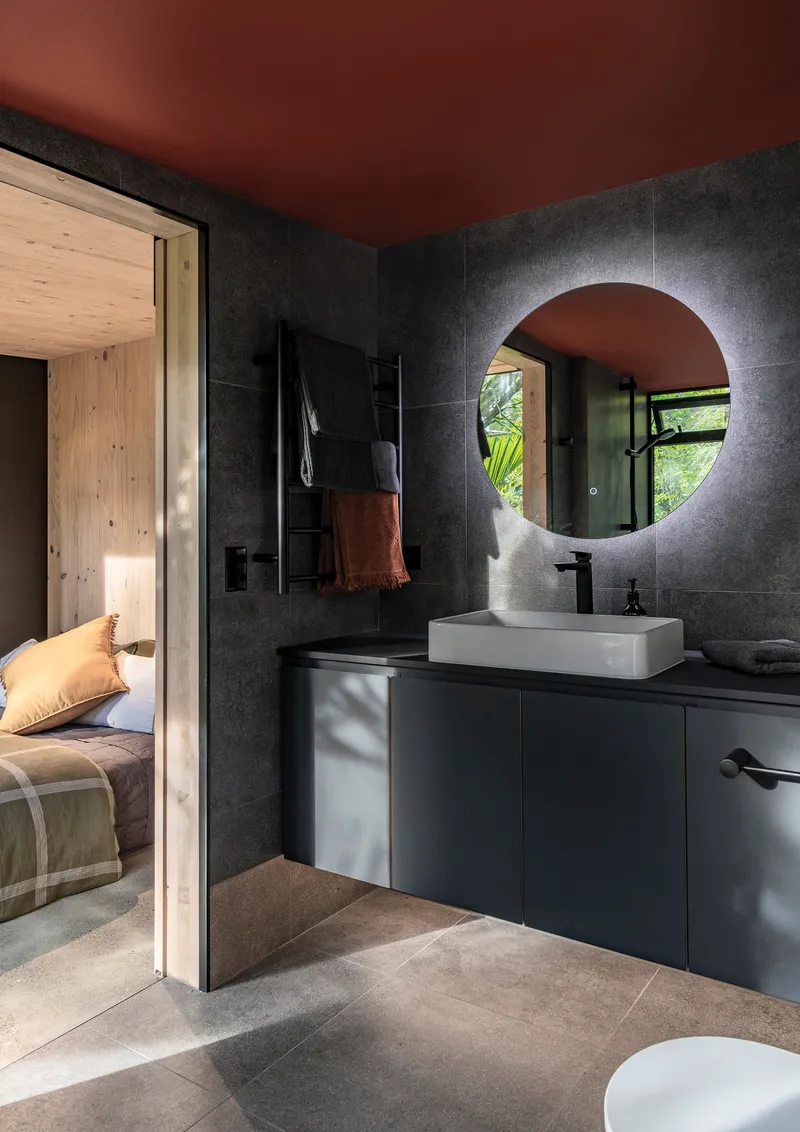
The bathroom introduces the only departure from the dominant timber and concrete palette. Black tiles line the walls, a backlit circular mirror floats against the dark surface, and the room opens directly into the timber-lined bedroom. The contrast is sharp and deliberate: a moment of compression and darkness before the double-height volume of the main living space opens up again.
The polished concrete floor throughout the ground level serves a dual function. It provides the thermal mass needed for passive heating, and it grounds the interior with a material that reads as cool and durable against the warmth of the CLT walls and ceiling. The woven pendant above, centered in the peaked volume, introduces a handmade texture that softens the precision of the timber joinery and the sharp metal exterior.
Plans and Drawings
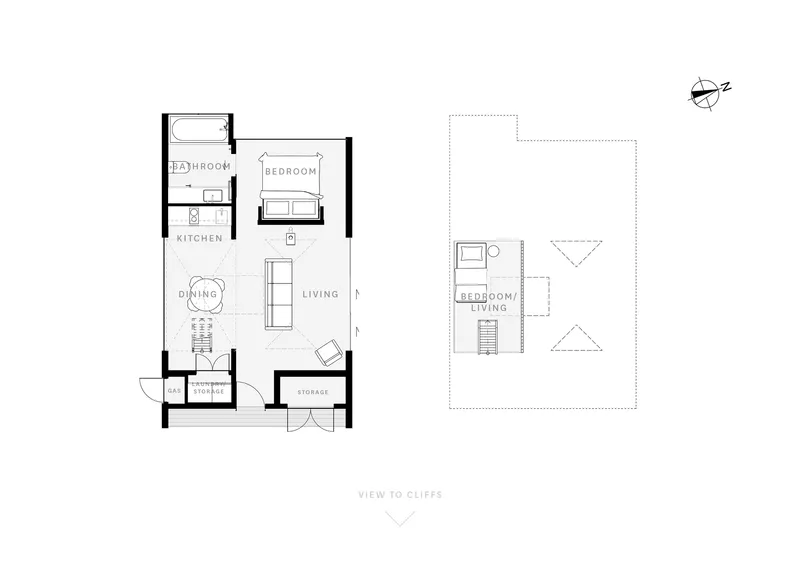
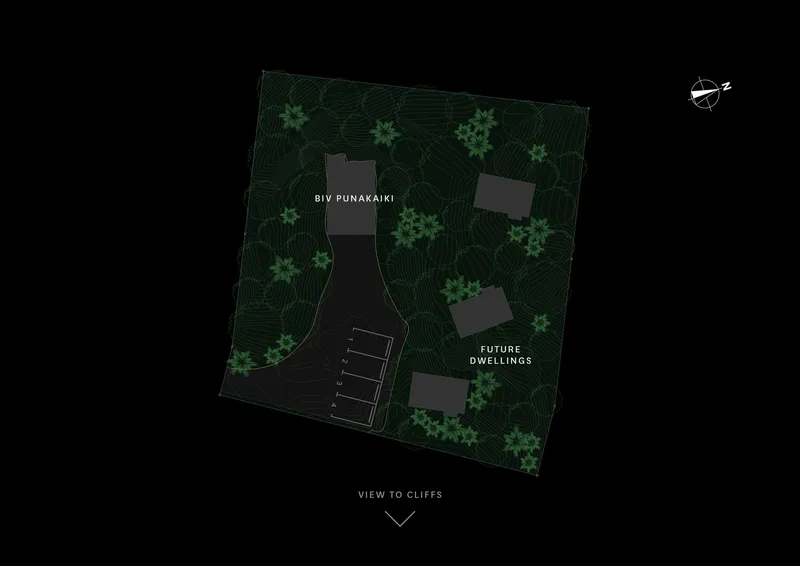
The floor plan reveals the efficiency of the layout: a single open volume containing kitchen, dining, and living at ground level, with the bathroom tucked to one side and the mezzanine bedroom above. The site plan shows the cabin's footprint relative to the surrounding topography, illustrating how the building is positioned to preserve existing trees while orienting views toward the cliff behind and the bush in all directions. The contour lines confirm the challenging terrain that necessitated the deep-piled foundation system.
Why This Project Matters
Biv Punakaiki matters because it takes a typology, the luxury micro-cabin, that frequently drifts into lifestyle branding and anchors it to a specific place, a specific history, and a specific set of construction problems. The chimney form is not decorative; it generates the section, the skylight, and the spatial experience. The material choices are not aesthetic preferences; they are direct responses to corrosive salt air, remote access, and seismic loading. Every decision earns its place.
As the first in a planned series, this cabin also functions as a prototype. Fabric has demonstrated that prefabricated CLT, deep piles, and passive thermal strategies can produce a building that holds its own in one of the most demanding coastal environments in the Pacific. If the subsequent cabins maintain this standard of specificity and restraint, Punakaiki may end up with a small collection of buildings that are as considered as the landscape they sit within.
Biv Punakaiki Cabin by Fabric (lead architect: Mitchell Coll). Punakaiki, New Zealand. 46 m². Completed 2022. Photography by Stephen Goodenough.
About the Studio
Share Your Own Work on uni.xyz
If projects like this are the kind of work you want to make, uni.xyz is a place to publish your own, find collaborators, and enter design competitions.




Popular Articles
Popular articles from the community


The Musturak Paradise: Senior Living Architecture for a Connected Future in Temara, Morocco
The Musturak Paradise reimagines senior living architecture in Temara via private homes, social spaces, culture, community, and shared care.

Play: Fragments of Their World
Familiar architecture becomes modular playground design, creating safe spaces where displaced children can learn, connect, imagine and play.

Co-Life: Senior Housing Design That Reconnects Older Adults With the City
Co-Life reimagines senior housing design through healing gardens, shared streets, workshops, and a sustainable community across generations.

Lunar Spiral: Space Architecture Shaped by the Mathematics of the Universe
Lunar Spiral reimagines space architecture through Fibonacci geometry, lunar regolith, levitating habitats, and self-sustaining Moon living.


Similar Reads
You might also enjoy these articles

Bao Huynh Watercolor Atelier: A Serene Art Retreat in Hội An
Bao Huynh Watercolor Atelier in Hội An blends multifunctional art spaces, sustainable design, local materials, and family-friendly living in a serene environment.

Atelier Macri Concept Store Interior Design by CASE-REAL
Atelier Macri store features a "ko" counter, walnut wood details, cork displays, blending retail, gallery, and seamless customer experiences.

Manuel Vargas Izquierdo Stadium and High-Performance Sports Center: Architectural Excellence in Jalpa de Méndez
The Manuel Vargas Izquierdo Stadium blends sustainable design, inclusive sports facilities, and cultural-inspired architecture, revitalizing Jalpa de Méndez’s public spaces.

KAKR Buluh Awar Hall: Revitalizing Community and Ecology Through Bamboo Architecture
Community built bamboo hall revitalizes Buluh Awar village, empowering youth, restoring ecology, celebrating vernacular craftsmanship through sustainable architecture and culture.


Explore Residential Building Competitions
Discover active competitions in this discipline



Challenge to design a portable theatre


Challenge to design a portable music platform


Challenge to design an open learning module for the elderly


Challenge to design mud housing for contemporary communities
Comments (0)
Please login or sign up to add comments
No comments yet. Be the first to comment!