

Fabrication Studio Wraps a 60 m² Garden Suite in Copper at the Edge of a Toronto Park
A compact pavilion in the Bridle Path neighbourhood ages alongside its landscape through a living copper skin and operable glass walls.


The brief started with two legendary precedents: Philip Johnson's Glass House and Mies van der Rohe's Farnsworth House. What Fabrication Studio and François Abbott actually built for a long-time homeowner on the edge of Toronto's Sunnybrook Park is something quieter, more tactile, and arguably more relevant. Copper House is a 60 m² garden suite that lets an aging client remain on a property they have occupied for two decades, while the main house becomes available for the next generation. It is a succession plan disguised as architecture.
What makes the project genuinely compelling is not the pavilion typology itself but the decision to build the entire envelope from a material that refuses to stay the same. Vertical copper panels will shift from their current reflective amber through browns and eventually into muted greens, tracking the same seasonal and annual cycles as the deciduous trees that screen the lot from the park beyond. In a neighbourhood where copper already appears on gutters and downspouts of established homes, the choice roots the building in its context even as it announces itself as something entirely new.
A Skin That Registers Time
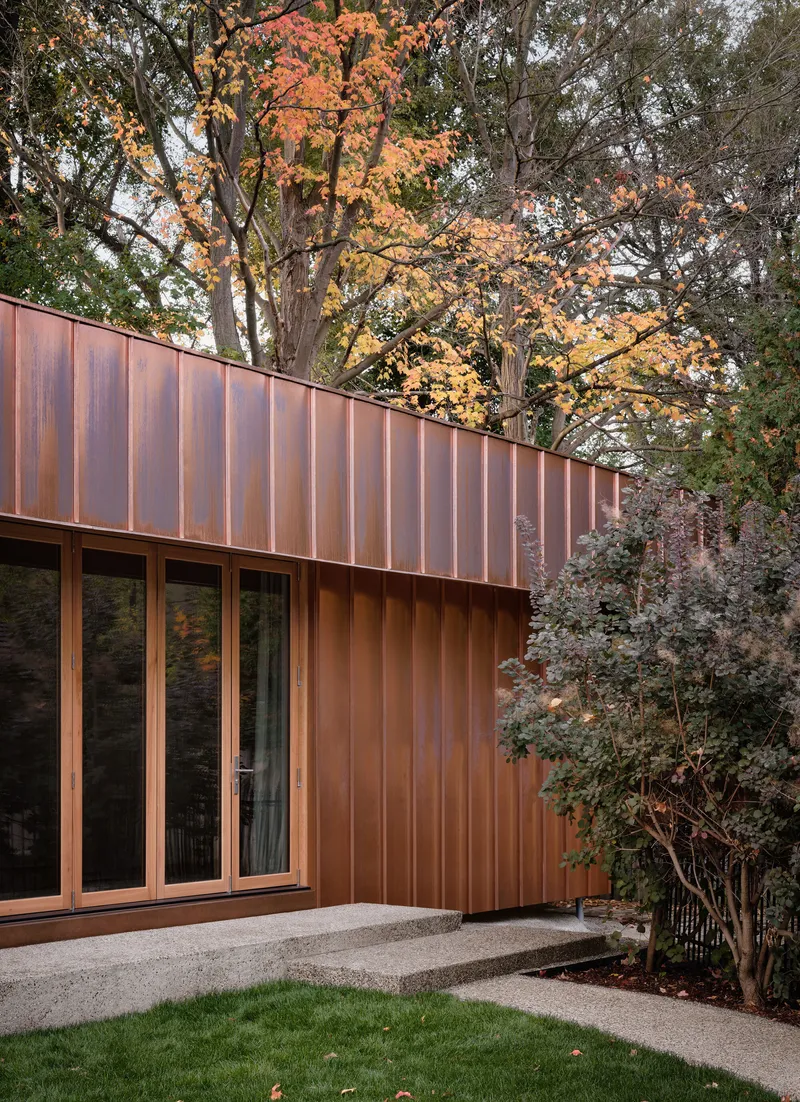
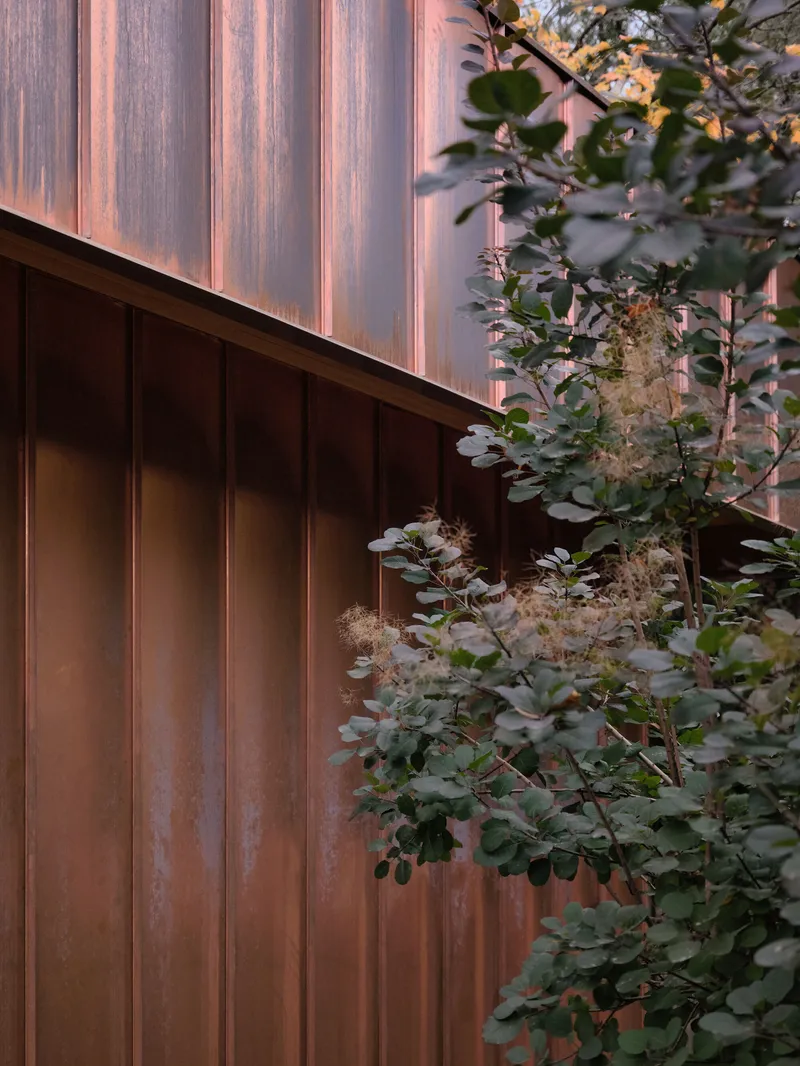

The copper cladding is not simply applied; it is detailed with care. Furring strips behind the panels hold the material in tension, allowing wider sheets and producing a subtle scalloped quality across the facade. Vertical joints create a rhythm that reads differently depending on light and proximity. Up close, individual seams and the early stages of patina are legible. From across the garden, the surface flattens into a warm monolith that shifts colour with the time of day.
The overhanging roofline, divided into evenly spaced panels, reinforces this optical cadence. It acts as a kind of forehead for the building, a deep brow that shelters the walls below from both snow load and direct sun. The result is a cladding system that does real environmental work while also operating as the building's primary expressive gesture.
Floating Above the Roots

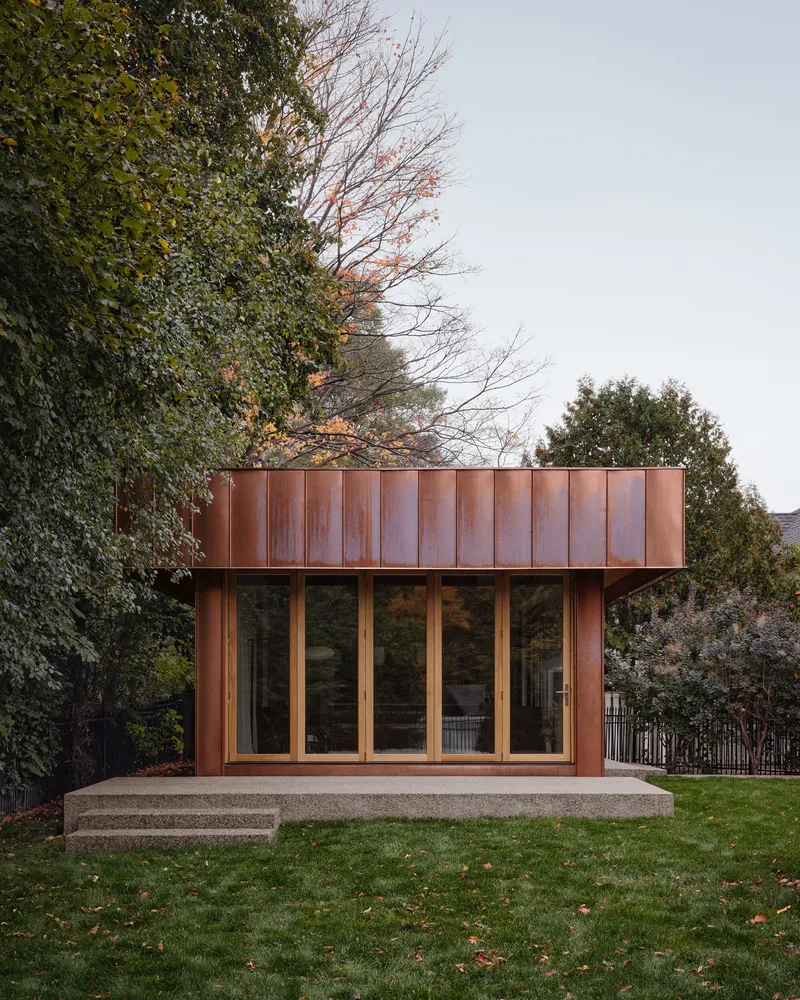
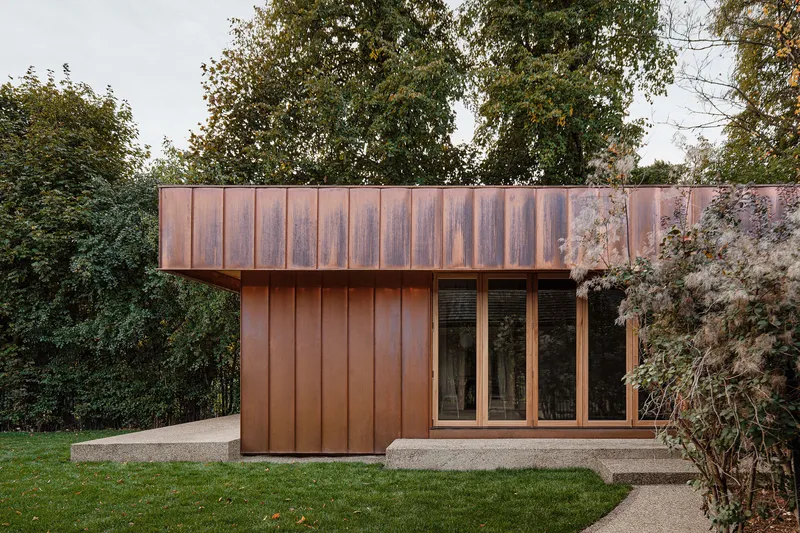
Set against a screen of mature deciduous trees at the boundary between a private lot and Sunnybrook Park, the building's most consequential structural decision happens underground, or rather, just above it. Helical piles lift the entire structure off the ground, avoiding a conventional foundation that would have damaged the root systems of surrounding trees. Air and water move freely beneath the raised floor, and the building sits on the landscape more like a piece of furniture than a permanent fixture.
Concrete platforms step down from the building's perimeter, mediating between the elevated interior and the garden. The effect is of a pavilion that belongs to the garden rather than dominating it. In summer the surrounding lawn and flowering shrubs soften the hard geometry; in autumn the copper panels echo the foliage turning overhead.
Opening the Walls to the Garden
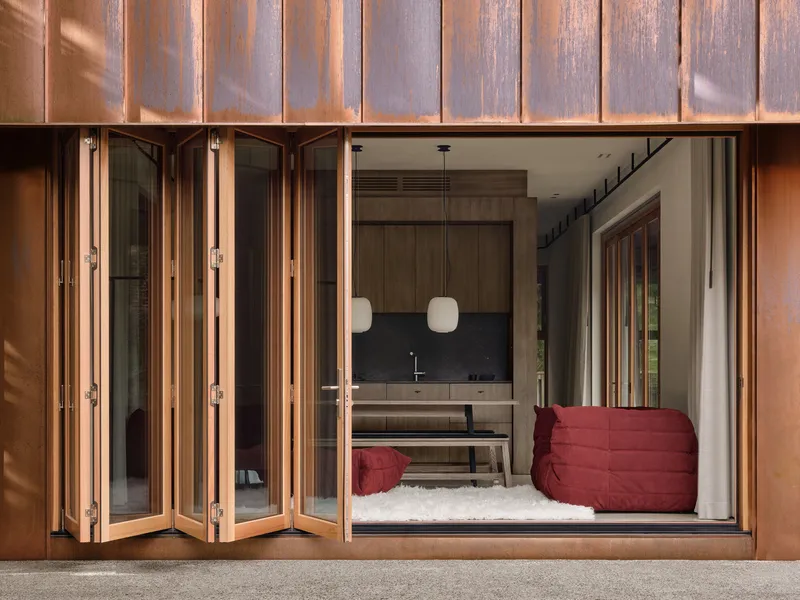
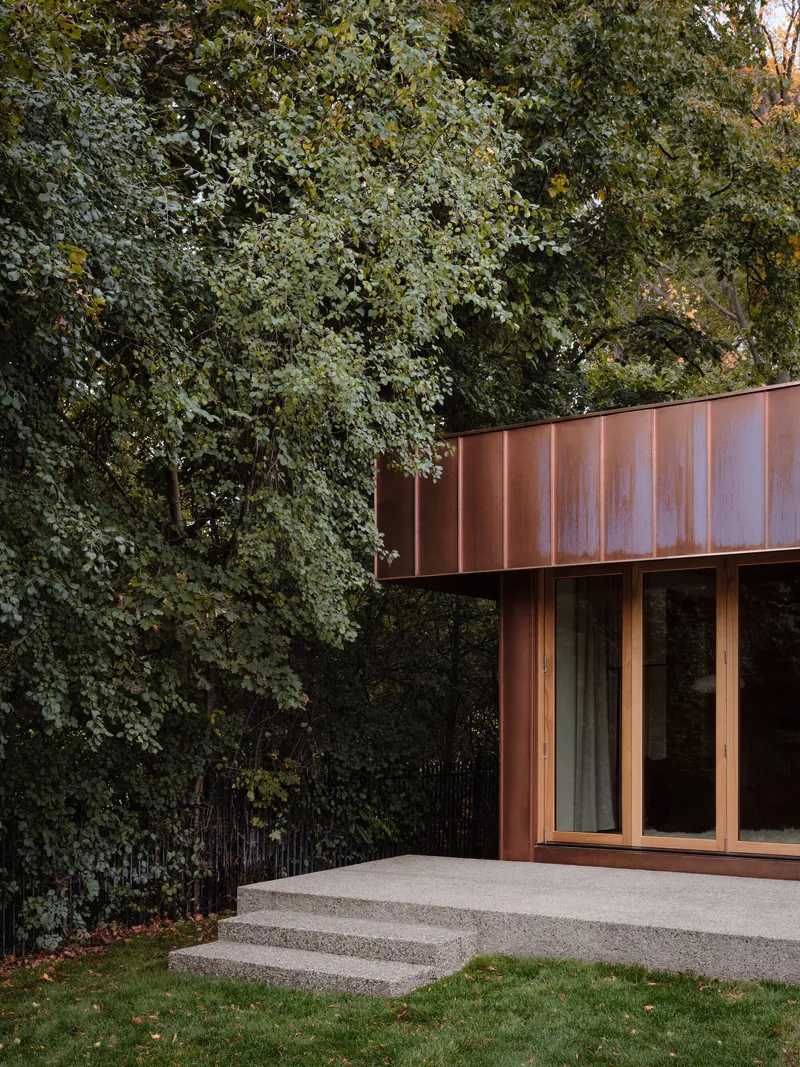
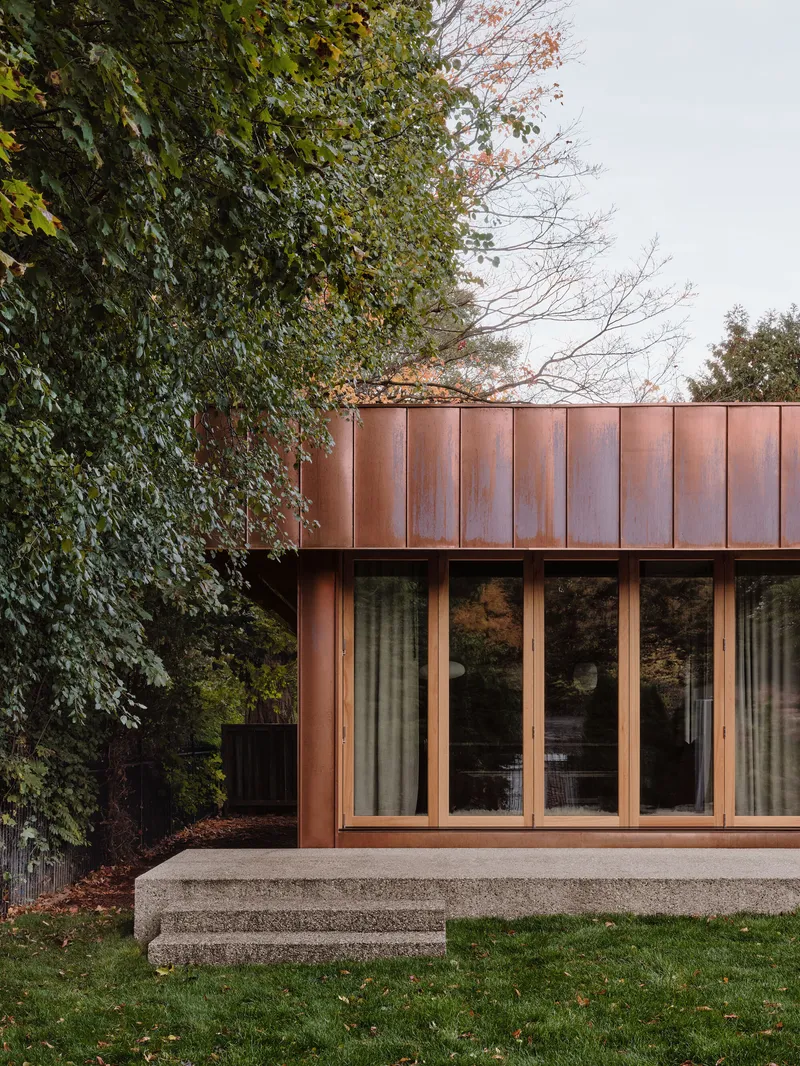
Garden-facing walls consist of bi-folding glass doors that stack outward beneath the deep overhangs when fully open. The interior, already compact at 60 m², effectively doubles in usable area by becoming a covered terrace. The overhang is calculated to protect the open threshold from rain and direct sun, so the doors can remain open through most of the warmer months without compromise.
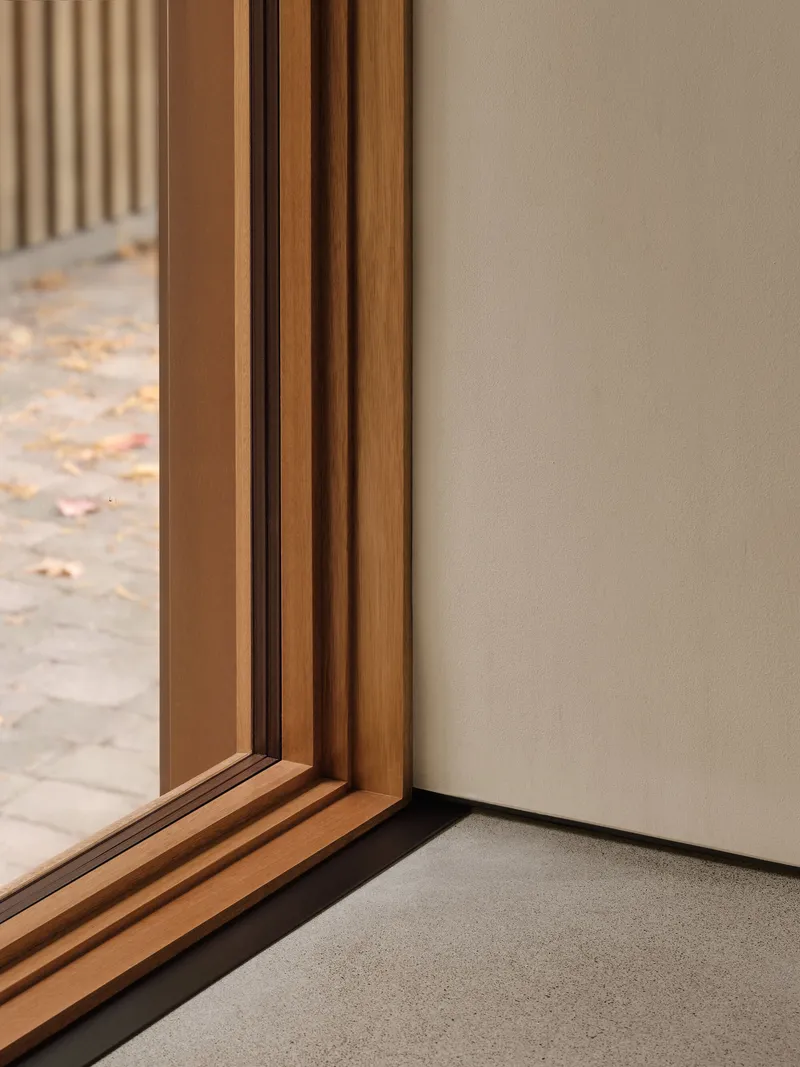
Each of the building's four facades contains a single deliberate opening. There is no gratuitous glazing here. Windows are placed to frame specific views, capture particular qualities of light, and maintain privacy from the park and the main house. The restraint makes each opening feel earned, and the deep timber frames that surround them register the play of light and shadow throughout the day.
The Wooden Core

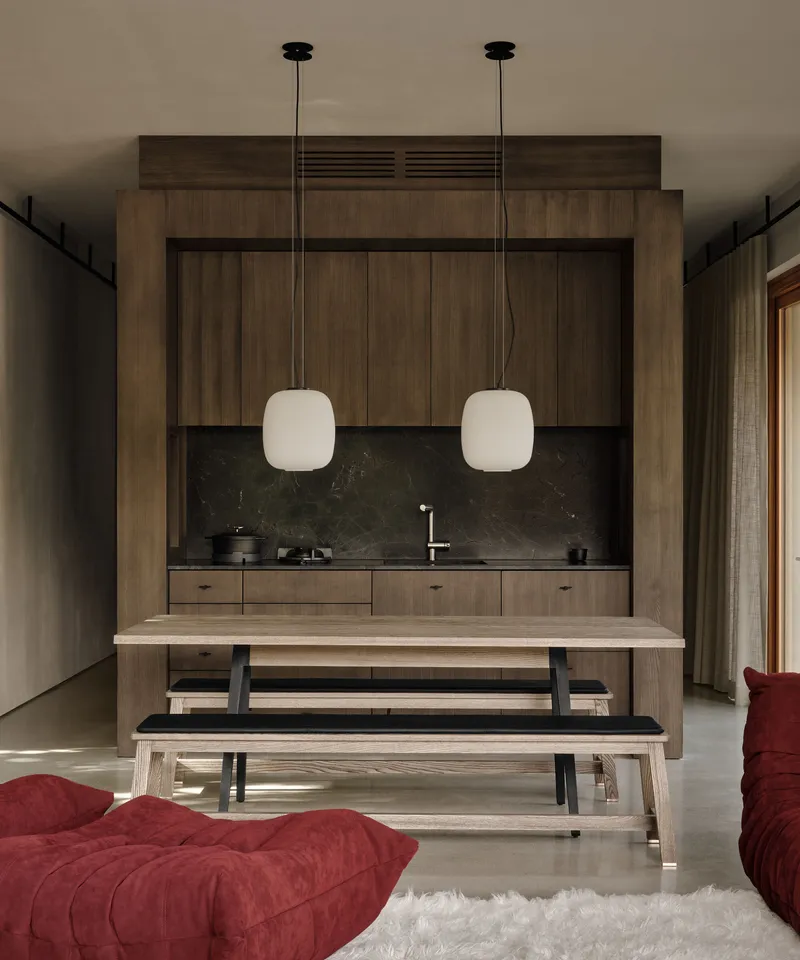

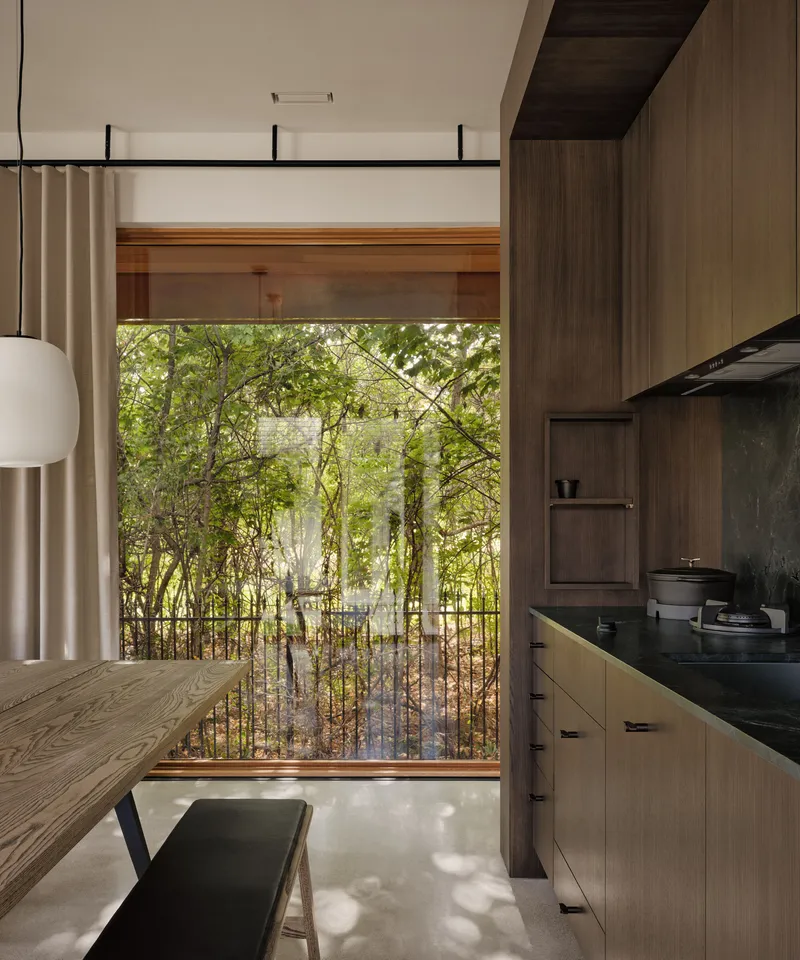
The interior plan is organized around a single monolithic timber core that houses the kitchen, bathroom, and all storage. Living space falls on one side, bedroom on the other, with a hallway running along each flank of the core. The arrangement is legible immediately upon entry: you understand the entire building in a glance, which is a rare and welcome clarity in domestic architecture at any scale.
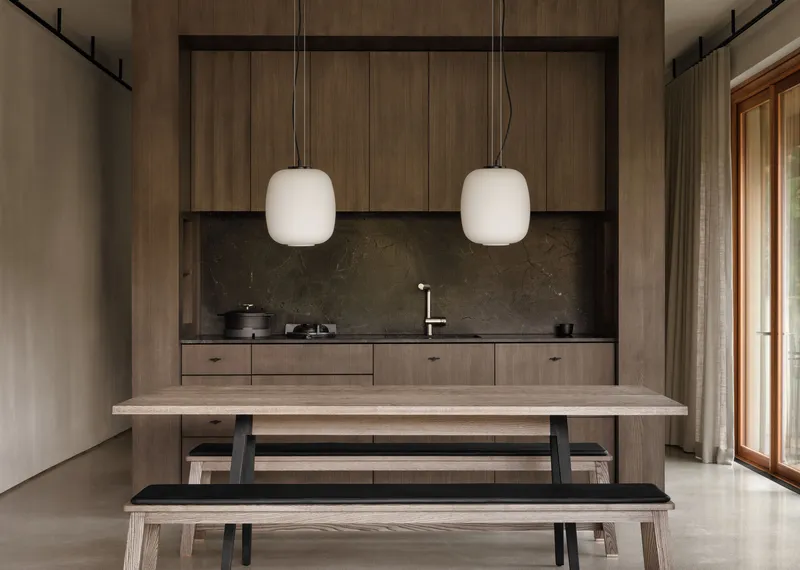
The kitchen unit itself is a piece of joinery as much as architecture. Dark veined stone forms the backsplash and counter, while the surrounding timber cabinetry includes recessed display niches and integrated lighting. Twin pendant lamps hang above a bench seating arrangement that doubles as a dining area. Vents are tucked discreetly into the top of the core, keeping the ceiling plane clean and uninterrupted.
Curtains, Light, and the Soft Layer
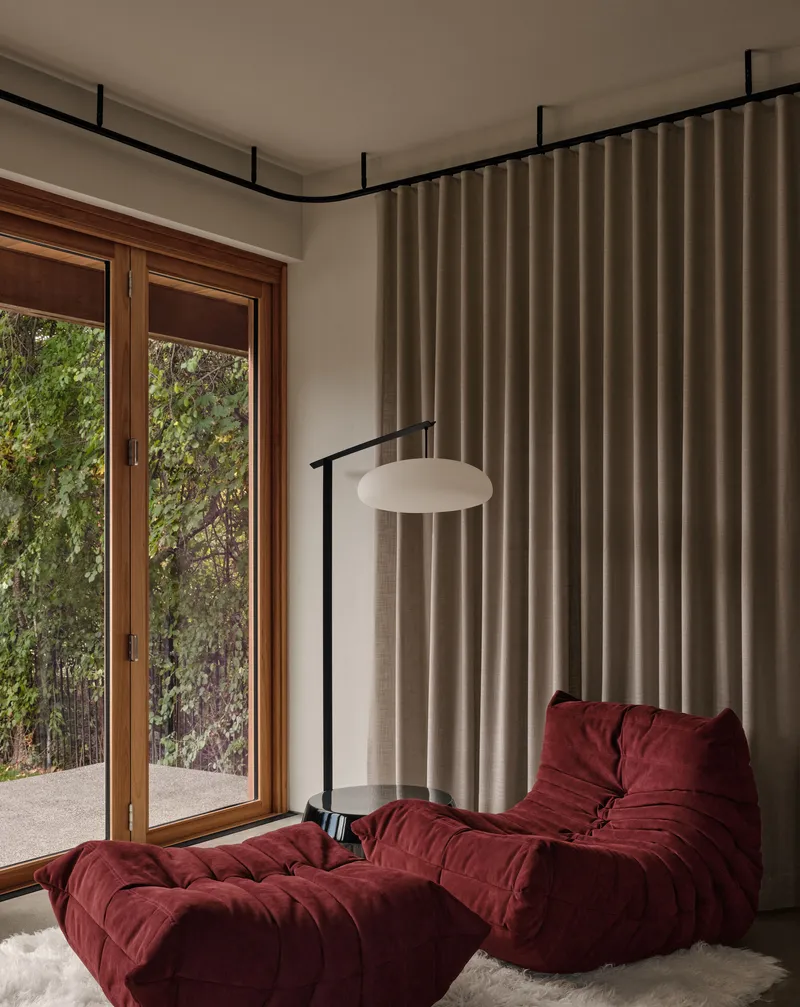
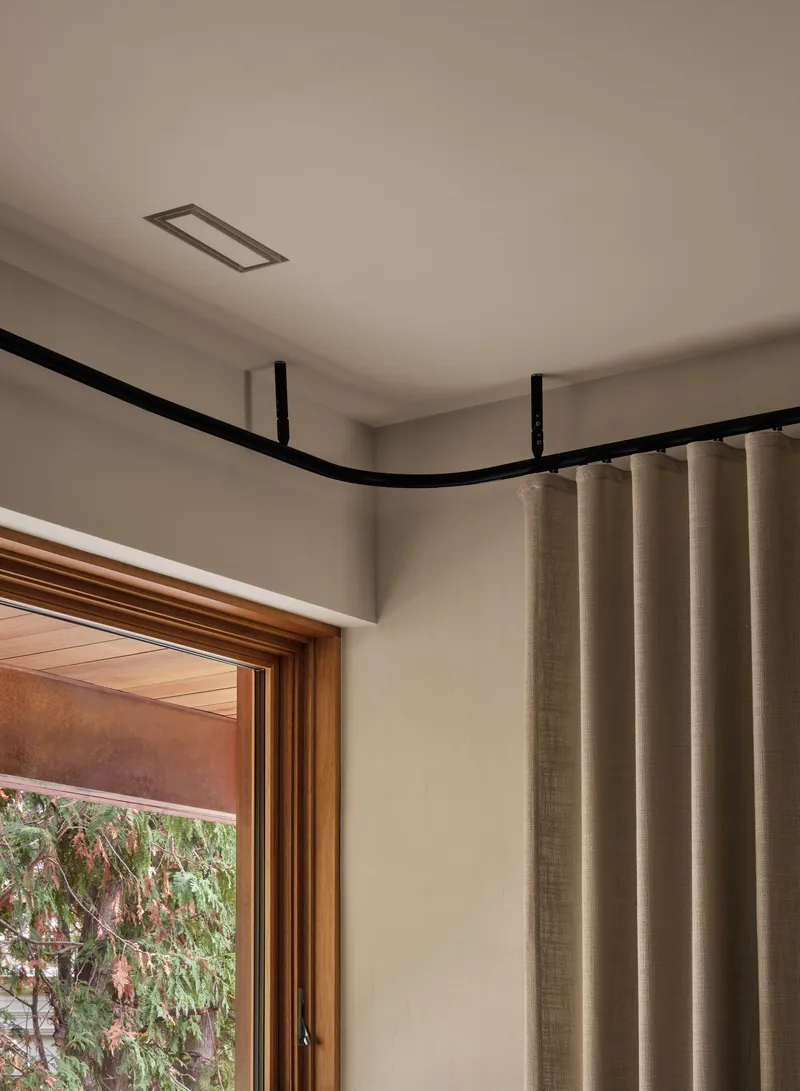
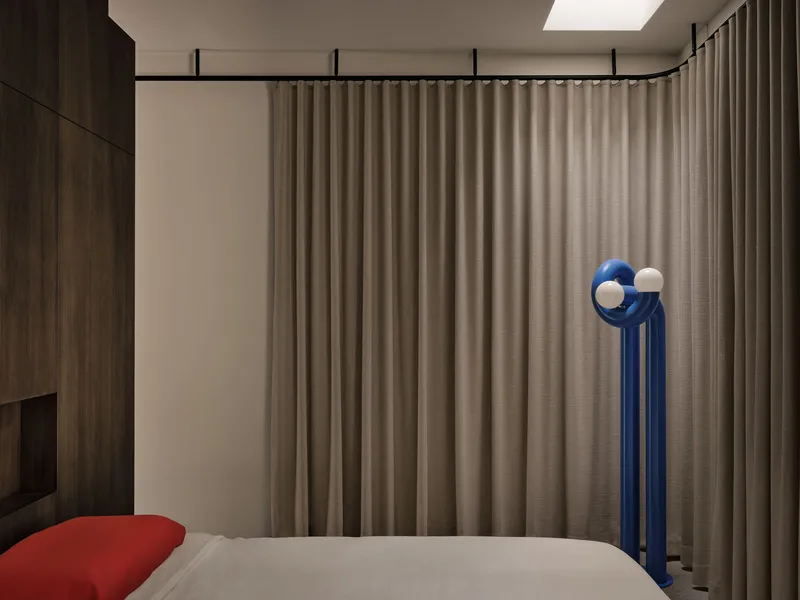
A continuous drop rail runs along the entire ceiling edge, supporting a curtain system that modulates privacy, light, and acoustics. The curtains can be drawn to subdivide the open plan, screen the bedroom from the living area, or simply soften the quality of daylight entering through the glazed walls. It is one of the building's smartest moves: a low-tech, infinitely adjustable layer that turns a rigid plan into something fluid.
The bedroom corner, with its sculptural blue tubular lamp and draped curtain track, reads less like a utilitarian sleeping area and more like a curated interior. A square skylight above punches a column of light into the space, changing character through the day. The material palette is deliberately restrained: timber, polished aggregate concrete flooring, plaster walls, copper. Everything that appears decorative is actually functional.
A Bathroom Carved from the Core
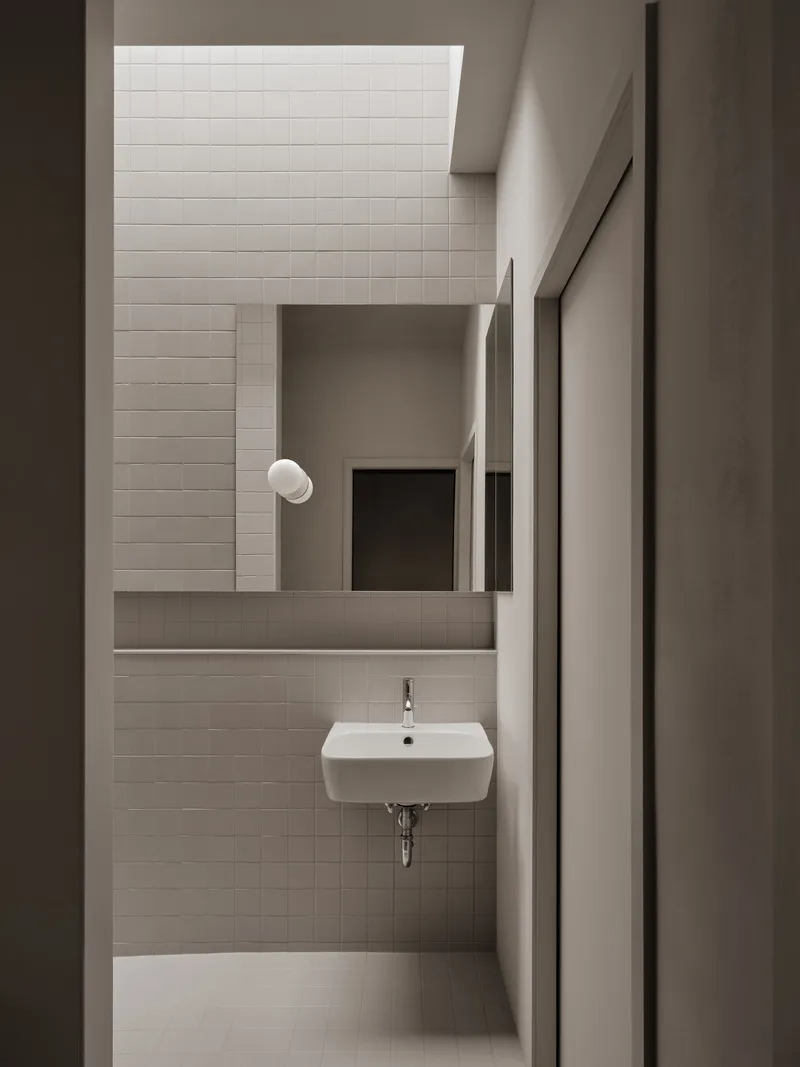
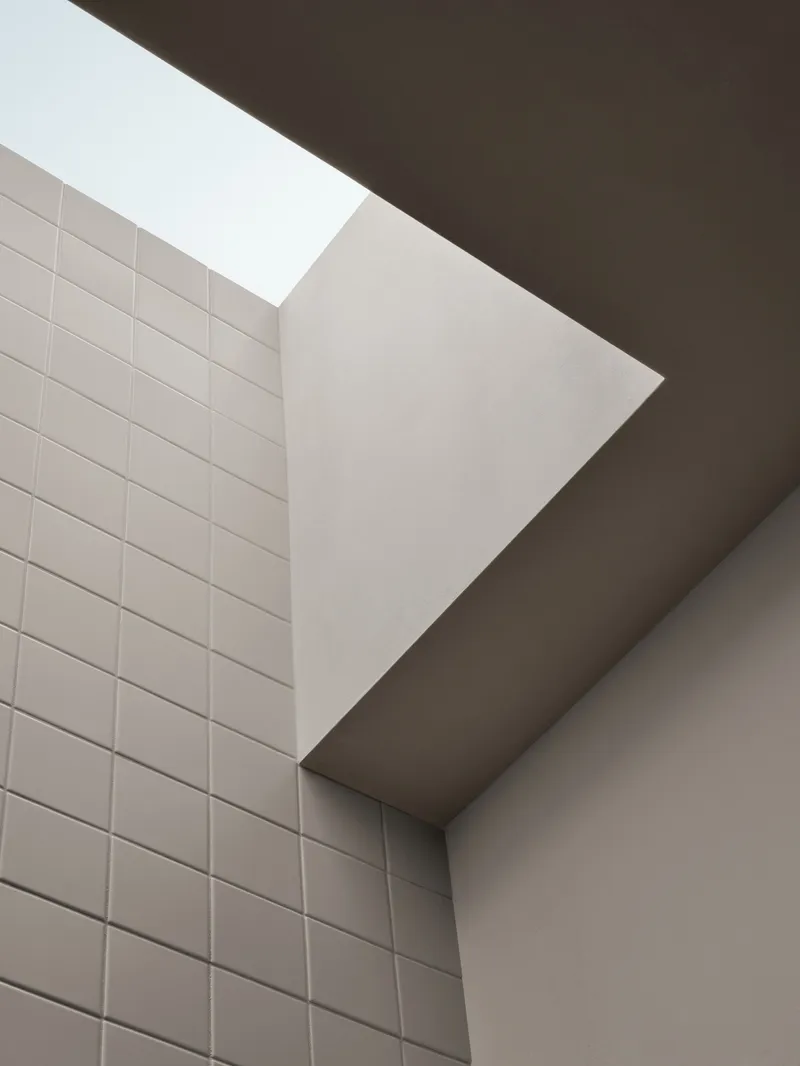
The bathroom occupies a narrow slot within the central timber core, clad entirely in white rectangular tiles. A wall-mounted sink sits beneath a skylight that floods the small room with natural light, eliminating any sense of claustrophobia. The angled ceiling planes where plaster meets tile reveal the geometry of the parallel chord trusses above, which integrate all mechanical services: pipes, ducts, and insulation within a single efficient roof assembly.
Dusk and the Lantern Effect


At dusk the building reveals a second identity. Interior light spills through the glazed openings and backlights the copper cladding, transforming the pavilion into a warm lantern set among darkening trees. The vertical metal panels catch ambient light differently than during daylight hours; they become a surface that glows rather than reflects. It is a reminder that architecture operates across a full diurnal cycle, and the best small buildings reward observation at every hour.
Inside, the timber cabinetry and stone surfaces take on a richer warmth under artificial light. The pendant fixtures, the blue floor lamp beside the bed, and the carefully framed views of garden foliage beyond the window all suggest an interior designed for evening occupation as much as daytime use. For a 60 m² building, the range of atmospheres is remarkable.
Plans and Drawings
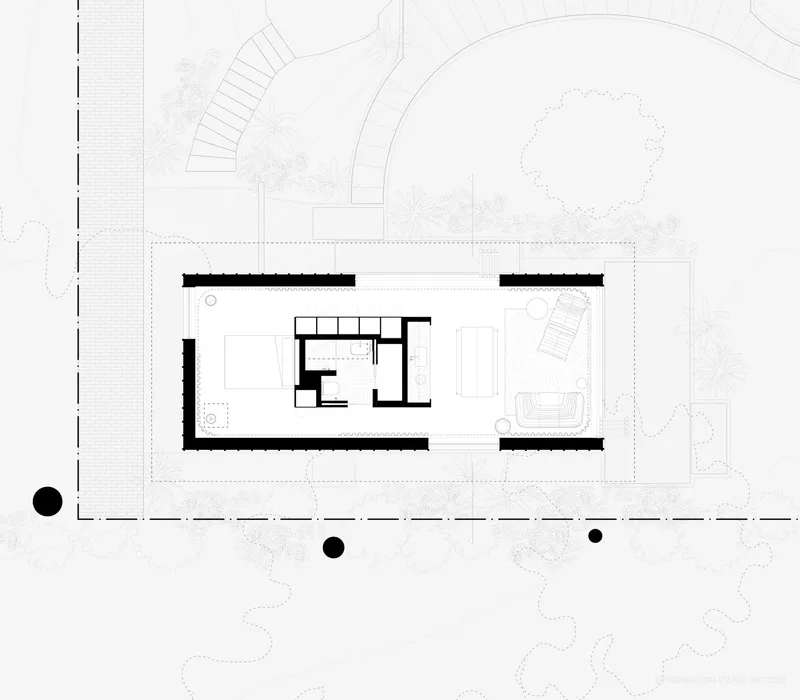
The floor plan makes the organizational logic unmistakable. A rectangular footprint is bisected by the central service core, with living and sleeping zones flanking it symmetrically. Each facade receives one carefully positioned opening, and the stepped concrete platforms extending outward from the building's edge are visible as a sequence of thresholds between interior and garden.
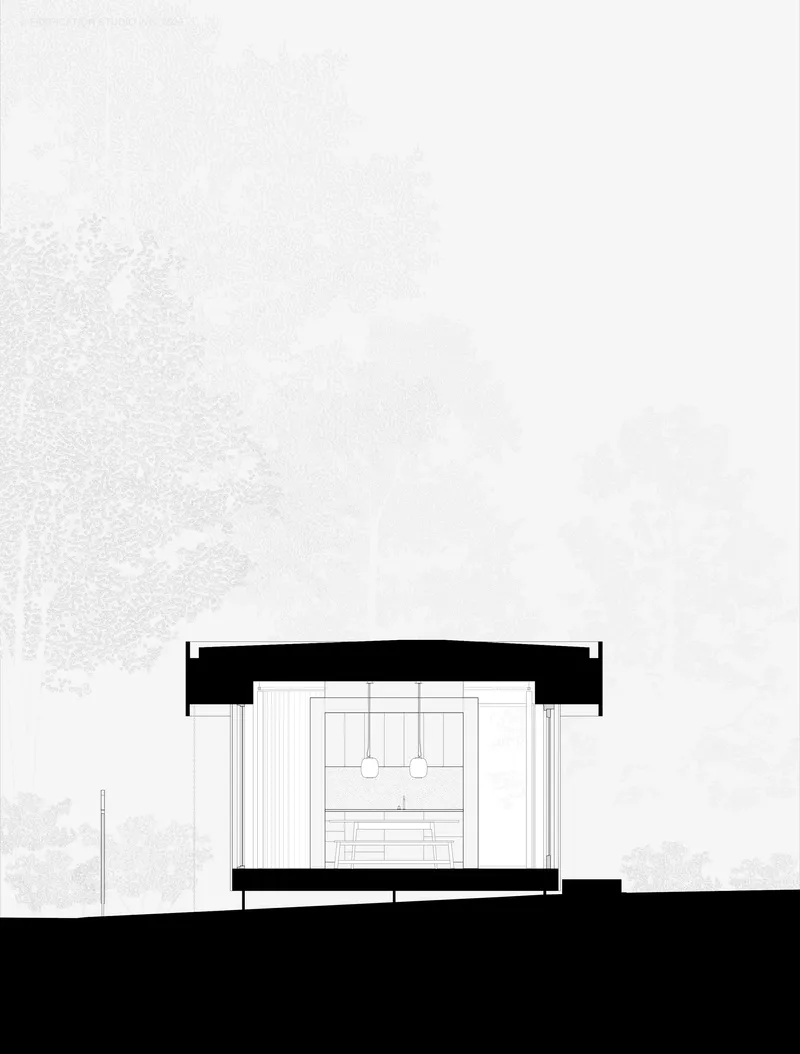
The section drawing reveals the thick roof assembly that conceals the parallel chord trusses and all mechanical infrastructure within a single horizontal band. The helical pile foundation is legible as a clear gap between ground and floor, and the deep overhang that protects the walls and shelters the operable doors extends well beyond the building's footprint. It is a drawing that explains how a small building can contain this much ambition without appearing oversized.
Why This Project Matters
Copper House matters because it takes a building type that is too often treated as an afterthought, the backyard accessory dwelling, and demonstrates that it can carry real architectural ideas. The decision to use a living material, to raise the structure off the ground to protect existing trees, to organize the entire plan around a single timber core, and to let curtains rather than walls define interior boundaries: these are not luxury gestures. They are design strategies that could apply to compact housing at far more accessible price points.
More broadly, the project offers a persuasive model for aging in place. Rather than forcing a homeowner to leave a property they know intimately, it carves out a self-contained dwelling within the existing garden, keeping family life connected while granting independence. As cities across North America grapple with housing density and an aging population, this kind of thinking, precise, site-specific, and materially intelligent, deserves far more attention than the typical laneway house receives.
Copper House by Fabrication Studio and François Abbott. Toronto, Canada. 60 m². Completed 2025. Photography by Alex Lesage.
About the Studio
François Abbott
Share Your Own Work on uni.xyz
If projects like this are the kind of work you want to make, uni.xyz is a place to publish your own, find collaborators, and enter design competitions.


Popular Articles
Popular articles from the community


Opera by the Sea Estonia: Three Shells Dissolving Architecture into Tallinn's Coastline
A winning opera house proposal replaces monumental form with interconnected shells that blur the boundary between building, park and Baltic Sea.

Opera on the Sea: Driftwood Logic Shapes a Timber Opera House on Estonia's Coast
Trevor Orgill's opera house translates the entangled drift of floating timber into a civic building where wood, water, and music converge.

Singing Woman: An Opera House That Performs Before the Curtain Rises
Ovidiu Cristian Pavel's conceptual opera house translates Estonia's choral identity into a sculpted waterfront landmark facing the Baltic Sea.

Temporary Home for Dogs: A Reversed Zoo Rethinks Animal Shelter Architecture
In Bucharest, a sinuous corridor and freed landscape flip the logic of containment, designing a shelter that works to make itself unnecessary.

Similar Reads
You might also enjoy these articles

Pixel Gardens: One Repeated Module Stacked Into a Terraced Social Housing Tower for Famagusta
Salem Bader's shortlisted housing tower builds a vertical neighbourhood from one repeated module, offsetting units to carve terraces, light and air.

Bao Huynh Watercolor Atelier: A Serene Art Retreat in Hội An
Bao Huynh Watercolor Atelier in Hội An blends multifunctional art spaces, sustainable design, local materials, and family-friendly living in a serene environment.

Atelier Macri Concept Store Interior Design by CASE-REAL
Atelier Macri store features a "ko" counter, walnut wood details, cork displays, blending retail, gallery, and seamless customer experiences.

Manuel Vargas Izquierdo Stadium and High-Performance Sports Center: Architectural Excellence in Jalpa de Méndez
The Manuel Vargas Izquierdo Stadium blends sustainable design, inclusive sports facilities, and cultural-inspired architecture, revitalizing Jalpa de Méndez’s public spaces.

Explore Double Skin Facade Competitions
Discover active competitions in this discipline

Challenge to design a portable theatre

Challenge to design a portable music platform

Challenge to design an open learning module for the elderly

Challenge to design mud housing for contemporary communities
Comments (0)
Please login or sign up to add comments
No comments yet. Be the first to comment!