
Facury, Guaja.cc, and Thiago Bandeira Build a Party House Facing Brazil's Serra da Moeda
A 686-square-meter family home in Brumadinho uses a double-height core and cantilevered timber roof to frame mountain views and generous social space.


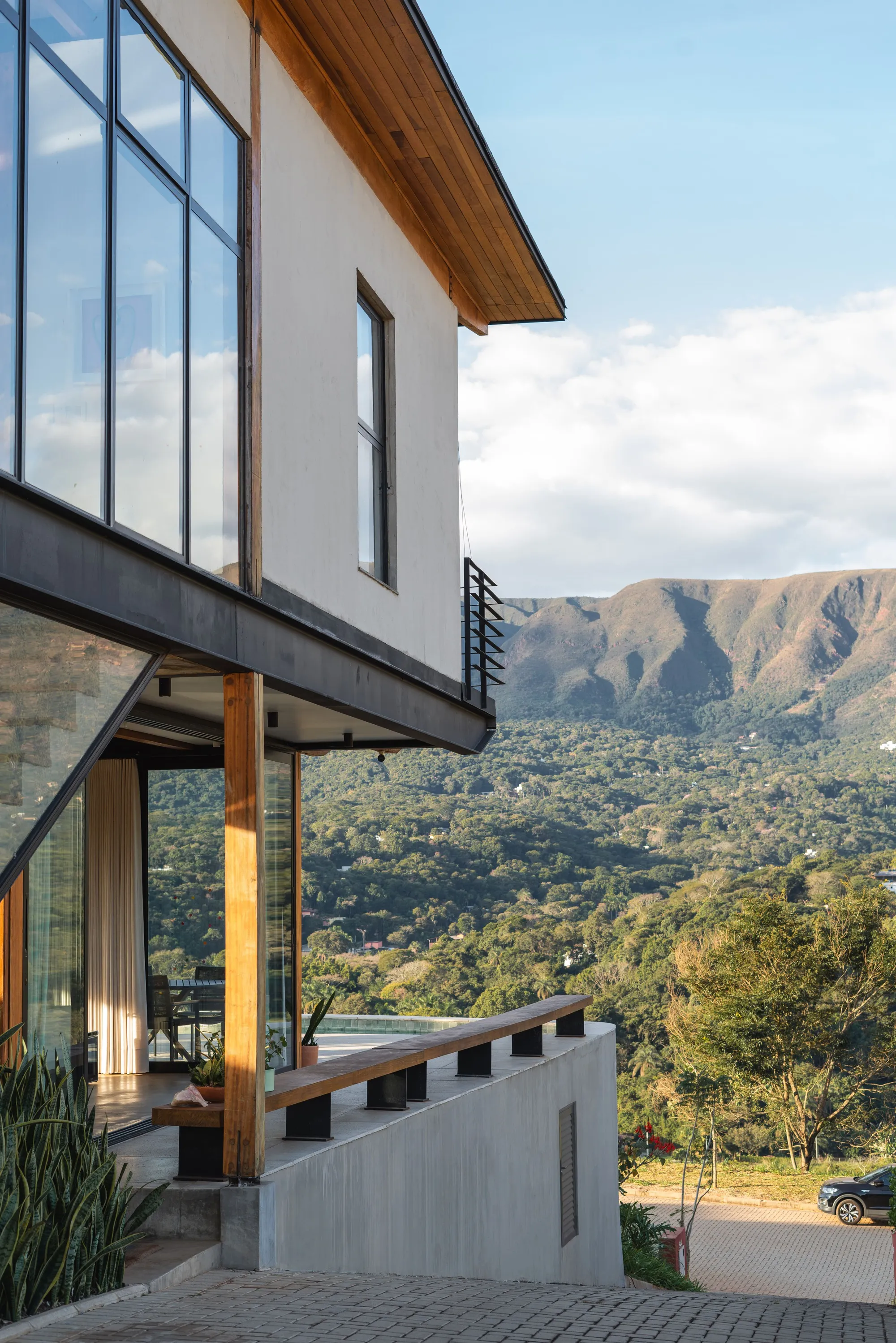
A house designed for hosting has to do more than provide square footage. It has to choreograph movement, compress and release space, and make the landscape feel like another room. Boa Vista House, a collaboration between facury, guaja.cc, and Thiago Bandeira, takes that brief literally. Sited on a sloping lot in Brumadinho, Brazil, the 686-square-meter residence confronts the Serra da Moeda mountain range with a long, low profile that opens almost entirely on its valley-facing side. Led by architects João Pedro Pujoni Facury and Lucas Durães, the design team treated the view not as a backdrop but as the organizing principle for every room in the house.
What makes the project worth studying is the way it resolves a tension that most party houses ignore: how to build for large gatherings without sacrificing intimacy during daily life. The answer here is a double-height kitchen and dining core that acts as a hinge between quieter private zones and expansive outdoor terraces. A cantilevered timber roof floats over the whole composition, giving the building a single, calm horizon line while the section underneath does all the heavy lifting.
Working the Slope
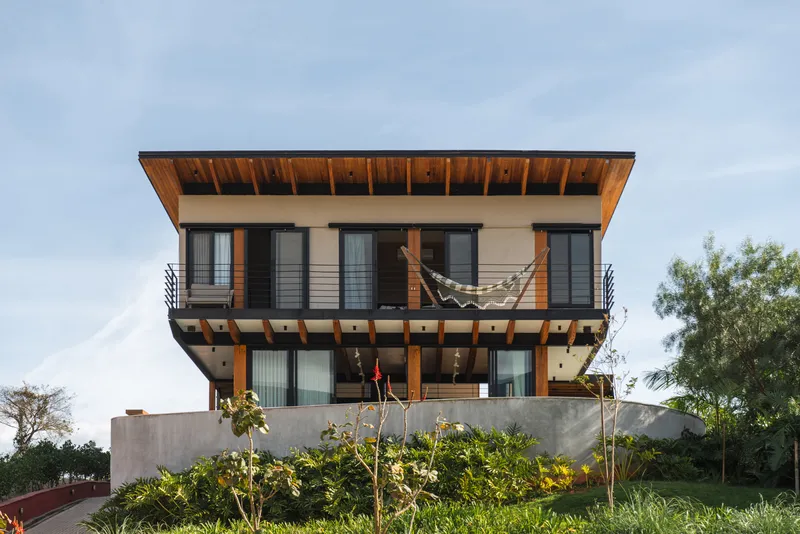
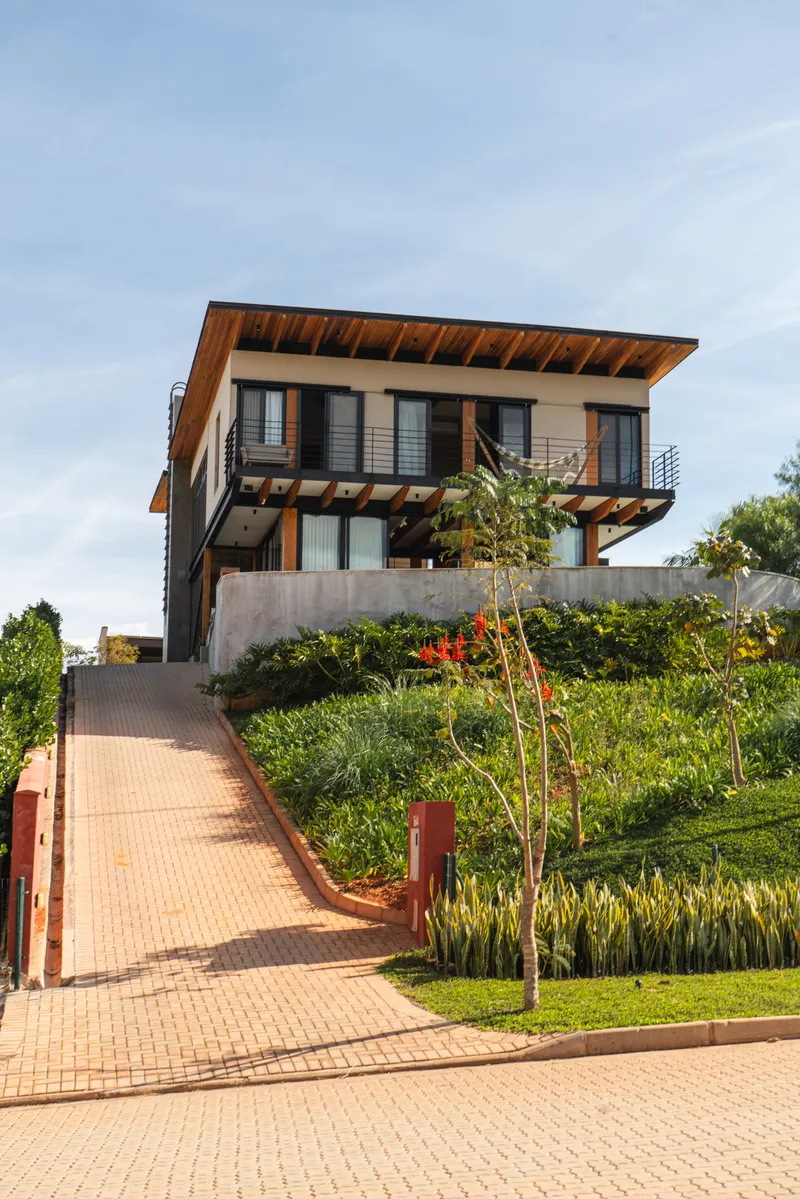
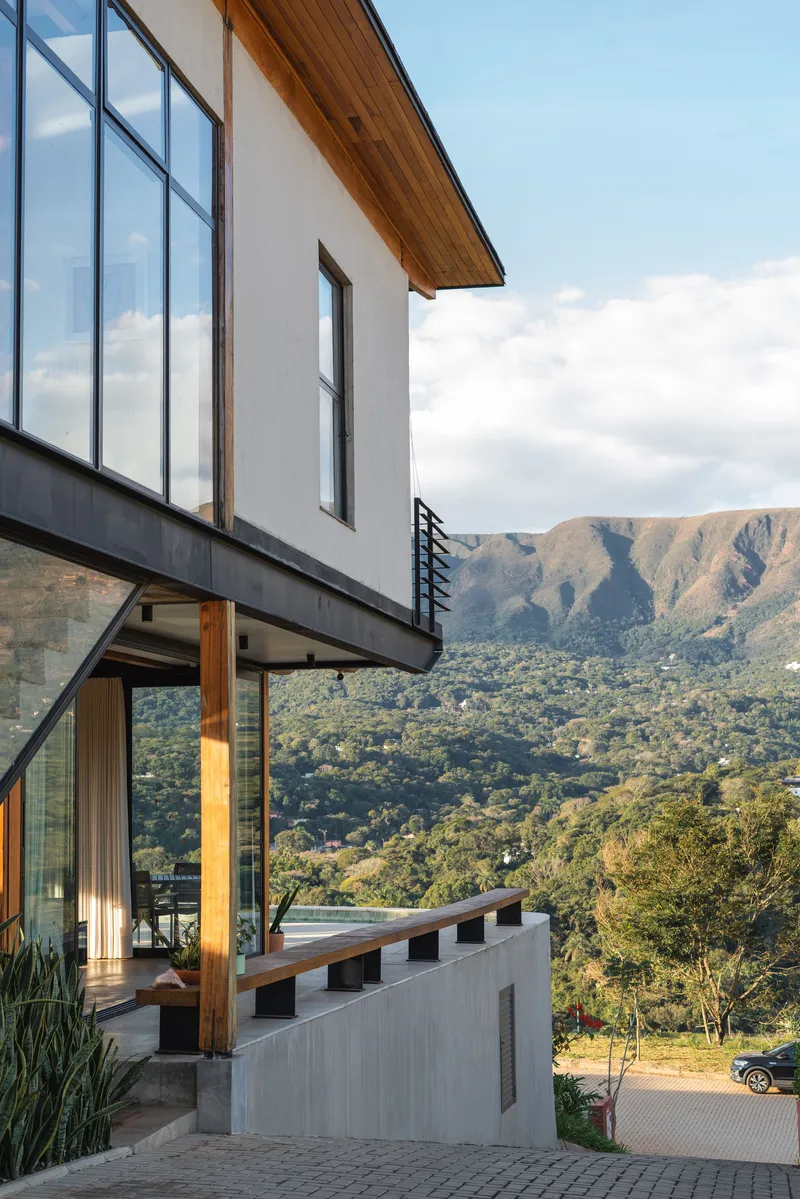
The entry sequence is one of descent. Visitors approach along a landscaped path that follows the grade down, passing a concrete retaining wall before arriving at a level where the house reveals its full valley-facing elevation. The upper volume cantilevers beyond its timber columns, hovering above the slope and framing a long panorama of the Serra da Moeda in the gap between structure and ground. It is a simple move, but it sets the tone: you arrive slightly above the main living level, then the house pulls you forward and down into the landscape.
The concrete base grounds the building into the hillside, managing water and soil pressure while providing a solid datum for the lighter timber and steel structure above. Horizontal railings on the upper level reinforce the sense of linearity, stretching the facade out and keeping the roofline low despite the generous interior heights.
The Double-Height Core
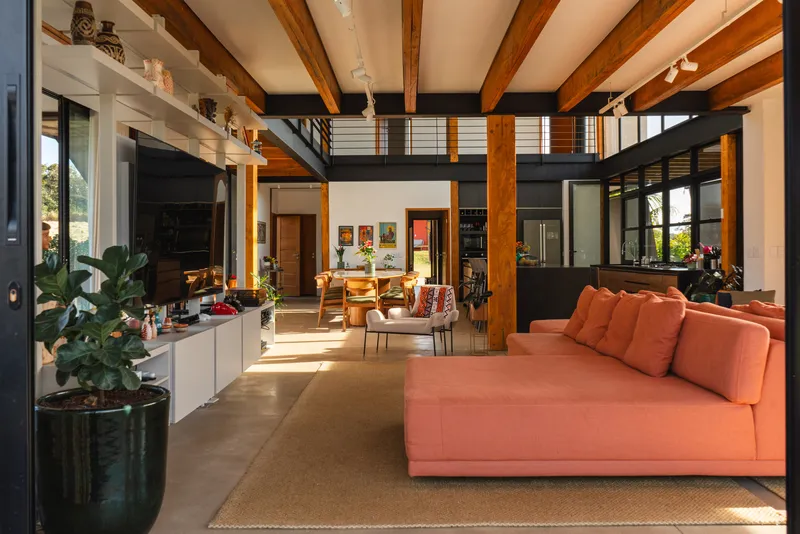
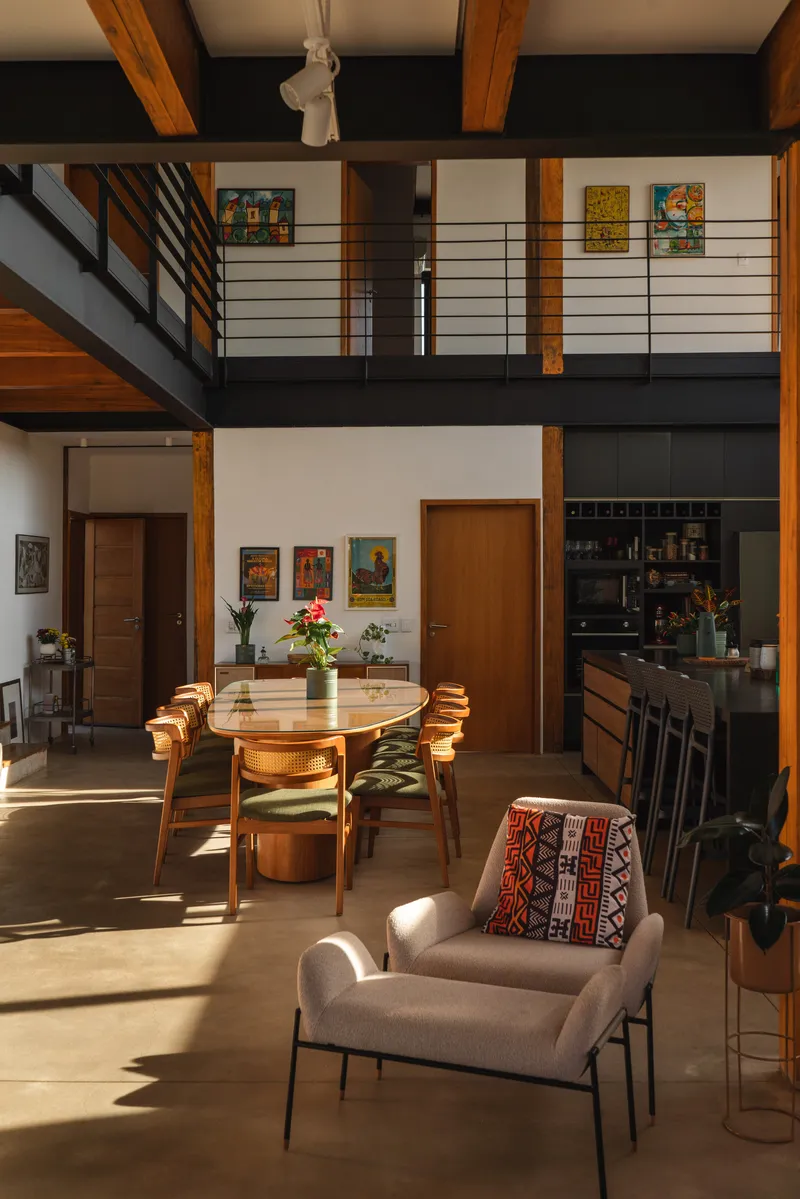
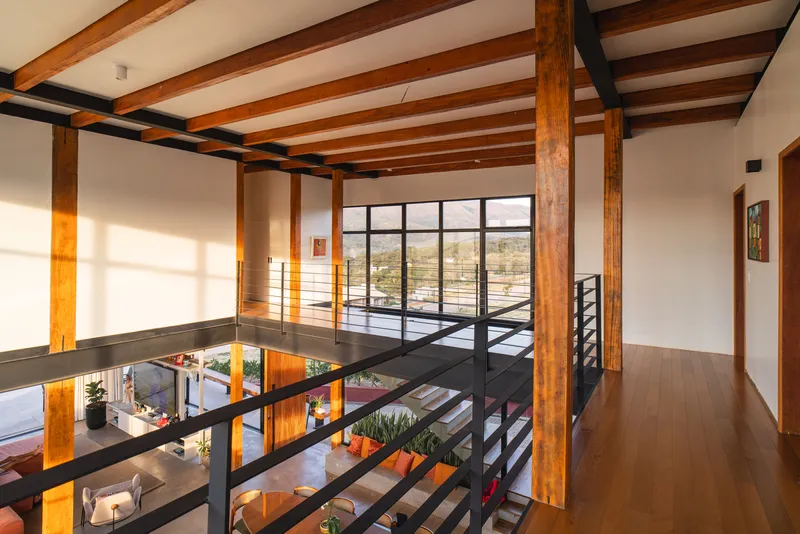
The kitchen and dining area sit at the heart of the plan under a double-height ceiling crossed by exposed timber beams. A black steel mezzanine bridges the upper floor above, creating a catwalk that lets family members look down into the social space below. Afternoon sun enters at a steep angle, lighting the polished concrete floor and turning the timber columns into warm vertical markers that punctuate the open volume.
This is the space that holds the house together, both structurally and socially. During a party, it is the natural gathering point: tall enough to absorb noise and crowd energy, connected on one side to the terrace and pool, and on the other to the more enclosed living room. During a quiet weekday, the mezzanine becomes a threshold between bedrooms and common areas, a place to pause and check who is downstairs before descending.
Kitchen, Dining, and the Art of the Long View
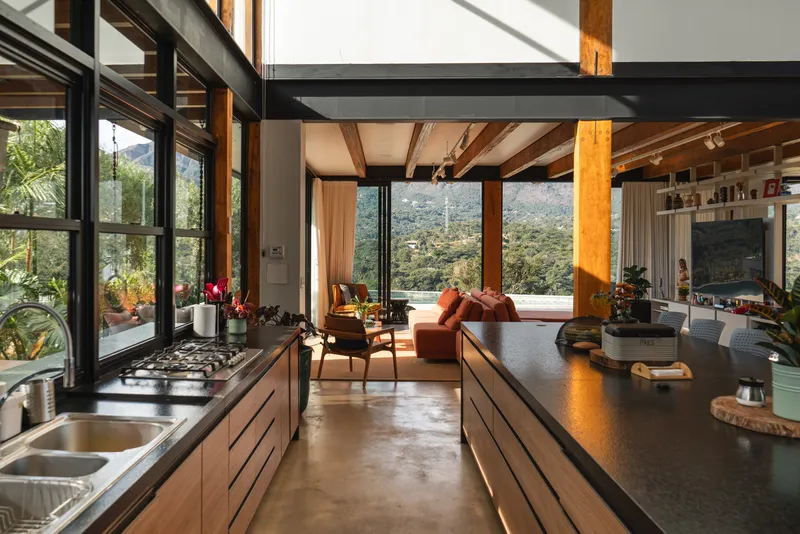
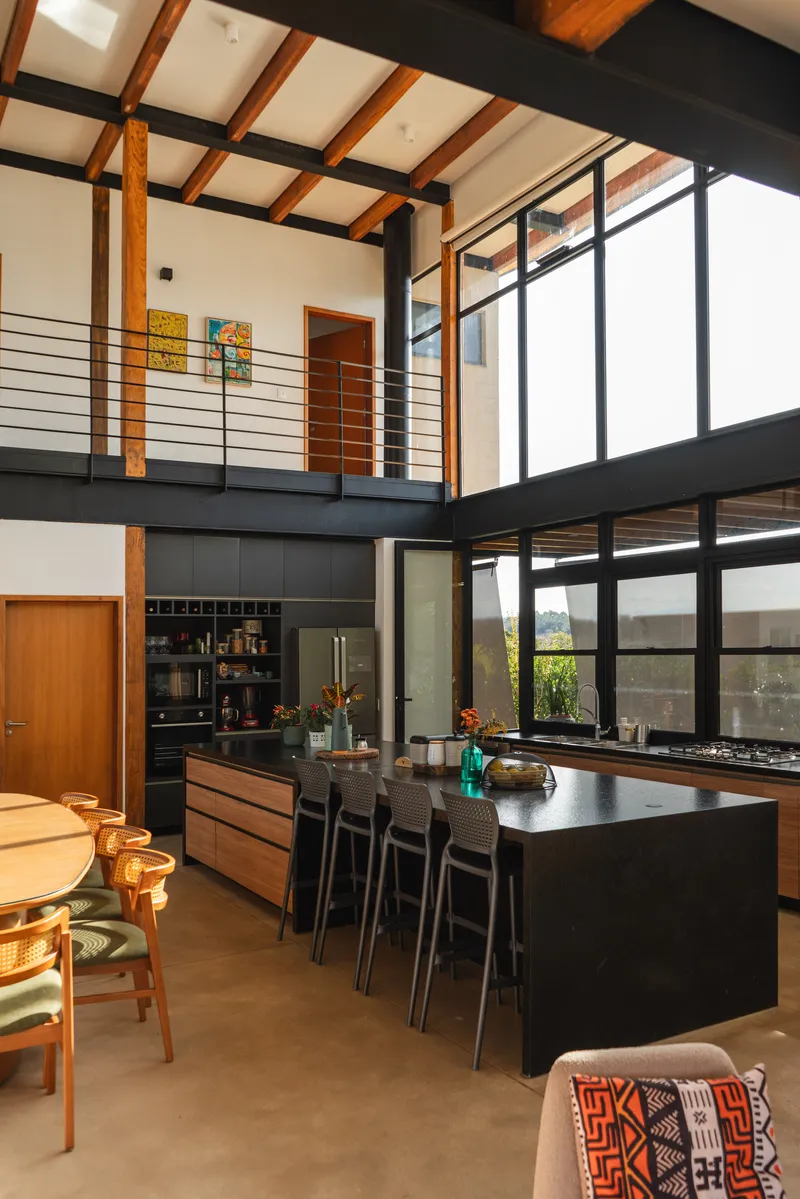
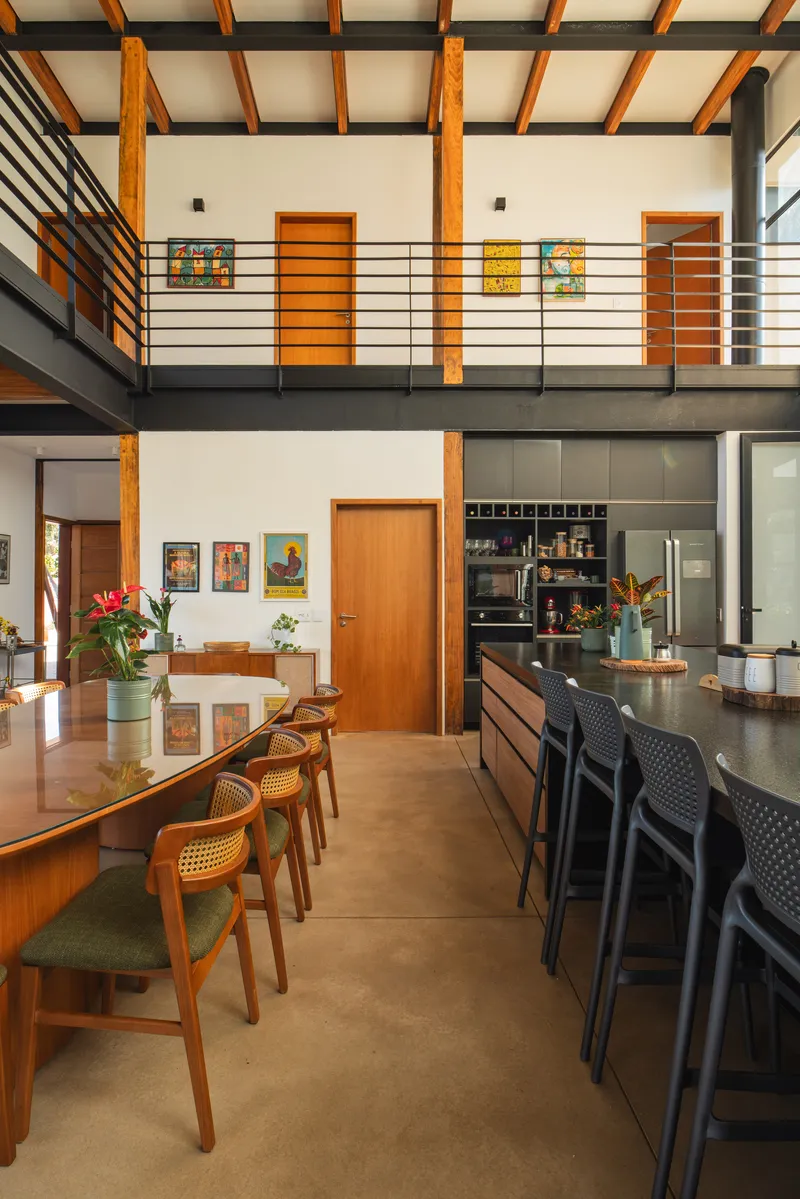
The kitchen island sits beneath the mezzanine, its ceiling compressed by the timber joists of the floor above. Floor-to-ceiling glazing on the courtyard side floods the cooking area with diffused light while maintaining visual privacy from the main entertaining spaces. It is a clever sectional trick: the cook is sheltered, almost cavelike, while the dining table a few steps away opens into the full double height.
A floating steel staircase with glass balustrades connects the two levels beside the dining zone, and through its transparent treads you catch the mountain view beyond the planted terrace. The staircase does not compete with the landscape; it frames it. The dining table itself is oriented so that seated guests look through the house's deepest axis toward the valley. Everything here is calibrated for sight lines.
Living Spaces and the Landscape Threshold
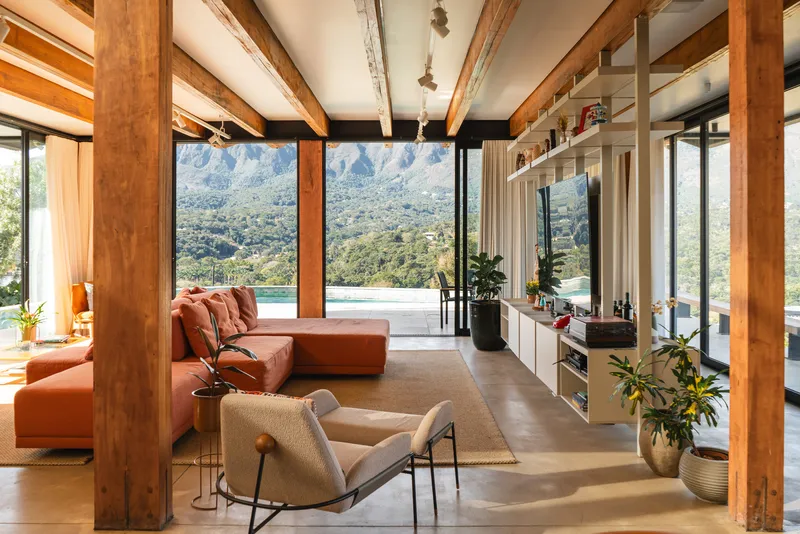
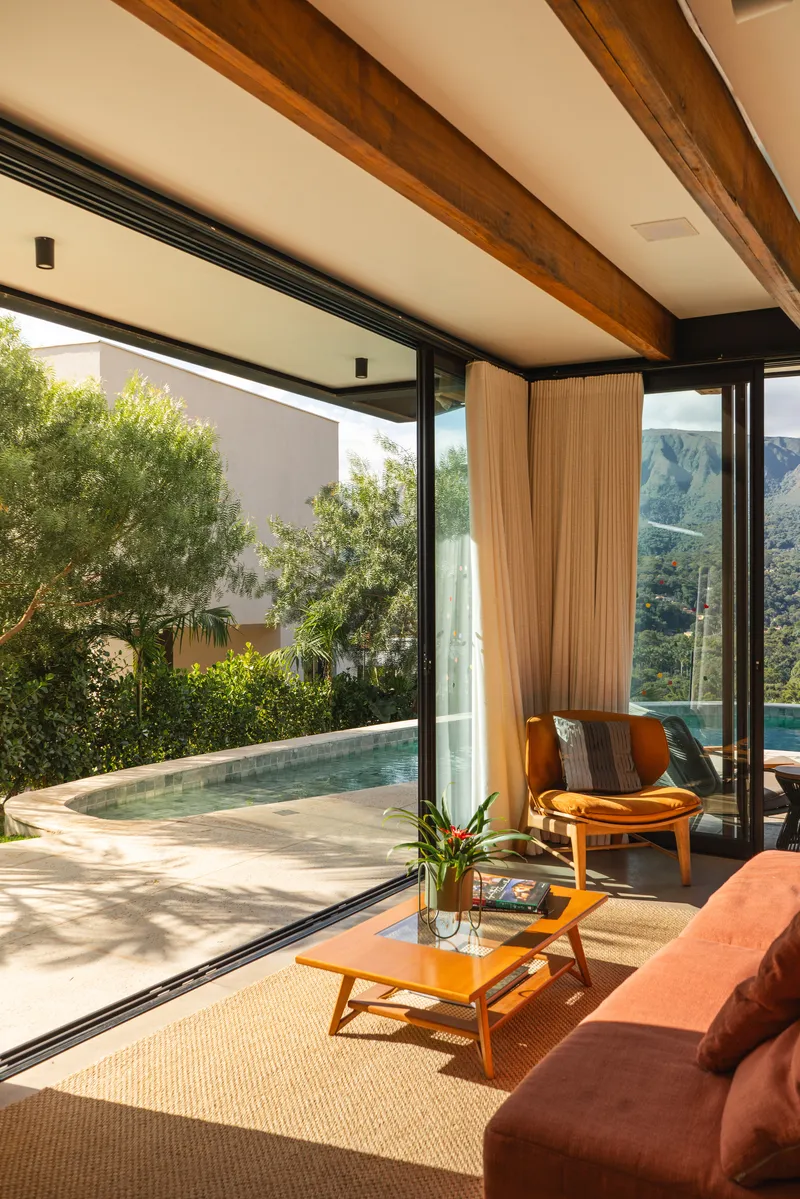
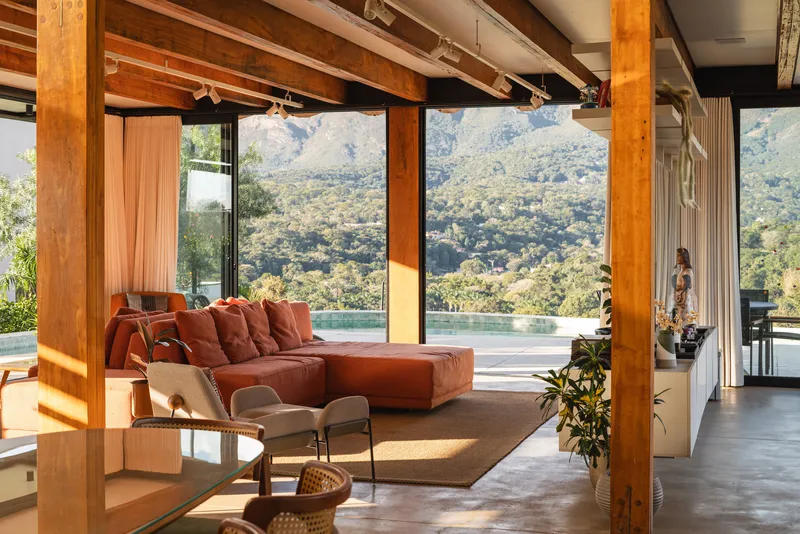
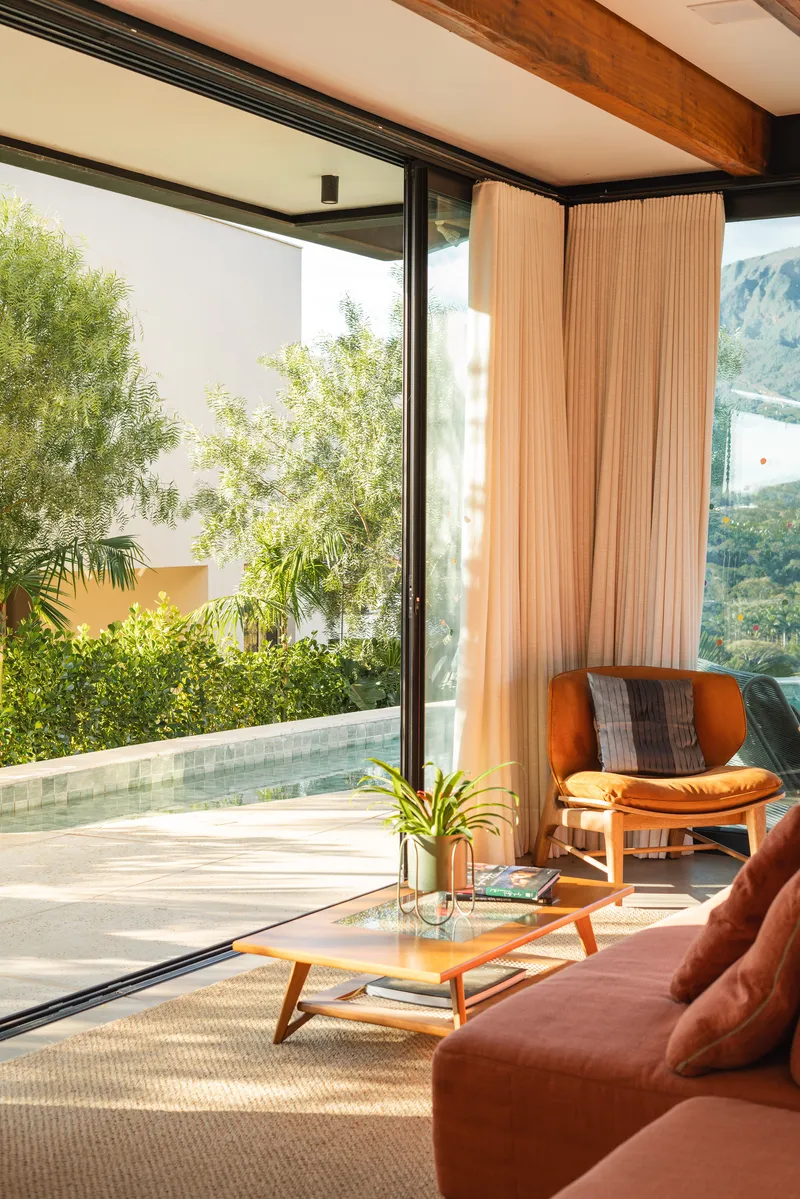
The living room occupies the front portion of the property, where full-height sliding glass panels dissolve the boundary between interior and terrace. Exposed timber beams run the length of the ceiling, extending visually beyond the glass line and into the covered outdoor zone. An infinity pool sits just past the terrace edge, its surface reflecting the distant hills and reinforcing the sense that the house is perched at the brink of the valley.
Timber columns do the structural work here, carrying the roof while keeping the wall plane free for glass. The result is a room that feels column-free at eye level, with the structural logic visible only when you look up at the ceiling. A polished concrete floor runs without interruption from the interior to the terrace, further blurring the indoor-outdoor divide.
Private Rooms and Considered Details
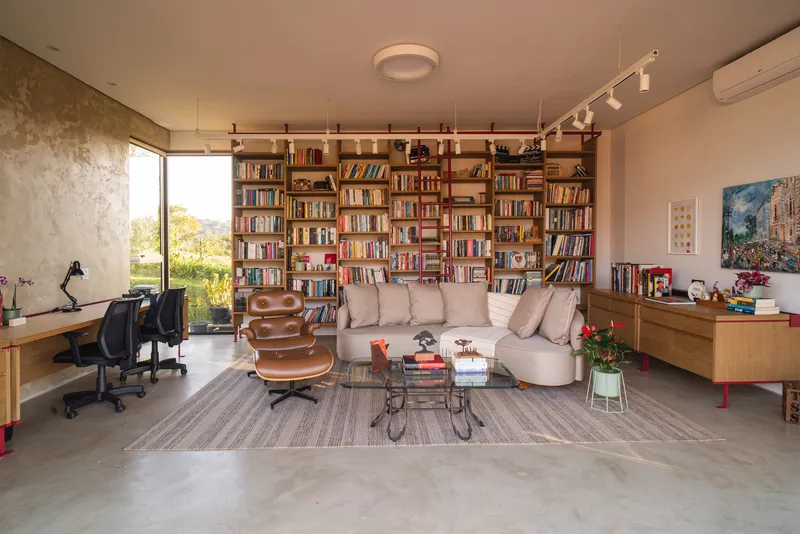
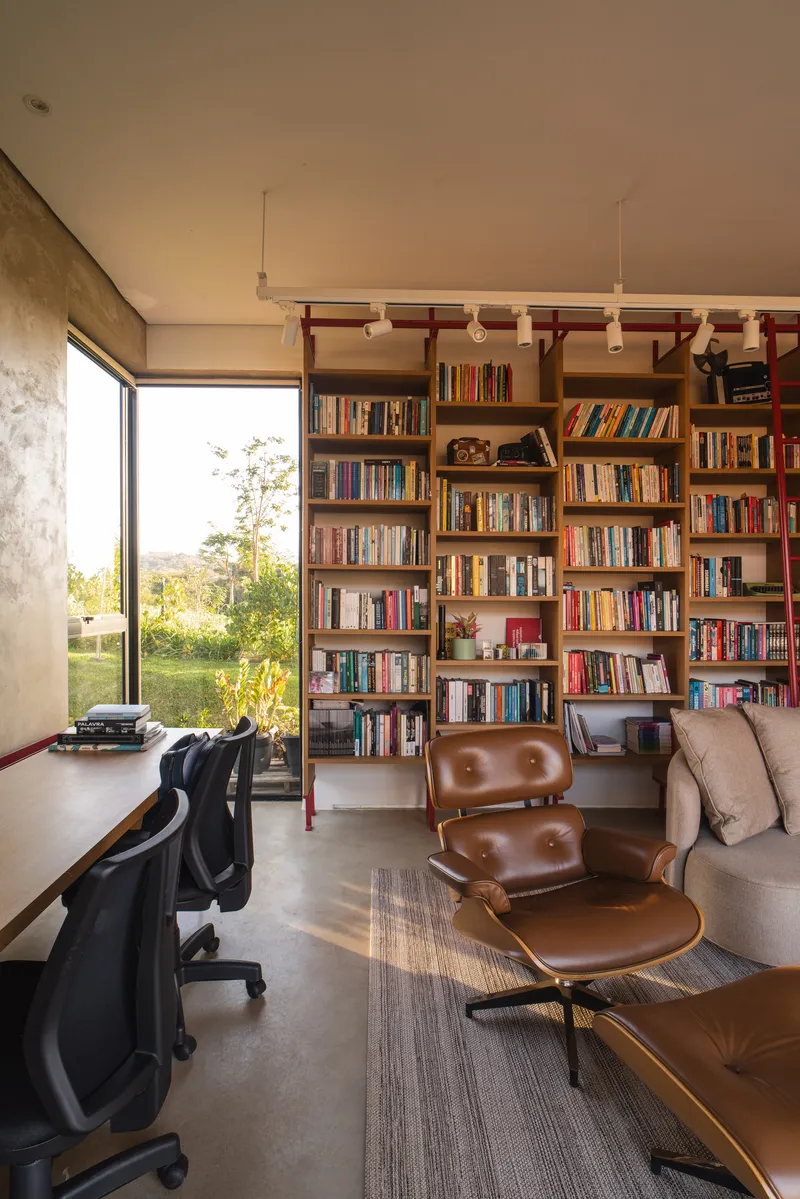
Away from the social core, the house shifts register. A living room lined with a floor-to-ceiling bookshelf and track lighting provides a quieter retreat, its polished concrete floor grounding a space that feels more library than lounge. A home office takes the same shelving system and adds a red steel ladder rail, a flash of color against otherwise neutral tones, with a corner window angled to capture a specific mountain view.
Vertical timber panels beside sliding glass doors introduce texture and modulate the light entering the private bedrooms. These panels work as shading devices and privacy screens simultaneously, filtering the strong Minas Gerais sun without requiring curtains. The material palette throughout is restrained: concrete, timber, steel, glass. Nothing competes with the landscape.
Outdoor Rooms and the Curved Pool
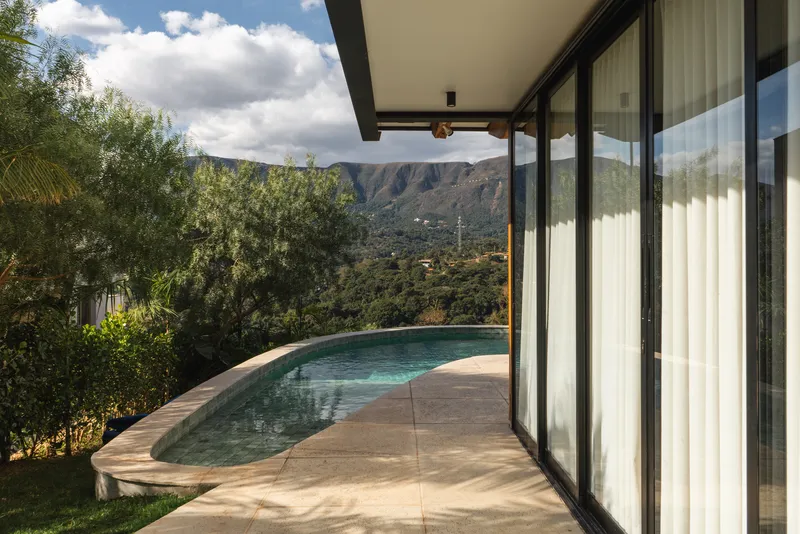
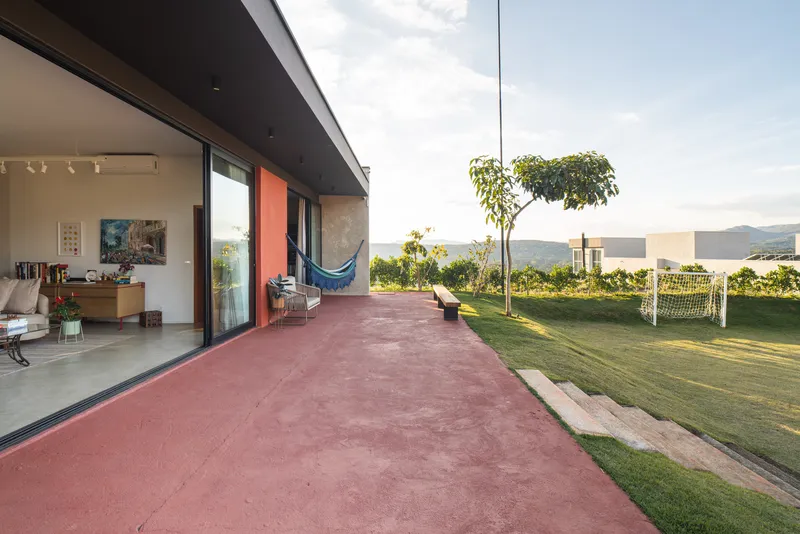
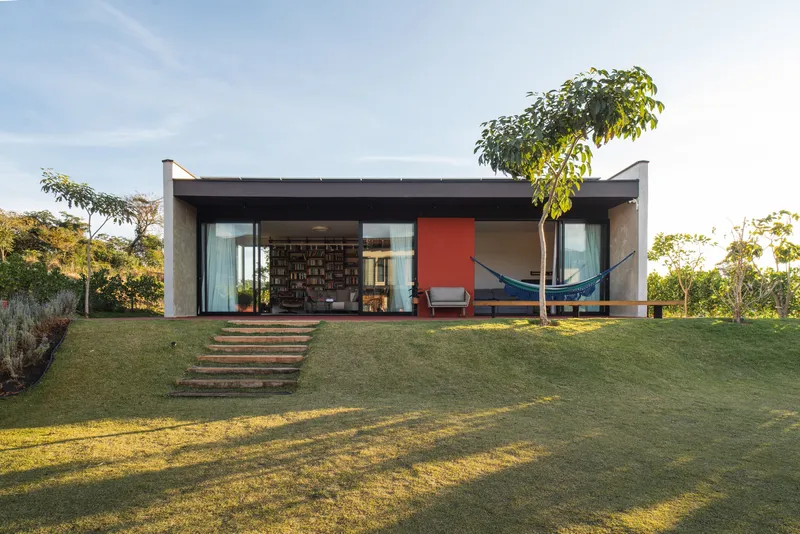
The terrace wraps around a curving pool whose organic geometry contrasts with the rectilinear discipline of the house itself. Stone pavers line the pool deck, providing a material break from the concrete interiors and signaling the transition to a distinctly outdoor register. A covered terrace with red concrete paving extends to a lawn fitted with a soccer goal, an unambiguous declaration that this is a house where people come to play.
At dusk, the garden facade reveals the building's section most clearly. A concrete butterfly roof caps one volume, its angular profile visible against the fading sky, while the glazed walls below glow with interior light. The two main volumes, connected by a covered walkway, read as separate pavilions from this angle, each with its own relationship to the grade and the garden.
Interior Light and Mezzanine Life
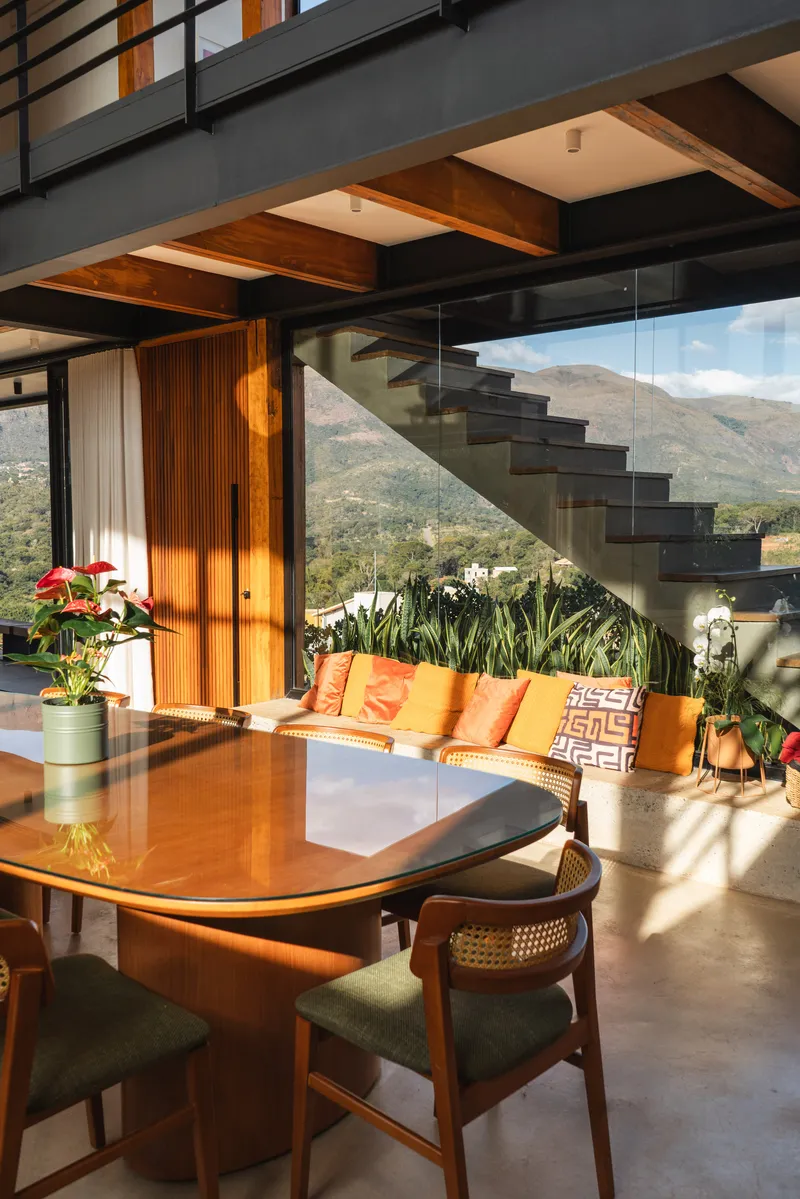
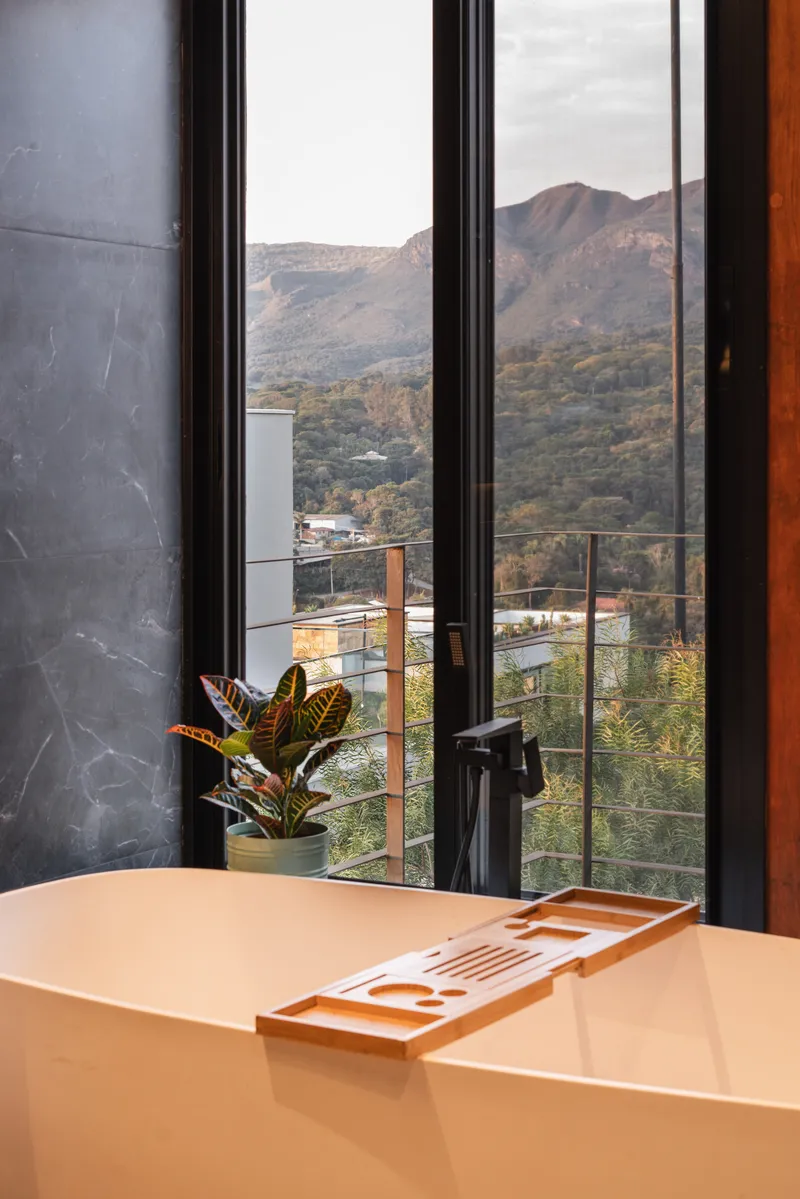
The way light moves through the double-height space changes the character of the house over the course of a day. In the afternoon, sun pours through the full-height glass and rakes across the polished floor, catching the horizontal steel railings of the mezzanine and casting long parallel shadows. By evening, the mountain view shifts from bright panorama to silhouette, and the interior volume becomes warm and contained under its timber ceiling.
Black-framed glass doors on the upper level open to a balcony that puts you at tree canopy height, a fundamentally different relationship with the landscape than the ground-floor terrace offers. The architects understood that a house on a slope should provide multiple elevations of experience, not just one.
Plans and Drawings
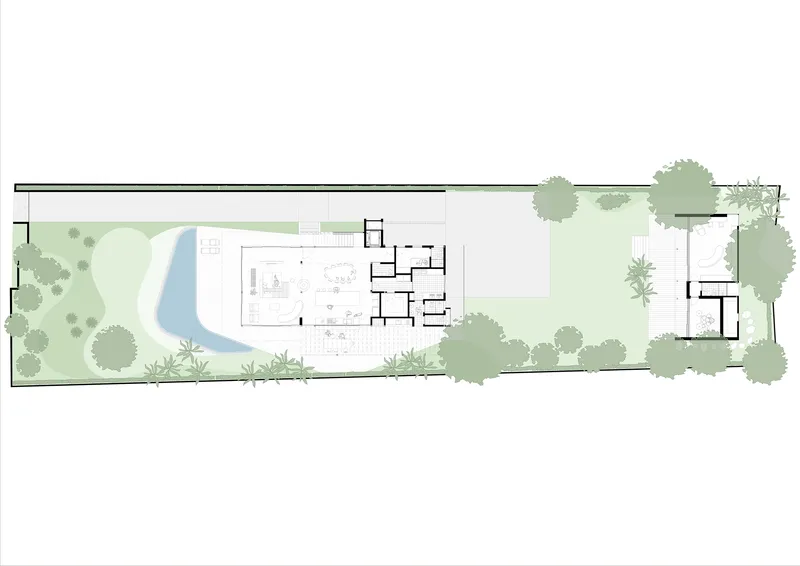
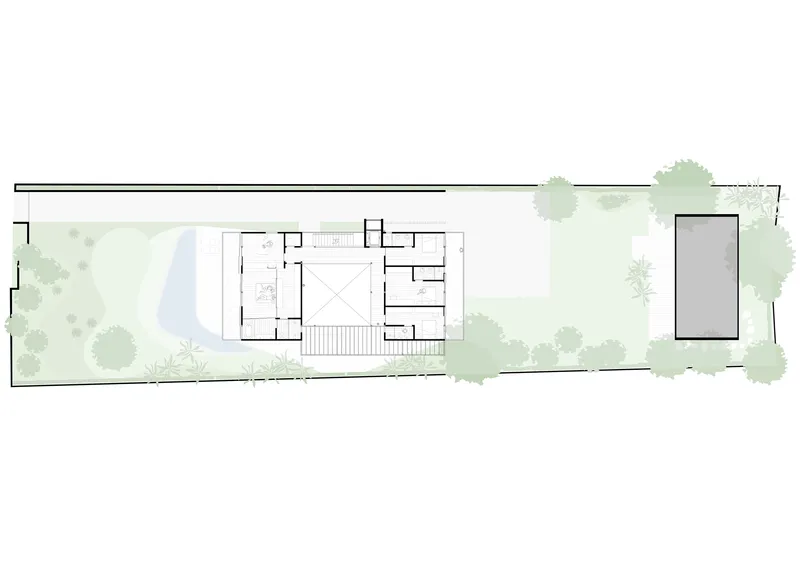
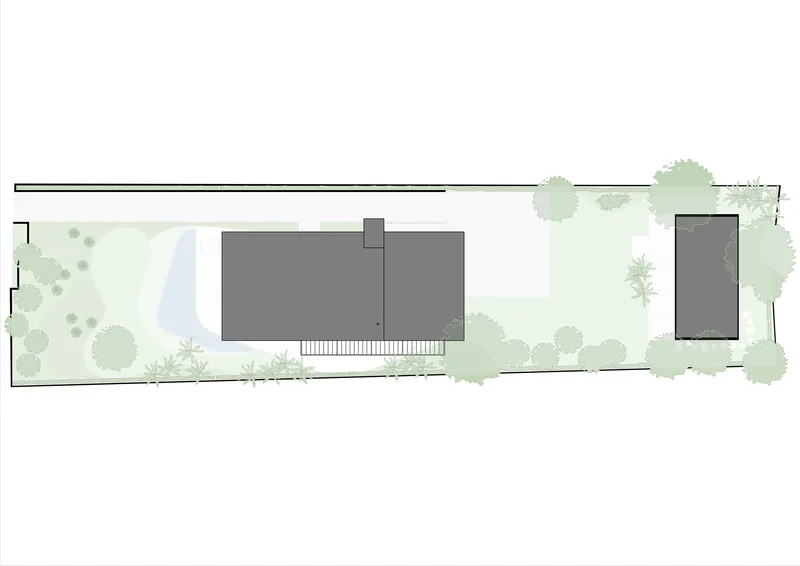
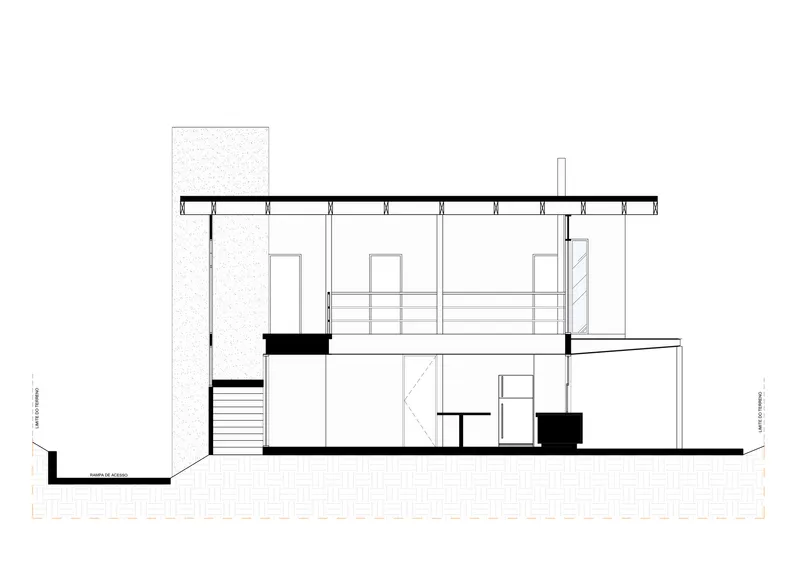
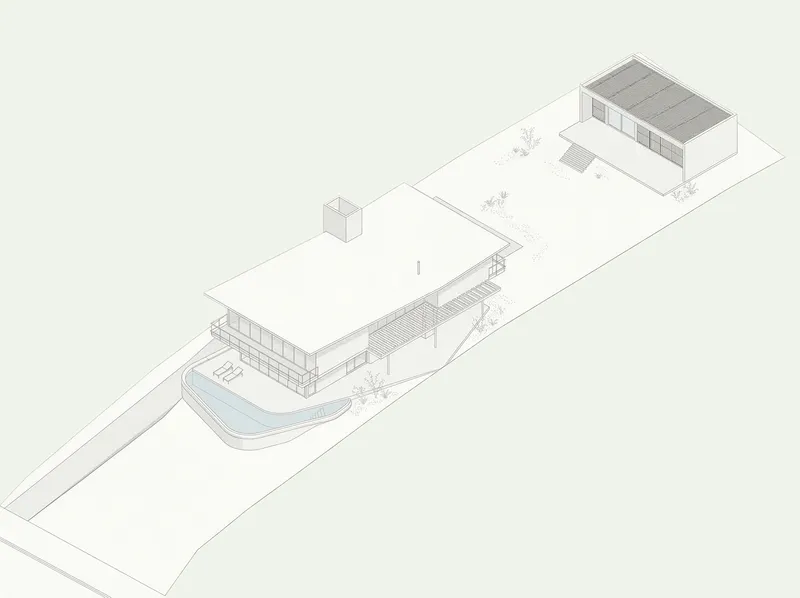
The ground floor plan confirms what the photographs suggest: the building is organized as two low-rise volumes connected by a covered walkway, with a curving pool wrapping along the downhill edge. The upper floor plan shows how the mezzanine bridges the double-height void, providing a second-floor walkway that links the private bedrooms to the central stair without requiring a corridor. The section drawing is the most revealing document, exposing the two-story interior volumes, the flat roof with its exposed structural beams, and the way the building steps down to meet the grade.
The axonometric drawing pulls the scheme apart into its clearest diagram: two rectangular bars, a connecting link, and a freeform water feature that softens the composition. The site plan shows just how much of the lot remains landscape, with perimeter vegetation enclosing the property and the building footprint occupying a relatively modest portion of the total area. It is a house that gives as much land back to the garden as it claims for structure.
Why This Project Matters
Boa Vista House is a reminder that the best party houses are not the biggest ones but the most precisely organized. The double-height kitchen core, the cantilevered roof, the dissolving glass walls, and the curving pool are not formal gestures for their own sake. Each one solves a specific problem: gathering a crowd, framing a view, connecting inside to outside, softening a rectilinear plan. The collaboration between three practices, facury, guaja.cc, and Thiago Bandeira, produced a design that feels unified rather than compromised, with a material palette that stays consistent from the retaining wall at the entry to the stone pavers at the pool.
For architects working on sloped sites in tropical climates, there is a lot to learn here about how section drives plan rather than the other way around. The house does not fight its topography; it uses the grade change to create distinct spatial experiences at each level, from the compressed entry sequence to the expansive valley-facing terrace. Brumadinho is already home to Inhotim, one of the world's great art and landscape parks. Boa Vista House argues that the domestic architecture of the region deserves equal attention.
Boa Vista House by facury, guaja.cc, and Thiago Bandeira. Brumadinho, Brazil. 686 m². Completed 2023. Photography by José Henrique Paiva.
About the Studio
facury
Share Your Own Work on uni.xyz
If projects like this are the kind of work you want to make, uni.xyz is a place to publish your own, find collaborators, and enter design competitions.



Popular Articles
Popular articles from the community


The Earth Pod: 3D Printed Homes for Resilient Refugee Communities
The Earth Pod reimagines refugee housing through 3D printed homes made from clay, combining resilience, self-sufficiency, and rapid shelter.

The Ocean Hive: Sustainable Architecture for a Self-Sufficient Civilization at Sea
The Ocean Hive imagines sustainable architecture at sea, where modular habitats, algae, wave power and ocean waste sustain a growing colony.

Co-life: Sustainable Architecture for Age-Friendly Community Living
Co-life reimagines sustainable architecture for seniors through courtyards, rammed earth, shared gardens, and spaces designed for belonging.

Co-Life: Senior Housing Design That Reconnects Older Adults With the City
Co-Life reimagines senior housing design through healing gardens, shared streets, workshops, and a sustainable community across generations.


Similar Reads
You might also enjoy these articles

Bao Huynh Watercolor Atelier: A Serene Art Retreat in Hội An
Bao Huynh Watercolor Atelier in Hội An blends multifunctional art spaces, sustainable design, local materials, and family-friendly living in a serene environment.

Atelier Macri Concept Store Interior Design by CASE-REAL
Atelier Macri store features a "ko" counter, walnut wood details, cork displays, blending retail, gallery, and seamless customer experiences.

Manuel Vargas Izquierdo Stadium and High-Performance Sports Center: Architectural Excellence in Jalpa de Méndez
The Manuel Vargas Izquierdo Stadium blends sustainable design, inclusive sports facilities, and cultural-inspired architecture, revitalizing Jalpa de Méndez’s public spaces.

KAKR Buluh Awar Hall: Revitalizing Community and Ecology Through Bamboo Architecture
Community built bamboo hall revitalizes Buluh Awar village, empowering youth, restoring ecology, celebrating vernacular craftsmanship through sustainable architecture and culture.



Comments (0)
Please login or sign up to add comments
No comments yet. Be the first to comment!