
Laurynas Žakevičius Architects Carve a Larch-Clad Barn House into a Lithuanian Pine Forest
A 170-square-meter family home in Druskininkai channels Dzūkija barn-building traditions through untreated larch and double-height living spaces.


The barn is one of Lithuanian vernacular architecture's most honest forms: a gabled volume, wooden from ground to ridge, built to weather. In Druskininkai, at the forested edge of the Dzūkija ethno-cultural region, Laurynas Žakevičius Architects took that typology and reworked it into a 170-square-meter family house that treats the entire envelope as a single, continuous larch surface. No paint, no impregnant, no maintenance schedule. The material simply ages, darkening after rain, burning paler on the south face, greying on the north, until the house looks less like something placed in the forest and more like something that grew out of it.
What makes this project worth studying is the tension between that austere exterior and the generously glazed, almost gallery-like interior. The house is one story with an attic, yet the double-height living space and interior mezzanine give it a spatial volume far larger than its footprint suggests. Exposed timber beams run the length of the ceiling, the structural logic on full display, while floor-to-ceiling glass on the ground level pulls the surrounding pine trunks into every room. It is a house that refuses to separate craft from concept.
A Gable in the Clearing
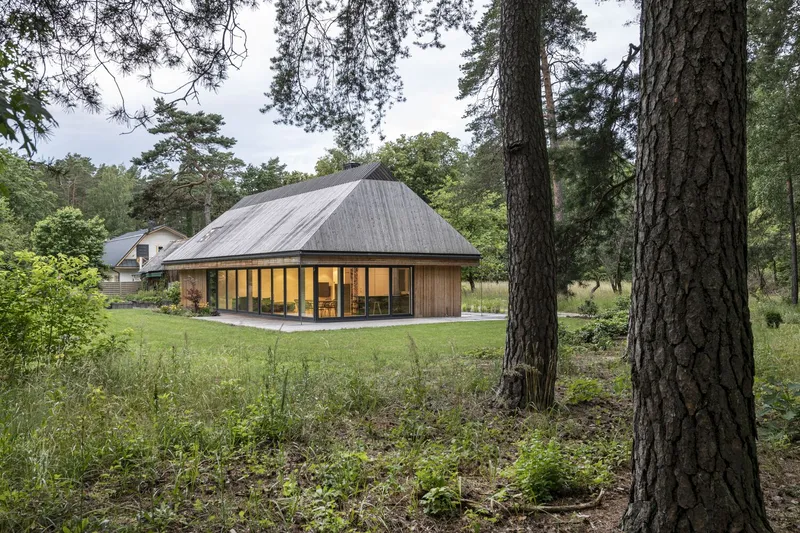
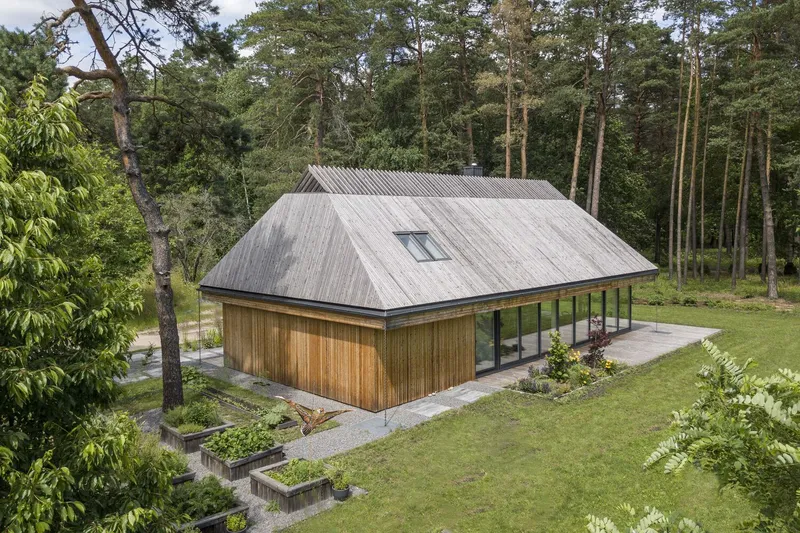
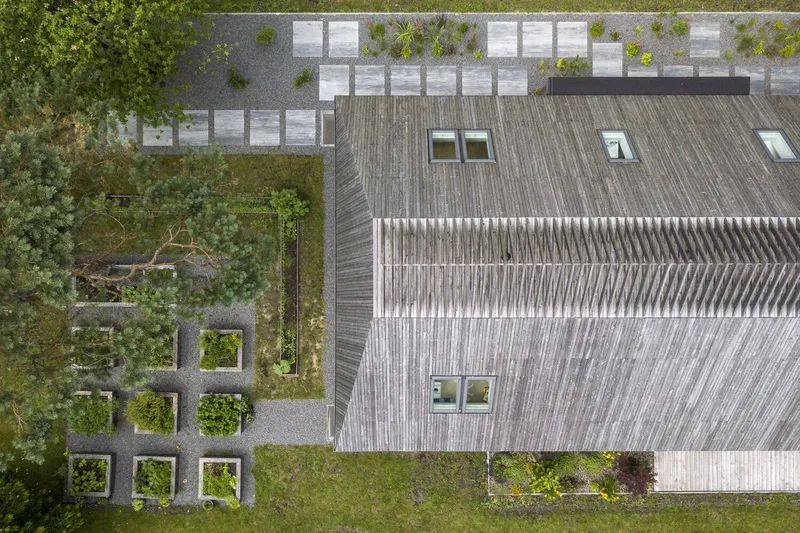
From the outside, the house reads as a compact sculptural object: a clean gable clad entirely in vertical larch boards, roof included. The corrugated metal cap along the ridge and the skylights punctuating the roof plane are the only concessions to non-wood materiality. Seen from above, the building sits in a gravel-and-planting matrix of raised beds and paved terraces that extend the domestic footprint without paving over the forest floor. The approaches to the house remain, in the studio's words, "naturally cultured," and the effect is a dwelling that occupies its clearing lightly.
One subtle detail worth noting is the hollow openwork screen at the roof's peak. Depending on angle and light, the perforated zone reads as ornament, ventilation, or both. It nods to traditional Dzūkija gable detailing while introducing a pattern that shifts with the viewer's movement, a controlled moment of visual complexity on an otherwise monolithic form.
Glass Walls and Pine Trunks
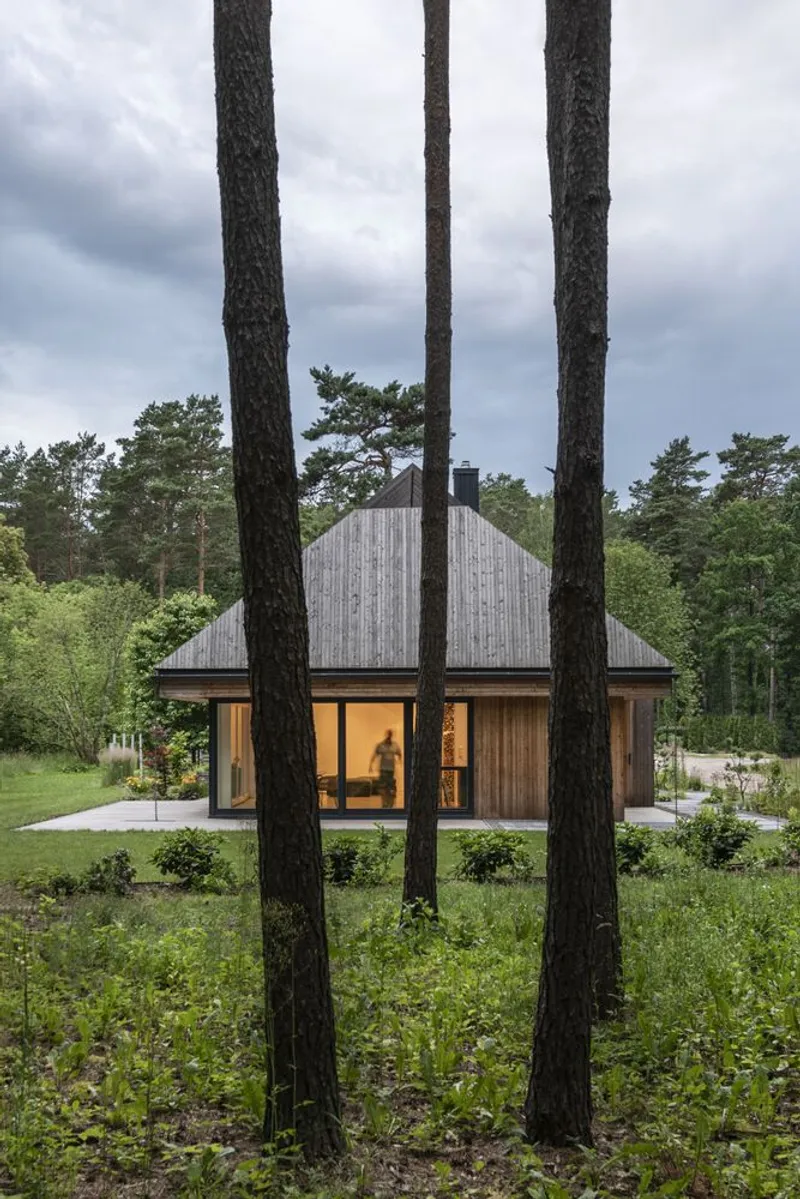
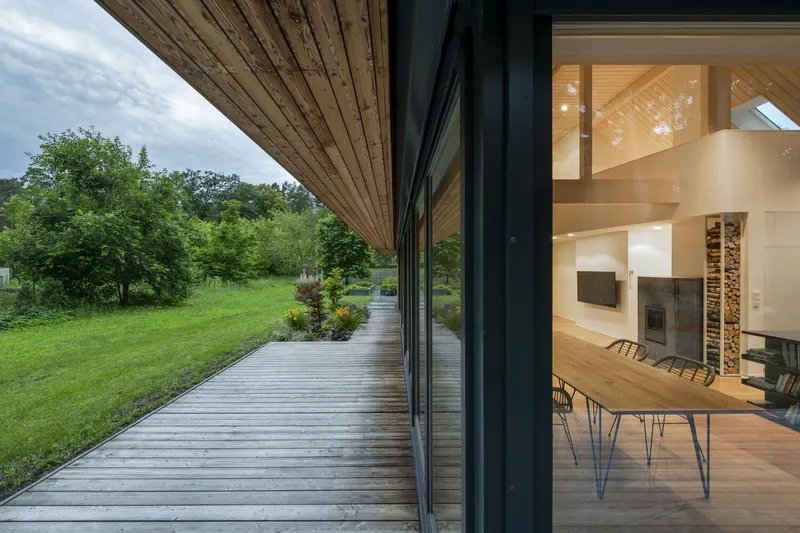
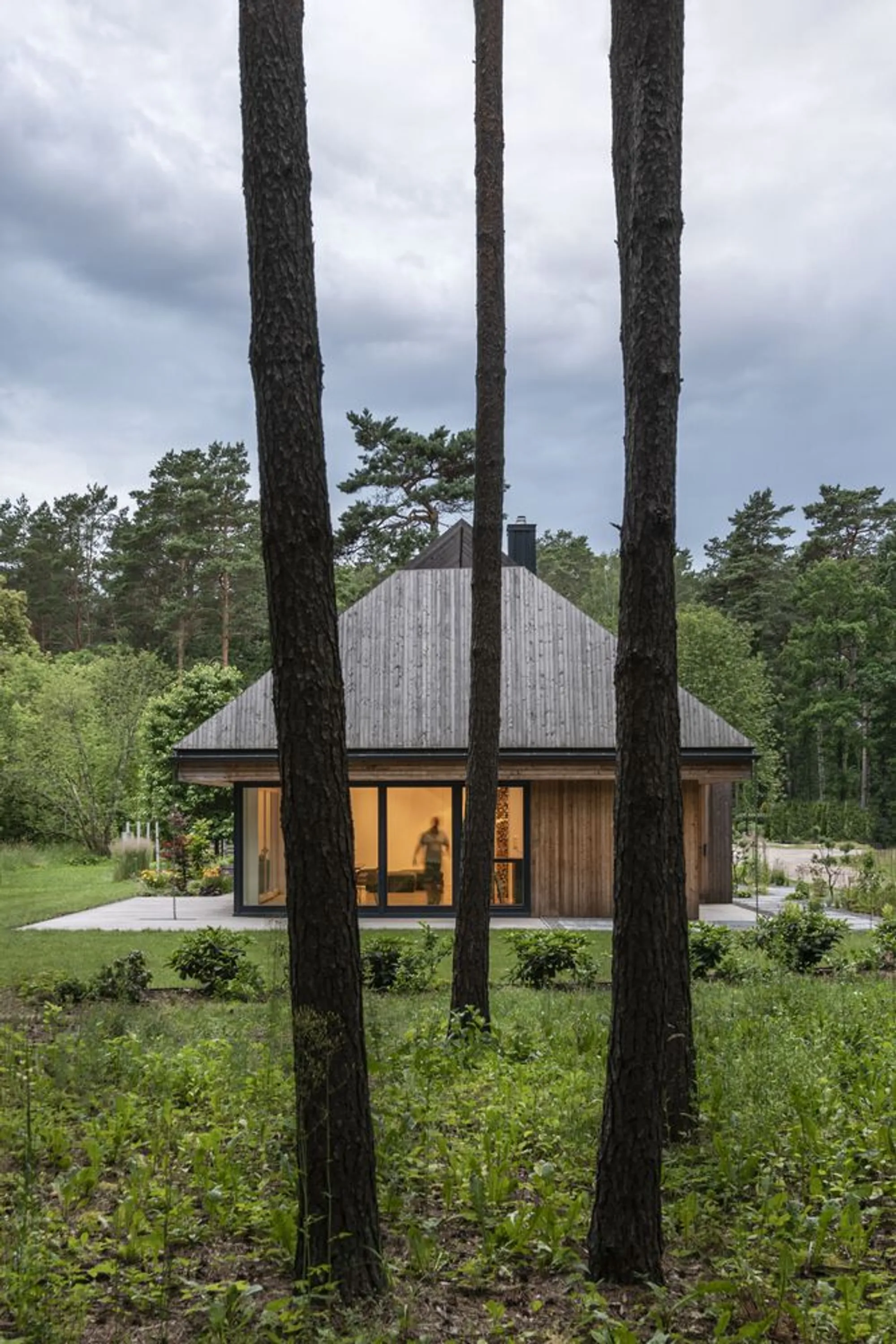
The ground floor is wrapped in floor-to-ceiling glazing that collapses the distinction between interior and exterior. At dusk, the house glows between pine trunks, the three or four nearest trees framing the facade like columns in a natural loggia. A timber deck circles the perimeter, functioning as both threshold and outdoor room. Through the glass, the dining table and kitchen counter are visible from the garden, reinforcing a transparency that makes the 170-square-meter plan feel borderless.
The strategy is not decorative. By orienting the large glazed openings toward the pine forest and meadow, the architects maximize passive daylight while keeping the occupants in constant visual contact with the landscape. The house does not demand a manicured garden because the forest itself is the garden.
The Double-Height Living Room
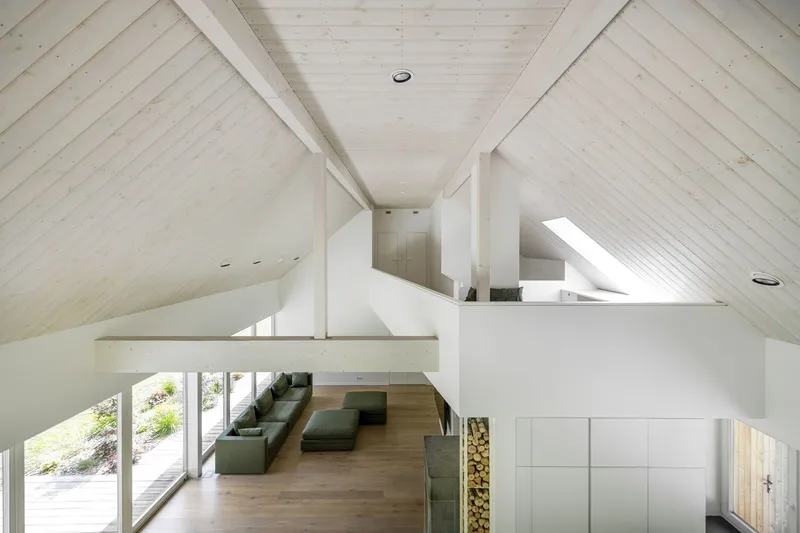
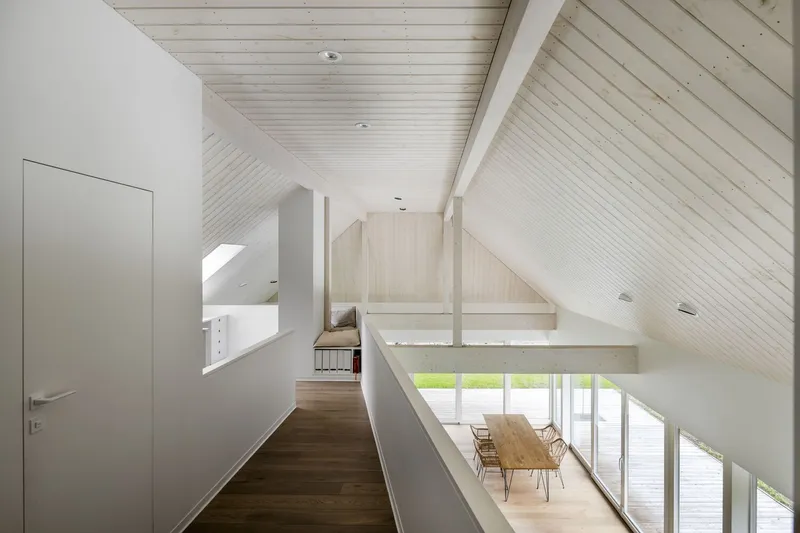
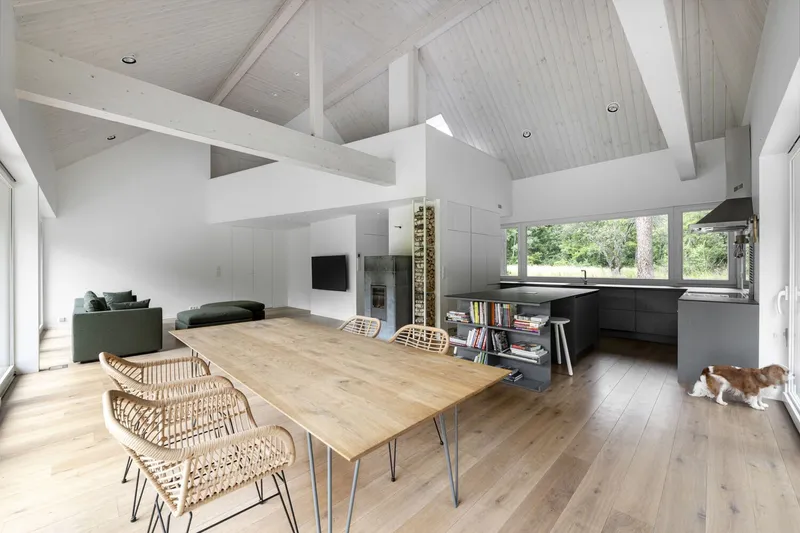
Step inside and the spatial generosity becomes clear. The living area rises to the full height of the gable, with exposed timber beams spanning the ceiling and diagonal planking adding texture overhead. From the upper mezzanine, the view down into the living and dining zone reveals the entire domestic program in a single glance: kitchen island, bookshelves, dining table, and the forest beyond the glass. A glass balustrade keeps the mezzanine visually open, allowing light from the skylights above to wash both levels.
The structural beams are not hidden or painted. They are the architecture. Every joint and span is legible, turning the ceiling into a lesson in Lithuanian timber construction. The palette is restrained: pale wood above, oak flooring below, white walls where the wood stops. The result is a room that feels simultaneously warm and precise.
Kitchen as Threshold
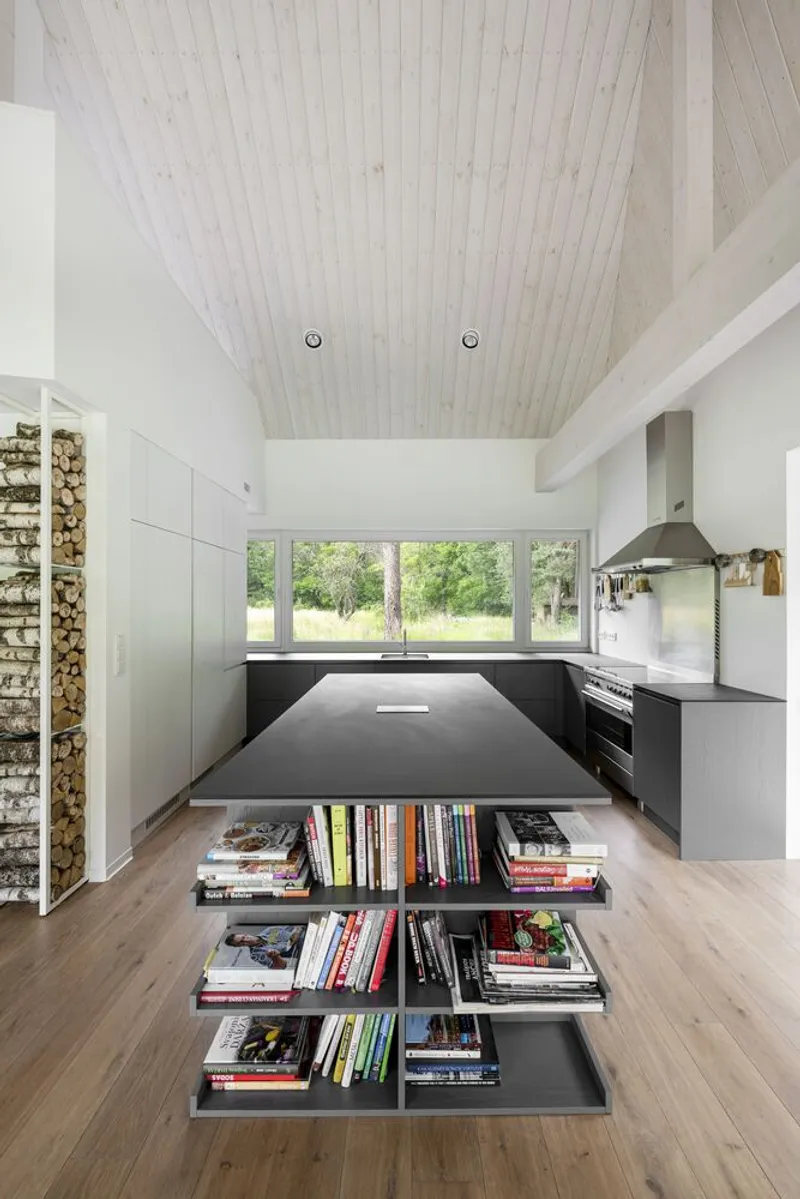
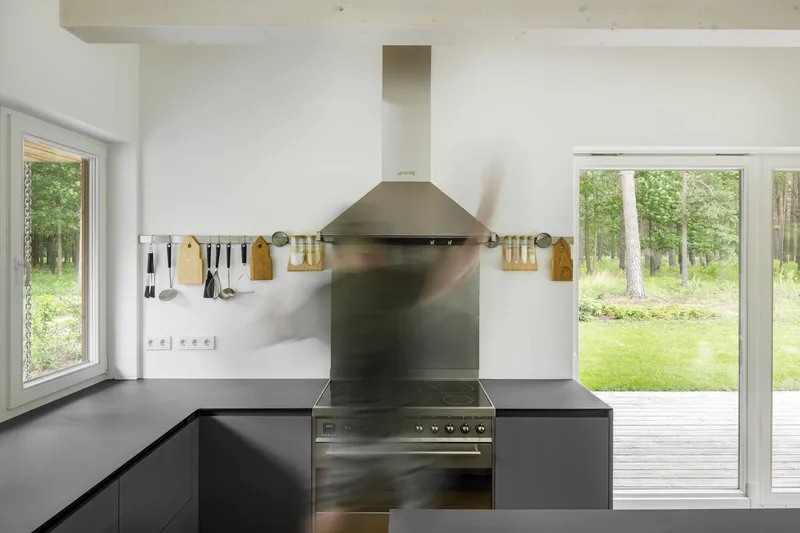
The kitchen sits beneath the vaulted ceiling where the attic floor pulls back, giving the cook the same spatial drama as the living room. A long island doubles as a library shelf on its lower face, an efficient move that keeps books within reach without introducing a separate piece of furniture. Black cabinetry and a stainless steel range hood anchor one wall, framed on both sides by windows that look directly into the forest. It is a kitchen designed for someone who wants to see trees while chopping onions, and there is nothing wrong with that.
Landscape as Architecture
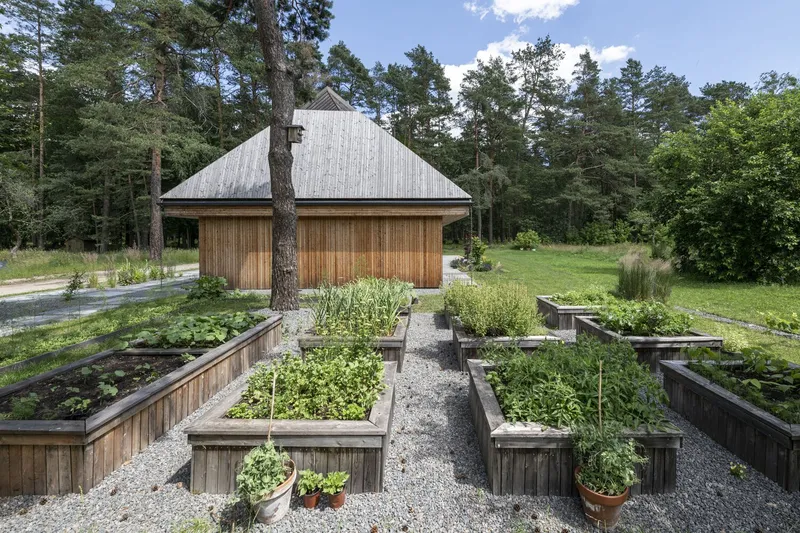
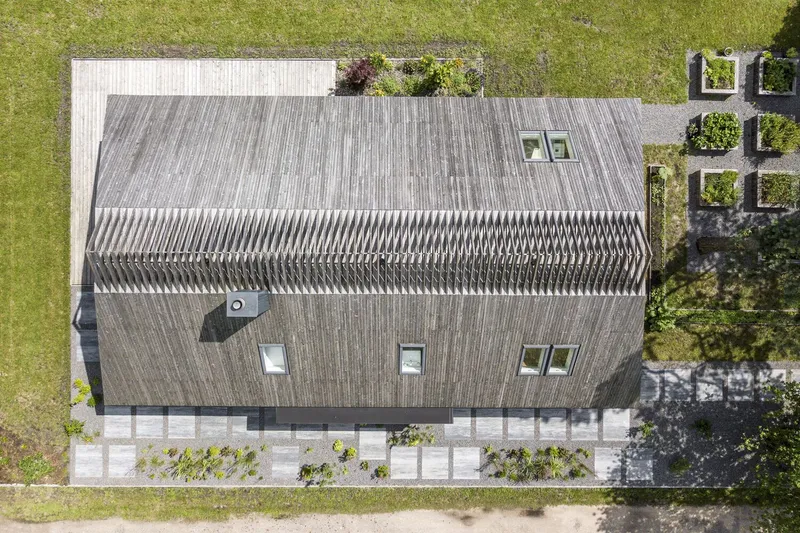
The raised timber garden beds arranged along gravel paths are not afterthoughts. Built by the homeowners, they use the same vertical larch cladding as the house, binding edible garden and architecture into one visual system. Herbs and vegetables grow against the facade as if the building were sprouting. Seen from above, the roof terrace garden, the skylights, and the planted beds below compose a domestic landscape that is productive, not merely scenic.
Druskininkai is a spa town surrounded by dense forests and rivers. By keeping the site interventions minimal and using untreated larch that requires zero chemical maintenance, the project avoids the paradox of a "nature house" that poisons its own soil. The larch will grey, the gardens will rotate crops, and the pine trees will keep growing taller than the ridge. That is the plan.
Plans and Drawings
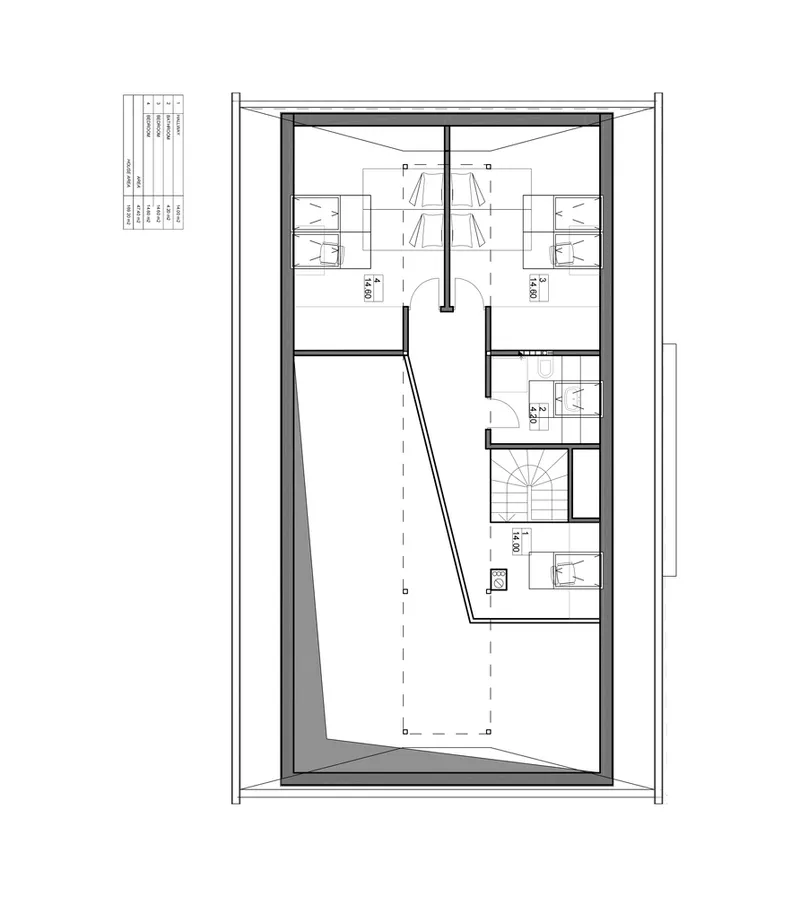
The upper-level plan reveals the economy of the layout. Two children's bedrooms and a bathroom occupy the attic, tucked under the sloping roof, while a diagonal stair void carves a sculptural opening that connects the mezzanine to the ground floor below. The void is not just circulation; it is the mechanism that allows the double-height living room to exist. Without it, the attic would seal the gable, and the house would lose its most compelling spatial quality.
Why This Project Matters
Small houses rarely get the attention they deserve. At 170 square meters, this is not a grand gesture but a disciplined one: a single material system, a single structural logic, a single spatial idea executed without compromise. The barn typology is a well-worn reference in contemporary residential architecture, yet Laurynas Žakevičius Architects avoid the twee by committing fully to the material. Untreated larch on every surface, no cladding hierarchy between wall and roof, no painted trim to soften the edges. The result is a house that will look better in ten years than it does today.
More broadly, the project demonstrates that regional identity in architecture does not require nostalgic mimicry. The barn motif is present in the gable, the openwork peak, and the timber construction, but the glazed ground floor, the mezzanine, and the skylights belong firmly to contemporary practice. The house sits in the overlap, and that is exactly where the most useful architectural work happens: in the space between tradition and the way people actually want to live now.
Family House in Druskininkai by Laurynas Žakevičius Architects. Druskininkai, Lithuania. 170 m². Completed 2019. Photography by Leonas Garbačauskas.
About the Studio
Share Your Own Work on uni.xyz
If projects like this are the kind of work you want to make, uni.xyz is a place to publish your own, find collaborators, and enter design competitions.




Popular Articles
Popular articles from the community


The Ocean Hive: Sustainable Architecture for a Self-Sufficient Civilization at Sea
The Ocean Hive imagines sustainable architecture at sea, where modular habitats, algae, wave power and ocean waste sustain a growing colony.

Lunar Spiral: Space Architecture Shaped by the Mathematics of the Universe
Lunar Spiral reimagines space architecture through Fibonacci geometry, lunar regolith, levitating habitats, and self-sustaining Moon living.

Co-Life: Senior Housing Design That Reconnects Older Adults With the City
Co-Life reimagines senior housing design through healing gardens, shared streets, workshops, and a sustainable community across generations.

Play: Fragments of Their World
Familiar architecture becomes modular playground design, creating safe spaces where displaced children can learn, connect, imagine and play.


Similar Reads
You might also enjoy these articles


Hodi-Mandai Geram
Project Function: Preservation and revitalization of the Intangible heritage and socio-spatial identity of the Hodi by Housing, Cultural Memory Center, Sacred Grove, landscape, local tourism economy


Olio Towers: A Mid-Rise for Performers That Fuses Housing, Rehearsal, and Stage
Located blocks from Houston's Theater District, this modular tower stacks living units around a central performance atrium.

Oasis: Modular Green Housing Carved into Dhaka's Urban Fabric
A shortlisted Plugin Housing entry reclaims unauthorized settlements in Dhaka with stepped concrete volumes, green roofs, and ventilation-driven design.

Black Hole: A Floating Megastructure for the Post-Physical Era
Emiliano Mazzarotto envisions a spherical, self-scaling arena where e-sports, digital hotels, and holographic stadiums replace traditional public space.
Explore Architecture Competitions
Discover active competitions in this discipline



Challenge to reimagine the Iron Throne


Photograph architecture without architects


Illustrate the lost glory of Angkor Wat - Render Challenge


Design challenge to reuse E-waste
Comments (0)
Please login or sign up to add comments
No comments yet. Be the first to comment!