

Fast-Paced Growth: A Skyscraper That Lets a Railway Punch Through Its Core
A hybrid tower lifts itself off the ground, threads a sky railway through its center, and refuses to repeat a single floor plan.


What happens when a skyscraper stops pretending to be a static object and starts behaving like an engine? "Fast-Paced Growth" answers that question by carving a dramatic circular void through the core of a hybrid tower, threading a sky railway straight through the building, and lifting the entire structure off the ground to hand the street back to pedestrians. It is a proposal that treats the high-rise not as a destination but as a node in a larger system of urban velocity, where architecture, transit, and public life fuse into a single vertical organism.
Designed by Alessandro Cece, Sana Masoud, and Maryam, the project reimagines the skyscraper typology for a city defined by speed, density, and programmatic fluidity. Stacked volumes house residential, office, hotel, and podium functions, yet no two floor plates are identical. Terraces modify the silhouette at multiple heights. Ecological pockets punctuate the facade. The result is a tower that reads as a living section through the future of vertical urbanism.
A Tower That Grows Sideways as Much as Up
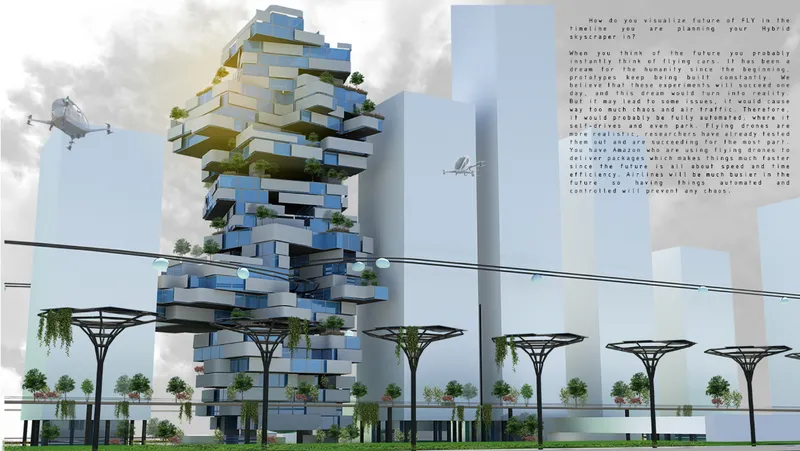

The exterior massing tells the story immediately: protruding balconies, planted terraces, and cantilevered slabs push outward at irregular intervals, giving the tower a restless, accumulated profile. Below, umbrella-shaped canopy structures mark the pedestrian realm, signaling that the ground plane belongs to the city, not to the building's lobby. The exploded axonometric diagram reveals how this complexity is organized. A structural core anchors the system, while sky bridges, infrastructure conduits, and stacked residential slabs distribute program across the height without defaulting to repetition.
Every floor plate is uniquely shaped, expanding and contracting depending on its function. Office zones differ from hotel zones differ from residential zones, and this variation is legible on the facade. The tower rejects the gridded extrusion that defines most high-rise construction and instead embraces what the designers call programmatic fluidity: spaces that respond to their use rather than to the convenience of structural repetition.
A Sky Railway Piercing Through the Building's Heart
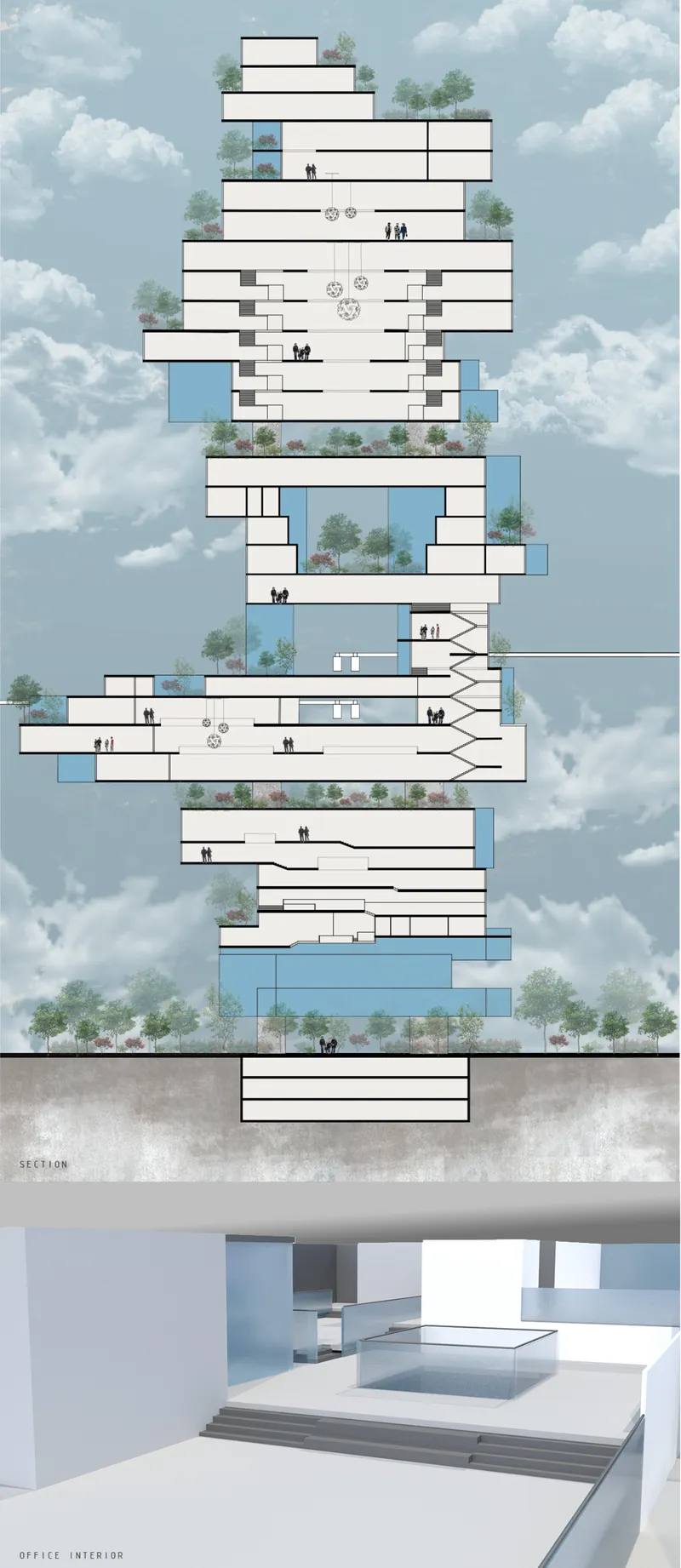
The section drawing makes the central proposition visceral. Staggered tower volumes open to reveal planted sky terraces at multiple levels, but the real provocation is the void at the core where the sky railway passes through. This is not a decorative atrium. It is an infrastructural gateway: a high-speed transit artery that transforms the skyscraper into a vertical station. Passengers transfer directly from the railway into the building's interior, bridging multiple city nodes without ever touching the congested ground.
By diverting rapid transit to the upper floors, the design accomplishes two things simultaneously. It accelerates urban connectivity at the metropolitan scale, and it liberates the street level from the burden of high-speed movement. The building becomes a vital urban connector, not merely a place people arrive at but a place people pass through on their way across the city.
Drones, Terraces, and the Space Between Floors
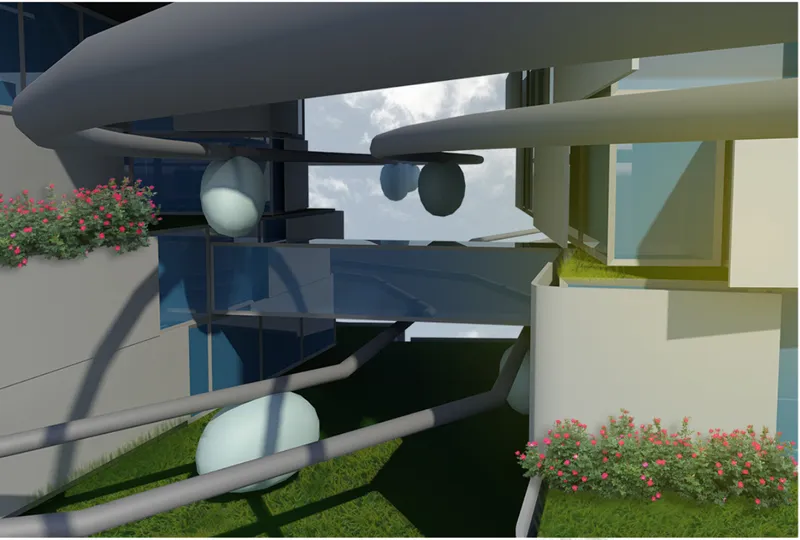
The rendered view between stacked balconies captures a slice of the tower's anticipated daily life. Planted terraces spill greenery at multiple heights, and spherical drone modules hover in the gaps between floors, suggesting an integration of flying mobility systems into the building's everyday operation. The atmosphere is dense, layered, and alive. It reads less like a conventional residential tower and more like a vertical neighborhood where ecological infrastructure and advanced transit coexist at close range.
These interstitial zones between slabs are critical to the design's ambition. They are not leftover voids but programmed thresholds: spaces for air circulation, light penetration, drone logistics, and social encounter. The terraces modify the skyline at multiple heights, breaking the tower's mass into a sequence of habitable landscapes rather than a monolithic extrusion.
Giving the Ground Back to Pedestrians
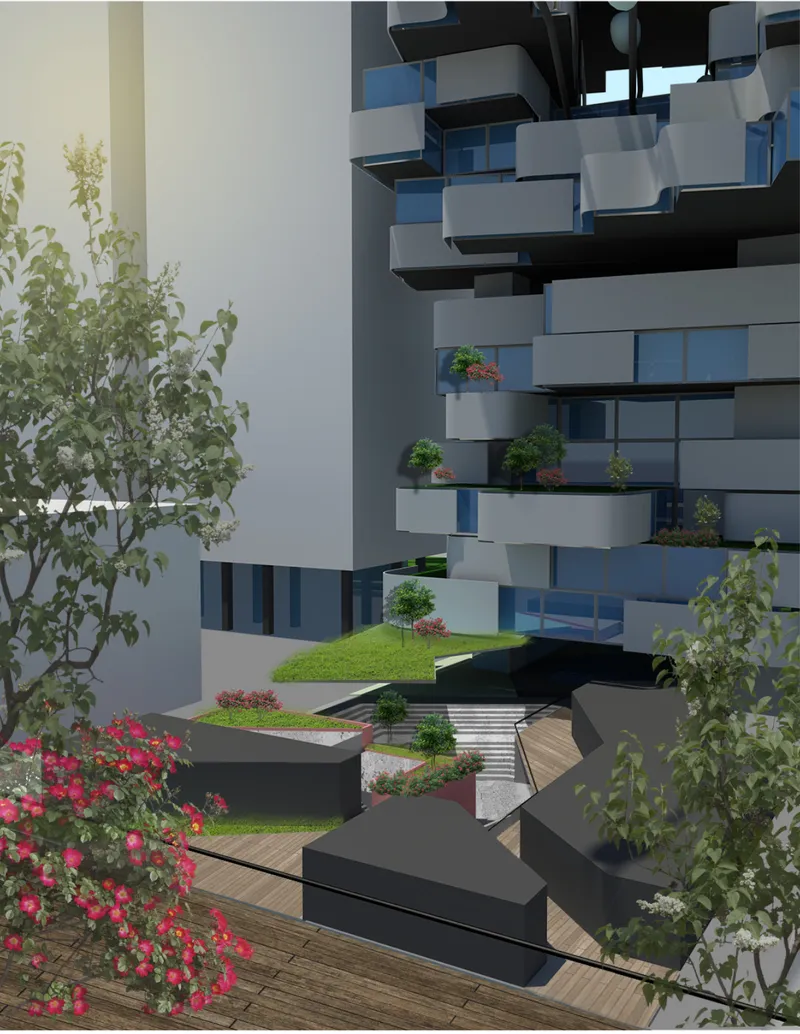

The most generous gesture in the project is structural: lifting the building above the earth to create a continuous pedestrian realm beneath it. The ground-level courtyard features curving lawns, timber decking, and flowering planters sheltered by the cantilevered residential slabs overhead. The scale is intimate and human, a deliberate counterpoint to the tower's metropolitan ambitions above. Raised planter boxes clad in grey stone strips hold pink flowering shrubs, grounding the landscape in tangible material detail.
The designers describe this as a philosophy of urban generosity: architecture that enhances city life rather than obstructing it. In dense urban centers where public land is scarce, the decision to sacrifice leasable ground-floor area for landscaped walkways, shaded gathering spaces, and connectivity to adjacent infrastructure is a direct statement about priorities. The building earns its height by earning its relationship to the street.
Why This Project Matters
"Fast-Paced Growth" works because it refuses to treat the skyscraper as a sealed container. By integrating a sky railway, elevating the structure off the ground, and rejecting floor plate repetition, the designers have produced a proposal where every architectural decision serves a larger argument about how cities might accommodate speed, density, and human comfort simultaneously. The tower is not a formal exercise; it is a systems diagram rendered in space.
What makes the project compelling at a deeper level is its honesty about the forces shaping contemporary urbanism. Cities are getting faster, denser, and more vertical, and pretending otherwise produces buildings that age poorly. Alessandro Cece, Sana Masoud, and Maryam have chosen instead to design for that velocity, proposing a structure that absorbs transit, generates public space, and adapts its interior to the unpredictable rhythms of mixed-use life. It is speculative, yes, but it is also structurally coherent, and that combination is rarer than it should be.
View the Full Project
About the Designers
Designers: Alessandro Cece, Sana Masoud, Maryam
Enter a Design Competition on uni.xyz
uni.xyz runs architecture and design competitions year-round that reward proposals with spatial conviction and real site intelligence.
Project credits: Fast-Paced Growth by Alessandro Cece, Sana Masoud, Maryam.


Popular Articles
Popular articles from the community


David Ortega Stacks a Two-Story Mexico City Penthouse Around a Steel Stair and a Pergola-Shaded Roof Terrace
In Colonia Roma, a 300 m² penthouse uses oak joinery, a planted steel stair and a slatted roof pergola to make a new-build apartment feel like a house.

GROUP A Strips a 1969 Rotterdam Harbor Headquarters to Its Frame and Wraps It in Timber Louvers
In Rotterdam's M4H harbor district, Ferro Offices reuses a 1969 frame, adds one timber storey and reaches BREEAM-NL Outstanding.

David Macias Steps a Doorless Stone and Plaster House Down a Tropical Colombian Hillside
In the humid hills of Colombia, Threshold House replaces the front door with an open void and terraces its 850 m² down the slope instead of fighting it.

longwave studio Reorganizes a 112 m² Tainan Apartment Around the Daily Routines of a Family and Two Cats
In Tainan, Taiwan, birch plywood, rust-red furniture and a freestanding plaster wall link arrival, storage, work and family life in one apartment.

Similar Reads
You might also enjoy these articles


Aquadapt: An Underwater Habitat That Rewrites Its Rooms by the Hour
Curved modules ring the seabed while one shell shifts from breakfast room to cinema, farm and football pitch as residents' needs change.

Play: Fragments of Their World: Remembered Architecture Rebuilt as a Modular Playground for Refugee Camps
Tom Gardner abstracts domes, arches and towers from the homelands of displaced families into a kit of child-scaled play parts for camp settlements.
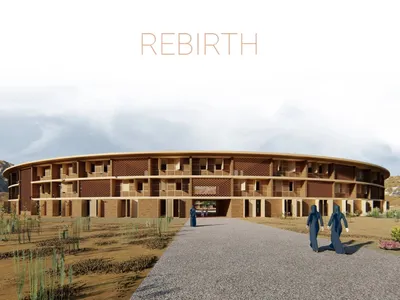
REBIRTH: A Circular Settlement Where Afghan Widows and Their Children Rebuild Life Together
A shortlisted Resile entry turns the circle into a protective ring of timber and brick, gathering homes, classrooms and gardens around a shared landscape.
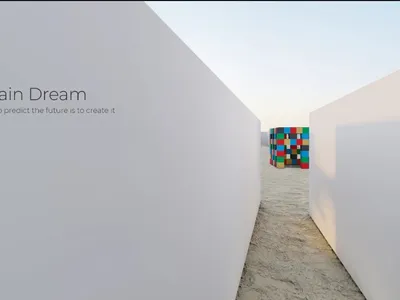
The Main Dream: A Recycled Plastic Kit That Lets Refugee Children Build Their Own Playground
Thirty-centimetre interlocking cubes that connect on three axes turn play into construction, letting children author the spaces they occupy.

Explore Kinetic Architecture Competitions
Discover active competitions in this discipline

Challenge to reimagine the Iron Throne

Photograph architecture without architects

Illustrate the lost glory of Angkor Wat - Render Challenge

Design challenge to reuse E-waste
Comments (0)
Please login or sign up to add comments
No comments yet. Be the first to comment!