
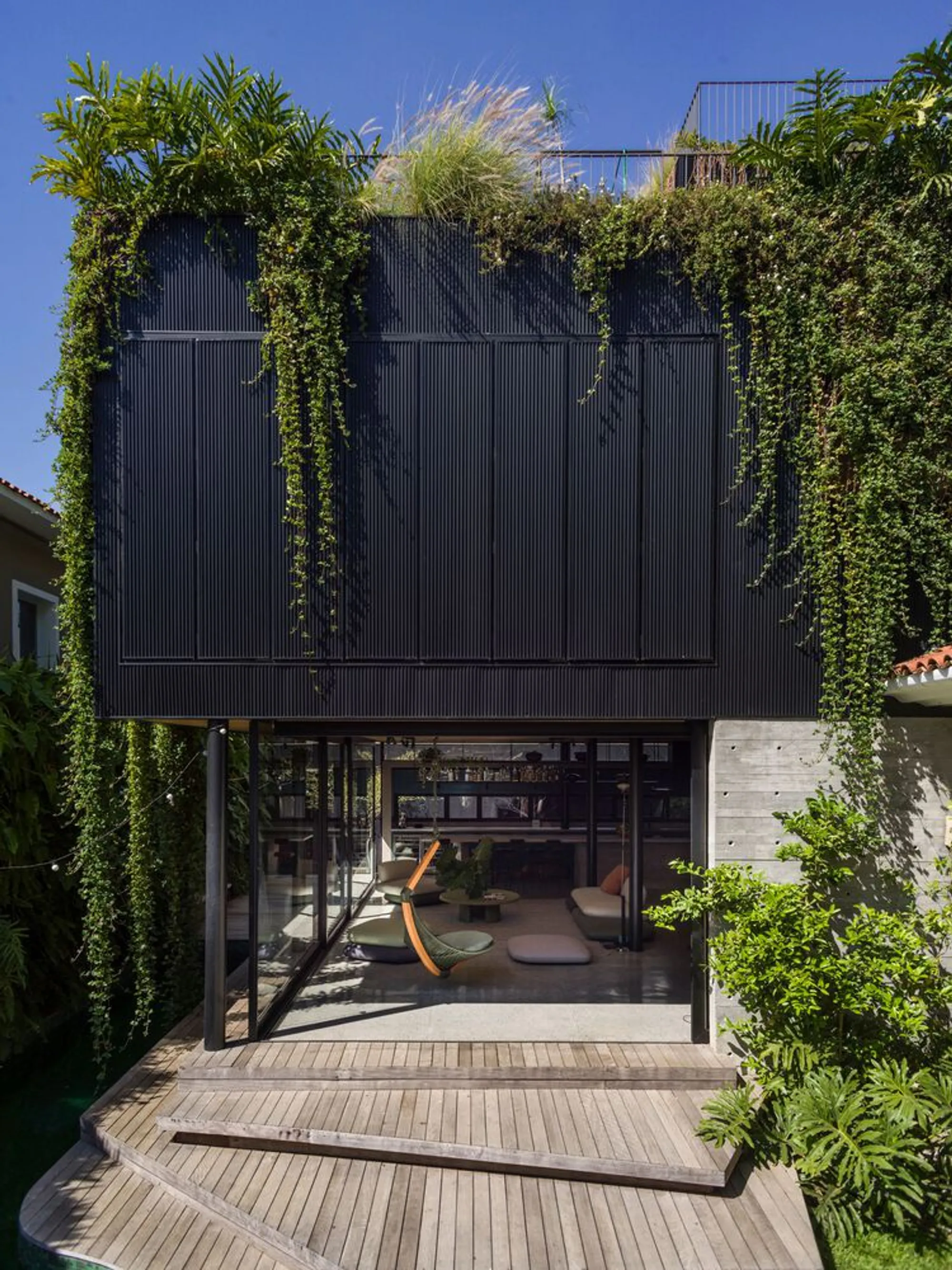
Claudia Haguiara Arquitetura Rescues a 1940s São Paulo House and Grafts a Steel Tower Onto It
A corner lot in São Paulo becomes the stage for a renovation that pairs a preserved white stucco pavilion with a dark, vertical new wing.


The FBL House was supposed to be a demolition job. A 1940s single-story home on a tree-lined corner lot in São Paulo had deteriorated enough that clearing the site and starting fresh seemed like the rational move. But when Claudia Haguiara Arquitetura, working with HGMA, arrived on site, the existing house argued its own case: intimate rooms, mature garden shade, a hidden lap pool, and the kind of spatial character that no new build can manufacture. The brief pivoted. Instead of erasure, the architects chose a strategy of preservation and addition, keeping the original structure and attaching a three-story steel-framed wing that rises like a dark counterpoint beside its white stucco neighbor.
What makes the project genuinely interesting is not just the decision to save the old house but the clarity of the formal argument between the two halves. A board-formed concrete corridor runs longitudinally through the plan, acting as both spine and threshold. On one side: terracotta tile roof, painted brick, herringbone timber floors. On the other: corrugated black metal cladding, plywood ceilings, steel columns, and full-height glass. The contrast is deliberate and legible, and the 450 square meters that result feel larger than the number suggests because the vertical wing stacks program aggressively while the original house sprawls horizontally into its garden.
Two Houses, One Address
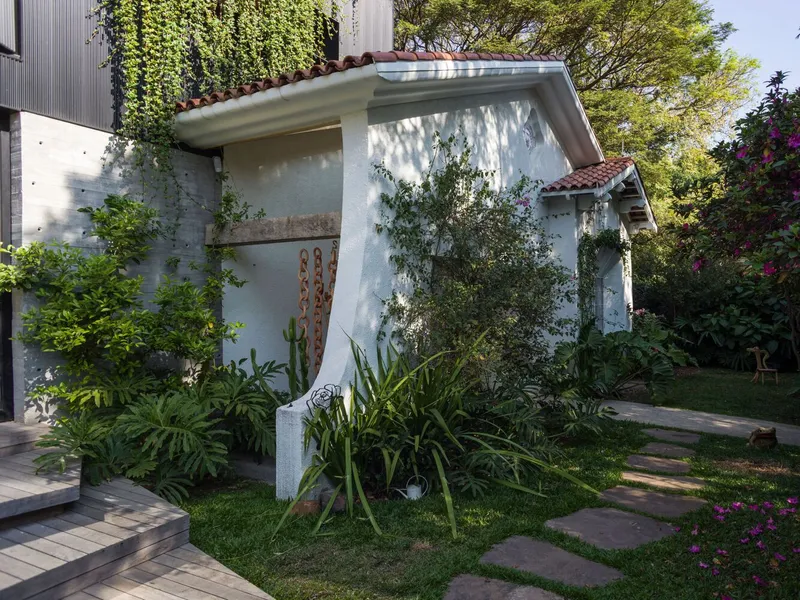
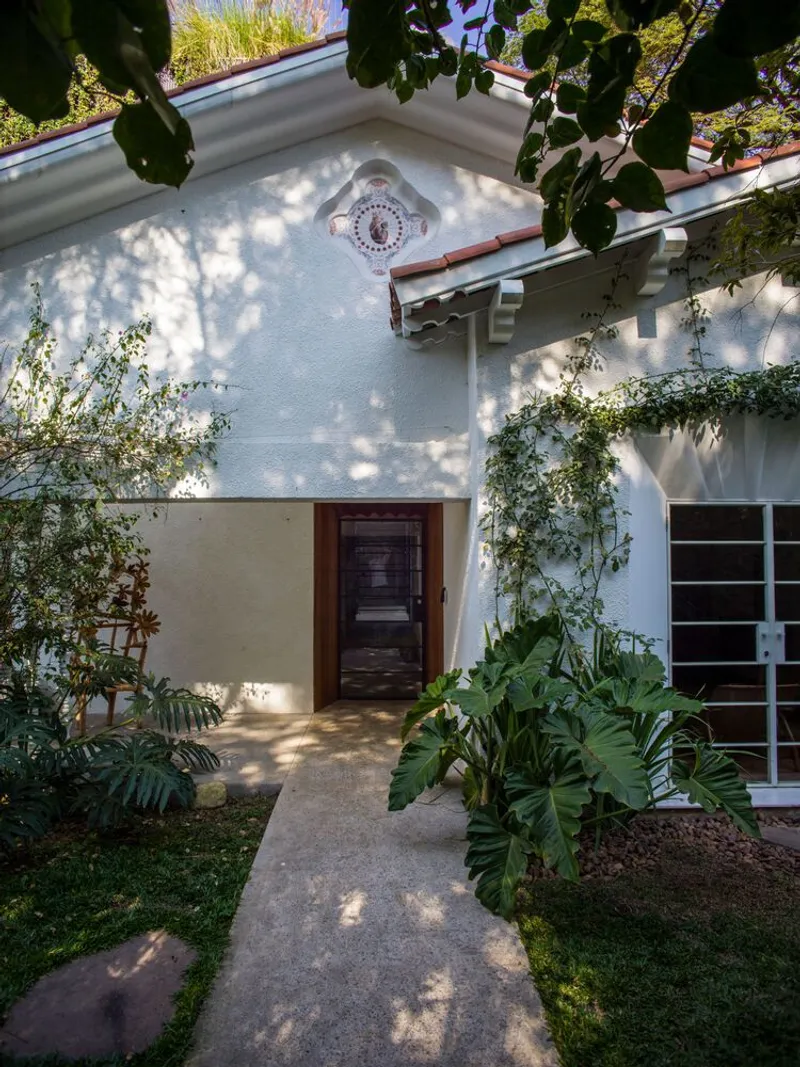
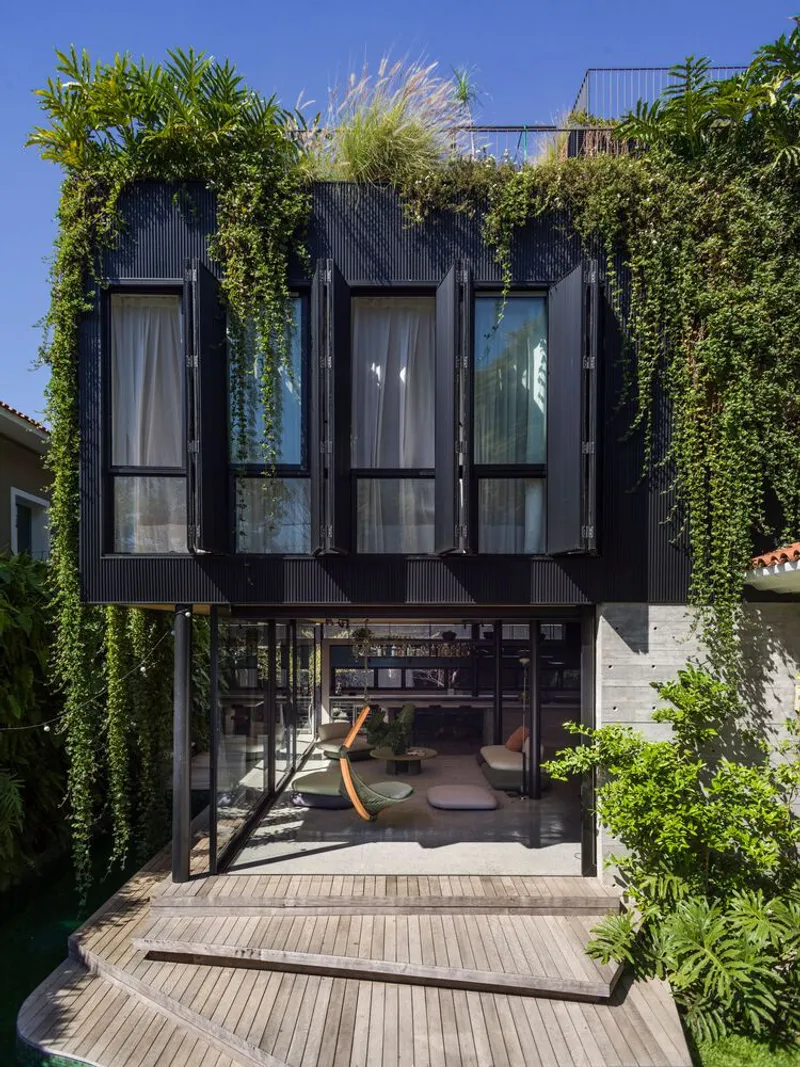
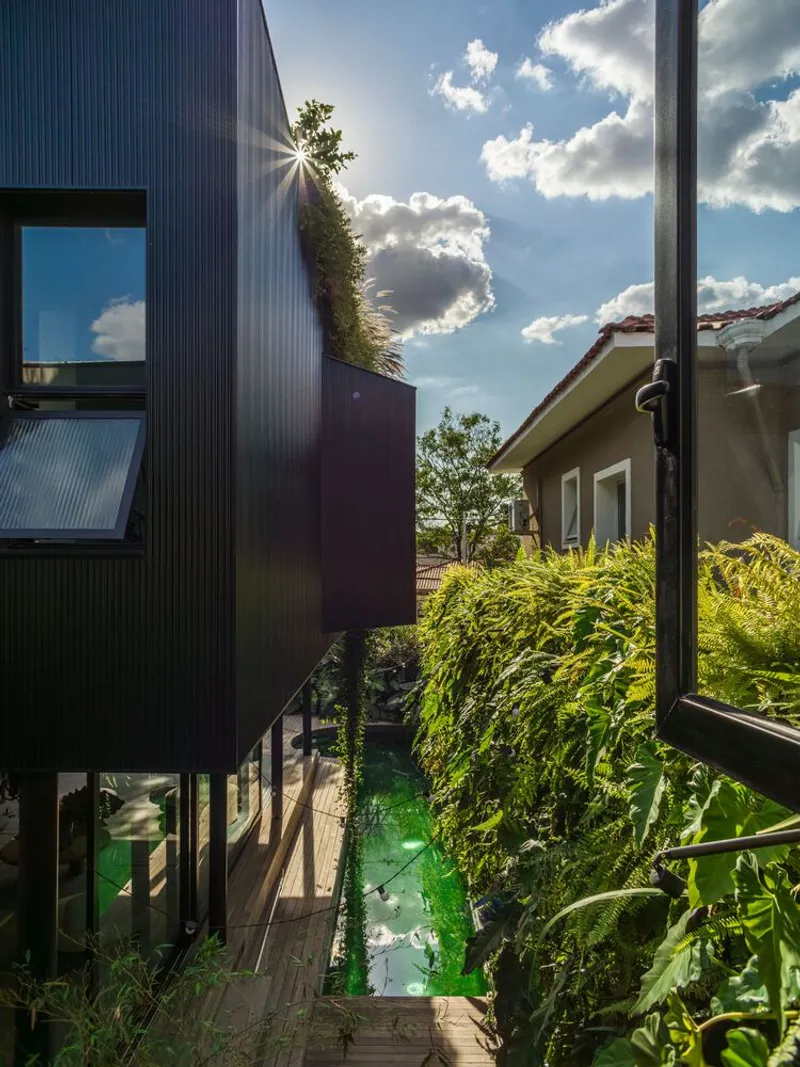
The street reads the project as two buildings. The original 1940s pavilion presents itself modestly: white stucco walls, a carved medallion over the wooden entry door, stepping stones through planted beds. Walk a few meters along the corner and the language shifts completely. A dark corrugated metal volume lifts off the ground on steel columns, its facade punctuated by vertical windows and cascading greenery from a planted roof edge. Neither building pretends to be the other, and that honesty is the project's strongest move.
The decision to separate the visual identities so starkly prevents the renovation from falling into the common trap of trying to blend old and new into one seamless skin. Instead, the junction between them becomes the most interesting architectural moment: a concrete corridor that acknowledges the seam rather than hiding it.
The Concrete Spine
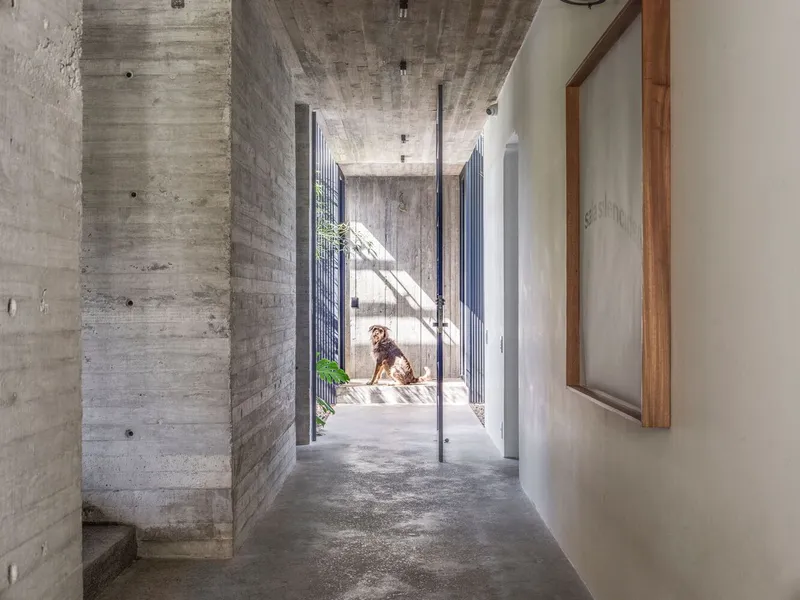
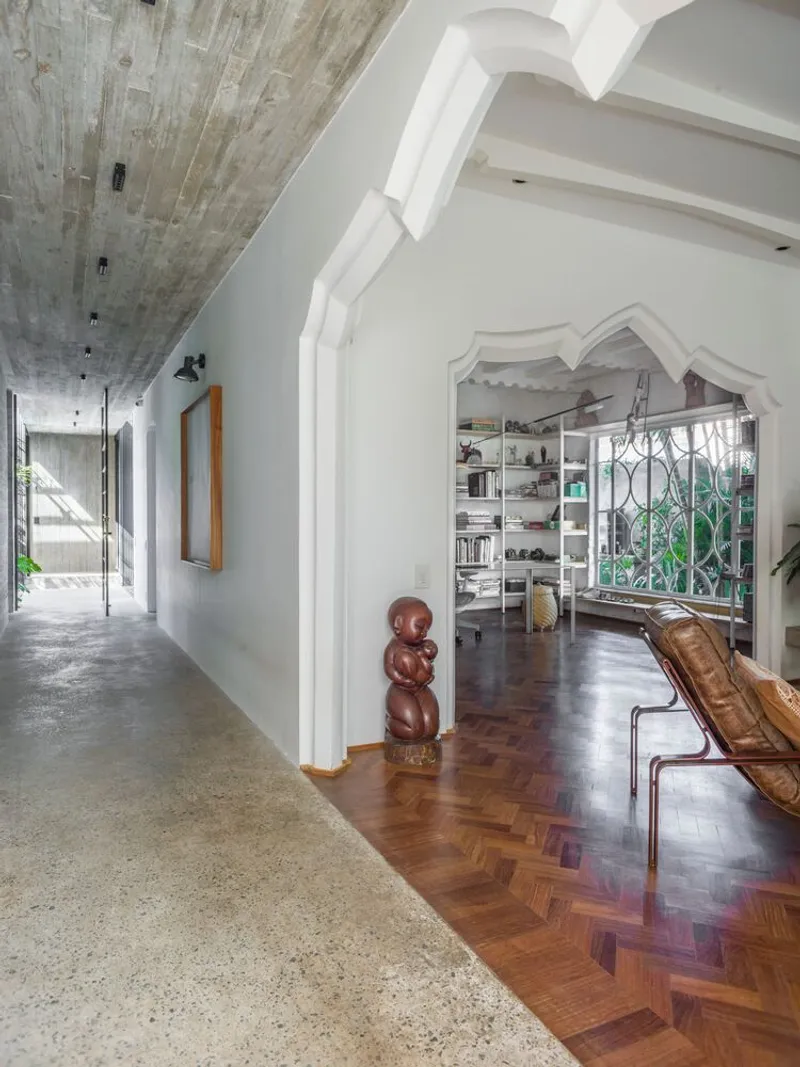
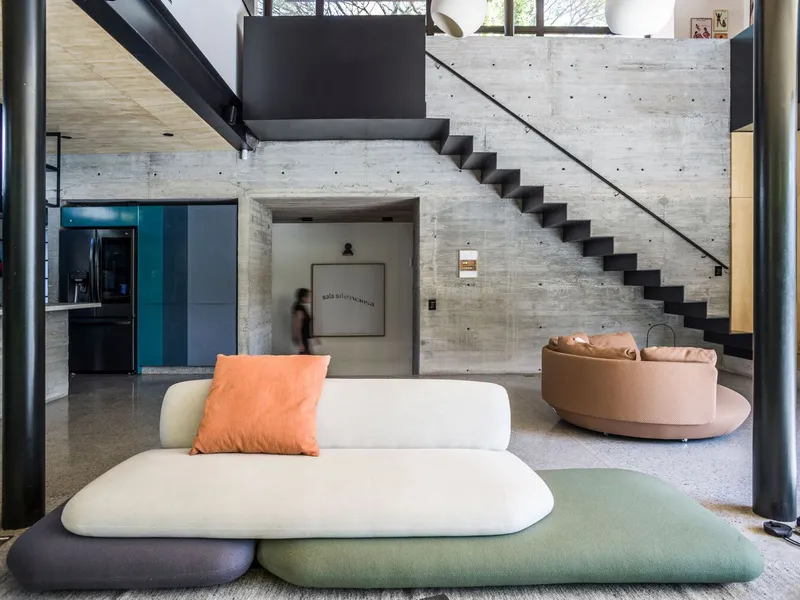
Board-formed concrete does the heavy lifting as the connective tissue between old and new. The corridor ceiling retains the grain of its formwork, giving the passage a tactile roughness that mediates between the delicate plaster of the original rooms and the industrial precision of the steel wing. A steel gate at one end lets daylight flood through, while the staircase along the concrete wall channels vertical movement with a sculptural directness.
This is not a neutral hallway. It is an argument about thresholds, a deliberate compression of space that makes arrival into either wing feel like an event. The dog sitting in a patch of sunlight at the gate is a reminder that architecture, when it works, accommodates life without demanding attention.
Living With the Original House
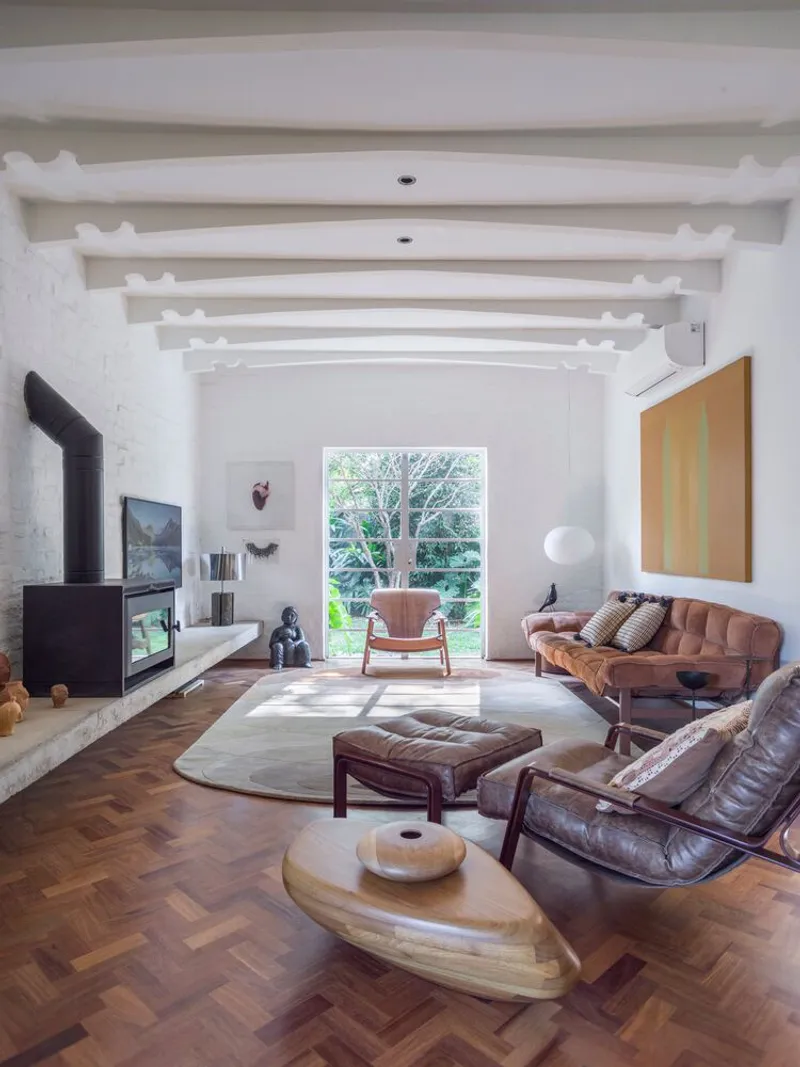
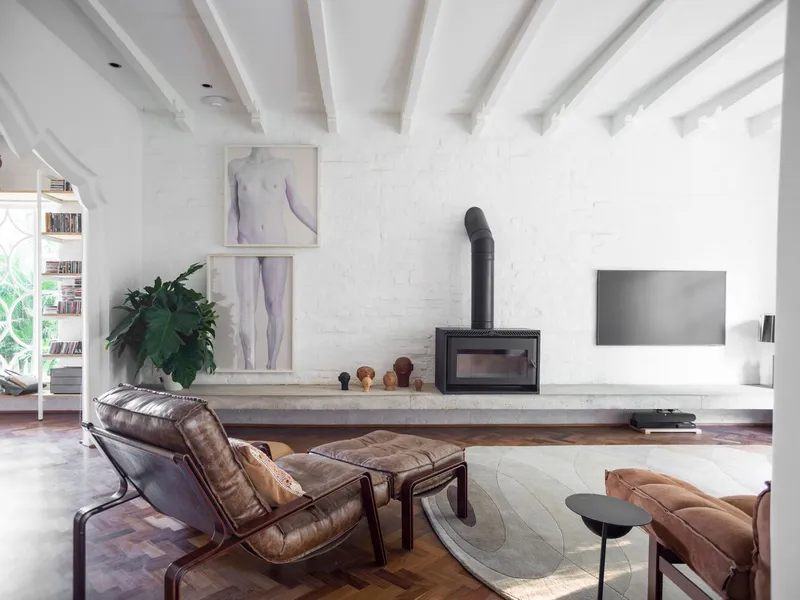
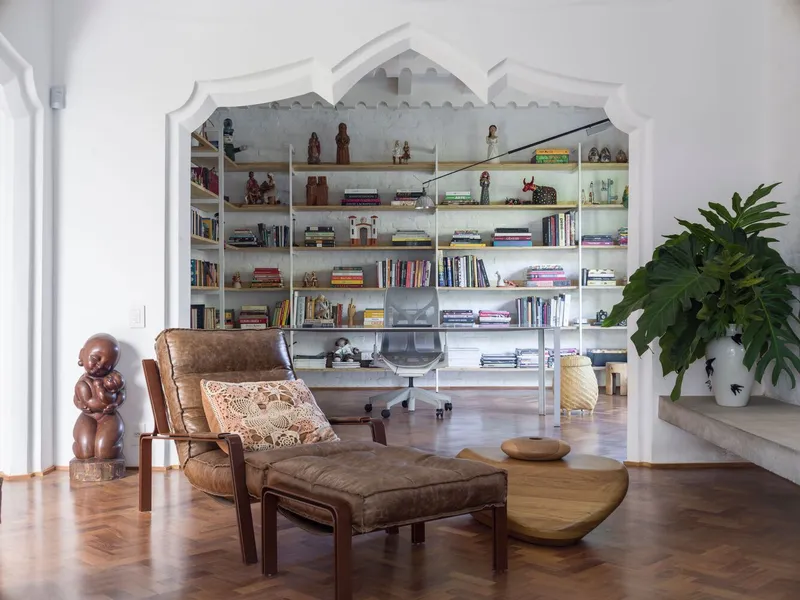
The restored ground floor of the 1940s house contains the rooms you'd want to linger in: a TV room anchored by a fireplace on a concrete plinth, a library with arched built-in shelving, and the main kitchen. White painted exposed beams and herringbone wood floors establish a warmth that the new wing intentionally does not replicate. The painted brick wall in the living area retains enough imperfection to signal authenticity without slipping into ruin-chic.
The architects resisted the temptation to modernize these rooms into oblivion. The arched doorways remain. The ceiling beams are exposed but painted rather than stripped. It is a renovation that respects the original spatial proportions while quietly inserting contemporary comfort where it counts.
The New Wing Rises
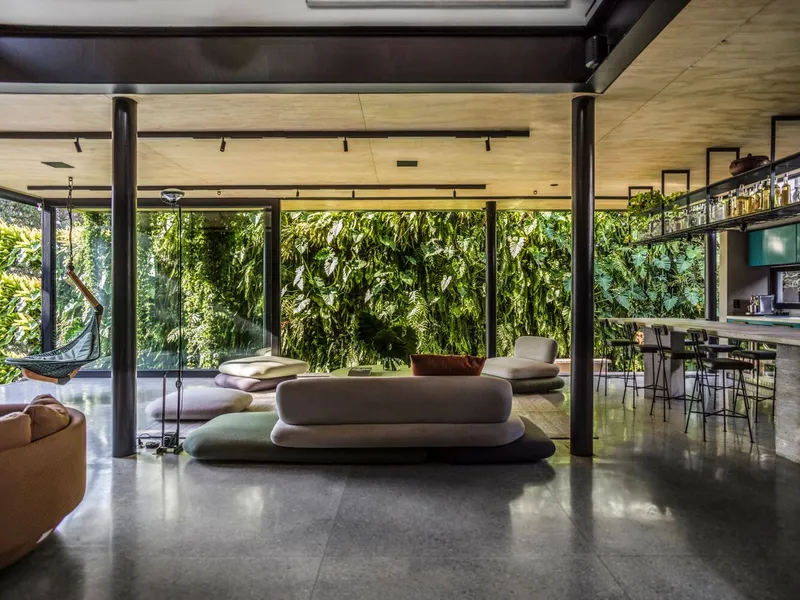
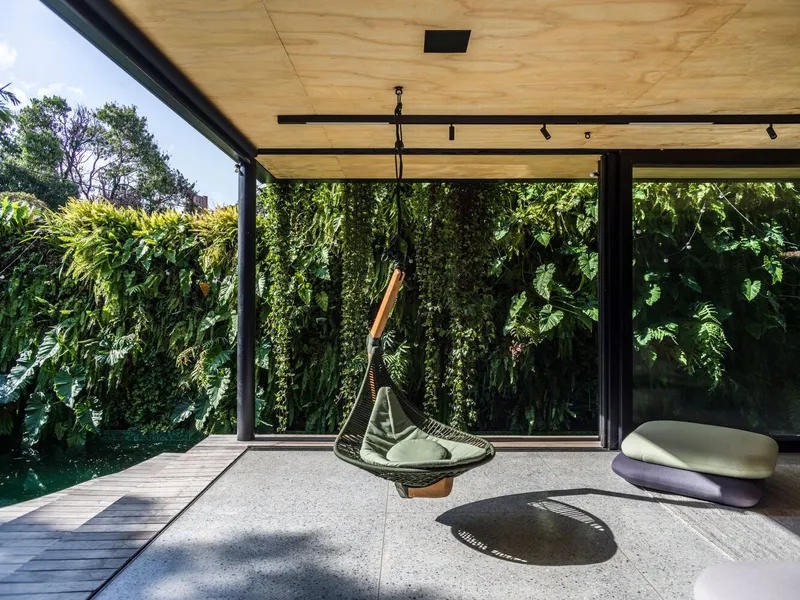
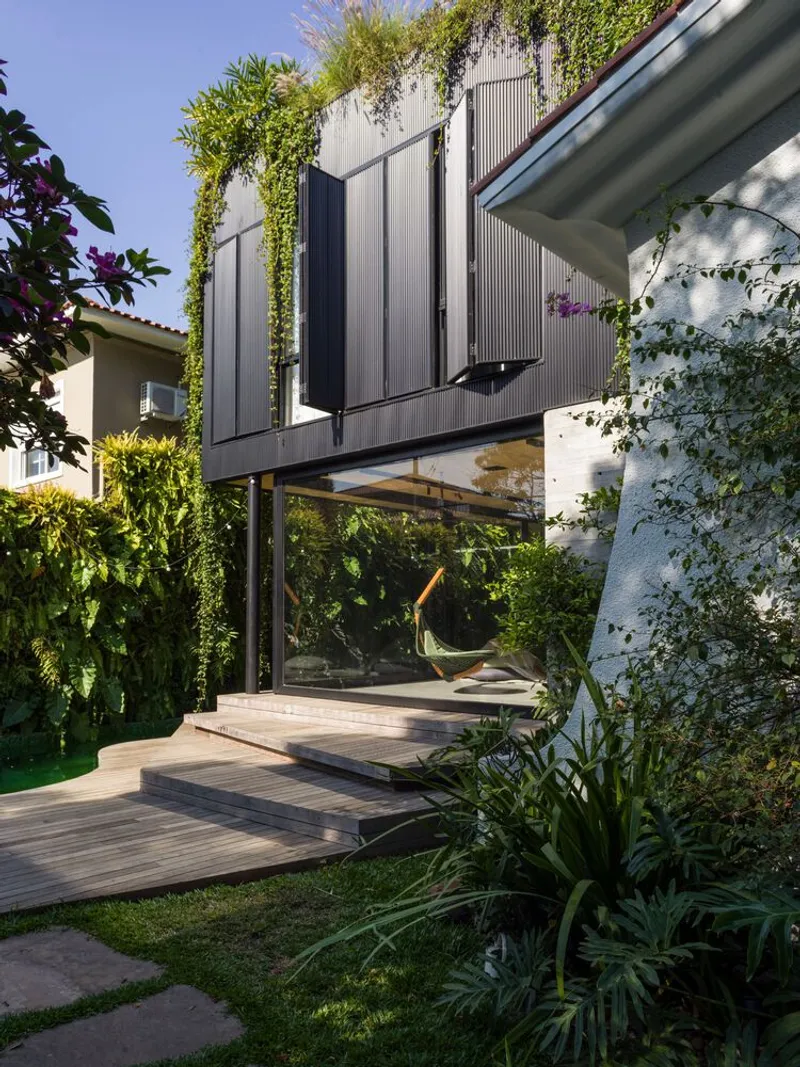
The new wing's ground floor opens entirely to the pool terrace through full-height glazing, with steel columns and a plywood ceiling defining a covered outdoor room that doubles as living space. A vertical garden wall stands as the visual terminus, replacing what would otherwise be a boundary wall with a surface that changes with the seasons. The elevated corrugated metal volume above hovers on its columns, creating a shaded outdoor zone at grade with a hanging chair and planted beds beneath.
Stacking the program across three floors plus the observation deck allows the new wing to maintain a compact footprint on the lot, preserving garden space and the existing pool. Cross-ventilation and generous glazing ensure that the vertical organization does not feel claustrophobic. The upper floors house the master suite and a home office with built-in desks along the glazed facade, while the roof becomes a sanctuary unto itself.
Water, Timber, Green
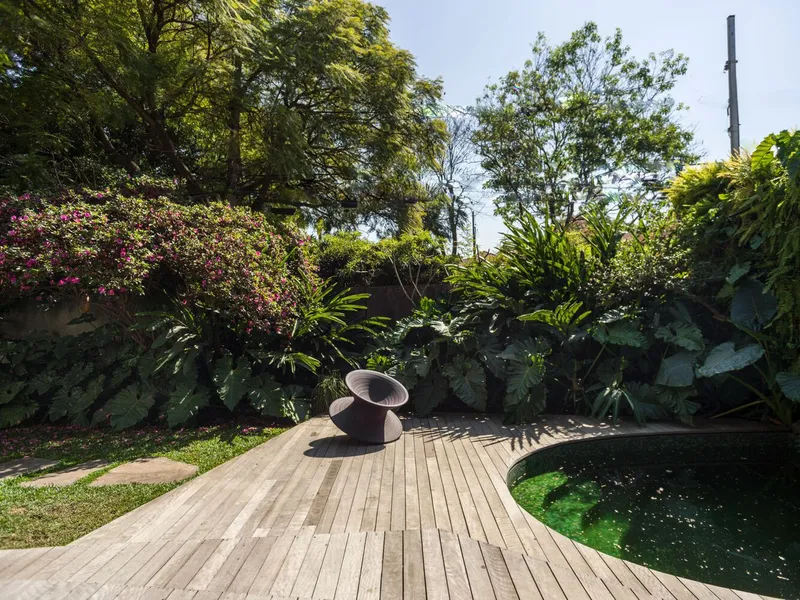
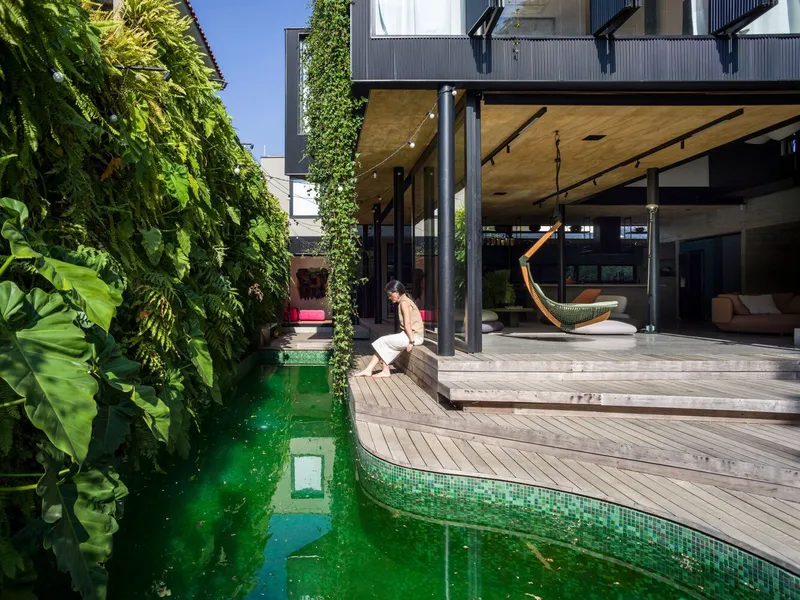
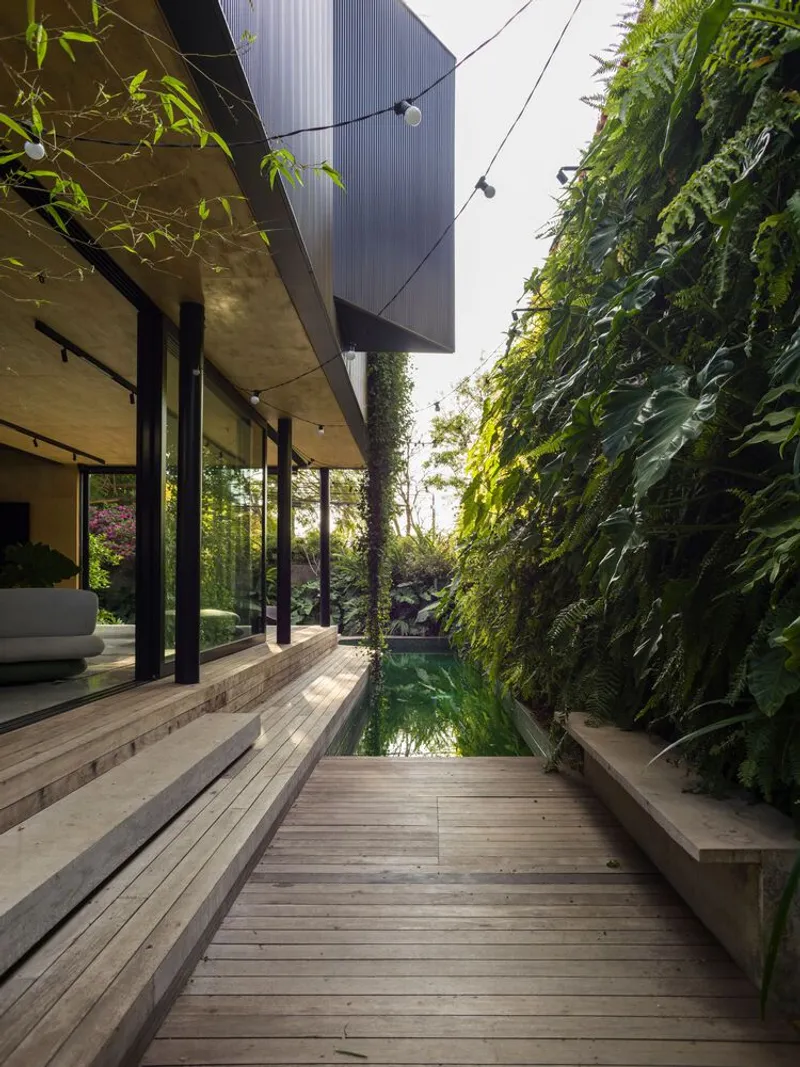
The landscape strategy is as considered as the architecture. A curving timber deck wraps the narrow pool, edged by layered tropical planting and mature trees that predate the renovation. Green mosaic tile lines the pool, and vertical planted walls enclose the narrow courtyard, creating an outdoor room that feels protected without being sealed off. Stepped seating ledges along the deck invite informal gathering, and the cantilevered volume overhead provides shade without blocking sky.
What emerges is a series of outdoor spaces calibrated to different moods: the reflective pool edge for solitude, the terrace for socializing, the rooftop for panoramic escape. The architects understood that in São Paulo's climate, the garden is not an amenity but a room.
Color as Architecture
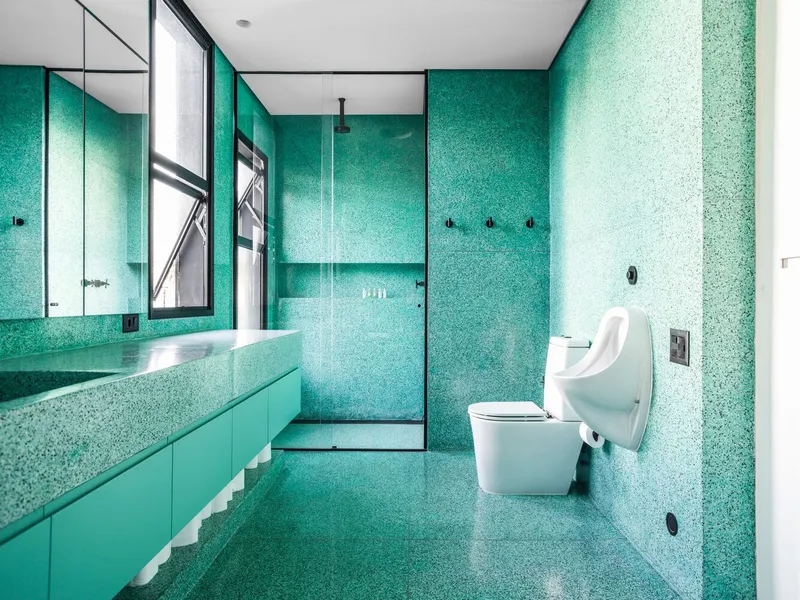
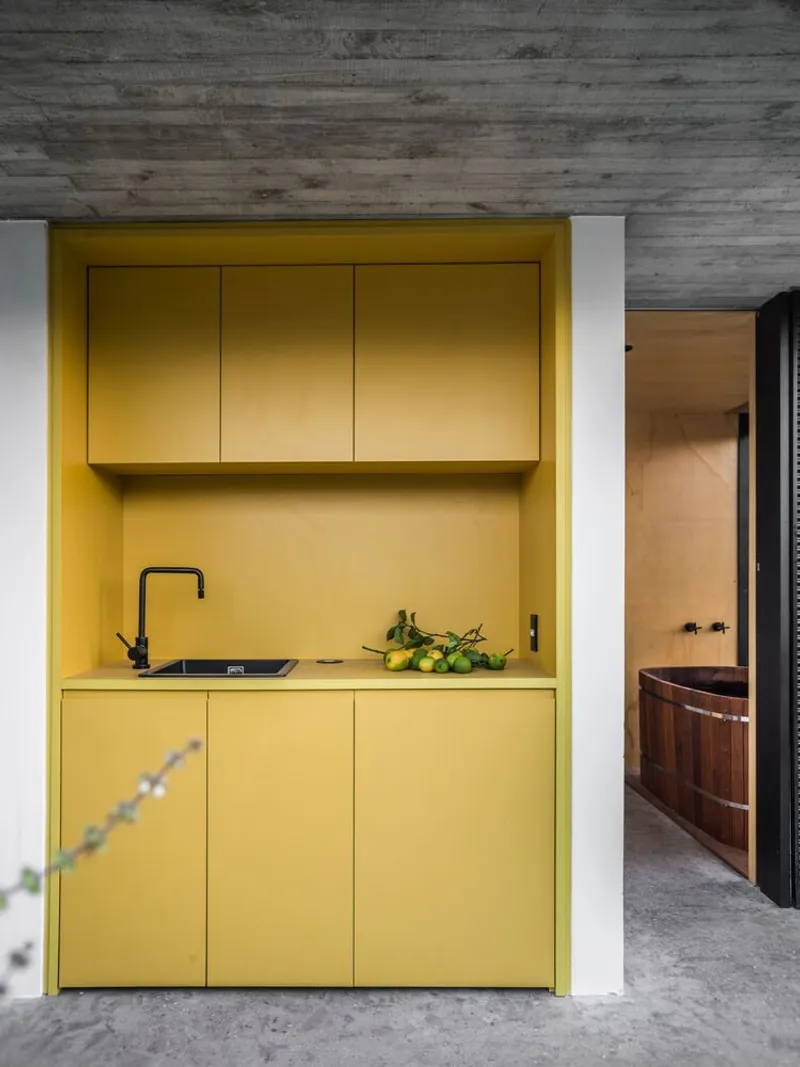
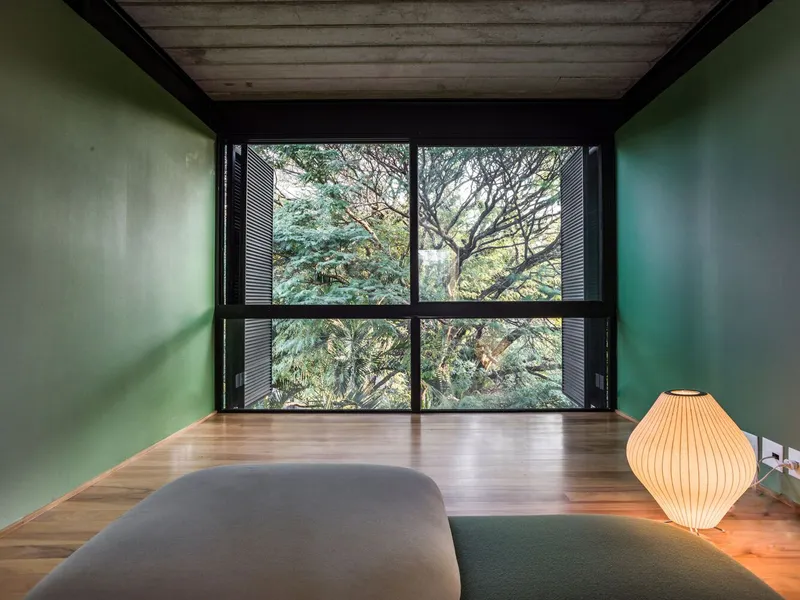
The interior palette takes risks that pay off. A bathroom clad entirely in turquoise terrazzo, with an integrated vanity and backlit wall niche, commits to a color choice with the kind of confidence that renovation projects often lack. A yellow kitchenette alcove with flush cabinetry beneath the board-formed concrete ceiling reads as a deliberate punctuation mark. A room finished in green plaster frames a view of trees beyond, collapsing the distinction between interior finish and landscape.
These moments prevent the house from settling into a predictable material narrative of concrete, steel, and timber. They signal personality, and they signal that the clients and architects trusted each other enough to make bold choices in rooms that matter.
Rooftop Refuge
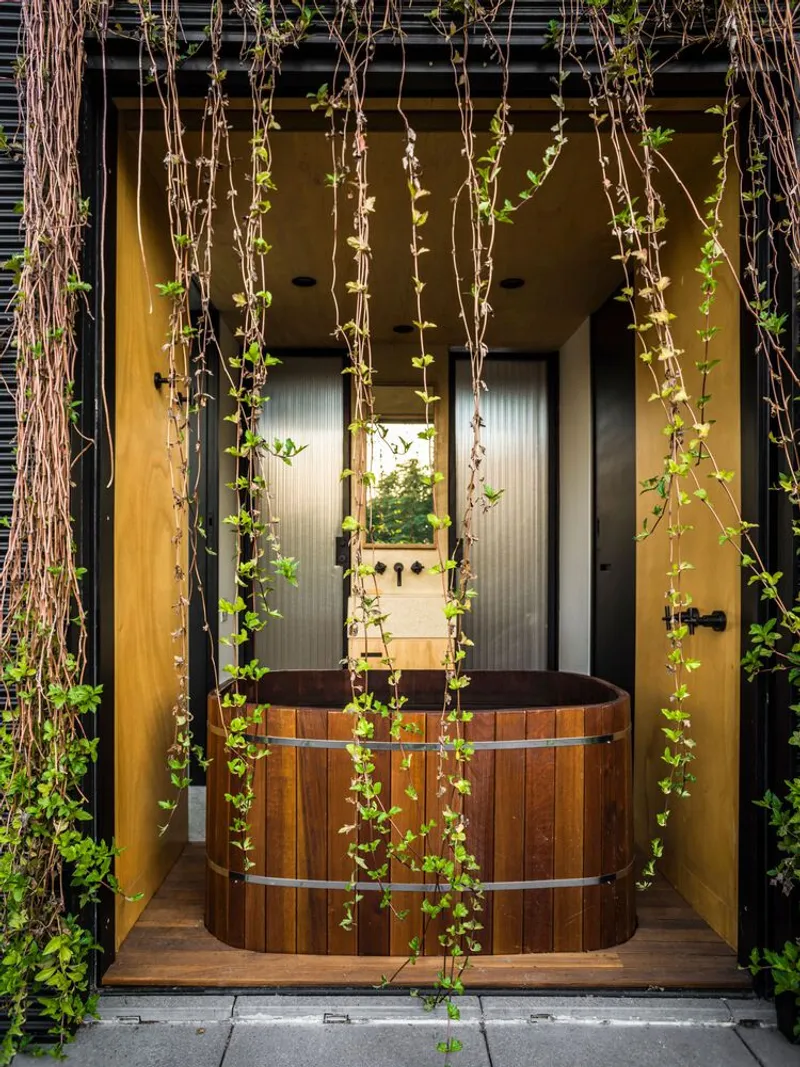
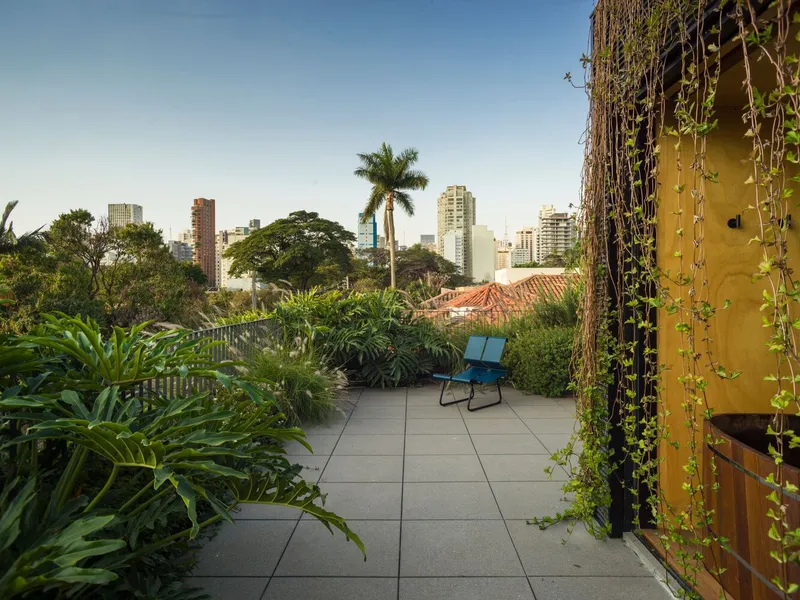
The rooftop level is where the vertical strategy justifies itself. A timber soaking tub sits on a covered balcony with climbing vines descending from a slatted canopy, creating a private retreat elevated above the neighborhood. The terrace proper, with planted beds and perforated screens, overlooks the São Paulo skyline while the dark corrugated volume below anchors the composition to the courtyard pool. The observation deck crowns the sequence, offering 360-degree views of the tree canopy that makes this residential district distinct.
Stacking a guest room, solarium, hot tub, and lookout on the roof transforms what could have been dead square footage into the most desirable space in the house. It is a strategy borrowed from dense urban contexts and applied here with a lightness that suits the residential scale.
Plans and Drawings
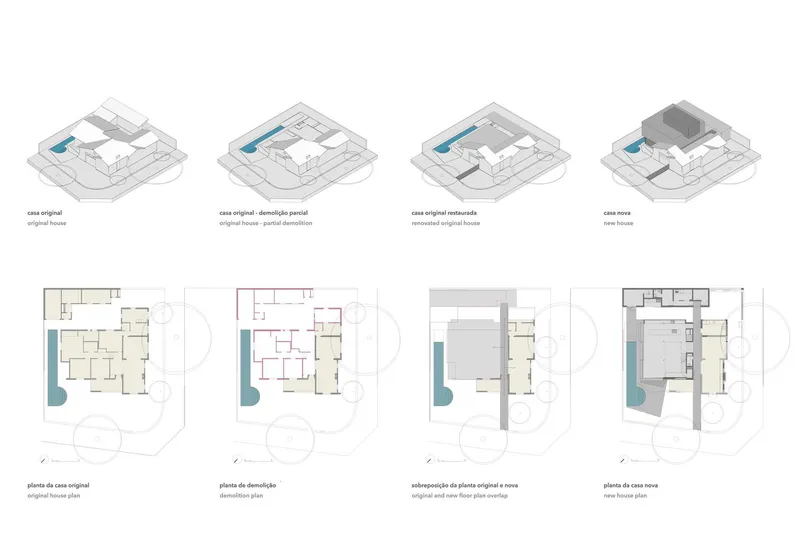
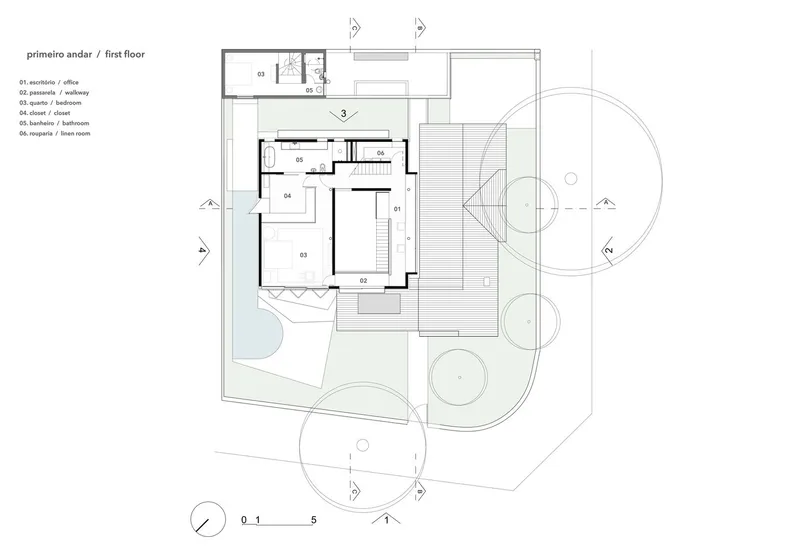
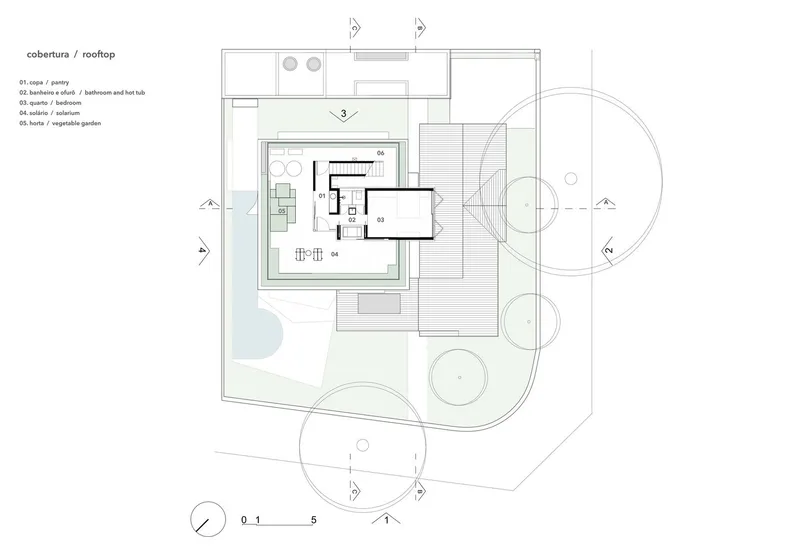
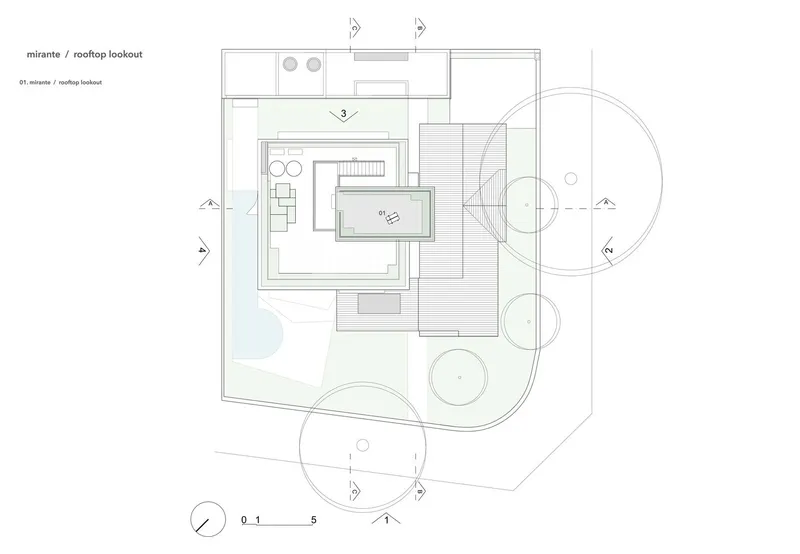
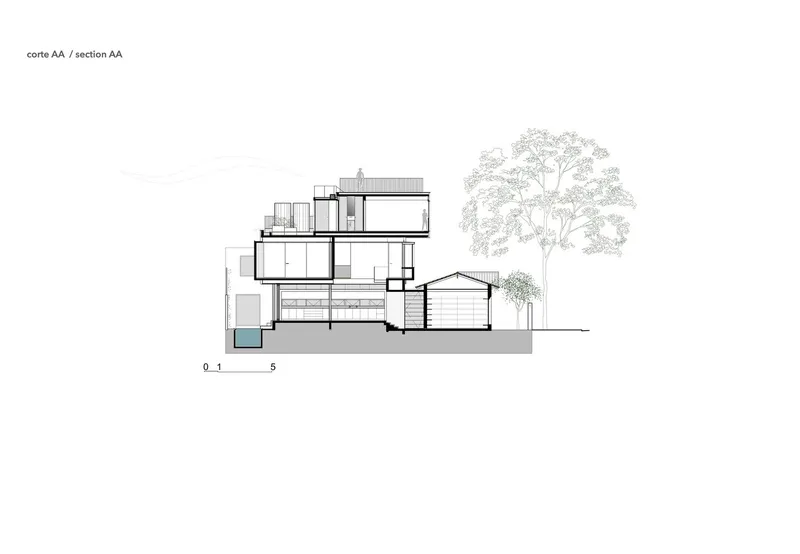
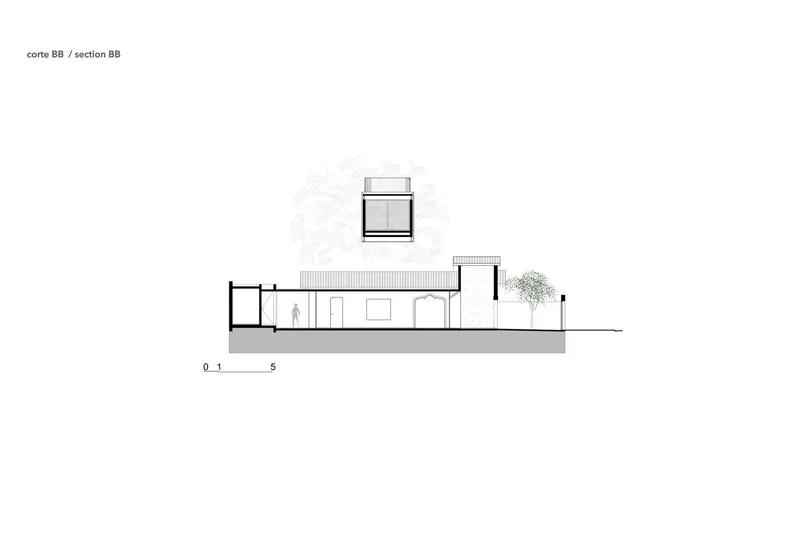
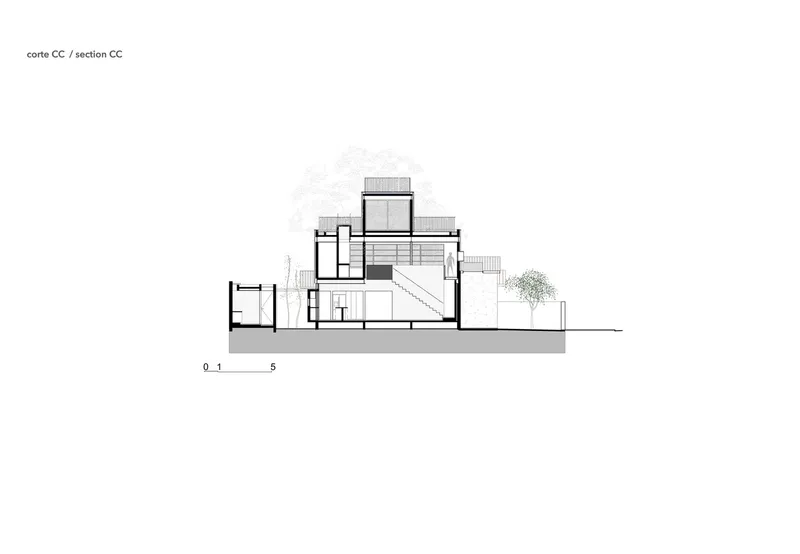
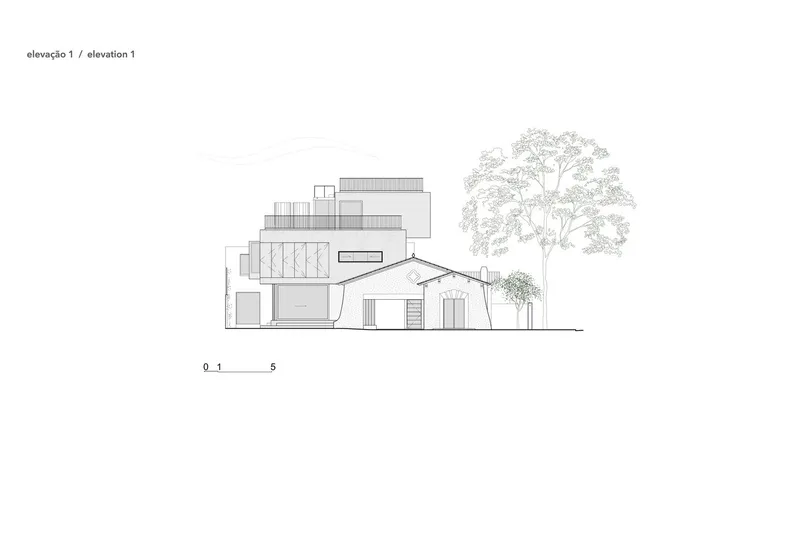
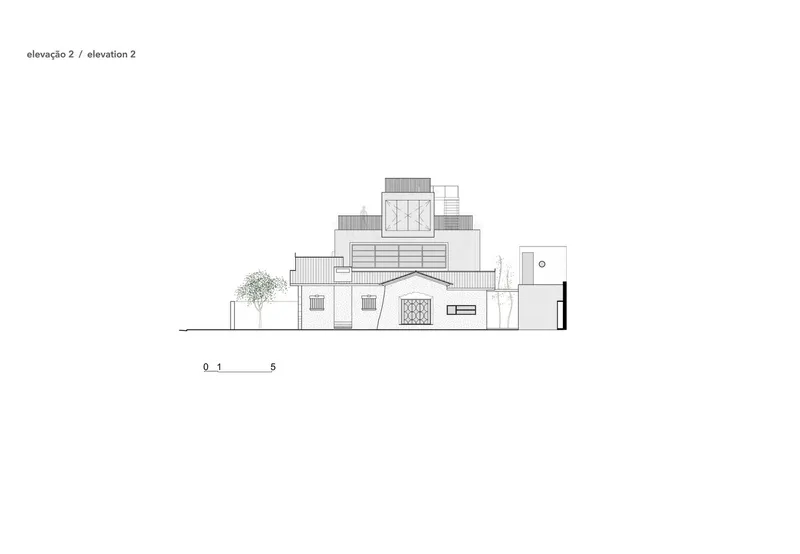
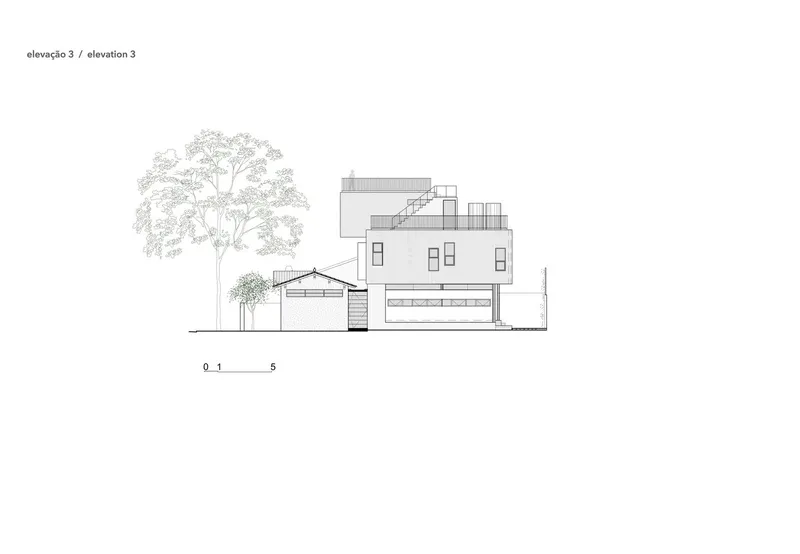
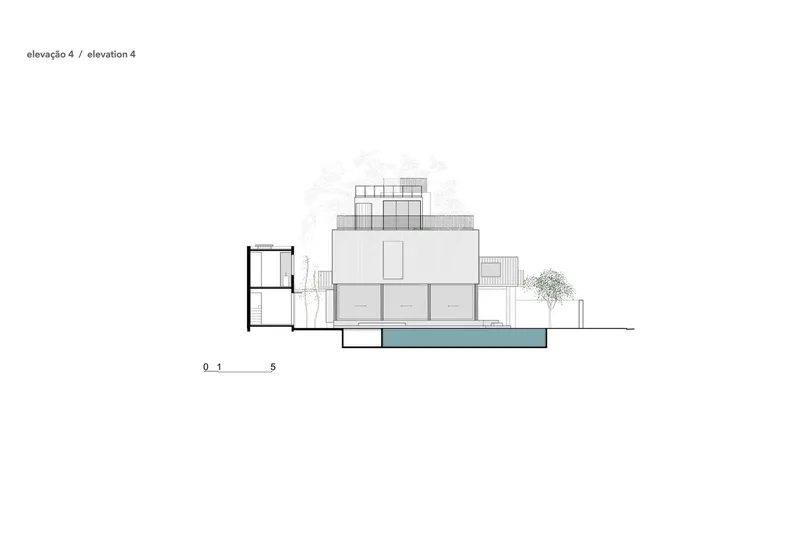
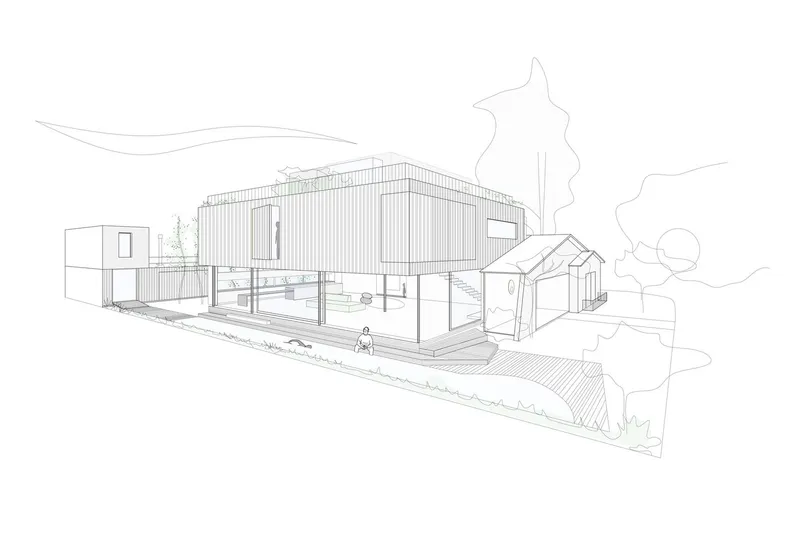
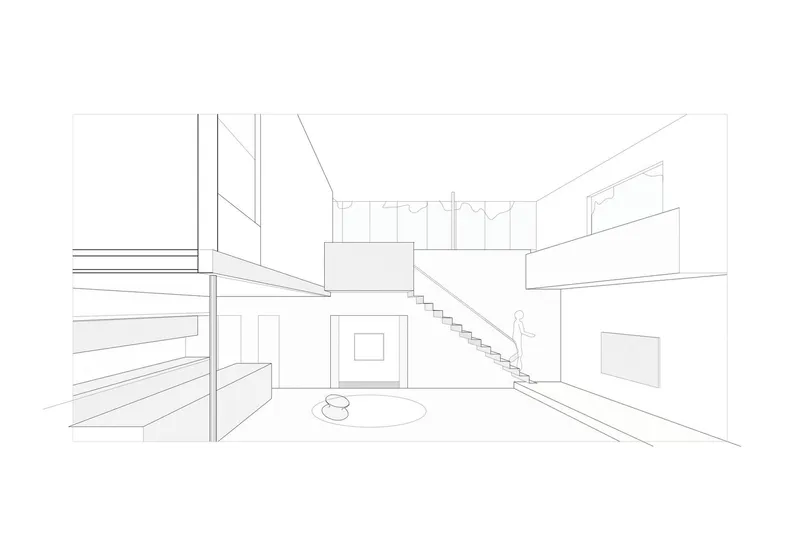
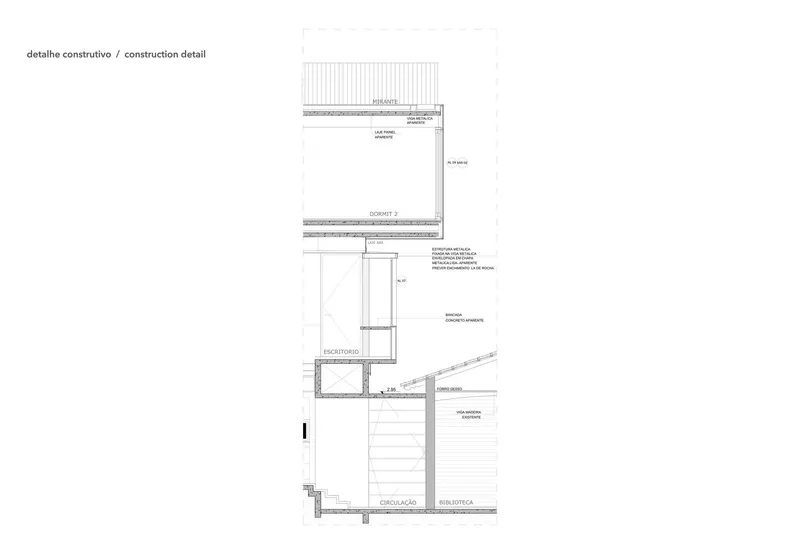
The axonometric phasing diagrams tell the story most concisely: the original house footprint, the concrete spine, the steel wing, and the rooftop additions layered in sequence. The sections reveal how the mature trees on site were treated as fixed elements around which the architecture was organized, not the other way around. The construction detail section is worth studying for the way the roof assembly, window openings, and stair connections are resolved with an economy that the finished surfaces conceal.
The floor plans confirm what the photos suggest: the original house operates as a series of discrete rooms while the new wing favors open plans with vertical connections. The first-floor bedroom plan shows the master suite wrapped around the central staircase, with landscape elements pressing in from all sides. The rooftop plans demonstrate how much program the architects managed to fit onto what is essentially a single elevated platform.
Why This Project Matters
The FBL House is a case study in what happens when architects resist the default impulse to demolish. The 1940s pavilion that was destined for the wrecking ball now anchors a composition that would not work without it. Its human scale, its garden relationships, its spatial warmth: these qualities cannot be replicated by new construction, and the architects were perceptive enough to recognize that before the excavator arrived. The decision to preserve was not sentimental; it was strategic, and the project is better for it.
More broadly, the project demonstrates that renovation and addition need not result in compromise. By drawing a hard line between old and new, both in material language and structural logic, the architects gave each half permission to be fully itself. The white stucco pavilion does not pretend to be modern. The steel tower does not pretend to be historic. And the concrete corridor between them holds the tension without resolving it into a bland middle ground. That tension is the architecture.
FBL House by Claudia Haguiara Arquitetura and HGMA. São Paulo, Brazil. 450 m². Completed 2023. Photography by Christian Maldonado.
About the Studio
Share Your Own Work on uni.xyz
If projects like this are the kind of work you want to make, uni.xyz is a place to publish your own, find collaborators, and enter design competitions.



Popular Articles
Popular articles from the community


Play: Fragments of Their World
Familiar architecture becomes modular playground design, creating safe spaces where displaced children can learn, connect, imagine and play.

The Musturak Paradise: Senior Living Architecture for a Connected Future in Temara, Morocco
The Musturak Paradise reimagines senior living architecture in Temara via private homes, social spaces, culture, community, and shared care.

Co-Life: Senior Housing Design That Reconnects Older Adults With the City
Co-Life reimagines senior housing design through healing gardens, shared streets, workshops, and a sustainable community across generations.

Hill & Cross Opera: Sculptural Opera House Architecture Shaped by Tallinn’s Landscape and Identity
Hill & Cross Opera reimagines opera house architecture in Tallinn through its sculptural hill, civic plaza, glass wave and a luminous cross.


Similar Reads
You might also enjoy these articles


Hodi-Mandai Geram
Project Function: Preservation and revitalization of the Intangible heritage and socio-spatial identity of the Hodi by Housing, Cultural Memory Center, Sacred Grove, landscape, local tourism economy


Olio Towers: A Mid-Rise for Performers That Fuses Housing, Rehearsal, and Stage
Located blocks from Houston's Theater District, this modular tower stacks living units around a central performance atrium.

Oasis: Modular Green Housing Carved into Dhaka's Urban Fabric
A shortlisted Plugin Housing entry reclaims unauthorized settlements in Dhaka with stepped concrete volumes, green roofs, and ventilation-driven design.

Black Hole: A Floating Megastructure for the Post-Physical Era
Emiliano Mazzarotto envisions a spherical, self-scaling arena where e-sports, digital hotels, and holographic stadiums replace traditional public space.


Explore Architecture Competitions
Discover active competitions in this discipline



Challenge to reimagine the Iron Throne


Photograph architecture without architects


Illustrate the lost glory of Angkor Wat - Render Challenge


Design challenge to reuse E-waste
Comments (0)
Please login or sign up to add comments
No comments yet. Be the first to comment!