
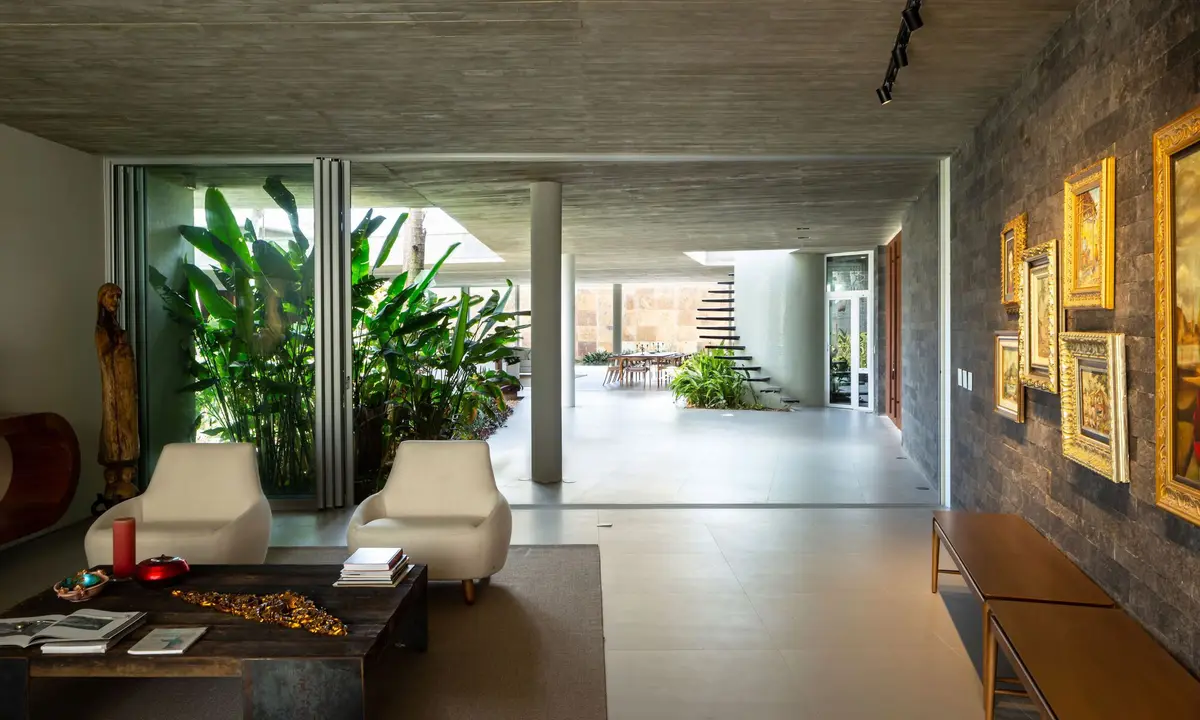
Fernandes Atem Arquitetos Builds a 1,400 m² House in Eusébio as One Continuous Porch
House GG reinterprets the northeastern Brazilian alpendre as a total domestic strategy, stretching concrete canopies across courtyards, pools, and gardens.


The porch, or alpendre, is one of the foundational spatial types of northeastern Brazilian architecture. It is a threshold zone, neither fully inside nor fully outside, designed to manage heat, light, and social exchange all at once. At House GG in Eusébio, a municipality on the outskirts of Fortaleza in Ceará, Fernandes Atem Arquitetos takes this single idea and stretches it across 1,400 square meters of built area. Lead architects Ricardo Fernandes and Juliana Atem do not treat the porch as a frontispiece or an afterthought tacked onto a conventional plan. Instead, the entire house is conceived as a porch: a series of deep concrete canopies that shelter life without ever fully enclosing it.
What makes the project genuinely interesting, rather than merely large, is the discipline with which it sustains that premise. Every room negotiates its relationship to the outdoors through layered intermediary spaces: reflecting pools, planted courtyards, timber screens, and stone walls that modulate privacy without resorting to hermetic enclosure. The structural concrete, left with board-formed texture, does the work of climate mediation. It is the roof, the shade device, and the primary aesthetic gesture all at once. In a region where the sun is relentless for most of the year, that kind of integration is not decorative; it is essential.
Arrival Under the Canopy
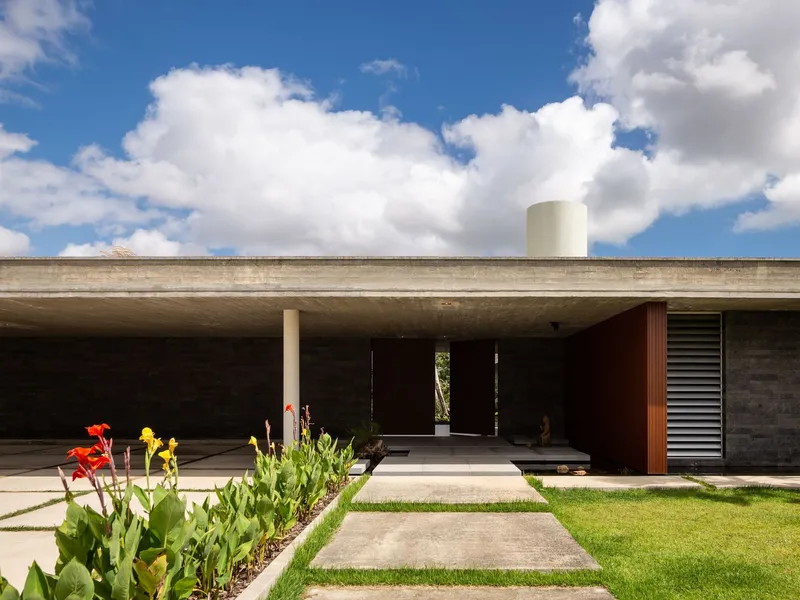
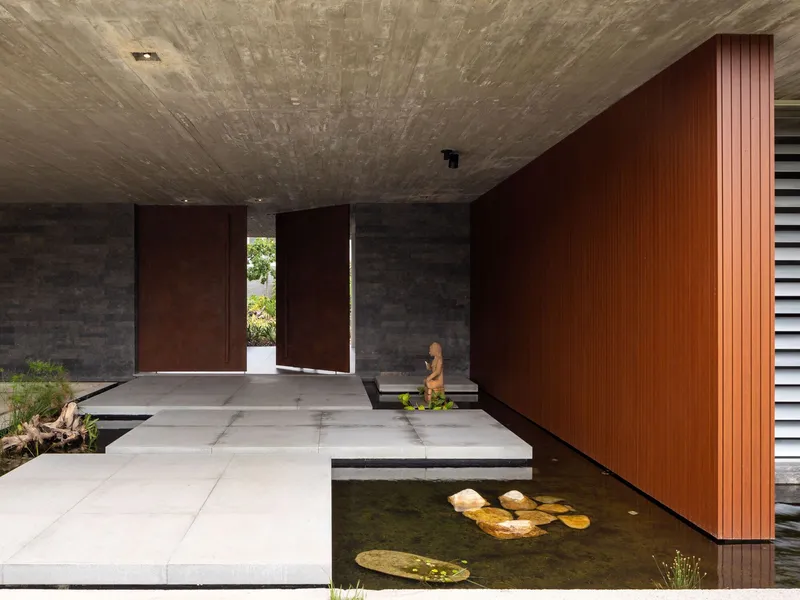
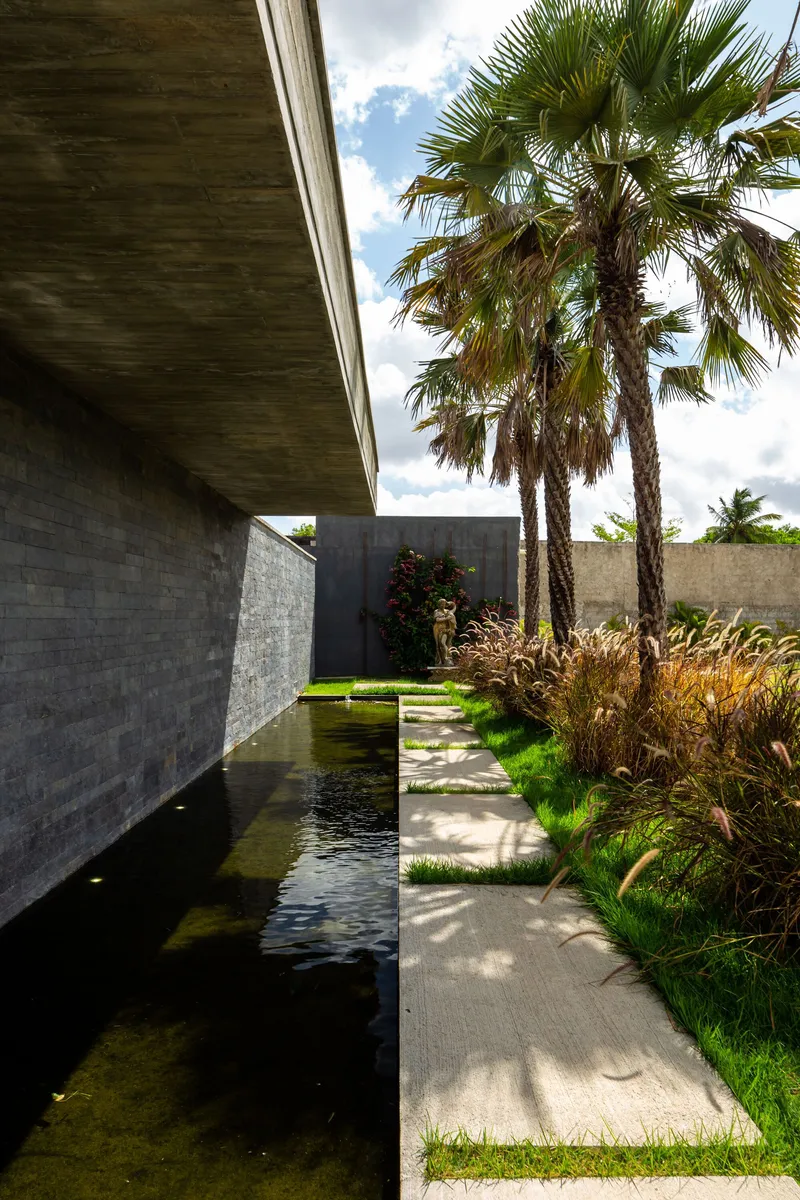
The approach sequence sets up the logic of the entire house. A broad concrete canopy cantilevers outward, floating above flowering canna lilies and a manicured lawn, signaling the entry without a conventional door or portico. You step onto a series of stones laid across a shallow reflecting pool beneath a board-formed concrete ceiling, flanked by a timber-clad wall on one side and water on the other. The combination of mass overhead and transparency at the periphery is characteristic of the project's tactic: the roof is always present, always heavy, always grounding the experience, while the enclosing walls dissolve.
Further along, narrow walkways parallel to the pool extend the procession under palms. Shadows from the trees pattern the concrete surfaces, an effect that changes by the hour and softens the hard material palette. The arrival is slow, deliberate, and theatrical in the best sense. It forces a transition between the heat of the street and the cool of the interior, mimicking the thermal logic of the traditional alpendre at a much larger scale.
Living Under Concrete
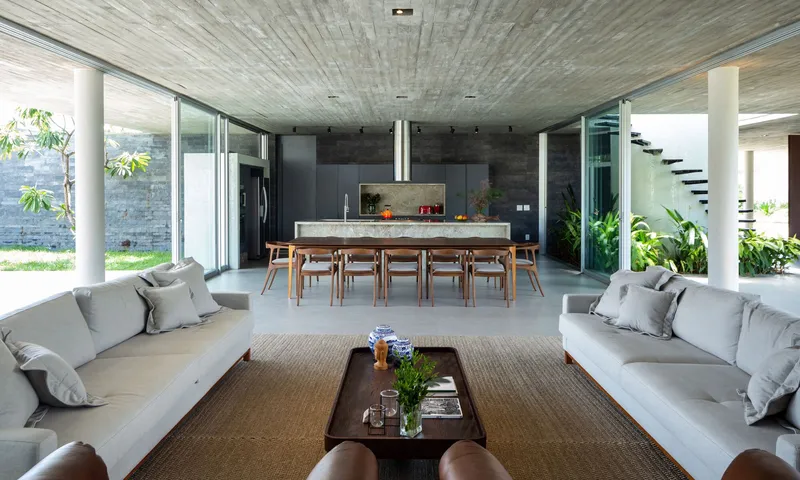
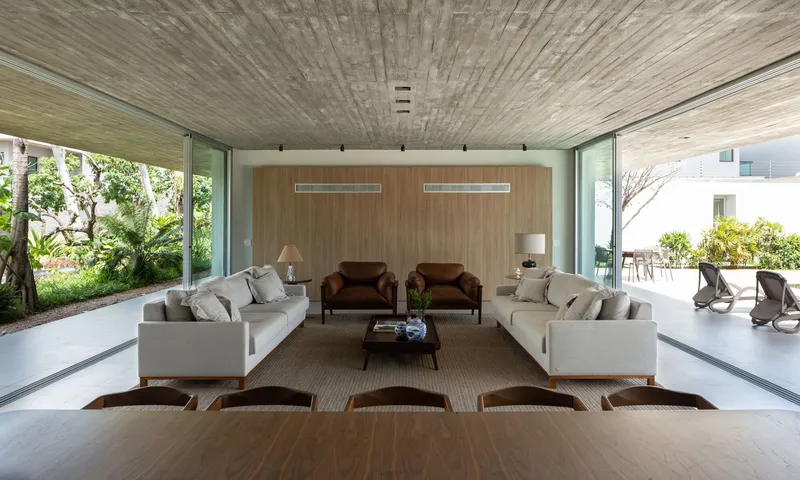
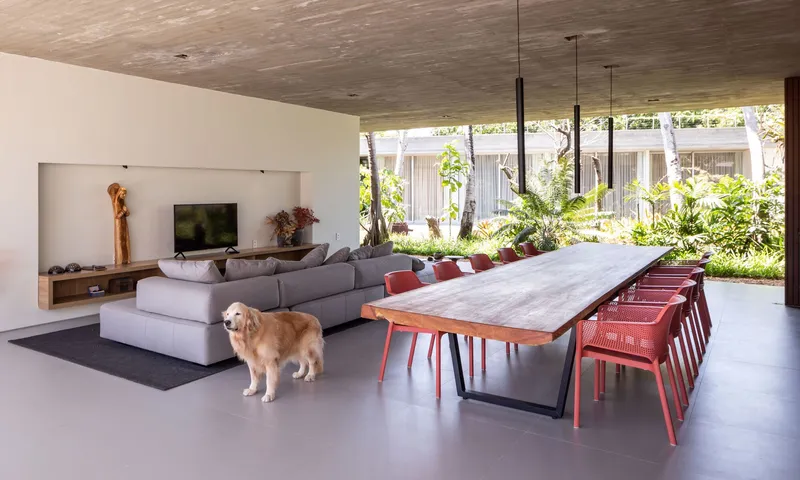
The main living spaces are organized as open-plan zones beneath expansive board-formed concrete ceilings. The formwork imprint gives the soffits a directional grain that reads almost like timber, warming a material that could otherwise feel oppressive at this scale. In image after image, the ceiling plane stretches uninterrupted from interior to exterior, erasing the boundary between the living room and the planted courtyard beyond. Glazed openings on both sides of the plan allow cross-ventilation and cross-views, so you are always aware of vegetation and sky.
The furniture and finishes are deliberately restrained. The striped timber ceiling panels that appear in some zones offer a lighter counterpoint to the concrete, while low-slung seating and clean lines keep the scale of the rooms legible. There is a warmth here that comes from the careful calibration of materials: stone, timber, concrete, and glass, each doing a specific thermal and visual job.
Courtyards as Rooms
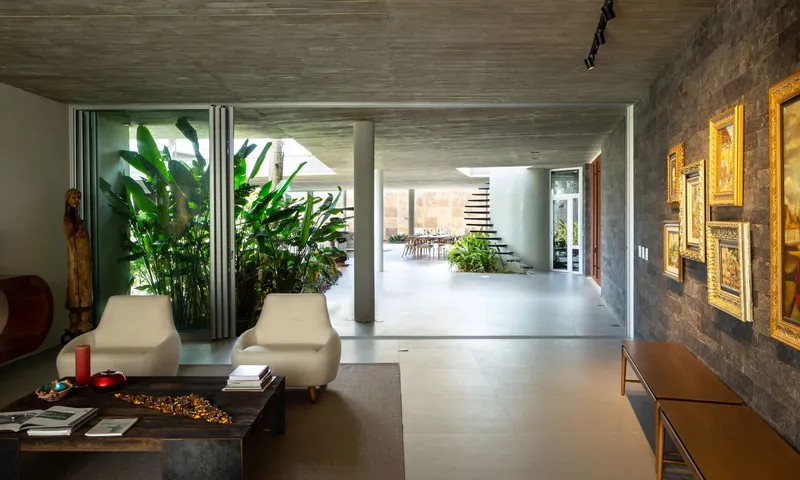
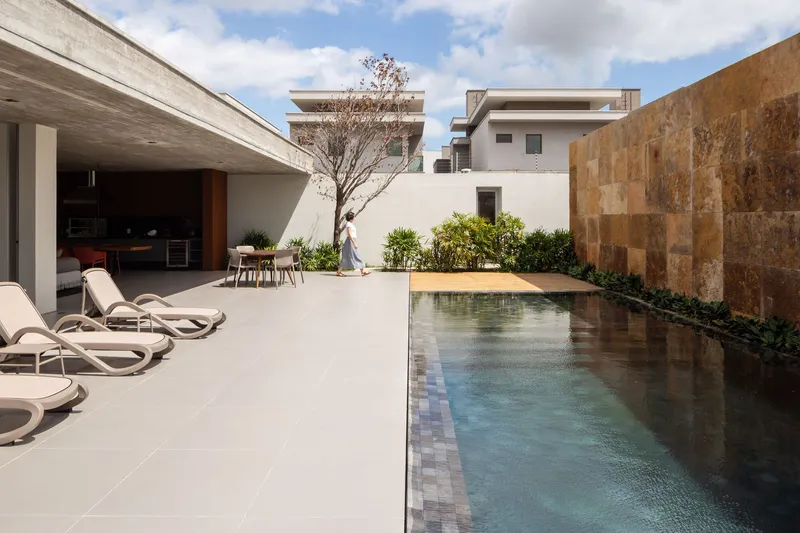

The courtyards in House GG are not leftover spaces between buildings. They are composed with the same rigor as the interior rooms. A central pool is bordered by large-format tile paving and a textured stone wall, with a leafless tree standing as a sculptural element against the sky. Elsewhere, tall banana palms rise through a void in the concrete ceiling, their leaves brushing the soffit, collapsing the distinction between landscape and structure.
One particularly compelling moment features a concrete platform hovering over a reflecting pool in an interior courtyard, backed by a vertical timber wall and a stone Buddha sculpture. It reads as a contemplative room without walls. These voids are doing real climatic work, pulling air through the plan and admitting light deep into the house, but they are also operating as social and psychological spaces. They give the 1,400 square meters a sense of intimacy that sheer area alone cannot provide.
The Kitchen and Domestic Core
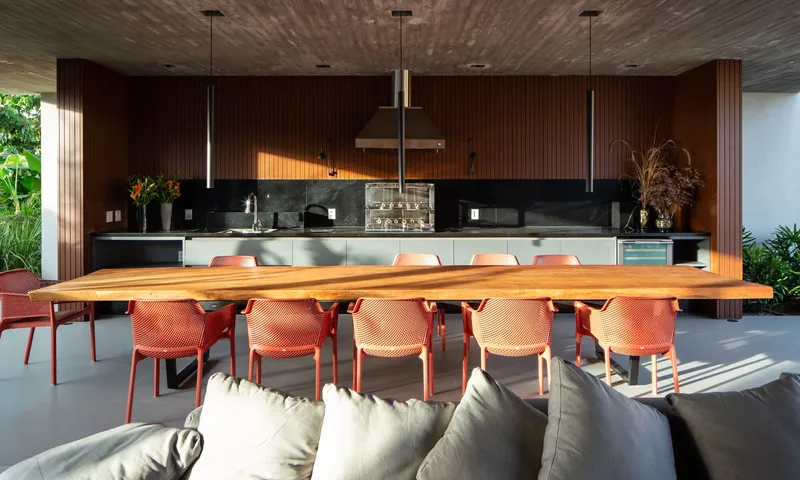
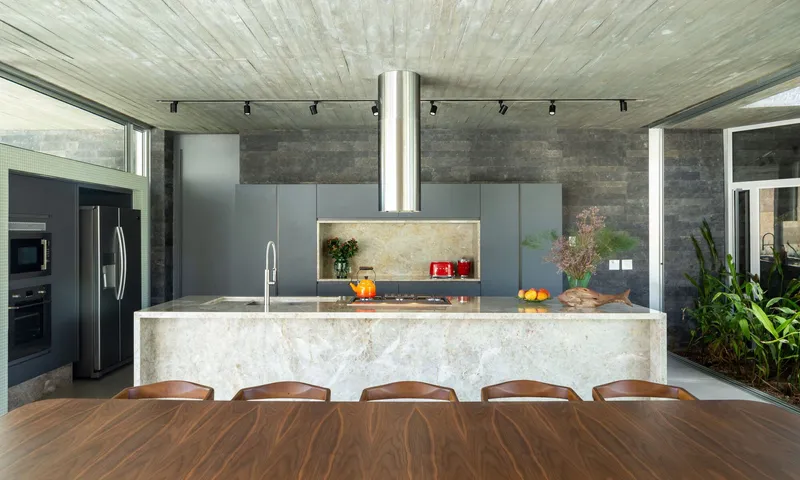

The kitchen is treated as a central gathering space rather than a service area tucked away from view. A veined marble island anchored by a suspended cylindrical steel hood sits beneath the ever-present board-formed concrete ceiling. Clerestory windows along the upper edge of the kitchen walls bring in controlled natural light without exposing the workspace to direct sun, a simple but effective detail for the Ceará climate.
In the open-plan dining zone, timber slatted walls filter light and provide privacy while orange mesh chairs inject a pop of color against the otherwise neutral palette. The material choices here, from the dark cabinetry to the striped timber ceiling panels, demonstrate a careful palette management: warm tones dominate the zones where people gather, while cooler concrete dominates the circulation and threshold spaces.
Shelter and Edges
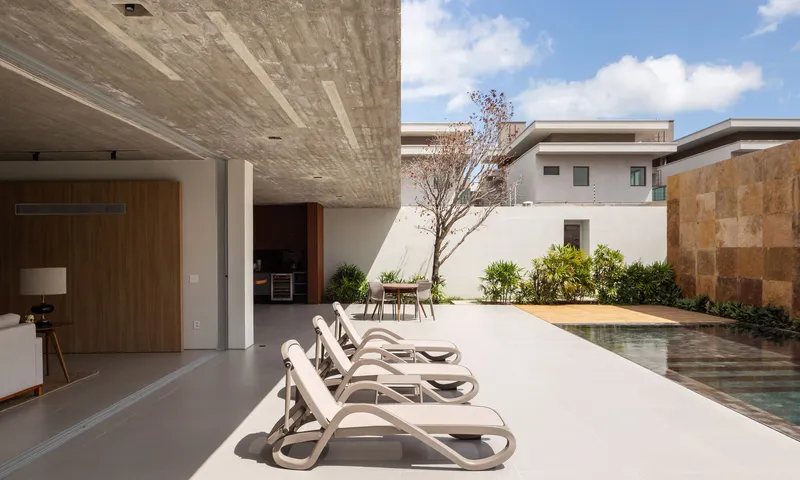

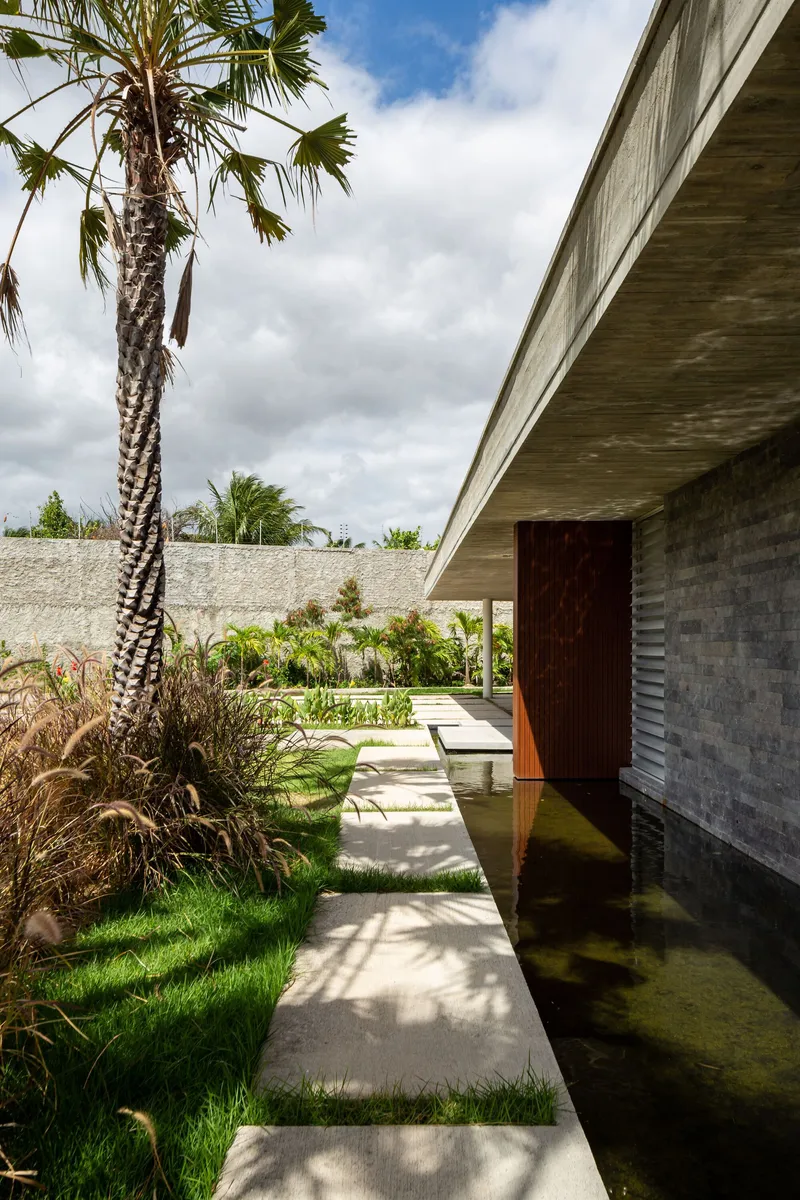
The pool terrace exemplifies the porch concept at its most relaxed: lounge chairs sit beneath a deep concrete soffit that frames views of the courtyard tree beyond. There is no railing, no threshold marker, no physical separation between the shaded zone and the sunlit pool deck. The transition is purely spatial, defined by the shadow line of the roof's edge.
At the building's perimeter, layered stone walls and planted beds create a buffer between the house and its surroundings. The concrete roof overhangs extend well beyond the walls below, shading the stone and the plantings. Grasses and palm fronds soften the hard edges. The overall effect is of a building that is intensely grounded in its site, heavy where it touches the earth, but open and generous where it meets the sky.
Interior Details and Atmosphere
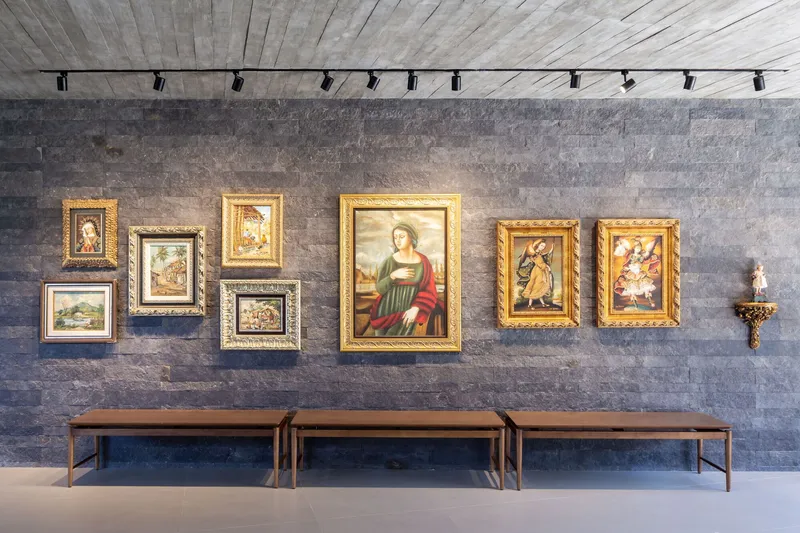
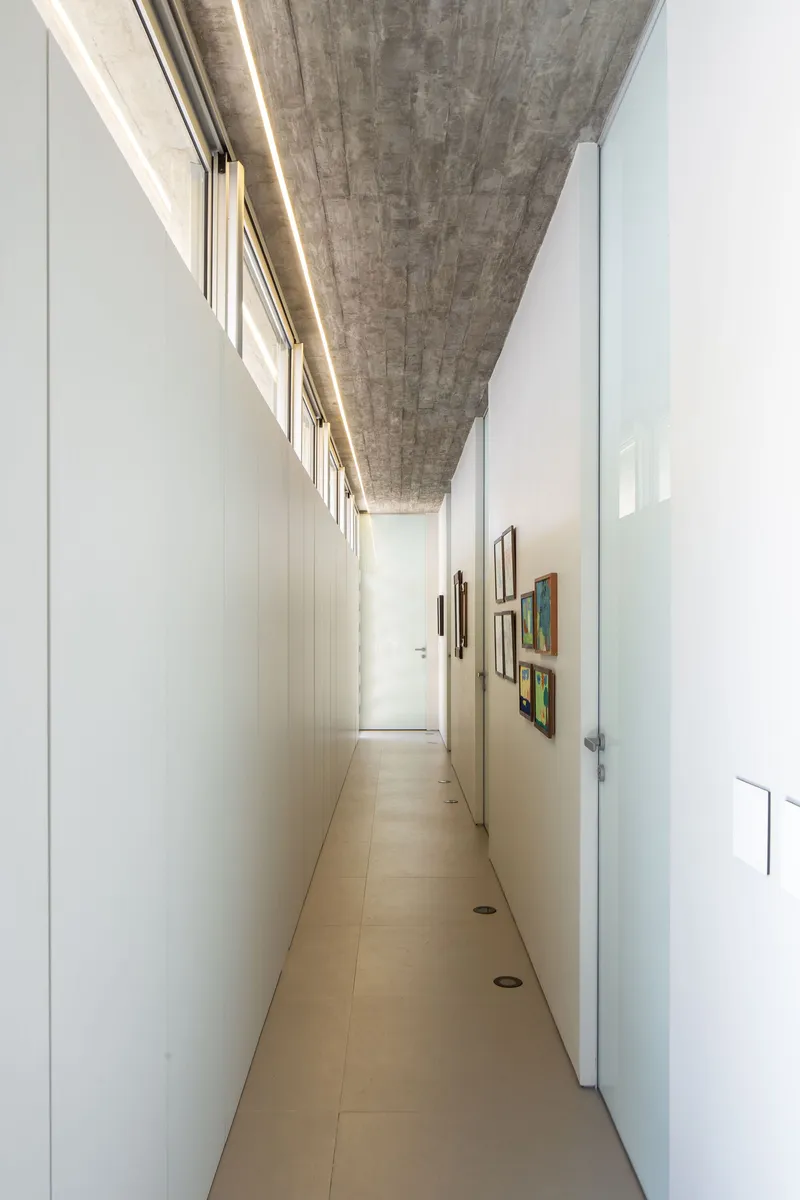
House GG reserves its moments of density for specific interior episodes. A dark stone wall serves as a gallery for gilt-framed paintings, lit by track lighting and fronted by three low wooden benches, a composition that treats art collecting as a spatial event rather than mere decoration. Nearby, a corridor with an exposed board-formed concrete ceiling uses a linear skylight along one edge to create a strip of daylight that washes the white wall and gives the passage a clear directional pull.
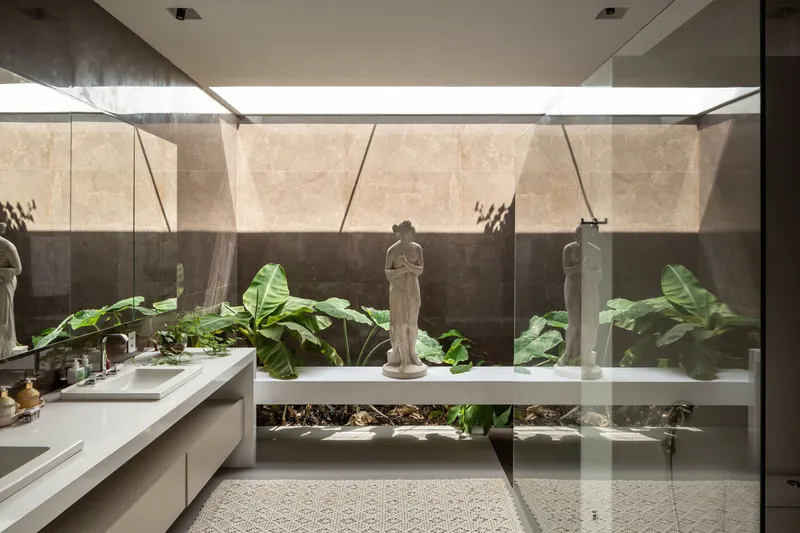
The bathroom pushes the landscape integration furthest: a stone-clad wall backs an integrated planter bed filled with tropical foliage, visible through a glass partition. A sculpture sits among the plants. It is a room that refuses to be sealed off from the garden logic of the rest of the house. Even the most private spaces participate in the project's central argument that every room should feel like a version of the porch.
Textures and Thresholds
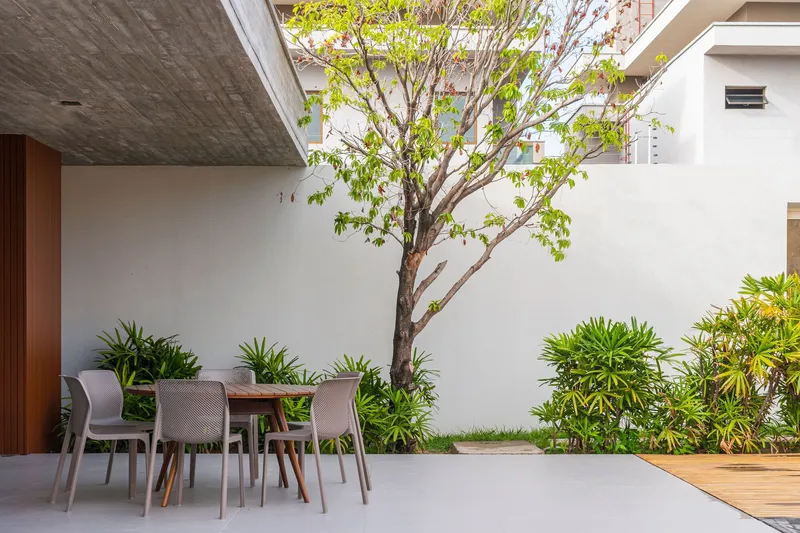
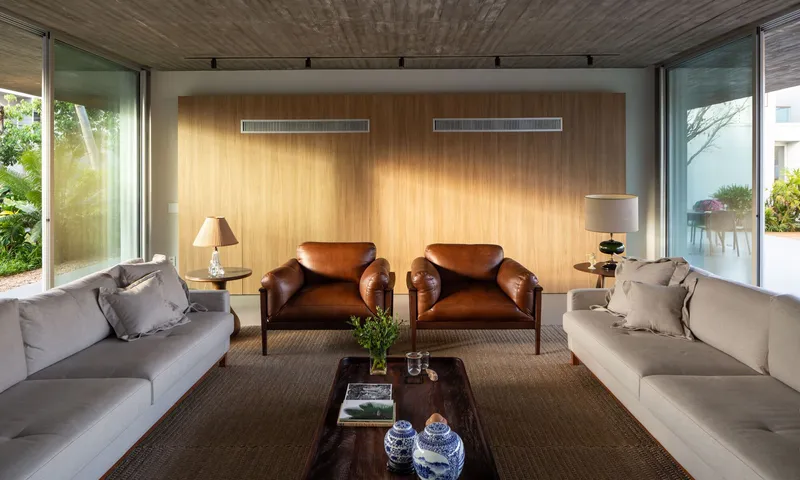
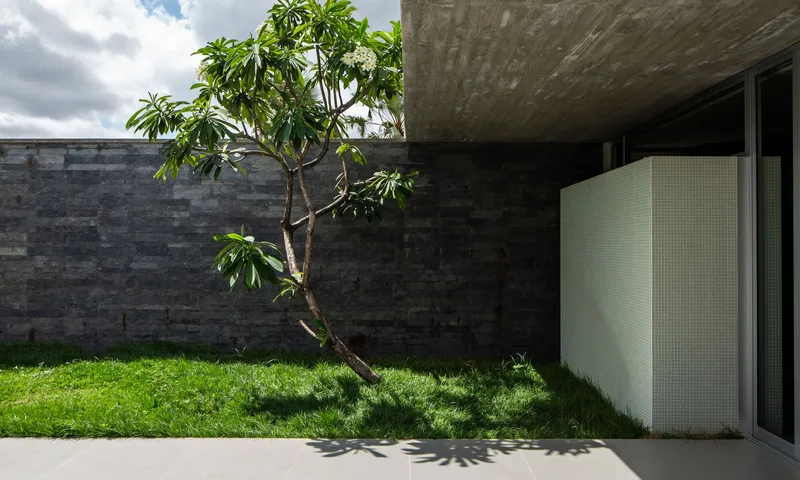
Several quieter moments throughout the house reward close attention. An outdoor dining area with a single tree and tropical plantings against a white wall works through simplicity: the dappled light does most of the compositional work. A sitting room with a timber-paneled wall opens through glazed corners to the garden, catching afternoon sunlight in a way that softens the room's geometry. The corner of a layered stone wall, with a frangipani tree casting sharp shadows on concrete paving, is one of those elemental encounters between material and light that makes good architecture legible without explanation.
Throughout House GG, thresholds are never abrupt. The project's real achievement is the consistency with which it choreographs the passage from public to private, from sun to shade, from hard to soft. Every transition is gradual, mediated by vegetation, water, or a change in ceiling height. The house never slams a door.
Plans and Drawings
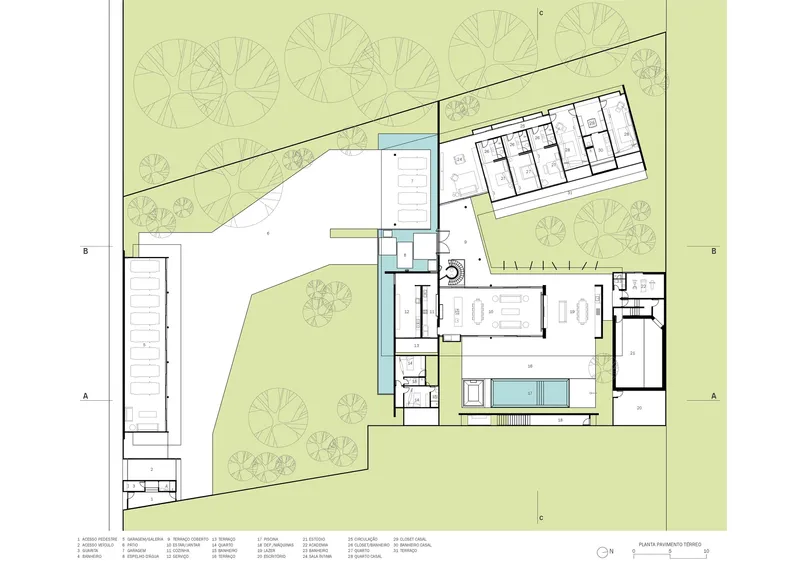
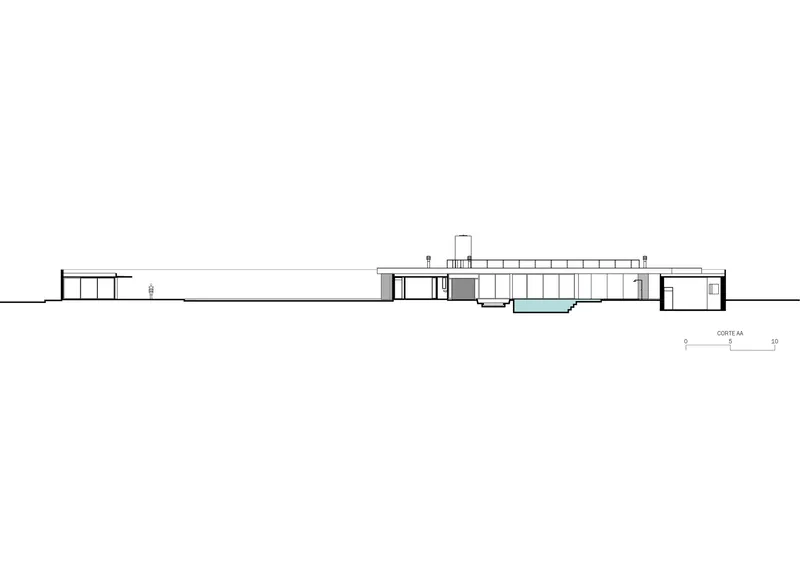
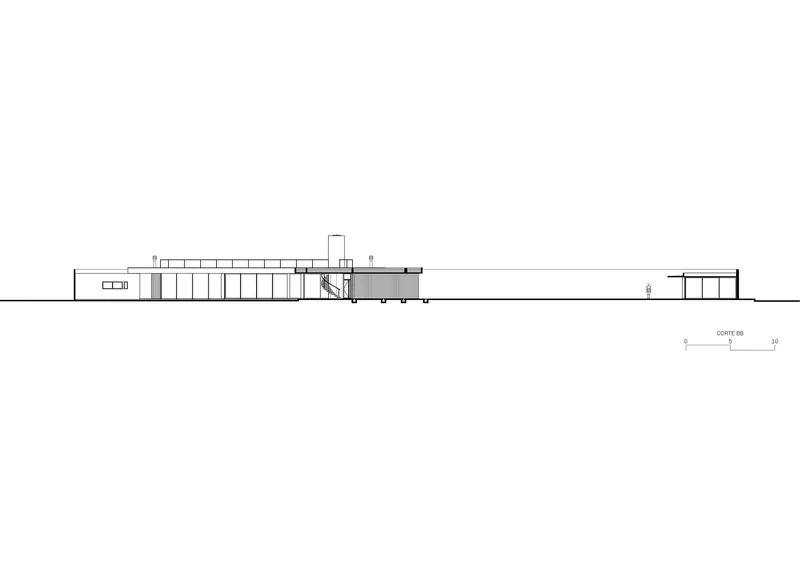
The site plan confirms an L-shaped organization of volumes arrayed around a central pool, with generous landscape buffers on all sides. The sections reveal the project's low-slung horizontal profile: flanking pavilions of relatively modest height bracket a central courtyard, and the roof planes extend well beyond the enclosed volumes to create the deep overhangs that are the project's primary architectural move.

A final section drawing shows the linear character of the plan at its clearest: varied ceiling heights modulate the spatial experience along the building's length, with a pool terminating one end. The structure reads as a series of connected pavilions rather than a single monolithic volume, which explains why a 1,400 square meter house never feels overwhelming. Structural engineer Luiz Bento Filho's concrete framework is both the visual language and the environmental strategy, eliminating the need for applied ornament or secondary shading systems.
Why This Project Matters
House GG matters because it demonstrates that a regional spatial type can be the generative idea for a large, contemporary residence without descending into nostalgia or pastiche. The alpendre is not quoted as a historical motif; it is operationalized as a total architectural strategy. Every decision, from the board-formed concrete ceilings to the placement of reflecting pools, serves the logic of a shaded, ventilated threshold space that mediates between body and climate. In a moment when tropical modernism risks becoming an aesthetic label applied to any concrete house with palms, this project earns the association through genuine performance.
At the scale of a single-family house, it is also a convincing argument that size does not have to mean opacity. The courtyards, pools, and gardens break the 1,400 square meters into comprehensible episodes, each with its own character but all united by the continuous roof plane. Fernandes Atem Arquitetos have built a house that is simultaneously monumental and permeable, a rare combination. It sits in Eusébio as a demonstration that the most sophisticated response to the northeastern Brazilian climate was already embedded in the region's oldest domestic tradition. The architects simply had to take it seriously.
House GG by Fernandes Atem Arquitetos (Ricardo Fernandes, Juliana Atem). Located in Eusébio, Ceará, Brazil. 1,400 m². Completed in 2020. Photography by Felipe Petrovsky and Igor Ribeiro.
About the Studio
Share Your Own Work on uni.xyz
If projects like this are the kind of work you want to make, uni.xyz is a place to publish your own, find collaborators, and enter design competitions.


Popular Articles
Popular articles from the community


David Macias Steps a Doorless Stone and Plaster House Down a Tropical Colombian Hillside
In the humid hills of Colombia, Threshold House replaces the front door with an open void and terraces its 850 m² down the slope instead of fighting it.

Cube Design Draws an Ecological Corridor Between Two Shenzhen Hills with the Nankai Building
Beside Shenzhen's container docks, the Nankai Building pairs stacked balconies with a climbing green screen to connect two hillsides across its height.

longwave studio Reorganizes a 112 m² Tainan Apartment Around the Daily Routines of a Family and Two Cats
In Tainan, Taiwan, birch plywood, rust-red furniture and a freestanding plaster wall link arrival, storage, work and family life in one apartment.

Jaramillo Van Sluys Arquitectura and Urbanismo Turn a Demolished Registry Lot in Quito into an Orchard Plaza
In Quito's Centro Histórico, a 2,800 m² plaza exposes the San Agustín convent wall and redraws its lost Augustinian orchard in volcanic stone.

Similar Reads
You might also enjoy these articles


LAVA Architecten Gives Vocational Education a Sawtooth-Roofed Face on a Mechelen School Campus
In Mechelen, Belgium, a 2,053 m² STEM school on a 6×6 m grid turns workshops and classrooms into rooms that can be rearranged as teaching changes.

KEMA Studio Turns a Derelict Marvila Attic into a 60 m² Lighthouse Apartment Above Lisbon
In Lisbon's Marvila district, a rebuilt roof, four skylights and two plywood volumes turn an unlivable attic into a bright home facing the Tagus.

Pixel Gardens: One Repeated Module Stacked Into a Terraced Social Housing Tower for Famagusta
Salem Bader's shortlisted housing tower builds a vertical neighbourhood from one repeated module, offsetting units to carve terraces, light and air.

Bao Huynh Watercolor Atelier: A Serene Art Retreat in Hội An
Bao Huynh Watercolor Atelier in Hội An blends multifunctional art spaces, sustainable design, local materials, and family-friendly living in a serene environment.

Explore Ai Generated Competitions
Discover active competitions in this discipline

Challenge to design mud housing for contemporary communities

Challenge to reimagine the Iron Throne

Photograph architecture without architects

Illustrate the lost glory of Angkor Wat - Render Challenge
Comments (0)
Please login or sign up to add comments
No comments yet. Be the first to comment!