
FGMF Buries a House Under Its Own Garden in the São Paulo Countryside
Colina House in Porto Feliz uses an inclined green roof to dissolve 810 square meters of living space into the landscape of Fazenda Boa Vista.


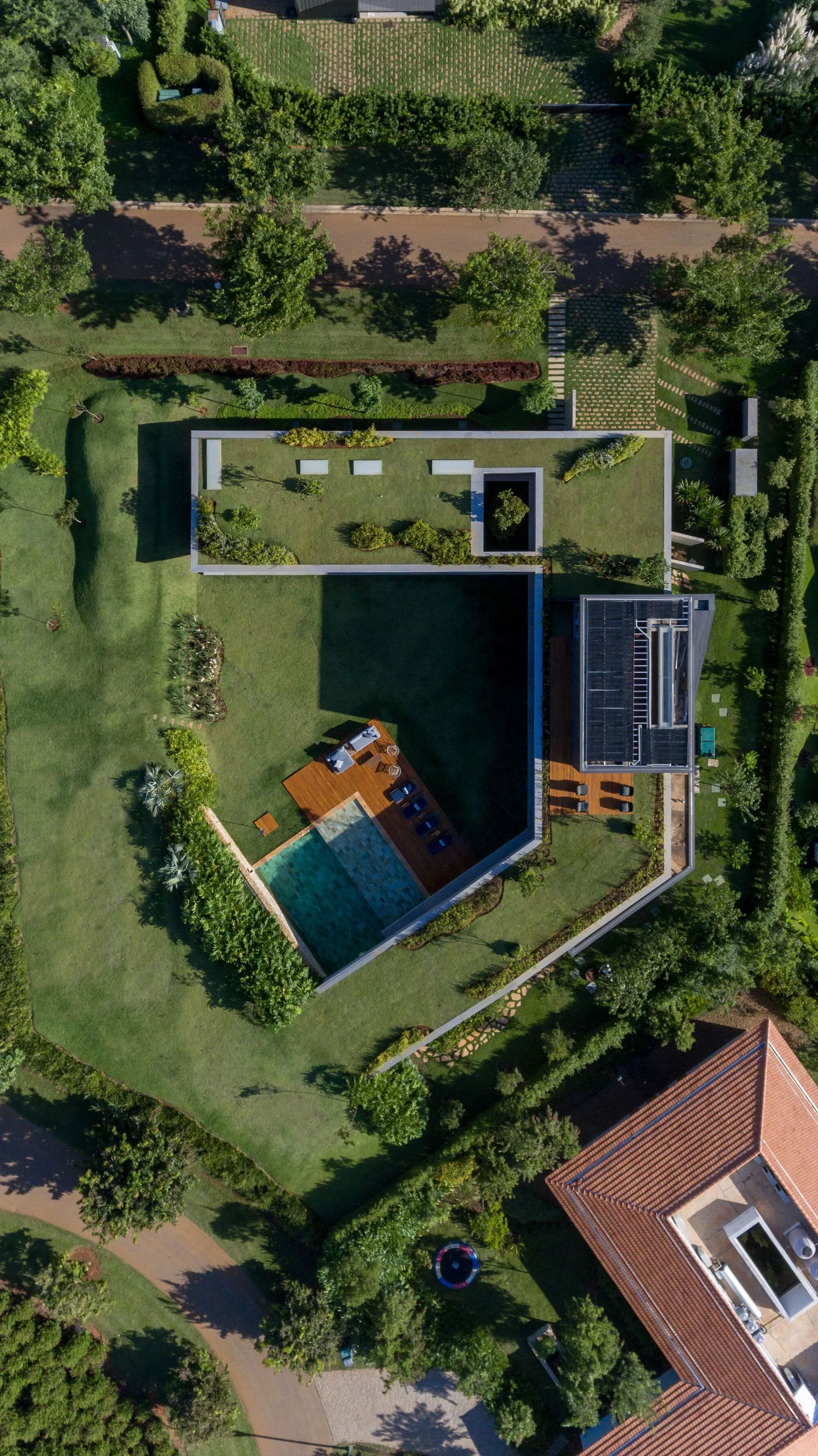
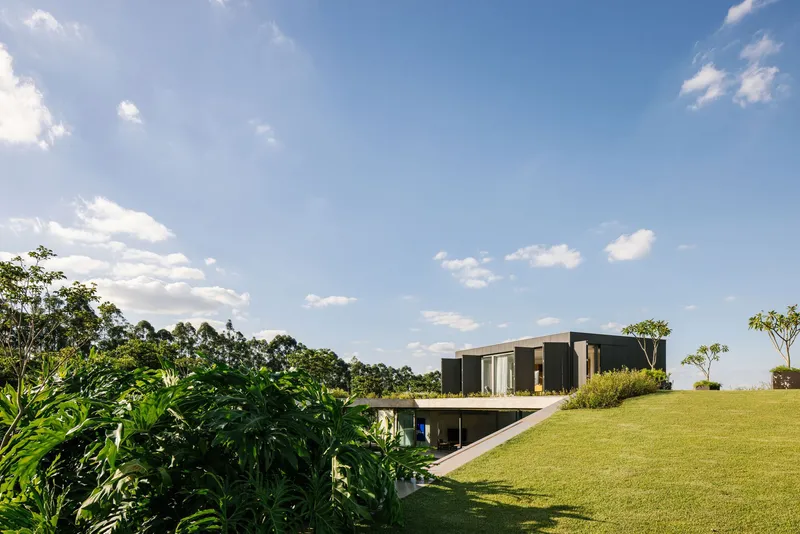
Most houses sit on their sites. Colina House by FGMF becomes its site. The 810-square-meter residence at Fazenda Boa Vista in Porto Feliz, two hours northwest of São Paulo, deploys an extensive ramp of turf that merges the rooftop with the surrounding terrain. From the air, the house reads as little more than a gentle hill with a pool, a sand court, and a row of solar panels. The ground swallows the architecture whole.
What makes the project genuinely compelling is the discipline with which partners Fernando Forte, Lourenço Gimenes, and Rodrigo Marcondes Ferraz restrain the formal gesture. The planted roof is not decorative; it is the logical consequence of a design that treats the plot's slight topographic slope as the organizing principle. Choosing a corner lot for its sun exposure and elevation change, the architects wrapped the program into a C-shaped plan that frames a lowered courtyard, shields the street side with concrete, and opens every social space toward the landscape through nine meters of continuous glazing.
A Hill You Can Live Inside
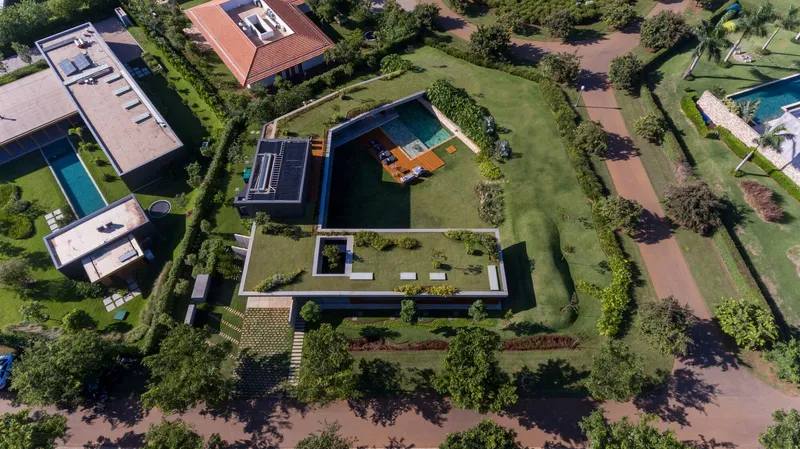
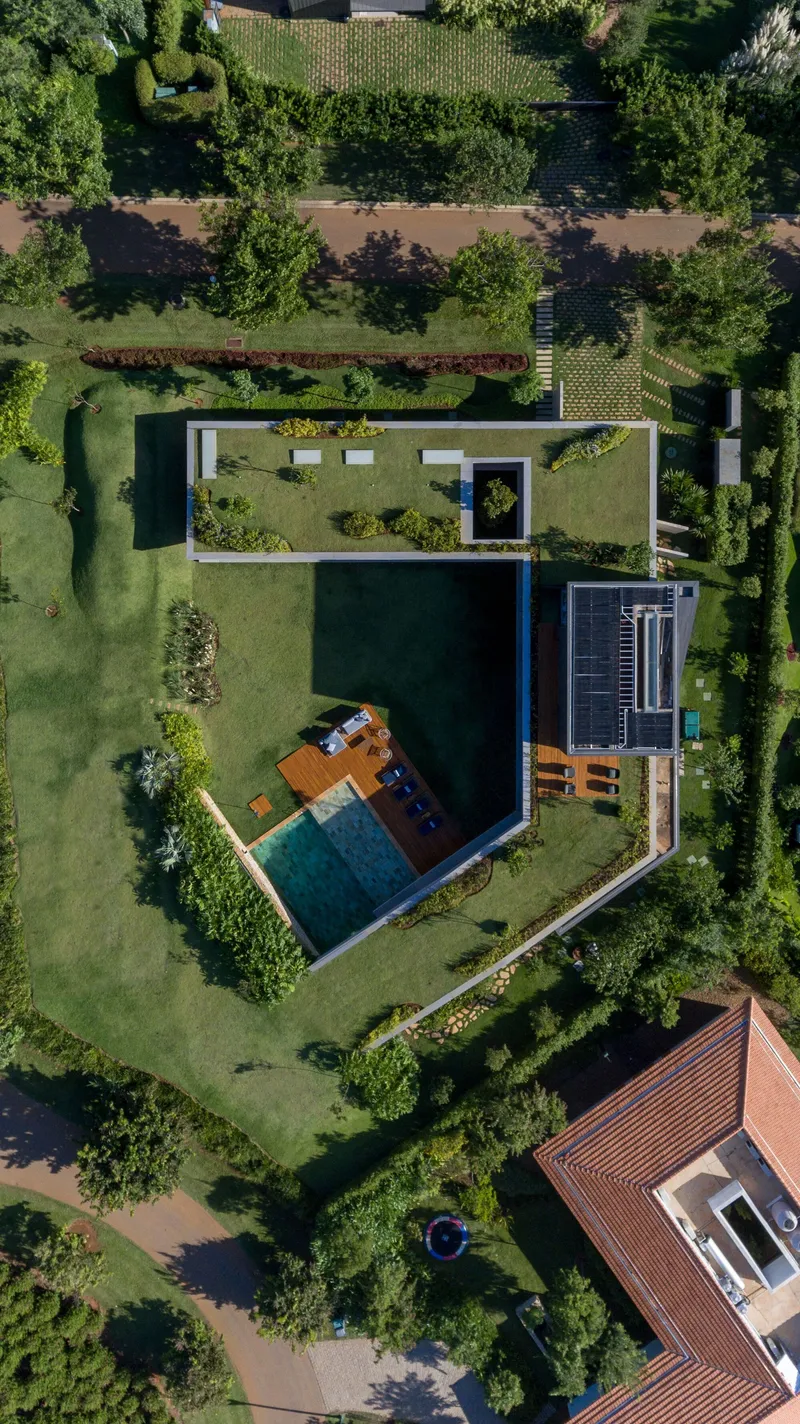
Aerial photographs tell the real story. Compared to neighboring plots, which announce their footprints with hard edges and reflective materials, Colina House barely registers. The inclined green roof follows the natural grade, creating a garden that slopes upward from the courtyard edge to the street level. It is a strategy of disappearance: the more you build, the less you see.
The planted surface does practical work too. It acts as thermal mass, insulating the flat concrete slab beneath it from direct solar gain. Combined with the solar panels tucked at the perimeter, the house leverages passive cooling and renewable energy without resorting to conspicuous sustainability theater.
Concrete Frame, Open Living
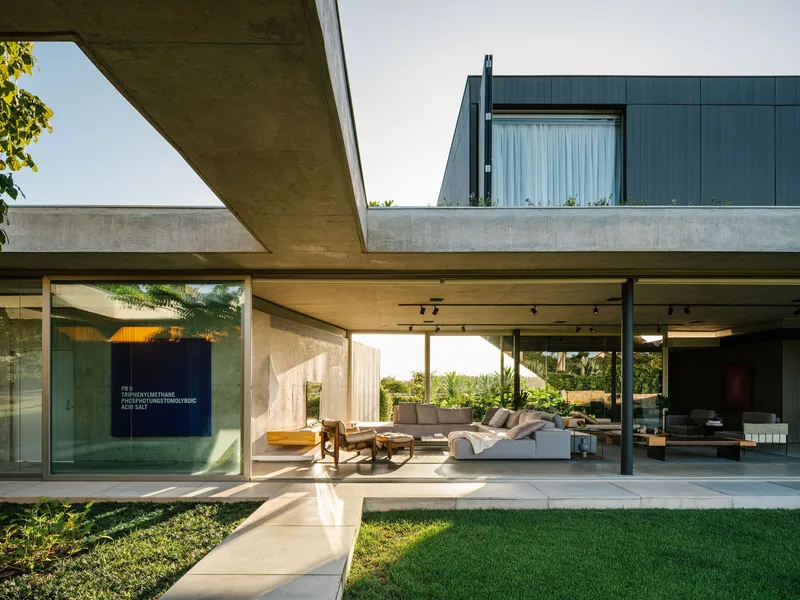
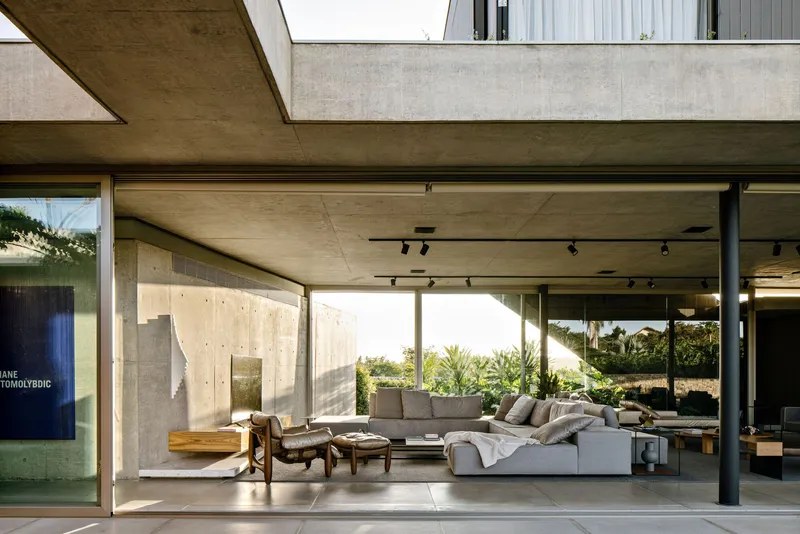
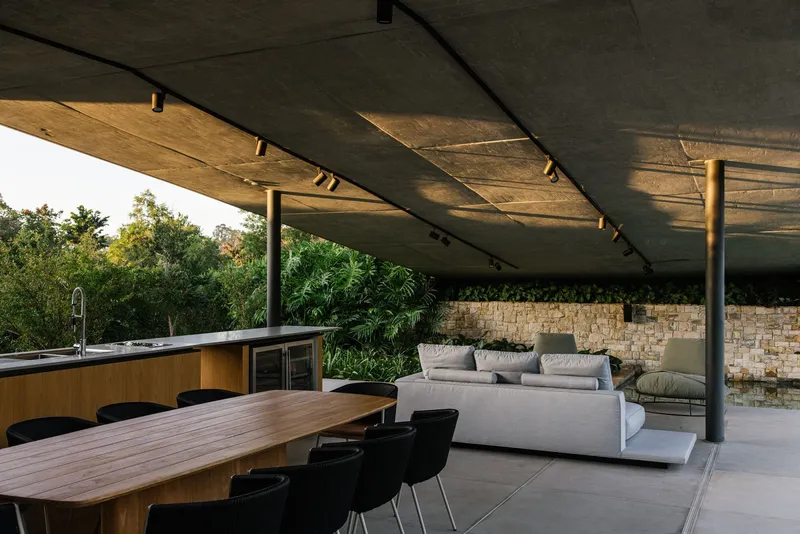
Beneath the slab, the social program unfolds as a series of covered terraces rather than enclosed rooms. Board-formed concrete columns and soffits establish a raw, tectonic order while the walls between them dissolve into sliding glass panels. The nine-meter-wide opening that connects the living and dining zones to the pool deck is not a window; it is the absence of a wall, turning inside and outside into a single register of floor plane and ceiling plane.
A limestone retaining wall anchors the pool's far edge and introduces a mineral texture that reads as geological rather than decorative. Porcelain flooring runs continuously from the interior social areas out onto the leisure deck, eliminating any threshold that might interrupt the spatial flow. The effect is one of calm horizontality: everything spreads, nothing rises.
The Timber Block and Its Double Life
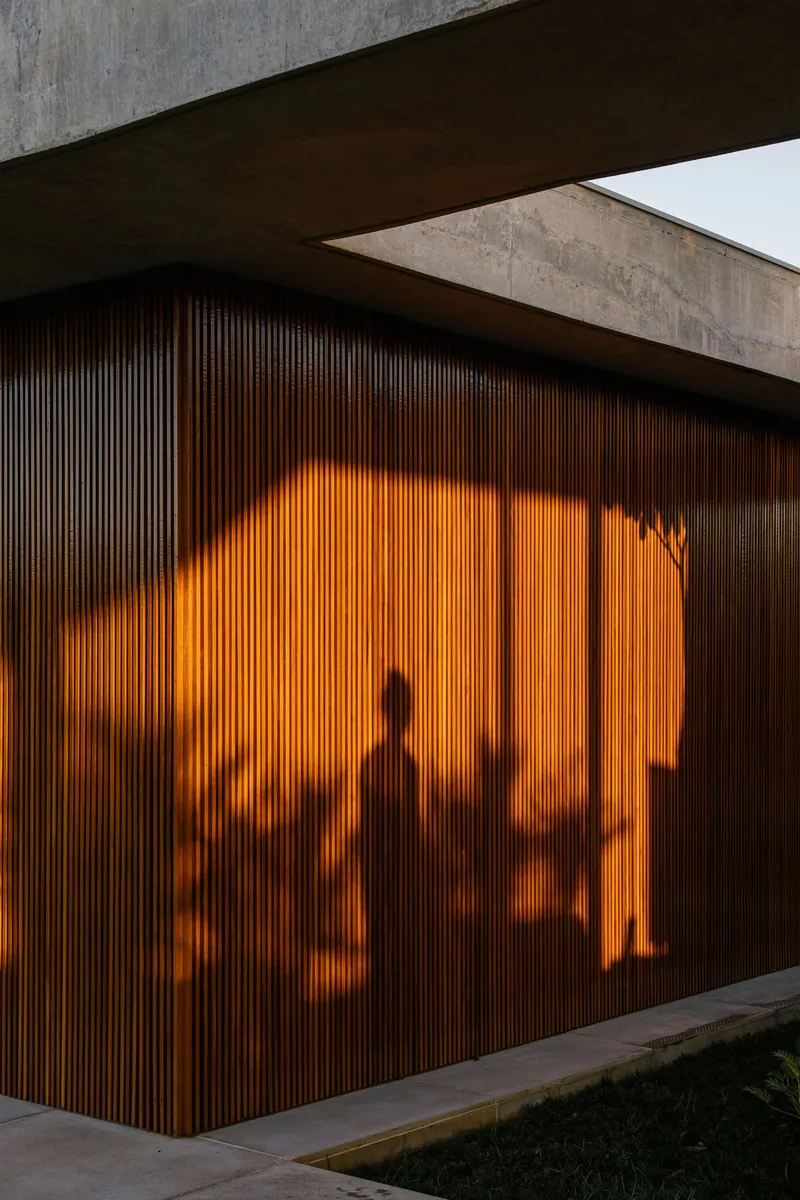
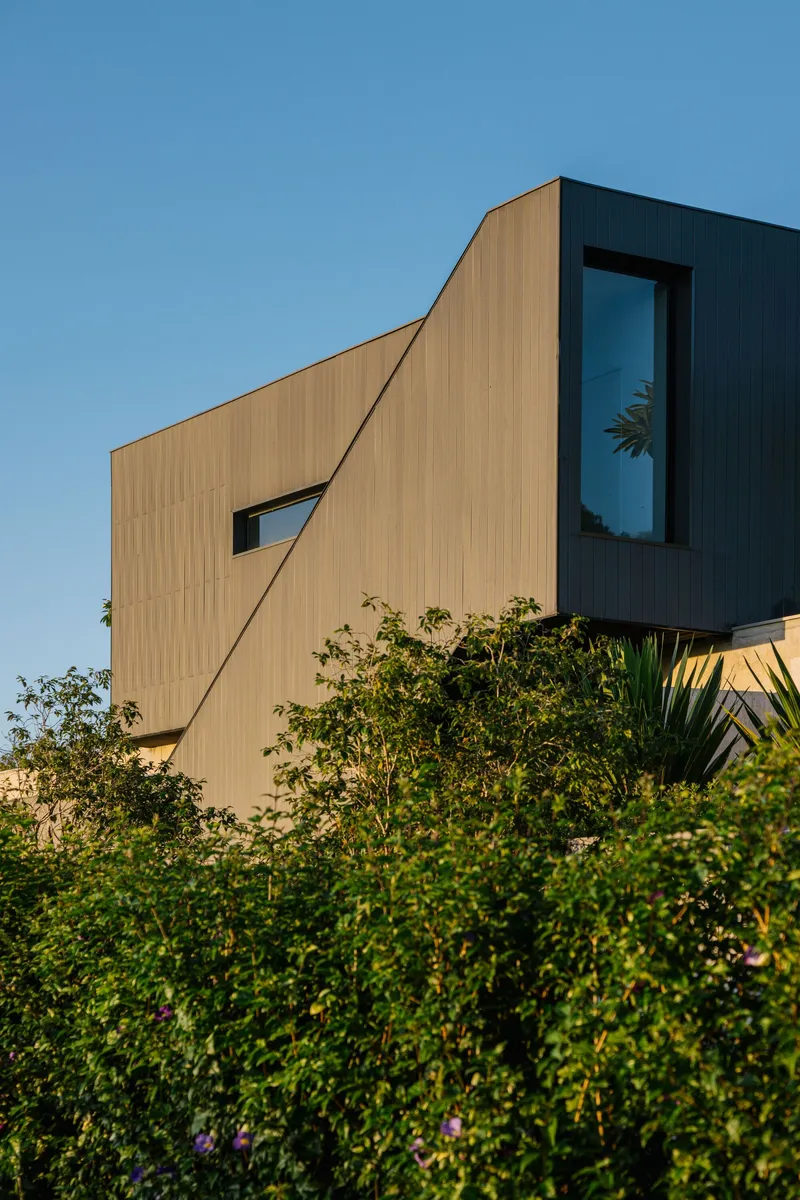
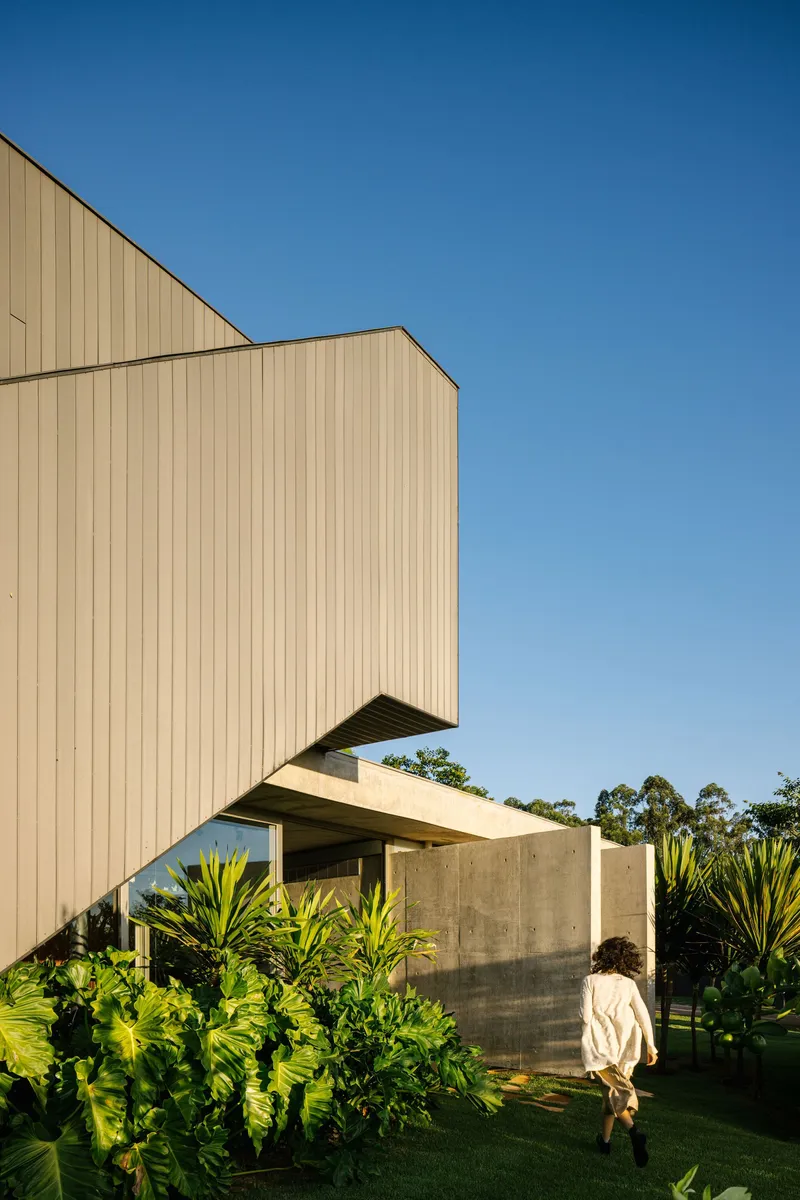
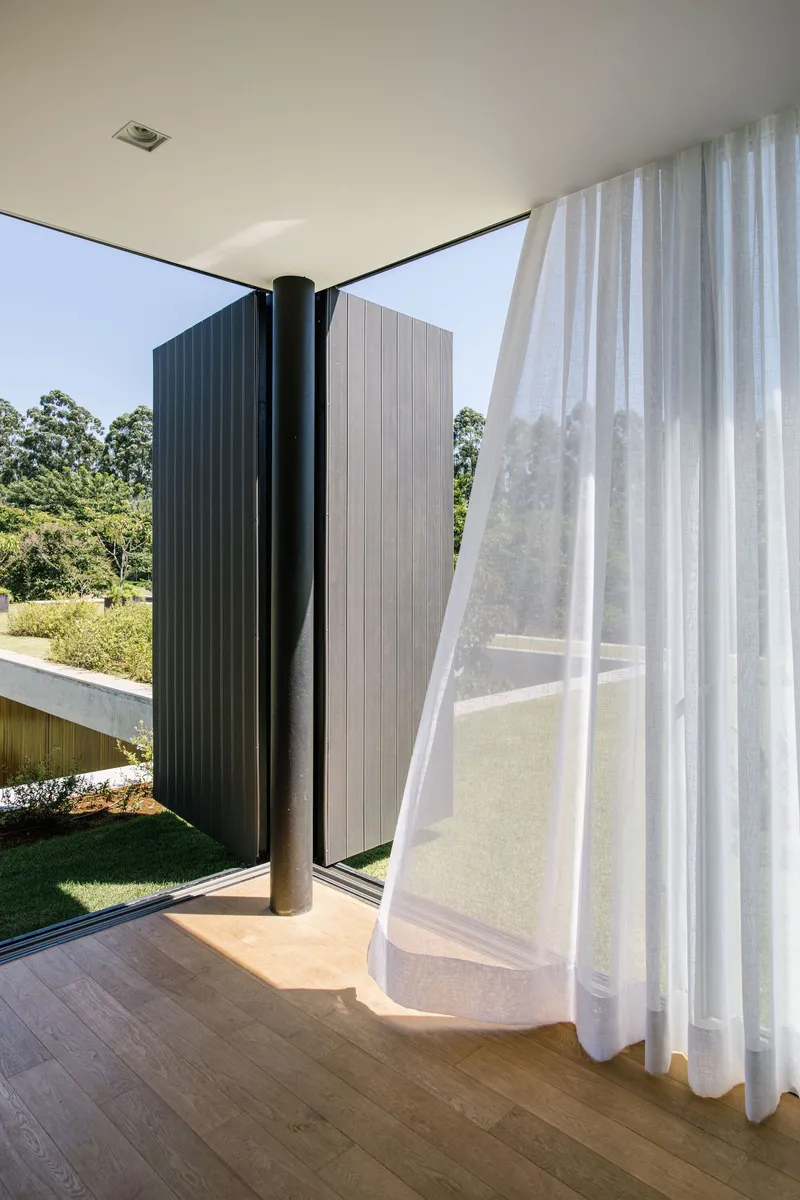
The guest wing introduces a material shift that is as much about atmosphere as it is about privacy. Clad in vertical ebonized timber, the volume reads as a monolithic block when its shutters are closed, absorbing light and reducing the wing's visual weight under the cantilevered slab. Open, it becomes a lantern, warm interior light filtering through the slats and casting silhouettes onto the garden.
The strategy is cinematic. At dusk, the timber screen transforms the house's character entirely. What was a recessive, camouflaged object during the day becomes a glowing volume set against tropical plantings and a rising moon. FGMF treats material not as finish but as performance: the same surface does privacy, ventilation, and spectacle in sequence.
Courtyard as Social Engine
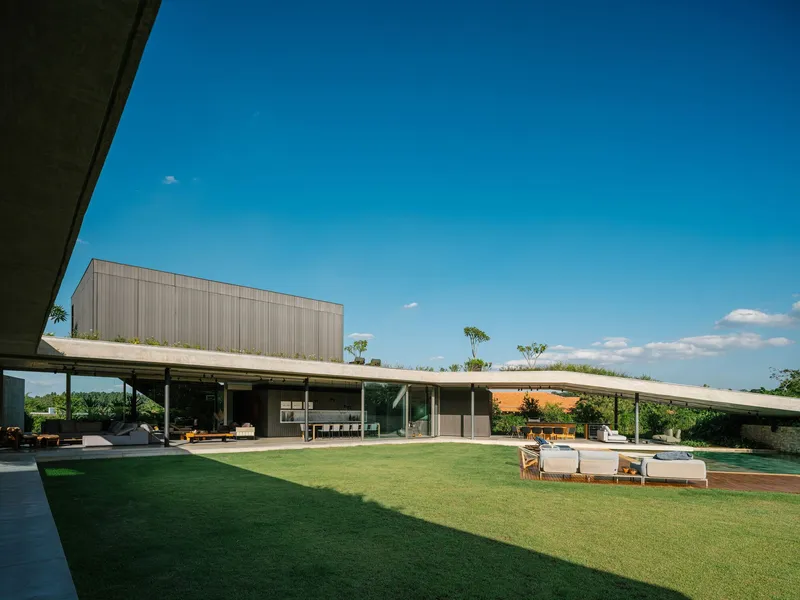
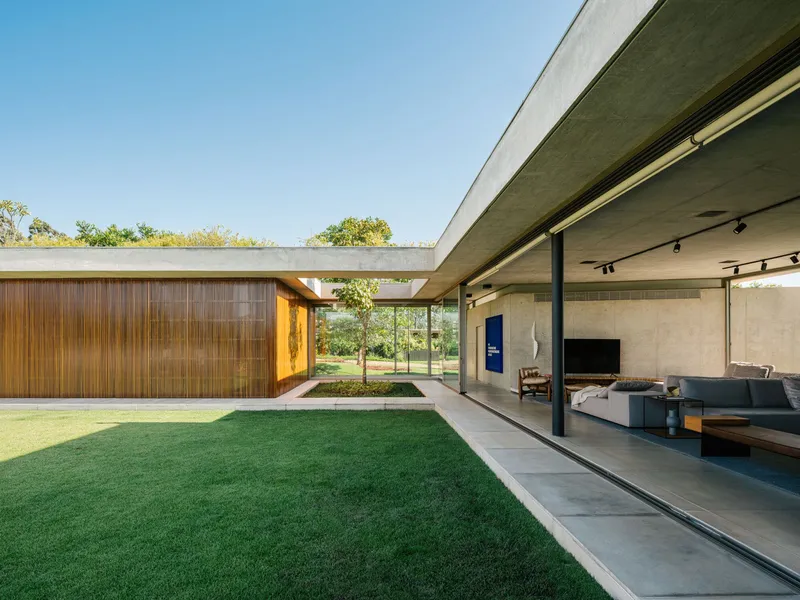
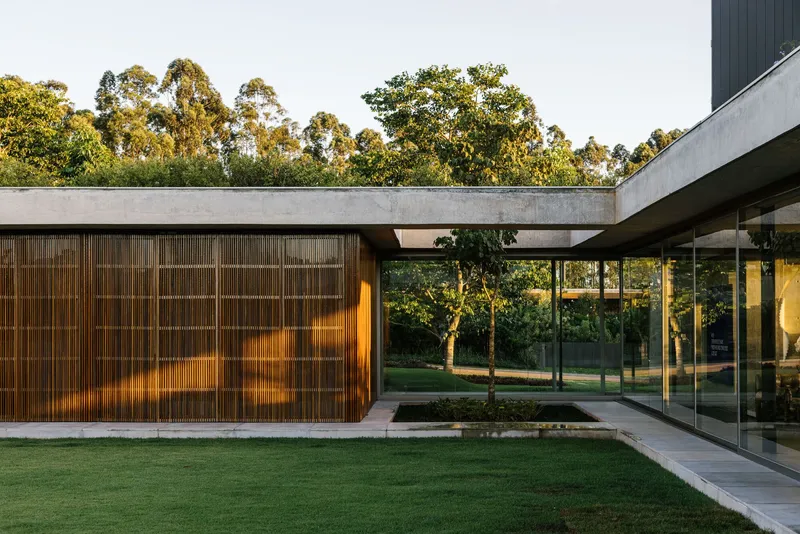
The C-shaped plan is a familiar courtyard typology, but Colina House deploys it with a topographic twist. By lowering the courtyard relative to the street, the architects create a semi-enclosed outdoor room that is invisible to passersby yet fully connected to the sky. Visual contact between every ground-floor space passes through this patio, making it the organizational core of daily life.
Planted beds at the courtyard edges soften the junction between concrete and lawn, while covered pavilions on two sides provide shade without blocking airflow. The effect is of a clearing in a constructed landscape, a void that gives the surrounding volumes their spatial logic.
Pool, Deck, and the Art of Reclining
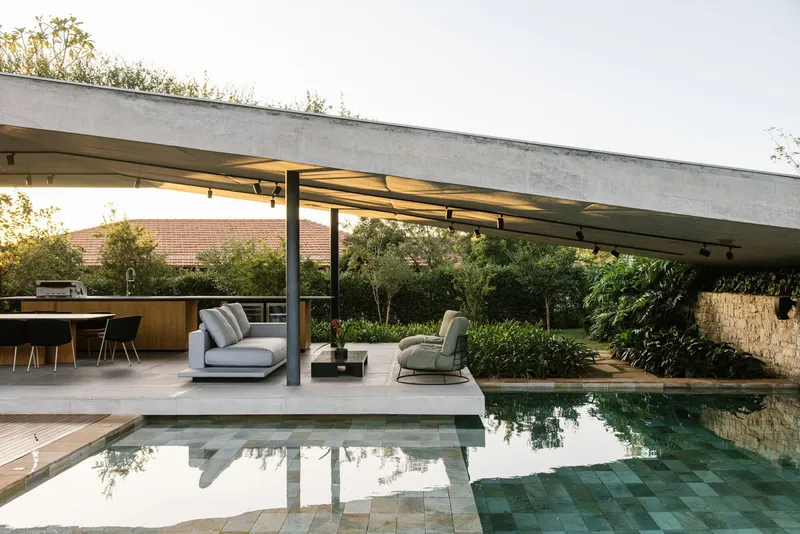
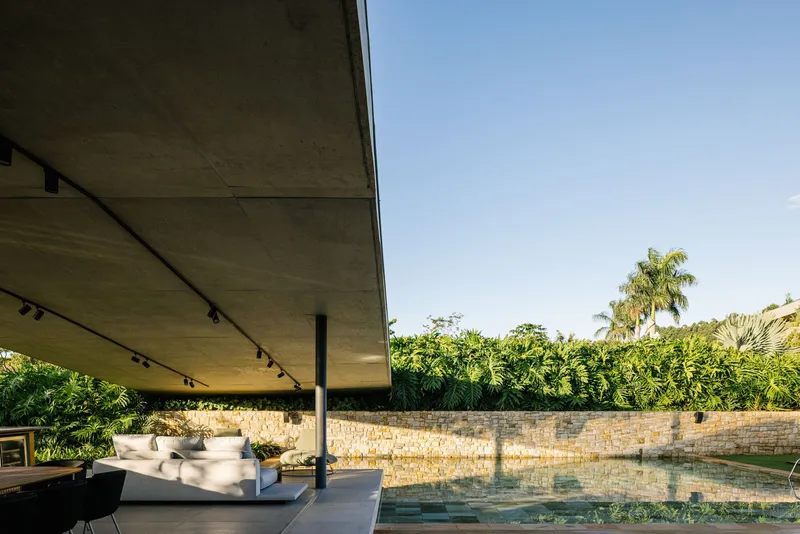
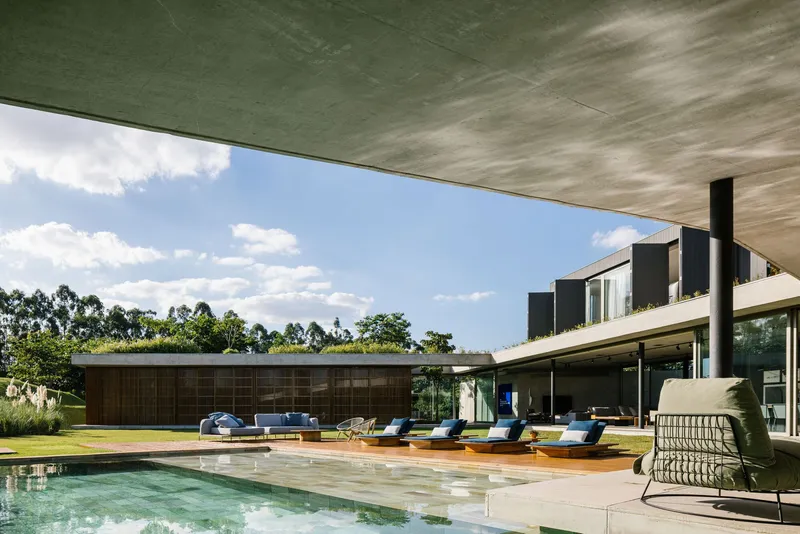
The pool is partially tucked beneath the ascending roof ramp, a move that creates a shaded lane of water alongside a fully sunlit deck. It is a small gesture with large consequences: swimmers get shade and reflected light from the concrete soffit above, while sunbathers occupy the open timber deck just beyond. The pool becomes two zones, not one.
Lounge furniture is kept deliberately low, reinforcing the house's commitment to a horizon line that never competes with the landscape. Natural mineral stone and timber on the sun deck introduce warmth underfoot, distinguishing the leisure zone from the cooler porcelain of the indoor areas.
Private Quarters in Timber and Light
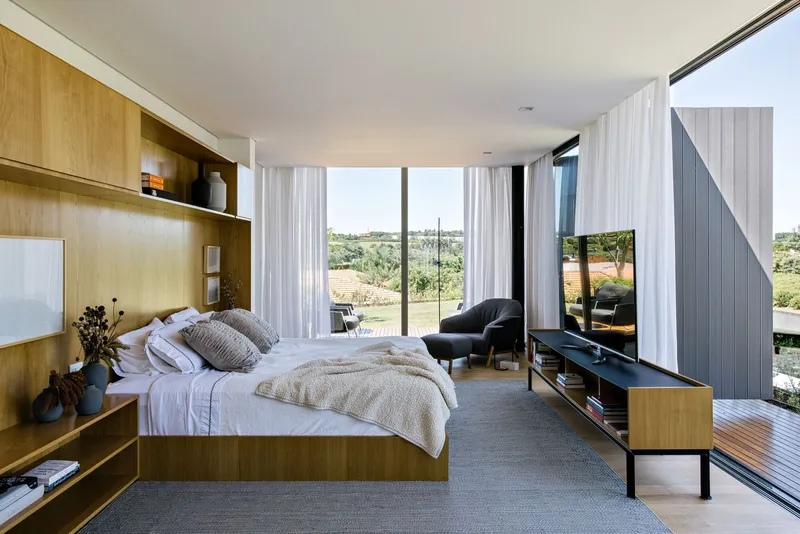
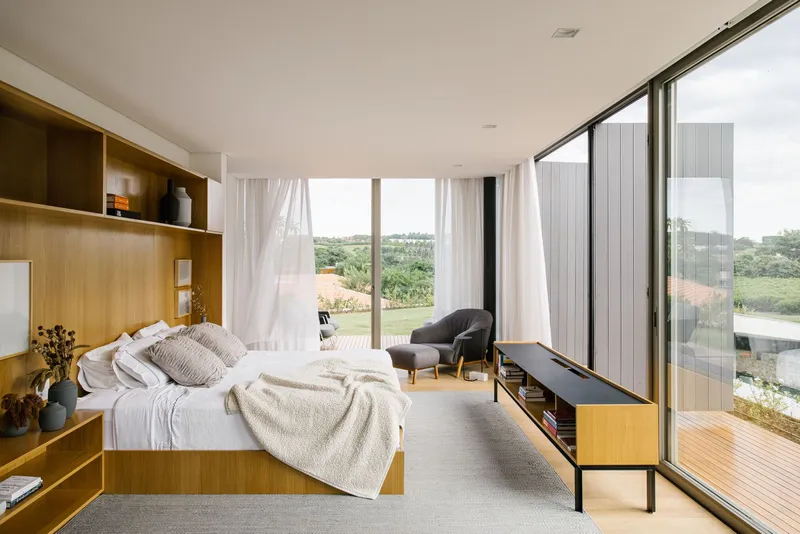
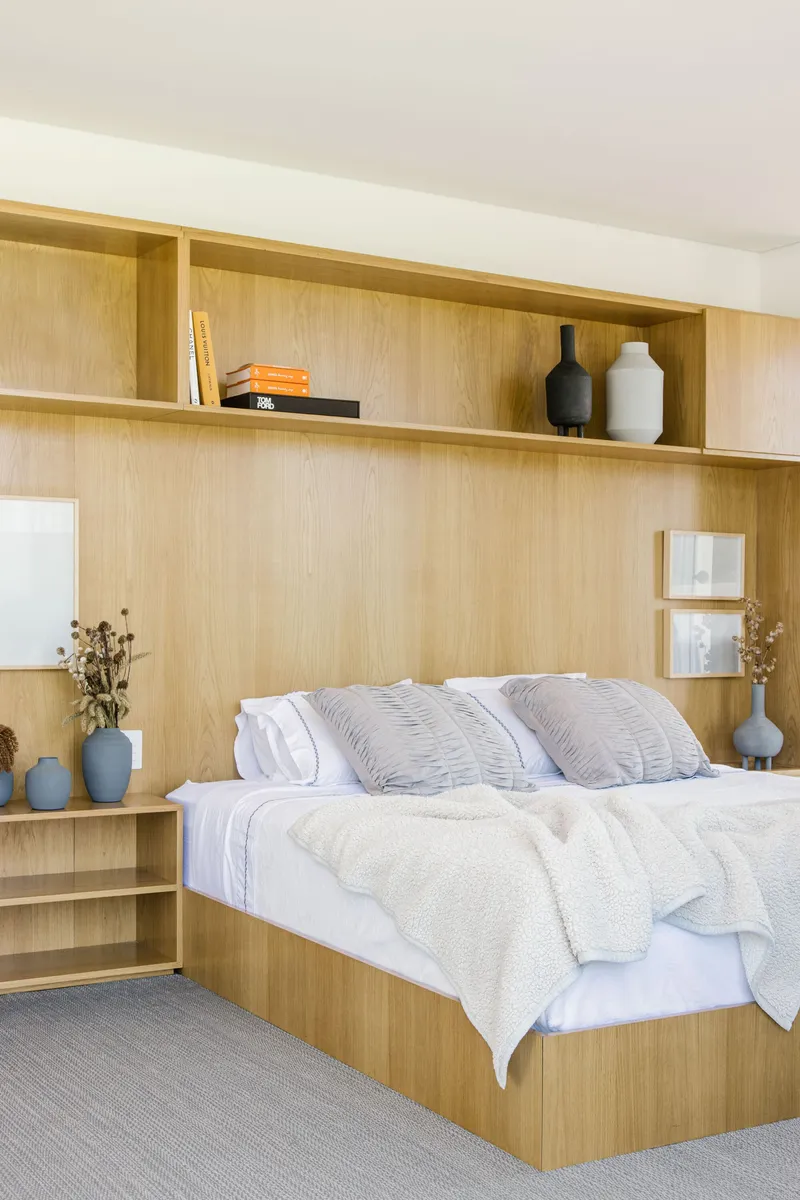
The bedrooms sit at the quieter end of the C, where the wing turns away from the social program. Integrated timber joinery wraps headboards, shelving, and overhead storage into a continuous surface that eliminates the distinction between furniture and architecture. Floor-to-ceiling glazing in every bedroom frames a private view of the landscape, each opening calibrated to avoid direct sightlines to neighboring plots.
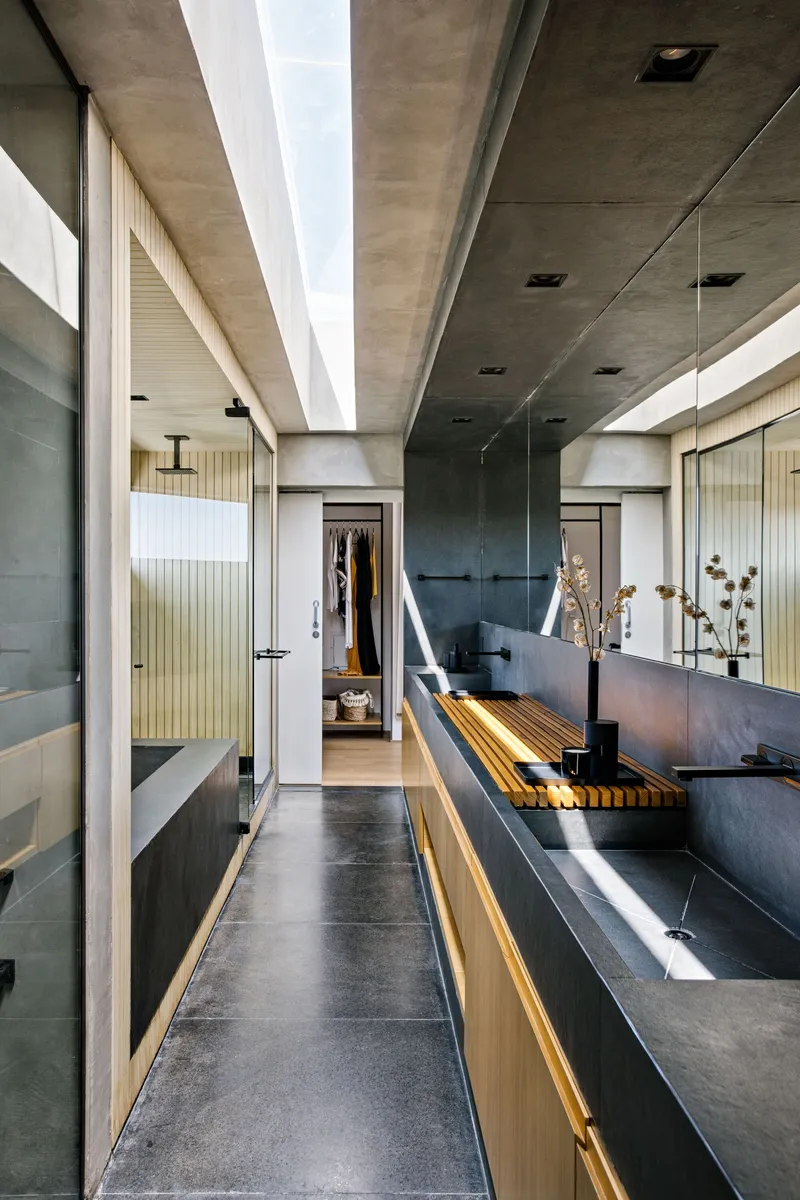
The master suite occupies the upper level, accessed from the flat concrete slab, and benefits from the elevation to gain a broader panorama. Below, the garage and entrance hall tuck under the same slab, keeping the arrival sequence low-key and sheltered. A bathroom with a skylit ceiling and a slatted timber bench offers a spa-like moment that reinforces the house's material palette without departing from it.

Street Face and Evening Reveal
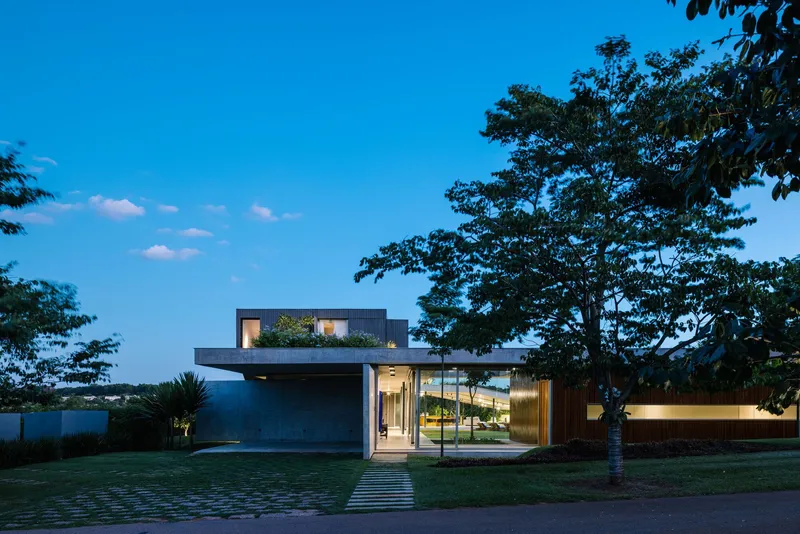
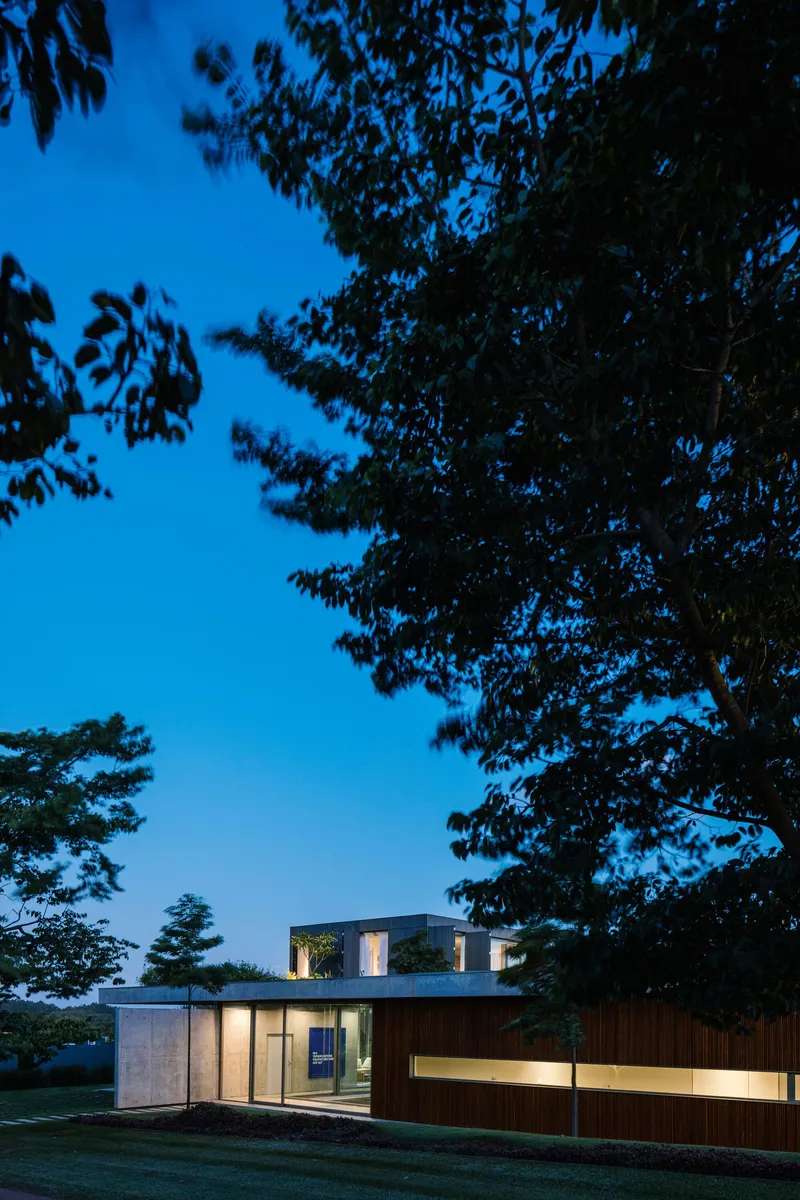
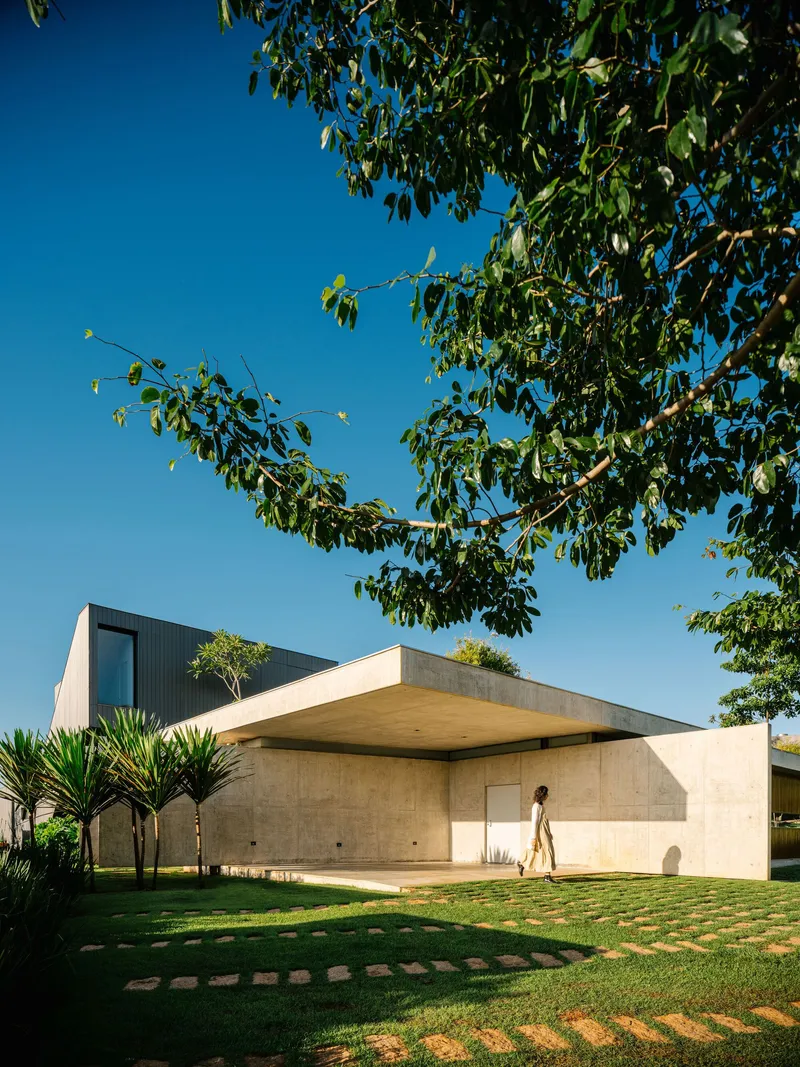
From the street, Colina House presents a restrained face of board-formed concrete, low plantings, and a grid-paver walkway that signals arrival without fanfare. The cantilevered slab hovers over the base, casting a deep shadow that compresses the entrance and directs you downward into the courtyard below.
At twilight the restraint pays off. Interior illumination reveals the spatial depth hidden behind the concrete shell: living areas, the timber guest wing, and the courtyard garden emerge as layered planes of light. The house that disappeared during the day reasserts itself at night, not through formal drama but through the quiet accumulation of warm, occupied space.
Plans and Drawings
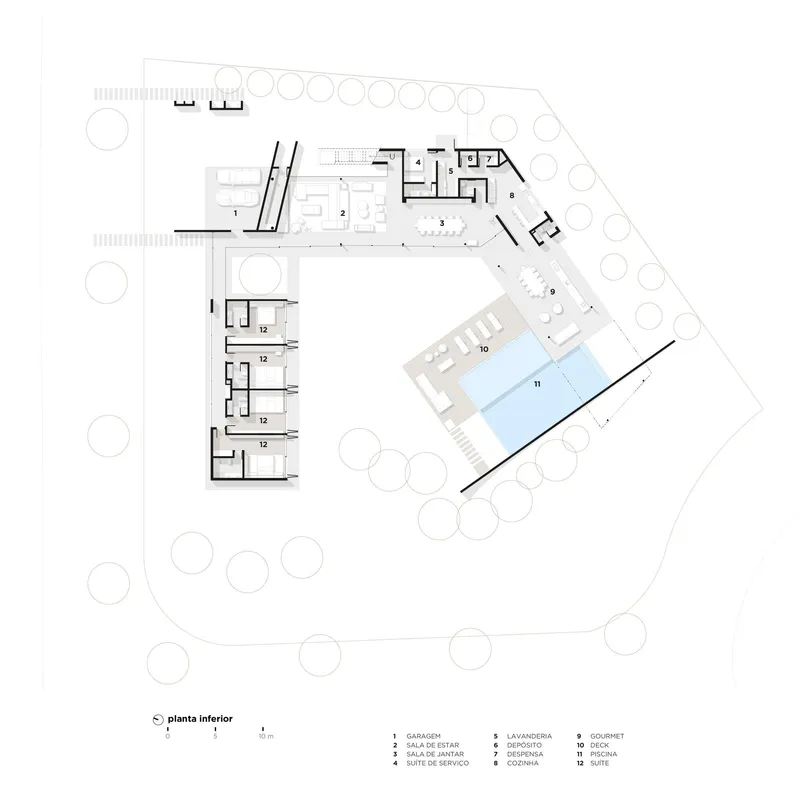
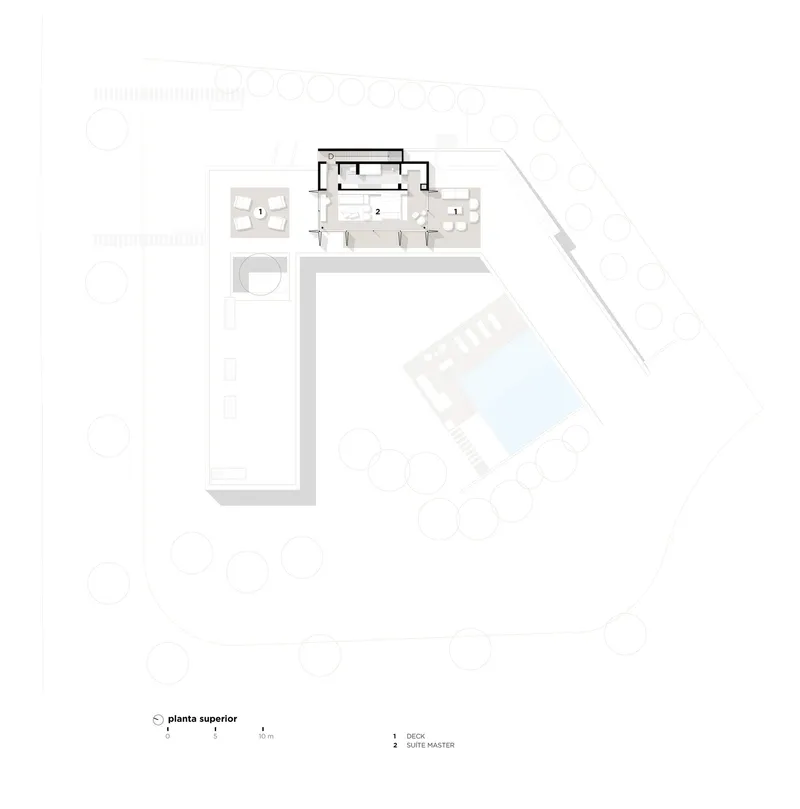
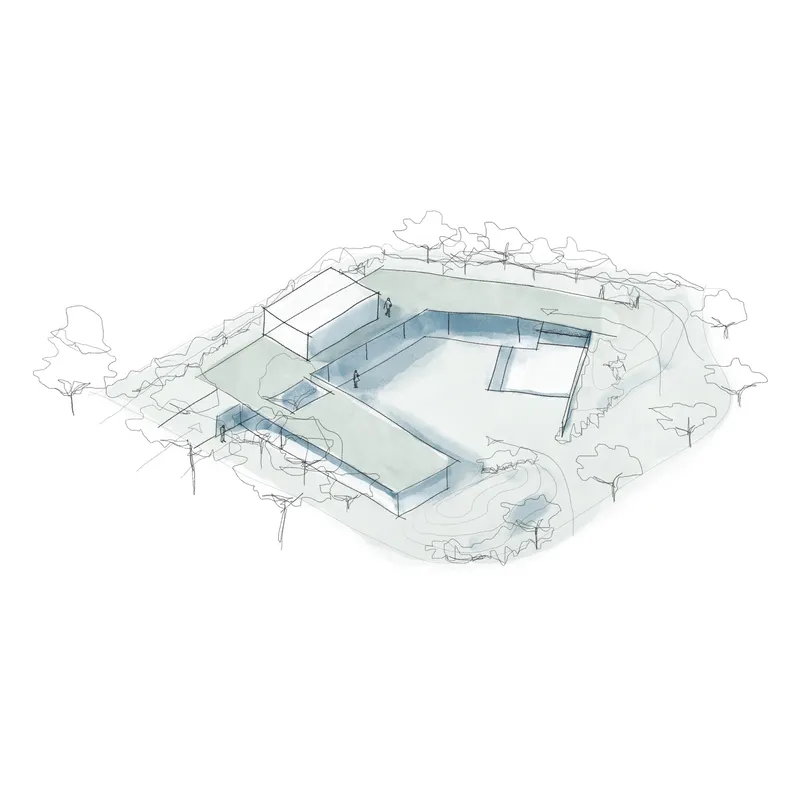
The ground floor plan reveals the angled wings of the C, with living, dining, and kitchen areas occupying the longest arm and the guest bedrooms forming the shorter return. The pool sits at the open end, oriented to catch afternoon sun. On the upper level, the master suite occupies a compact L-shaped volume that floats above the garage, its footprint deliberately modest compared to the sprawl below. The axonometric drawing confirms how the planted roof ties the fragments together into a single topographic gesture.
Why This Project Matters
Colina House belongs to a growing lineage of residences that treat landscape not as a setting but as a co-author of architecture. By grading the roof into the terrain, FGMF makes a credible argument that a large house need not dominate its surroundings. The strategy is replicable and site-specific at the same time: the incline of the lot generates the incline of the roof, so the form cannot be copy-pasted elsewhere without losing its logic.
What elevates the project beyond its green-roof peers is the clarity of the interior proposition. The C-plan, the material zoning between concrete, timber, and glass, the seamless porcelain floor plane, and the deliberate contrast between extroverted social areas and introverted bedrooms all work in concert. The house does not rely on a single spectacular image; it accumulates conviction through the consistency of its decisions. In an era when residential architecture often prioritizes the drone shot, Colina House earns its aerial view by being equally convincing at eye level.
Colina House by FGMF (Fernando Forte, Lourenço Gimenes, Rodrigo Marcondes Ferraz). Porto Feliz, São Paulo, Brazil. 810 m². Completed 2019. Photography by Fran Parente.
About the Studio
Share Your Own Work on uni.xyz
If projects like this are the kind of work you want to make, uni.xyz is a place to publish your own, find collaborators, and enter design competitions.




Popular Articles
Popular articles from the community


The Earth Pod: 3D Printed Homes for Resilient Refugee Communities
The Earth Pod reimagines refugee housing through 3D printed homes made from clay, combining resilience, self-sufficiency, and rapid shelter.

Play: Fragments of Their World
Familiar architecture becomes modular playground design, creating safe spaces where displaced children can learn, connect, imagine and play.

Lunar Spiral: Space Architecture Shaped by the Mathematics of the Universe
Lunar Spiral reimagines space architecture through Fibonacci geometry, lunar regolith, levitating habitats, and self-sustaining Moon living.

Hill & Cross Opera: Sculptural Opera House Architecture Shaped by Tallinn’s Landscape and Identity
Hill & Cross Opera reimagines opera house architecture in Tallinn through its sculptural hill, civic plaza, glass wave and a luminous cross.


Similar Reads
You might also enjoy these articles

Bao Huynh Watercolor Atelier: A Serene Art Retreat in Hội An
Bao Huynh Watercolor Atelier in Hội An blends multifunctional art spaces, sustainable design, local materials, and family-friendly living in a serene environment.

Atelier Macri Concept Store Interior Design by CASE-REAL
Atelier Macri store features a "ko" counter, walnut wood details, cork displays, blending retail, gallery, and seamless customer experiences.

Manuel Vargas Izquierdo Stadium and High-Performance Sports Center: Architectural Excellence in Jalpa de Méndez
The Manuel Vargas Izquierdo Stadium blends sustainable design, inclusive sports facilities, and cultural-inspired architecture, revitalizing Jalpa de Méndez’s public spaces.

KAKR Buluh Awar Hall: Revitalizing Community and Ecology Through Bamboo Architecture
Community built bamboo hall revitalizes Buluh Awar village, empowering youth, restoring ecology, celebrating vernacular craftsmanship through sustainable architecture and culture.


Explore Residential Building Competitions
Discover active competitions in this discipline



Challenge to design a barrier free sports center


Challenge to design an outdoor ice-rink and park


Challenge to design mud housing for contemporary communities
Comments (0)
Please login or sign up to add comments
No comments yet. Be the first to comment!