

Field Office Architecture Builds a Forever Home That Borrows Its Garden from a Prime Minister's Estate
A two-storey timber and blockwork house in Point Lonsdale, Victoria, trades suburban constraint for coastal generosity through passive design.


Most beach houses on the Bellarine Peninsula have drifted a long way from the archetype they claim to reference. The old timber cottages that once defined Point Lonsdale were modest, thermally intuitive, and nearly invisible against the scrub. Field Office Architecture's Point Lonsdale House, completed in 2024 for a semi-retired couple, is a genuine attempt to recover that character without nostalgia. At 310 square metres it is not small, but its material palette is so restrained, and its siting so deliberate, that the building reads as a quiet presence among the eucalypts rather than a statement on a suburban block.
The most compelling move here is territorial. The site backs onto the grounds of the Arilpa nature reserve, itself adjacent to Ballara, the 1907 holiday retreat of Australia's second Prime Minister Alfred Deakin. By pushing the house hard against that shared boundary, where a wire fence dissolves into vegetation, Field Office effectively annexed a borrowed landscape of native grasses, coastal scrub, and tall gums. A standard suburban lot suddenly performs like a rural estate. That sleight of hand, combined with near off-grid performance, makes this project worth studying closely.
Two Weights: Blockwork Below, Timber Above
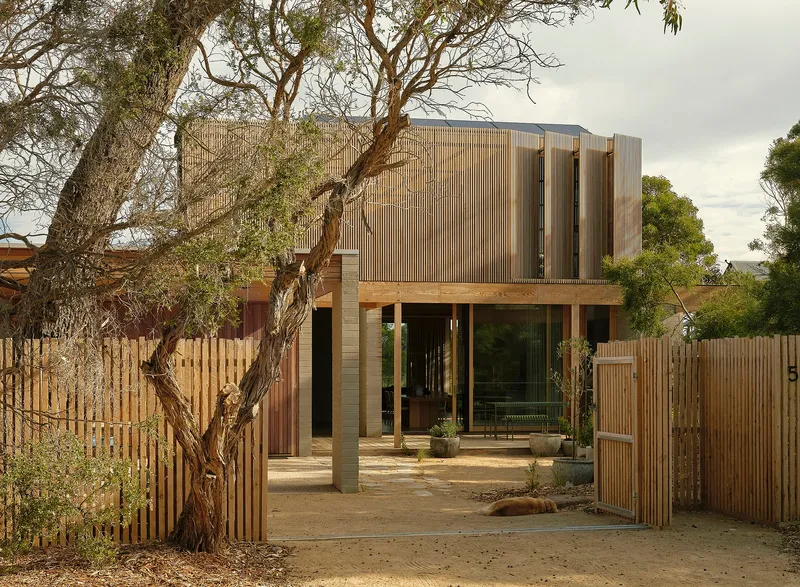
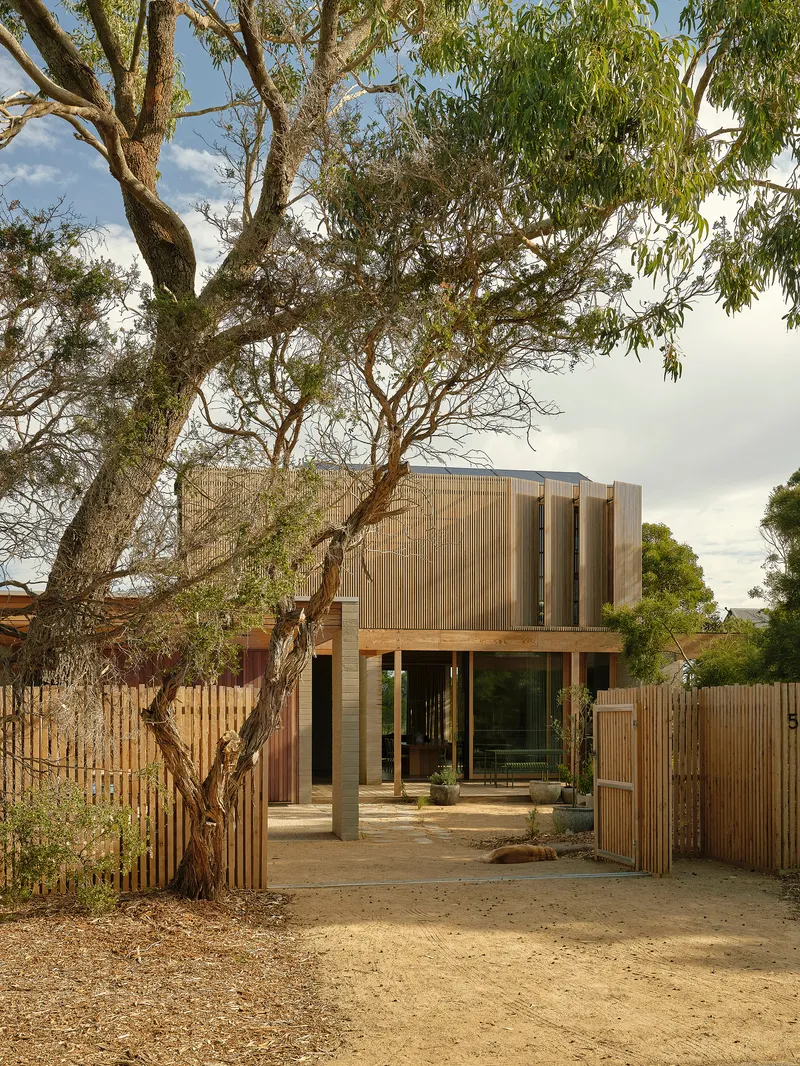
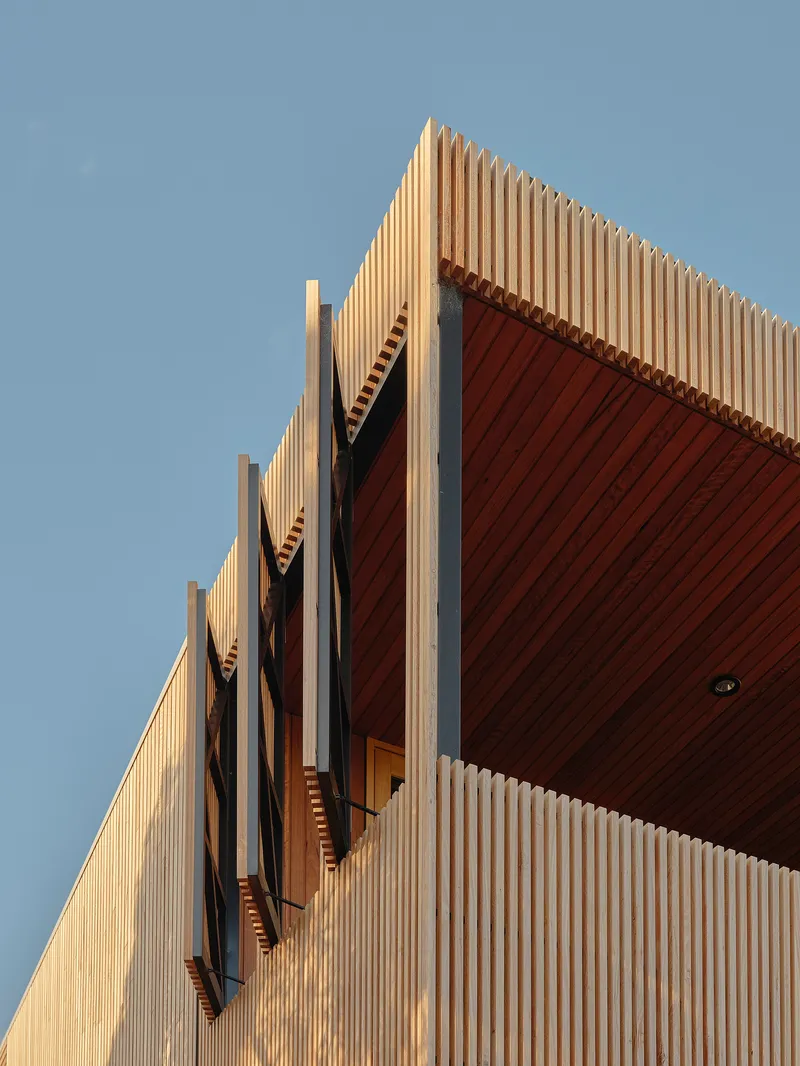
The structural logic is legible from any angle. A heavy masonry base anchors the ground floor, providing thermal mass that absorbs and releases heat through the day. Above it, a lighter timber-clad volume sits like a hat tipped forward, its vertical battens catching light and filtering views. The combination is not arbitrary: blockwork handles durability and passive heating, while the timber upper storey stays shaded and ventilated. External timber is left to grey naturally, a detail that signals the architects' commitment to materials that age rather than deteriorate.
Timber screens wrap selected facades in a slatted second layer, softening the boundary between inside and outside. They temper glare, hold dappled light across walls and floors, and provide privacy without closing the house off from its surroundings. It is a simple device, but it works harder than most facade treatments because it serves thermal, visual, and spatial roles simultaneously.
Siting as Strategy
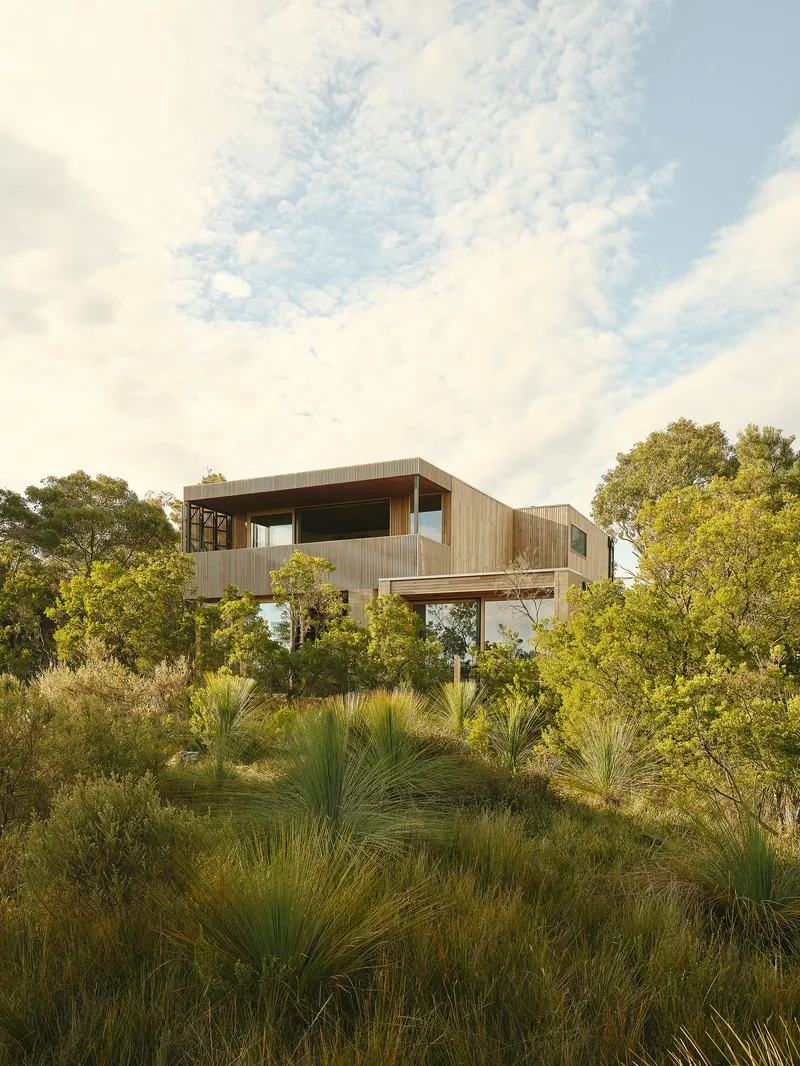
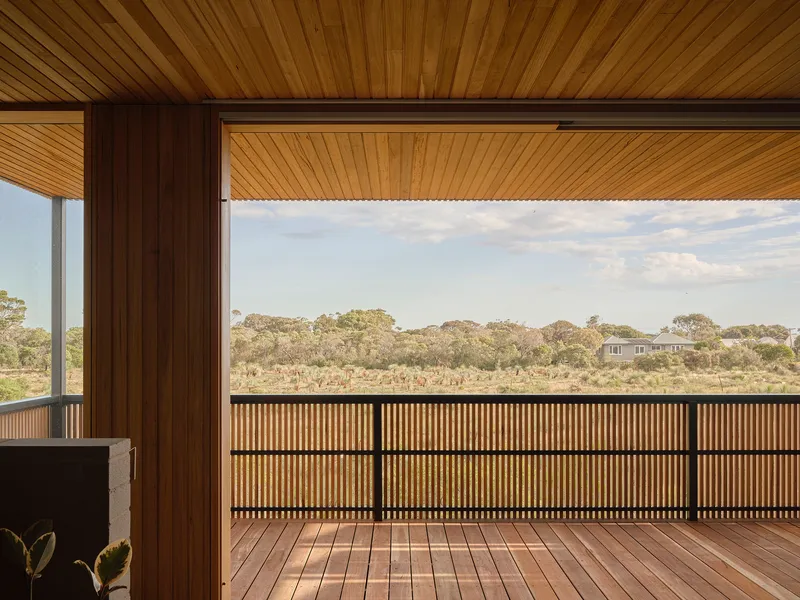
Point Lonsdale sits on a coastline where the best views face south but the sun arrives from the north, a tension that forces every house to choose between prospect and warmth. Field Office resolved this by setting the building back from the street to open a north-facing garden and outdoor living zone. Living spaces face north for passive solar gain, while the elevated rear of the house commands the southward view across the Arilpa reserve through floor-to-ceiling glazing. The entertaining deck extends kitchen and dining areas outward, and rooms open to decks in two directions, so the house breathes laterally as well as longitudinally.
From the native scrub below, the upper volume appears to float on steel columns above coastal grasses. It is a strong image, but it also tells you something practical: the house is designed for aging in place, which means the ground floor contains the main bedroom, everyday living areas, and a workshop. The upper level, with its rumpus room and guest accommodation, is the social overflow, not the daily circuit.
Interior Grain and Spatial Unfolding
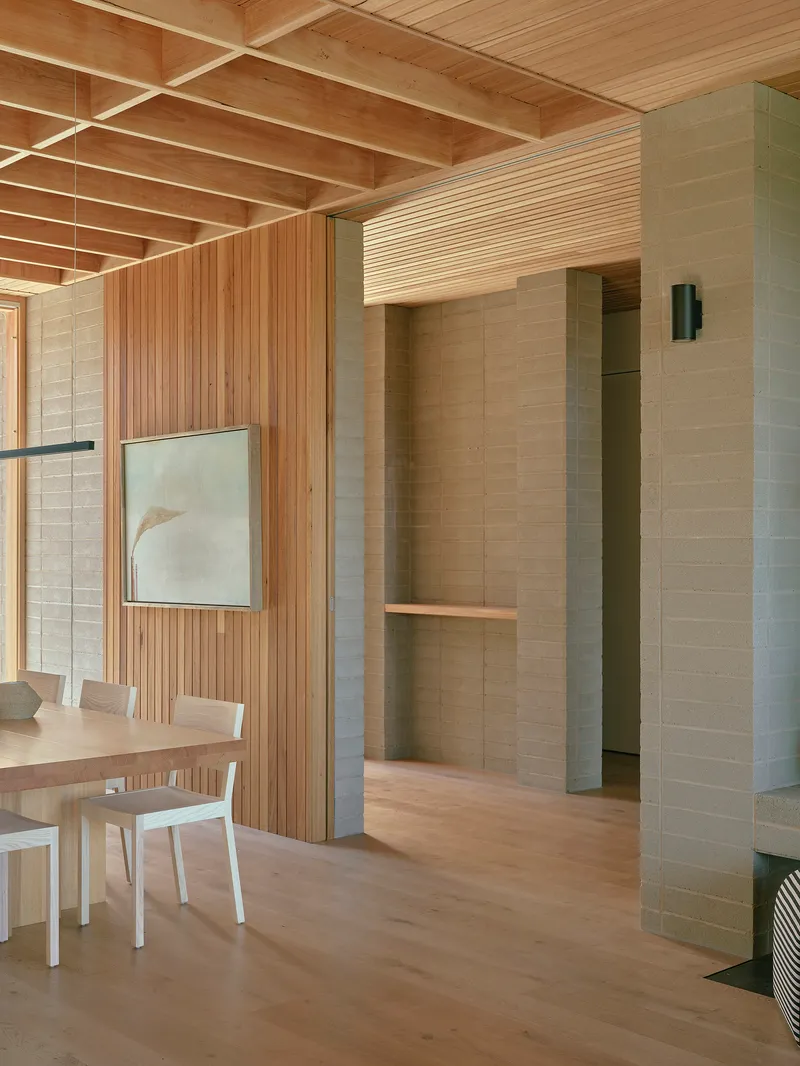
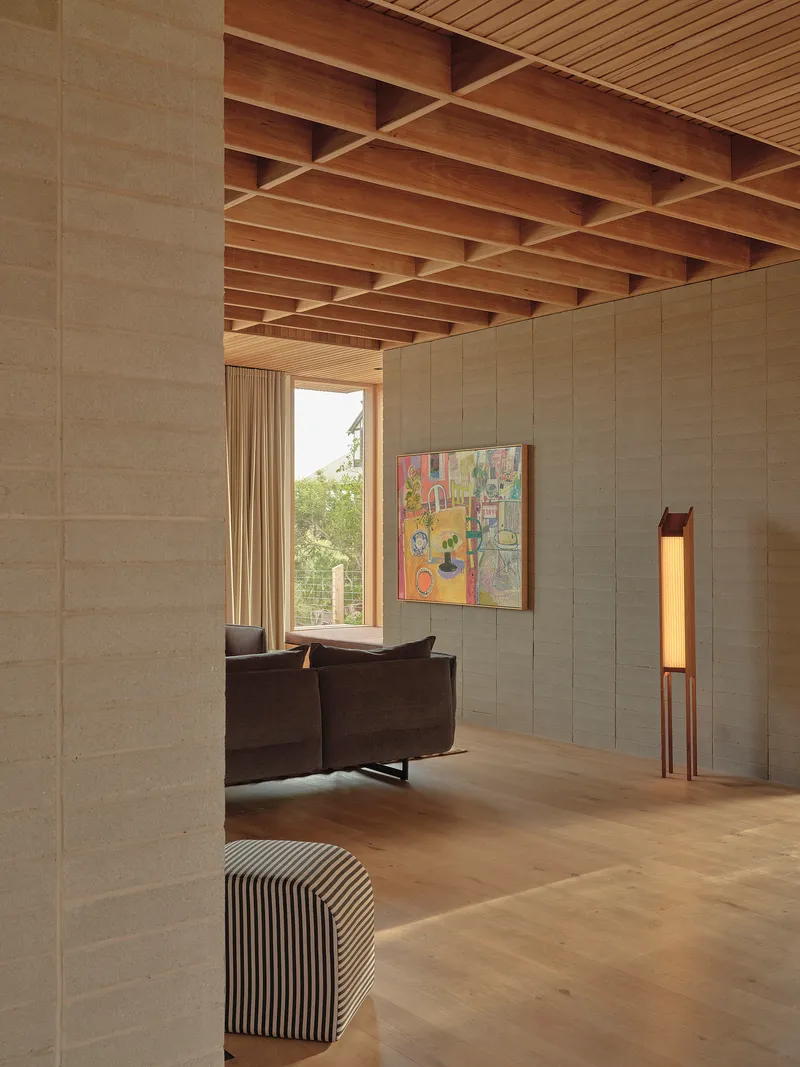
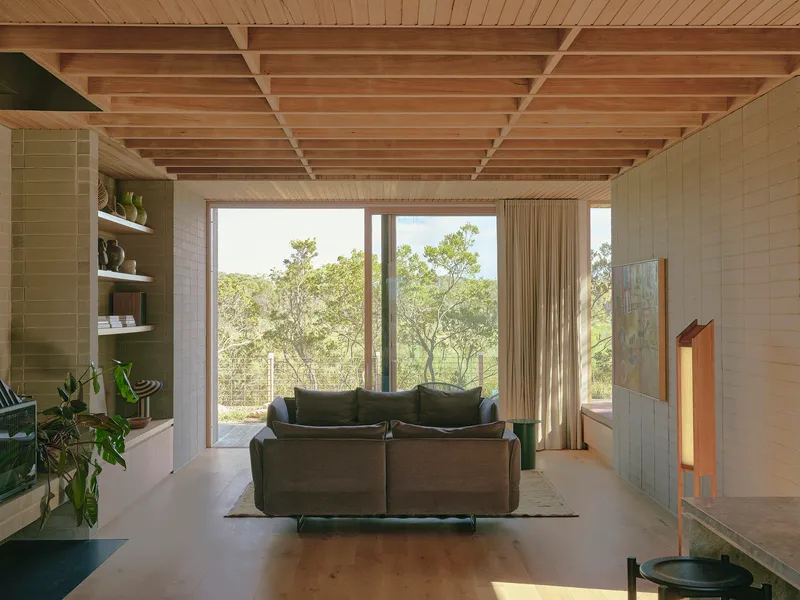
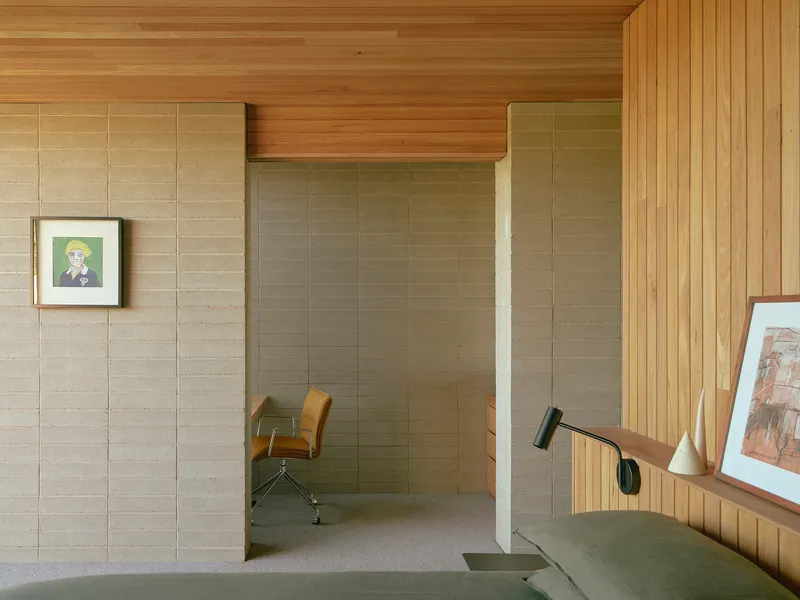
Inside, the material range narrows further: exposed timber ceiling joists, textured blockwork walls, and occasional stone surfaces define every room. The palette's restraint keeps attention on the spatial sequence rather than on surfaces. Partial walls segment the ground floor into zones that unfold gradually as you move through the house. Rooms can open to one another for large gatherings or close down into quieter pockets, a flexibility that matters when a house is designed to serve its occupants for decades.
The living room's full-height glazing toward the woodland is the strongest interior moment. Framed by exposed timber joists above and a textured block wall to one side, the window becomes a landscape painting that changes by the hour. There is nothing clever about it, which is precisely the point: the architecture gets out of the way and lets the borrowed view do the work.
Kitchen, Dining, and the Social Core
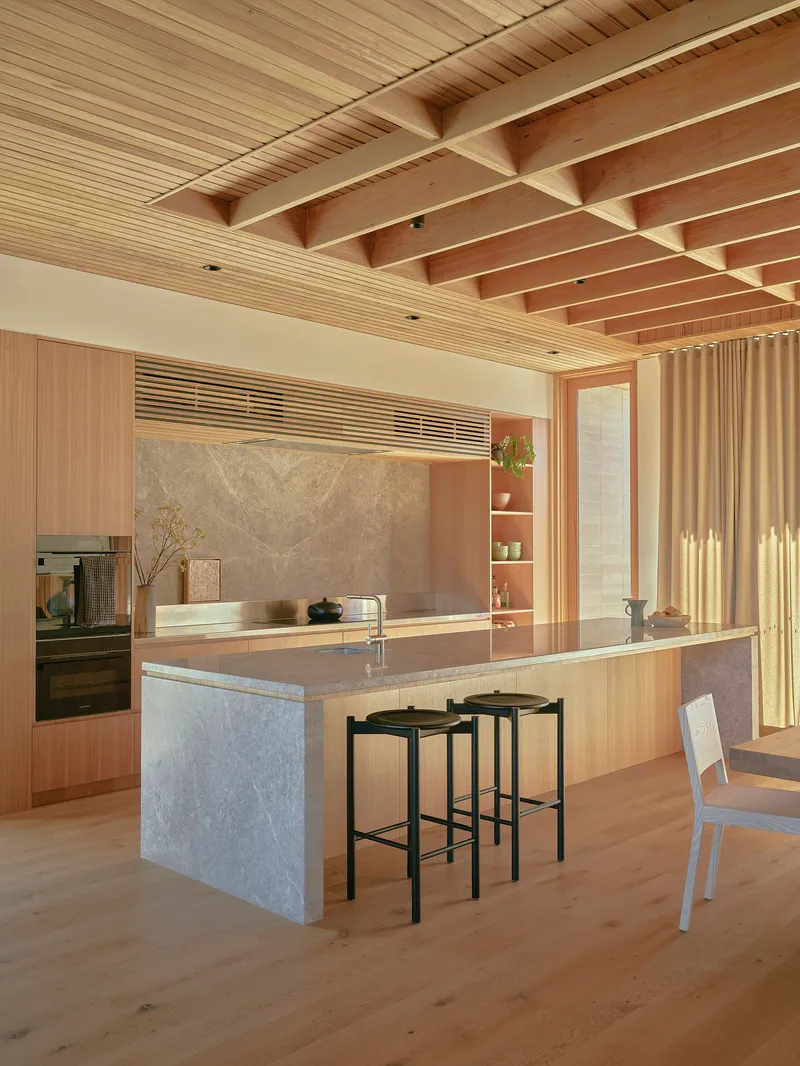
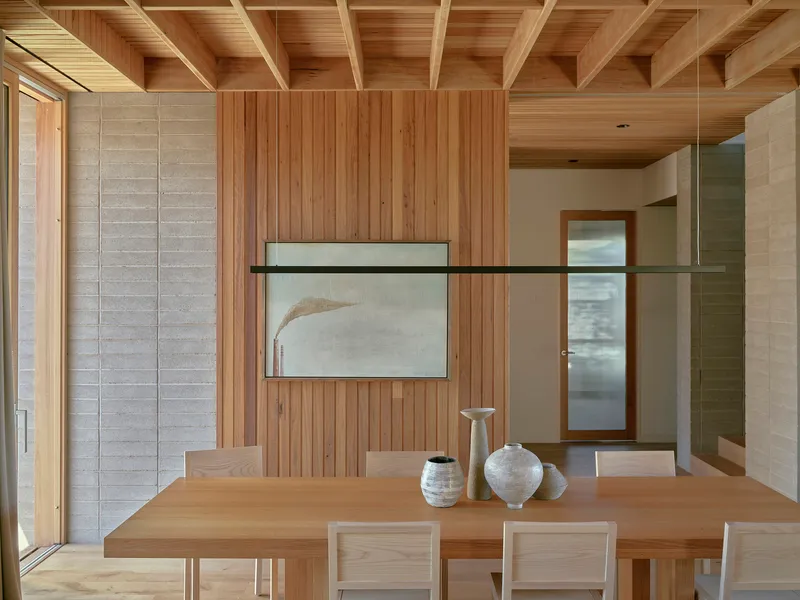
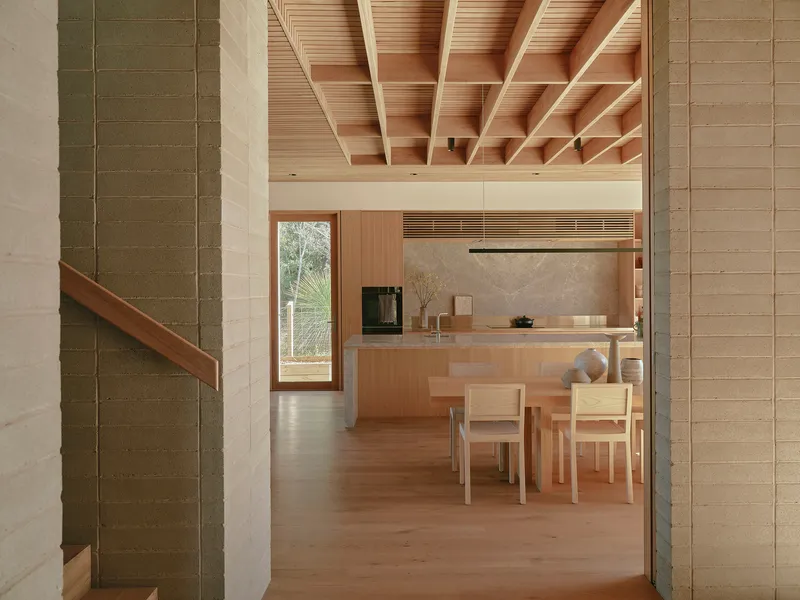
The kitchen and dining area sits at the building's social center, connected to the entertaining deck on one side and deeper living spaces on the other. A stone-based island anchors the kitchen beneath exposed timber beams and a slatted ceiling, giving the room a workshop quality that suits the house's ethos of utility over display. The dining area, with its suspended linear light fixture and timber-clad walls, is warmer and more enclosed, a room designed for evening use when the house contracts around its occupants.
Views through stone tile columns into the kitchen from adjacent circulation spaces reinforce the idea that this house is organized around sightlines, not corridors. You always know where you are relative to the garden, the deck, and the kitchen bench.
Threshold Moments: Decks, Nooks, and the In-Between
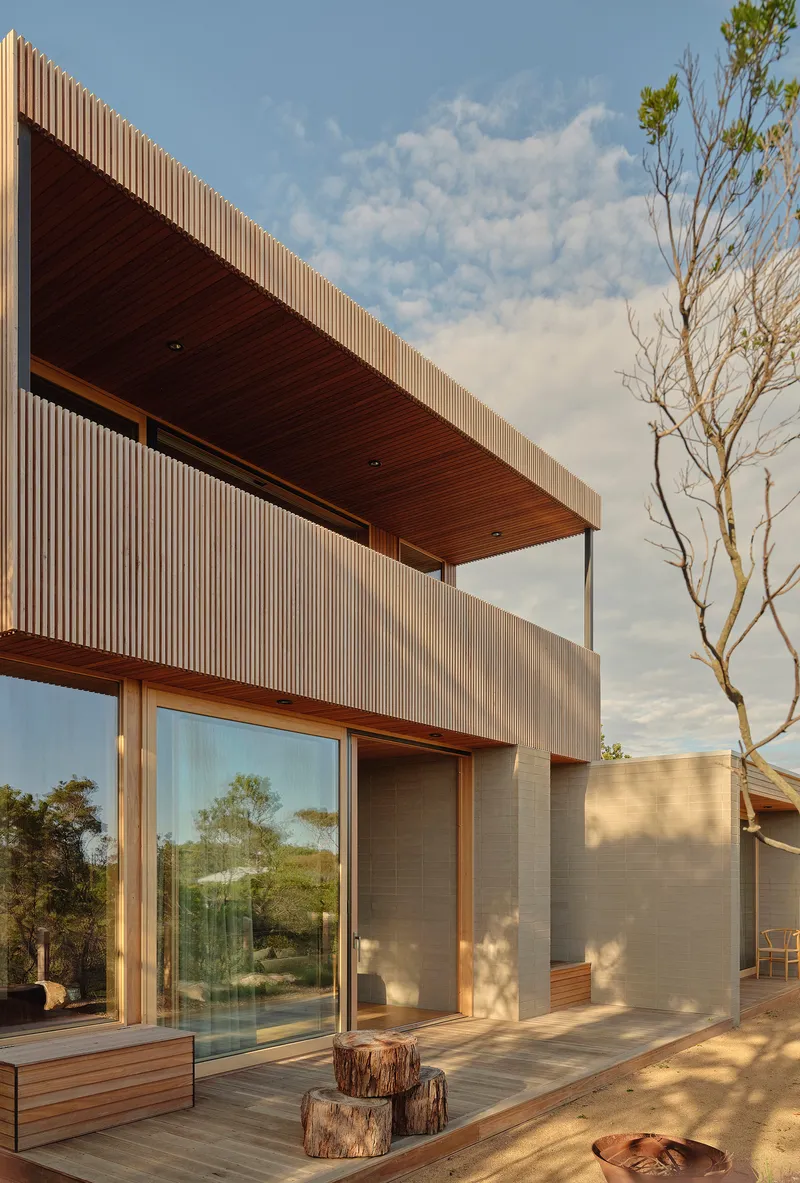
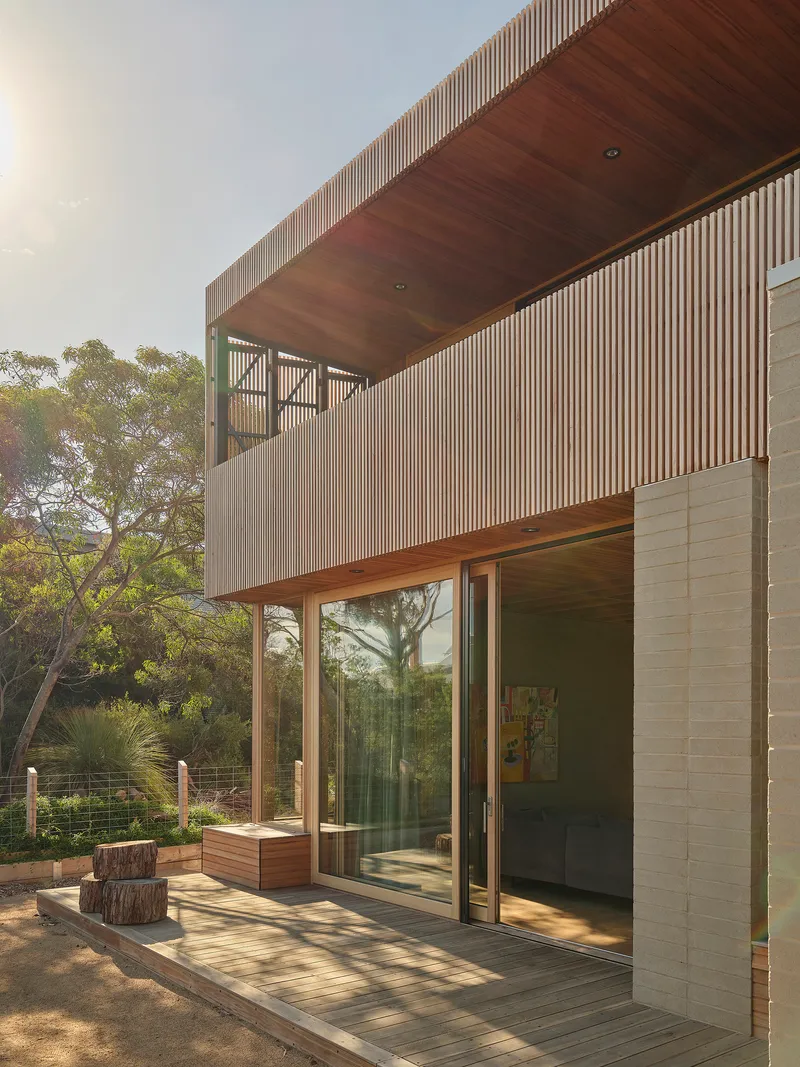
The cantilevered timber soffits that shelter the corner terrace and upper deck are generous enough to function as outdoor rooms. Tree stumps at the terrace edge suggest a landscape that was edited, not cleared, and the vertical slatted facade above provides shade without enclosure. These in-between spaces are where the house most resembles the old Bellarine beach cottages: informal, shaded, and oriented toward the breeze.
Inside, recessed nooks with rammed earth walls and timber soffits offer quieter counterpoints. These are not leftover spaces but deliberately carved retreats within the larger plan, places to read or sit without committing to a room. They reflect the architects' understanding that a forever home needs both communal generosity and private refuge.
Materiality in Detail
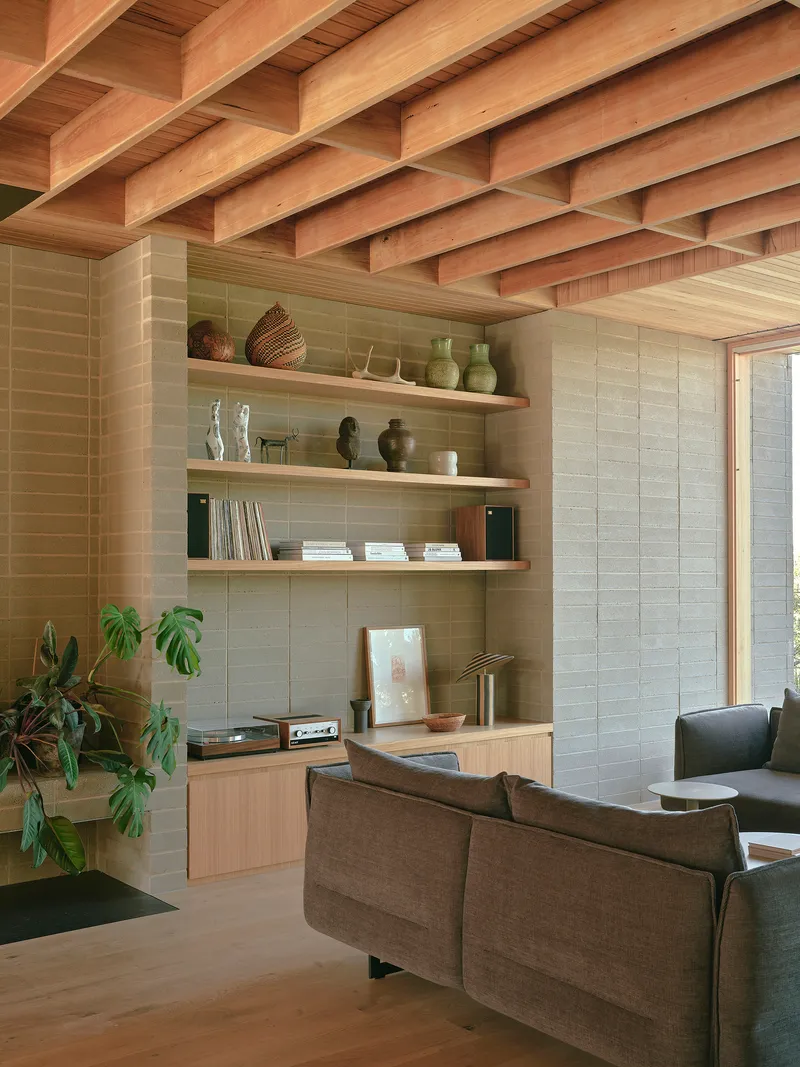
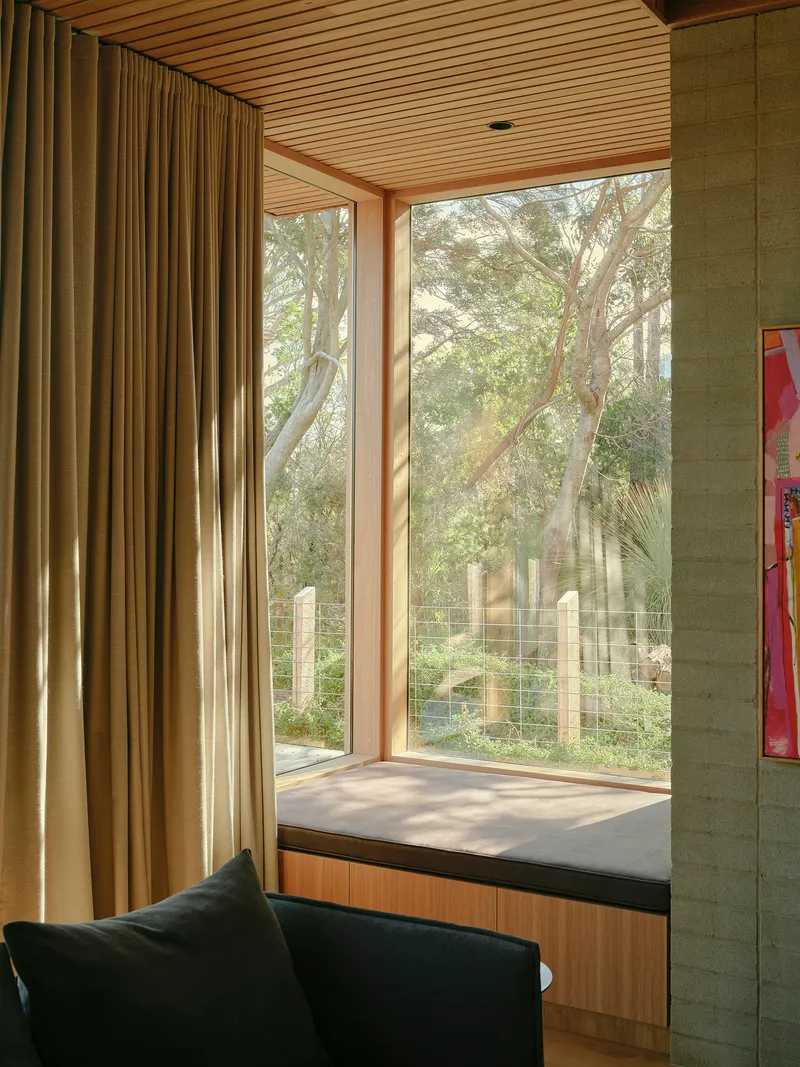
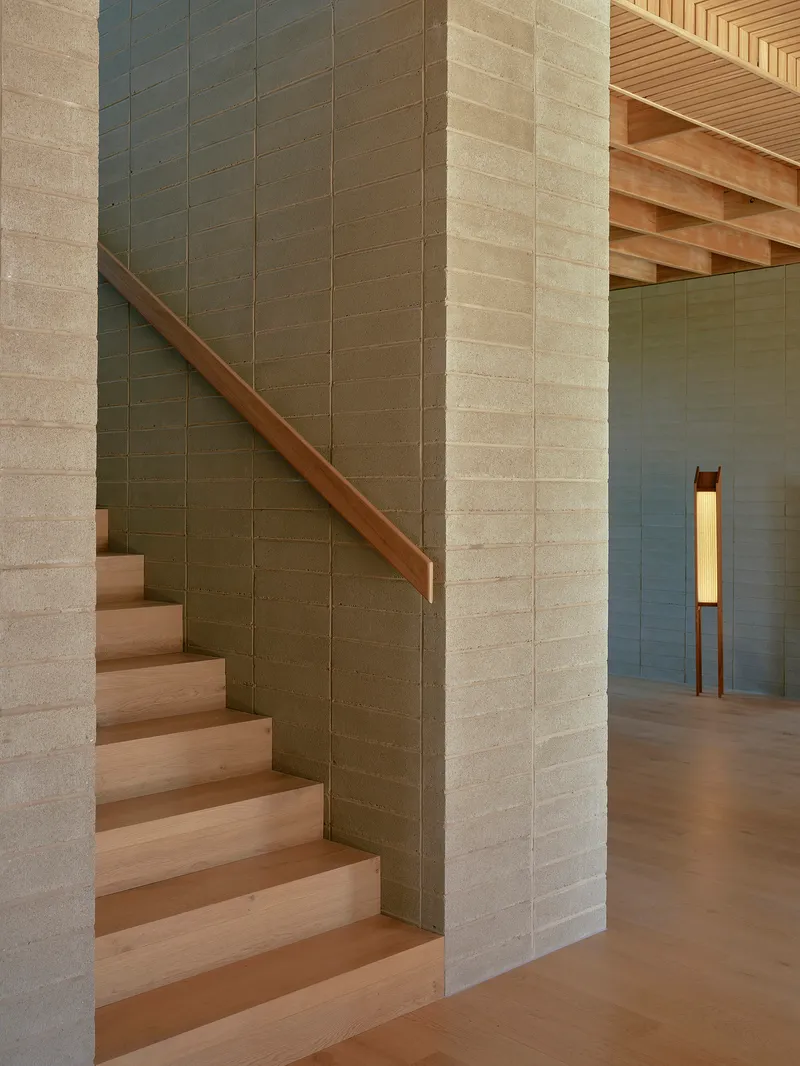
Built-in timber shelving set against textured masonry walls, a window seat overlooking the garden in afternoon light, a stair rising past exposed ceiling joists beside a stone tile wall: these are the details that confirm the project's coherence. Every junction between timber, block, and stone is handled with the same spare logic. Nothing is decorative. Colours stay natural. The result is a house that already looks settled, as though it has been there long enough to belong.
The timber stair deserves particular attention. It connects the grounded masonry world of the ground floor to the lighter timber realm above, and its material transition, from stone tile to timber, makes that shift legible. A floor lamp at the landing is the only concession to styling in any of the published images, and even that feels earned.
Why This Project Matters
Point Lonsdale House is not experimental. It does not propose a new material system or a radical typology. What it does, with real conviction, is demonstrate that a suburban coastal lot can perform like something much larger and much more responsible. The near off-grid energy strategy (solar panels, battery storage, rainwater harvesting, in-slab hydronic heating, and serious insulation) is delivered without the aesthetics of sustainability theatre. The house simply works well passively and mechanically, then gets on with being a comfortable place to live.
Field Office's decision to borrow the Arilpa landscape rather than build their own is the kind of site reading that separates good architecture from competent building. By aligning the house with its historic neighbour rather than asserting itself against it, the project extends a lineage that runs back through Ivy Deakin's 1913 retreat to the original timber beach houses of the peninsula. That is not nostalgia. It is continuity, and it is increasingly rare.
Point Lonsdale House by Field Office Architecture, Point Lonsdale, Victoria, Australia. 310 m². Completed 2024. Photography by Sean Fennessy.
About the Studio
Share Your Own Work on uni.xyz
If projects like this are the kind of work you want to make, uni.xyz is a place to publish your own, find collaborators, and enter design competitions.


Popular Articles
Popular articles from the community


Aquadapt: An Underwater Habitat That Rewrites Its Rooms by the Hour
Curved modules ring the seabed while one shell shifts from breakfast room to cinema, farm and football pitch as residents' needs change.


graciastudio Turns a Viewless Tijuana Lot Inward Around a Courtyard of Concrete, Timber and Trees
In Tijuana, Jorge Gracia's GA2 House stacks a timber-clad private floor over exposed concrete and replaces a missing view with a planted interior patio.

FCC Arquitectura Expands a Portuguese Granite House with a Board-Marked Concrete Wing
In Portugal, JV House pairs a cleaned-up whitewashed and granite dwelling with a timber-shuttered concrete extension, courtyards and a garden pool.

Manzana Morphosis: Stretching Barcelona's Grid into a Living Landscape for 2050
A radical reworking of the Eixample manzana turns density into a tool for generous public space, vertical ecology, and environmental performance.

Similar Reads
You might also enjoy these articles

LAVA Architecten Gives Vocational Education a Sawtooth-Roofed Face on a Mechelen School Campus
In Mechelen, Belgium, a 2,053 m² STEM school on a 6×6 m grid turns workshops and classrooms into rooms that can be rearranged as teaching changes.

KEMA Studio Turns a Derelict Marvila Attic into a 60 m² Lighthouse Apartment Above Lisbon
In Lisbon's Marvila district, a rebuilt roof, four skylights and two plywood volumes turn an unlivable attic into a bright home facing the Tagus.

Pixel Gardens: One Repeated Module Stacked Into a Terraced Social Housing Tower for Famagusta
Salem Bader's shortlisted housing tower builds a vertical neighbourhood from one repeated module, offsetting units to carve terraces, light and air.

Bao Huynh Watercolor Atelier: A Serene Art Retreat in Hội An
Bao Huynh Watercolor Atelier in Hội An blends multifunctional art spaces, sustainable design, local materials, and family-friendly living in a serene environment.

Explore Residential Building Competitions
Discover active competitions in this discipline

Comments (0)
Please login or sign up to add comments
No comments yet. Be the first to comment!