

Atelier Guo Builds a Blue Cable-Braced Fire Tower on a Former Sugar Factory Dock in Yangshuo
A 10 m² timber and steel tower on the Li River terrace of Yangshuo Sugar House, built to burn for New Year 2021 and then return as a permanent landmark.


Most architecture is designed to last. The Fire Pit Tower 2021 by Atelier Guo was designed to be set on fire. Commissioned by the Aurua Arts Foundation as the centerpiece of a New Year's celebration in Yangshuo, China, the 10 m² installation sits on the riverside terrace of Yangshuo Sugar House. The night opens with a burning ceremony to welcome the new year. Lead architect Liaohui Guo, working with Ziqian Wang and structural engineers iStructure, produced a stack of blue triangular tiers held together by a web of thin steel cables. It reads less like a bonfire and more like a small, precise piece of architecture.
What interests us is the double life built into the brief. After the 2021 burning, the tower is to be rebuilt and kept permanently on the Sugar House grounds, at an axial turning point that leads guests from the hotel's main building down to the Li River bank. So the same object has to work as a ritual prop meant for one night and as a lasting piece of wayfinding. That tension between the ephemeral and the permanent runs through every decision you can see in the photographs.
A Dock Becomes a Stage
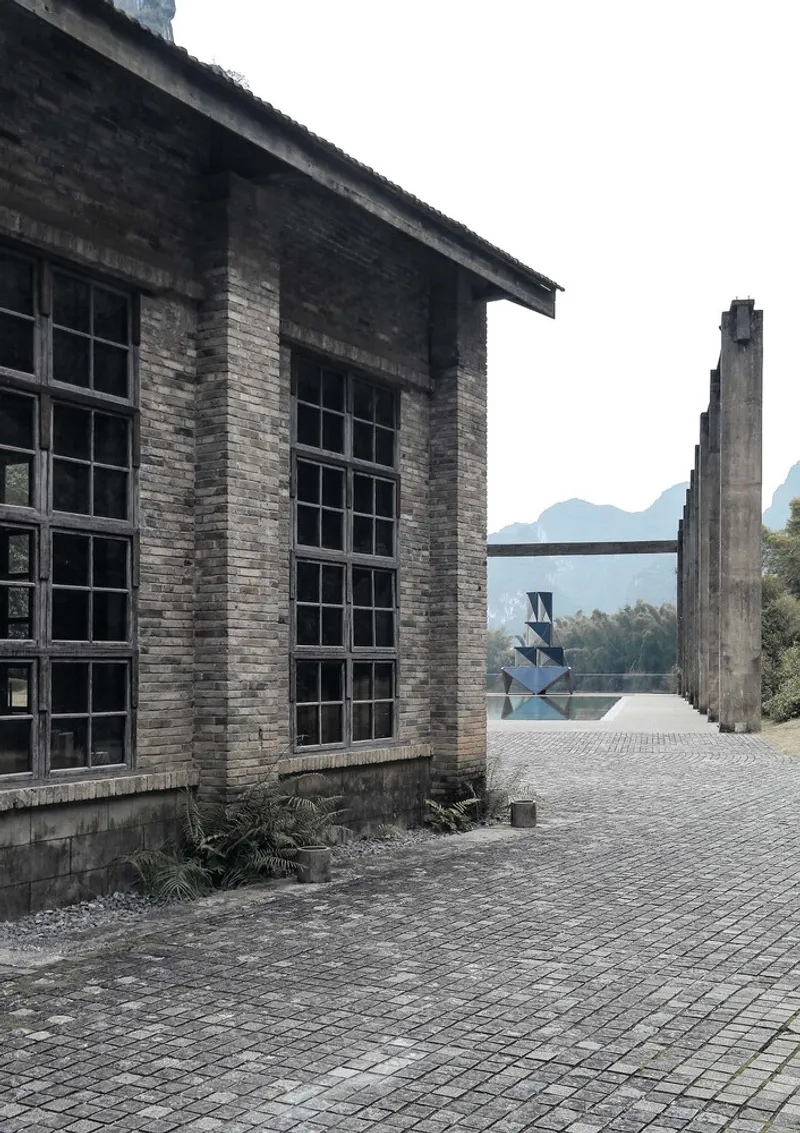
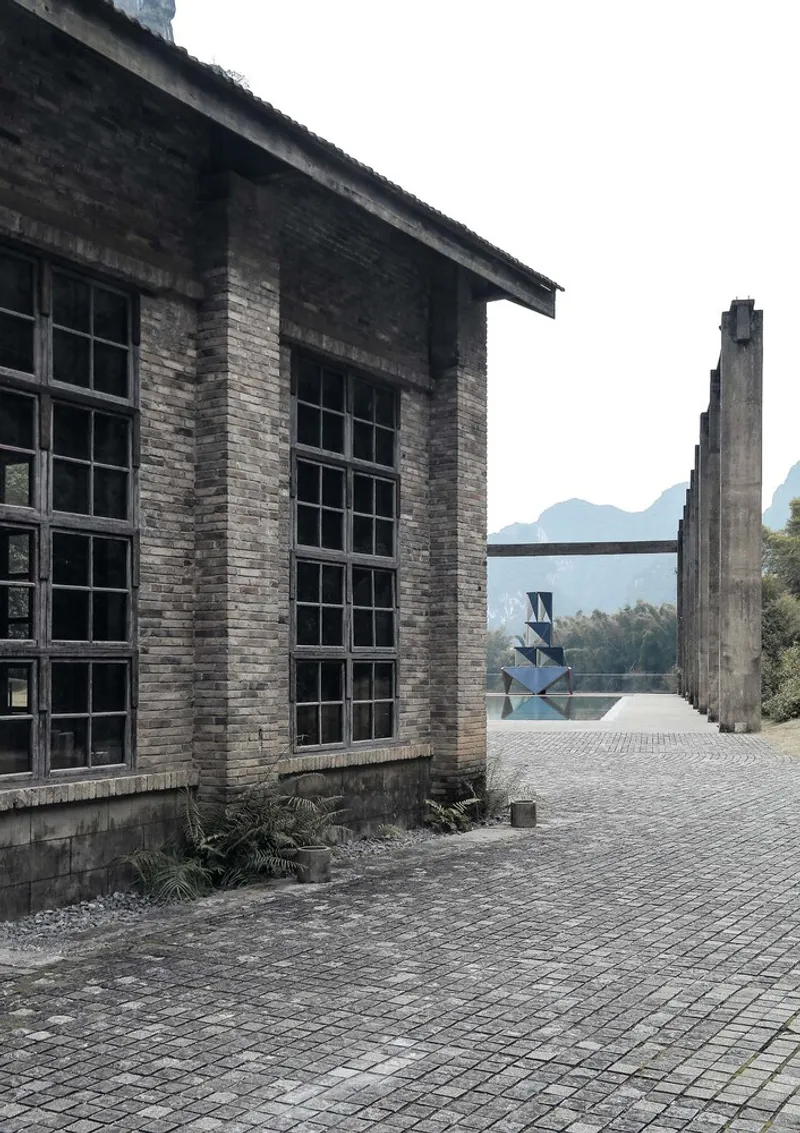
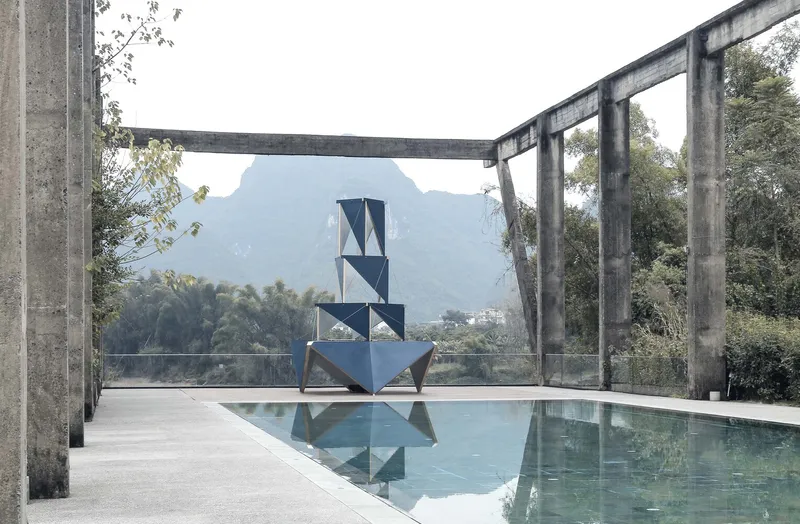
The terrace was once a dock where the old sugar factory sent its goods out by river. The weathered brick halls with their gridded steel windows still define the courtyard, and the concrete colonnade, a leftover frame from the industrial era, runs alongside. Atelier Guo does not try to compete with any of this. The tower appears at the far end of the paved yard as a small blue accent, set against grey brick, grey concrete and grey mist.
This is a smart reading of the site. The industrial fabric supplies the mass and the history. The installation supplies the colour and the event. From the hotel buildings, you see the tower as a destination before you understand what it is. That is exactly the job it will keep doing once it becomes permanent.
Doubled in the Pool
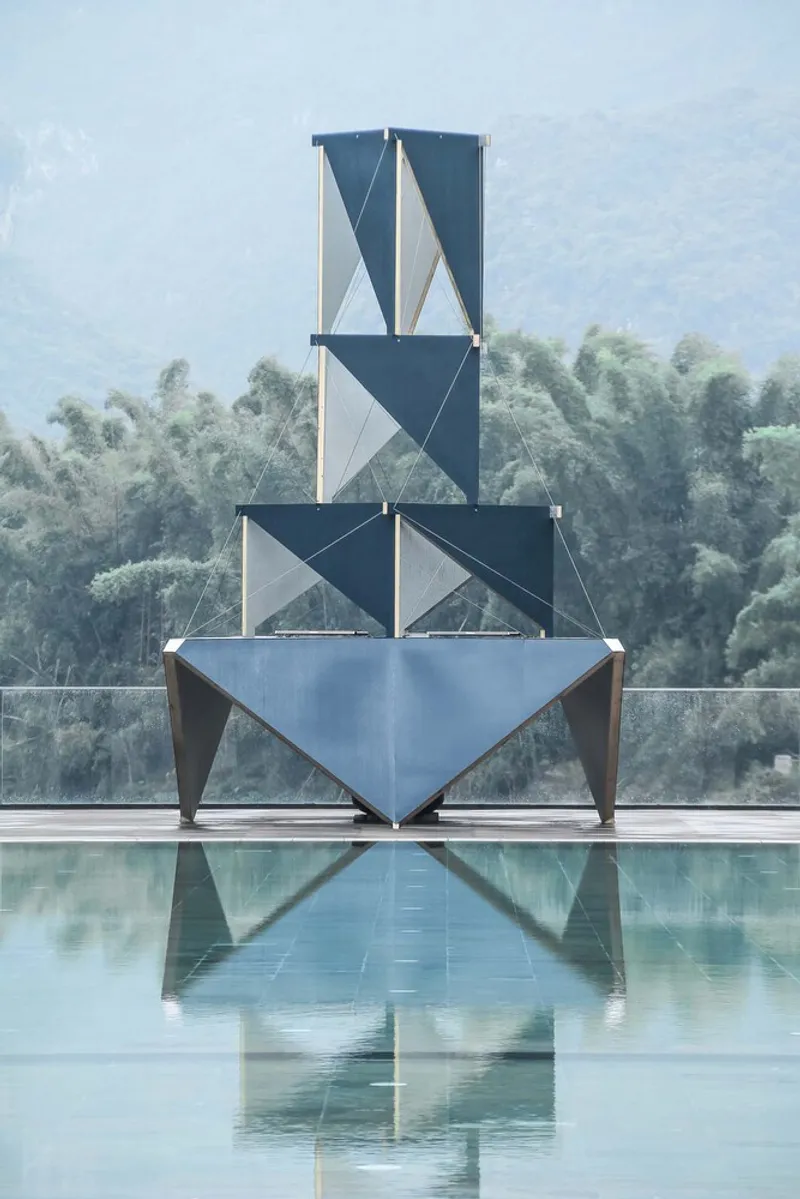
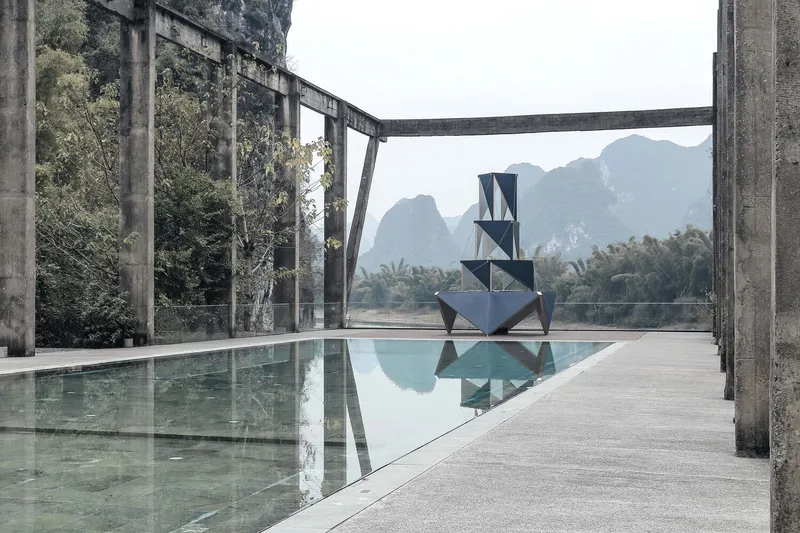
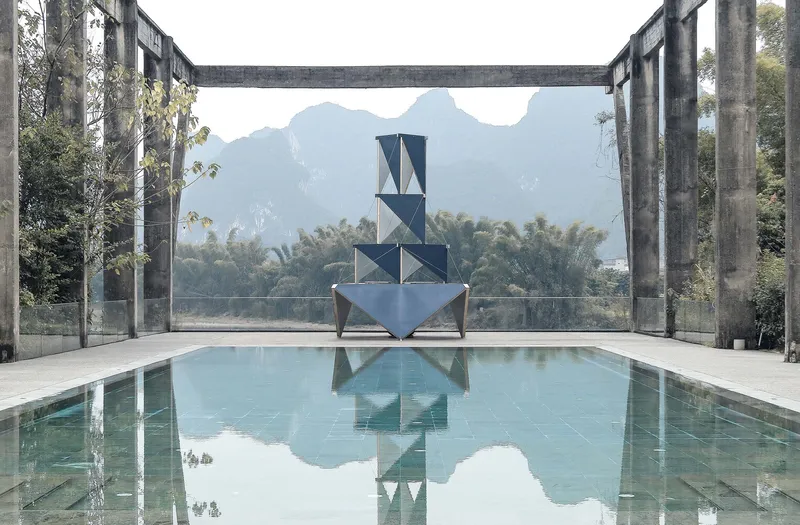
The reflecting pool may be the most effective companion to the tower. Seen head-on, the stacked triangles rest on an inverted pyramid base, and the still water mirrors them into an almost symmetrical figure. A 10 m² object picks up a vertical presence well beyond its footprint. Behind it, the bamboo hills and karst peaks fade into mist, so the tower's saturated blue becomes the sharpest thing in the frame.
There is a ritual logic to placing a fire beside water, and the effect will clearly change after dark. The images here show the daytime condition, but the long pool makes it easy to imagine flames flickering on the surface during the ceremony. The landscape does half the work of turning a small installation into a memorable scene.
Framed by the Industrial Grid
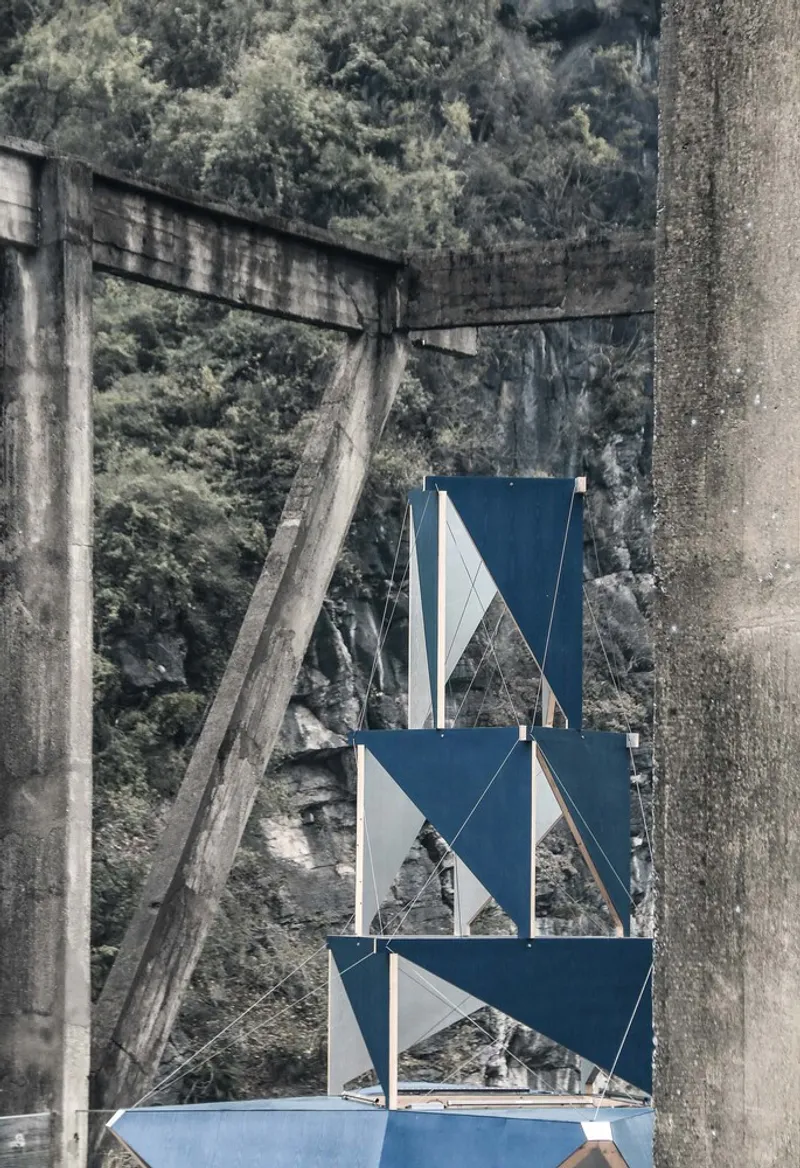
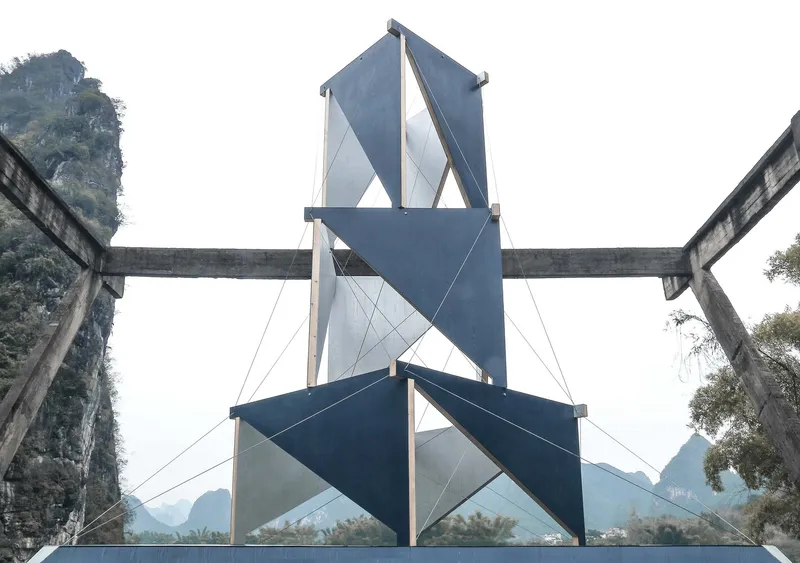
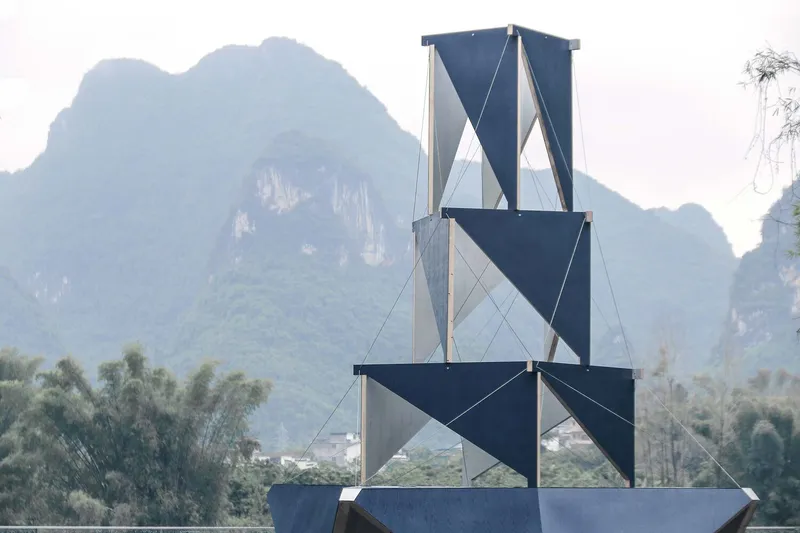
Many of the best views catch the tower through the old concrete frame: between columns, under a beam, beside a diagonal brace. The contrast does a lot of work. The concrete is heavy, orthogonal and stained by time. The tower is light, faceted and freshly painted. Each one makes the other look more like itself.
Against the forested karst and the village rooftops, the tiered silhouette also suggests a tower type at home in southern China's rural settlements, without copying one. We think that restraint is right. A literal vernacular quotation would have felt like set dressing in a resort context. A loose echo lets the object belong without pretending to be old.
Tension as Structure and Image
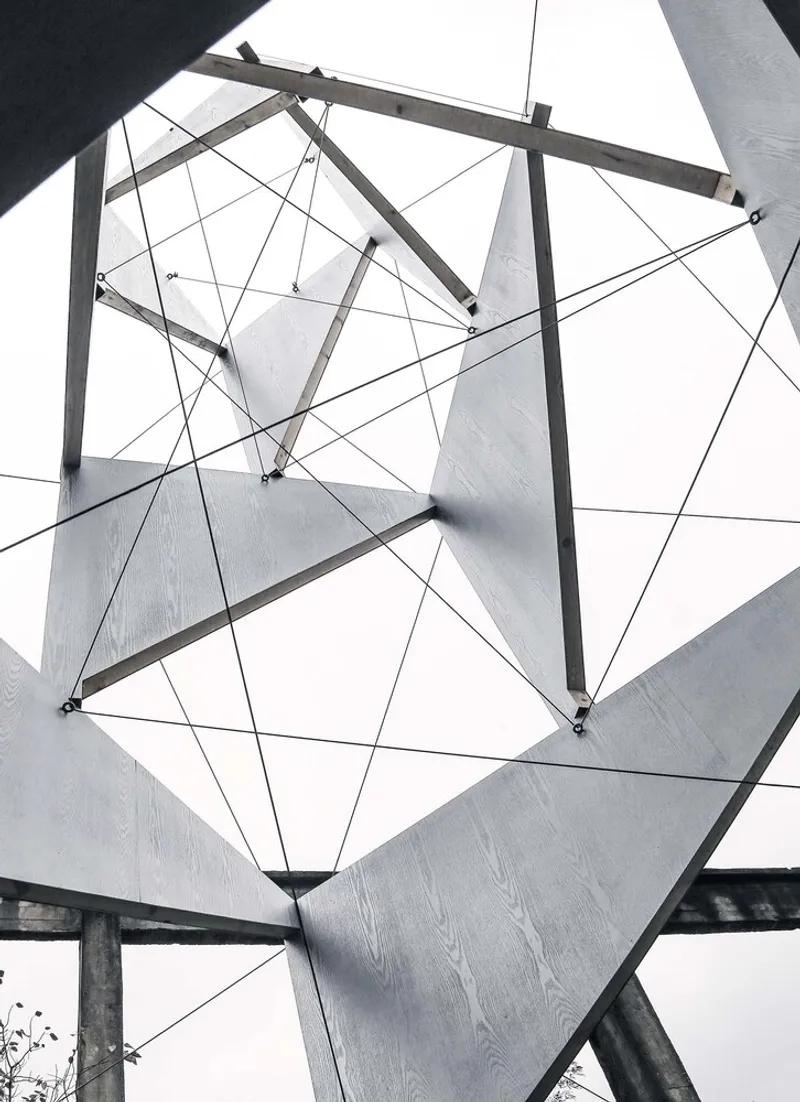
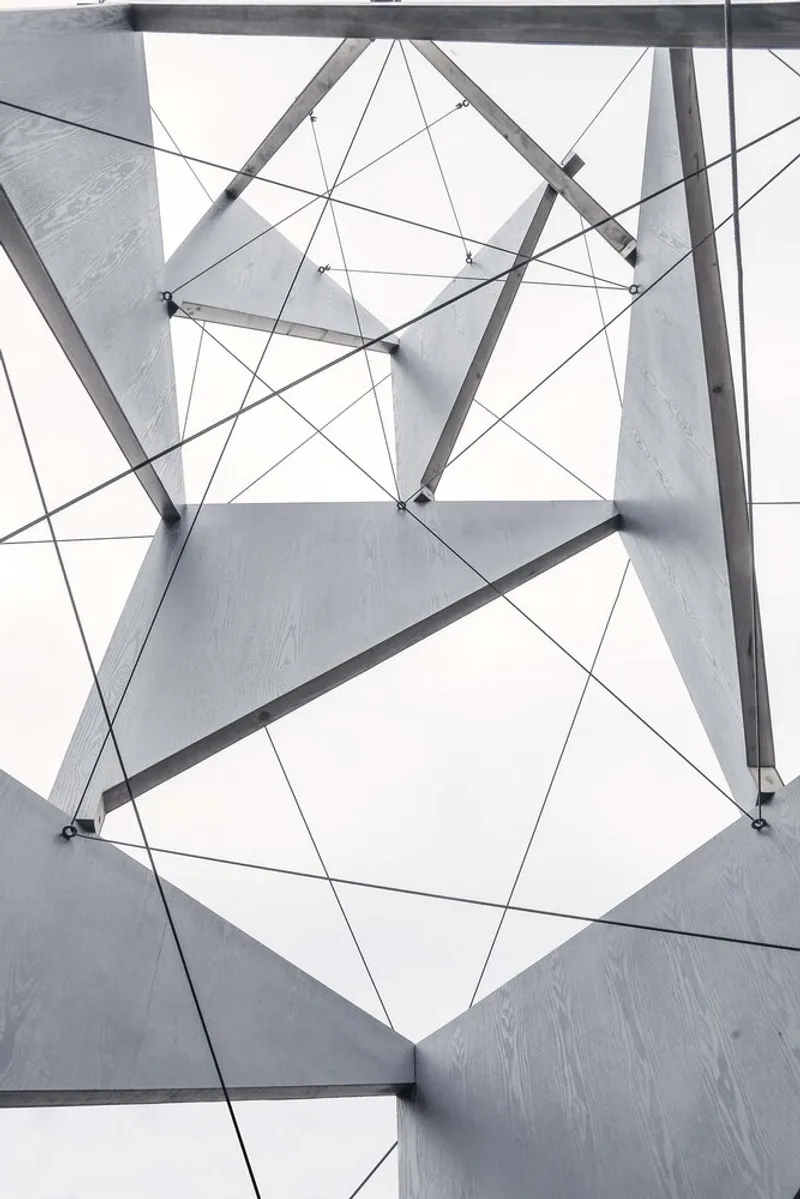
Look up from below and the tower turns into a drawing in lines. Timber edge beams outline each triangular panel, and thin tensioned cables cross between the tiers and pin the stack together. The cables are not hidden. They are the main ornament, a fine graphic layer that reads clearly against the flat grey sky.
This is honest engineering for an object meant to burn. Panels and cables keep the material lean, which suits a structure built to be consumed and then made again. With iStructure on the structural side, the cable network also allows the tiers to look as if they barely touch, so the stack appears to float rather than pile up.
Looking Through the Void
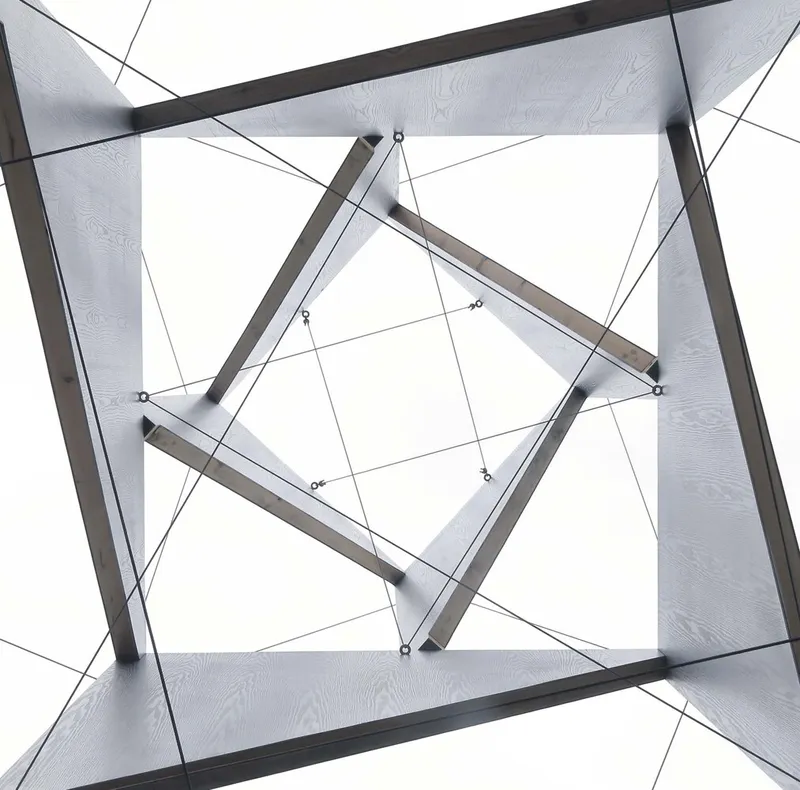
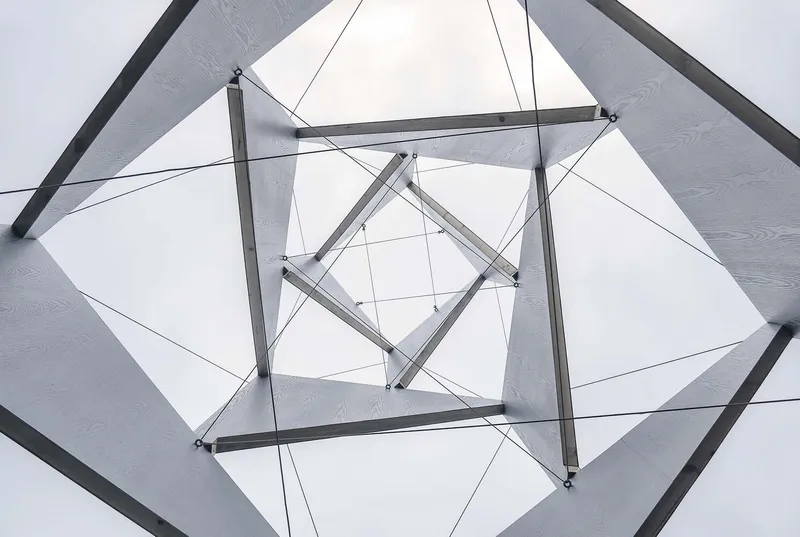
Stand at the base and look straight up. The nested frames rotate as they rise, and the cable lines spiral toward an open sky. The geometry funnels your eye the same way the fire will funnel smoke and heat. Here the form is doing practical work: an open core is what lets a fire breathe and lets its glow travel the full height of the tower.
The pale grained surfaces on the inside catch the diffuse light very differently from the blue exterior. Even in daylight, the interior feels like a chimney made into a viewing device. Once flames are inside it, that inner surface becomes the reflector that sets the whole object glowing.
Plywood, Paint and the Fire Bowl
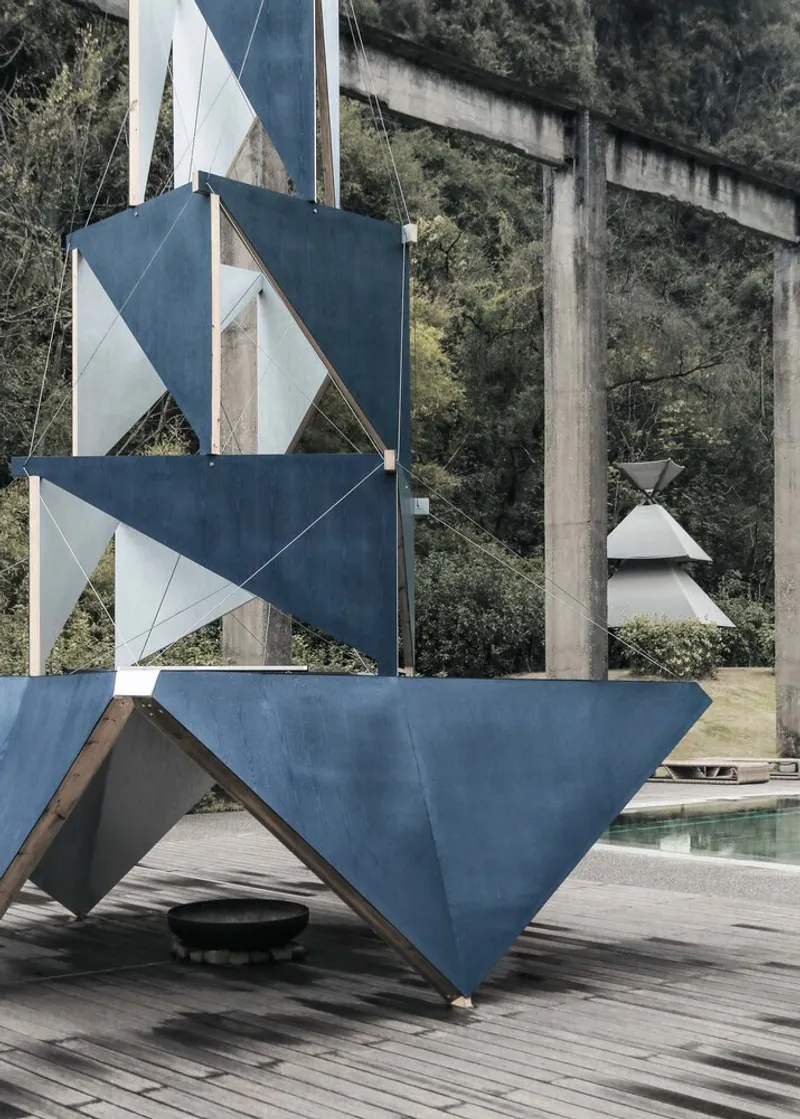
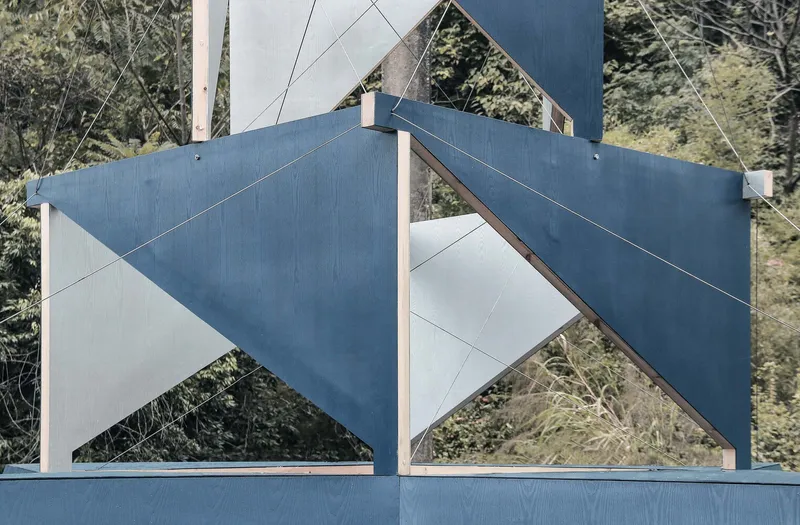
Up close, the material story is modest: blue and pale grey plywood panels, timber edges, thin steel cables, a timber deck, and a fire bowl set beneath the tiers. Nothing here is precious, and it shouldn't be. The palette suits a structure whose first role is to be lit. Its quality comes from careful assembly and a confident colour choice, not from expensive finishes.
The fire bowl at the base is the key detail. It anchors the program at human height, where people gather, while the tower above turns that small flame into a vertical marker you can see across the terrace. Against dense green foliage, the blue reads almost like enamel, a crafted object rather than scaffolding.
Why This Project Matters
The Fire Pit Tower shows how much a very small commission can carry. In 10 m², Atelier Guo addresses ritual, site memory, wayfinding and the reuse of an industrial landscape, and it does so with a clear structural idea instead of decoration. The cable-braced stack is legible, cheap to rebuild and photogenic in a way that serves the client's hospitality context without feeling like marketing.
The more lasting lesson is the life cycle. A tower that is burned and then rebuilt as a permanent fixture turns an ephemeral event into lasting architecture. The rebuilt version will mark the hinge between hotel and river, and it will carry the memory of the night it went up in flames. For designers working on installations, that is a useful model: design the temporary piece so that it earns a second, permanent life.
Fire Pit Tower 2021 by Atelier Guo (lead architect Liaohui Guo, design team Ziqian Wang). Structural engineering by iStructure, consultant Sugar House Yangshuo, client Aurua Arts Foundation. Location: Yangshuo, China. Area: 10 m². Year: 2020.
About the Studio
Share Your Own Work on uni.xyz
If projects like this are the kind of work you want to make, uni.xyz is a place to publish your own, find collaborators, and enter design competitions.


Popular Articles
Popular articles from the community


David Macias Steps a Doorless Stone and Plaster House Down a Tropical Colombian Hillside
In the humid hills of Colombia, Threshold House replaces the front door with an open void and terraces its 850 m² down the slope instead of fighting it.

Jaramillo Van Sluys Arquitectura and Urbanismo Turn a Demolished Registry Lot in Quito into an Orchard Plaza
In Quito's Centro Histórico, a 2,800 m² plaza exposes the San Agustín convent wall and redraws its lost Augustinian orchard in volcanic stone.

LT2A and OPEN Architectes Thread a Brick and Glass High School Through a Wooded Belgian Campus
In Braine-l'Alleud, a 3,000 m² wing for Collège Cardinal Mercier pairs pale brick with a glazed colonnade, deferring to a small chapel and a dense wood.

Juan García Correa, John González and Claudia Rueda Sink a Circular Amphitheater into a Manizales Engineering Building
On the La Nubia campus in Manizales, Colombia, the S1 Building folds labs and offices into a hillside of ramped lawns that double as a campus route.

Similar Reads
You might also enjoy these articles

Bamboo Housing Challenge 2026: Design Affordable, Sustainable Homes Using Bamboo
An international design competition by Bamboo U and IBUKU inviting architects and designers to reimagine affordable housing using bamboo — with the winning design built full-scale in Bali.

Computational Design & Education: Beegraphy Design Awards Introduces 7th Category (Featuring Jiyun's Innovative Approach)
Dive into Beegraphy’s 7th Design Awards category, where computational design meets education to create immersive, interactive learning tools, inspired by Jiyun’s work.
From Parametric Lighting to Urban Furniture: Join the 2nd Workshop in Beegraphy’s Computational Design Series
Dive into Cutting-Edge Design Techniques and Practical Applications with Industry Experts

Last Call: Unleash Your Architectural Genius in SHAK's Kindergarten Design Competition
Urgent call for architects to join SHAK's kindergarten design competition before the looming deadline

Explore Architecture Competitions
Discover active competitions in this discipline

Challenge to design a portable theatre

Challenge to design a portable music platform

Challenge to design an open learning module for the elderly

Challenge to reimagine the Iron Throne
Comments (0)
Please login or sign up to add comments
No comments yet. Be the first to comment!