

Fire Station in Straubenhardt by wulf architekten: A Landmark of Sustainable Civic Architecture
Sustainable fire station in Straubenhardt by wulf architekten unites six units with circular construction, layered design, and landscape integration.


A Pioneering Fire Station Embracing Circular Construction in Germany
Located in Straubenhardt, Germany, the newly completed Fire Station by wulf architekten is not just a response to local firefighting needs—it is a forward-thinking architectural statement rooted in sustainable construction, circular design, and functional innovation. Completed in 2022, the 3,996 m² facility consolidates six previously independent firefighting units into a centralized hub, strategically positioned along Langenalberstraße. This project exemplifies a new generation of public safety buildings that are environmentally conscious, contextually integrated, and future-oriented.
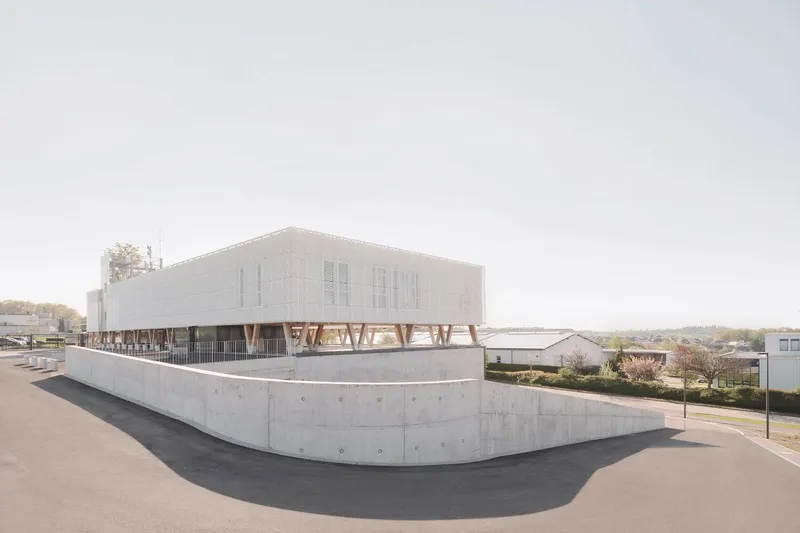

Integration of Architecture and Landscape
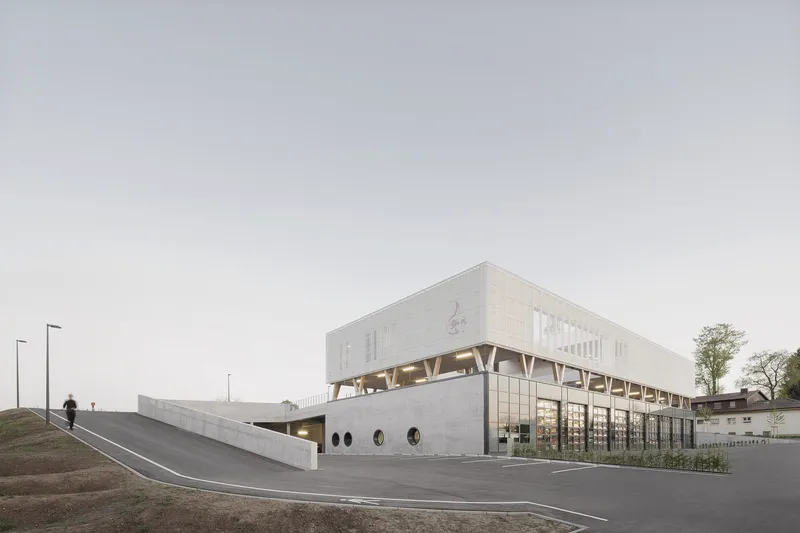
One of the most compelling aspects of the design is how the architecture harmonizes with the natural topography. By embracing the site's sloping terrain, the architects minimized soil sealing and reduced environmental impact. The fire station's base is anchored by a robust concrete plinth, which is thoughtfully embedded into the hillside. This approach not only reinforces structural stability but also visually embeds the station within its landscape. The north-facing façade opens toward the street, enhancing visibility and accessibility while maintaining an understated civic presence.
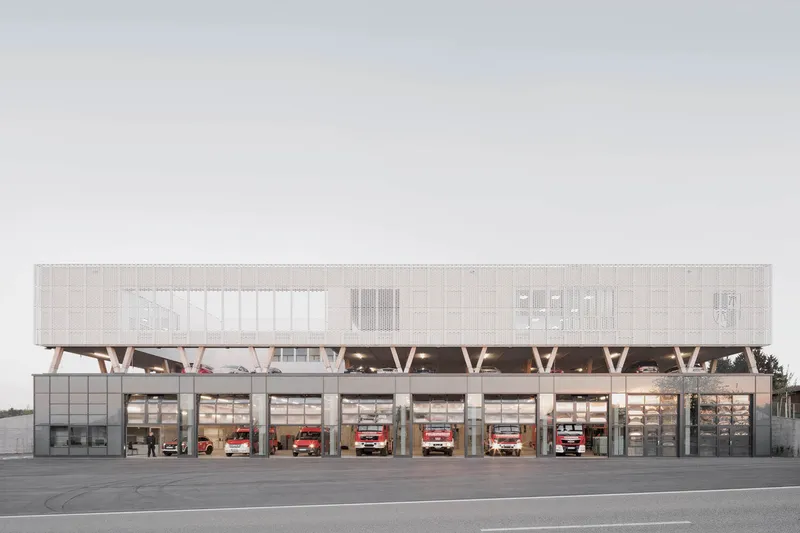

Layered Functionality Through Vertical Zoning
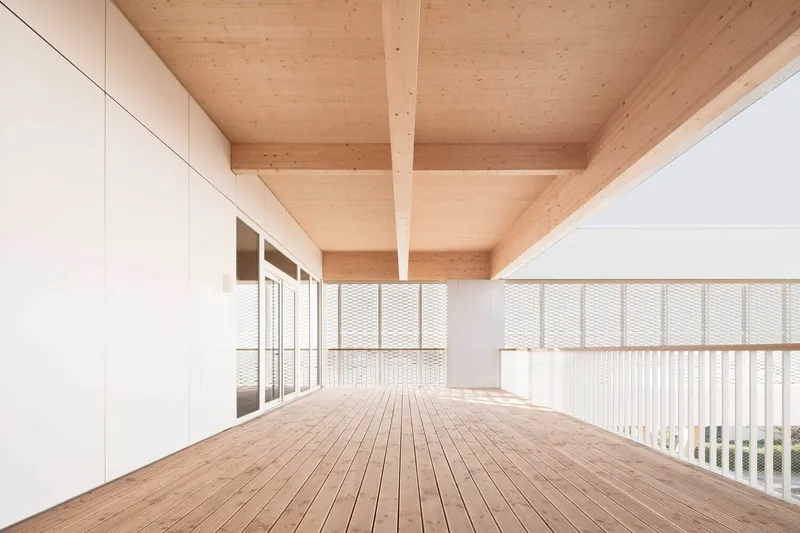
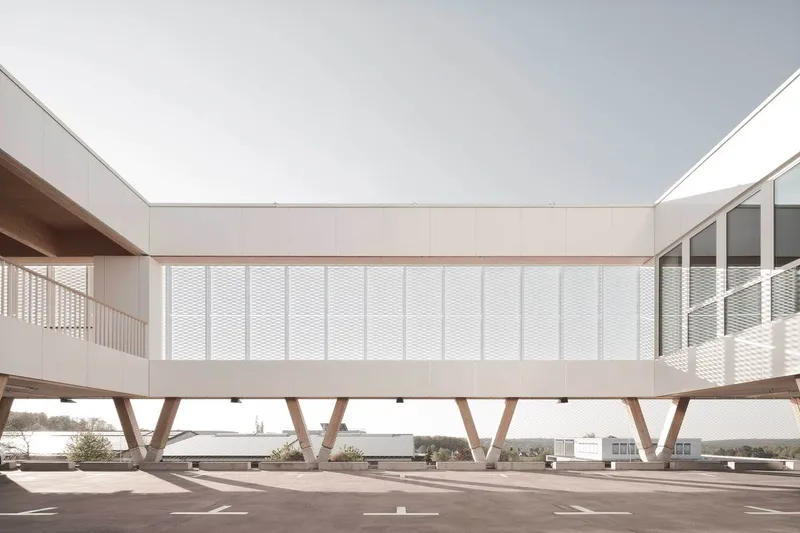
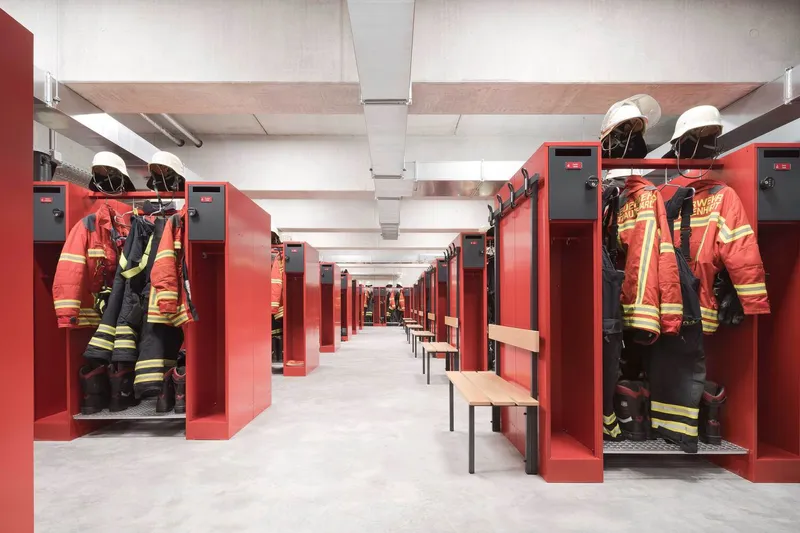
The design employs a stacked spatial organization, clearly articulating each programmatic layer. The ground level houses the garage bays for emergency vehicles, technical support areas, and operational infrastructure. Above this is an open-air intermediate level, accessible via an exterior ramp, which includes two landscaped atriums. This multifunctional level serves as a parking deck and a community gathering space, highlighting the fire station’s dual role as an emergency hub and civic center.
At the top level, a timber-framed structure sheathed in white expanded metal creates a visually distinctive silhouette. This upper volume accommodates training rooms, administrative offices, and communal spaces, all designed to promote collaboration, learning, and adaptability. The use of expanded metal not only provides a modern aesthetic but also contributes to ventilation and daylight filtration, enhancing interior comfort.

Cradle to Cradle: A Blueprint for Circular Construction
As one of the first Cradle to Cradle-certified public buildings in Germany, the fire station stands as a benchmark for circular construction in civic architecture. Every material used in the building was selected based on its recyclability, low toxicity, and ease of disassembly. This ensures that, at the end of its lifecycle, the building will serve as a valuable source of reusable materials—an architectural material bank for future generations.
By integrating low-emission materials and a construction methodology that anticipates deconstruction, wulf architekten demonstrates a deep commitment to environmental responsibility. The fire station is not just a sustainable building—it is a prototype for regenerative design, where the built environment contributes to rather than depletes ecological systems.
A Model for the Future of Civic Architecture
The Fire Station in Straubenhardt is more than a functional facility; it is a symbol of civic identity, environmental stewardship, and architectural excellence. With its layered functionality, innovative material use, and community-oriented design, it sets a new standard for public infrastructure projects across Europe.


Popular Articles
Popular articles from the community


Cube Design Draws an Ecological Corridor Between Two Shenzhen Hills with the Nankai Building
Beside Shenzhen's container docks, the Nankai Building pairs stacked balconies with a climbing green screen to connect two hillsides across its height.

LT2A and OPEN Architectes Thread a Brick and Glass High School Through a Wooded Belgian Campus
In Braine-l'Alleud, a 3,000 m² wing for Collège Cardinal Mercier pairs pale brick with a glazed colonnade, deferring to a small chapel and a dense wood.

GROUP A Strips a 1969 Rotterdam Harbor Headquarters to Its Frame and Wraps It in Timber Louvers
In Rotterdam's M4H harbor district, Ferro Offices reuses a 1969 frame, adds one timber storey and reaches BREEAM-NL Outstanding.

Juan García Correa, John González and Claudia Rueda Sink a Circular Amphitheater into a Manizales Engineering Building
On the La Nubia campus in Manizales, Colombia, the S1 Building folds labs and offices into a hillside of ramped lawns that double as a campus route.

Similar Reads
You might also enjoy these articles


Hodi-Mandai Geram
Project Function: Preservation and revitalization of the Intangible heritage and socio-spatial identity of the Hodi by Housing, Cultural Memory Center, Sacred Grove, landscape, local tourism economy


Olio Towers: A Mid-Rise for Performers That Fuses Housing, Rehearsal, and Stage
Located blocks from Houston's Theater District, this modular tower stacks living units around a central performance atrium.

Oasis: Modular Green Housing Carved into Dhaka's Urban Fabric
A shortlisted Plugin Housing entry reclaims unauthorized settlements in Dhaka with stepped concrete volumes, green roofs, and ventilation-driven design.

Black Hole: A Floating Megastructure for the Post-Physical Era
Emiliano Mazzarotto envisions a spherical, self-scaling arena where e-sports, digital hotels, and holographic stadiums replace traditional public space.

Explore Staarch Architects Competitions
Discover active competitions in this discipline

Challenge to reimagine the Iron Throne

Photograph architecture without architects

Illustrate the lost glory of Angkor Wat - Render Challenge

Design challenge to reuse E-waste
Comments (0)
Please login or sign up to add comments
No comments yet. Be the first to comment!