
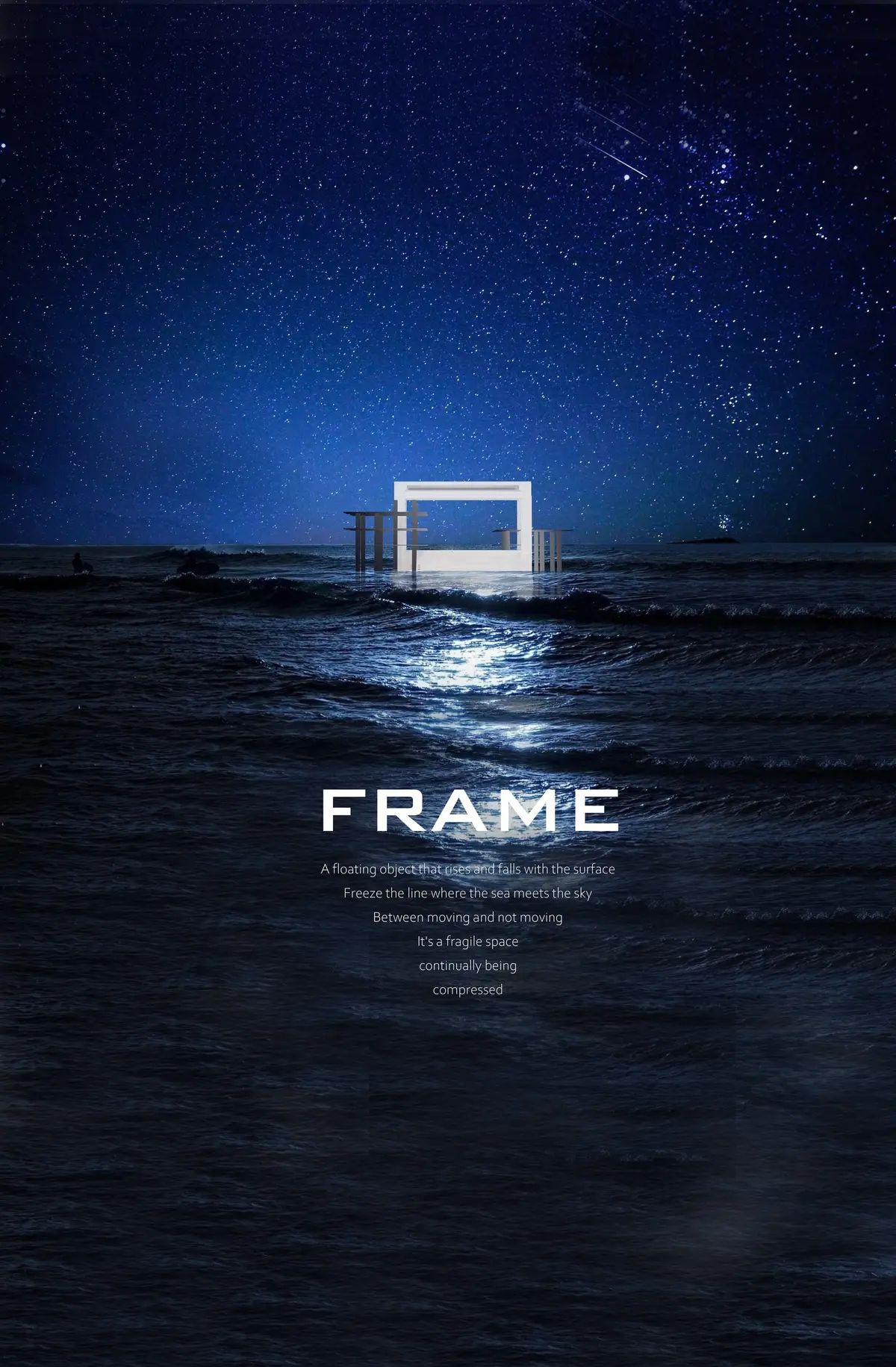
Proximity Island Frame: A Floating Platform That Holds the Horizon Still While the Sea Moves
qiaoxi wu's Editor's Choice entry rides existing offshore columns with the tide, framing the sea-sky line as a fixed datum in a restless ocean.


Most floating architecture is sold on survival: rise with the water, stay dry, carry on. Proximity Island Frame takes that premise and asks a stranger, more interesting question. If a building moves with the ocean, what can it hold still? The answer here is the horizon. The project sets out to "freeze" the line where sea meets sky, turning that thin band into a constant visual datum inside an environment that never stops shifting.
Designed by qiaoxi wu and recognised as an Editor's Choice entry in Proximity Island 2019, the proposal sits offshore on an existing column system, the kind of structural leftover that industrial marine development tends to abandon. Rather than treat that inheritance as wreckage, wu treats it as a guide rail. The building glides vertically along the columns as sea levels change, and the whole scheme is organised around three operations the designer names Touch, Frame and Memorize.
Starting From the Wreckage of Extraction
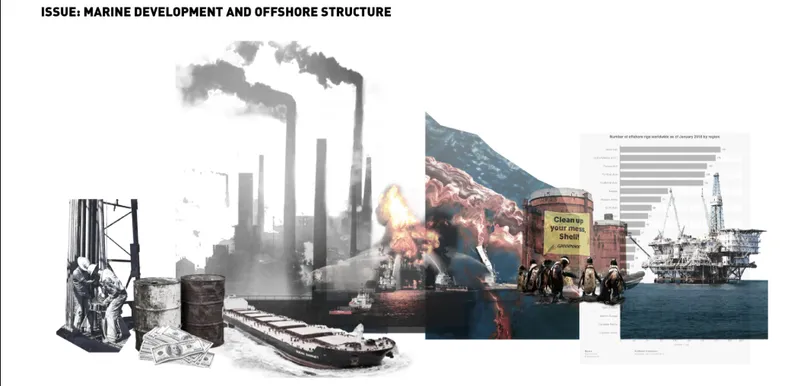
The opening collage is blunt about where offshore building has come from: smokestacks, oil barrels, a cargo ship, an oil-spill protest and a rig, set against a bar chart of rig counts. It frames the ocean as a site that has been organised almost entirely around extraction, with ecological balance a distant afterthought. As these platforms fall out of use, they leave behind both an environmental liability and a ready-made structural foundation in open water.
wu pairs this industrial history with the parallel pressure of sea-level rise on coastal populations. The move is smart because it refuses to separate the two problems. The same infrastructure that helped drive the crisis becomes the testing ground for a response, one aimed as much at human perception and environmental awareness as at engineering.
Touch: A Building That Slides on Inherited Columns
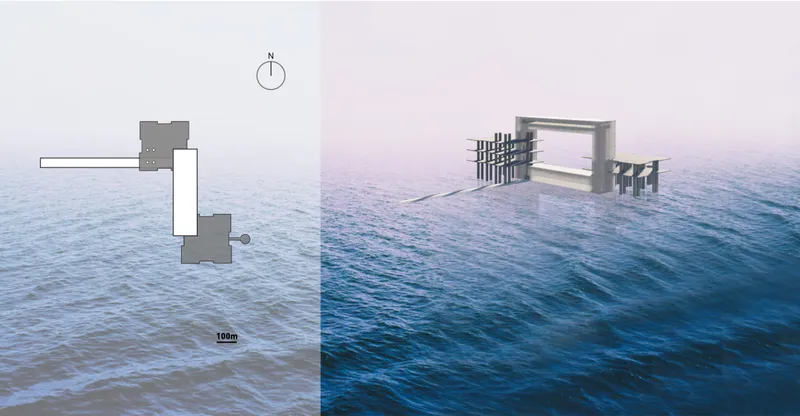
The site plan, scaled to 100 metres, sits beside a render of the frame-shaped platform hanging in misty open sea. What the drawing makes clear is the simplicity of the footprint: a bounded rectangle anchored to existing offshore columns rather than a sprawling island. This is the Touch strategy. Instead of fighting water levels with height or mass, the structure moves vertically along its supports, keeping its relationship to the surface constant as the surface itself rises and falls.
The consequence is worth dwelling on. A fixed building on a rising sea slowly loses its relationship to the water; a floating one maintains it indefinitely. Functional and experiential continuity become the design goal, and the tide becomes a force that compresses and releases the space rather than one that threatens it.
Frame: Circulation Turned to Face the Sea
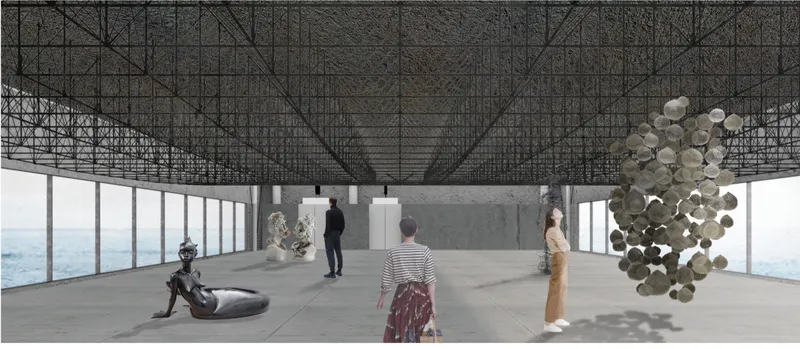
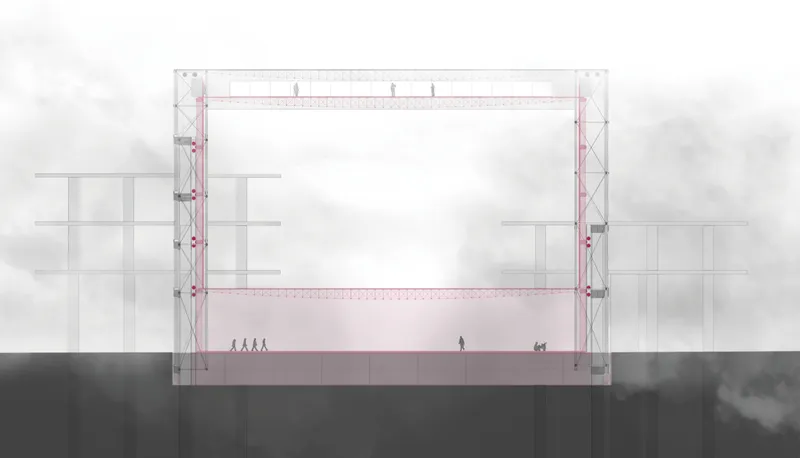
The gallery interior shows visitors moving among sculptures under an exposed steel truss, with glazing opening toward the water in soft, diffused light. The section beside it explains the logic: an open rectangular frame with pink-tinted decks, steel bracing and small figures walking its levels, all wrapped in heavy fog. wu organises circulation perpendicular to the sea, so movement through the building becomes a gradual approach to the horizon rather than a parallel stroll alongside it.
This is where the linear frame earns its name. It works less like an enclosure and more like a viewing instrument, cropping the vastness of open water into something a body can register. The fog in the section is not just atmosphere; it suggests how much the experience depends on weather, with the frame offering a stable edge against conditions that constantly dissolve and redraw the view.
A Concrete Edge Against a Grey Horizon
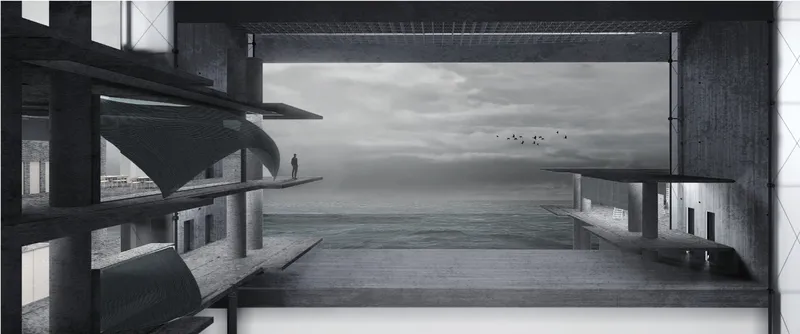
The most persuasive image in the set is also the quietest. A lone figure stands on a cantilevered slab, looking through a concrete frame toward a grey sea, with birds wheeling overhead. Here the concept of the frozen horizon becomes legible. The frame's edges stay fixed in the viewer's eye while the water beyond keeps moving, producing exactly the condition wu describes as being between moving and not moving.
The fragility the designer talks about is palpable in this view. The slab projects into empty air, the horizon sits as the only reliable line, and the architecture shrinks to a set of edges that make the ocean's scale readable. It is a restrained, almost meditative image, and it carries the project's argument more convincingly than any diagram could.
Labs, Homes and a Ping Pong Table in the Fog
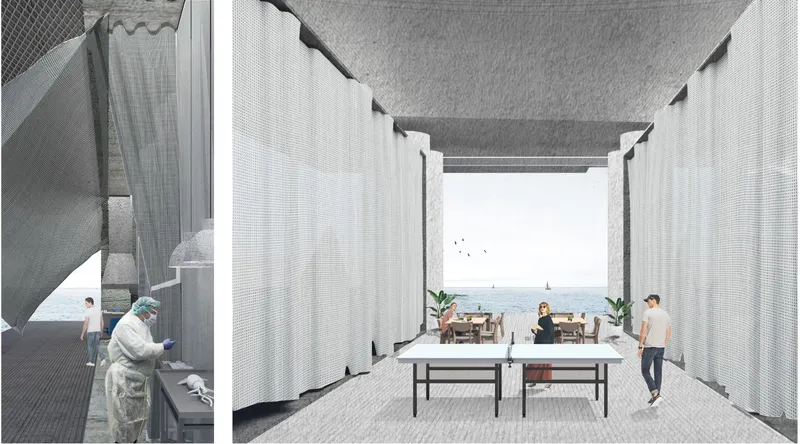
The final pair of renders grounds the poetics in daily life. A worker in protective gear bends over a lab bench; elsewhere, a corridor of white mesh curtains leads to a ping pong table facing the sea. The programme folds laboratories, exhibition spaces, residential units and communal areas into the same framing device, so research, display, rest and play all share the same oriented relationship to the horizon.
That mix matters. An offshore platform devoted only to contemplation would read as a folly; one devoted only to research would repeat the instrumental logic of the rigs it replaces. By placing a lab bench and a ping pong table within the same continuous sequence, wu imagines an offshore community where the ocean is both the subject of study and the backdrop to ordinary routines.
Why This Project Matters
Floating architecture is often discussed in purely technical terms: buoyancy, mooring, resilience. Proximity Island Frame argues that adaptation is also a perceptual problem. When the ground beneath you rises and falls, architecture can offer a fixed reference that helps people understand their place in a changing environment. Turning the horizon into that reference is a precise, transferable idea, and it gives the vertical mobility of the structure a meaning beyond staying afloat.
The project's reuse of an existing offshore column system is equally significant. It suggests that the decommissioned infrastructure of extraction need not be simply removed or left to decay; it can become the armature for research, habitation and reflection on the sea. For a competition entry, that combination of conceptual clarity and grounded strategy is exactly what makes it worth the Editor's Choice recognition.
View the Full Project
About the Designers
Designer: qiaoxi wu
Enter a Design Competition on uni.xyz
uni.xyz runs architecture and design competitions year-round that reward proposals with spatial conviction and real site intelligence.
Project credits: Proximity Island – Frame by qiaoxi wu Proximity Island 2019 (uni.xyz).


Popular Articles
Popular articles from the community


Temporary Home for Dogs: A Reversed Zoo Rethinks Animal Shelter Architecture
In Bucharest, a sinuous corridor and freed landscape flip the logic of containment, designing a shelter that works to make itself unnecessary.

Opera by the Sea Estonia: Three Shells Dissolving Architecture into Tallinn's Coastline
A winning opera house proposal replaces monumental form with interconnected shells that blur the boundary between building, park and Baltic Sea.

Extended Shell: Retrofitting Kolkata's Balconies as Living Urban Thresholds
A modular retrofit system recovers the social and environmental intelligence of Kolkata's historic verandas for contemporary Park Street residents.

Manzana Morphosis: Stretching Barcelona's Grid into a Living Landscape for 2050
A radical reworking of the Eixample manzana turns density into a tool for generous public space, vertical ecology, and environmental performance.

Similar Reads
You might also enjoy these articles

Healing Façade: A Modular Chapel System That Restores Ethiopia's Sacred Forests
Winner of the Eco-Chapel competition, this circular timber façade collects water from air to rebuild soil and reforest degraded Ethiopian landscapes.
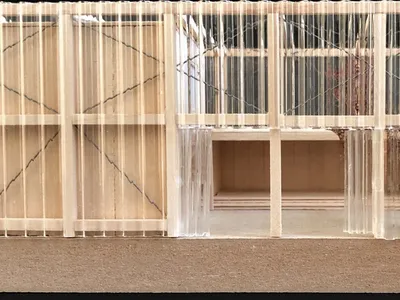
Kaffeebühnen: Where Coffee Shop Architecture Becomes a Civic Stage in Vienna
A linear sequence of timber boxes, transparent shells, and open yards turns the Viennese café tradition into a public performance space.
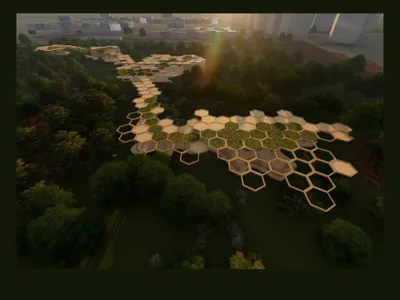
Eco Chapel: A Modular Forest Pavilion That Grows Like the Landscape It Protects
Hexagonal timber modules weave through existing trees, turning a chapel into a living system for prayer, education, and reforestation.

Urban Forest: A Vertical Ecosystem for 5,000 Workers in Singapore's Changi Business Park
Radially stacked pods and layered green decks turn a 7-acre plot into 47 acres of ecological workspace projected for 2040.

Explore Ocean Architecture Competitions
Discover active competitions in this discipline

Challenge to reimagine the Iron Throne

Photograph architecture without architects

Illustrate the lost glory of Angkor Wat - Render Challenge

Design challenge to reuse E-waste
Comments (0)
Please login or sign up to add comments
No comments yet. Be the first to comment!