
FLOW
'Flow' refers to the process of imagining a work environment from a child's perspective.
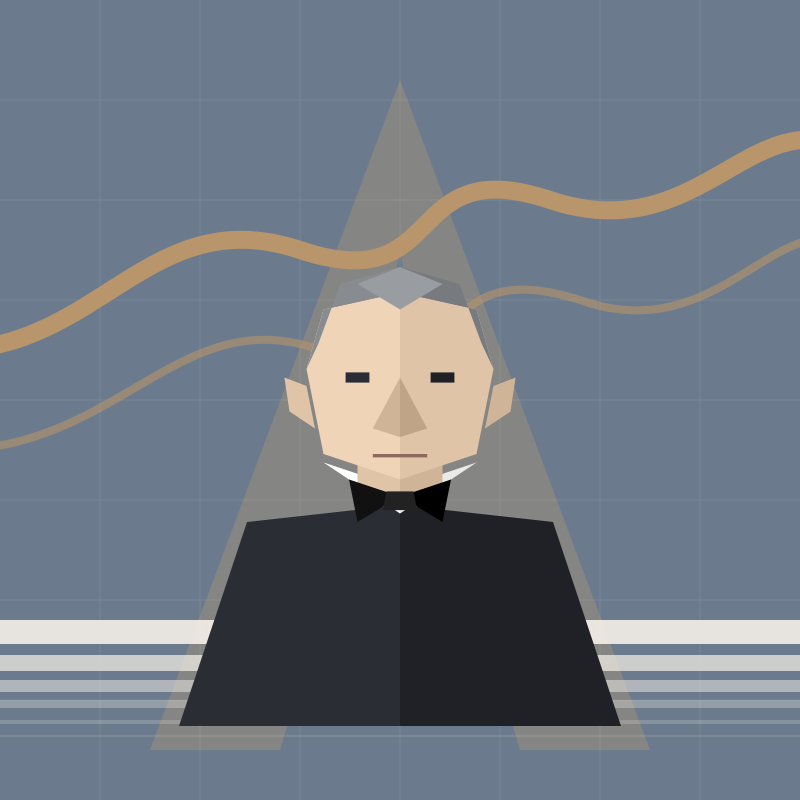
The design area is located in the city of Pittsburgh, where two rivers meet in the American state of Pennsylvania. When we look at the design area from a higher scale, there is the city center in the west, the residential area in the north, and the commercial area in the south. When the surrounding neighborhoods of the design area are examined, it is seen that although the neighborhoods are very close to the city center, the income level is low and the unemployment rate is high. When the reasons for this situation are investigated, it is the inequality in educational conditions and the lack of investment in the region in the past. Based on all these data, it was decided to create a start-up center for the region to be in a more advantageous position and for individuals who have entrepreneurial ideas but cannot realize their dreams due to financial difficulties. When the child communicated with his teammate and drew his dream workspace, he drew a picture that actually defined and followed a process-flow that included different actions at different levels. In this picture, when the child enters the office, the entrance area where he first hangs his clothes is described. He defines each action in the painting as a different space and connects the relationship between spaces at different levels with a staircase. To give an example from the picture of the child, he/she first goes to the study area and aims to work for a while, then moves to the room where he/she listens to music and creates free time for himself during the study process. At the same time, it has created many places where one can watch movies, sleep, order and eat food and relax. By placing each action that the child tells us in this drawing in a different place, he has created a process in which many different actions can be performed in a working place. Based on the data of the child's teammate, this flow and process were processed together in the Start-up center in Pittsburgh, where we identified the process that the child told us as a need. As a result, we defined a ramp trace into the design area. This trail defines a process and acts as a corridor connecting the actions taking place around it, creating a viewing area that can view the Monongahela River when viewed from the top elevation of the defined ramp. The process that takes place around the ramp begins with the organization of a competition in the event hall located at -5 elevation. People with entrepreneurial ideas and different socio-economic status participate in this competition. Then, the people participating in the competition exhibit the data they have on the ramp, which is the main element of the design, to the start-up center employees and investors who will support them in the process of developing this idea. After this exhibition process, the elimination process begins and the people who pass the preliminary elimination make a presentation to the start-up center in the center's amphitheater at level -5, and the process begins for the participants who pass the final elimination process. Afterwards, the process of developing entrepreneurial ideas begins in the work spaces at +3 and +6 elevations. The work space consists of movable screens. This screen idea was inspired by his teammate boy. When the child described his father's workplace, he mentioned that it consisted of screens, but that it was fixed and disturbing. The screens in this idea were incorporated into the design as a free plan, which can be transformed into private office spaces where meetings can be held at any time, and can actually be shaped according to the need of the moment. The design was created with the flexibility of a child's perspective.

Popular Articles
Popular articles from the community


longwave studio Reorganizes a 112 m² Tainan Apartment Around the Daily Routines of a Family and Two Cats
In Tainan, Taiwan, birch plywood, rust-red furniture and a freestanding plaster wall link arrival, storage, work and family life in one apartment.

GROUP A Strips a 1969 Rotterdam Harbor Headquarters to Its Frame and Wraps It in Timber Louvers
In Rotterdam's M4H harbor district, Ferro Offices reuses a 1969 frame, adds one timber storey and reaches BREEAM-NL Outstanding.

Jaramillo Van Sluys Arquitectura and Urbanismo Turn a Demolished Registry Lot in Quito into an Orchard Plaza
In Quito's Centro Histórico, a 2,800 m² plaza exposes the San Agustín convent wall and redraws its lost Augustinian orchard in volcanic stone.

David Macias Steps a Doorless Stone and Plaster House Down a Tropical Colombian Hillside
In the humid hills of Colombia, Threshold House replaces the front door with an open void and terraces its 850 m² down the slope instead of fighting it.

Similar Reads
You might also enjoy these articles

The Rhythm of Seasons
A Farmers' Market Connecting Nature and the City

More Than a Building-Designing a Living System
More Than a Building-Designing a Living System
Base Beyond
DESERT COMPOUND ARID: TOURISM OF ABSENCE AND ABUNDANCE

Explore Spatial Flow Competitions
Discover active competitions in this discipline


Challenge to reimagine the Iron Throne

Photograph architecture without architects

Illustrate the lost glory of Angkor Wat - Render Challenge

Design challenge to reuse E-waste
Comments (0)
Please login or sign up to add comments
No comments yet. Be the first to comment!