

Foster + Partners Unveils a Stepped, Terraced Tower to Complete the World Trade Center Campus
Two World Trade Center rises 55 stories in Lower Manhattan, weaving planted terraces and a fully electric design into the city's most charged site.


Twenty-five years after the destruction of the original complex, the last piece of the World Trade Center puzzle is finally taking shape. Foster + Partners has unveiled new renderings for Two World Trade Center, a 373-meter, 55-story office tower at 200 Greenwich Street that will bring roughly 1.95 million rentable square feet to Lower Manhattan when it opens, tentatively, in 2031. The design replaces earlier iterations for the site, including proposals by Bjarke Ingels Group, and commits to a stepped massing that cascades westward in dialogue with One World Trade Center across the plaza.
What makes the scheme worth watching is not simply its scale but its argument about what a supertall commercial tower can be in the mid-2020s. Foster's team has distributed more than an acre of planted terraces and green roofs across the building's midsection, turning what could have been a monolithic glass slab into a vertically disaggregated series of slender volumes. The tower is designed to be fully electric and is pursuing LEED certification. It is engineered to accommodate 10,000 workers, and it is trying, at least on paper, to make their daily experience something other than sealed floor plates and recirculated air.
A Stepped Silhouette Against the Skyline

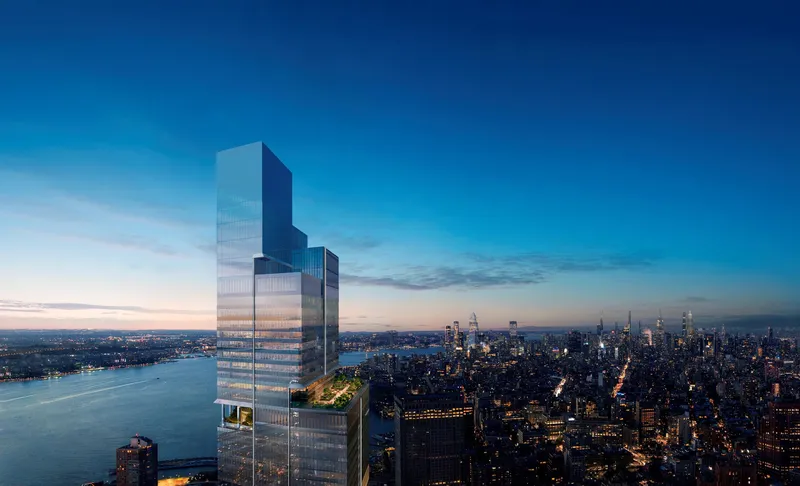
The tower's most legible move is its cascading profile. Rather than a single extrusion, the massing is composed of offset rectangular volumes that step down as they approach One World Trade Center, creating an asymmetric silhouette that reads differently from every vantage point. At dusk, the fully glazed facade catches the last light over the Hudson, making the terraces glow green against the surrounding stone and glass of the Financial District. The gesture is not just aesthetic: each setback generates a sky terrace, turning structural articulation into occupiable landscape.
From the river, the tower holds its own against the skyline without competing with its neighbor's height. The 373-meter datum is respectful, even deferential, to the symbolic primacy of One WTC, but the stepped profile ensures Two WTC is never merely a sidecar. It is a counterpoint: horizontal layering versus vertical singularity.
Vertical Landscape Strategy


The planted terraces are more than greenwashing. Over an acre of outdoor space is distributed through the building at intermediary amenity levels, offering panoramic views of Manhattan and the Hudson River. Each terrace is scaled to function as a genuine gathering place, not just a planter box bolted to a ledge. The worm's-eye view from street level reveals the terraces as horizontal bands of vegetation that break the vertical rhythm of the facade, introducing a layered depth that flat curtain walls cannot achieve.
From above, the terraces register as a series of green shelves that articulate the building's massing. They also serve a passive design function, shading the floors below and potentially reducing cooling loads on south-facing exposures. Whether the greenery thrives at 200 meters in a North Atlantic wind corridor remains to be seen, but the ambition is real: to make the tower's sustainability claims legible in its form, not just its mechanical systems.
The Facade Up Close
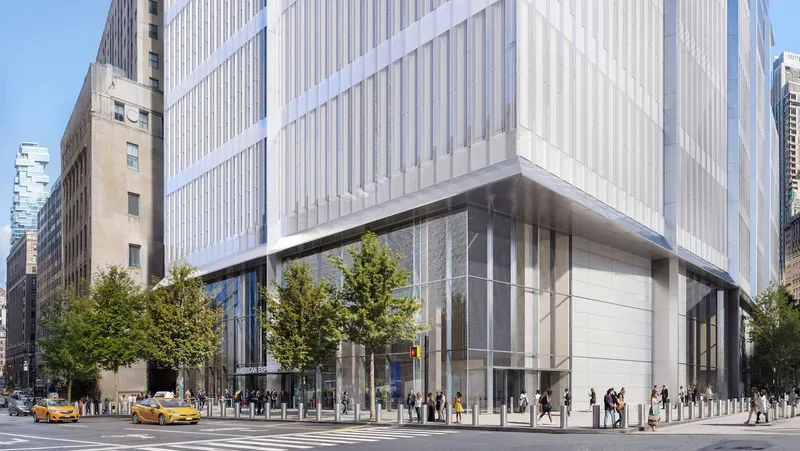
The curtain wall is vertically articulated with expressed structural mullions that emphasize the building's upward thrust. Horizontal metal strips delineate each floor, creating a fine-grained grid that recalls the rational modernism of earlier Foster towers while acknowledging the contemporary appetite for transparency and daylight. Floor-to-ceiling glazing is the default, which will flood the flexible floorplates with light but also demands rigorous solar control, likely handled by the smart-building technologies the team has referenced.
At the street corner, the facade opens into a generous glazed entrance. The renderings show the metal mullion system continuing down to the ground plane without interruption, giving the base a civic legibility that many supertalls sacrifice when they retreat behind blank podiums or retail frontage. The vertical lines draw the eye upward, while the pedestrian activity at ground level, taxis, trees, foot traffic, keeps the tower grounded in the rhythm of Lower Manhattan.
Ground Plane and Public Interface
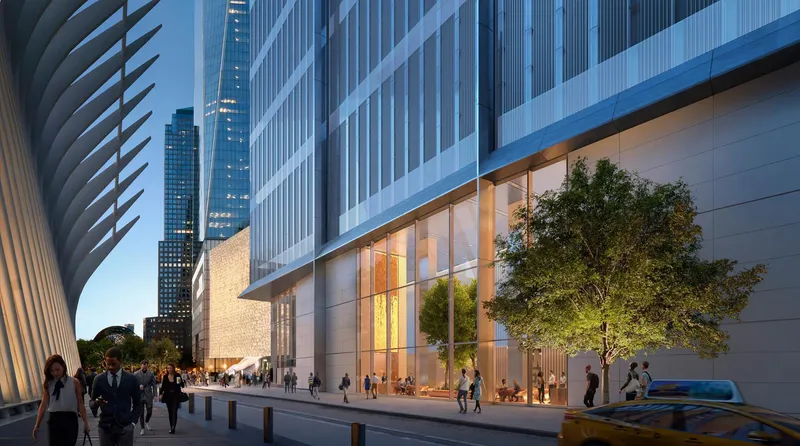
A triple-height lobby anchors the base, and the renderings show a streetscape lined with mature trees and broad sidewalks. Positioned directly across from Santiago Calatrava's Oculus transportation hub, the tower's ground level must negotiate heavy pedestrian flows and a visually intense neighbor. Foster's response is restrained: a rectilinear glass base that lets the interior lobby read as an extension of the sidewalk, rather than a separate precinct.
The street-level rendering is perhaps the most telling image of the set. It shows the tower as a piece of urban infrastructure, not a monument. Yellow cabs, crossing pedestrians, and planted trees occupy as much visual real estate as the glass facade. For a site freighted with enormous symbolic weight, this ordinariness is a deliberate choice. Foster is betting that the best tribute to what was lost is a building that functions, quietly and effectively, as part of the city's daily life.
Context and Memory
Two World Trade Center occupies the site of the original 5 World Trade Center, on a full block bounded by Vesey, Fulton, Church, and Greenwich streets. The foundation work was completed back in 2013, meaning the substructure has been waiting more than a decade for a design to build upon. The scheme incorporates elements of Daniel Libeskind's original 2006 master plan, including the so-called "wedge of light" concept, though how literally that translates into the final architecture remains to be seen.
The 16-acre World Trade Center complex has been one of the longest-running construction sagas in American urbanism. One WTC, the 9/11 Memorial, the Oculus, and towers Three and Four are all complete. Two WTC is the finale, and with construction slated for spring 2026, there is finally a credible timeline. The pressure on Foster + Partners is not just architectural. It is civic: the building must close a wound that has been open for a generation.
Why This Project Matters
Two World Trade Center matters because it tests whether a fully electric, terrace-laden supertall can be more than a marketing exercise. The distributed landscape, the LEED ambitions, and the smart-building framework all sound promising in a press release, but at 55 stories and nearly two million square feet, the margins for greenwashing are enormous. If Foster's team delivers a tower that genuinely reduces energy consumption and improves occupant wellbeing at this scale, it will set a benchmark. If the terraces end up as inaccessible decoration, the industry will notice that too.
More broadly, the project closes the most emotionally charged development site in the Western Hemisphere. Every design decision, from the cascading massing to the transparent lobby, carries weight beyond its functional rationale. Foster + Partners has chosen understatement over spectacle, and that restraint feels appropriate. Lower Manhattan does not need another icon. It needs a building that works, that breathes, and that completes a campus the city has been waiting decades to finish.
Two World Trade Center, designed by Foster + Partners, 200 Greenwich Street, Lower Manhattan, New York. 186,000 square meters (approximately 1.95 million rentable square feet), 55 stories, 373 meters. Construction anticipated to begin spring 2026, with completion expected in 2031.
About the Studio
Share Your Own Work on uni.xyz
If projects like this are the kind of work you want to make, uni.xyz is a place to publish your own, find collaborators, and enter design competitions.


Popular Articles
Popular articles from the community


Architekt Andreas Gruber Scatters 23 Dark Timber Chalets Across a South Tyrolean Forest Edge
In Molini di Tures, Amonti Chalets breaks a resort into a hamlet of gabled timber houses, with parking, storage and services pushed into the slope.

Jaramillo Van Sluys Arquitectura and Urbanismo Turn a Demolished Registry Lot in Quito into an Orchard Plaza
In Quito's Centro Histórico, a 2,800 m² plaza exposes the San Agustín convent wall and redraws its lost Augustinian orchard in volcanic stone.

David Macias Steps a Doorless Stone and Plaster House Down a Tropical Colombian Hillside
In the humid hills of Colombia, Threshold House replaces the front door with an open void and terraces its 850 m² down the slope instead of fighting it.

U.GA Architects Wraps an Oval Rooftop Pool in Curved Board-Formed Concrete on Busan's Jeollidan-gil
In Busan's Jeonpo-dong, a 454 m² mixed-use block stacks a neighborhood facility, guest rooms and an oval rooftop pool inside spiraling concrete walls.

Similar Reads
You might also enjoy these articles


LAVA Architecten Gives Vocational Education a Sawtooth-Roofed Face on a Mechelen School Campus
In Mechelen, Belgium, a 2,053 m² STEM school on a 6×6 m grid turns workshops and classrooms into rooms that can be rearranged as teaching changes.

KEMA Studio Turns a Derelict Marvila Attic into a 60 m² Lighthouse Apartment Above Lisbon
In Lisbon's Marvila district, a rebuilt roof, four skylights and two plywood volumes turn an unlivable attic into a bright home facing the Tagus.

Pixel Gardens: One Repeated Module Stacked Into a Terraced Social Housing Tower for Famagusta
Salem Bader's shortlisted housing tower builds a vertical neighbourhood from one repeated module, offsetting units to carve terraces, light and air.

Bao Huynh Watercolor Atelier: A Serene Art Retreat in Hội An
Bao Huynh Watercolor Atelier in Hội An blends multifunctional art spaces, sustainable design, local materials, and family-friendly living in a serene environment.


Comments (0)
Please login or sign up to add comments
No comments yet. Be the first to comment!