

Foster + Partners Create a Playful and Elegant Stadium for Qatar World Cup Final
Design Merges Geometric Precision with Dynamic Sculptural Forms

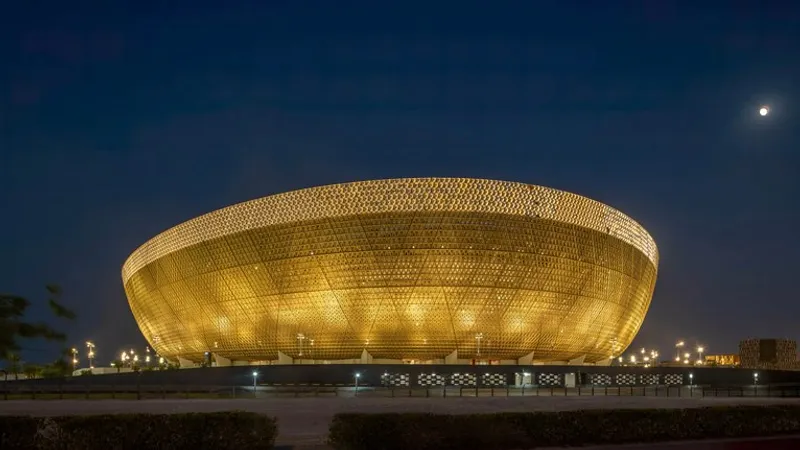
On September 9th, Lusail Stadium – the focal point for the upcoming FIFA World Cup Qatar 2022TM – hosted the Lusail Super Cup final. This match served as a preview to the highly anticipated FIFA World Cup Qatar 2022TM set to take place later in the year.

Luke Fox, Head of Studio, Foster + Partners, said: “It was a delight to be at the game and see the stadium nearly filled with spectators for the first time. Our ambition was to create a striking yet simple form that reflects the building’s function, responds to the climate of Qatar and enhances the theatre of the event. The arrival experience is intuitive and immersive. Spectators enter the vessel between two tiers of seating that have been intentionally compressed to heighten the sense of drama as they emerge into the generous seating bowl flooded with natural light.”

A thorough examination of the brief and the client's needs, combined with an understanding of the unique climate and cultural traditions of Qatar, served as the foundation for the design. The exterior of the seating bowl is showcased as a shimmering golden container, which gleams in the sunlight.

The facade of the new Lusail Stadium boasts triangular openings that not only enhance the structural design of the bowl but also serve as a perforated screen that provides shade and a dappled light effect on the internal areas. The innovative design of the high-performance facade and roof contribute to the reduction of the stadium's energy consumption. To ensure maximum comfort in the open-air stadium, outdoor cooling technologies have been utilized. This has earned the stadium a five-star rating under the Global Sustainability Assessment System.
The design of the stadium was centred around creating an immersive atmosphere for both players and spectators, with the pitch and its relationship to the seating bowl as the starting point. Spectators are welcomed with a grand entrance through a broad podium as they approach the gates. The stadium bowl acts as a lively "vessel" during matches and events, with the capacity to host some of the most exciting international events in the region as the largest stadium in the area.
The 307-meter-diameter cable net roof, known as the "spoke-wheel," is one of the largest tensile cable-net roofs in a stadium and provides environmental comfort while unifying the entire stadium under a single envelope. The outer compression ring is connected to the central tension ring through a complex cable system, resulting in a wide-spanning roof without the need for supporting columns. The sand-coloured palette extends to the seating, offering a peaceful background for the vibrant and energetic supporters dressed in team colours.
With its playful scale and geometric elegance, the new Lusail Stadium will be a lasting symbol of Qatar's post-FIFA World Cup legacy. Its pure and simple form makes it a stunning addition to the city's skyline.
Angus Campbell, Senior Partner, Foster + Partners, added: “Using the experience of redesigning Wembley Stadium with its now iconic arch, we are incredibly proud to have created a unique and instantly recognisable symbol for Qatar as host of the FIFA World Cup Qatar 2022TM, including the final in Lusail. Together with our joint venture partner, Arup and sports specialist Populous, we believe the stadium will be a truly memorable venue for this year’s final and many other international events in the future.”
Courtesy of Foster + Partners
Photos Nigel Young / Foster + Partners

Popular Articles
Popular articles from the community


Temporary Home for Dogs: A Reversed Zoo Rethinks Animal Shelter Architecture
In Bucharest, a sinuous corridor and freed landscape flip the logic of containment, designing a shelter that works to make itself unnecessary.
Extended Shell: Retrofitting Kolkata's Balconies as Living Urban Thresholds
A modular retrofit system recovers the social and environmental intelligence of Kolkata's historic verandas for contemporary Park Street residents.

The Amber Palace Opera: A Geological Fiction Surfaces on Tallinn's Baltic Waterfront
Pierre Brillard reimagines a Baltic legend as a public landscape, opera house, and waterfront promenade rooted in Tallinn's coastal identity.
Tsunami Convergenics: Turning Catastrophic Ocean Forces into Underwater Housing Infrastructure
A speculative underwater settlement off the coast of Onagawa, Japan, treats tsunamis and typhoons as energy sources rather than threats.

Similar Reads
You might also enjoy these articles
116 Rokeby Building, Collingwood
Sustainable Collingwood office building featuring double-skin façade, natural ventilation, rooftop amenities, and carbon-neutral design focused on wellbeing and longevity.
Contemporary Apartment Renovation in Spain: RV House by BIAN Opens Up to the Sea
A minimalist 1930s apartment in Santander is transformed into a flexible, sea-facing home through contemporary Spanish renovation.
3 Marías House: A Contemporary Mediterranean Courtyard Retreat by Bajet Giramé + Burckhardt
Mediterranean courtyard home blending traditional architecture with modern design, terracotta flooring, flexible interiors, sustainable climate strategies, and garden integration.
NZ10 Apartment by auba studio: Adaptive Reuse in Palma de Mallorca
Adaptive reuse apartment transforms bakery into light-filled home with patios, privacy layers, and wood interiors enhancing urban living experience.

Explore Stadium Competitions
Discover active competitions in this discipline


Challenge to design a barrier free sports center

Challenge to design an outdoor ice-rink and park

Challenge to reimagine the Iron Throne

Photograph architecture without architects
Comments (0)
Please login or sign up to add comments
No comments yet. Be the first to comment!