
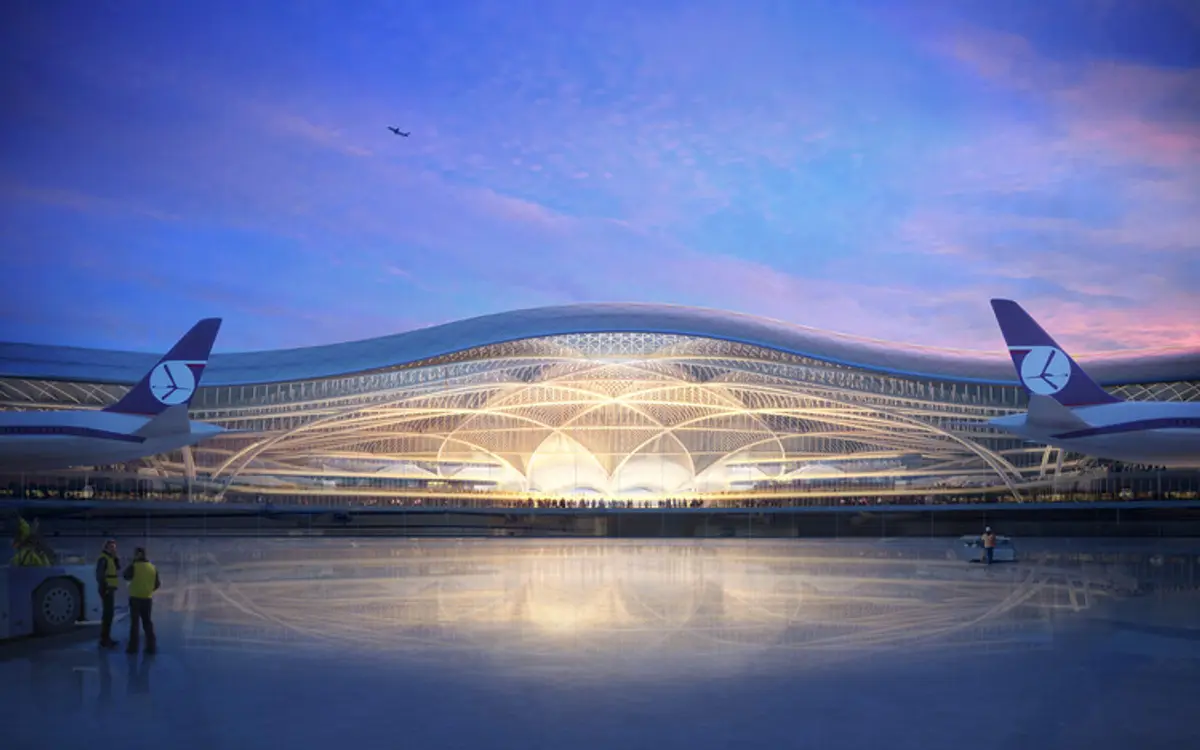
Foster + Partners has been selected to design a new airport in Poland.
The new airport will be located in the city of Warsaw and will be 40 million passengers annually from 2028.

The CPK airport in Poland has chosen Foster + Partners as the winner of its design competition, beating out six other leading global practices. Foster + Partners' concept designs for the CPK airport are understood to have been chosen ahead of bids from teams featuring Zaha Hadid Architects, Perkins & Will, Weston Williamson + Partners, GMP International, and KPF. The practice will now start working on completing a full concept design by the middle of 2023. Construction is expected to begin on the 3,000-ha site between Warsaw and Łódź as part of a €150 million contract with CPK.
The planned completion date for the project is 2028, at which point CPK will replace Warsaw Chopin Airport as the main airport for the Polish capital. In addition, the airport will also become a major new transport interchange for road and rail passengers.

Fosters has just added the Polish scheme to its aviation portfolio. Ranked as the AJ100 top-ranked practice in 2019, they won the design contract for a new ‘eco-friendly’ Red Sea airport serving a luxury resort in Saudi Arabia. A year later, the architect revealed plans for another international airport in the same country - this time for the resort in Amala.
Fosters head of studio Grant Brooker said that the practice was ‘proud and excited to be chosen by CPK as the designers of this project. Once completed, it will ‘create a model for the future of totally integrated transportation design’.
He added: ‘[This] project will completely revolutionise travel across the country and beyond. The vision of woven architectural form is deliberately and strongly expressed.
‘It could shape the building and guide the passengers through its spaces, while also serving as a powerful symbolic reference to Poland’s rich cultural heritage and the united strength of its people.’
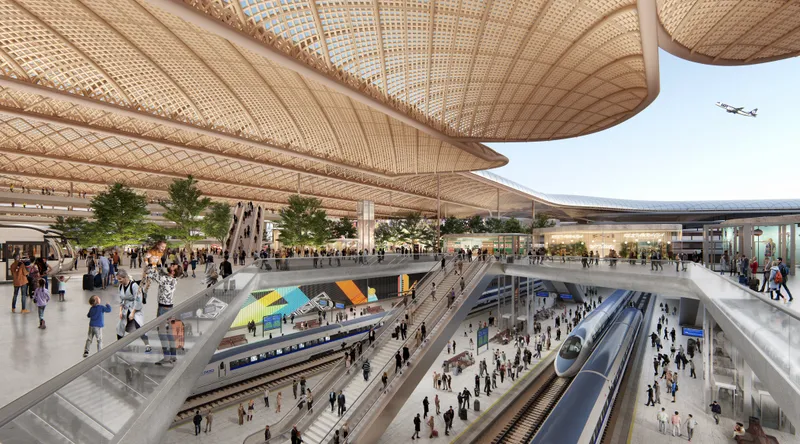
Early proposals for the Central Pacific Airport include a central terminal building that would offer connections to airlines, railroads, and roads. The building would also be filled with greenery and natural light, according to airport designer Fosters. The concept also provides opportunities for the airport and transport hub to expand in future, thanks in part to a proposed design for two terminal buildings that would be connected by a light rail system.
The main terminal building will be constructed initially, with the second terminal being built at a later date depending on the number of passengers, which CPK estimates will be 40 million annually from 2028. That number is expected to rise to 65 million a year by 2060, according to a goal set out by CPK, also known as the Solidarity Transport Hub. Almost two years after it pulled out of the Architects Declare movement, which encouraged architects to discontinue airport design work because of the high environmental cost of constructing new airports and of air travel overall, Foster's is now involved in the project.
In a statement released today, Architects Declare accused practices working in aviation of "seriously undermining the effectiveness and credibility of the organisation." It also called for "those practices to either join the wave of positive change or have the integrity to withdraw."
Its stand led to both Fosters and Zaha Hadid Architects – both of whom submitted proposals for the CPK airport – withdrawing from Architects Declare. In a statement, Fosters founder Norman Foster said: ‘Since our founding in 1967, we have pioneered a green agenda and believe that aviation, like any other sector, needs the most sustainable infrastructure to fulfil its purpose.’
Foster + Partners, a leading architecture firm founded by Norman Foster, has a long history of working on some of the world's most iconic airports, including London Stansted Airport, Beijing Capital International Airport, and Hong Kong International Airport.
Earlier this week, Norman Foster returned to his alma mater, Manchester School of Architecture (MSA), to give a guest lecture to current students. During his speech, he spoke about the importance of sustainability in architecture, saying:
"Sustainability has been the lifeblood of my practice since the 1960s. It's gained momentum, of course, since then, and it's very much in the public eye."
We all know about the effects of global warming and the importance of being eco-friendly. But sometimes it can be hard to know how to make changes that will actually make a difference. That's why we're always trying to find new ways to be more energy-efficient and responsible in our design choices. We want to make sure that we're not just doing our part to save the planet, but also making life better for everyone in the process.
References (2)

Popular Articles
Popular articles from the community


Juan García Correa, John González and Claudia Rueda Sink a Circular Amphitheater into a Manizales Engineering Building
On the La Nubia campus in Manizales, Colombia, the S1 Building folds labs and offices into a hillside of ramped lawns that double as a campus route.


Singing Woman: An Opera House That Performs Before the Curtain Rises
Ovidiu Cristian Pavel's conceptual opera house translates Estonia's choral identity into a sculpted waterfront landmark facing the Baltic Sea.

Aquadapt: An Underwater Habitat That Rewrites Its Rooms by the Hour
Curved modules ring the seabed while one shell shifts from breakfast room to cinema, farm and football pitch as residents' needs change.

The Amber Palace Opera: A Geological Fiction Surfaces on Tallinn's Baltic Waterfront
Pierre Brillard reimagines a Baltic legend as a public landscape, opera house, and waterfront promenade rooted in Tallinn's coastal identity.

Similar Reads
You might also enjoy these articles

Rede Arquitetos Turns Circulation into Civic Space at the Educar II SESC School in Fortaleza
In Fortaleza, Brazil, Educar II SESC-CE trades a signature form for mesh screens, yellow thresholds and courtyard walkways built for equatorial heat.
116 Rokeby Building, Collingwood
Sustainable Collingwood office building featuring double-skin façade, natural ventilation, rooftop amenities, and carbon-neutral design focused on wellbeing and longevity.
Contemporary Apartment Renovation in Spain: RV House by BIAN Opens Up to the Sea
A minimalist 1930s apartment in Santander is transformed into a flexible, sea-facing home through contemporary Spanish renovation.
3 Marías House: A Contemporary Mediterranean Courtyard Retreat by Bajet Giramé + Burckhardt
Mediterranean courtyard home blending traditional architecture with modern design, terracotta flooring, flexible interiors, sustainable climate strategies, and garden integration.

Explore Infrastructure Design Competitions
Discover active competitions in this discipline


Challenge to reimagine the Iron Throne

Photograph architecture without architects

Illustrate the lost glory of Angkor Wat - Render Challenge

Design challenge to reuse E-waste
Comments (0)
Please login or sign up to add comments
No comments yet. Be the first to comment!