

Fpoles Arquitetos Stretches a Single Canopy Across an Entire São Paulo House
CS Residence uses one dominant roof plane to dissolve the threshold between domestic life and a lush tropical garden in São Paulo.


A roof can be a wall, a threshold, or an entire argument. At CS Residence in São Paulo, Fpoles Arquitetos chose the last option. Designed by Fernando Poles, Tiago Martins, and Fábio Chaves, the 413 m² house is organized under a single generous canopy that reaches from the main living spaces all the way to the garage, turning what would normally be separate programmatic zones into one continuous landscape experience. The gesture is simple to describe but difficult to execute well: keep one plane overhead and let everything beneath it breathe.
What makes the project genuinely interesting, rather than just formally ambitious, is the way the canopy reframes the relationship between structure and planting. Tropical gardens, internal courtyards, and translucent screens all operate as spatial dividers under the roof, replacing conventional walls with layers of foliage and filtered light. The house does not so much sit on its site as hover above it, a white datum line against which palms, ferns, and lawn do the real work of defining rooms.
Arrival Under the Slab


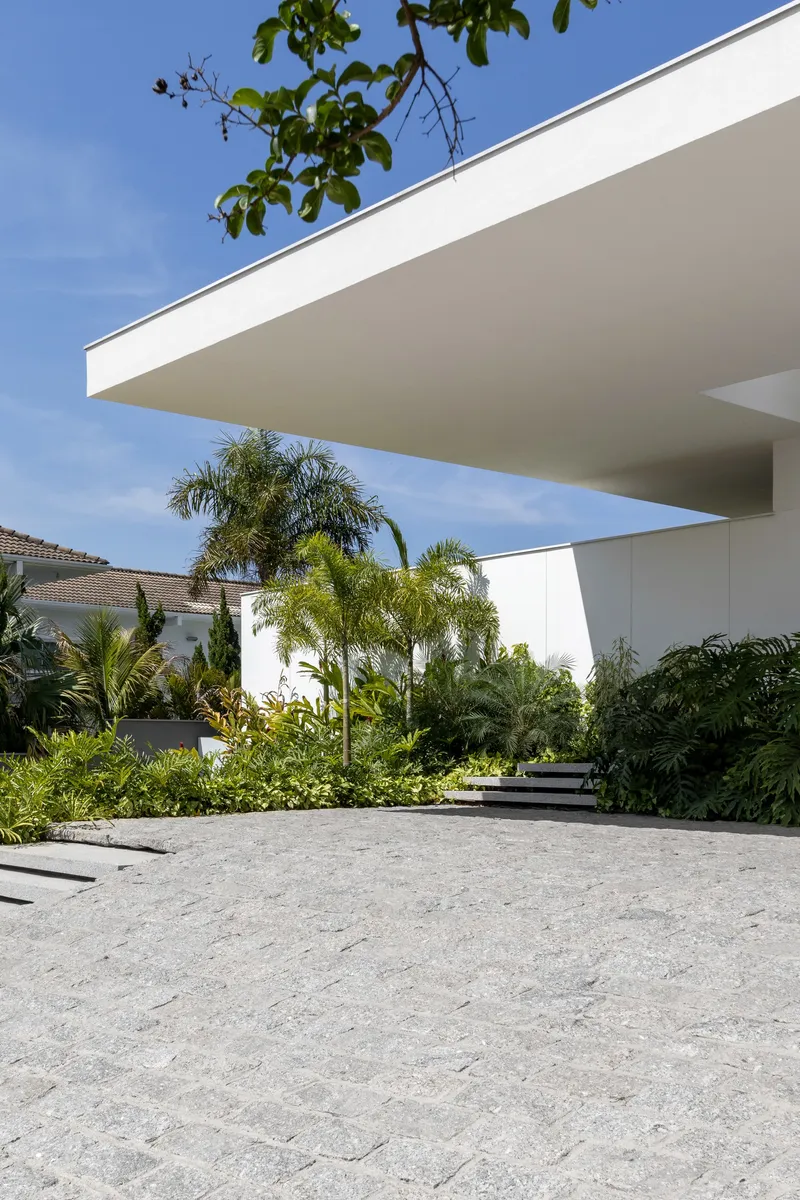
From the street, CS Residence reads as a cantilevered white volume propped on angled supports, its mass floating above a landscaped entry sequence. Concrete stepping pads and recessed stairs draw you upward through palms and bamboo, compressing the approach before the canopy opens overhead. The entry is theatrical without being overwrought. There is no grand portico or pivot door; the drama comes from the sheer horizontal reach of the roof slab and the shade it throws across the path.
Diagonal columns at the perimeter give the canopy a lightness that a conventional post grid would not. They angle outward like struts on an airplane wing, turning structural necessity into a visual cue that the roof is pulling away from the ground plane. It is a clever inversion: the house looks like it wants to lift off, but the deep planted beds anchor it firmly to the terrain.
The Courtyard as Room

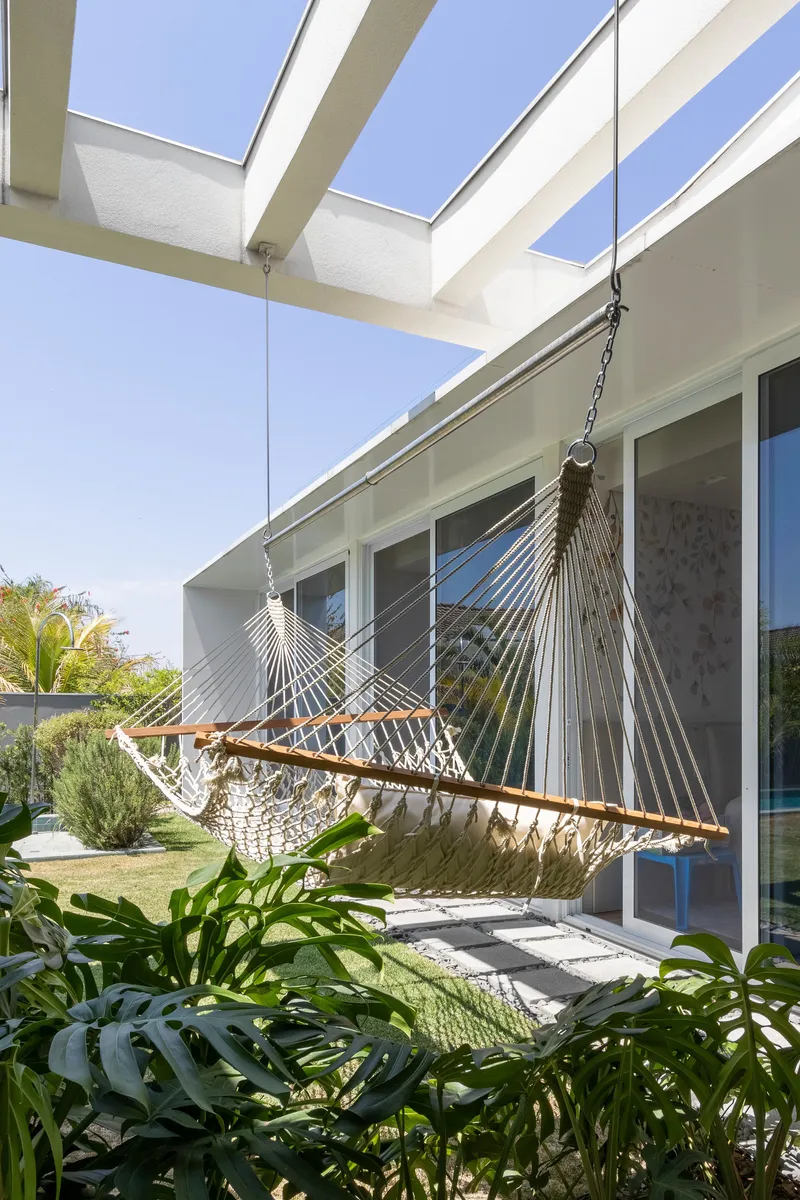

A rope hammock slung beneath white pergola beams turns an outdoor void into arguably the most inviting room in the house. The courtyard strategy here is distinctly Brazilian: open to the sky but framed tightly enough by structure and planting to feel enclosed. Tropical foliage creeps into every gap, softening the geometry of the concrete and steel.
Landscape architect Gustavo Carvallho's planting palette leans on ferns, palms, and dense colorful ground cover that reads as texture rather than decoration. The result is a green datum running parallel to the architectural datum of the roof. Between those two horizontal lines, life happens: lounging, eating, passing through. The courtyard is not a leftover space carved from the plan; it is the organizational heart of the house, pulling light and air into every adjacent room.
Filtered Light and Translucent Screens


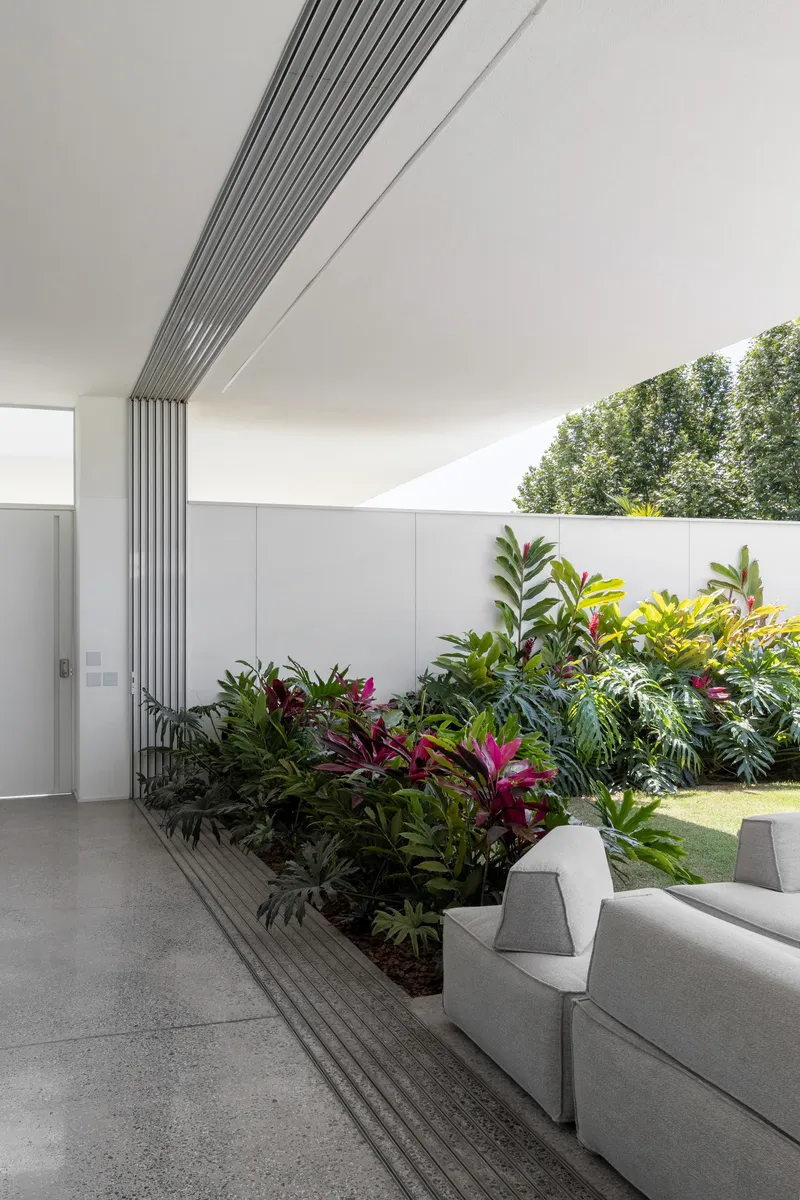
Where the canopy provides shade, the vertical screens provide privacy, and they do it without sacrificing transparency. Translucent glass louvers and linear metal fins replace solid walls along the garden edge, breaking direct sunlight into soft stripes that shift across the polished concrete floor throughout the day. The effect is close to what you see in traditional Japanese shoji screens, though the scale and material vocabulary are entirely contemporary.
From inside, the screens turn the garden into an impressionist backdrop. Foliage becomes blurred color rather than identifiable species. From outside, they give the facade a layered depth that makes the house appear larger and more complex than its single-story footprint would suggest. It is a smart duality: one device doing two jobs simultaneously.
Living Under the Canopy

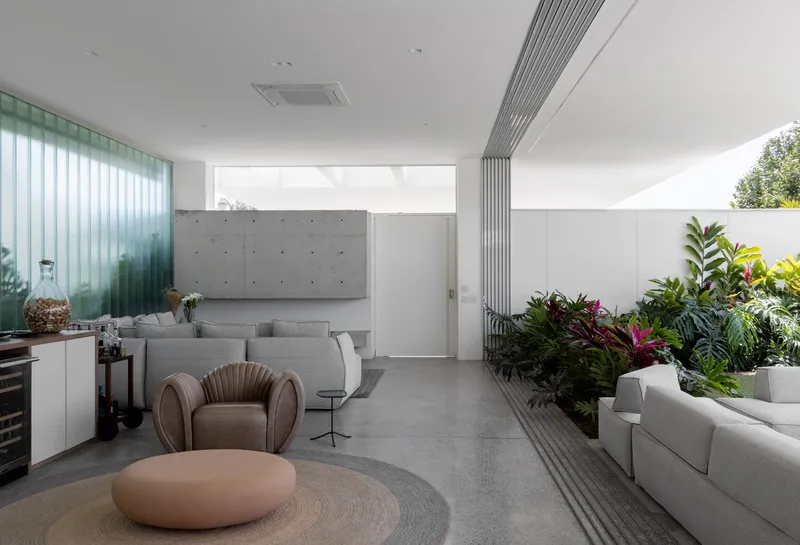
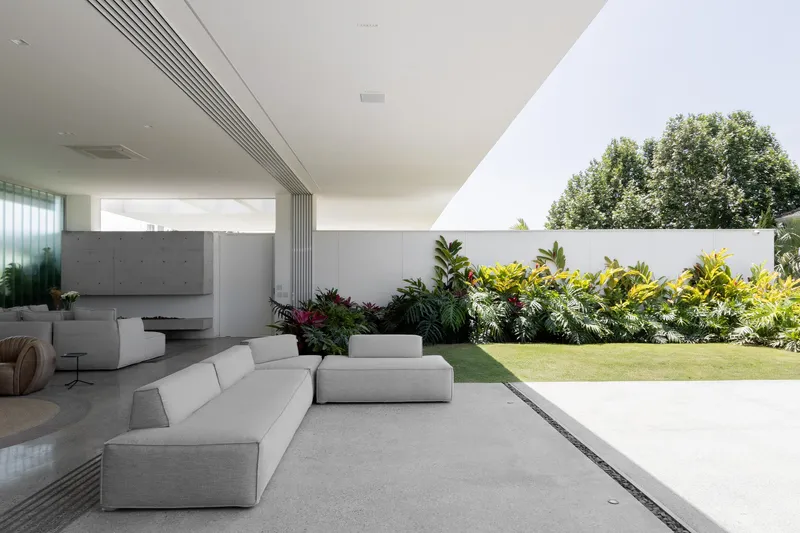
The main living volume deploys a limited material palette to maximum effect. Board-formed concrete appears as a textured feature wall behind the sofa, its grain reading like a timber panel until you get close enough to feel the cold surface. A clerestory window above washes the concrete in indirect light, turning a structural element into a piece of visual furniture. The floor is polished concrete throughout, cool underfoot and relentless in its horizontal continuity.
Glass sliding doors vanish into wall pockets, collapsing the boundary between the living room and the planted courtyard. When fully open, the space is essentially an elevated garden pavilion. This is the promise of the canopy made literal: one roof sheltering both interior and exterior, with no hierarchy between the two conditions.
Terrace, Pool, and the Extended Ground Plane


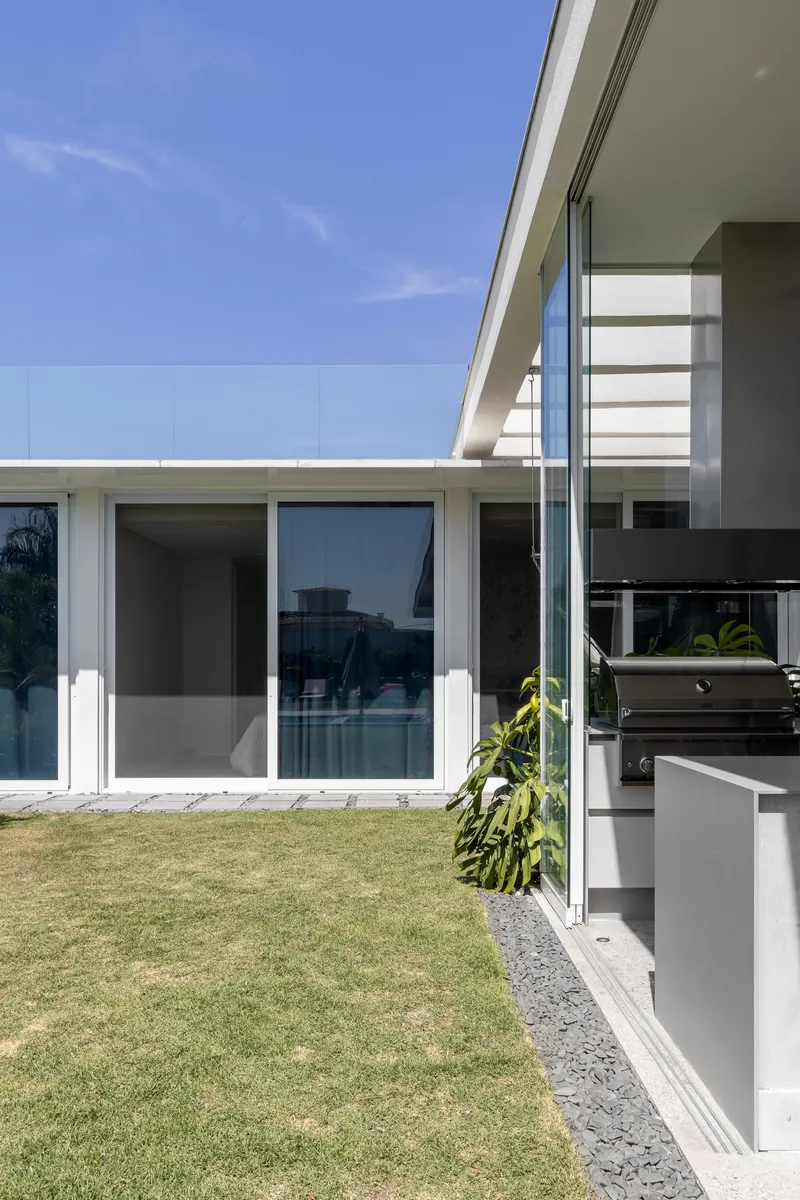
The covered terrace facing the pool is where the canopy's logic pays off most clearly. Concrete columns frame views of the lawn and water without any intervening glass, so the line between dining terrace and poolside is purely atmospheric. The outdoor dining table sits under the ribbed ceiling in full shade while looking out onto bright São Paulo daylight, a contrast that makes the covered space feel like a cool cave.
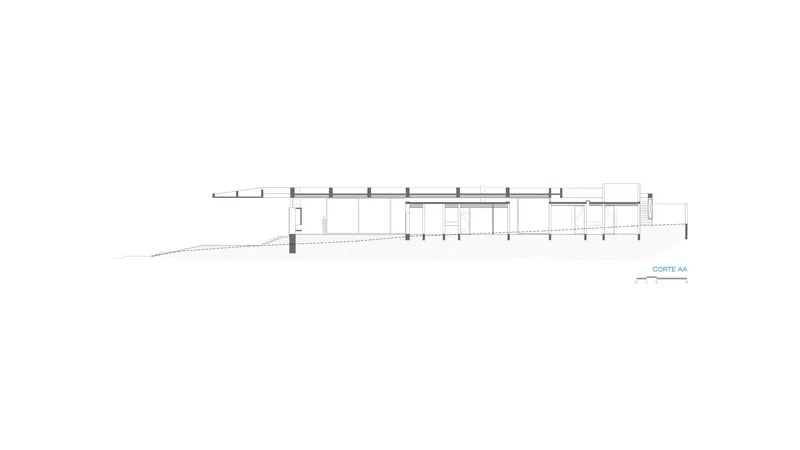
The pool itself, as the section drawings reveal, sits at a lower level, taking advantage of the site's natural slope. This terracing strategy means the house steps down toward the garden rather than imposing a single datum on the topography. Water, lawn, and terrace form a gentle cascade, each one a few hundred millimeters below the last.
Kitchen and Dining: Warmth Against the White


Against the prevailing palette of white concrete and polished floors, the kitchen and dining zone introduces walnut cabinetry and cane-backed chairs that bring warmth and grain into the composition. The kitchen island doubles as a breakfast bar with timber stools facing an internal courtyard visible through full-height glass. It is a domestic scene that feels both casual and deliberately composed.
A colorful artwork on the walnut-paneled wall behind the dining table provides the one concentrated burst of pigment in an otherwise restrained interior. The move is calculated: by keeping the background neutral, the architects ensure that moments of color, whether from art, foliage, or even the sky, register with greater intensity. The cane chairs are a nice regional touch, nodding to Brazilian modernist furniture traditions without quoting any specific piece.
Planted Edges and Landscape Integration

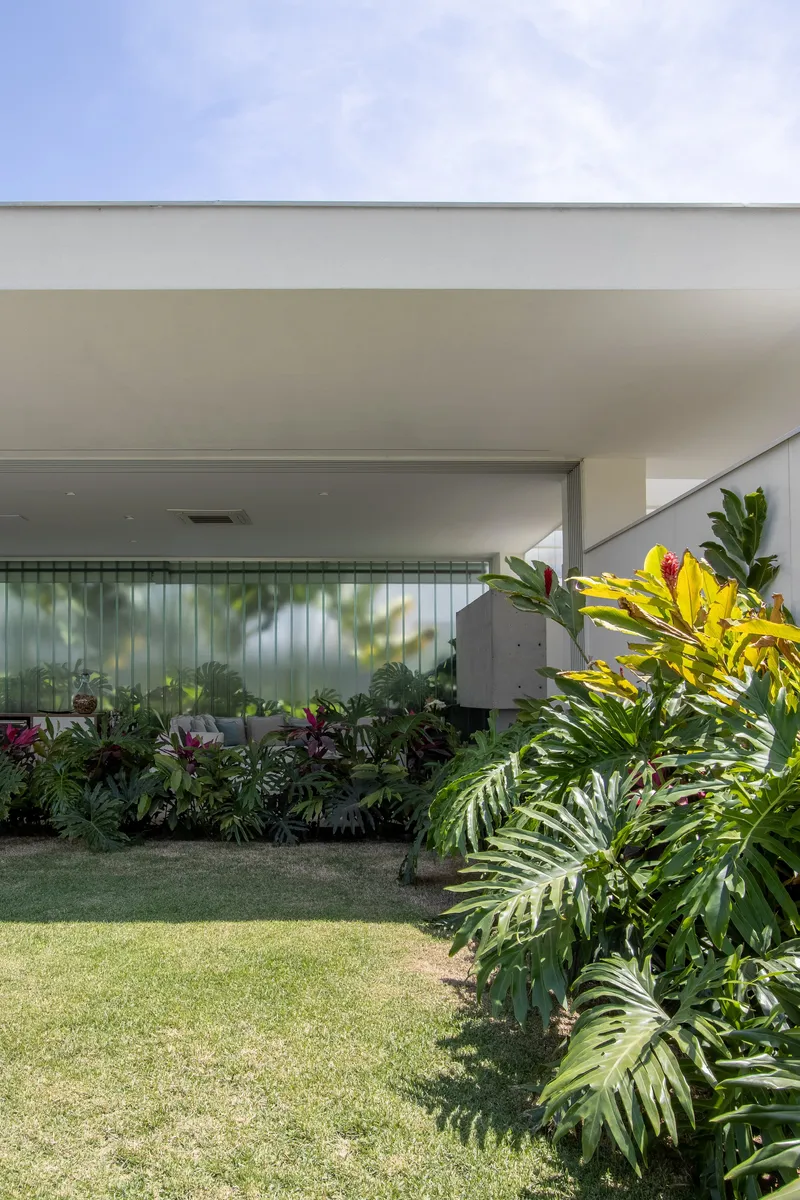
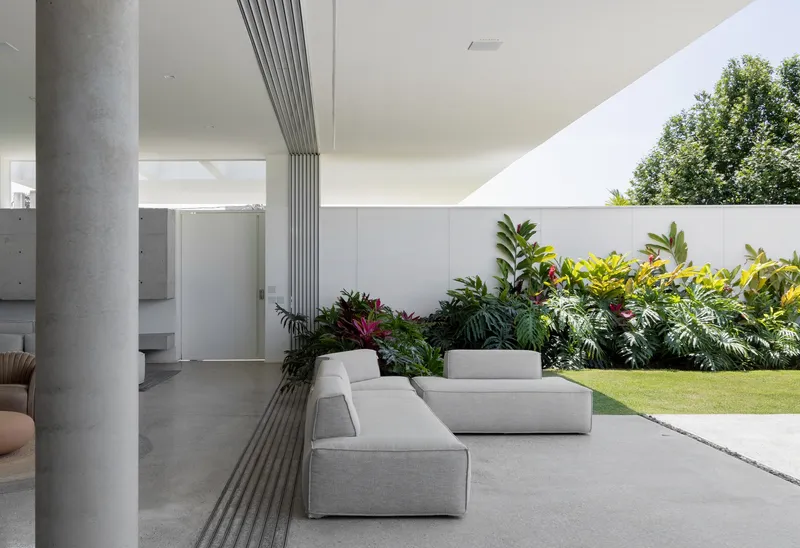
Every edge of the house that could hold a planter does. Ferns, bromeliads, and low tropical shrubs line the base of walls, fill gaps between columns, and spill out from beneath the terrace overhang. The effect is cumulative: no single planted bed is remarkable, but taken together they wrap the architecture in a green border that softens every hard corner.
The landscape strategy also serves a practical purpose. Dense planting at the perimeter provides privacy from neighbors without relying on high walls or fences, keeping the house open and airy at eye level. Aluxe's lighting design, visible in some of the twilight-adjacent shots, washes the foliage from below, turning the garden into a glowing screen after dark.
Plans and Drawings


The floor plan confirms what the photos suggest: a rectangular volume organized around a central courtyard, with the swimming pool flanked by living zones on one side and service areas on the other. The plan is essentially a U wrapped around green space, a typology with deep roots in Latin American residential architecture but executed here with a clarity that avoids fussiness.
The longitudinal and transverse sections are the most revealing drawings. They show the house stepping down a sloped site, with a basement-level pool that is invisible from the street. The dominant roof plane reads in section as a thin line floating above the terrain, supported by the angled columns that define the entry. The gap between the underside of the canopy and the top of the site wall is where the architecture happens: a single inhabited layer, never more than one story tall, stretched across the full width of the lot.
Why This Project Matters

CS Residence does not try to reinvent the Brazilian courtyard house. It does not need to. Instead, it refines a proven typology by committing fully to a single architectural idea: one canopy, one ground plane, and as few walls as possible. That commitment produces a house where structure, landscape, and domestic program are genuinely inseparable rather than merely adjacent. Every room borrows light and air from the garden; every garden moment is framed by concrete overhead.
For Fpoles Arquitetos, the project is a convincing demonstration that restraint and ambition can coexist. The material palette is tight, the structural logic is legible, and the landscape does real architectural work. In a city where residential design often oscillates between fortress-like enclosure and Instagram-friendly spectacle, CS Residence quietly stakes out a middle position: open but private, dramatic but livable, rooted in tradition but uninterested in nostalgia.
CS Residence by Fpoles Arquitetos (Fernando Poles, Tiago Martins, Fábio Chaves). São Paulo, Brazil. 413 m². Completed 2024.
About the Studio
Share Your Own Work on uni.xyz
If projects like this are the kind of work you want to make, uni.xyz is a place to publish your own, find collaborators, and enter design competitions.


Popular Articles
Popular articles from the community


LT2A and OPEN Architectes Thread a Brick and Glass High School Through a Wooded Belgian Campus
In Braine-l'Alleud, a 3,000 m² wing for Collège Cardinal Mercier pairs pale brick with a glazed colonnade, deferring to a small chapel and a dense wood.

David Ortega Stacks a Two-Story Mexico City Penthouse Around a Steel Stair and a Pergola-Shaded Roof Terrace
In Colonia Roma, a 300 m² penthouse uses oak joinery, a planted steel stair and a slatted roof pergola to make a new-build apartment feel like a house.

GROUP A Strips a 1969 Rotterdam Harbor Headquarters to Its Frame and Wraps It in Timber Louvers
In Rotterdam's M4H harbor district, Ferro Offices reuses a 1969 frame, adds one timber storey and reaches BREEAM-NL Outstanding.

longwave studio Reorganizes a 112 m² Tainan Apartment Around the Daily Routines of a Family and Two Cats
In Tainan, Taiwan, birch plywood, rust-red furniture and a freestanding plaster wall link arrival, storage, work and family life in one apartment.

Similar Reads
You might also enjoy these articles


LAVA Architecten Gives Vocational Education a Sawtooth-Roofed Face on a Mechelen School Campus
In Mechelen, Belgium, a 2,053 m² STEM school on a 6×6 m grid turns workshops and classrooms into rooms that can be rearranged as teaching changes.

KEMA Studio Turns a Derelict Marvila Attic into a 60 m² Lighthouse Apartment Above Lisbon
In Lisbon's Marvila district, a rebuilt roof, four skylights and two plywood volumes turn an unlivable attic into a bright home facing the Tagus.

Pixel Gardens: One Repeated Module Stacked Into a Terraced Social Housing Tower for Famagusta
Salem Bader's shortlisted housing tower builds a vertical neighbourhood from one repeated module, offsetting units to carve terraces, light and air.

Bao Huynh Watercolor Atelier: A Serene Art Retreat in Hội An
Bao Huynh Watercolor Atelier in Hội An blends multifunctional art spaces, sustainable design, local materials, and family-friendly living in a serene environment.


Comments (0)
Please login or sign up to add comments
No comments yet. Be the first to comment!