
Framework: A Modular Housing System That Grows With Its Residents
Anna Szczepaniak proposes an expandable residential framework where inhabitants assemble their own flats within a shared structural grid.


What if a building could grow the way a family does? Framework takes that question literally, proposing a residential structure that functions less like a finished product and more like a scaffolding for life. The concept replaces fixed apartment layouts with an open beam-and-column grid that residents fill, expand, and personalize over time. A single structural module can evolve from a 43 m² studio into a 143 m² three-bedroom apartment, all without altering the building's fundamental skeleton. It is architecture designed not for a moment, but for a timeline.
Designed by Anna Szczepaniak, Framework draws on self-built housing traditions where informal modifications are the norm, not the exception. Rather than resisting those impulses, the project builds a system around them: a fixed kitchen and bathroom core anchors each unit, while surrounding rooms can be added incrementally. Layered on top of this residential logic is an integrated landscape strategy featuring aquaponic gardens, a vast central courtyard, and communal green infrastructure that binds the scheme together ecologically and socially.
A Perimeter Building Wrapped Around a Circular Park
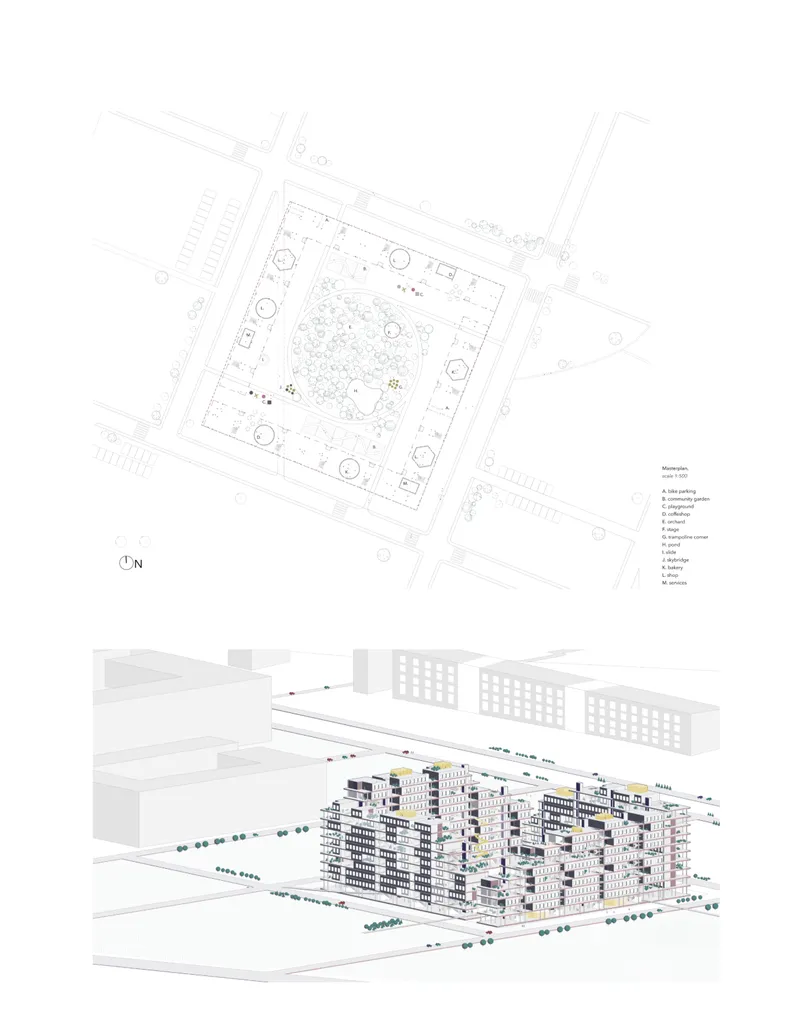
The site plan and exploded axonometric reveal the project's organizing gesture: a continuous perimeter building enclosing a vast circular courtyard that doubles as a park, orchard, and social hub. Residential blocks are arranged to frame this interior landscape, creating a protected microclimate within. The courtyard includes vegetable gardens, fruit trees, play areas, a community pond, open lawns, and polygonal pavilions for local retail and services. It is the project's public heart, a shared ecosystem where the boundary between domestic life and communal space dissolves.
The ground floor plan reinforces this reading: residential wings reach outward while dense tree planting fills the courtyard's center. Orientation is deliberate. Each flat receives windows in two directions, ensuring cross-ventilation and views toward the green interior. The circular geometry distributes sunlight equitably across facades and seasons, an advantage over the rigid orthogonal blocks typical of mass housing.
Four Stages of Growth Within a Single Structural Module
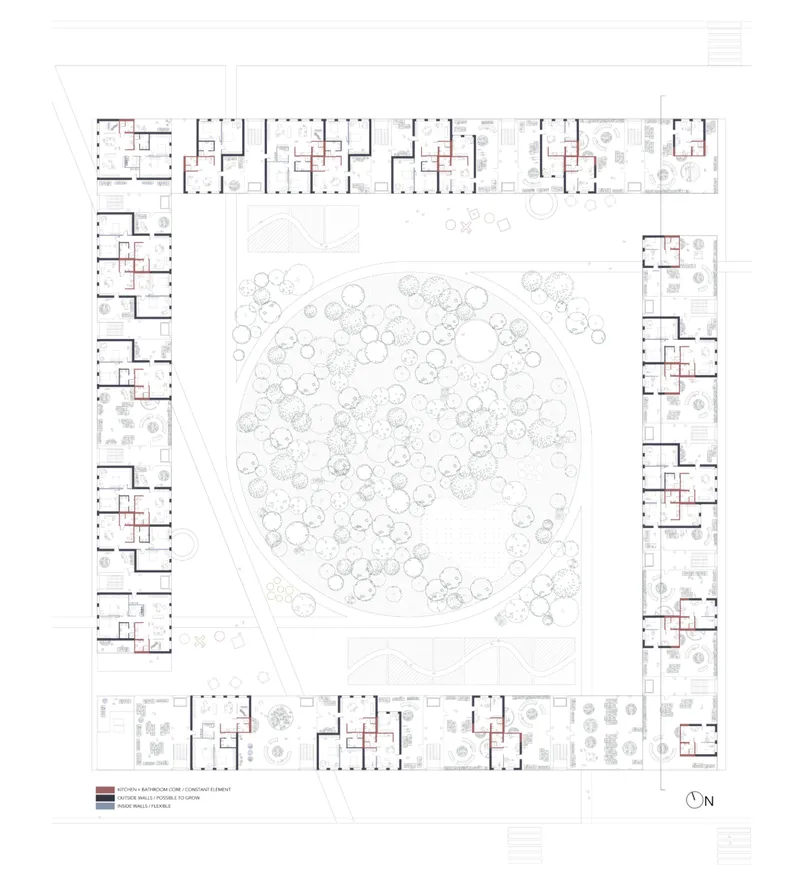
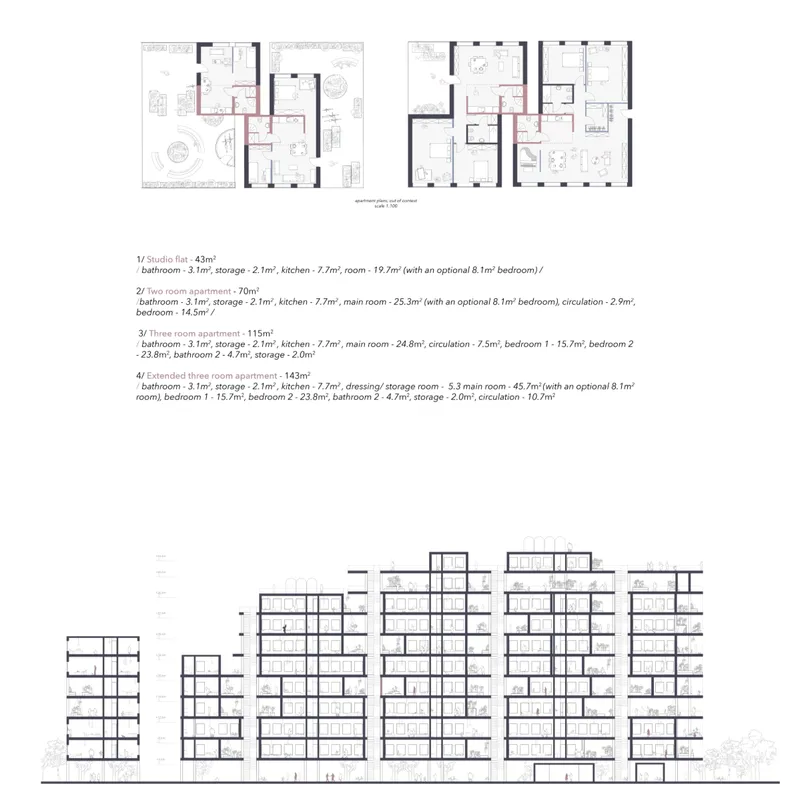
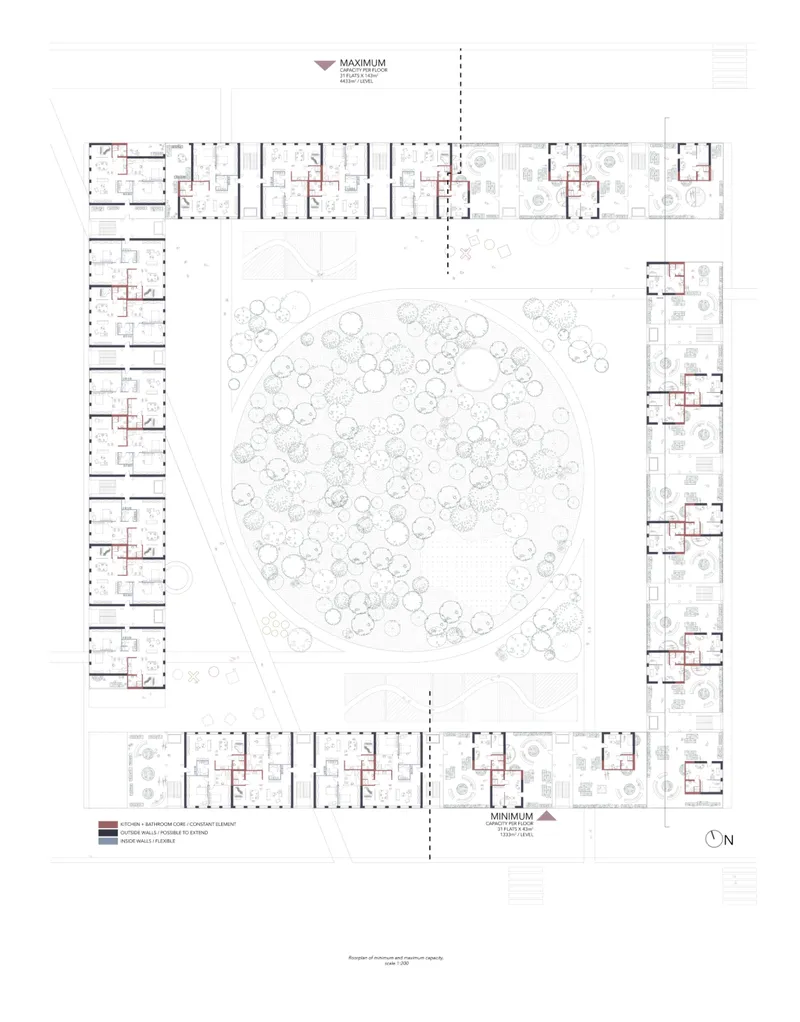
The upper-level floor plan and unit drawings illustrate how the modular system works in practice. A fixed kitchen and bathroom core sits at the center of each unit, and rooms radiate outward in four expandable stages: a 43 m² studio with the option for an 8.1 m² additional bedroom; a 70 m² two-room apartment with distinct social and private zones; a 115 m² three-room family layout; and a maximum 143 m² configuration with dual bathrooms, generous storage, and flexible room divisions. Residents can stop at any stage or continue expanding as their circumstances change.
The building section is equally revealing. Stepped massing across multiple towers creates a varied skyline of terraces, gardens, and balconies while maximizing daylight penetration into lower floors. Vertical stacking allows apartments to repeat in flexible combinations along each facade, so the same structural frame can accommodate singles, couples, and multi-generational families simultaneously. The architecture becomes less a container and more a set of rules that produce diversity.
Aquaponics and Planted Terraces as Vertical Agriculture
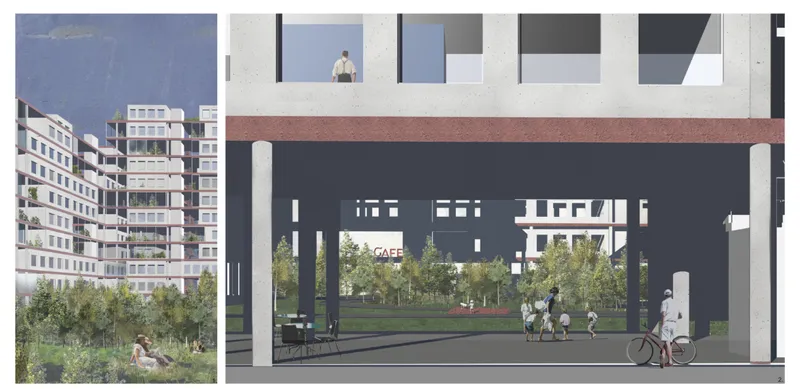
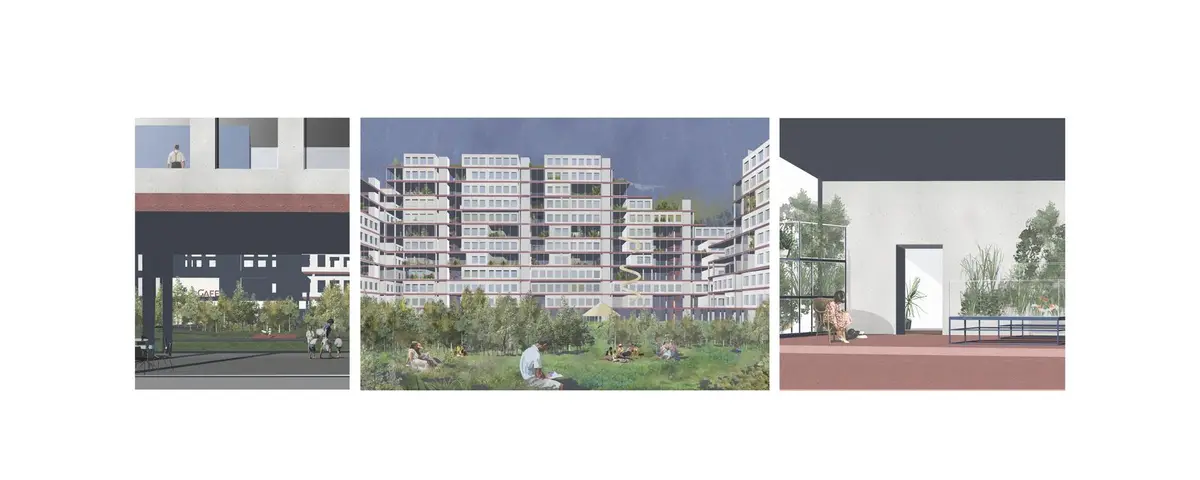
The rendered section through the colonnade captures the layered quality of life Framework intends. At ground level, a café and retail pavilions activate the street edge, with cyclists passing through. Above, residential blocks step back to create planted terraces visible against the green courtyard beyond. Between these layers sits the project's most distinctive innovation: on-site aquaponic gardens where plants grow using nutrient-rich water from fish tanks. Because upper floors lack outdoor soil, the aquaponic modules provide year-round food production, act as green buffers between apartments, and improve indoor air quality. Tomatoes, herbs, grains, and small vegetables are all viable crops. The system is deliberately DIY-friendly, reinforcing Framework's core premise that residents should have tools to shape their own environment.
Courtyard Life Between Recessed Balconies and Open Lawns
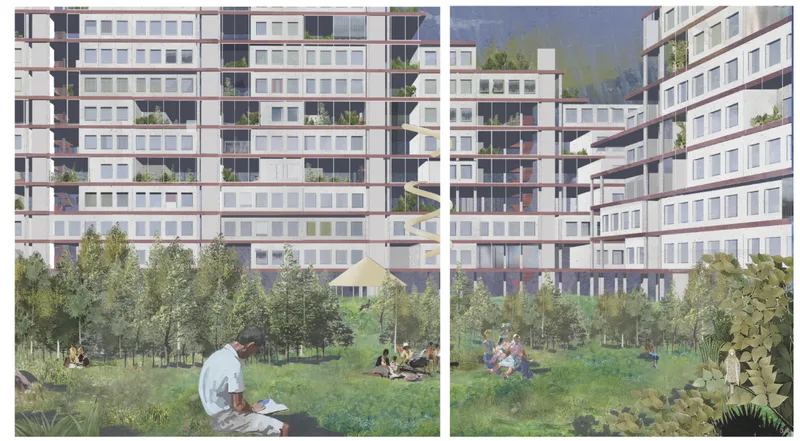
The courtyard view renders what the plans promise: a genuine landscape, not a leftover gap between buildings. Residents gather on the lawn beneath facades articulated with recessed balconies and planted terraces. The depth of those balconies matters; they provide shade, privacy, and space for personal gardening, extending the modular logic of the interiors onto the building's skin. The facades read as inhabited surfaces rather than flat planes, each balcony a small signal of the life happening inside.
What the image conveys most effectively is scale. The courtyard is generous enough to function as a neighborhood park, not merely a light well. Trees are mature, lawns are usable, and the social distance between ground-level activity and upper-floor observers feels comfortable rather than surveilled. Framework's ambition is to make density feel generous, and this rendering suggests it could succeed.
Why This Project Matters
Housing discourse often splits into two camps: mass-produced efficiency or bespoke customization. Framework refuses that binary. By providing a structural grid and a set of expansion rules, Szczepaniak creates a third option where affordability and individuality coexist. The four-stage growth model, from 43 m² to 143 m², means a young professional and a growing family can occupy the same building type without either compromising. That is a genuinely useful idea, not just a conceptual provocation.
Equally significant is the ecological integration. Aquaponic gardens, a central courtyard orchard, and planted terraces are not decorative additions; they are embedded in the building's spatial logic and daily routines. Framework proposes that sustainable living is not a sacrifice residents make but a benefit the architecture delivers. For a student project, the ambition is striking. For the housing crisis many cities face, it is precisely the kind of systemic thinking the discipline needs more of.
View the Full Project
About the Designers
Designer: Anna Szczepaniak
Enter a Design Competition on uni.xyz
uni.xyz runs architecture and design competitions year-round that reward proposals with spatial conviction and real site intelligence.
Project credits: Framework by Anna Szczepaniak.


Popular Articles
Popular articles from the community


Aquadapt: An Underwater Habitat That Rewrites Its Rooms by the Hour
Curved modules ring the seabed while one shell shifts from breakfast room to cinema, farm and football pitch as residents' needs change.

Manzana Morphosis: Stretching Barcelona's Grid into a Living Landscape for 2050
A radical reworking of the Eixample manzana turns density into a tool for generous public space, vertical ecology, and environmental performance.


graciastudio Turns a Viewless Tijuana Lot Inward Around a Courtyard of Concrete, Timber and Trees
In Tijuana, Jorge Gracia's GA2 House stacks a timber-clad private floor over exposed concrete and replaces a missing view with a planted interior patio.

FCC Arquitectura Expands a Portuguese Granite House with a Board-Marked Concrete Wing
In Portugal, JV House pairs a cleaned-up whitewashed and granite dwelling with a timber-shuttered concrete extension, courtyards and a garden pool.

Similar Reads
You might also enjoy these articles
Aquadapt: An Underwater Habitat That Rewrites Its Rooms by the Hour
Curved modules ring the seabed while one shell shifts from breakfast room to cinema, farm and football pitch as residents' needs change.

Play: Fragments of Their World: Remembered Architecture Rebuilt as a Modular Playground for Refugee Camps
Tom Gardner abstracts domes, arches and towers from the homelands of displaced families into a kit of child-scaled play parts for camp settlements.
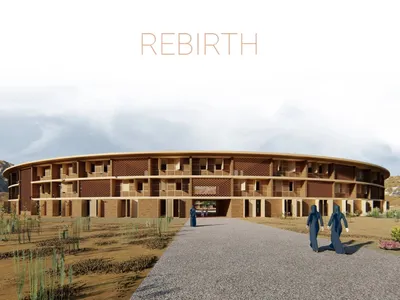
REBIRTH: A Circular Settlement Where Afghan Widows and Their Children Rebuild Life Together
A shortlisted Resile entry turns the circle into a protective ring of timber and brick, gathering homes, classrooms and gardens around a shared landscape.
The Main Dream: A Recycled Plastic Kit That Lets Refugee Children Build Their Own Playground
Thirty-centimetre interlocking cubes that connect on three axes turn play into construction, letting children author the spaces they occupy.


Comments (0)
Please login or sign up to add comments
No comments yet. Be the first to comment!