
Francisco Cadau Converts a 1970s Corner House in Campana into Four Compact Dwellings
A light steel-and-timber upper volume lands on a brick base, turning a single Argentine home into a tectonic study in railroad vernacular.


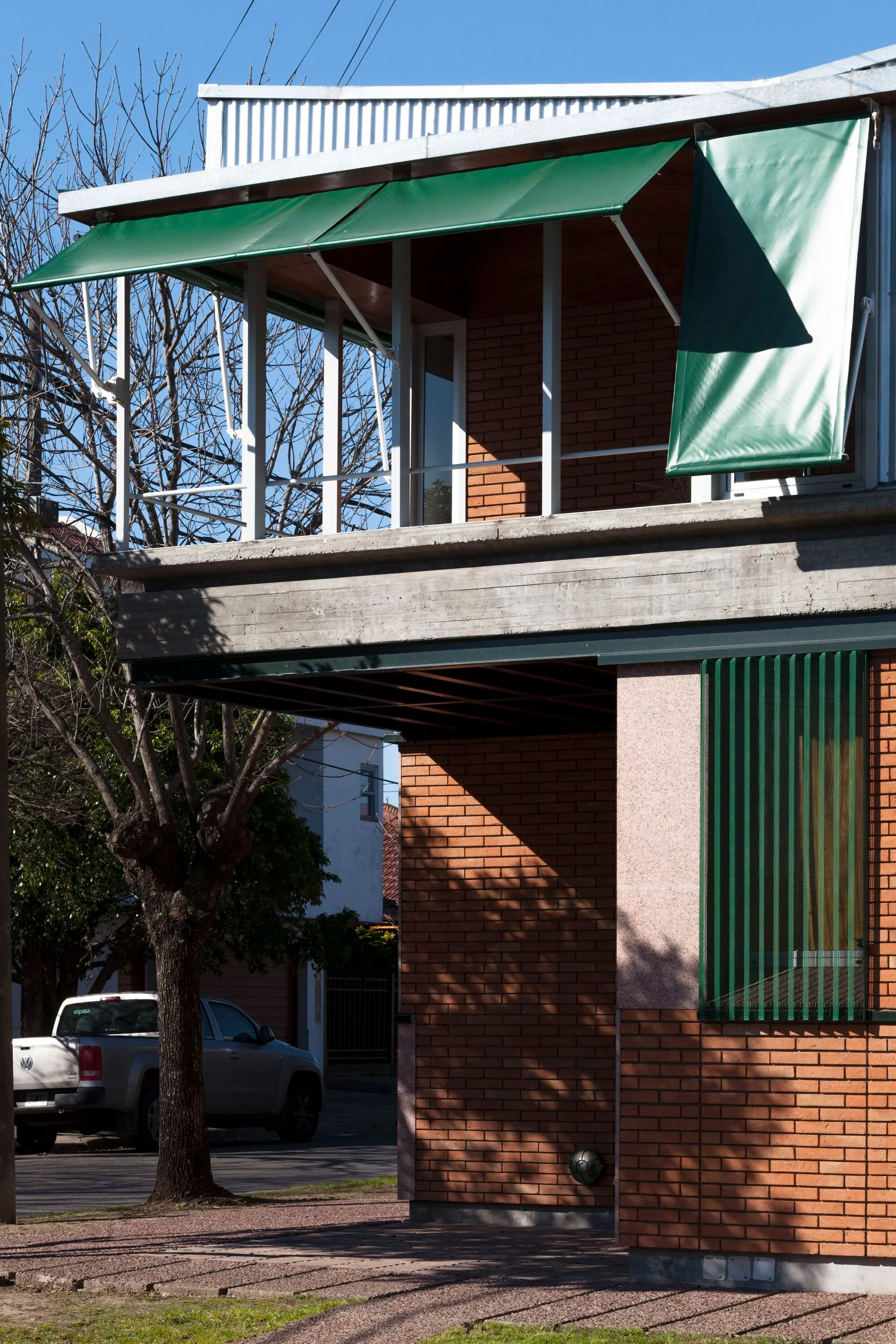
On a corner lot near the edge of Campana's foundational grid, a modest 1970s masonry house has been split, stacked, and rewired into four independent housing units totaling just 185 square meters. The project by Francisco Cadau Oficina de Arquitectura takes its name and its logic from the guardabarreras, the small railroad gatekeeper houses that once dotted Argentina's rail network. Those structures were blunt assemblies of heavy walls and light roofs, built fast from catalogued parts. Cadau treats that tectonic formula as a design thesis rather than a nostalgic reference.
What makes the project genuinely interesting is not the density trick itself but the way Cadau stages the collision between two construction systems. The existing load-bearing brick box stays put, barely touched. On top of it, a light steel frame clad in white corrugated metal and lined in plywood arrives like a second building from a different era. The joint between the two is legible from every angle: a concrete slab, a row of slender white columns, a gap of air and shadow. The house does not pretend to be one thing. It is two things bolted together, and the project's honesty about that fact is its strongest move.
Heavy Below, Light Above

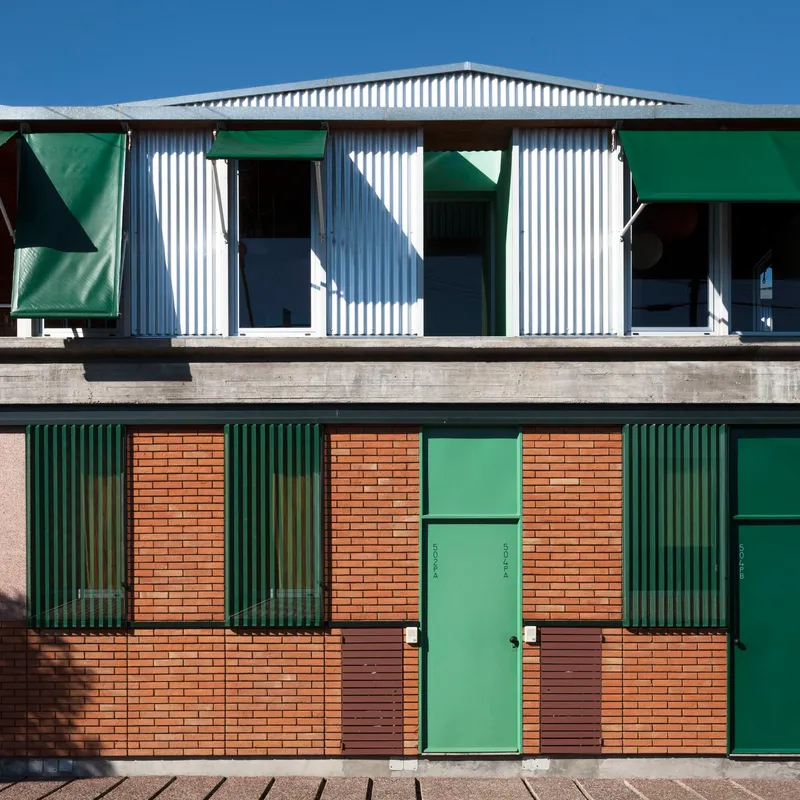

The street elevations read as a clear diagram of the structural strategy. Red-orange brick walls anchor the ground level, their mass punctuated by green corrugated metal shutters that fold, hinge, and slide. Above, the white corrugated metal volume sits back slightly, cantilevered beyond the brick in places and recessed in others. A pair of brick chimneys punch through both levels, stitching the two systems together vertically while reinforcing the railroad vernacular. The proportions recall utilitarian infrastructure more than domestic architecture, and that is precisely the point.
The corner condition is handled with particular care. Rather than wrapping the upper volume around both street fronts symmetrically, Cadau lets it step and shift, creating overhangs and setbacks that respond to solar orientation. The north and west facades get the operable shutters and the deepest shading devices, while the upper terrace opens toward afternoon light.
Green Shutters and Controlled Permeability


The green perforated metal shutters do more work than any single element in the project. They regulate privacy between units, control solar gain on the western facade, and give the otherwise austere brick base a graphic rhythm that reads well from the street. Up close, the perforations cast a fine pattern of dappled light onto the brick, a detail that feels almost accidental but is clearly calibrated. The shutters also unify ground-floor openings that vary in size and function: front doors, kitchen windows, service entries all get the same green panel, erasing the hierarchy of program behind a single material gesture.
The Courtyard as Hinge


Where the original house had a vague backyard, Cadau inserts a compact brick-paved courtyard that reorganizes the services for all four units. Bathrooms and kitchens cluster around this void, their glazed walls extending the visual depth of each unit while maintaining a shared communal quality. The courtyard is small, barely more than a light well, but it does the critical work of ventilating the deep plan and giving the interior units access to sky.
From the courtyard, the project's sectional ambition is most visible. The existing masonry walls frame the lower field of vision; the white steel columns lift the upper volume clear of the brick; and the concrete slab between them registers as a thick horizontal line. The staircase that Cadau threads through the existing structure to reach the upper units enters from this space, making the courtyard the building's true front door.
Timber-Lined Interiors and the Upper Pavilion
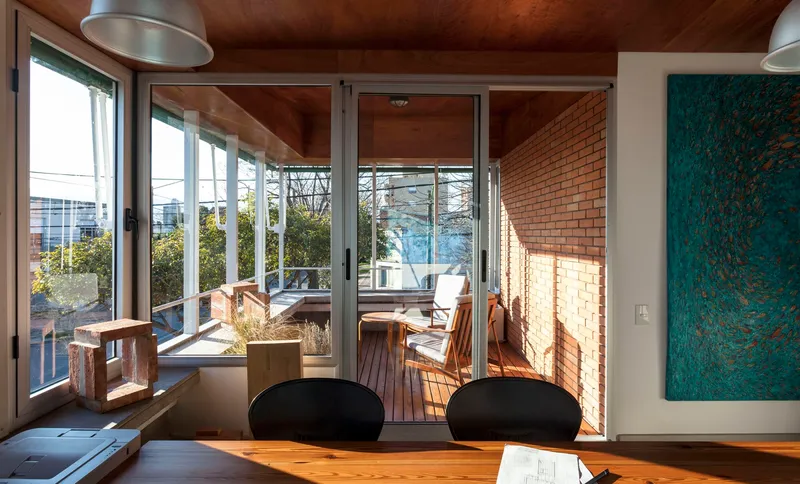


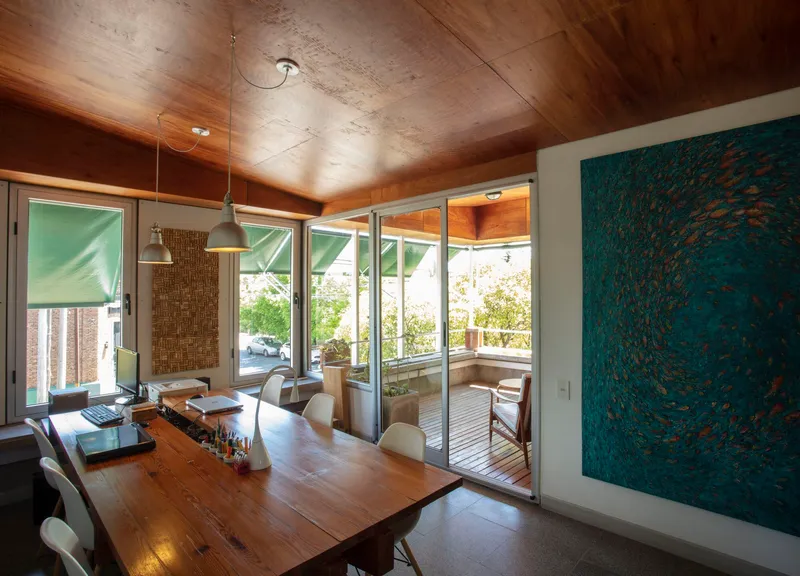
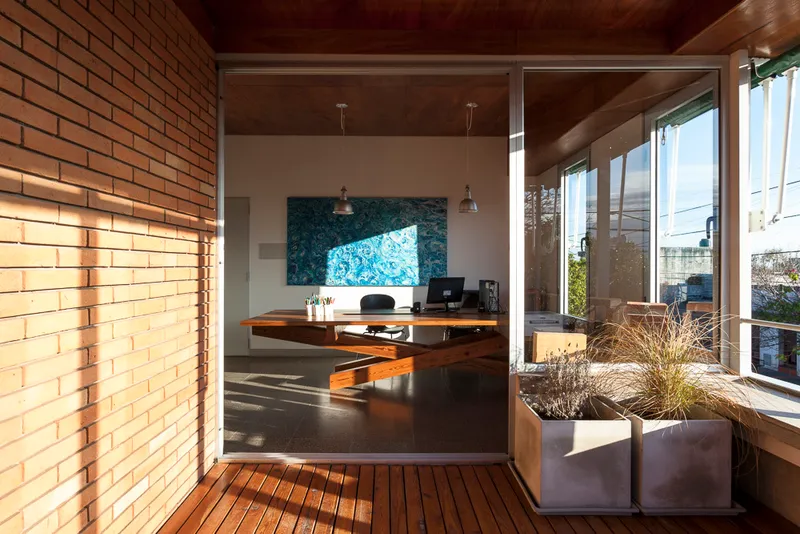
Step inside the upper units and the material register shifts entirely. Plywood ceilings and walls create a warm, continuous lining that wraps dining areas, workspaces, and window seats without a break. Sliding glass doors open onto the timber deck terrace, collapsing the boundary between interior room and outdoor platform. The effect is closer to a well-detailed cabin than to conventional Argentine apartment construction, and it works because the proportions are compact enough to feel intentional rather than cramped.
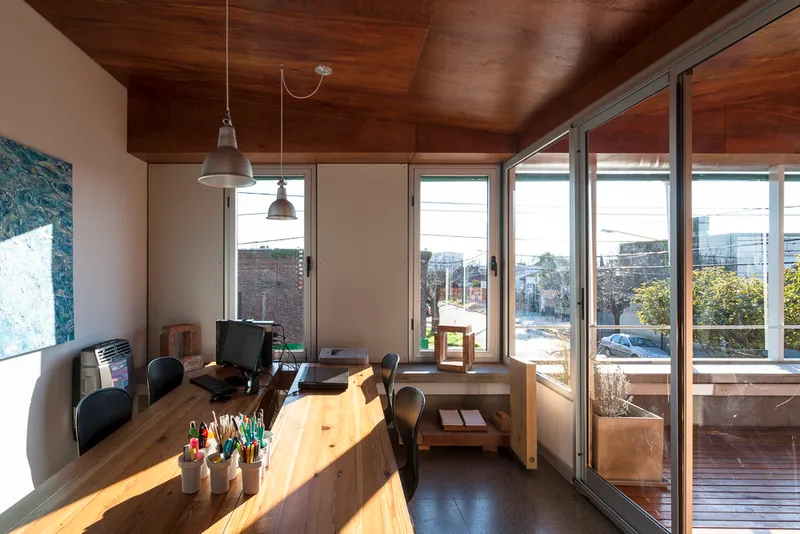


Workspaces within the upper volume take advantage of the glazed doors to flood narrow rooms with afternoon light. Open shelving lines the walls, and the timber ceiling follows a gentle angle that adds a few centimeters of headroom where it matters most. Cadau treats every surface as structure, enclosure, and finish simultaneously, an economy of means that keeps the 185-square-meter budget from feeling thin.
Rooftop Terrace and Urban Context


The timber deck terrace is the project's social reward. Surrounded by white steel columns and low railings, it sits above the roofline of the surrounding one-story fabric, offering views across Campana's flat suburban grid. Planter boxes along the edges soften the industrial palette without disguising it. At dusk, the aerial view reveals how tightly the corrugated metal roof fits within the block, its geometry clean against the patchwork of neighboring lots.
Kitchen and Bath: Green Mosaic as Accent


The service rooms introduce a third material mood. Green mosaic tile lines the bathroom walls and wraps into the compact kitchens, picking up the hue of the exterior shutters and binding inside to outside through color rather than form. Granite countertops and recessed tubs indicate a level of finish that exceeds what the building's modest exterior might suggest. These are small rooms, but they are carefully resolved, with pendant fixtures and ceiling-mounted lights placed to avoid the clinical glare that budget bathrooms often suffer.
Plans and Drawings

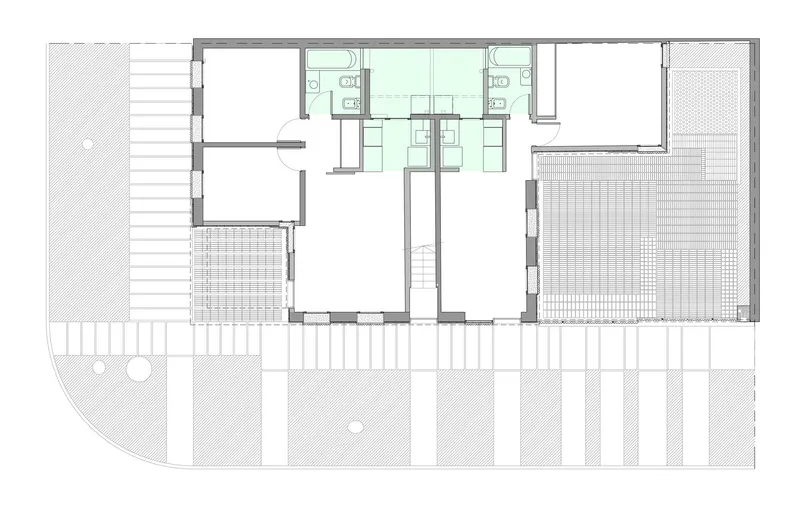
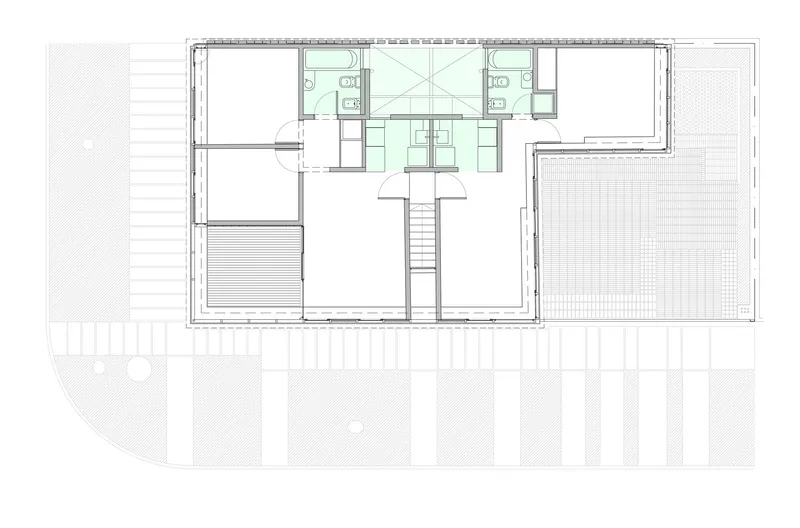
The site plan reveals how the project occupies its corner: two street fronts, a rear courtyard, and a tight perimeter of trees that screen the building from its neighbors. The ground floor plan shows how the existing house was subdivided by the central staircase, with services reorganized around the compact patio. The upper-level plan mirrors the logic below, placing two bathrooms flanking the stair core and opening the remaining area to enclosed living spaces that reach the terrace.


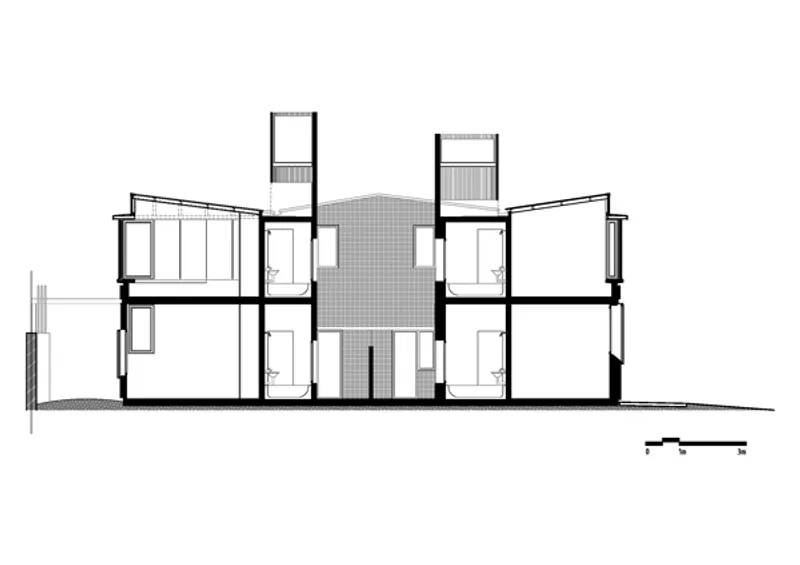

The elevations and sections are the most revealing documents. Every facade is drawn with alternating solid panels and glazed openings, and the sections confirm the central atrium strategy: staggered volumes flank a vertical circulation core, with the brick chimneys rising as anchoring elements through both levels. The detail sections show how carefully the steel frame meets the existing masonry, with insulation layers, corrugated metal roofing, and stone foundation assembly all documented at a scale that speaks to the project's real ambition as a construction prototype.

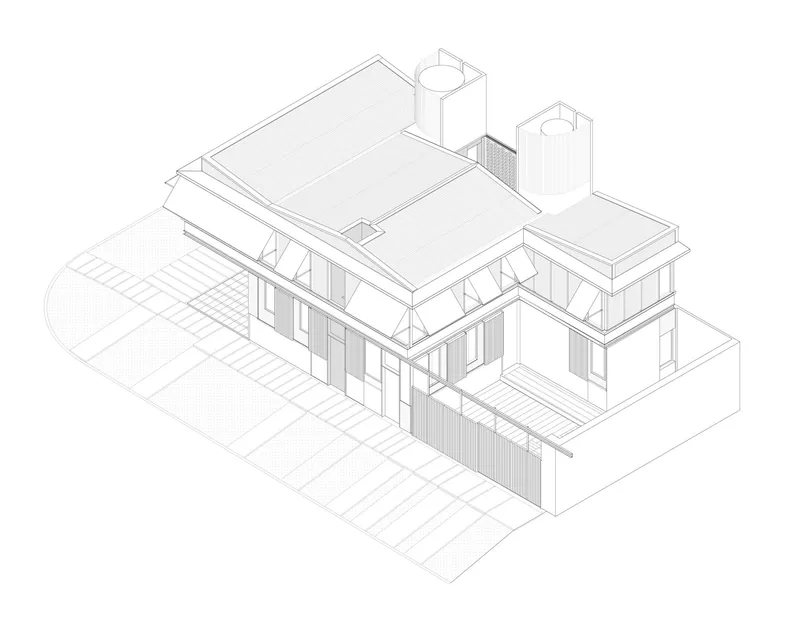
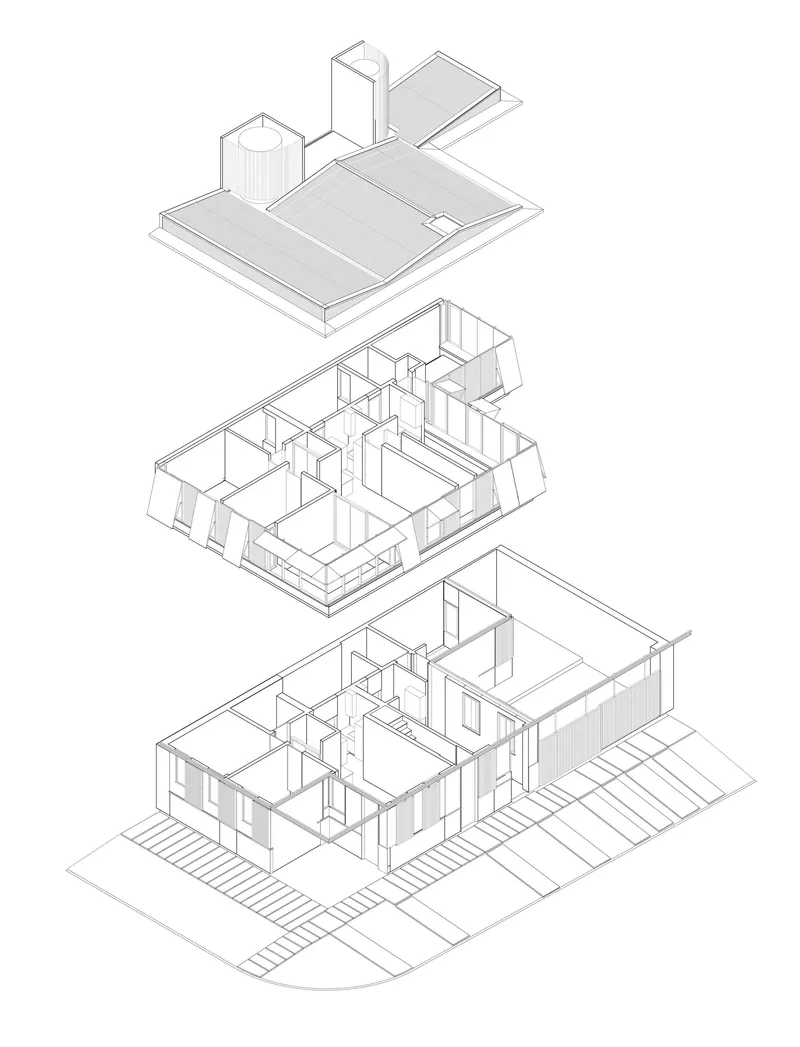
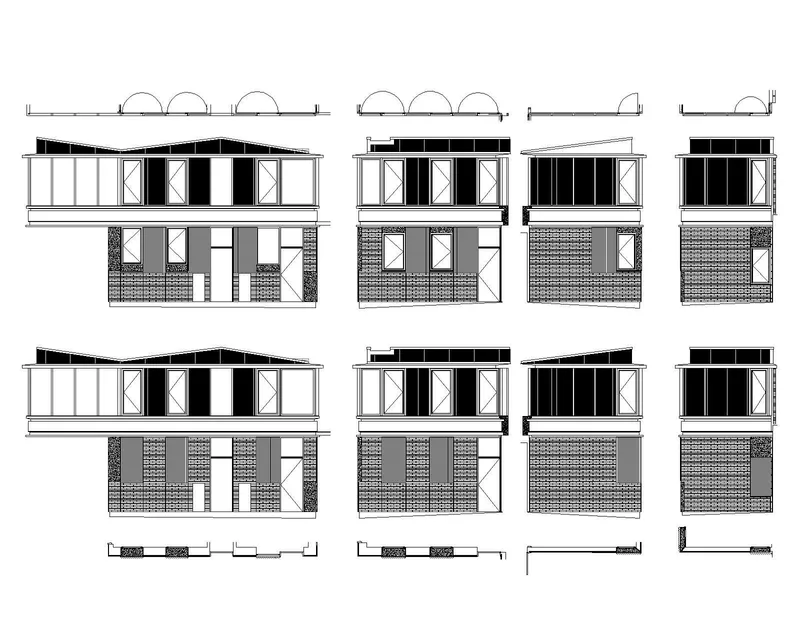

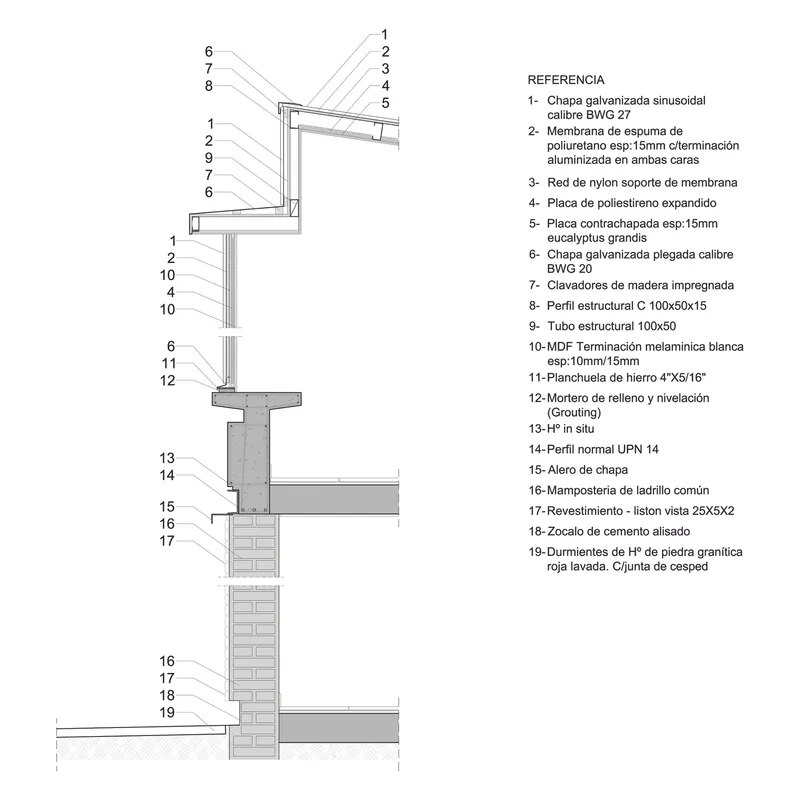


The axonometric drawings make the assembly logic explicit. One view shows the flat-roofed volumes with their vertical towers and surrounding paved courtyard as a composition of discrete objects. The exploded axonometric separates the project into three layers: roof plane, interior partitions, and ground floor, revealing how the light structure sits on the heavy base like a kit of parts. The wall section details close the loop, showing the multi-layer facade construction at full resolution.
Why This Project Matters
Guardabarrera houses is a small project with an outsized idea: that the logic of infrastructure typologies, specifically the Argentine railroad guardhouse, can be productively recycled as a method for densifying existing residential fabric. Cadau does not romanticize the vernacular. He extracts its tectonic principle, heavy base plus light canopy, and applies it to a real problem: how to multiply housing units on a single lot without demolishing what is already there. The result is legible, buildable, and replicable, three qualities that most adaptive reuse projects claim but few actually deliver.
The project also demonstrates that material honesty and atmospheric warmth are not mutually exclusive. The corrugated metal, exposed brick, and plywood interiors feel like themselves, not like cheaper substitutes for something else. In a discipline increasingly drawn to surface effects and computational novelty, the Guardabarrera houses remind us that a well-joined corner, a properly hinged shutter, and a staircase threaded through a masonry wall can carry enough architectural intelligence to sustain a building for decades.
Guardabarrera Houses by Francisco Cadau Oficina de Arquitectura, lead architect Francisco Cadau. Campana, Argentina. 185 m², completed 2013. Photography by Gustavo Sosa Pinilla.
About the Studio
Share Your Own Work on uni.xyz
If projects like this are the kind of work you want to make, uni.xyz is a place to publish your own, find collaborators, and enter design competitions.


Popular Articles
Popular articles from the community


The Musturak Paradise: Senior Living Architecture for a Connected Future in Temara, Morocco
The Musturak Paradise reimagines senior living architecture in Temara via private homes, social spaces, culture, community, and shared care.

The Ocean Hive: Sustainable Architecture for a Self-Sufficient Civilization at Sea
The Ocean Hive imagines sustainable architecture at sea, where modular habitats, algae, wave power and ocean waste sustain a growing colony.

Riyadh For All: Intergenerational Urban Design for Active Aging in Rabat
Riyadh For All reimagines urban design in Rabat with intergenerational co-living, adaptive courtyards, and Moroccan cultural exchange today.
AL-JANNAH: Sustainable Architecture and Permaculture for Afghan Widows
AL-JANNAH uses sustainable architecture and permaculture to create resilient oasis of housing, learning, work and renewal for Afghan widows.


Similar Reads
You might also enjoy these articles

Bao Huynh Watercolor Atelier: A Serene Art Retreat in Hội An
Bao Huynh Watercolor Atelier in Hội An blends multifunctional art spaces, sustainable design, local materials, and family-friendly living in a serene environment.

Atelier Macri Concept Store Interior Design by CASE-REAL
Atelier Macri store features a "ko" counter, walnut wood details, cork displays, blending retail, gallery, and seamless customer experiences.

Manuel Vargas Izquierdo Stadium and High-Performance Sports Center: Architectural Excellence in Jalpa de Méndez
The Manuel Vargas Izquierdo Stadium blends sustainable design, inclusive sports facilities, and cultural-inspired architecture, revitalizing Jalpa de Méndez’s public spaces.

KAKR Buluh Awar Hall: Revitalizing Community and Ecology Through Bamboo Architecture
Community built bamboo hall revitalizes Buluh Awar village, empowering youth, restoring ecology, celebrating vernacular craftsmanship through sustainable architecture and culture.
Explore Residential Building Competitions
Discover active competitions in this discipline


Challenge to design mud housing for contemporary communities


Challenge to reimagine the Iron Throne


Photograph architecture without architects


Illustrate the lost glory of Angkor Wat - Render Challenge
Comments (0)
Please login or sign up to add comments
No comments yet. Be the first to comment!