

Francl Architecture Roots a Mass Timber Community Center in Musqueam Ancestral Territory
The leləm̓ Community Center weaves Indigenous art and glulam structure into Vancouver's Pacific Spirit Park landscape.


Community centers rarely carry the cultural weight that the leləm̓ Community Center does. Designed by Francl Architecture under the lead of architect Alain Prince, the 1,403 square meter building sits within the University of British Columbia's Endowment Lands of Pacific Spirit Park, on the ancestral territory of the Musqueam people. It is not just a place for fitness classes and conference calls. It is a civic threshold where Indigenous stewardship, mass timber construction, and the towering Douglas firs of the Pacific Northwest meet on terms that feel genuinely negotiated rather than decoratively applied.
What makes the project worth studying is how precisely it calibrates structure and symbolism. The hybrid construction system, built around prefabricated nail-laminated timber panels over top-tapered glulam beams, does real environmental work: the taper creates natural roof drainage and eliminates the need for additional rigid insulation, while the prefabricated panels shortened on-site construction time considerably. At the same time, Indigenous artwork is woven into the facade and interiors, not as afterthought murals but as architectural elements that shape how the building is read from the street and experienced from within. LEED Gold was the target, and the ambition shows.
A Canopy That Announces Itself
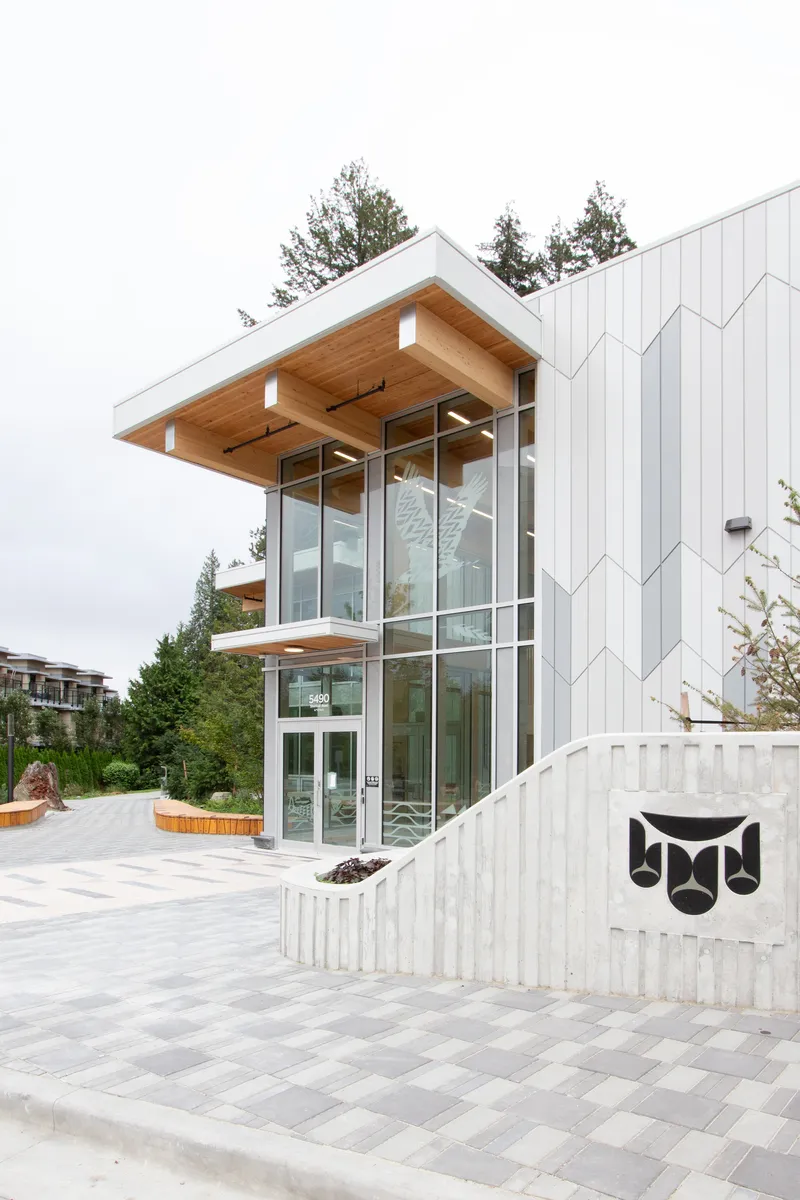
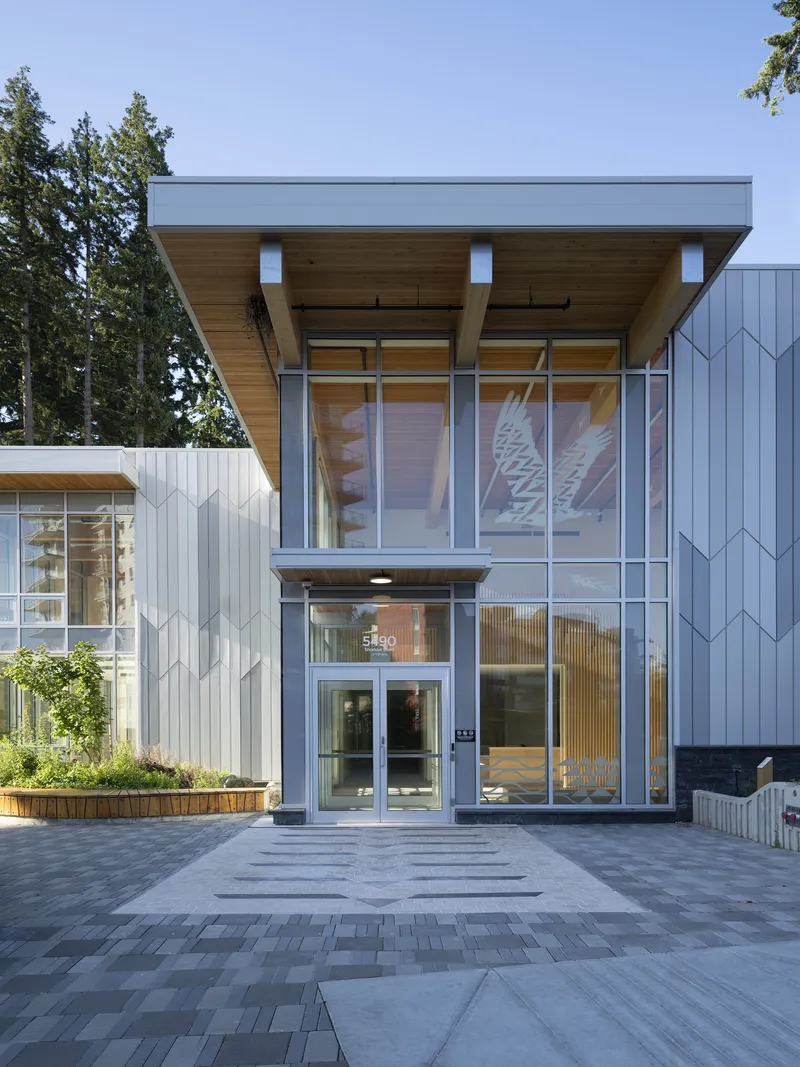
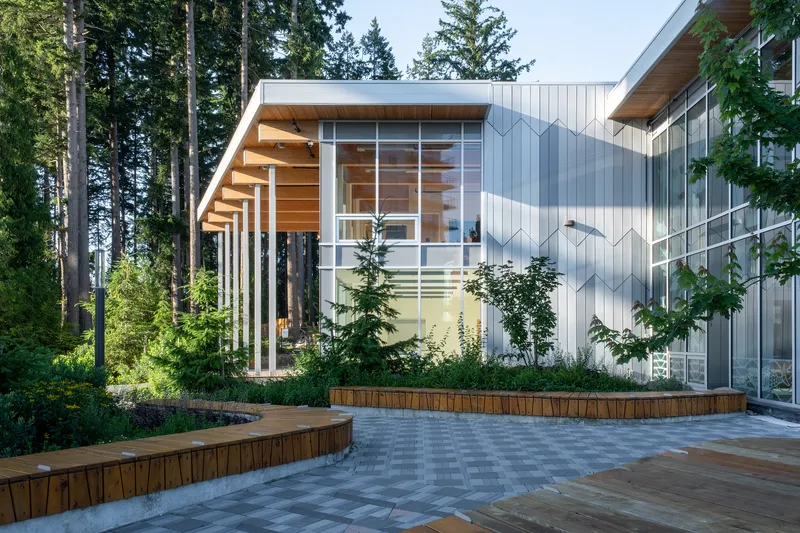
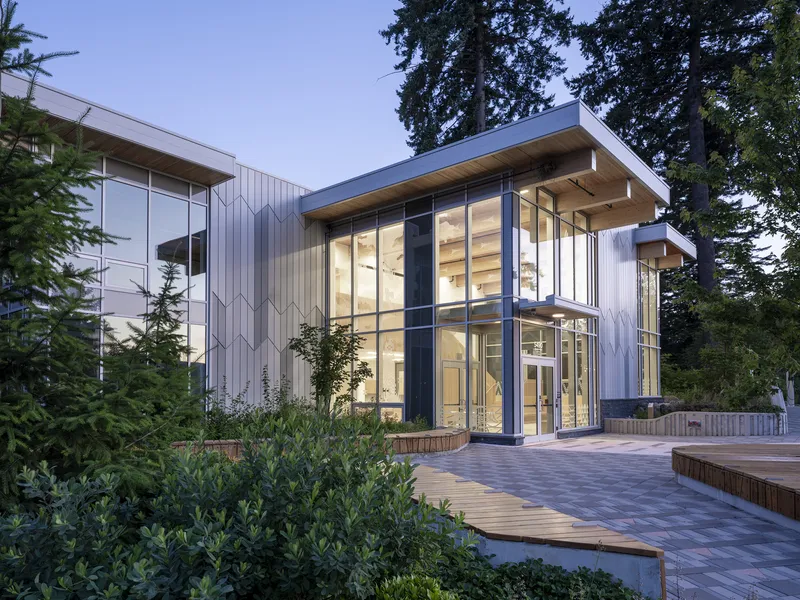
The entry sequence is defined by a generous cantilevered timber soffit that projects well beyond the building envelope. This is not ornamental: the overhang shelters outdoor gathering and activity space while signaling arrival from a distance. Chevron-patterned metal cladding flanks the glazed entry wall, giving the facade a texture that reads as both industrial and handcrafted. At dusk, the warm glow of the timber-lined canopy against the cool blue sky turns the building into a lantern within the park.
Planted beds with young trees soften the ground plane, extending the forest context right up to the building's edge. The intention is clearly to blur the line between site and structure, letting the park claim some of the architecture rather than treating landscape as setback.
Metal Skin, Timber Core
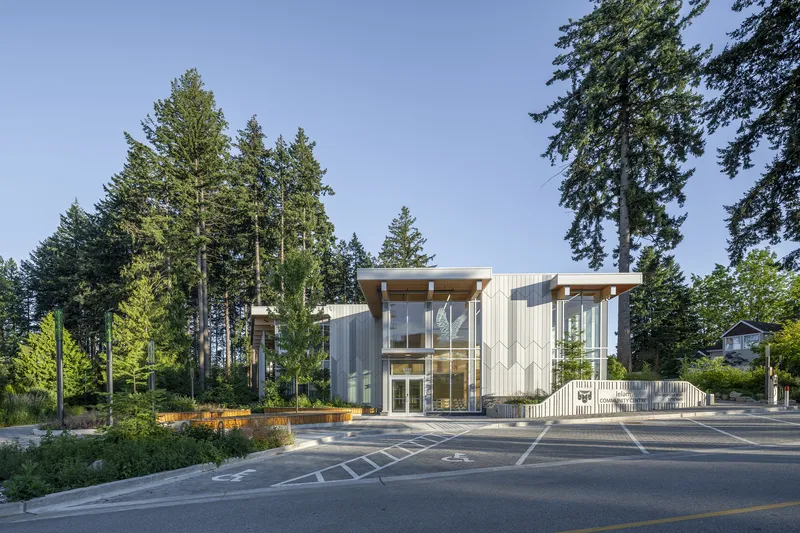
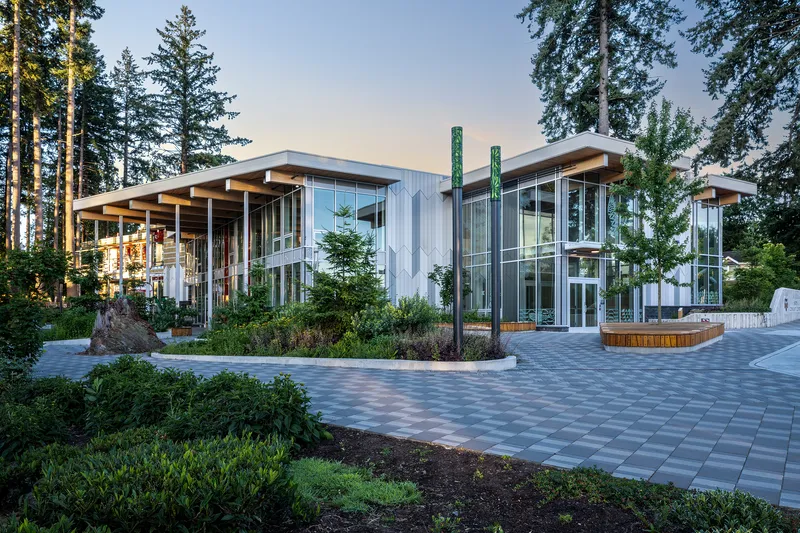
From certain angles the building reads as a crisp, dark volume wrapped in vertical metal cladding, its proportions modulated by the tall conifers that frame it. The facade is restrained: no performative geometry, no gratuitous folds. Instead, the material palette does the talking. Dark metal panels give the exterior a quiet density, while full-height glazing on the primary elevations opens the interior life of the building to the surrounding park and courtyard.
The two-story glass and metal composition at the courtyard side, visible especially at dusk, reveals the sectional logic of the building. Public and active spaces read clearly from outside, reinforcing the center's role as a gathering point for the leləm̓ community.
The Double-Height Lobby as Cultural Ground
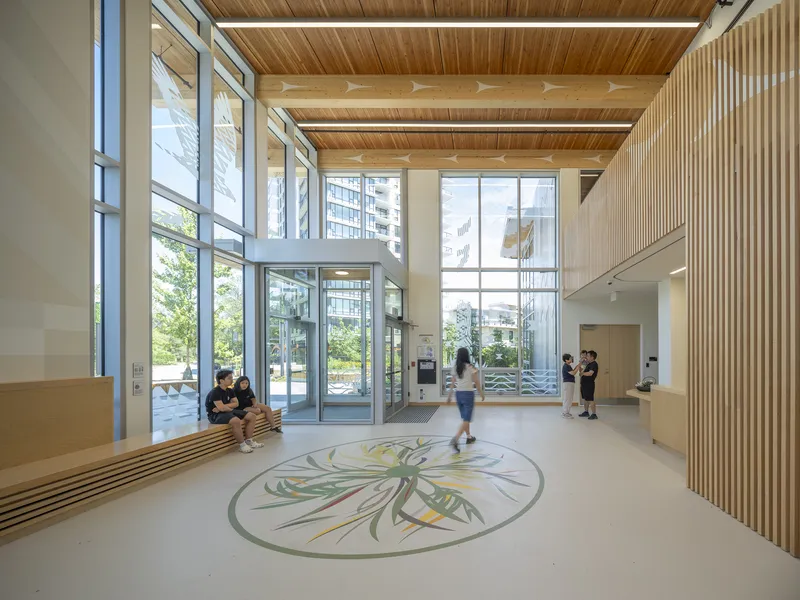
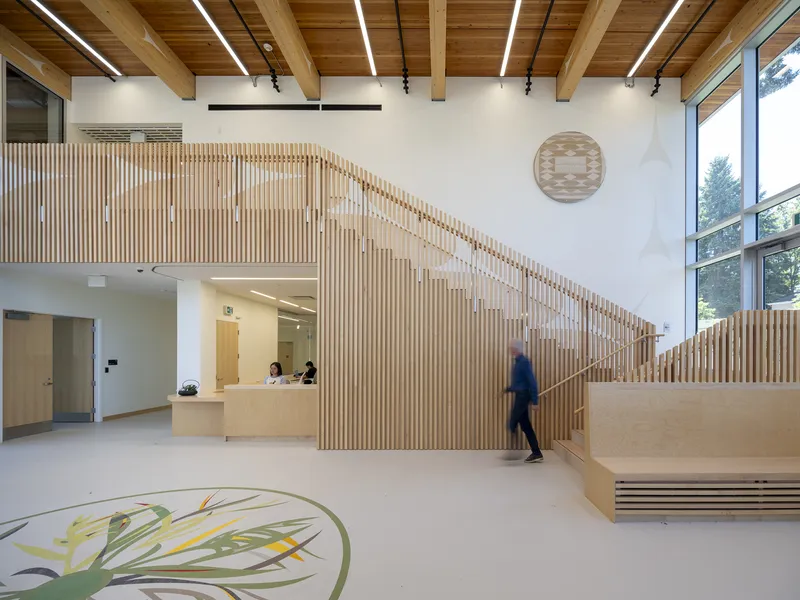
Step inside and the double-height entry atrium immediately reframes the experience. Exposed glulam beams span overhead, their warm tones amplified by daylight washing down the glazed walls. A botanical floor medallion at the center of the lobby grounds the space with a direct reference to the natural world, while vertical timber slat screens wrap the feature stair, filtering views between levels and lending the circulation a layered quality that avoids the typical open-plan monotony of community buildings.
The reception area is tucked alongside the stair, accessible but not dominant. People move through this space rather than parking in it, which is exactly right for a building that wants to encourage flow between its gym, multipurpose rooms, offices, and kitchen facilities.
Active Spaces Under Timber
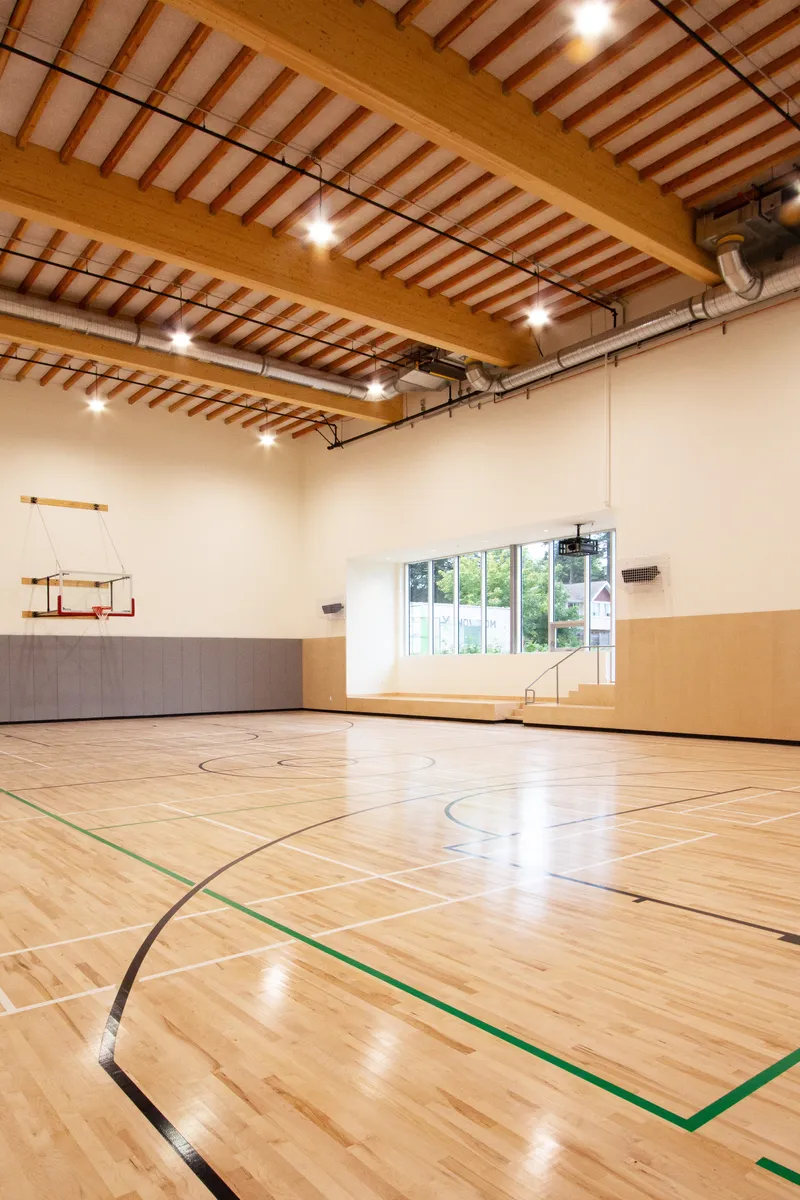
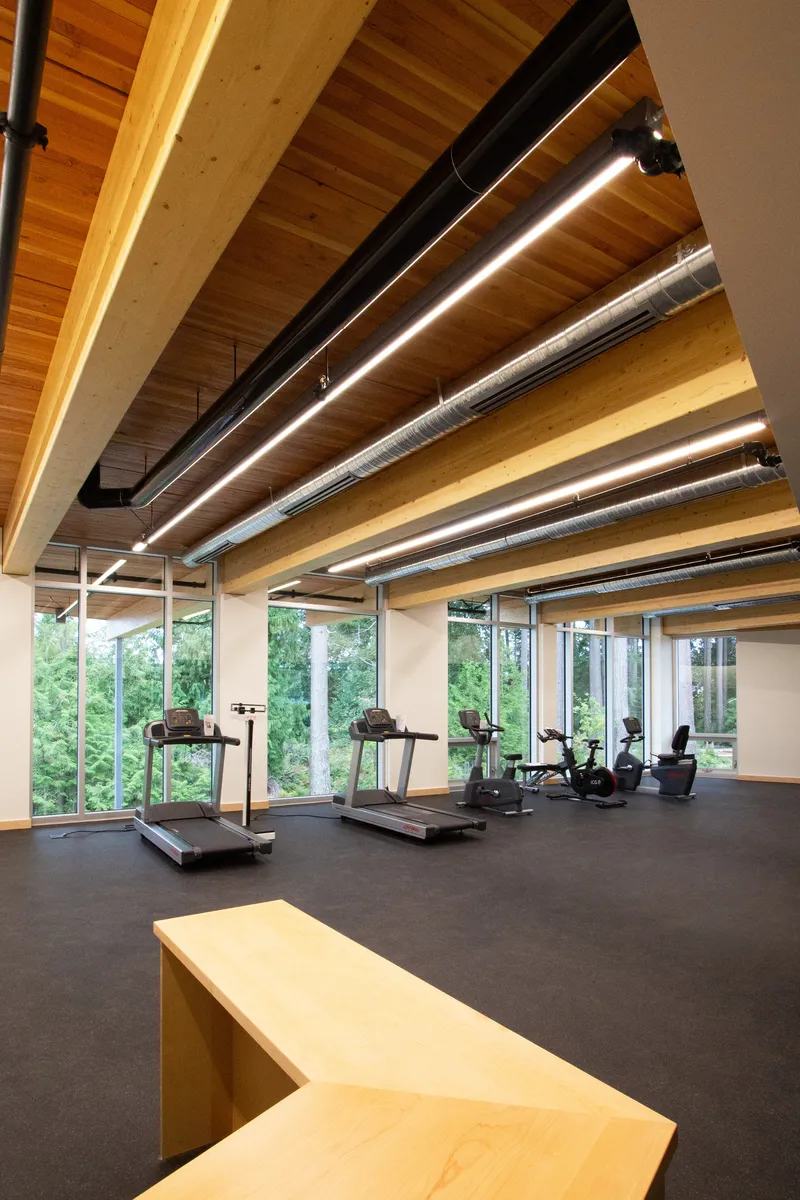
The gymnasium and fitness room demonstrate how mass timber can perform in spaces that are typically dominated by steel and concrete. The basketball court sits beneath exposed timber beams and ductwork, with clerestory windows pulling in natural light along the upper walls. There is an honesty to the ceiling here: the NLT panels and glulam structure are left unadorned, their grain and joinery fully legible. The result is a gym that feels warmer and more grounded than the typical fluorescent-lit box.
The fitness room follows the same logic. Exposed timber ceiling joists run in parallel with linear lighting fixtures, and a fully glazed wall connects treadmill users to the planted landscape outside. It is a small move, but aligning exercise equipment with a view of the forest rather than a mirror wall says something about the building's values.
Volume and Light in the Lounge
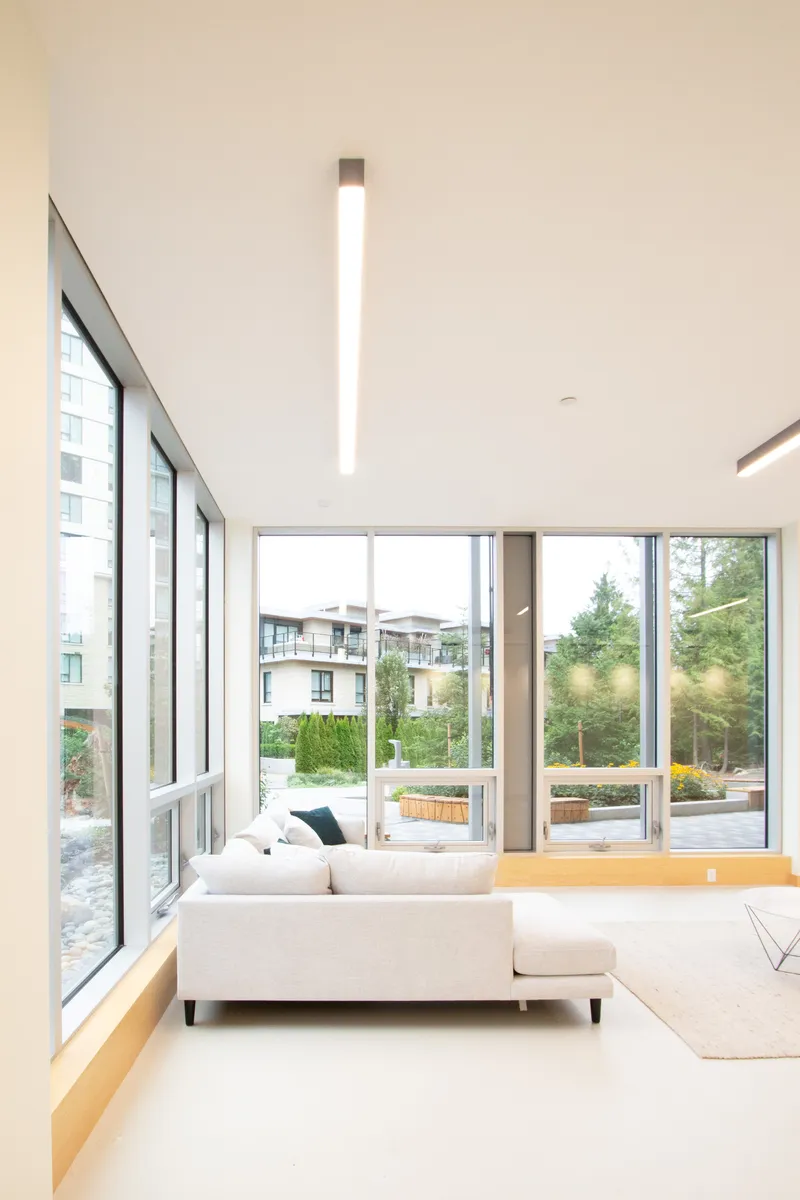
A double-height lounge with a sloped ceiling and glazed walls acts as the building's social heart beyond the lobby. The suspended linear pendant fixture running the length of the space provides scale and rhythm, while the pitched ceiling gives the room a gentle directionality, guiding the eye toward the park. This is a space designed for lingering: community meetings, casual work, post-event gathering.
Viewed from outside at evening, the lounge glows through the full-height glazing beneath the timber-lined canopy. The interior warmth of the wood structure against the darkening sky makes the building's civic purpose legible from a distance, functioning as an invitation to the broader community.
Plans and Drawings
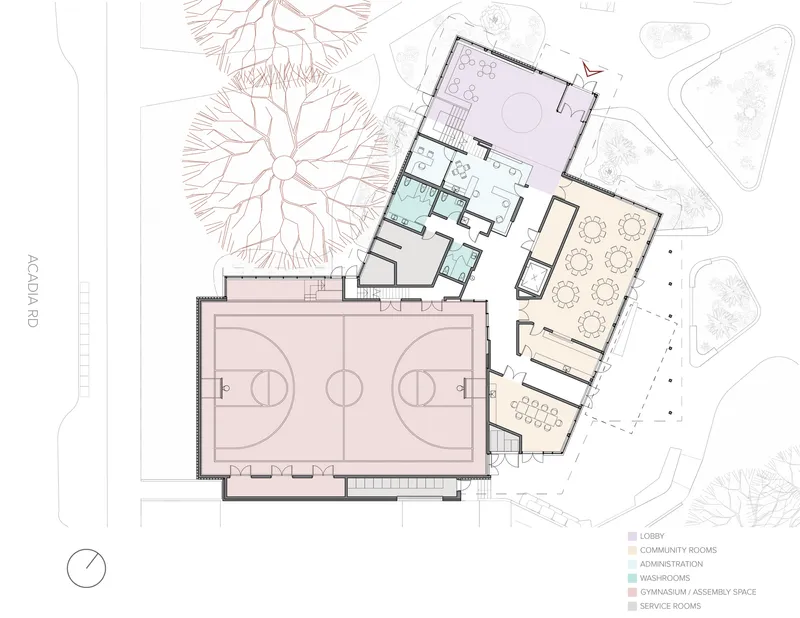
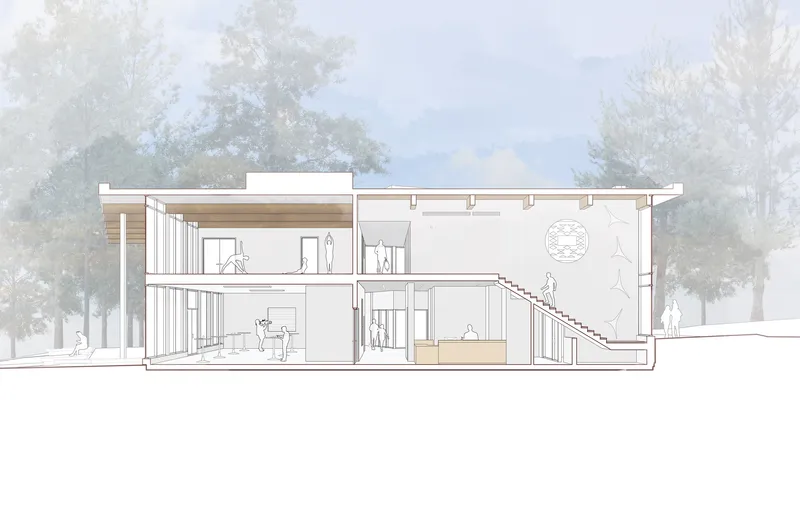
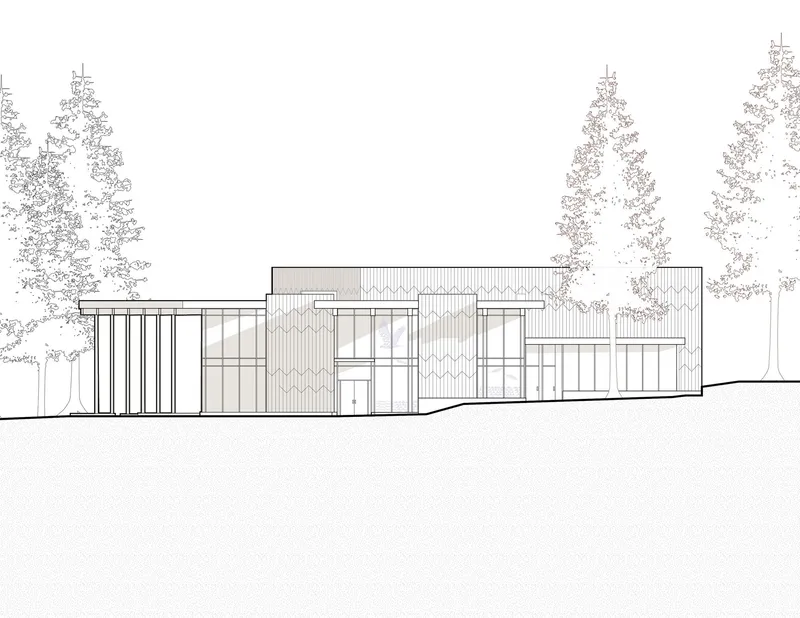
The floor plan reveals a compact but well-organized layout. The gymnasium occupies the largest single volume, flanked by the lobby and community rooms along a clear circulation spine. The plan's perimeter is studded with trees in the drawing, reinforcing how deliberately the architects embedded the building into its forested site. Surrounding landscape is not residual space; it is integral to the architecture.
The section drawing exposes the two-story massing and the structural legibility of the timber framing. Top-tapered glulam beams slope naturally toward drainage points, a detail that eliminates the need for added rigid insulation and gives the roofline its subtle pitch. The elevation drawing, meanwhile, shows the horizontal proportionality of the building against the vertical rhythm of surrounding conifers, a dialogue between built form and forest that the architects clearly calibrated with care.
Why This Project Matters
The leləm̓ Community Center matters because it demonstrates that cultural specificity and environmental performance are not competing agendas. The Musqueam commitment to environmental stewardship is not expressed through signage or programming alone; it is embedded in the choice of mass timber, the LEED Gold targeting, the barrier-free accessibility, and the landscape strategy that dissolves the boundary between park and building. Too many community centers are anonymous boxes dropped onto available lots. This one is inseparable from its place.
Francl Architecture has delivered a building that respects Indigenous sovereignty over the land it occupies while providing genuinely useful civic space: a gym, a kitchen, conference rooms, fitness facilities, and a lounge that invites the community to stay. The hybrid timber structure shortened construction timelines and reduced material impact without sacrificing spatial quality. In a city where reconciliation is an ongoing conversation, a building like this is not a conclusion. It is a credible contribution.
leləm̓ Community Center by Francl Architecture, lead architect Alain Prince. Located in Vancouver, Canada, on the ancestral territory of the Musqueam people within UBC's Endowment Lands of Pacific Spirit Park. 1,403 m². Completed 2025. Photography by Michael Elkan.
About the Studio
Share Your Own Work on uni.xyz
If projects like this are the kind of work you want to make, uni.xyz is a place to publish your own, find collaborators, and enter design competitions.


Popular Articles
Popular articles from the community


The Amber Palace Opera: A Geological Fiction Surfaces on Tallinn's Baltic Waterfront
Pierre Brillard reimagines a Baltic legend as a public landscape, opera house, and waterfront promenade rooted in Tallinn's coastal identity.

Tsunami Convergenics: Turning Catastrophic Ocean Forces into Underwater Housing Infrastructure
A speculative underwater settlement off the coast of Onagawa, Japan, treats tsunamis and typhoons as energy sources rather than threats.

Temporary Home for Dogs: A Reversed Zoo Rethinks Animal Shelter Architecture
In Bucharest, a sinuous corridor and freed landscape flip the logic of containment, designing a shelter that works to make itself unnecessary.

Faces of the Soviet Avant-Garde: Turning Moscow's Street Names into an Open-Air Museum
A network of sculptural installations across a Moscow residential district transforms forgotten architect names into spatial encounters with cultural memor

Similar Reads
You might also enjoy these articles

Bao Huynh Watercolor Atelier: A Serene Art Retreat in Hội An
Bao Huynh Watercolor Atelier in Hội An blends multifunctional art spaces, sustainable design, local materials, and family-friendly living in a serene environment.

Atelier Macri Concept Store Interior Design by CASE-REAL
Atelier Macri store features a "ko" counter, walnut wood details, cork displays, blending retail, gallery, and seamless customer experiences.

Manuel Vargas Izquierdo Stadium and High-Performance Sports Center: Architectural Excellence in Jalpa de Méndez
The Manuel Vargas Izquierdo Stadium blends sustainable design, inclusive sports facilities, and cultural-inspired architecture, revitalizing Jalpa de Méndez’s public spaces.

KAKR Buluh Awar Hall: Revitalizing Community and Ecology Through Bamboo Architecture
Community built bamboo hall revitalizes Buluh Awar village, empowering youth, restoring ecology, celebrating vernacular craftsmanship through sustainable architecture and culture.


Comments (0)
Please login or sign up to add comments
No comments yet. Be the first to comment!