
Frederico Bicalho Stretches a Concrete House Along a Minas Gerais Hillside to Chase the Horizon
A 600 m² residence in Condomínio Serra dos Manacás uses a longitudinal plan and raw concrete to anchor itself against Brazil's red earth.


Most houses on steep sites try to negotiate with the slope, terracing down in polite increments or perching on stilts to pretend the ground is flat. GM House, completed in 2025 by Frederico Bicalho Arquitetura, does something more committed: it stretches lengthwise along the gradient, letting gravity organize the plan rather than fighting it. The result is a 600 m² residence in Condomínio Serra dos Manacás, Minas Gerais, that reads less like a house and more like a concrete spine laid across the landscape, with every room oriented toward the mountain horizon.
What makes the project worth studying is the discipline of its strategy. A single longitudinal axis governs circulation, views, and privacy simultaneously. The back wall closes itself off with solid concrete, shielding against future neighboring construction, while the front dissolves into floor-to-ceiling glass. It is a house with a clear opinion about where to look, and that decisiveness shapes everything from the bedroom blocks on the upper level to the social heart at the intermediate floor. Exposed concrete was chosen not for aesthetic posturing but because the bright red earth of this region of Brazil demands a material that won't stain or degrade on contact.
Arrival as Threshold
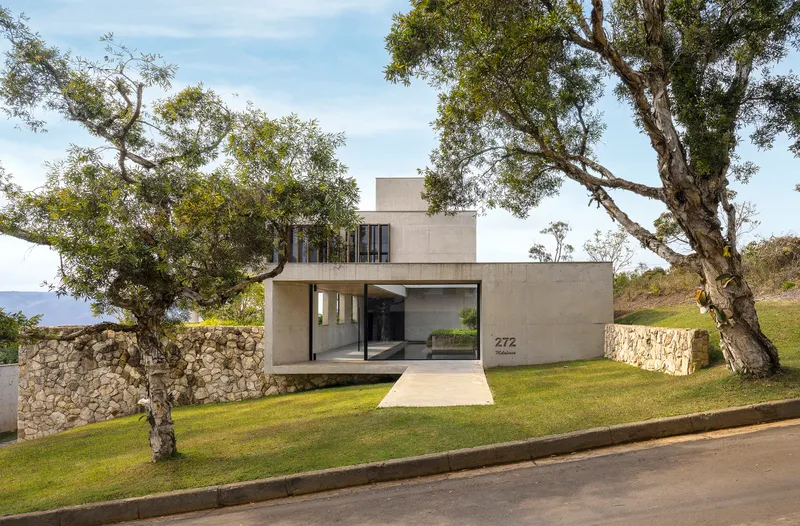
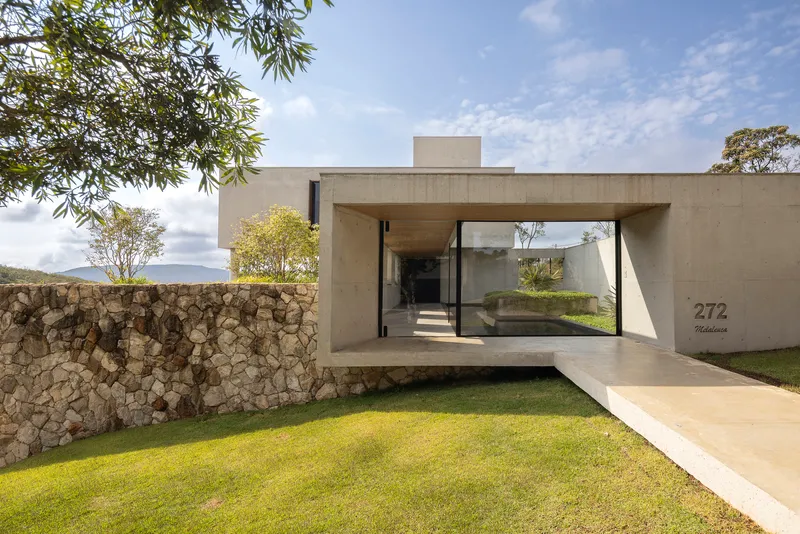
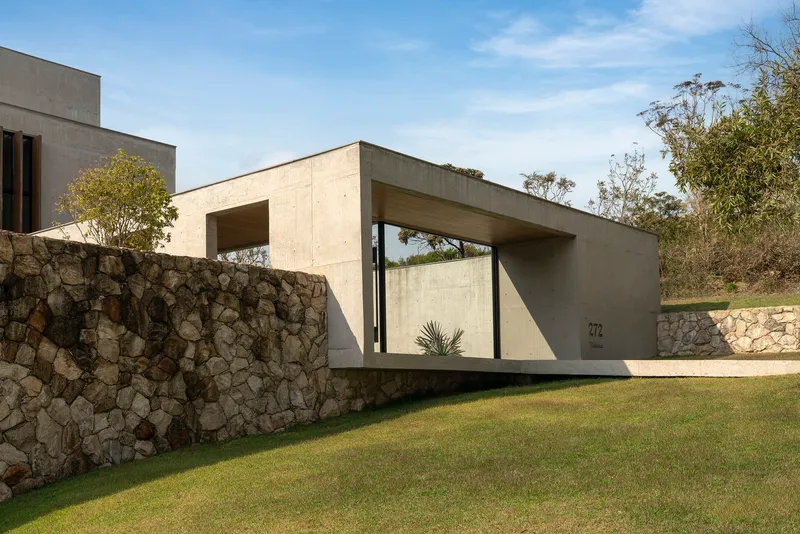
The approach to GM House is deliberately staged. Gabion stone walls flanking the entrance establish a material dialogue between the raw concrete volumes and the geology underfoot. The entry sequence requires visitors to cross a cantilevered concrete bridge that passes directly over a reflecting pool, framing a view through to the interior courtyard beyond. It is a simple move, but it converts what could be a mundane threshold into an event. You are, quite literally, walking over water to reach the front door.
The portal itself, a crisp rectangular void punched through the concrete mass, telescopes the gaze inward while the stone walls on either side ground the composition. Seen in afternoon light, the entry facade has a monolithic quality, tempered only by the planted edges and the mature trees that Bicalho kept standing during construction.
Water and the Circulation Spine
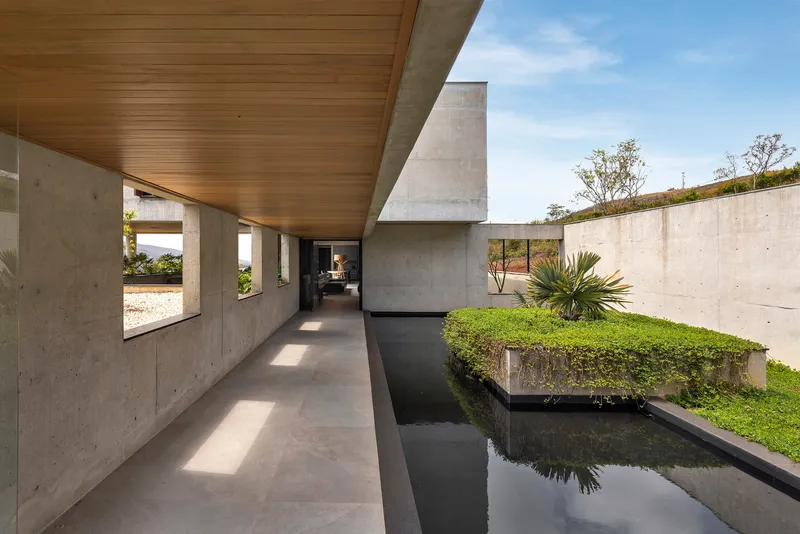
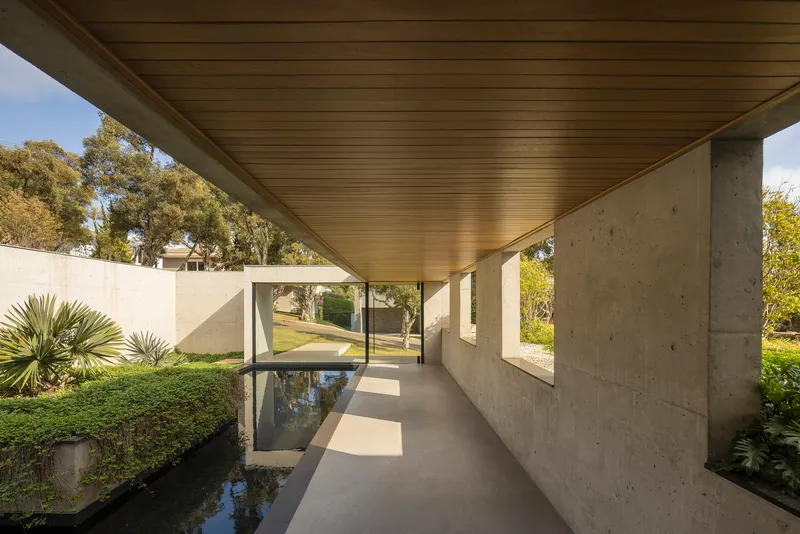
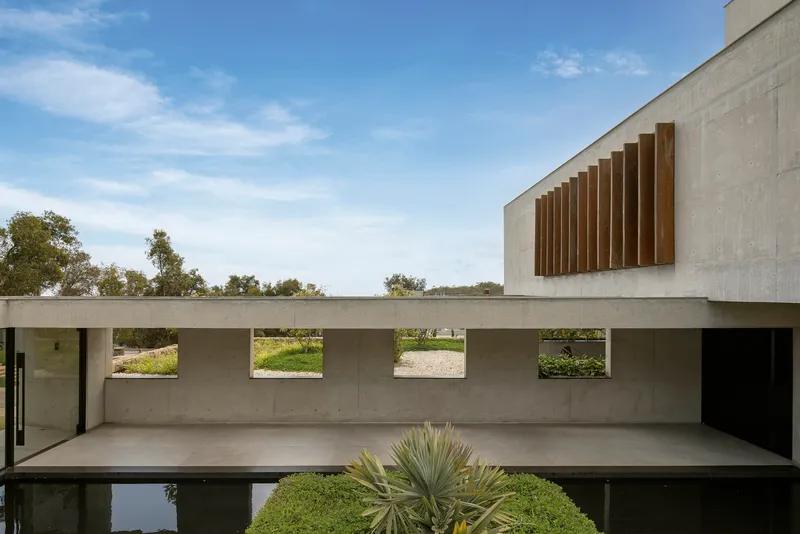
Reflecting pools appear at multiple moments along the plan, not as ornamental afterthoughts but as organizing devices. The covered walkway that runs alongside the main pool, with its timber ceiling and planted courtyard walls, doubles as the primary circulation route and as a controlled microclimate zone. Air moves across the water surface before entering the interior, and the visual continuity of the pool draws you deeper into the house.
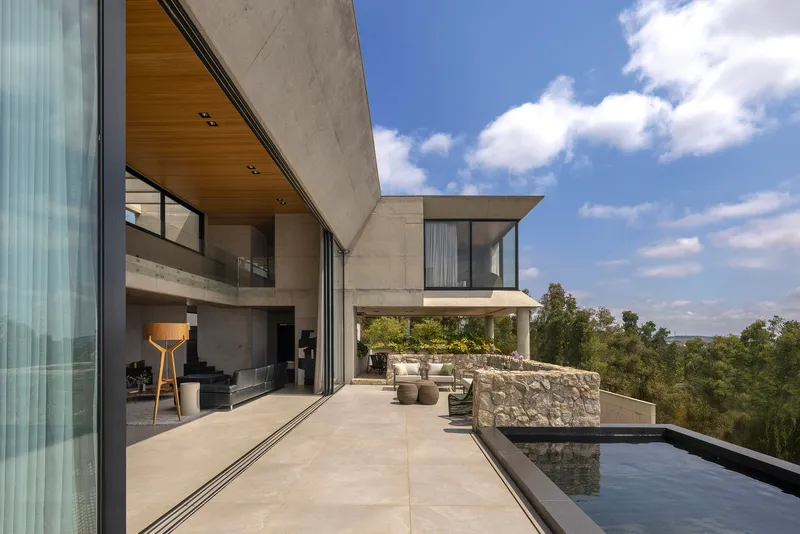
At the terrace level, a still-edged pool mirrors the cantilevered volumes above. Agave plants frame the water's edge with a geometric rigor that matches the architecture. Horizontal slot windows in the concrete wall behind the pool create a layered composition: solid, void, reflection, sky. It is restrained detailing that rewards slow observation.
Living Spaces That Dissolve Into the Valley
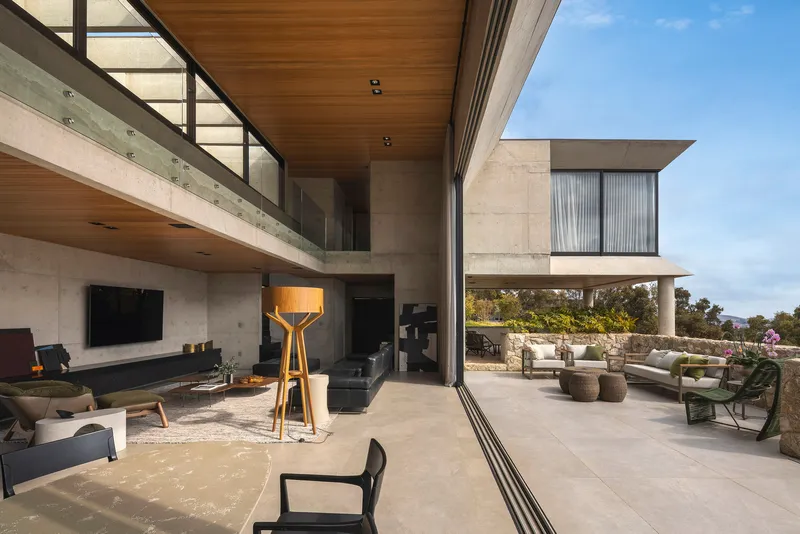
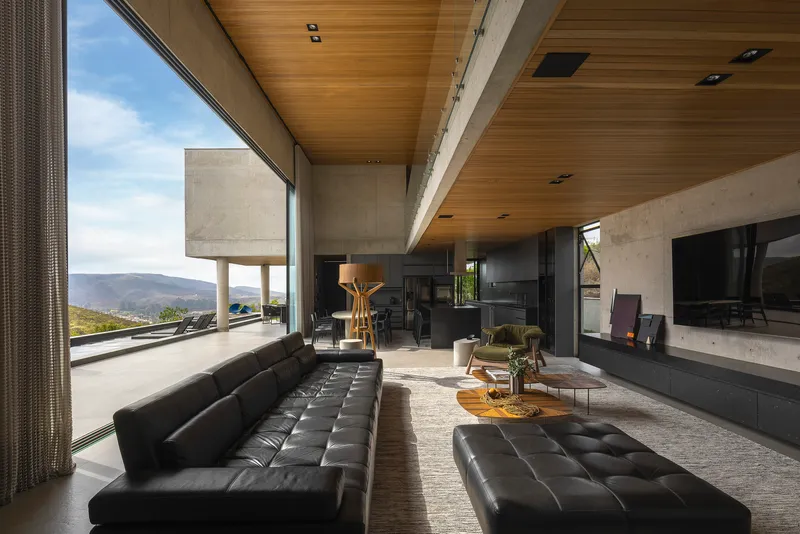
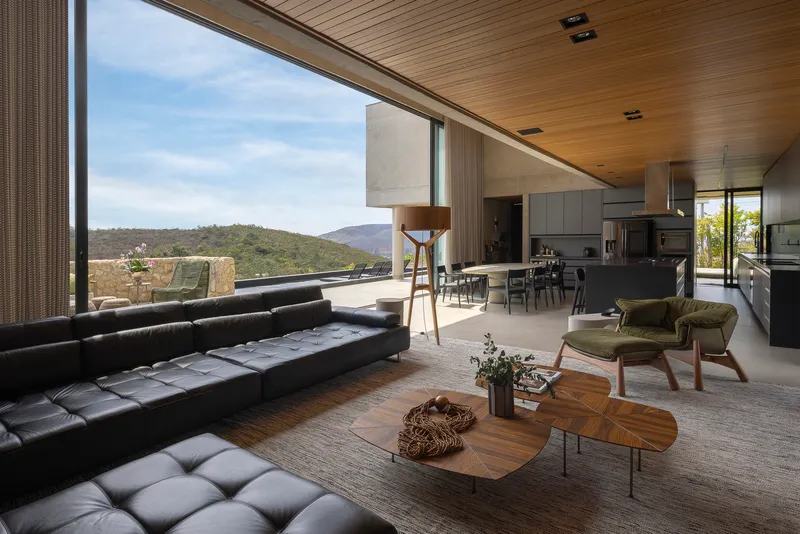
The social floor sits at the intermediate level, connecting a covered veranda to the pool terrace and, beyond that, to the forested hills of the Serra dos Manacás. The double-height living space is the hinge of the entire plan, with a concrete soffit overhead and full-height glazing on the valley side. Timber ceilings soften what could otherwise be a relentlessly hard palette, and they perform acoustically in a room of this scale.
Floor-to-ceiling glass is a common enough gesture in contemporary residential work, but here it is justified by the site: the distant mountain landscape is the entire point. Bicalho has been careful to keep the framing minimal so that the view reads as a continuous panorama rather than a series of framed pictures. The furniture, low slung and neutral, stays out of the conversation.
The Mezzanine Bridge and Vertical Section
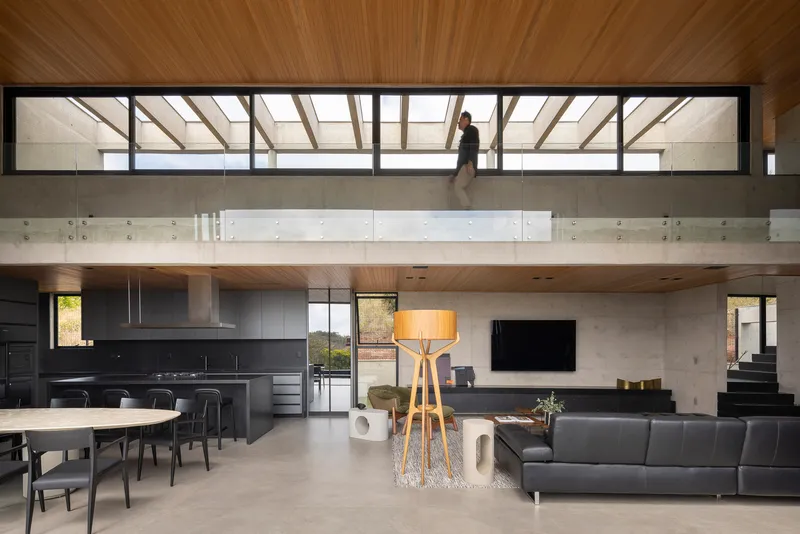
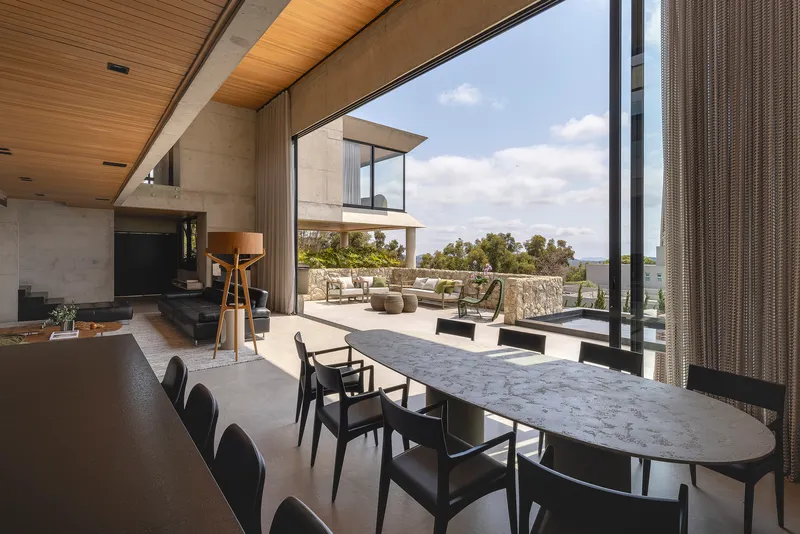
The upper floor organizes bedrooms into two separate blocks connected by a walkway, a move that introduces a deliberate pause in the plan. The mezzanine bridge crossing above the living space is visible from below as a concrete bar, with clerestory glazing above admitting light into the double-height volume without compromising privacy on the bedroom level. It is a sectional trick that keeps the interior from feeling like a single open loft while maintaining visual connectivity between floors.
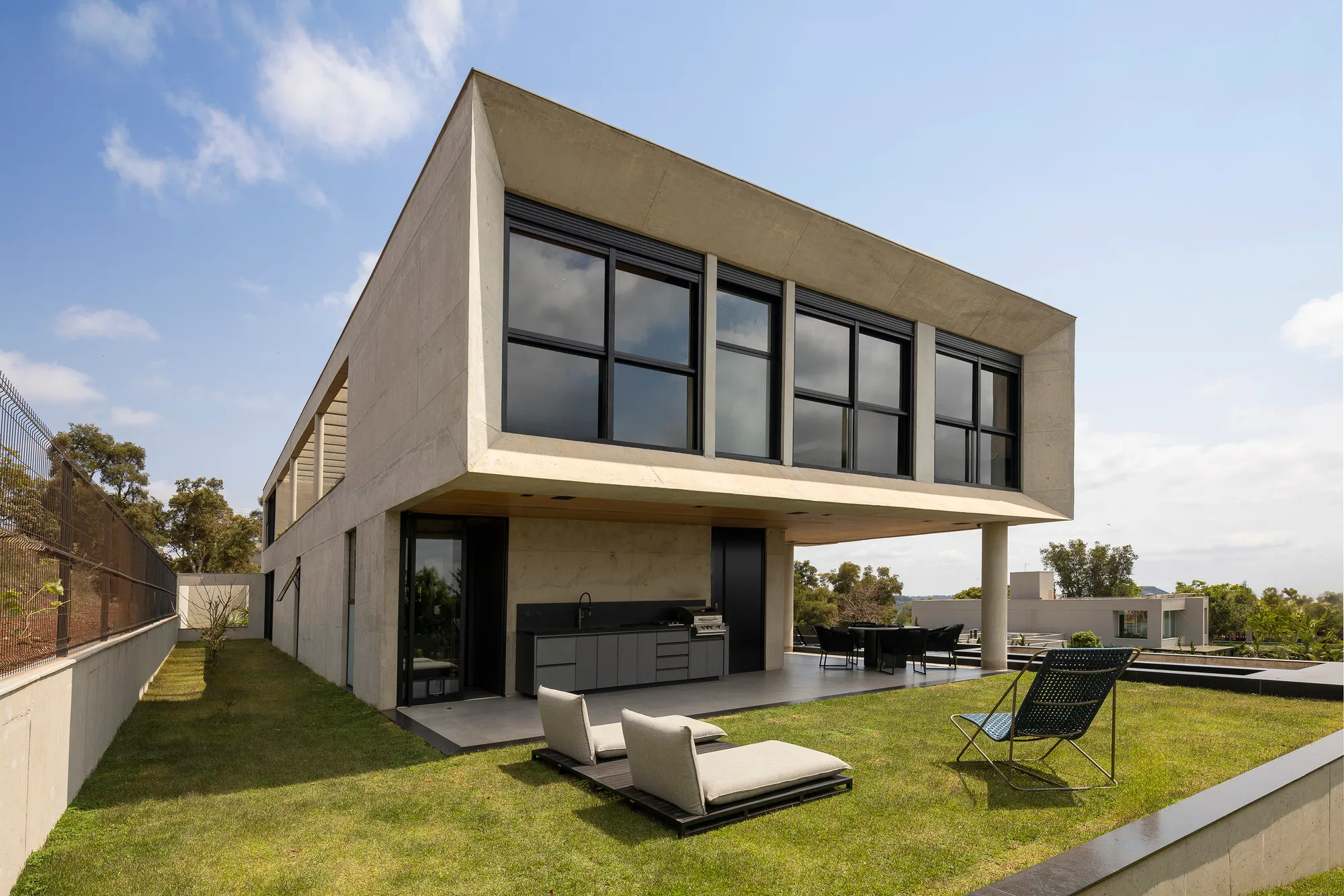
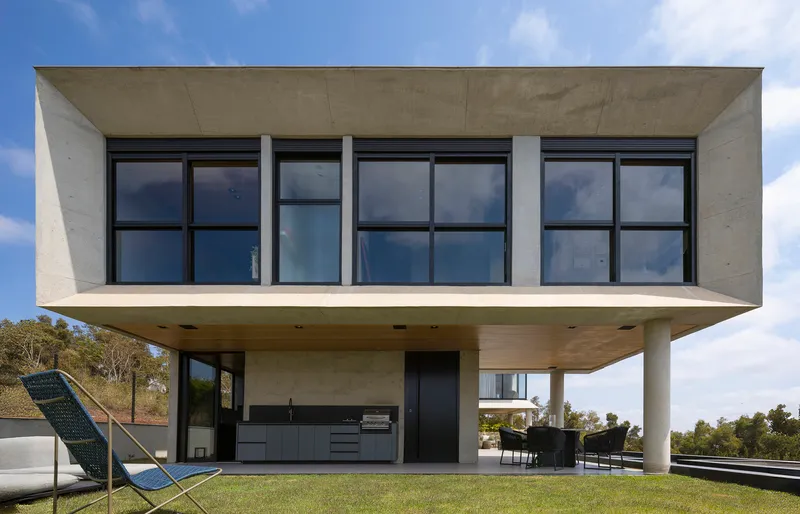
Below, the dining area pushes outward toward the terrace and pool, with a marble table positioned to exploit the longitudinal axis. Above, the cantilevered upper volume projects beyond the footprint of the floor below, creating a covered outdoor kitchen zone in its shadow. Grid windows in the cantilever filter light into the upper bedrooms while presenting a controlled, graphic facade to the approach side.
Concrete Against Red Earth
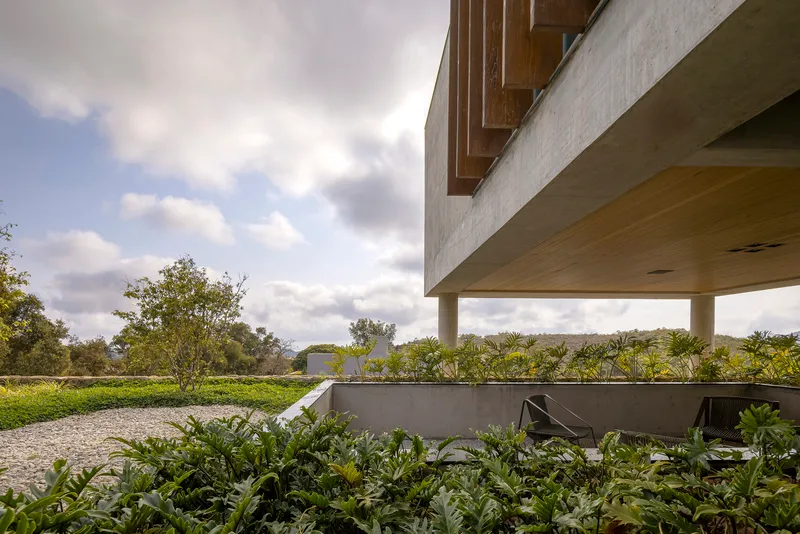
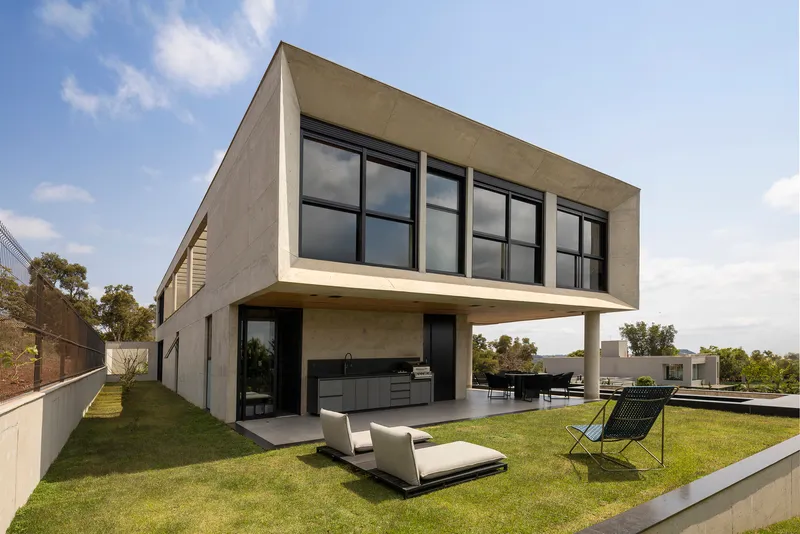
The material logic of GM House is straightforward and defensible. The bright red laterite soils of Minas Gerais are notorious for staining lighter materials, and exposed concrete weathers predictably against them. Bicalho has left the concrete board-formed in places and smooth in others, creating a tonal range within a single material system. Cylindrical columns supporting the elevated upper volume are the only moment where the structure becomes legible as distinct elements rather than monolithic planes.
Seen from below, the cantilevered box floating above the lawn on those columns has a brutalist clarity, but the proportions stay domestic. The gravel paths, stone retaining walls, and planted terraces work hard to mediate between the architecture and the steep topography, and the staggered volumes stepping down the slope give the house a profile that reads as geological rather than imposed.
Intimate Rooms and Controlled Light
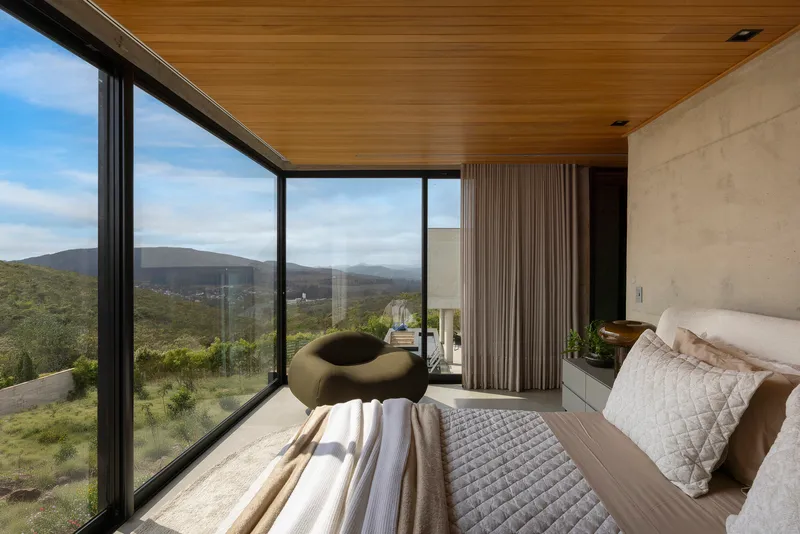
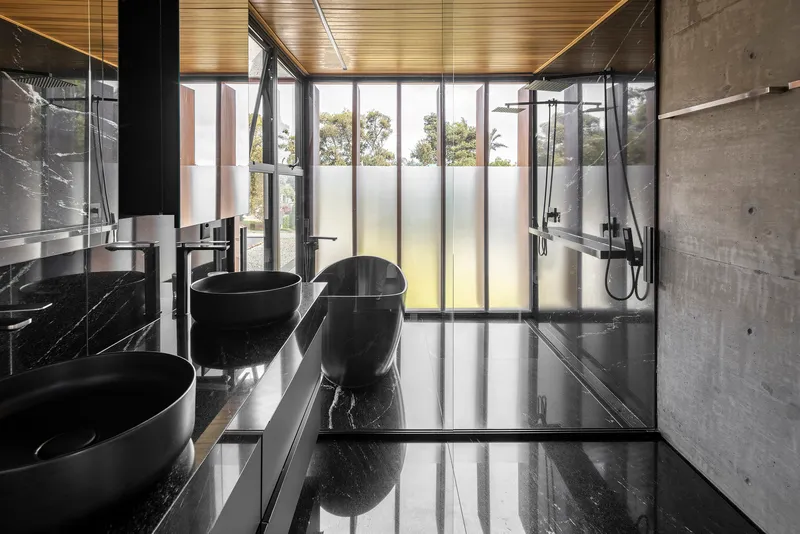
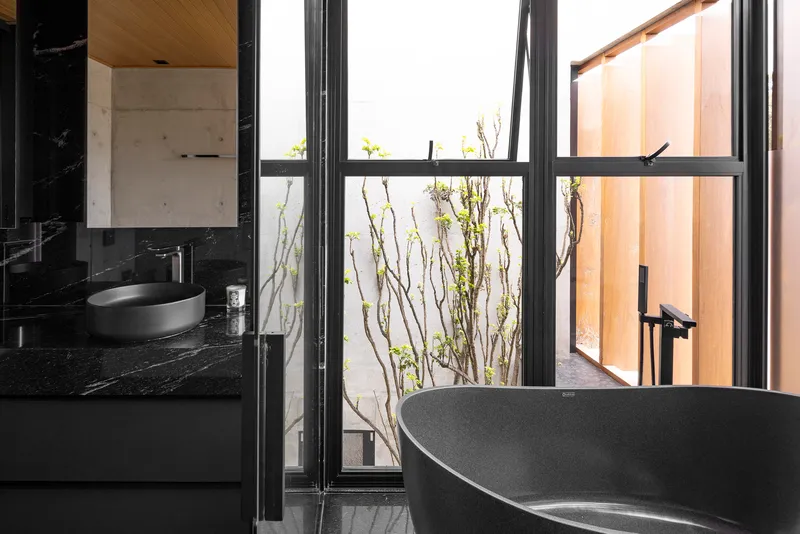
The bedrooms and bathrooms reveal a more intimate register. All sleeping rooms orient toward the horizon, per Bicalho's brief, with timber ceilings and full-height glazing that frame the distant hills as a waking view. The material palette shifts subtly here: warmer wood tones, softer textiles, and a lower ceiling height create a sense of enclosure that contrasts with the expansive social spaces below.
In the bathrooms, black marble surfaces and translucent glazing panels produce a contained, almost chapel-like atmosphere. A freestanding bathtub positioned beside a steel-framed window looks out onto a planted courtyard, turning a utilitarian room into one of the house's most considered moments. The daylight here is filtered and indirect, a deliberate counterpoint to the wide-open panoramas that dominate the rest of the plan.
Terraces as Outdoor Rooms
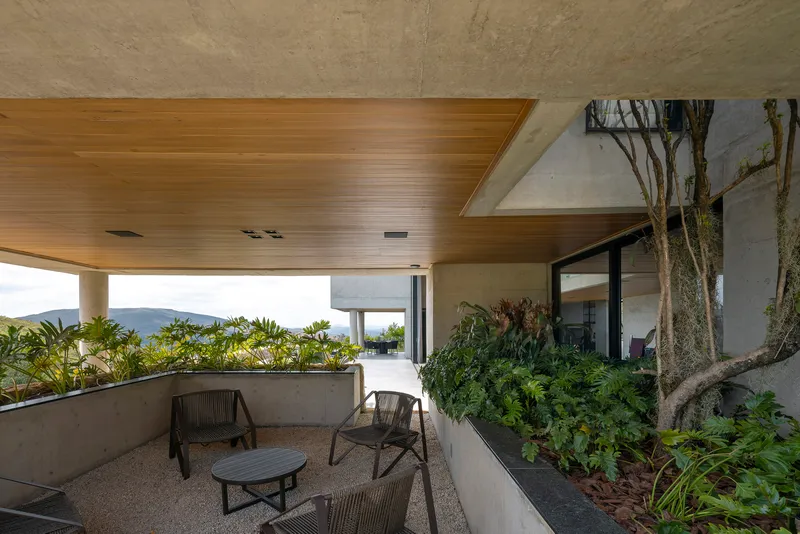
The covered terraces function as proper outdoor rooms, not as transitional leftover space. Planted beds interrupt the concrete decks, and in at least one instance a mature tree trunk rises through the timber ceiling, kept deliberately intact. The proportions of these terraces, generous depth, controlled openings to the valley, make them usable for most of the year in this climate. They are where the house's relationship to the landscape becomes reciprocal: not just a view outward, but a habitat embedded in it.
Plans and Drawings
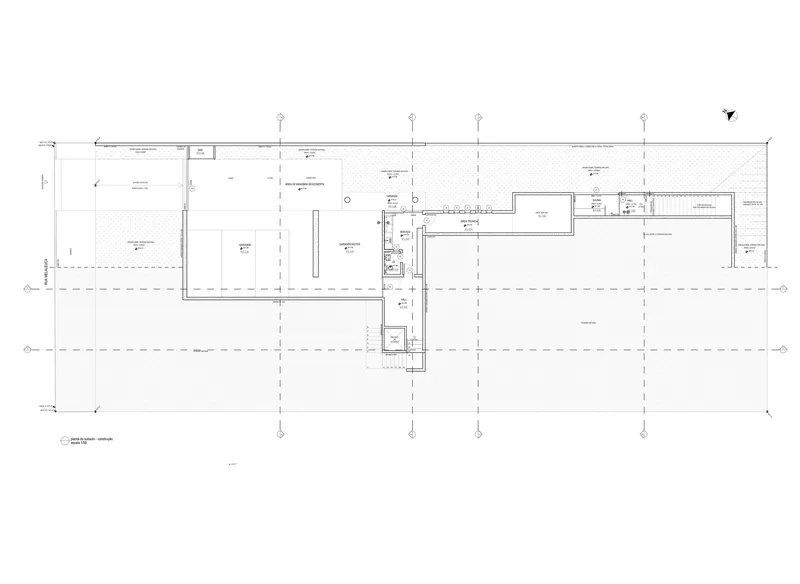
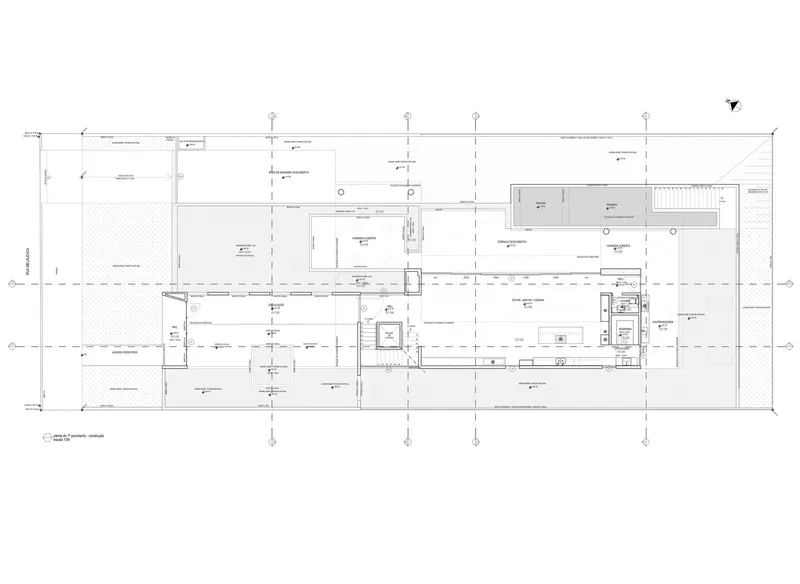
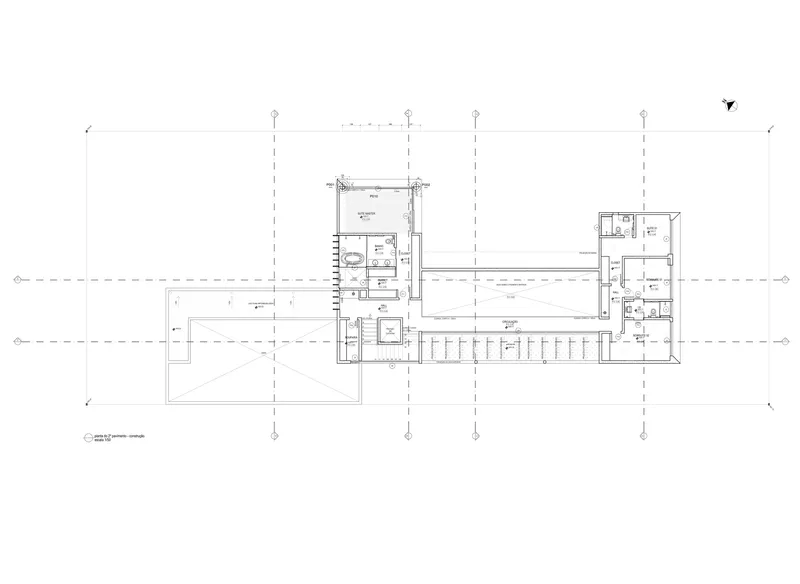
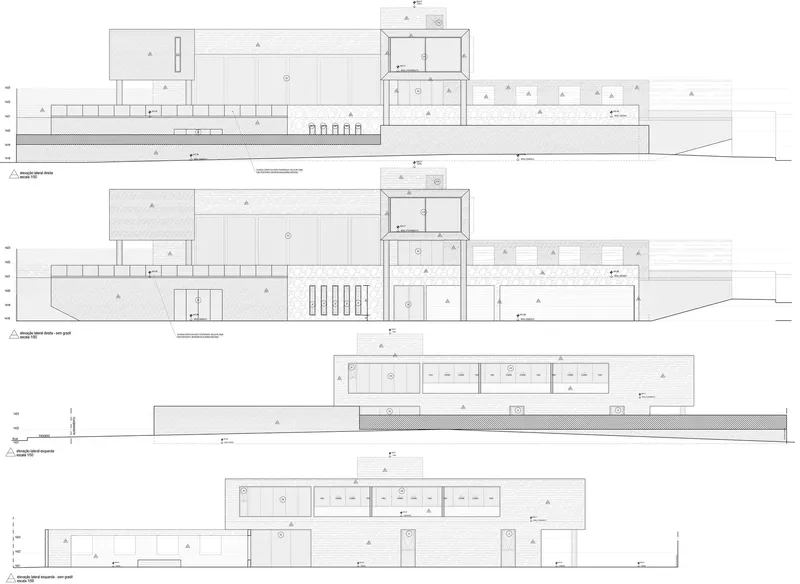
The floor plans confirm the longitudinal strategy: two elongated volumes connected by a central circulation spine and service core, with courtyards and terraces inserted as spatial buffers between programmatic zones. The upper floor plan makes the separation between bedroom blocks legible, with stairs and open courts providing both connection and distance. What reads from the exterior as a single continuous mass is, in plan, a carefully fragmented sequence of interconnected pavilions.
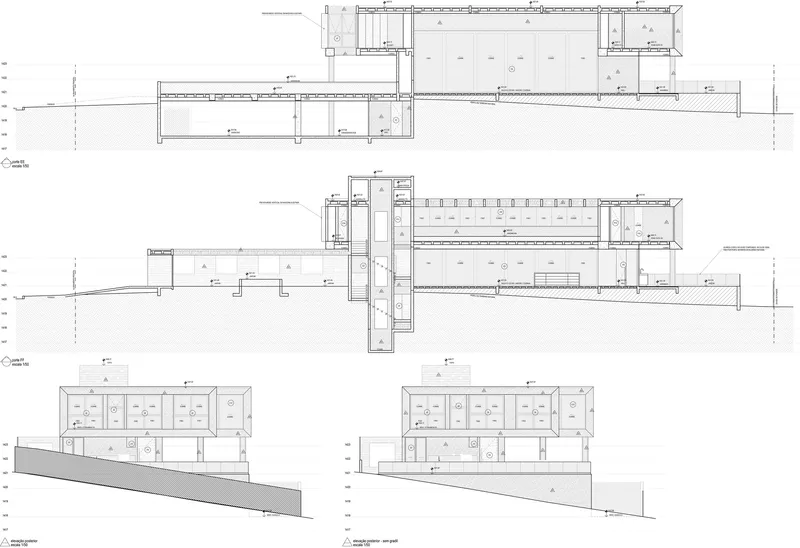
The sections are perhaps the most revealing drawings. They show the multi-level spaces with varying ceiling heights stepping down the slope, and they make clear how the closed upper back wall and the open lower front wall work in tandem to manage privacy, views, and solar exposure. The staggered profile visible in the elevations explains why the house feels anchored to the hillside rather than placed upon it: each volume meets the terrain at a different grade, and the gaps between them admit light and air to the center of the plan.
Why This Project Matters
GM House is a clear example of what happens when site analysis drives every design decision rather than serving as a post-rationalization. The longitudinal plan, the closed back and open front, the concrete as a response to red soil, the separated bedroom blocks for future-proof privacy: none of these choices are novel in isolation, but their alignment around a single steep site produces a house that feels both inevitable and specific. There is no generic version of this project that could be dropped onto a flat plot.
Frederico Bicalho's work here also demonstrates a mature understanding of when to be assertive and when to recede. The cantilevered volumes and monolithic facades are bold moves, but they are counterbalanced by the courtyard plantings, the reflected pools, and the timber-lined interiors that absorb and soften the concrete's severity. In a region where residential architecture too often defaults to either rustic pastiche or imported modernist templates, GM House carves out a position that belongs to its landscape.
GM House by Frederico Bicalho Arquitetura, Condomínio Serra dos Manacás, Brazil. 600 m². Completed 2025. Photography by Jomar Bragança.
About the Studio
Share Your Own Work on uni.xyz
If projects like this are the kind of work you want to make, uni.xyz is a place to publish your own, find collaborators, and enter design competitions.




Popular Articles
Popular articles from the community


Hill & Cross Opera: Sculptural Opera House Architecture Shaped by Tallinn’s Landscape and Identity
Hill & Cross Opera reimagines opera house architecture in Tallinn through its sculptural hill, civic plaza, glass wave and a luminous cross.

The Ocean Hive: Sustainable Architecture for a Self-Sufficient Civilization at Sea
The Ocean Hive imagines sustainable architecture at sea, where modular habitats, algae, wave power and ocean waste sustain a growing colony.

Lunar Spiral: Space Architecture Shaped by the Mathematics of the Universe
Lunar Spiral reimagines space architecture through Fibonacci geometry, lunar regolith, levitating habitats, and self-sustaining Moon living.

Riyadh For All: Intergenerational Urban Design for Active Aging in Rabat
Riyadh For All reimagines urban design in Rabat with intergenerational co-living, adaptive courtyards, and Moroccan cultural exchange today.


Similar Reads
You might also enjoy these articles

Bao Huynh Watercolor Atelier: A Serene Art Retreat in Hội An
Bao Huynh Watercolor Atelier in Hội An blends multifunctional art spaces, sustainable design, local materials, and family-friendly living in a serene environment.

Atelier Macri Concept Store Interior Design by CASE-REAL
Atelier Macri store features a "ko" counter, walnut wood details, cork displays, blending retail, gallery, and seamless customer experiences.

Manuel Vargas Izquierdo Stadium and High-Performance Sports Center: Architectural Excellence in Jalpa de Méndez
The Manuel Vargas Izquierdo Stadium blends sustainable design, inclusive sports facilities, and cultural-inspired architecture, revitalizing Jalpa de Méndez’s public spaces.

KAKR Buluh Awar Hall: Revitalizing Community and Ecology Through Bamboo Architecture
Community built bamboo hall revitalizes Buluh Awar village, empowering youth, restoring ecology, celebrating vernacular craftsmanship through sustainable architecture and culture.




Comments (0)
Please login or sign up to add comments
No comments yet. Be the first to comment!