

Heritage Stone Meets Timber Portals in Montreal
MAJ transforms a riverside heritage home in Sainte-Anne-de-Bellevue into a layered dialogue between rough stone, oak frames, and waterfront light.


Sainte-Anne-de-Bellevue sits at the western tip of the island of Montreal where the Ottawa River widens into Lac des Deux Montagnes. It is a place defined by water, and the homes that line its banks carry decades of accretion: stone walls thickened by repointing, dormers added and re-roofed, interiors chopped into dark corridors. When MAJ (Mise à Jour) took on this heritage residence, the challenge was not simply to modernize but to decide which layers of history to amplify and which to strip away.
What makes the project genuinely interesting is the strategy the studio chose: a system of oak timber portals that thread through the interior like a new structural grammar laid over the old stone one. These frames do not mimic the heritage fabric. They contrast with it, warm against cool, precise against rough, and in doing so they give each room a legible threshold. The result is a house that reads as a sequence of framed views rather than a collection of renovated rooms.
Stone and Slate: The Heritage Envelope

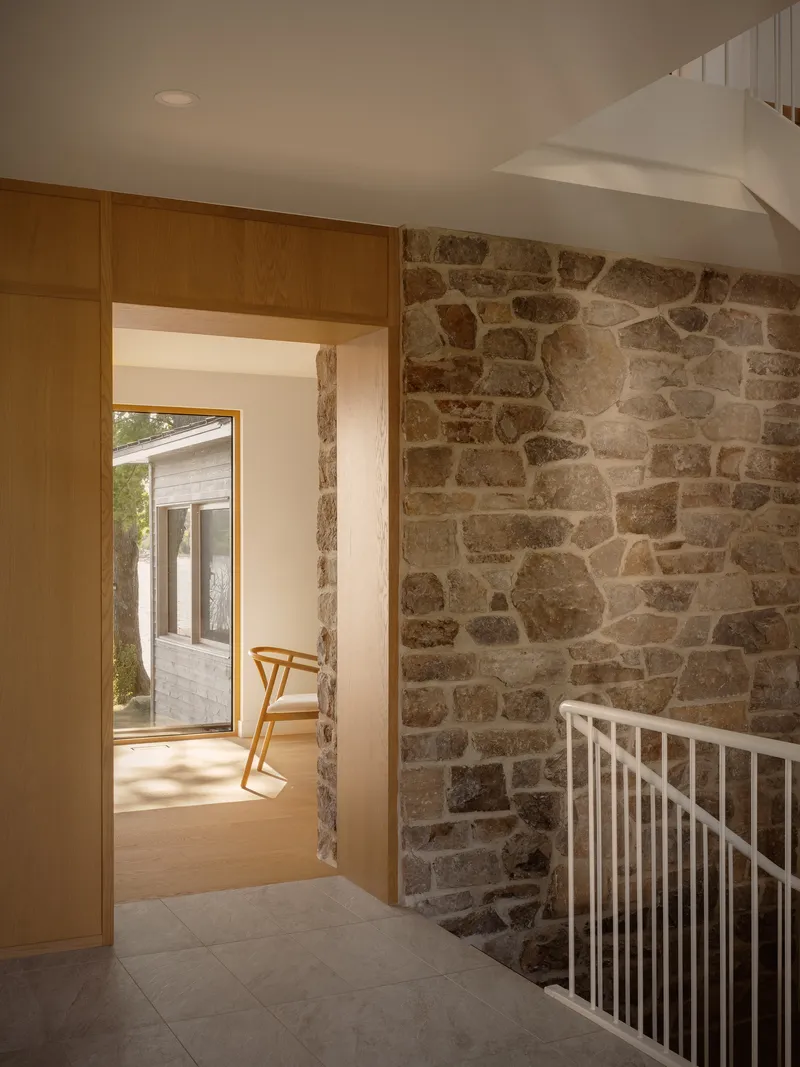

The exterior tells you almost nothing about the intervention inside. A steeply pitched slate roof, rubble stone walls, and dormer windows compose a facade that could belong to any number of 19th century houses along the riverbank. MAJ kept that reticence deliberate. The real conversation between old and new happens at the threshold: step inside and you encounter exposed stone meeting white steel balustrades, timber treads climbing alongside masonry that has been cleaned but left unfinished. The entry stairwell is where the two eras shake hands.
Retaining the stone in its raw state, rather than plastering over it or treating it as a feature wall behind glass, gives the interior an honesty that many heritage renovations lack. The stone is not decoration. It is structure, and MAJ lets it behave that way.
Timber Portals as Spatial Organizers
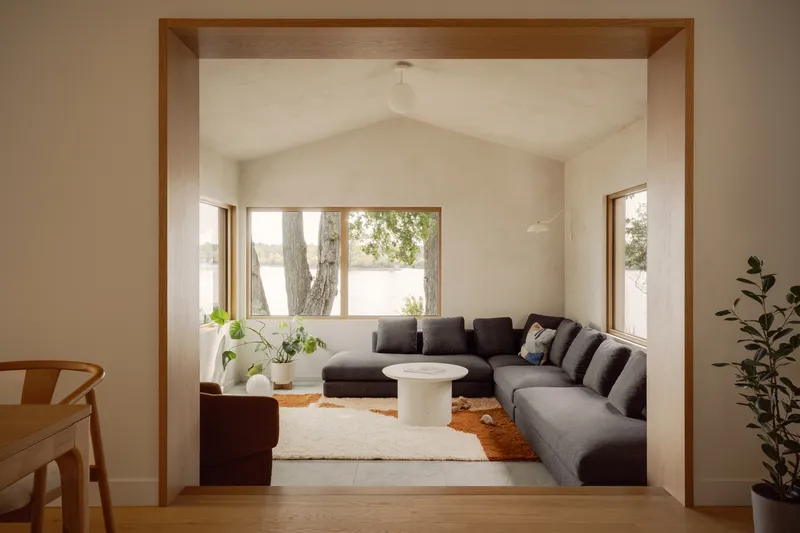
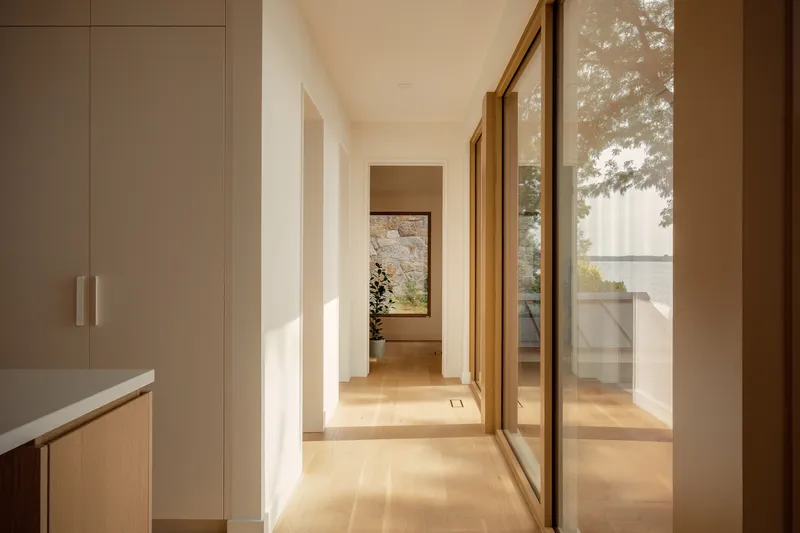
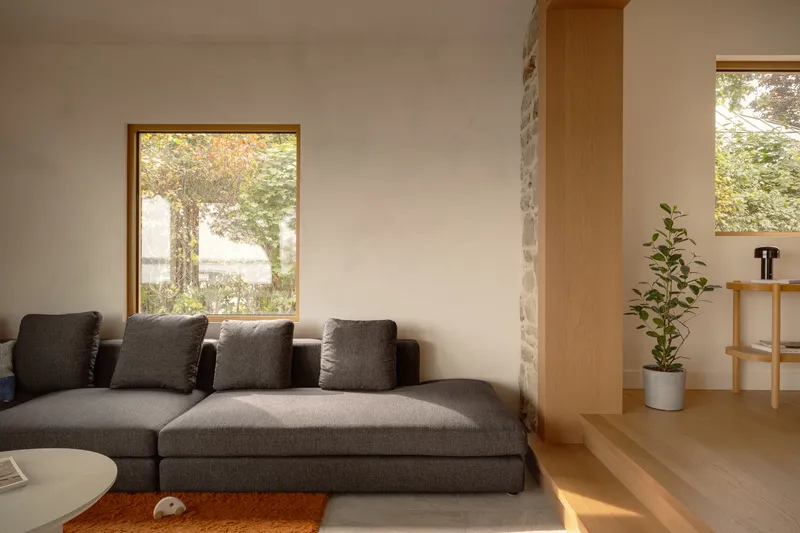
The oak portal system is the single most consequential design move in the house. In the living room, a timber frame defines the transition from circulation to gathering space, its proportions echoing the vaulted white ceiling above a generous sectional sofa that faces the lake. Along the hallway, full-height glazing is set within these same timber frames, turning a corridor into a gallery of water views. The frames compress and release space in a rhythm that heritage walls alone could never achieve.
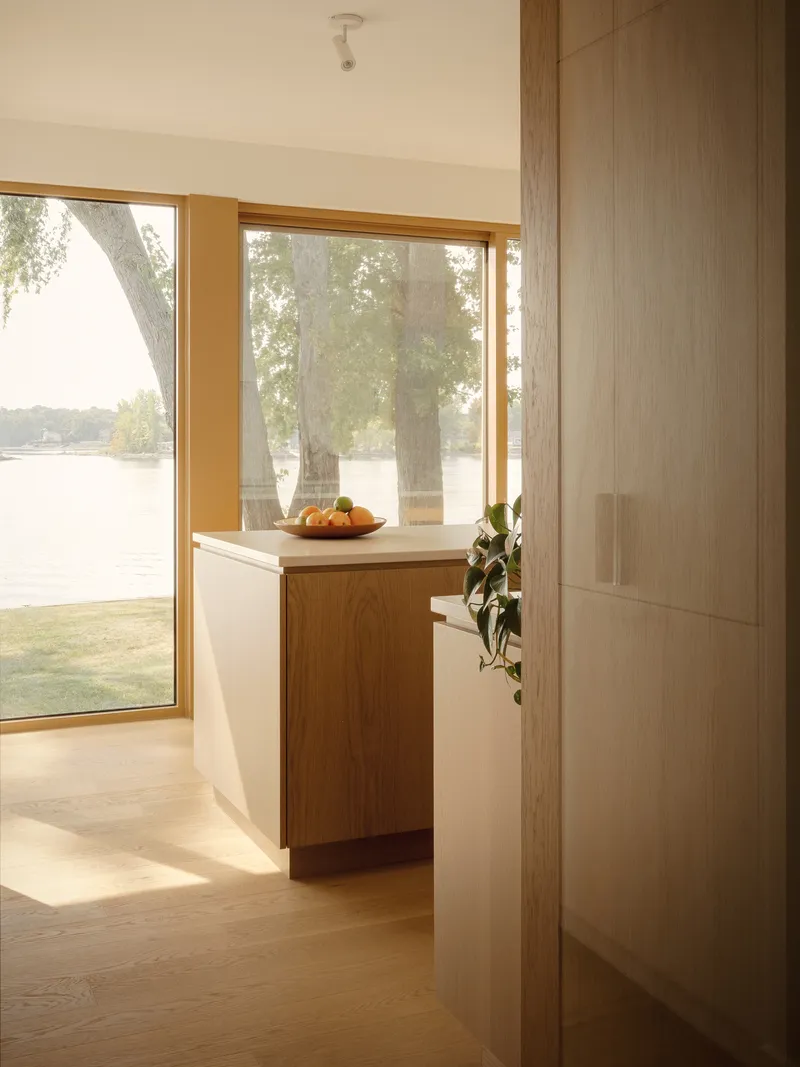
Critically, the portals also control light. Afternoon sun enters through the lakeside glazing and is sliced into strips by the timber mullions, casting shadow patterns across pale floors. It is a simple effect, but it transforms a hallway from a passage into a destination.
Kitchen and Dining: Material Warmth
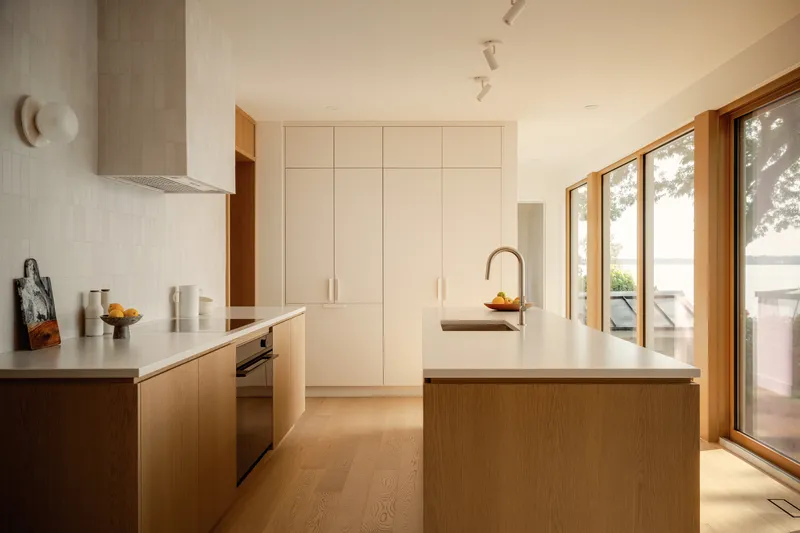
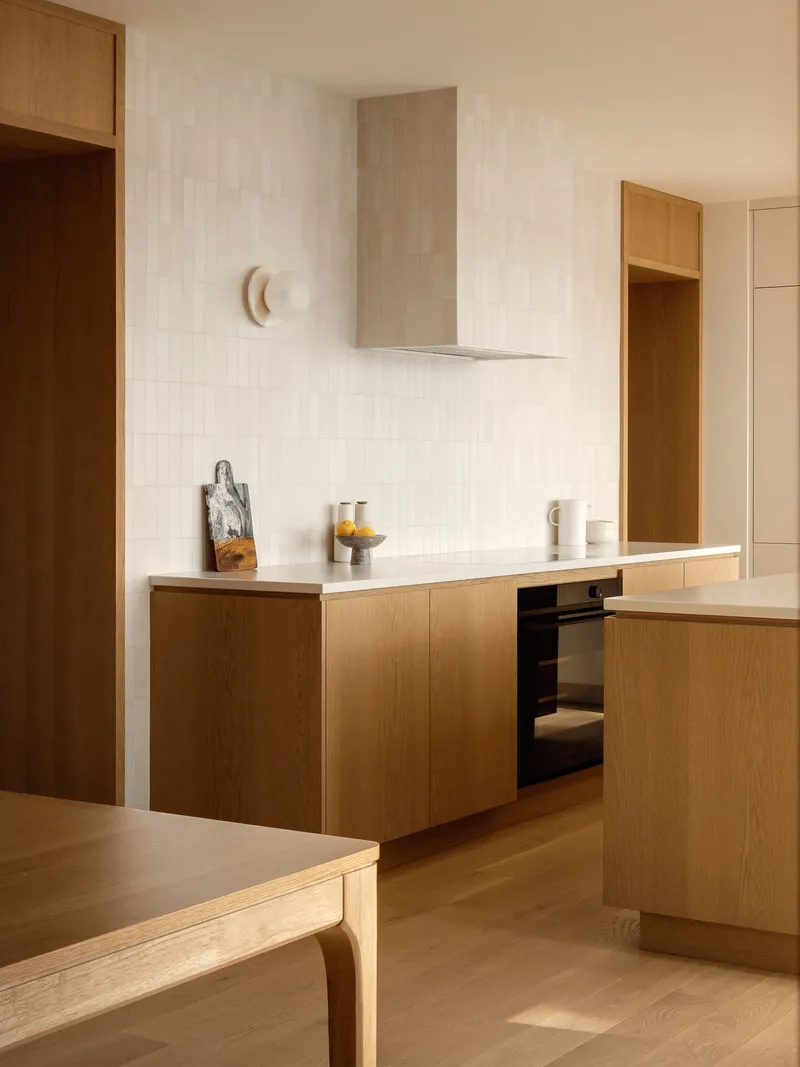
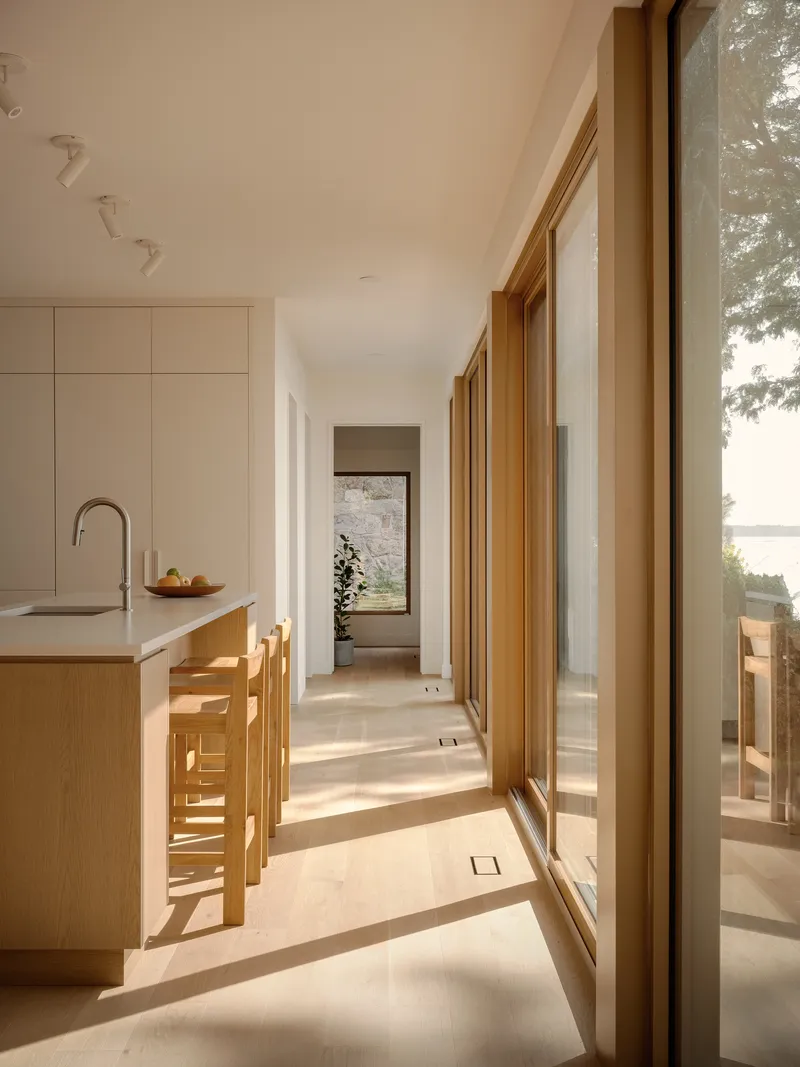
The kitchen is where the renovation's material palette comes into sharpest focus. Oak cabinetry sits below white countertops, and a vertical tile backsplash adds a textural layer without competing with the wood grain. Glazed doors open directly to the waterfront, collapsing the distance between cooking and landscape. Morning light filters through timber-framed glazing in the adjacent corridor, landing on white cabinetry in a way that makes the kitchen feel both contained and open.
The dining area, viewed through one of those signature timber openings, places an exposed stone wall and fireplace at the focal point. It is the room where heritage mass and contemporary lightness coexist most comfortably: stone absorbs sound, oak radiates warmth, and the fire anchors the composition.
Living with the Fireplace Wall
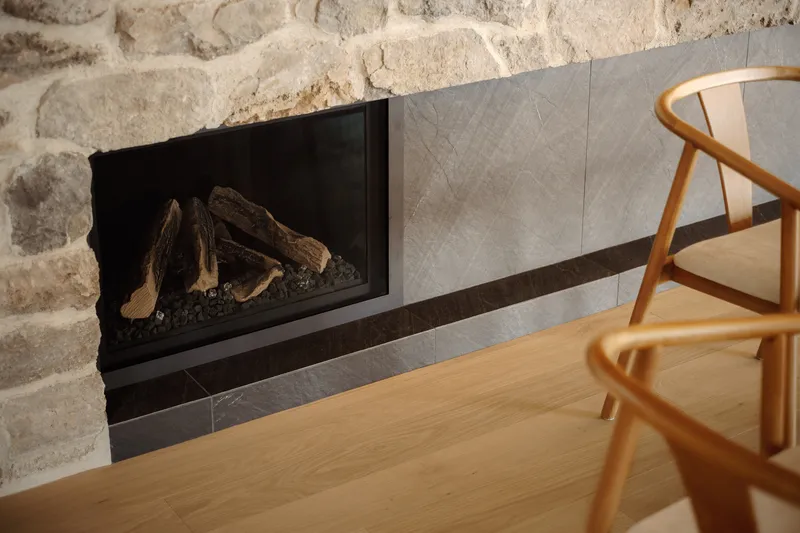
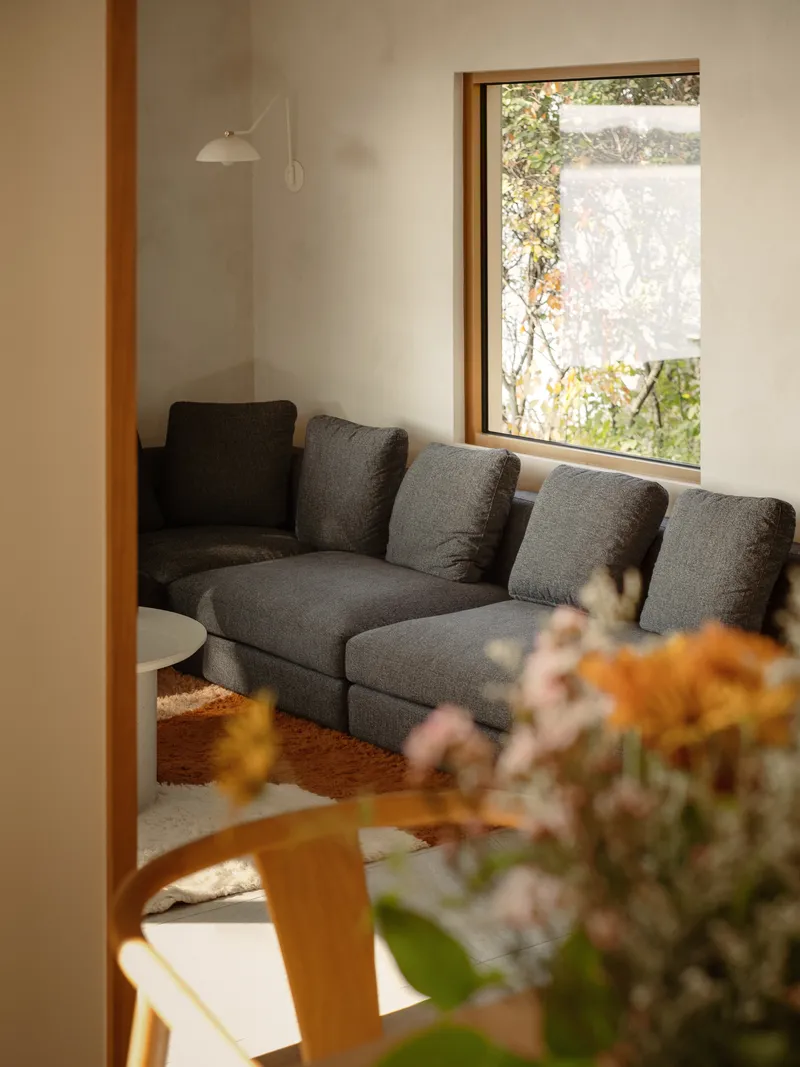
A gas fireplace insert, framed by grey stone tiles and set into the sandstone wall, is a quietly radical detail. Rather than carving out a new opening or importing a freestanding unit, MAJ calibrated the insert to sit flush with the existing masonry, letting the two stone tones create a figure-ground relationship. A timber chair beside it reinforces the domestic scale. Elsewhere, a drawn shade softens daylight onto a sofa, and a vase of flowers on a ledge suggests that this is a home designed for the slow accumulation of everyday rituals, not just for photographs.
Upper Floor: Bedrooms and the Oak Threshold
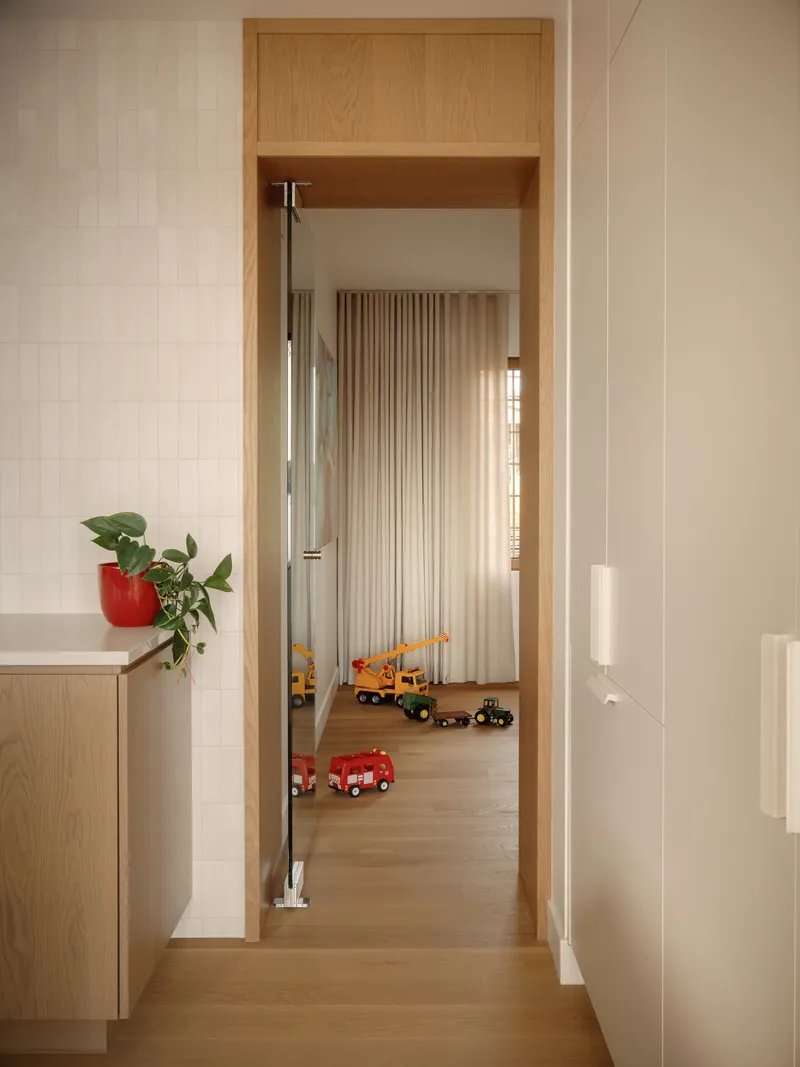
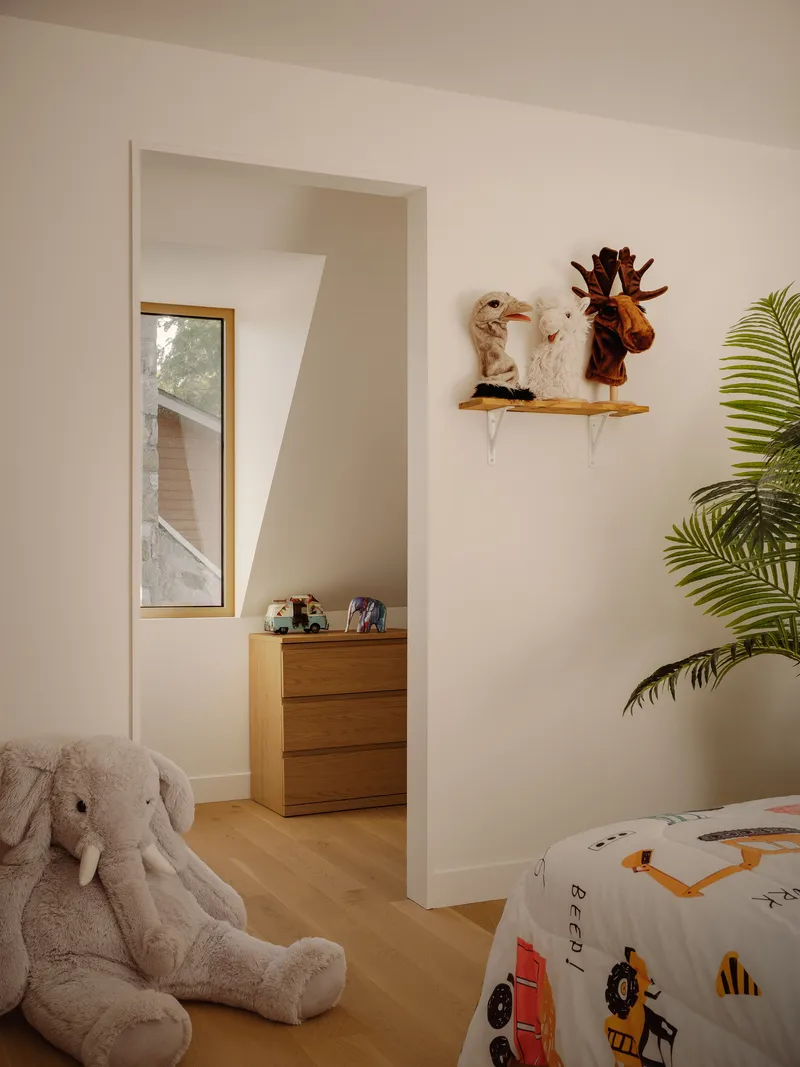
Upstairs, the oak-lined doorways continue, framing glimpses into bedrooms where fluted curtains filter light and children's toys scatter across timber floors. These are deliberately understated rooms. The architecture does its work at the edges: a narrow vertical window punctuates an otherwise blank white wall, and a hallway storage cabinet in oak sits against a lakeside window, its grain matching the frames throughout the house. Consistency of detail, not spectacle, is what holds the upper floor together.
Attic Bathrooms: Brick, Skylights, and Ceremony
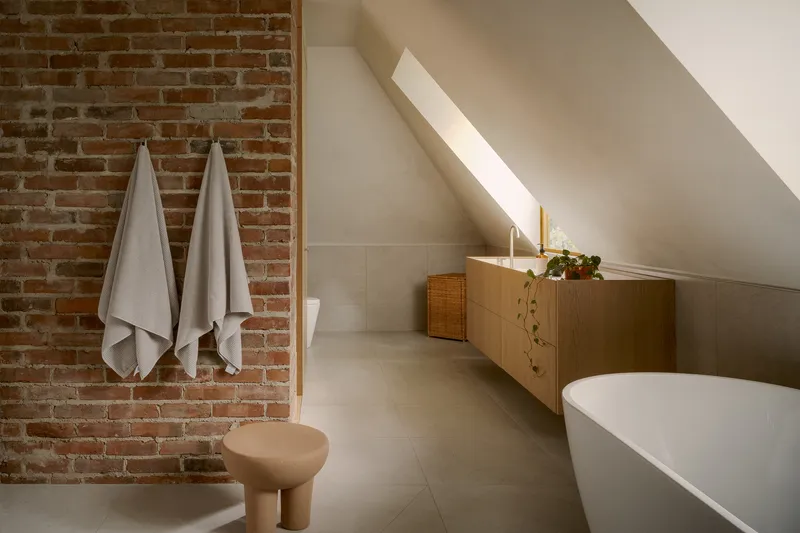


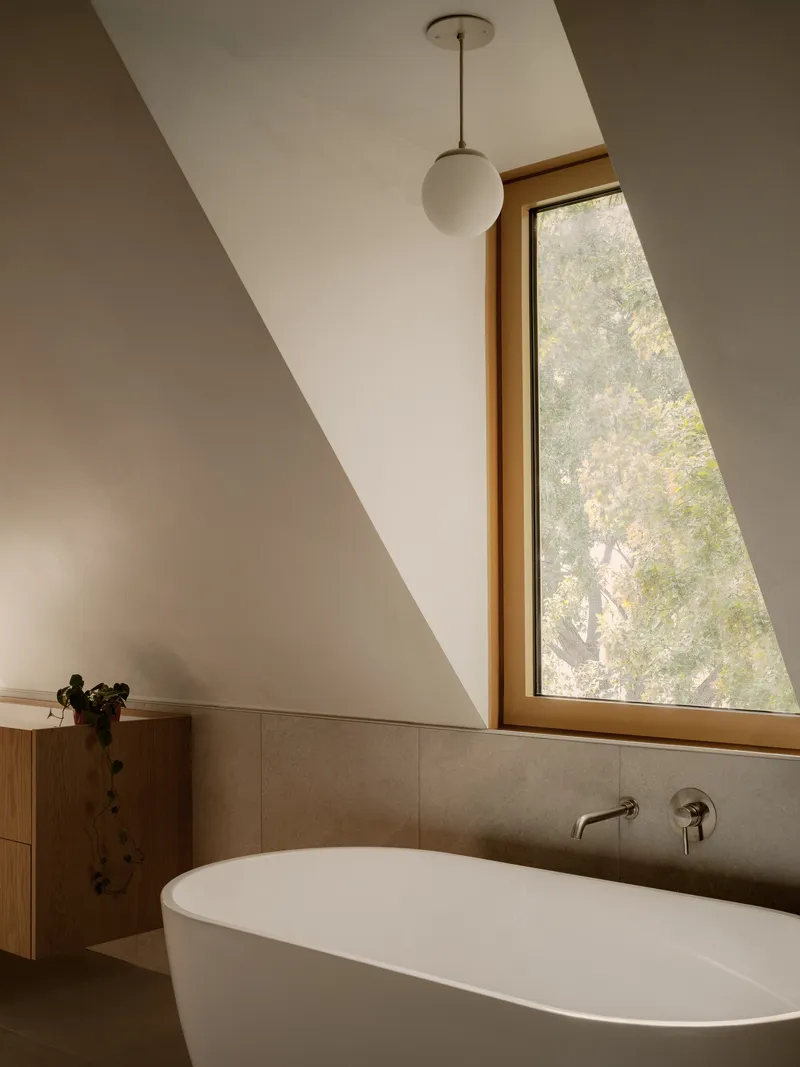
The attic level is where MAJ takes the most liberties. Exposed brick walls and columns meet linear skylights that slice across the ceiling plane, introducing controlled strips of daylight into rooms that would otherwise be dim. A freestanding bathtub sits beneath one of these skylights, a deliberate staging of the bathing ritual. The triangular geometry of the roof becomes an asset rather than a constraint.
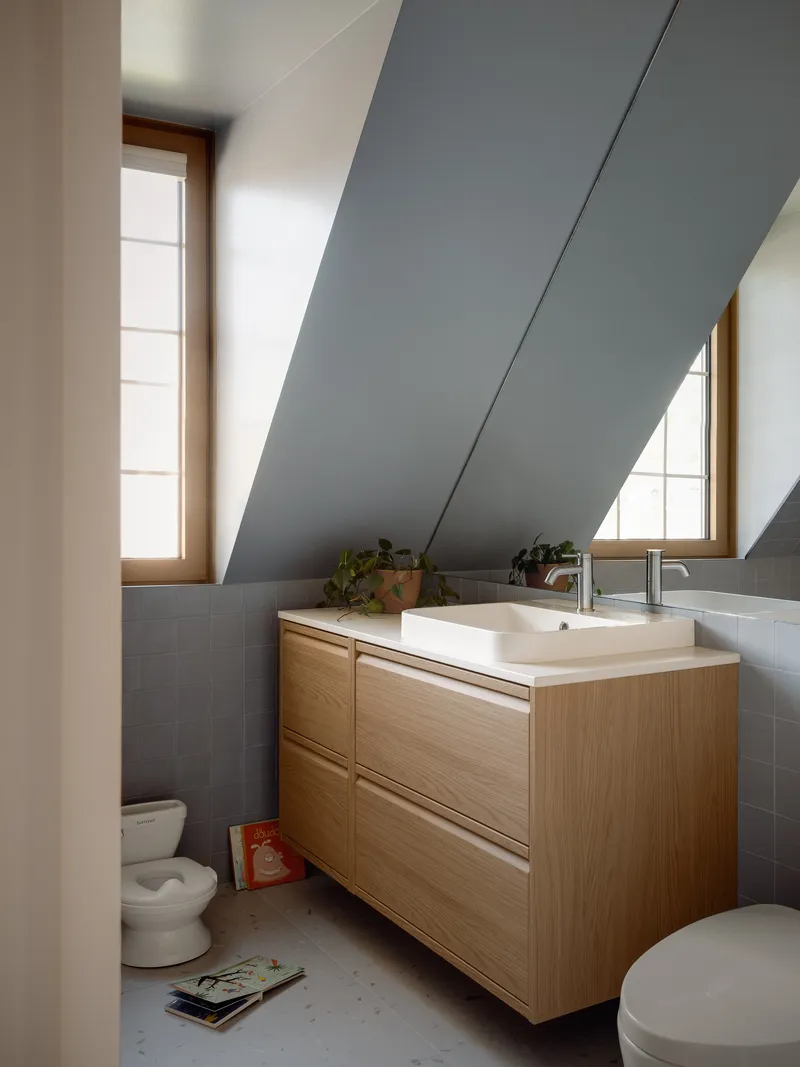
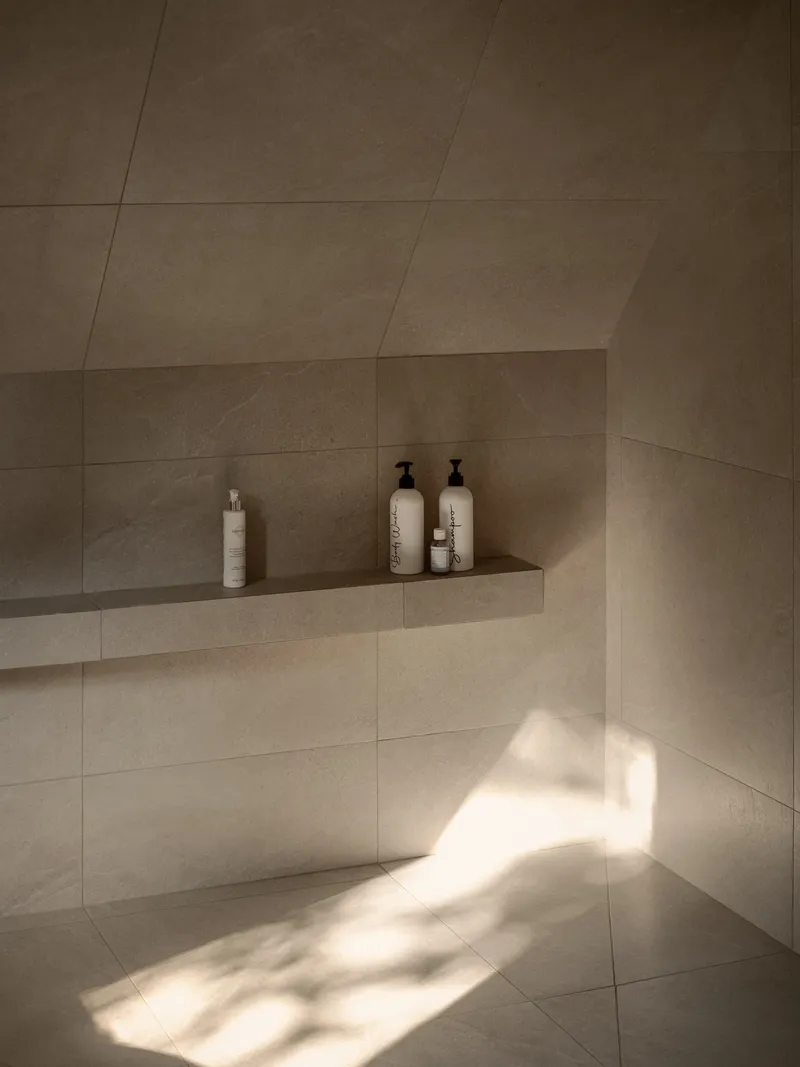
In the shower enclosure, dual rainfall heads are set against brick alongside large-format stone tiles, creating a textural contrast that feels almost geological. A recessed niche catches filtered sunlight across its surface, turning a shelf for shampoo bottles into a small moment of beauty. Even the vanity, tucked under a sloped grey ceiling with an angled skylight above, treats utility as an opportunity for spatial drama.
Circulation: The Staircase as Spine
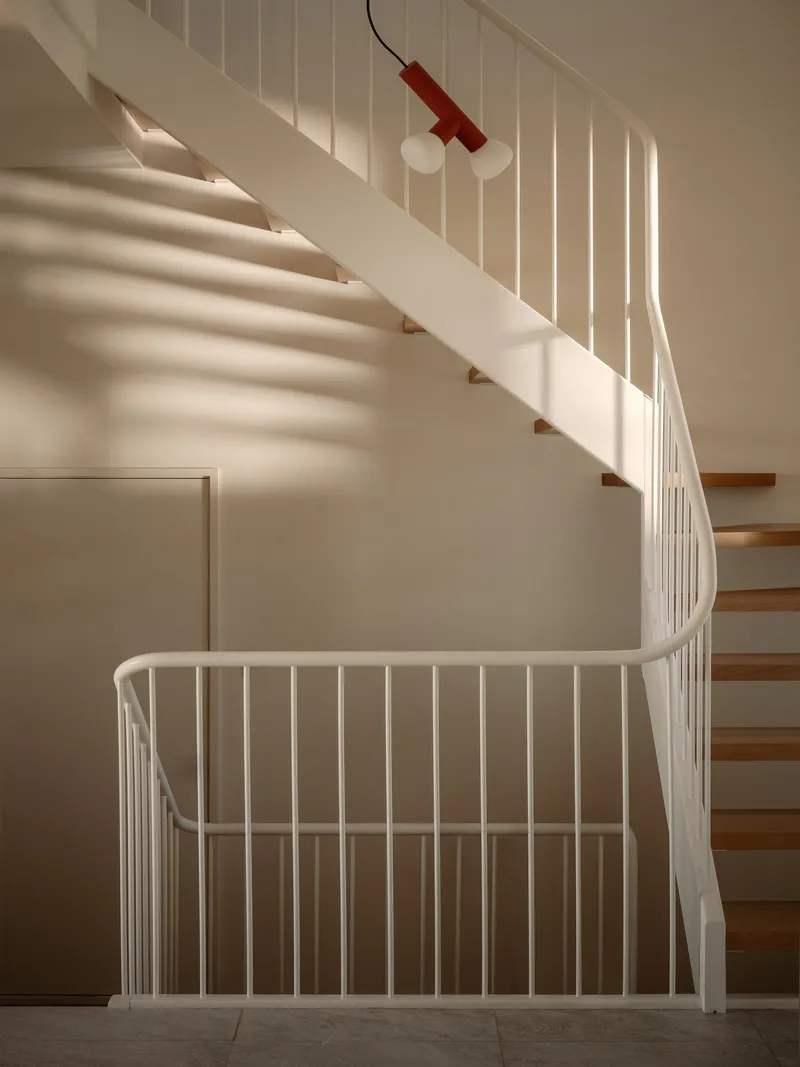
The curved staircase with its white metal balustrade and timber treads is the vertical spine of the house. A red pendant light at its apex is the only bold color gesture in the entire project, and it works precisely because everything else is restrained. The staircase connects the stone-walled ground floor to the brick-walled attic, and its form curves where the heritage walls are straight, a counterpoint that keeps the circulation from feeling like a leftover space.
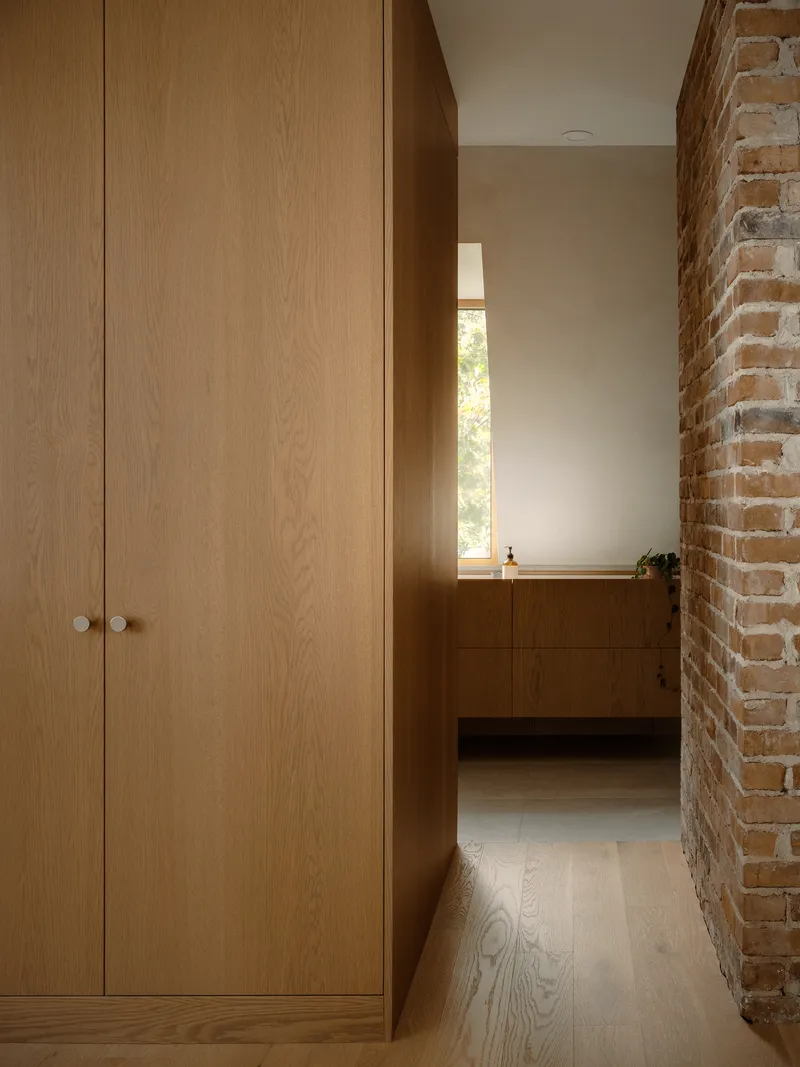
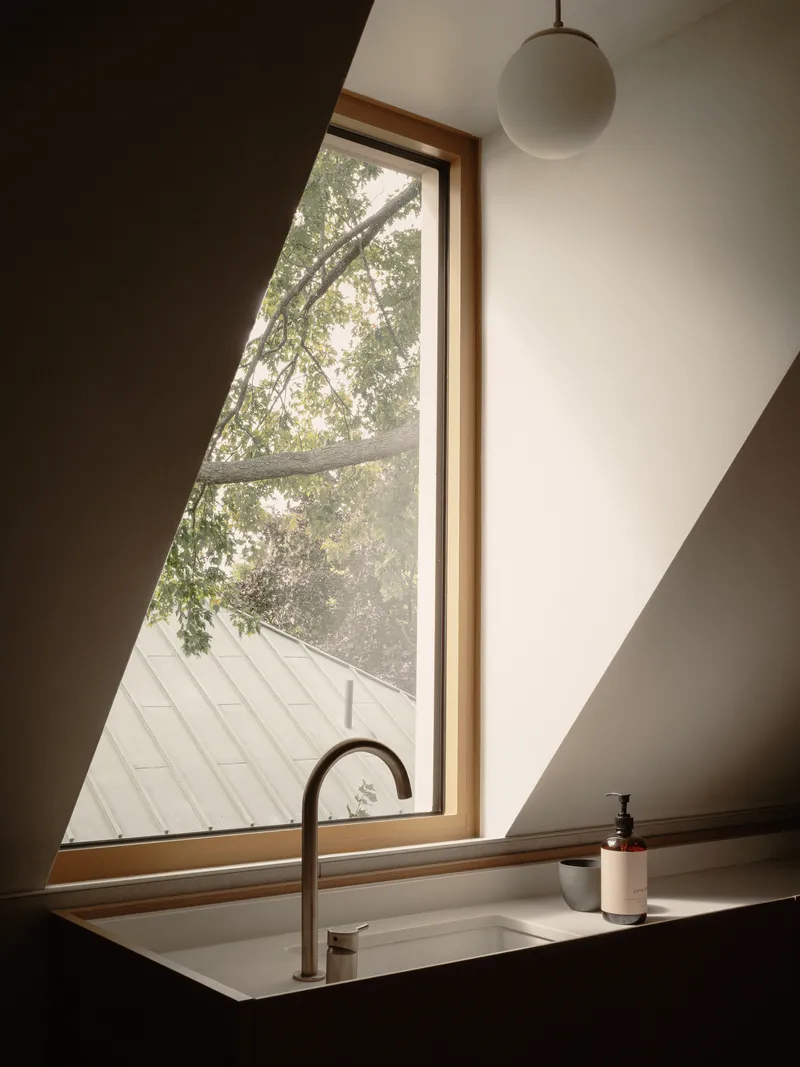
Along the narrow hallway on an intermediate level, oak cabinetry lines one side while exposed brick occupies the other. An angled window with a timber frame above a recessed sink looks out to tree branches. These are small moves, but they accumulate into an experience of the house as a place where every turn offers a considered view.
Plans and Drawings
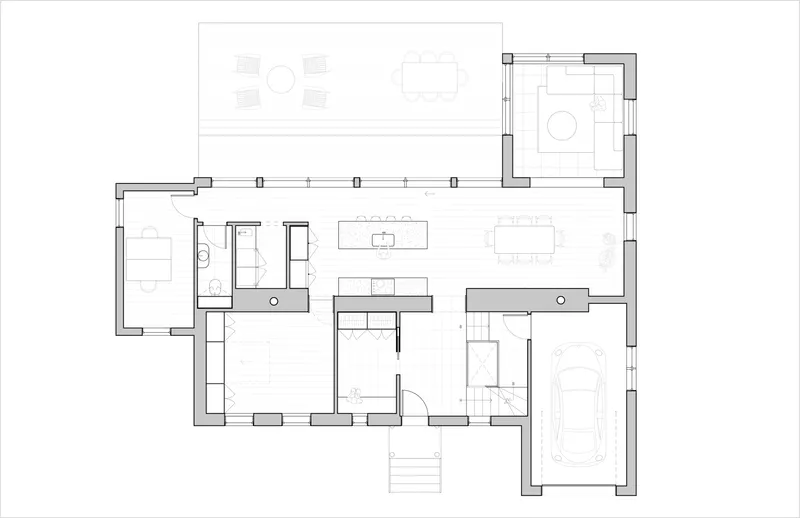
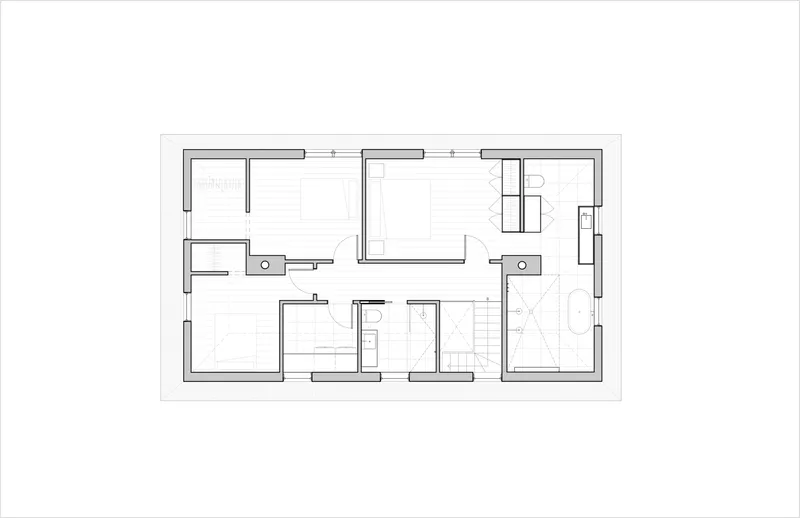
The ground floor plan reveals the logic behind the portal system: living areas, kitchen, and dining room are organized along the waterfront edge, with a garage and study room anchoring the street side. The upper floor distributes bedrooms around a central staircase, maintaining a compact footprint that respects the heritage envelope. What the plans make clear is that MAJ did not extend the house; they reorganized it, finding openness within existing walls rather than pushing beyond them.
Why This Project Matters
Heritage renovation in Canada often defaults to one of two modes: the museum approach, where every original element is preserved under glass, or the gut-and-fill, where only the facade survives. From the Shore Residence refuses both. MAJ kept the stone, kept the roof, kept the proportions, and then introduced a contemporary language of oak portals and linear skylights that is clearly of its own time. The two registers coexist without pretending to be the same thing.
The project also makes a quiet argument about domesticity. In a market saturated with open-plan renovations that treat the entire ground floor as a single volume, this house maintains thresholds. Rooms begin and end. Views are framed, not panoramic. The result is a home that rewards movement through it, where the act of walking from kitchen to living room or climbing from bedroom to bath is an experience shaped by material, light, and proportion. That is what good renovation work should do: not erase the past, but give it a reason to keep standing.
From the Shore Residence by MAJ (Mise à Jour), Sainte-Anne-de-Bellevue, Montreal, Canada. Category: Houses, Renovation. Photography by Félix Michaud.
About the Studio
Share Your Own Work on uni.xyz
If projects like this are the kind of work you want to make, uni.xyz is a place to publish your own, find collaborators, and enter design competitions.




Popular Articles
Popular articles from the community


Hill & Cross Opera: Sculptural Opera House Architecture Shaped by Tallinn’s Landscape and Identity
Hill & Cross Opera reimagines opera house architecture in Tallinn through its sculptural hill, civic plaza, glass wave and a luminous cross.
EW PARK: Sustainable Architecture Reimagines the Future of Urban Parking
EW PARK reimagines city parking as a modular wooden tower combining automation, solar energy, electric mobility, and adaptable urban design.

Conexión: Biophilic Design Reimagines High-Rise Living in Hong Kong
Conexión reimagines high-rise living in Hong Kong through biophilic design, green facades, shared spaces, daylight, water and nature within.

The Earth Pod: 3D Printed Homes for Resilient Refugee Communities
The Earth Pod reimagines refugee housing through 3D printed homes made from clay, combining resilience, self-sufficiency, and rapid shelter.


Similar Reads
You might also enjoy these articles

Bao Huynh Watercolor Atelier: A Serene Art Retreat in Hội An
Bao Huynh Watercolor Atelier in Hội An blends multifunctional art spaces, sustainable design, local materials, and family-friendly living in a serene environment.

Atelier Macri Concept Store Interior Design by CASE-REAL
Atelier Macri store features a "ko" counter, walnut wood details, cork displays, blending retail, gallery, and seamless customer experiences.

Manuel Vargas Izquierdo Stadium and High-Performance Sports Center: Architectural Excellence in Jalpa de Méndez
The Manuel Vargas Izquierdo Stadium blends sustainable design, inclusive sports facilities, and cultural-inspired architecture, revitalizing Jalpa de Méndez’s public spaces.

KAKR Buluh Awar Hall: Revitalizing Community and Ecology Through Bamboo Architecture
Community built bamboo hall revitalizes Buluh Awar village, empowering youth, restoring ecology, celebrating vernacular craftsmanship through sustainable architecture and culture.


Explore Architecture Competitions
Discover active competitions in this discipline


Challenge to design mud housing for contemporary communities


Challenge to reimagine the Iron Throne


Photograph architecture without architects


Illustrate the lost glory of Angkor Wat - Render Challenge
Comments (0)
Please login or sign up to add comments
No comments yet. Be the first to comment!