

Future Brownfield, Hendon: Steering Contaminated Groundwater Through Wetlands Toward a 2050 Landscape
Ding Ruoyu reroutes polluted groundwater beneath Hendon's former industrial zone through bioswales, wetlands and planting that slowly cleans the ground.


Most brownfield schemes start by asking how to contain the poison. Future Brownfield asks where it wants to go, then builds a landscape along that route. The project accepts that contamination beneath Hendon already moves with the groundwater, drifting toward low ground. Rather than fight that current, the design bends it through bioswales, wetlands and root systems so the site filters itself over time.
Developed by Ding Ruoyu, the proposal is a reclaiming plan for the former industrial zone of Hendon in South Australia. Decades of industrial discharge have left toxins in the soil, groundwater and vapour layers, and the scheme treats that damage as the starting brief for a productive, publicly accessible landscape. Every layer is calibrated against Adelaide's projected conditions in 2050, so the plan works as long-term infrastructure, not a one-off cleanup.
Reading the Ground Before Drawing on It

The analysis board shows how much of the design comes from diagnosis. A groundwater section traces how pollutants have migrated toward lower elevations and pooled in basin areas next to surrounding neighbourhoods. Mapping of PCE, TCE, DCE and TDS levels turns an invisible problem into a legible gradient, and climate charts and a sewer plan add Adelaide's future pressures to the picture. The strategy flowchart linking soil, water and contamination is the key drawing: it frames the site as connected systems, which is why the later interventions read as a chain rather than a collection of features.
This rigour matters because surface-level remediation often moves pollution somewhere else. By setting out the hydrology first, Ding Ruoyu earns the right to design with it, and the population and ageing projections on the board point toward the social programme that follows.
Bioswales and Contours That Redirect the Flow

The hydrology plan sits at the centre of the project, with a site plan ringed by detail circles that zoom into specific moments. Engineered bioswales change the direction of groundwater flow and slow contaminated movement before passing water into constructed wetlands. Subtle micro-topography does quiet but decisive work: small contour shifts set up gravity-driven flow that guides contamination toward reclamation zones without pumps or heavy engineering.
The wetland sections show these basins as living purification systems that reduce salinity and filter toxins through their root zones. Rainwater harvesting and groundwater recharge complete the loop and reduce reliance on municipal supply. A music fountain appears among the detail circles, an early sign that the water infrastructure is also meant to be a place people visit.
Roots as Filtration Membranes

The planting board treats species selection as an engineering decision. Native and salt-tolerant plants carry out phytoremediation, and their roots act like biological membranes that improve soil structure and limit the spread of pollutants. The olive-toned site plan shows vegetation spread across the whole terrain rather than collected into ornamental patches, which matches the idea that the entire ground surface does remedial work.
The four circular vignettes of walkers beside water are a useful counterweight to the diagrams. They show that the reward for patient ecological repair is an everyday experience of shade, water and movement on land that was once off-limits.
Raised Planters, Yoga Lawns and a Place to Sketch

Beyond repair, the masterplan sets up a layered greenland system organised by service radii and community zones. The scenery board makes this concrete: orange raised planters with large-leaf plants, people doing yoga, a playground and a seated figure sketching. The raised planters are an apt detail for a contaminated site, lifting growing beds and seating to a comfortable height, which suits the ageing population the project expects in Adelaide.
The emphasis on accessibility is the social argument of the scheme. Green infrastructure here is not a buffer people look at from the edge; it is public space built for daily, unhurried use by residents of every age.
Water Made Visible in Glass Columns

The fountain board brings the hydrological story to the surface. A rendering of glass water columns and a heart sculpture sits above stacked diagrams of fountain flow forms, showing water moving in controlled, legible shapes. After a project spent mostly underground, among plumes, swales and roots, this piece gives the public a direct view of the substance the whole landscape is organised around.
It also works as a quiet piece of advocacy. As Adelaide's projections point toward greater dependence on recycled stormwater and desalination, a fountain that celebrates managed water helps residents understand reuse as part of civic life.
Why This Project Matters
Future Brownfield shows what changes when a designer treats contamination as a moving system instead of a fixed stain. By working with groundwater direction, gravity and plant biology, the proposal aims to stabilise, filter and gradually reduce pollution rather than displace it, a more honest approach than capping the ground and hoping for the best. Its 2050 horizon pushes the design toward slow processes that improve over time instead of solutions that look finished on opening day.
Just as important, Ding Ruoyu does not let the technical work crowd out people. The same wetlands that cleanse the ground frame walking routes, the planters support older visitors, and the fountain turns water management into something to enjoy. For cities with industrial land left behind, the project offers a clear model: diagnose the hydrology carefully, let ecology carry the remediation, and give the healed ground back to the public.
View the Full Project
About the Designers
Designer: Ding Ruoyu
Enter a Design Competition on uni.xyz
uni.xyz runs architecture and design competitions year-round that reward proposals with spatial conviction and real site intelligence.
Project credits: Future Brownfield, by Ding Ruoyu.


Popular Articles
Popular articles from the community


David Ortega Stacks a Two-Story Mexico City Penthouse Around a Steel Stair and a Pergola-Shaded Roof Terrace
In Colonia Roma, a 300 m² penthouse uses oak joinery, a planted steel stair and a slatted roof pergola to make a new-build apartment feel like a house.

Jaramillo Van Sluys Arquitectura and Urbanismo Turn a Demolished Registry Lot in Quito into an Orchard Plaza
In Quito's Centro Histórico, a 2,800 m² plaza exposes the San Agustín convent wall and redraws its lost Augustinian orchard in volcanic stone.

Juan García Correa, John González and Claudia Rueda Sink a Circular Amphitheater into a Manizales Engineering Building
On the La Nubia campus in Manizales, Colombia, the S1 Building folds labs and offices into a hillside of ramped lawns that double as a campus route.

Cube Design Draws an Ecological Corridor Between Two Shenzhen Hills with the Nankai Building
Beside Shenzhen's container docks, the Nankai Building pairs stacked balconies with a climbing green screen to connect two hillsides across its height.

Similar Reads
You might also enjoy these articles
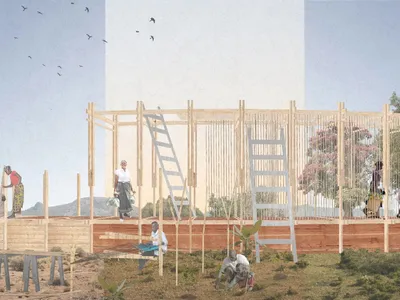
Healing Façade: A Modular Chapel System That Restores Ethiopia's Sacred Forests
Winner of the Eco-Chapel competition, this circular timber façade collects water from air to rebuild soil and reforest degraded Ethiopian landscapes.
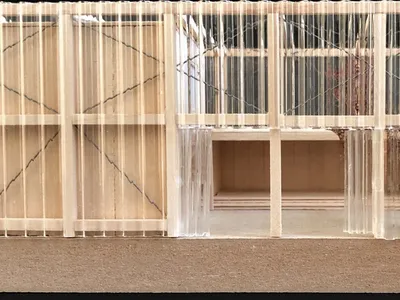
Kaffeebühnen: Where Coffee Shop Architecture Becomes a Civic Stage in Vienna
A linear sequence of timber boxes, transparent shells, and open yards turns the Viennese café tradition into a public performance space.
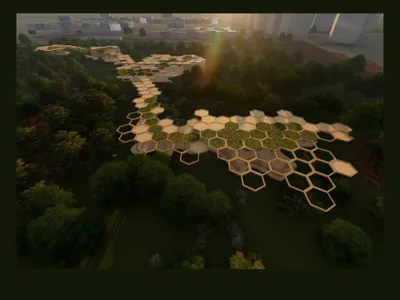
Eco Chapel: A Modular Forest Pavilion That Grows Like the Landscape It Protects
Hexagonal timber modules weave through existing trees, turning a chapel into a living system for prayer, education, and reforestation.


Urban Forest: A Vertical Ecosystem for 5,000 Workers in Singapore's Changi Business Park
Radially stacked pods and layered green decks turn a 7-acre plot into 47 acres of ecological workspace projected for 2040.

Explore Architecture Competitions
Discover active competitions in this discipline

Challenge to reimagine the Iron Throne

Photograph architecture without architects

Illustrate the lost glory of Angkor Wat - Render Challenge

Design challenge to reuse E-waste
Comments (0)
Please login or sign up to add comments
No comments yet. Be the first to comment!