
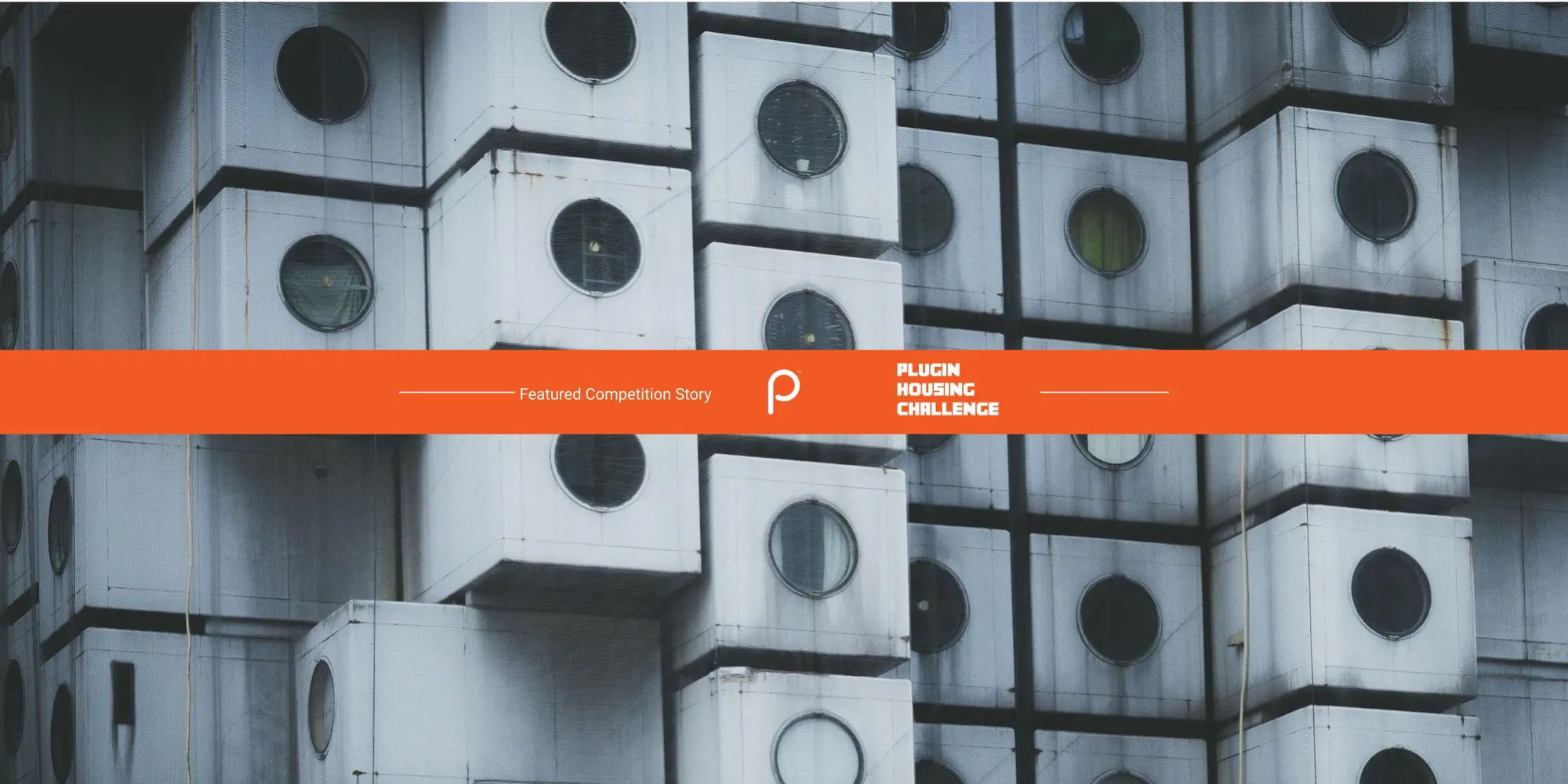
Plugin Housing Challenge - Jury panel interview
Future of Urban-Housing


The scarcity of land as a resource is increasing day by day, fueled by population growth. At the same time, the migration of a large number of people towards dense urban areas is also increasing. This has inevitably generated the need for affordable compact housing options and designs that can optimize good living standards in a limited area.
In the wake of this issue, “Classroom Competitions” has launched a Plug-in housing challenge that aims to discover new-age designs for housing that has adequate space utilization in a limited area. The Lead Jurors from the Panel have shared their perspectives on the same.
1. How do you envision the future of compact housing for the masses?
The term “micro-housing” is an established reality, the question one should be aiming to answer is if this housing model is what we want to offer to the generations to come.
What if these ideas will be criticized, as Le Corbusier’s ones are being criticized now, by the architects of 2100? Would this model work?
Our vision is to join social disciplines with public policies and a greater understanding of the urban. Social problems push us towards the mass production of compact housing.
-Alejandro Guardado
Now when the world population is growing, demand for affordable housing is rising. There are many reasons why Compact architecture is a growing trend. First of all modern architectural tendencies strive to reduce ecological impact, build a self-sufficient home and live sustainably. I think that future architecture will be influenced by the architectural tradition of Metabolists Kisho Kurokawa, Arata Isozaki, Archigram, Yona Friedman and other great architects bringing ideas and forces of gravity into reality. Modern technologies give us the possibility to construct the cities like “Plug-in city” by Peter Cook or “Spatial City” by Yona Friedman.
-George Sakvarelidze
The need to provide quality spaces for everybody with limited resources is inevitable. While leaving behind common connotations of the architecture of the last century, we have to achieve quality through new strategies and morphologies. While using even more sustainable materials like wood, we can build in a more raw and simple way and can achieve new esthetics with less economical outlay. The use of renewable materials and running the buildings through renewable green energy is inevitable, while cutting the individual traffic. The car in a city is a relic of the past. We will have to focus on providing infrastructure, green spaces and common public space in these areas. Density demands very thorough handling of these actors.
-Gus Wüstemann
2. How have the basic amenities that comprise a living space for individuals changed from the past?
A recent study at (The Wall Street Journal) shows through heat maps, that spaces that we used to use as gathering points are no longer in use. Before a basic need was to have a place to cook, now is a place where you can get wifi. The digital era offers much more variety of spaces and of easier Access making our life “more comfortable”, leaving aside spaces like the kitchen. We prefer digital consumption.
-Alejandro Guardado
The shrinking of living space is derived from Socioeconomic circumstances. Compact living has many benefits: construction time, reduced construction costs, monthly expenses, and becoming environmentally friendly. Now people are more concerned about resource consumption and waste production. Tiny house helps you to stay environment friendly, while you for example build with recycled shipping containers, collect rainwater, manage waste etc.
-George Sakvarelidze
The basic need for quality of light, air, living hygiene, common spaces and security have not changed if not increased since the past. The average used surface per person has increased. We now have to find ways to produce more quality living space on less surface per person. What has changed dramatically is the concept of today’s social life and the view that each individual can take upon the responsibility in his/her life, regarding saving energy, saving water, recycling, eating less (no) meat and cycling instead of using cars. Nowadays people get older, live better and fitter lives at the same time. The last century image of a couple getting married, having kids and getting older together is no more the only reality. People live in more flexible, individual and free situations; there are single parents, young and older singles, gay couples and patchwork families. Providing living space for all these constellations means as well smaller entities and creating more quality common living spaces, like roof terraces and green spaces on the ground level for everybody. If we provide these platforms a part of the social can again take place outside and strengthen the common life. Like our affordable housing for the Bauchi Foundation.
-Gus Wüstemann
3. How does one achieve mass fabrication/production-friendly design while leaving room for customization?
"Walter Gropius came to see me at my house at Canoas above Rio. I designed it in a sequence of natural curves to flow in and out of the existing landscape. He said, it's beautiful, but it can't be mass-produced. As if I had intended such a thing! What an idiot." By following the principle that each individual is different. Housing is not a machine for a living (Le Corbusier) The idea of designing a module with the capacity of adapting itself in an immediate way or in the long term without influencing on the development of housing in general (the user develops itself at her own rhythm) According to the context, type of population which will inhabit the housing, a previous analysis would define the configuration of the finite spaces; the decisions taken by the “inhabitant” would have been already studied and would adapt themselves at the same time to the needs of the architectural ensemble. The architectural ensemble is then a living element and it becomes a database that we feed with our customization.
-Alejandro Guardado
Already in 1972 Nakagin Capsule tower by Kurokawa was built, which exemplified the Metabolist movement. The modular building was made from pre-fabricated capsules that were designed to be added or replaced when needed. Capsules were similar, but the architectural form and scale of the building was and still is astonishing. So, I think that mass production is not an obstacle to creativity.
-George Sakvarelidze
One way to keep costs low and the quality high, while following up the above-mentioned strategies, is the model of community housing. In that, the state or city supports the community with cheap land and each family or member of this community is a co-owner, with a minimal input of capital. The buildings of these housing projects can be delivered in a total basic state. That means Structure, façade, technical installations, main walls and common spaces are finished. All the interior finishes and furniture like kitchen, cupboards, wall plaster and painting can be added by the inhabitants. Each place will look differently as the basic spaces are equal. Such an example is ‘la borda’ in Barcelona by Lacol or deFlat in Amsterdam by NL Architects.
-Gus Wüstemann
4. How can spaces be made more flexible/adaptive in such constrained areas?
We have to analyze the options that this “container” could “contain” I refer to concepts as basics as furniture or even the gadgets that make our life easier.
-Alejandro Guardado
Although it is not easy to have minimal space for creating, still it’s an interesting challenge for the designer. As said before Average Floor Area in Nakagin Capsule was 3 square meters. Still, the space was full of all necessary items. I think that Modular home designs will develop further, nowadays you can create any style without limitations.
-George Sakvarelidze
The following are some examples of an affordable Apartment designed for a couple by the team of architects from ALL ARQUITECTURA and Affordable Housing in Zurich by Gus Wüstemann and his team, which can be seen as a point of inspiration and case study for the participants of this challenge.
Title of the Project : Białołęka Flat
Project Location : Warsaw, Poland
Project Category : Residential
Project Area/Builtup Area : 36 m2
Project Duration : 2016-2017
Project Budget : 10,000.00 DLS
Project Team
- Alejandro Guardado
- Eduardo Ugalde
- Josemaria Quintanilla
- Rodrigo Guardado
- Salvador Guardado
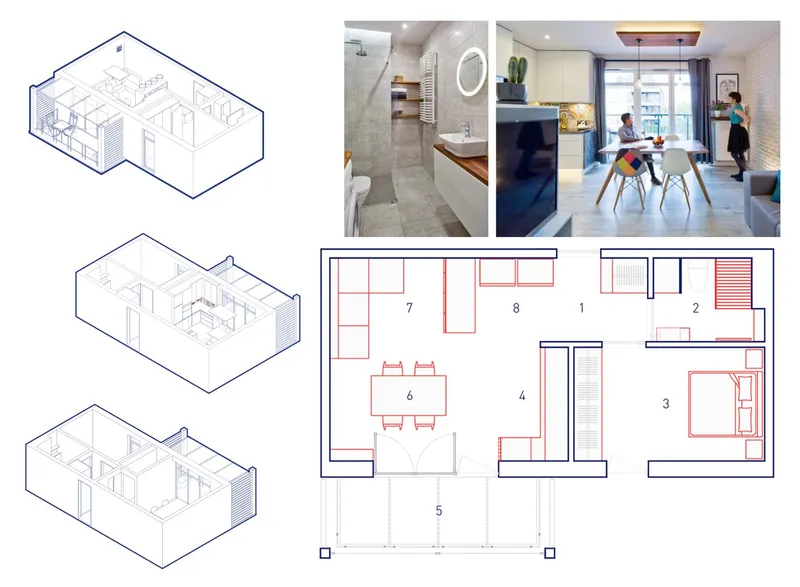
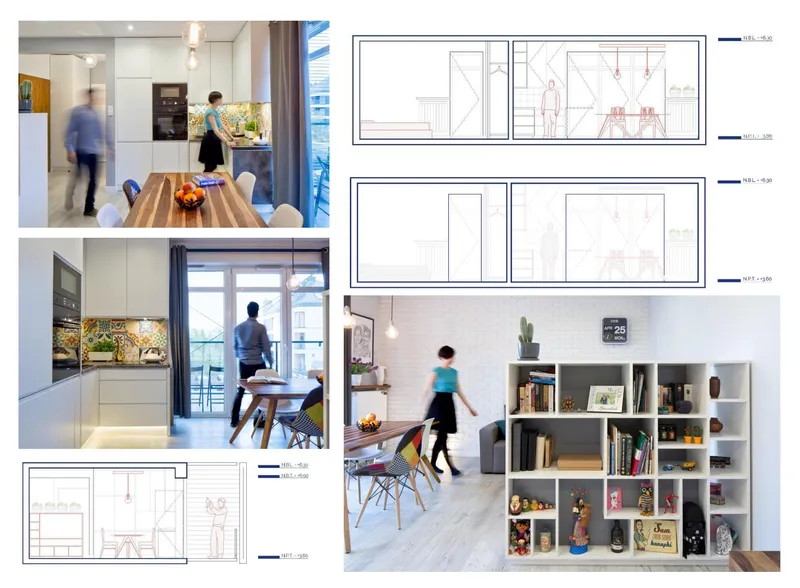
Project Description: Just after the practice participation at the Biennale of Architecture Kraków (2015), and with the intention of expanding the office in Eastern Europe, an opportunity presents itself. The challenge, to redesign a small flat in the suburbs of the Polish capital (Warsaw), this project as the first of the practice outside México. Located up north of the capital, in the district of Białołęka the interior design of a 39 sqm dwelling space. The place, first home of a young couple, that through the design looks for reflecting the vision of both. Because of the reduced spaces, one of the key points was to design all the furniture, achieving an ambience that optimizes the storage and workspaces, places like the living room, dining room and kitchen felt now integrated into one big, open and harmonious area, giving the essential comfort to the spaces removing physical barriers making the latter also unnecessary. The project is composed of colours and neutral textures, excluding some spots that highlight the finishings. The design process is experimentation, the outcome is an apartment that allows the play and multiple configurations, experimentation space and a manifest about the minimum housing.
--------------
Title of the Project: AFFORDABLE HOUSING IN ZURICH FOR THE BAECHI FOUNDATION
Project Location: Zurich, Switzerland
Project Category: Residential
Project Area/Builtup Area: 988.3 m2
Project Duration: October 2016 - January 2019
Project Budget: 3.6 Mio
Project Team
- Gus wüstemann
- Bianca Kilian – Project leading Architect
- Daniel Pelach, Architect
- Panagiota Sarantinoudi, Architect
- Valentin Kokudev, Architect
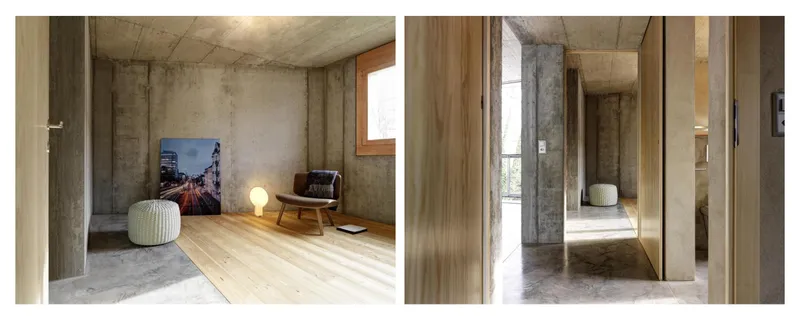
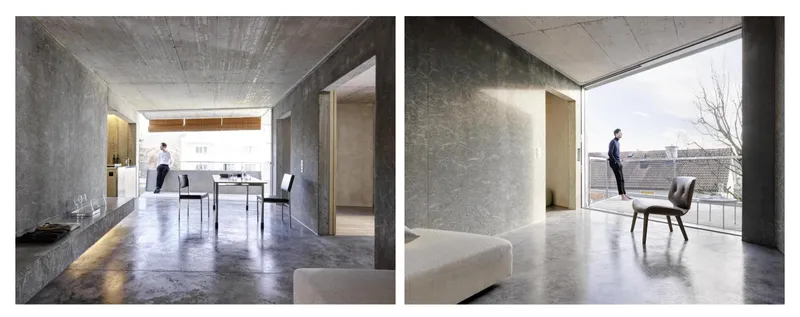
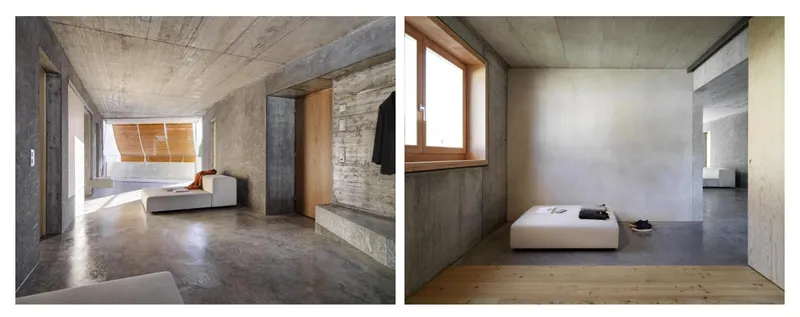
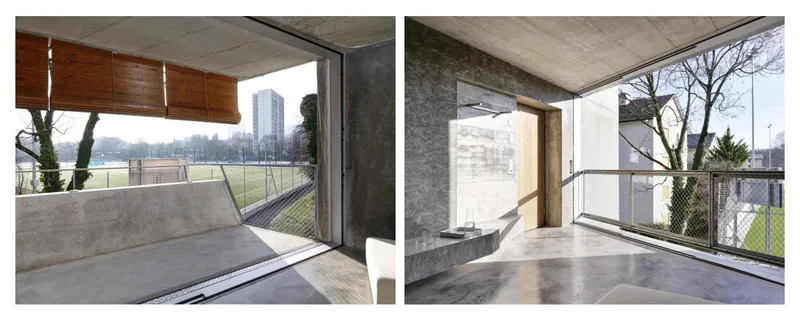
Project Description :
AFFORDABLE HOUSING IN ZURICH FOR THE BAECHI FOUNDATION
The Baechi Foundation contracted gus wüstemann architects to build a housing block in Zurich with a high living quality on a low budget.
CONTEXT
This housing project is a building of nine flats in the outer green belt of Albisrieden in the city of Zurich. The urban structure is characterized by simple linear buildings from the 1950s with generously sized gardens, which are arranged at right angles to one another. The new building is inside such a green area as part of the rising density within the city, a solitaire, in between the linear buildings.
The Baechi Foundation specifically asked for affordable housing with a great quality of living in the centre of Zurich. Natural light, privacy and a spatial moment of generosity were the focus of this project.
ETHICAL EVIDENCE IN CONTEMPORARY HOUSING - SUSTAINABILITY
The project Langgrütstrasse 107 should prove that by targeting interventions
in light and space and at the same time reducing common standards, great and lively spaces
are possible. This is without any additional economical effort.
In today's world, it takes a rethink. Sustainability in the sense of loss for the individual, but more for the community is becoming increasingly important.
In architecture, here in housing construction, we show with this project - how the shift of the focus, away from connotations and standards - to space, momentum and room quality, makes this possible. These are four two-bedroom apartments of 60m2 and five three-bedroom apartments of 95m2 each.
LOW BUDGET - ARCHITECTURE FOR EVERYBODY
The rents had to be affordable and so all the flats were rented out considerably cheap – the rent is amongst the cheapest in the city of Zurich – Architecture for a low Budget – Architecture for Everybody.
MORPHOLOGY
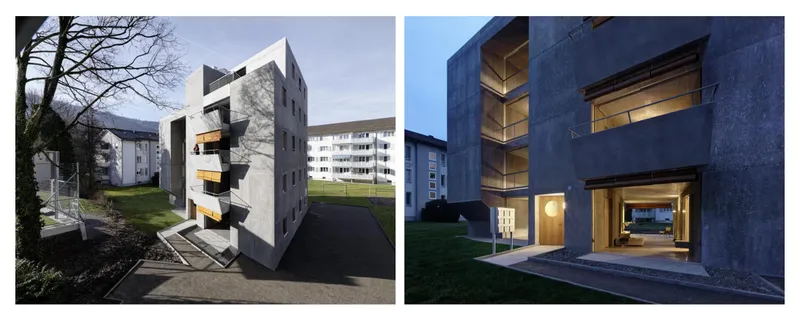
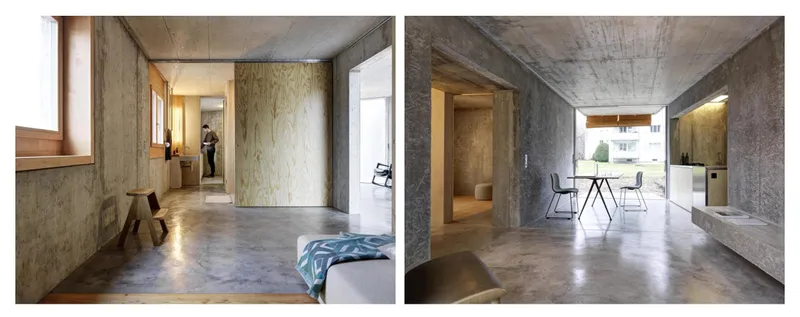
Morphologically it is a solid concrete block, organically formed, from which two courtyards were cut out. In these courtyards, the living spaces float like bridges, from the morning sun to the evening sun. A continuous space that topographically creates the feeling that the living space is an exterior space – and not an interior space filled up with housing programs.
This results in an incredible moment of magnitude in a small space.
Hence there is a generous open living space – which can be enlarged to the periphery of the balconies and sheltered by the famous wooden persianas from Barcelona.
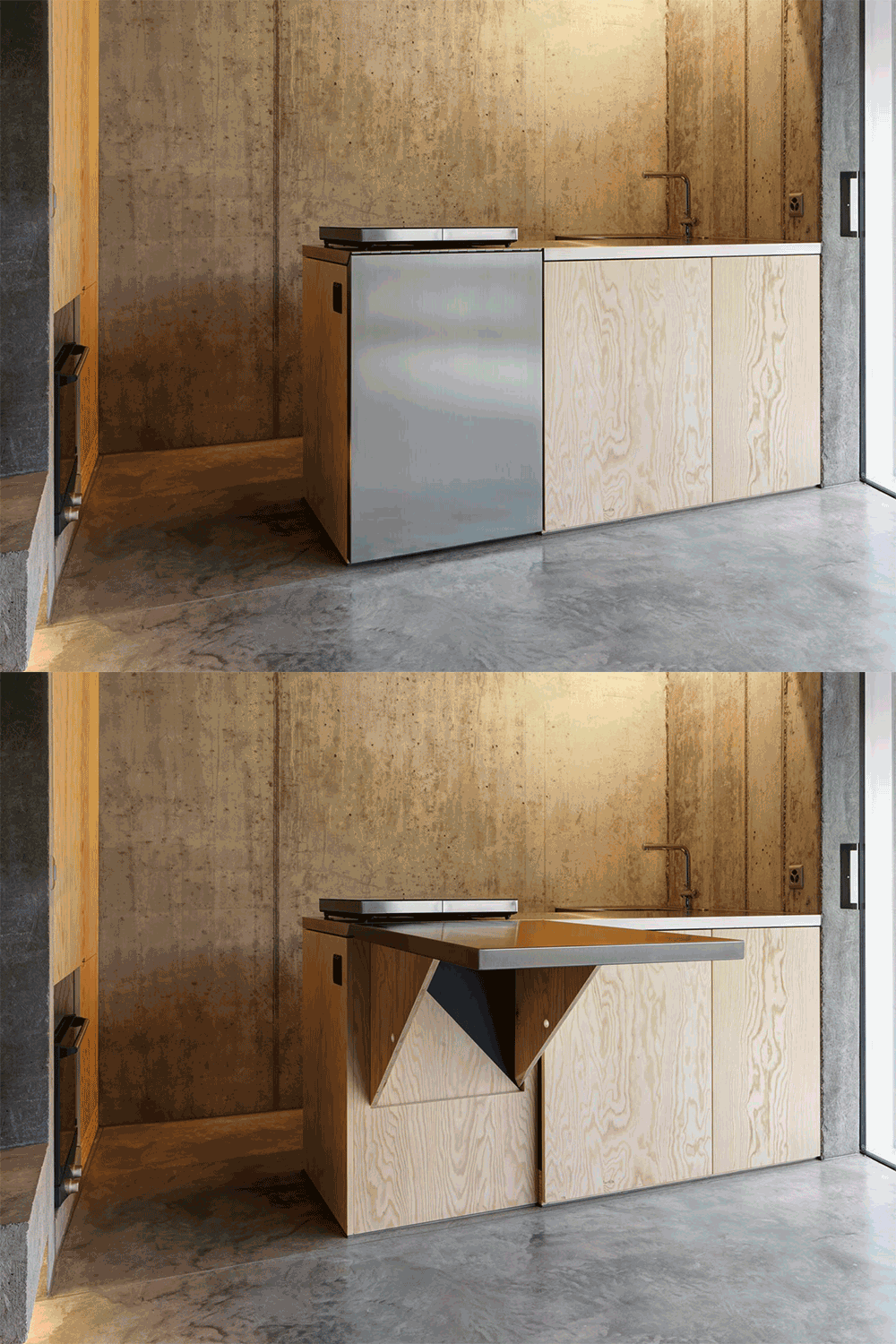
Economically optimized interventions by reducing all the technical installations of the building to a minimum – in swiss standards – we focus on a couple of interventions that add major value to the quality of the living space. These are sliding windows and a built-in bench as the communicative element of the concrete topography.
CONCRETE TOPOGRAPHY AND SENSUALITY
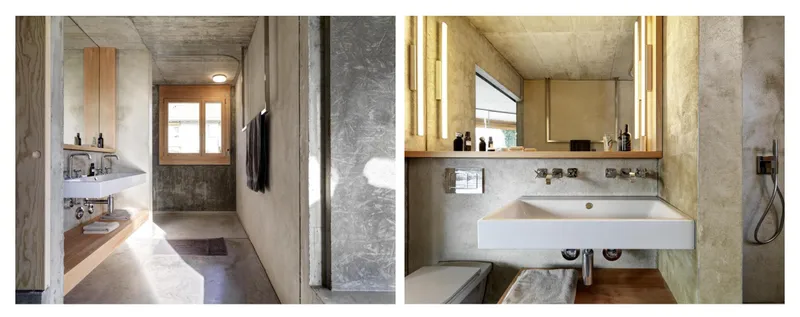
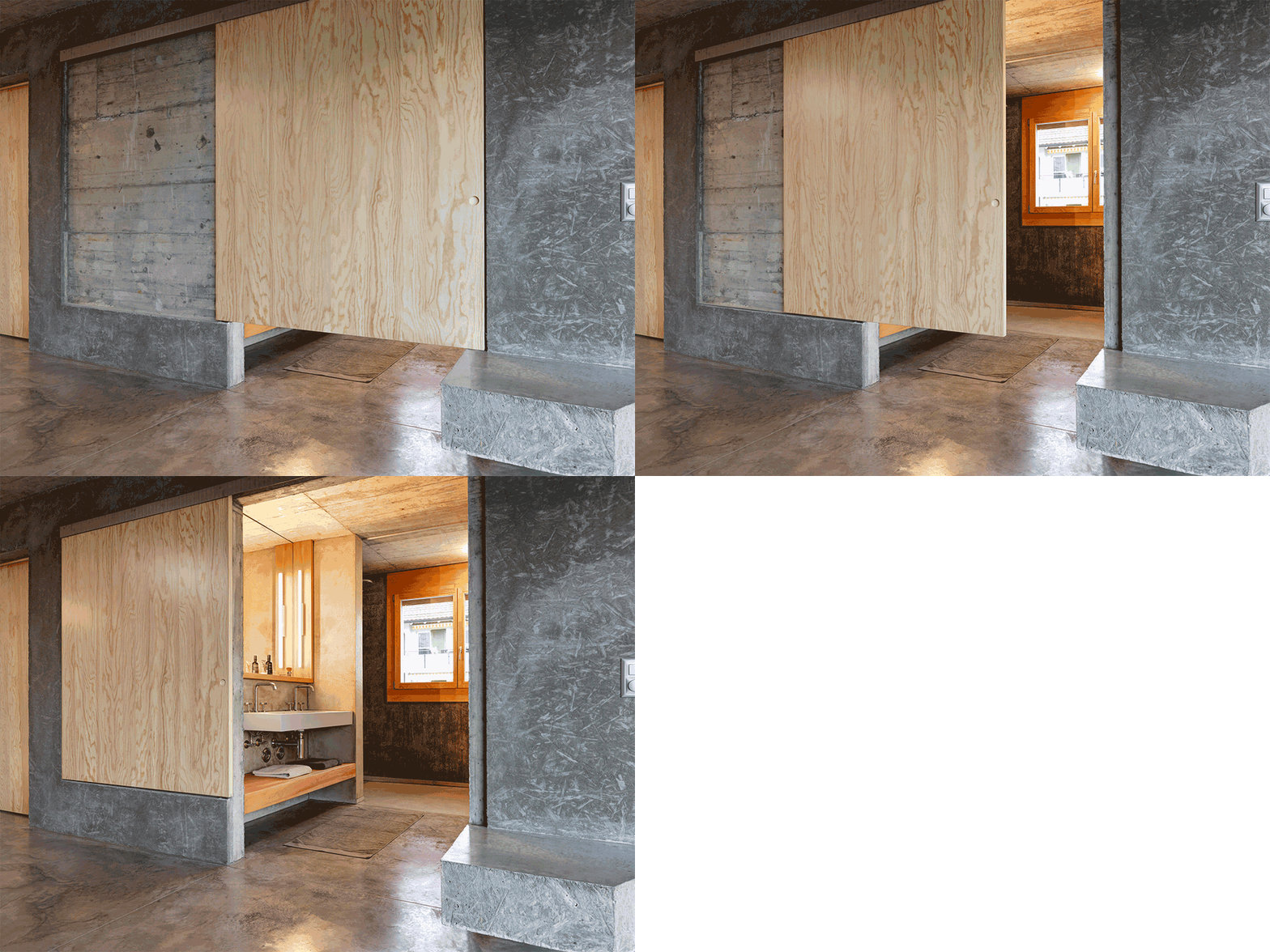
The periphery of the living space is topographically processed and makes the space-limiting elements communicative. Therefore, the building elements and especially the periphery of the space is not parting wall, but a topographically shaped protagonist – the topography incorporates programmed like wardrobe and living room bench. The bathroom of the 3-bedroom flat is separated from the common area by a sliding door, that does not touch the floor. It keeps the space floating as a common space, what it is and at the same time gives all the intimacy you need.
The entrance to each flat is guided by a condensed massive concrete beam, that catches the moment of entry.
The concrete bench growing out of the bathroom wall creates a common space just at the entry of the bath sliding door, there is a moment of program intersection. The concrete floor floats in all the bedrooms, letting the common space flow and then inside the room a wooden floor implicates another level of intimacy.
Discover more about the challenge on: https://uni.xyz/competitions/plugin-housing-challenge/info/about




Popular Articles
Popular articles from the community


Conexión: Biophilic Design Reimagines High-Rise Living in Hong Kong
Conexión reimagines high-rise living in Hong Kong through biophilic design, green facades, shared spaces, daylight, water and nature within.

The Musturak Paradise: Senior Living Architecture for a Connected Future in Temara, Morocco
The Musturak Paradise reimagines senior living architecture in Temara via private homes, social spaces, culture, community, and shared care.

The Ocean Hive: Sustainable Architecture for a Self-Sufficient Civilization at Sea
The Ocean Hive imagines sustainable architecture at sea, where modular habitats, algae, wave power and ocean waste sustain a growing colony.

The Earth Pod: 3D Printed Homes for Resilient Refugee Communities
The Earth Pod reimagines refugee housing through 3D printed homes made from clay, combining resilience, self-sufficiency, and rapid shelter.


Similar Reads
You might also enjoy these articles

Little Red Riding Hood: Architectural Design as a Journey Through Fear, Light, and Storytelling
Little Red Riding Hood reimagines the fairy tale through architectural design shaped by fear, light, scale, memory, uncertainty, and choice.

Floating Urban Village: Sustainable Architecture for a Climate-Resilient Community on Water
A modular floating village uses sustainable architecture, local materials and self-sufficient systems to create resilient life on water.
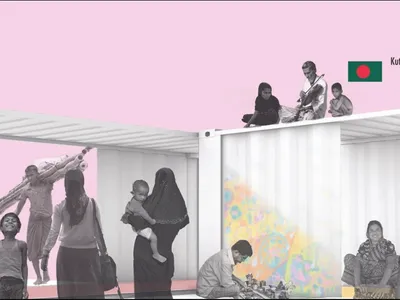
IN ONE, MANY, IN MANY, ONE: Modular Architecture for Play, Learning and Community
Modular architecture turns a travelling container into a flexible hub for play, learning, community life and belonging across refugee camps.

Creative Board: Modular Architecture for Play, Learning and Community Participation
Creative Board reimagines modular architecture as a flexible kit for play, learning and community building in temporary refugee settlements.


Explore Plugin Housing Competitions
Discover active competitions in this discipline


Challenge to design luxury tourism on rails


VR headsets Storefront design competition

Designing a staircase for a client
Comments (0)
Please login or sign up to add comments
No comments yet. Be the first to comment!