

Studio Bright Wraps a 4.2-Metre-Wide Cremorne Cottage in Breeze Block Towers That Will Vanish Under Vines
Garden Tower House stacks vertical gardens, courtyards, and rooftop decks onto a 144-square-metre workers' cottage site in inner Melbourne.


A site 4.2 metres wide leaves almost no room for sentimentality. In Cremorne, a postage-stamp inner suburb on the northern bank of the Birrarung (Yarra River), Studio Bright took a dilapidated Victorian workers' cottage and built upward rather than outward, adding two slender towers clad in pale pink breeze blocks. The result is Garden Tower House, a 2022 project that treats its extreme constraints not as limitations but as a design engine. Where a conventional renovation would have accepted darkness and compression, this one chases light, air, and greenery across every vertical surface it can claim.
What makes the project genuinely interesting is the long game it plays. The breeze block skin is not decorative wallpaper; it is a trellis. Climbing plants are intended to colonize the towers over years, gradually softening the geometry until the house reads less as architecture and more as topography. That ambition, to design a building that improves by becoming less visible, runs counter to most residential practice in Melbourne's increasingly dense inner ring. Studio Bright, led on this project by architect Emily Watson, is making a quiet argument: the best response to urban sprawl is a house that grows its own camouflage.
Two Towers on a Night-Cart Lane
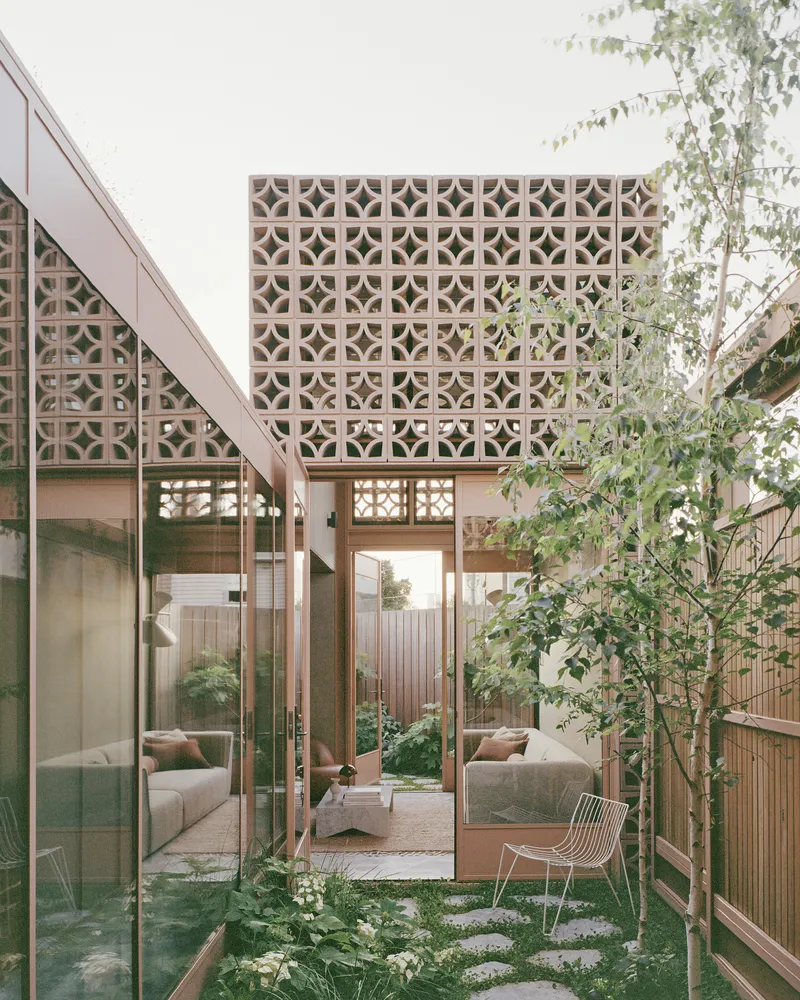
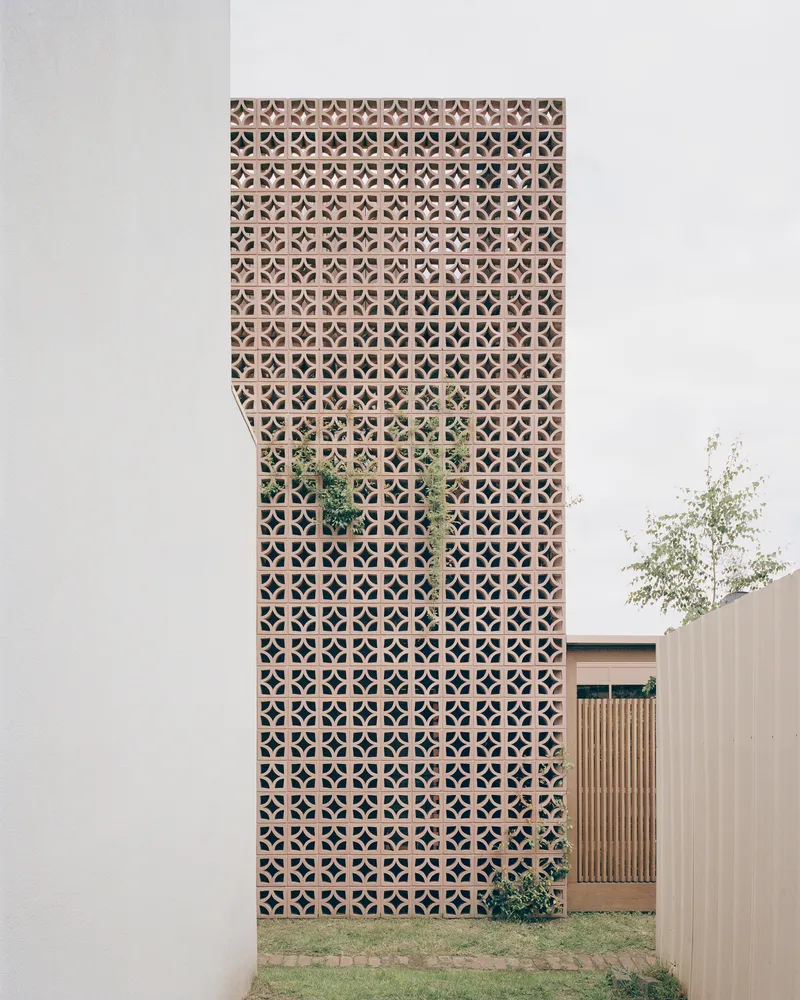

The twin tower volumes sit behind the restored weatherboard frontage, their pale pink breeze blocks announcing a clear break from the heritage fabric. The larger tower holds the bedroom zone on its upper level and a rooftop deck above that. The smaller tower punches daylight into a high-ceilinged living space below. Between them, a screened courtyard acts as the social heart of the house, a sliver of open sky that pulls northern light deep into the plan. A narrow night-cart lane running along the northern boundary gave Studio Bright an opportunity most inner-city cottages lack: a second exposed edge to exploit for sun and ventilation.
The breeze block facade is doing serious work here. Because it stands proud of the actual building envelope, the architects were able to run full windows on two sides without creating privacy conflicts with neighbours. The perforated screen filters views in and out, turning potential overlooking into a controlled relationship with the lane and courtyard. It is a permeable wall, not a barrier, and the distinction matters on a site this tight.
Green from Floor to Roof


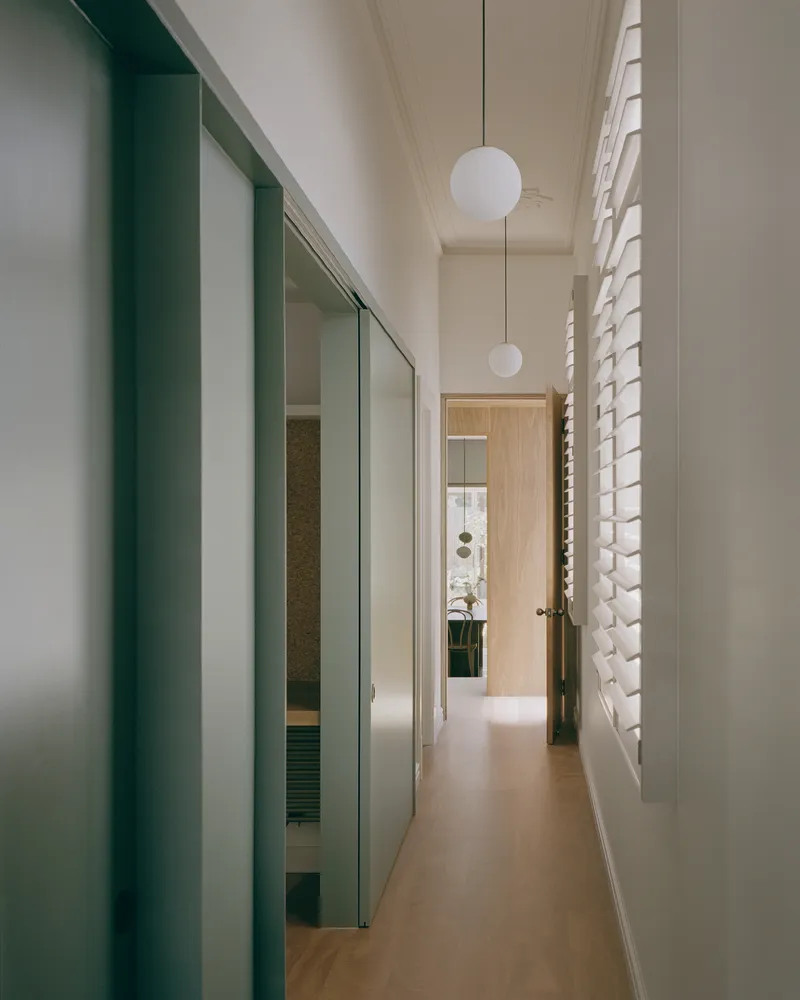
Inside, a tonal green palette ties the rooms together with surprising warmth. The kitchen wears pale green panelled cabinetry and a mosaic tile backsplash, its fluted trim adding a tactile layer that keeps the surface from reading as flat. The hallway running toward the courtyard is lined with matching green cabinetry and sliding doors, creating a continuous colour thread that draws you through the plan. Globe pendants along the corridor cast soft, even light against the perforated screen wall, reinforcing the sense that interior and exterior are part of the same system.
It is worth noting the restraint. On a project that could easily have leaned into maximalist colour to compensate for small rooms, Studio Bright kept to a single hue family. The green reads as an extension of the planting strategy rather than a standalone interior decision, blurring the line between what is cultivated and what is constructed.
The Courtyard as Organizing Principle

On a 144-square-metre site, the decision to leave any ground area unbuilt is a serious commitment. The courtyard between the two towers is modest in footprint but outsized in its effect. Viewed through full-height glass doors, it brings birch trees, stepping stones, and climbing plantings into every sightline. A latticed overhead screen tempers the sun while framing the sky above. The passage space connecting the towers doubles as a seating area that overlooks this garden, turning circulation into the most desirable room in the house.
A narrow corridor linking the lounge to the kitchen and dining area includes a north-facing daybed, an element that could easily be dismissed as a luxury but functions here as essential spatial generosity. In a house where every millimetre has been accounted for, this pause in the plan acknowledges that compression needs relief. The daybed faces the courtyard through the perforated screen, giving residents a way to feel expansive even when the walls are close.
Living at the Top

The rooftop terrace crowns the larger tower with a weathered timber deck and geometric screen walls that rhyme with the breeze block below. From here, the Melbourne skyline opens up, a reward for the vertical climb through the house. Solar panels and a planted green roof (by Coolth Inc) sit alongside this usable outdoor space, embedding sustainability infrastructure into what is also the most generous social area in the project.
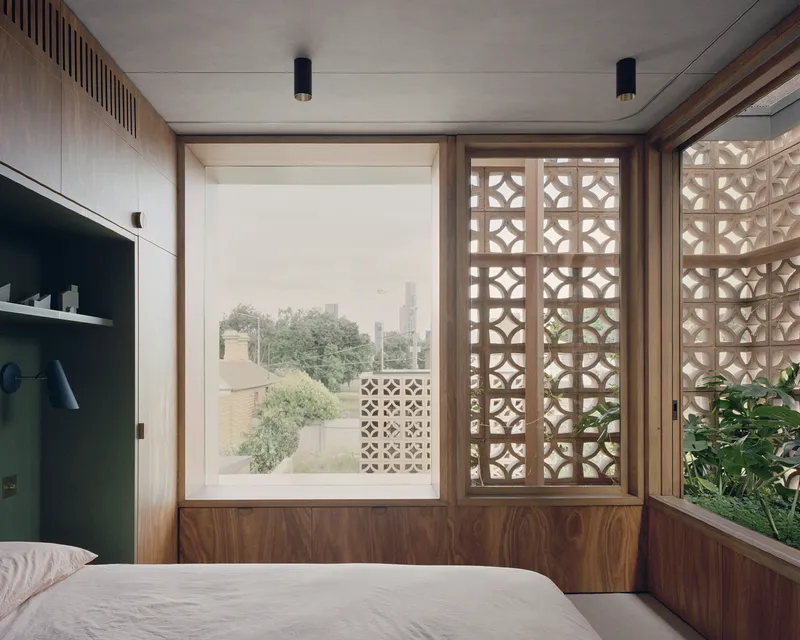
One level below, the bedroom wraps itself in walnut-clad walls, a deliberate shift in tone from the green public zones. Sliding lattice panels frame views to the treetops, layering privacy control in timber rather than curtains. It is a room that feels elevated in both senses: physically above the street and psychologically removed from the tight urban grain below. The retractable slatted screens let residents calibrate their relationship to the city, choosing full exposure to the canopy or near-total enclosure.
Why This Project Matters
Garden Tower House is a polemic built in breeze block. It argues that the narrow workers' cottages of Melbourne's inner suburbs, the ones routinely dismissed as too small to accommodate contemporary family life, are in fact the right scale for a more sustainable urban future. Rather than demolishing or sprawling, Studio Bright proved that vertical stacking, intelligent screening, and an obsessive attention to every cavity and surface can yield a home that feels generous on a site most developers would write off.
The most radical move may be the one you cannot see yet. By designing the facade as a scaffold for climbing plants, the architects have handed the building's final appearance over to time and horticulture. In ten years, the breeze block towers should be substantially covered in green. The house will have earned its name. That willingness to cede authorship to nature, to accept that the best version of the building has not been built yet, is a posture more practices should adopt as cities densify and the pressure to perform on tight sites only grows.
Garden Tower House by Studio Bright. Cremorne, Melbourne, Australia. 144 sqm site. Completed 2022. Photography by Rory Gardiner.
About the Studio
Share Your Own Work on uni.xyz
If projects like this are the kind of work you want to make, uni.xyz is a place to publish your own, find collaborators, and enter design competitions.


Popular Articles
Popular articles from the community


Juan García Correa, John González and Claudia Rueda Sink a Circular Amphitheater into a Manizales Engineering Building
On the La Nubia campus in Manizales, Colombia, the S1 Building folds labs and offices into a hillside of ramped lawns that double as a campus route.

Jaramillo Van Sluys Arquitectura and Urbanismo Turn a Demolished Registry Lot in Quito into an Orchard Plaza
In Quito's Centro Histórico, a 2,800 m² plaza exposes the San Agustín convent wall and redraws its lost Augustinian orchard in volcanic stone.

GROUP A Strips a 1969 Rotterdam Harbor Headquarters to Its Frame and Wraps It in Timber Louvers
In Rotterdam's M4H harbor district, Ferro Offices reuses a 1969 frame, adds one timber storey and reaches BREEAM-NL Outstanding.

U.GA Architects Wraps an Oval Rooftop Pool in Curved Board-Formed Concrete on Busan's Jeollidan-gil
In Busan's Jeonpo-dong, a 454 m² mixed-use block stacks a neighborhood facility, guest rooms and an oval rooftop pool inside spiraling concrete walls.

Similar Reads
You might also enjoy these articles


Hodi-Mandai Geram
Project Function: Preservation and revitalization of the Intangible heritage and socio-spatial identity of the Hodi by Housing, Cultural Memory Center, Sacred Grove, landscape, local tourism economy


Olio Towers: A Mid-Rise for Performers That Fuses Housing, Rehearsal, and Stage
Located blocks from Houston's Theater District, this modular tower stacks living units around a central performance atrium.

Oasis: Modular Green Housing Carved into Dhaka's Urban Fabric
A shortlisted Plugin Housing entry reclaims unauthorized settlements in Dhaka with stepped concrete volumes, green roofs, and ventilation-driven design.

Black Hole: A Floating Megastructure for the Post-Physical Era
Emiliano Mazzarotto envisions a spherical, self-scaling arena where e-sports, digital hotels, and holographic stadiums replace traditional public space.

Explore Vertical Garden Competitions
Discover active competitions in this discipline

Challenge to design mud housing for contemporary communities

Challenge to reimagine the Iron Throne

Photograph architecture without architects

Illustrate the lost glory of Angkor Wat - Render Challenge
Comments (0)
Please login or sign up to add comments
No comments yet. Be the first to comment!