
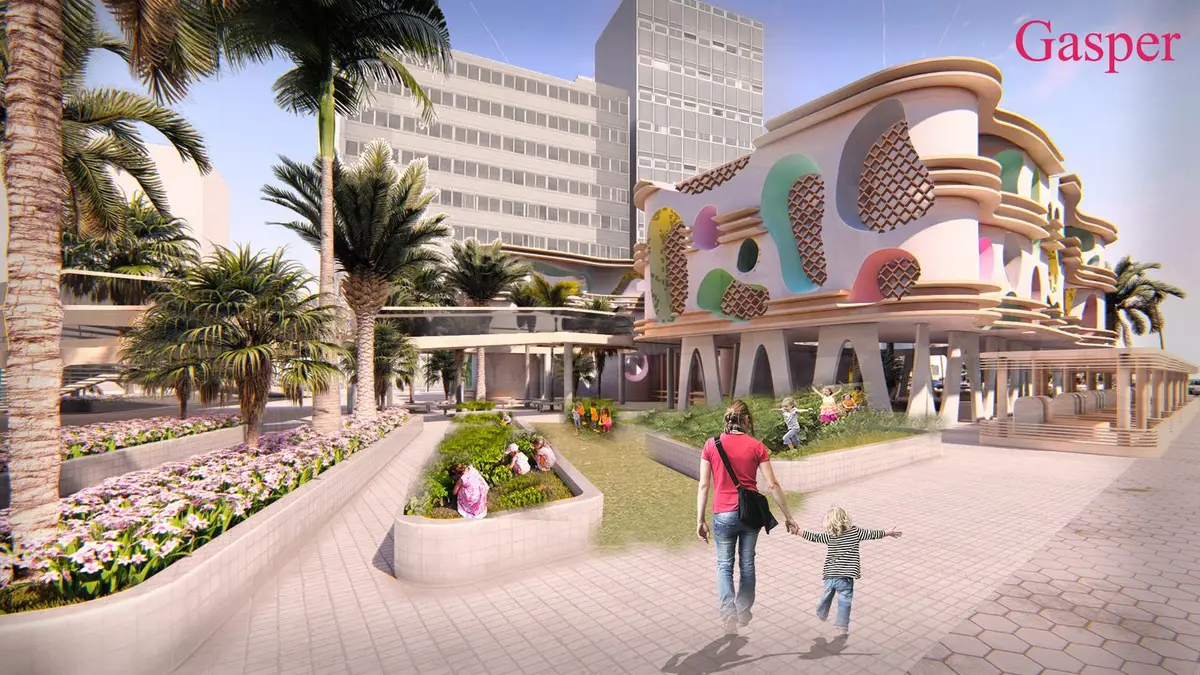
GASPER: A Sponge-Like Building That Breathes in the Tropics
A children's facility treats its envelope as a porous living skin, channeling wind, filtering light, and harvesting rain across modular tropical volumes.


What if a building could inhale? GASPER proposes exactly that: an architecture modeled on the physiology of marine sponges, where every surface draws air through its pores, filters daylight through calibrated openings, and sheds rainwater into collection systems below. Designed as a children's facility for a tropical climate, the project refuses to treat the envelope as a sealed barrier. Instead, walls, roofs, floors, and fenestration merge into a single climatic interface that responds to humidity, solar radiation, and shifting wind patterns the way skin responds to heat.
The project was designed by Yeganeh Esmaeilkhani, Afshin Razmi, Elnaz Samandari, and Ali Khani, and was awarded the People's Choice Award in the Form Follows Climate 2020 competition. GASPER stands out in that crowded field not for flashy parametricism but for a rigorous integration of passive strategies into a building that children can actually play in, learn in, and feel safe inside.
Curving Volumes and Perforated Openings Shape a Pedestrian Landscape
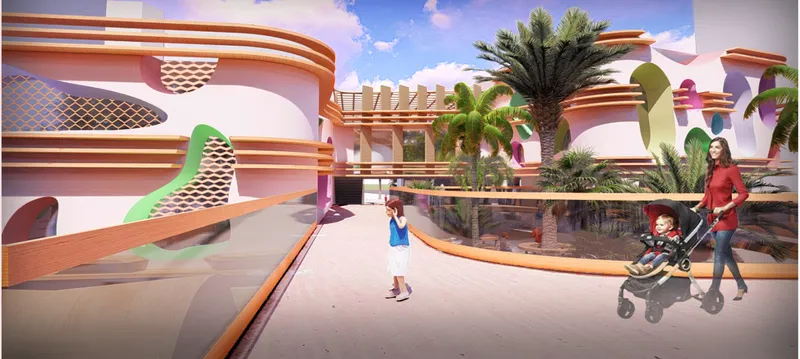
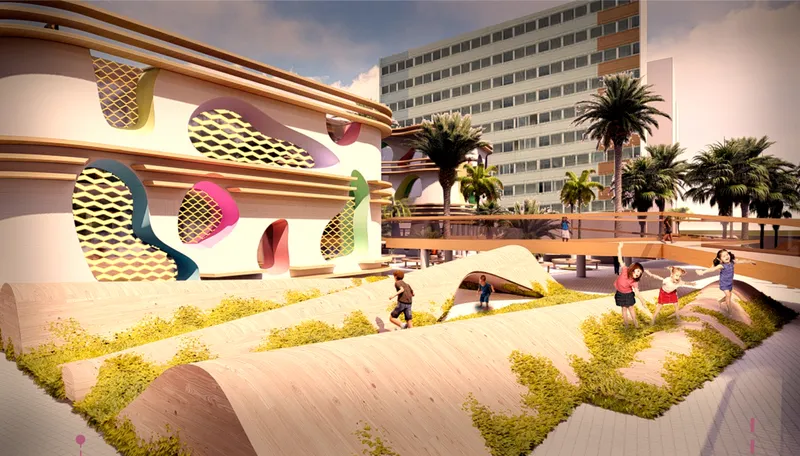
From plaza level, GASPER reads as a cluster of white curvilinear volumes punctured with circular perforations, connected by ramped pathways that weave through groves of palm trees. The site planning follows a modular system based on 30×30 spatial units, scaled specifically to children's step lengths and movement patterns. These modules align along prevailing wind axes, meaning airflow is not an afterthought bolted onto the form; it is the generator of the form. Voids between the modules pull daylight deep into the plan and amplify cross-ventilation.
The terraced courtyard introduces undulating planted beds that soften the ground plane and create microclimatic zones. Green terraces, pilot areas, and photovoltaic ring structures layer into the massing, transforming the site from a single enclosed building into what the designers call a "multi-climatic landscape." It is an apt description: each terrace operates at a slightly different temperature, shade level, and humidity, offering children a variety of sensory environments rather than one uniform interior.
A Facade That Regulates Itself
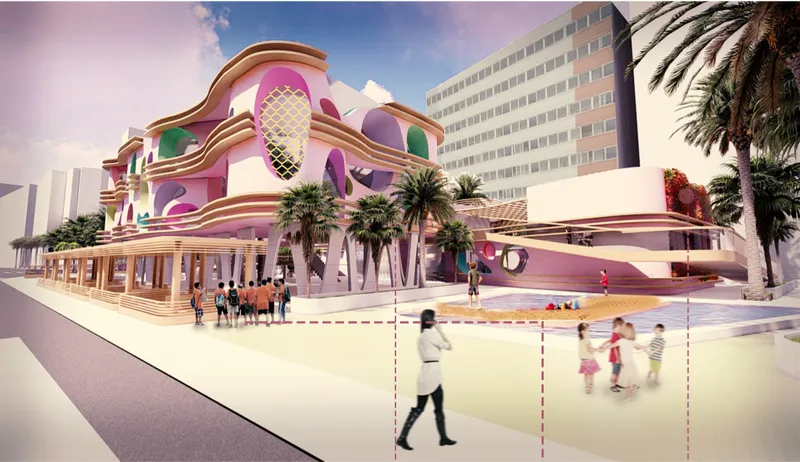
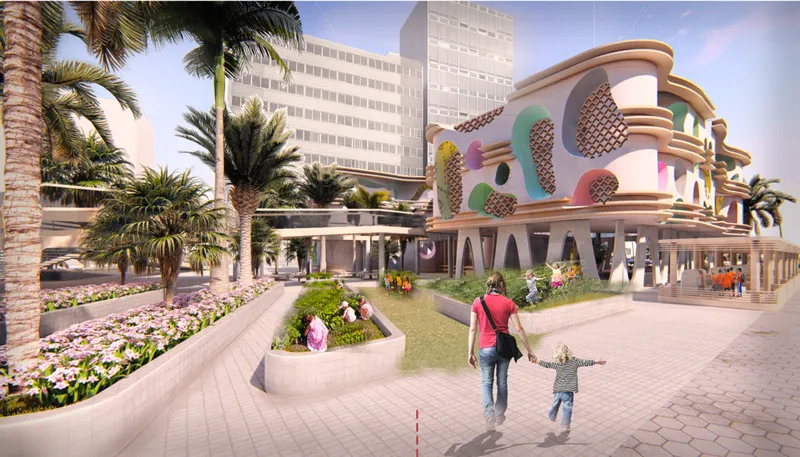
At street level, the curvilinear facade wraps around pedestrian passages with pink banding and perforated mesh panels that act as self-shading elements, reducing direct solar gain without blocking views or airflow. Individual facade components can open or close in response to extreme weather, giving the building an almost respiratory quality. Below, tapered concrete columns form a ground-level colonnade that lifts the upper volumes off the earth, creating shaded passages where sub-floor airflow systems feed cooler air upward through the building's section.
The passive strategy list is extensive: incorporative shading, cross and stack ventilation supported by sub-floor airflow, rainwater harvesting, photovoltaic panel rings for renewable energy generation, and Solatube daylighting systems that push natural light into spaces far from the perimeter. What matters here is that none of these systems exist in isolation. The facade is the structure is the ventilation system. That integration is what distinguishes a genuinely climate-responsive building from one that merely wears green credentials on its surface.
A Palm Tree at the Heart of the Section
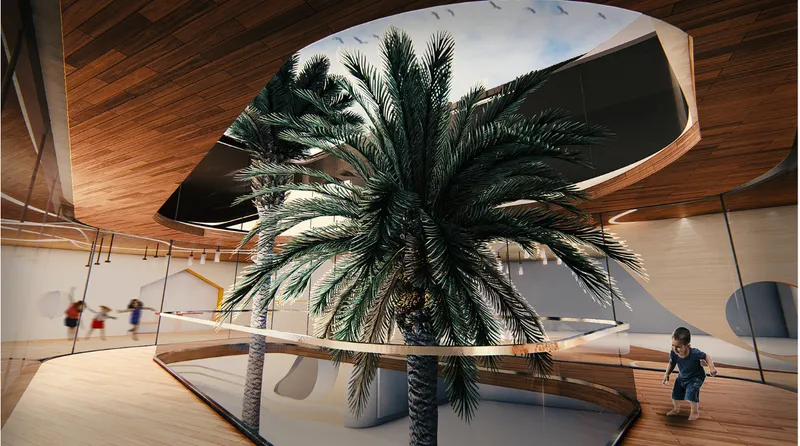
The interior section reveals GASPER's climatic heart: a central courtyard anchored by palm trees that rise through angular skylight openings in a curved timber ceiling. These trees are not decorative. The courtyard functions as a thermal chimney, drawing warm air upward and pulling cooler air through the ground-level openings. The timber ceiling curves overhead with an organic geometry that extends the building's sponge metaphor into the interior experience, where soft materials and fluid spatial boundaries create a child-friendly atmosphere without sacrificing structural clarity.
The layout itself carries a poetic dimension: the plan conceptually reflects the footprints of a mother and child placed side by side, symbolizing protection, care, and emotional bonding. That metaphor translates into real zoning logic, with educational, recreational, and restorative functions distributed across classrooms, workshops, amphitheaters, and quiet treatment areas. The building reads as playful but never whimsical; every curve serves a thermal or spatial purpose.
Semi-Enclosed Courts as Social and Climatic Infrastructure
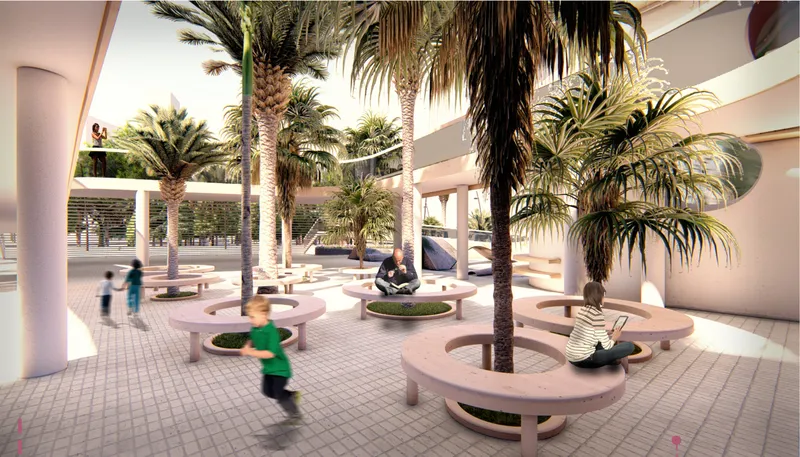
The semi-enclosed courtyard at the lower levels reinforces GASPER's strategy of blurring the line between inside and outside. Circular planters containing palms sit among curved benches and tiled flooring, creating communal spaces that are shaded but open to breezes. Transparency at ground and intermediate levels ensures visual continuity between interior and exterior, reinforcing a sense of openness and safety critical for a children's facility. These are not leftover spaces between programmed rooms; they are the building's primary social infrastructure, activated by the same passive systems that keep them comfortable.
Why This Project Matters
GASPER succeeds because it treats climate not as a problem to be solved by mechanical systems but as a design collaborator. Humidity, wind, and solar radiation become the literal forces that shape the plan, the section, and the envelope. In tropical contexts where energy-intensive cooling dominates new construction, this kind of integrated passive approach offers a viable alternative, one where the architecture itself does the work of conditioning the air and filtering the light.
Equally important is the project's commitment to designing for children without condescending to them. The organic geometries, the courtyard palm trees, the modular units scaled to a child's stride: these choices are grounded in spatial intelligence, not aesthetic whimsy. Esmaeilkhani, Razmi, Samandari, and Khani demonstrate that climate-responsive architecture can be simultaneously rigorous and generous, technically demanding and deeply humane.
View the Full Project
About the Designers
Designers: Yeganeh Esmaeilkhani, Afshin Razmi, Elnaz Samandari, Ali Khani
Enter a Design Competition on uni.xyz
uni.xyz runs architecture and design competitions year-round that reward proposals with spatial conviction and real site intelligence.
Project credits: Gasper by Yeganeh Esmaeilkhani, Afshin Razmi, Elnaz Samandari, Ali Khani Form Follows Climate 2020 (uni.xyz).


Popular Articles
Popular articles from the community


Aquadapt: An Underwater Habitat That Rewrites Its Rooms by the Hour
Curved modules ring the seabed while one shell shifts from breakfast room to cinema, farm and football pitch as residents' needs change.


FCC Arquitectura Expands a Portuguese Granite House with a Board-Marked Concrete Wing
In Portugal, JV House pairs a cleaned-up whitewashed and granite dwelling with a timber-shuttered concrete extension, courtyards and a garden pool.

Manzana Morphosis: Stretching Barcelona's Grid into a Living Landscape for 2050
A radical reworking of the Eixample manzana turns density into a tool for generous public space, vertical ecology, and environmental performance.

ETEH Reworks the Shared Spaces of São Domingos School in Brazil Around Timber, Color and Hanging Plants
At São Domingos School in Brazil, 436 m² of hall, refectory and library are recast with timber joinery, a yellow and blue code and trailing greenery.

Similar Reads
You might also enjoy these articles
Yenisei Monitoring Center: A Sun-and-Moon Sphere Anchors a Research Campus on Siberia's Great River
In Krasnoyarsk, shifting square blocks, a glazed central sphere and descending window rhythms turn river science into a public spectacle on the Yenisei.
Andretta Artist's Village: A Node-Based Masterplan That Lets the Hills Write the Plan
A cultural landscape strategy for Palampur's artist colony threads studios, residences and stages along a porous spine shaped by the Dhauladhar terrain.
Street Children Rehabilitation Center: A Brick Campus That Eases Children From Street to Safety
A low-rise courtyard campus where learning streets, uthans and shaded verandahs stage a gradual passage from street into protective, family-scale life.

The NEON Culture: A Field of Pavilions Built for the 24-Hour City
Smaran Alva spreads galleries, stages, clubs and markets across a varied site, treating light, sound and ramped movement as the real building materials.


Comments (0)
Please login or sign up to add comments
No comments yet. Be the first to comment!