
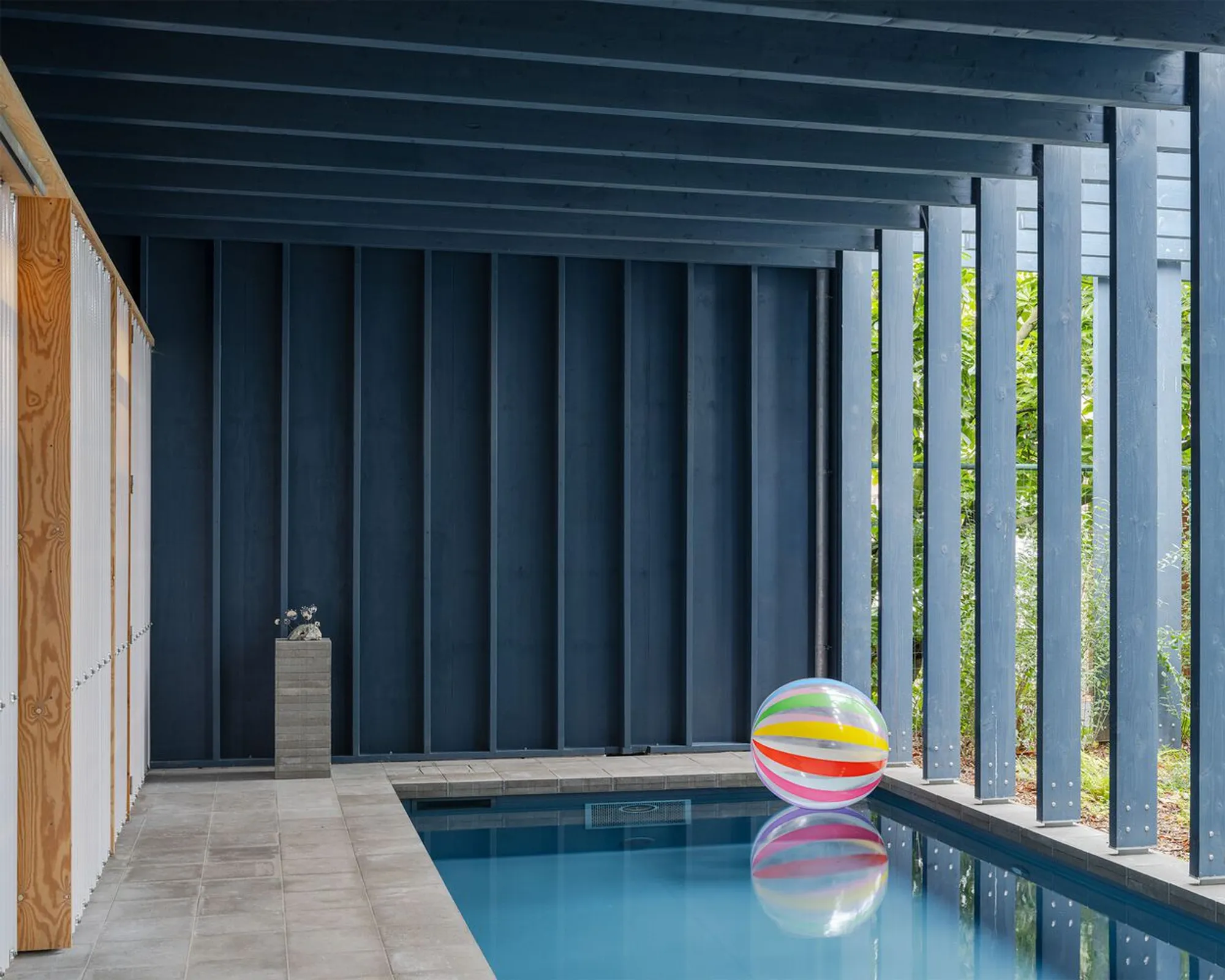
Atelier Janda Vanderghote Wraps a Belgian Pool Pavilion in Steel, Timber, and Filtered Light
In Geluveld, a layered garden structure dissolves the boundary between pool house and landscape through rhythm and material honesty.


A pool pavilion is, by definition, a secondary structure. It exists to serve the house, the garden, the ritual of swimming. But when Atelier Janda Vanderghote designed the Ge(LUIF)el Pool Pavilion in Geluveld, Belgium, they treated it as something more considered: a piece of architecture that earns its place among mature trees and dense foliage by being both rigorously structured and atmospherically loose. The pavilion is not a box beside a pool. It is a series of thresholds, screens, and covered walkways that dissolve into the garden while maintaining a clear tectonic logic.
What makes this project genuinely interesting is how it uses repetition and material layering to create spatial depth without mass. Steel columns, timber rafters, corrugated translucent panels, and vertical metal fins are arranged in overlapping rhythms that filter light and frame views differently at every point. The result is a pavilion that feels open and enclosed simultaneously, a kind of inhabited pergola that shifts character with the time of day and the season.
Colonnade as Architecture
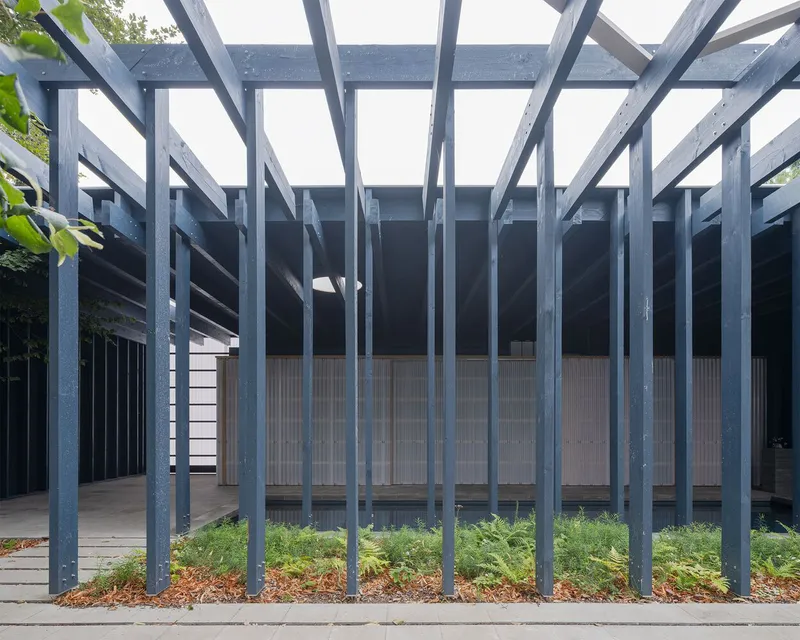
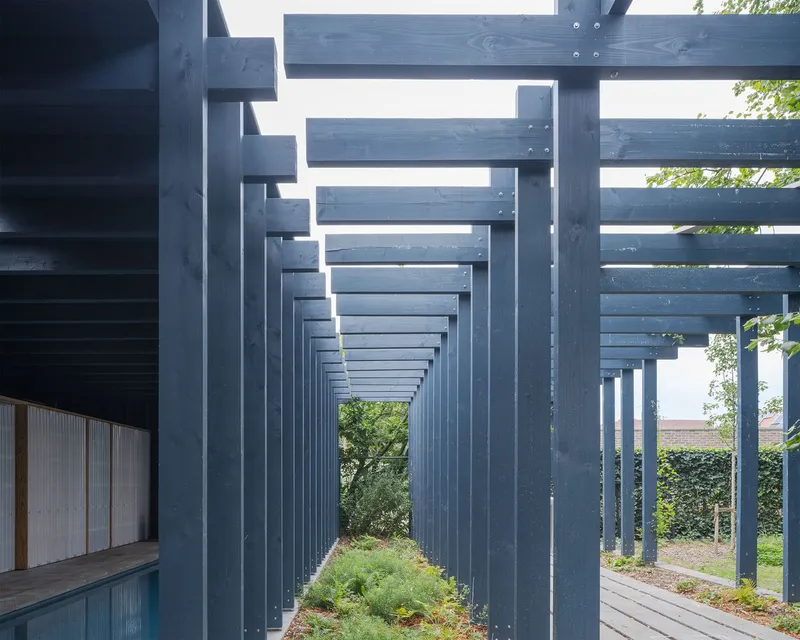
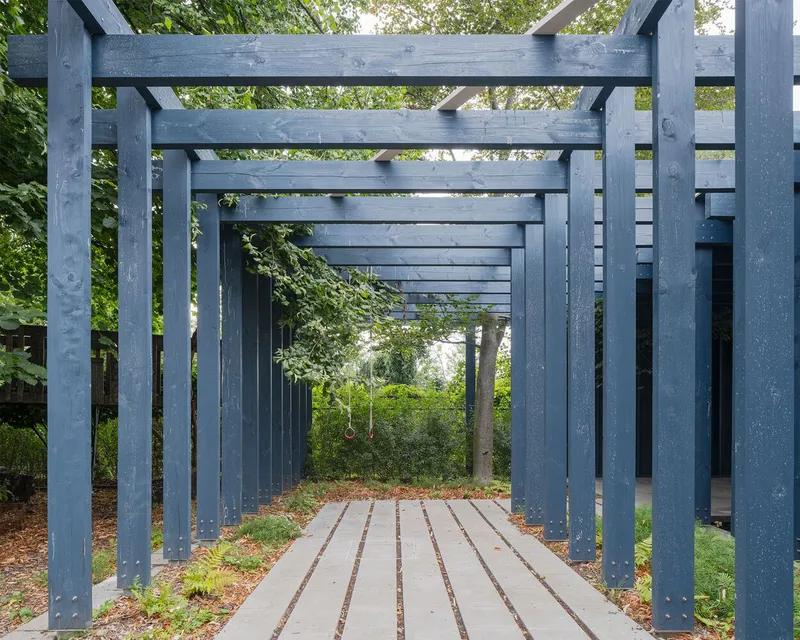
The pavilion's primary spatial device is the colonnade. Repeated blue-grey posts, spaced tightly and consistently, form linear passages alongside the pool and through the garden. These are not merely structural: they create a rhythmic cadence that slows your movement and sharpens your awareness of the landscape beyond. Walking through these covered timber walkways feels like reading a sentence one word at a time.
The proportions matter. The columns are slender enough to avoid heaviness, but the spacing is tight enough to register as enclosure. Planted beds sit within the colonnade's footprint, reinforcing the idea that this is not a building set against the garden but one woven through it.
Steel and Timber in Dialogue
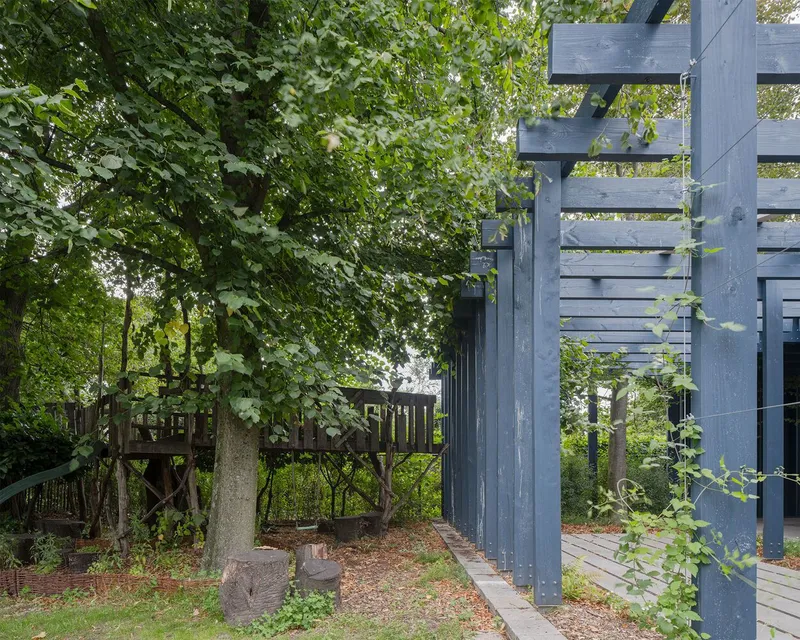
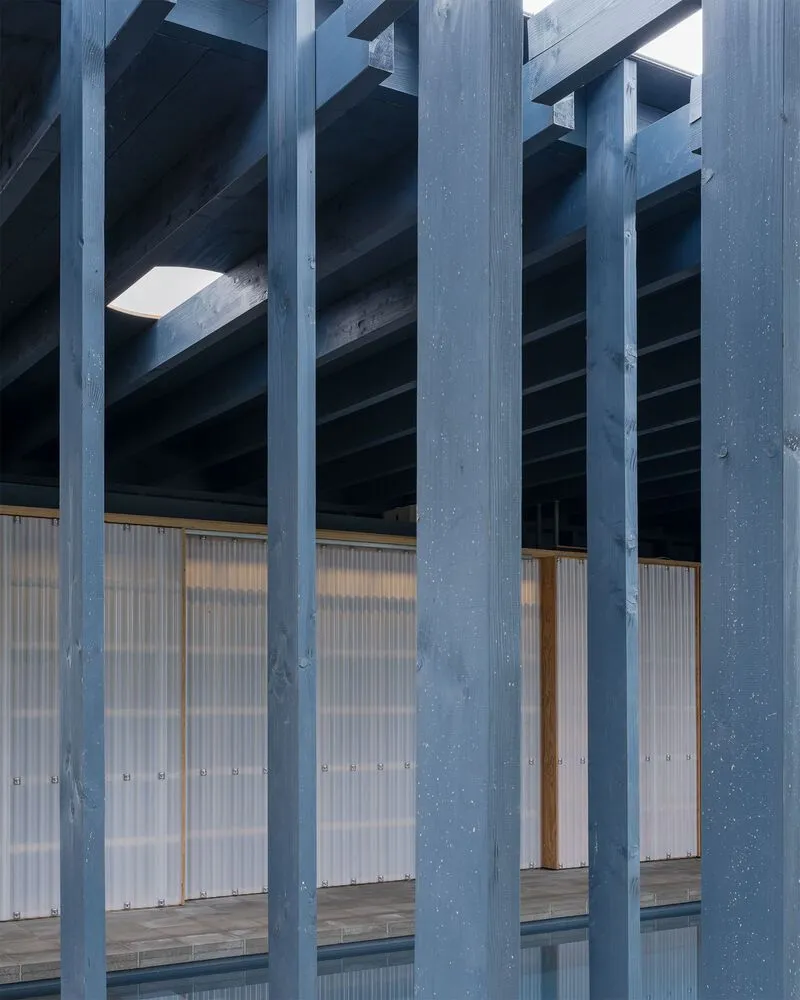
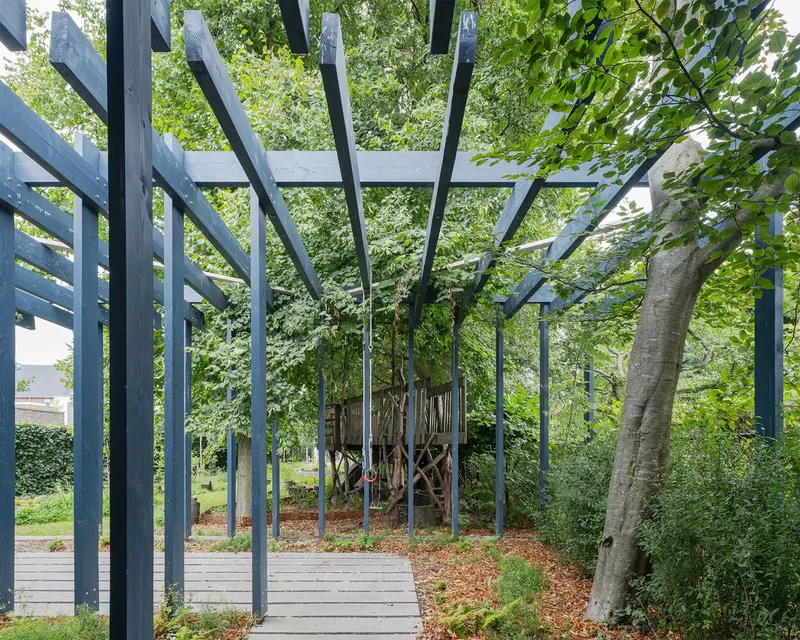
Atelier Janda Vanderghote maintains an honest distinction between the two primary structural materials. Steel appears at the primary column connections and in the vertical screening elements, while timber handles the rafters, decking, and secondary framing. The two materials are never disguised as each other, and their junction points are legible, almost didactic. You can trace the load path with your eyes.
The timber pergola sections, with their angled rafters and vertical posts, wrap around mature trees rather than competing with them. Fallen leaves collect on the decking. Bark textures echo the wood grain. The architects clearly designed with the expectation that the garden would colonize the structure over time, not the other way around.
Translucent Enclosure
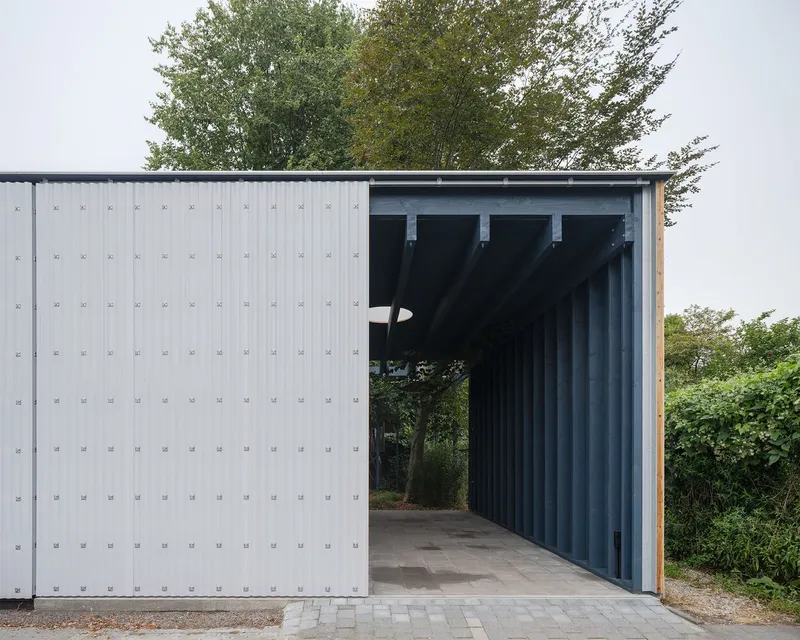
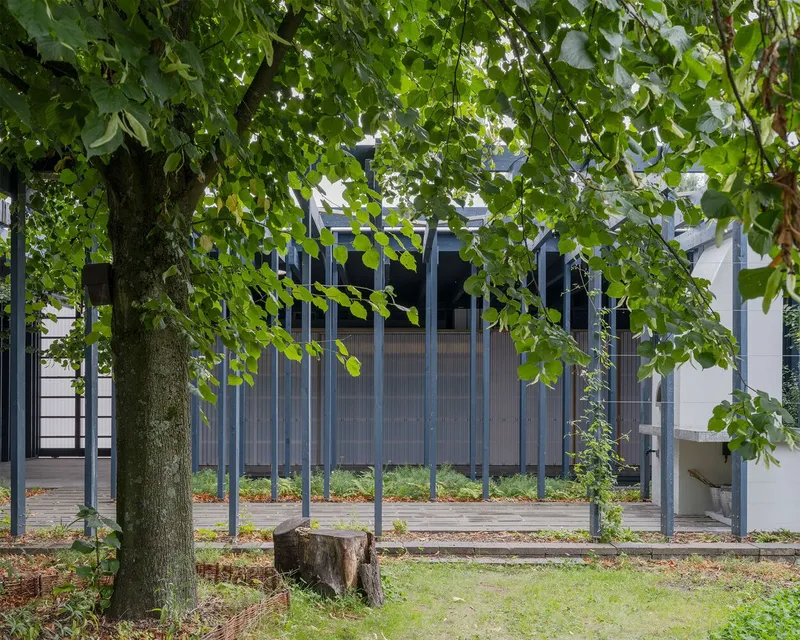
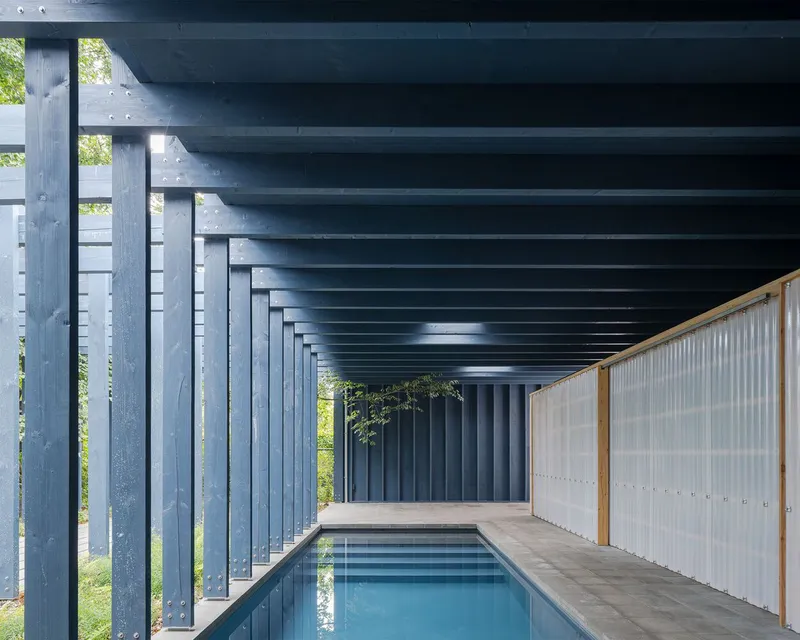
Where the pavilion needs to close off from wind or rain, corrugated translucent panels do the work. These are not shy about their industrial origins. Mounted in sliding frames against the steel structure, they glow softly during the day and turn the interior into a lantern at dusk. The effect is practical and atmospheric: they provide shelter without blocking light, and they make the enclosure feel provisional, almost temporary.
The sliding white corrugated panel at the entrance is particularly effective. It allows the threshold to open fully or close partially, giving the pavilion a variable degree of porosity. Combined with the vertical steel columns flanking the opening, the entrance reads as a framed aperture rather than a door.
Light Through Layers
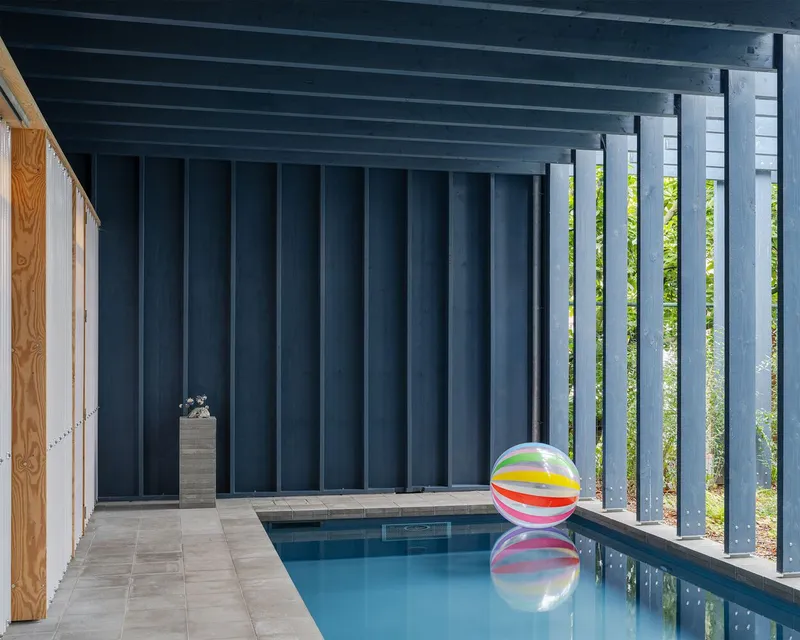
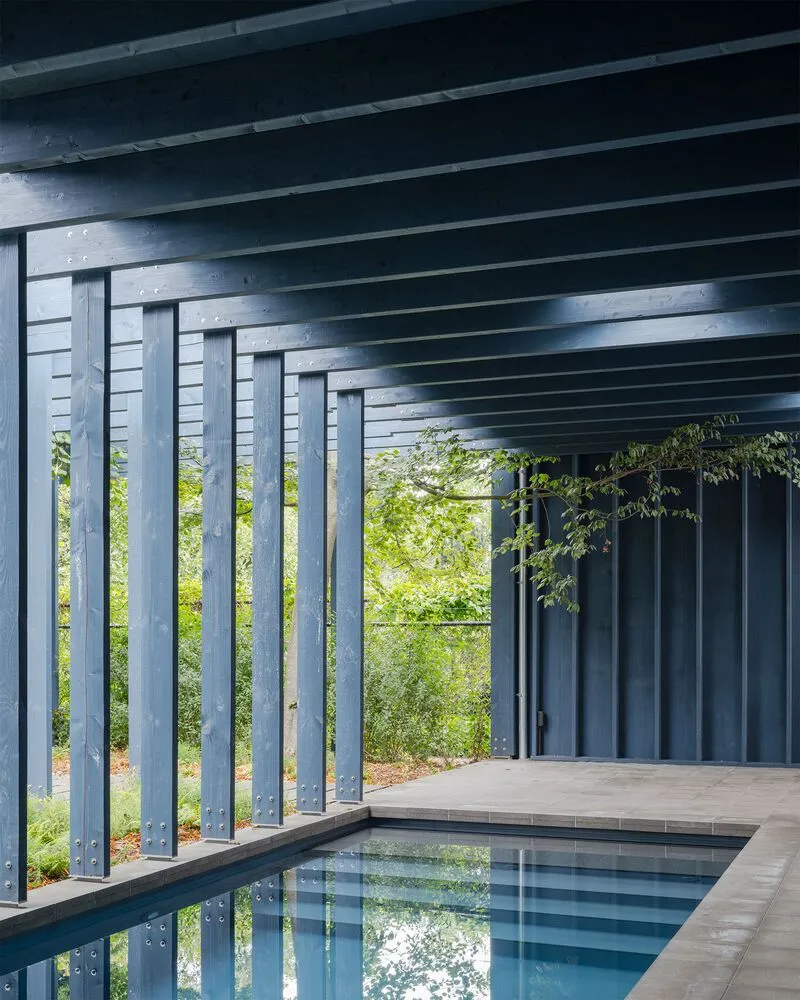
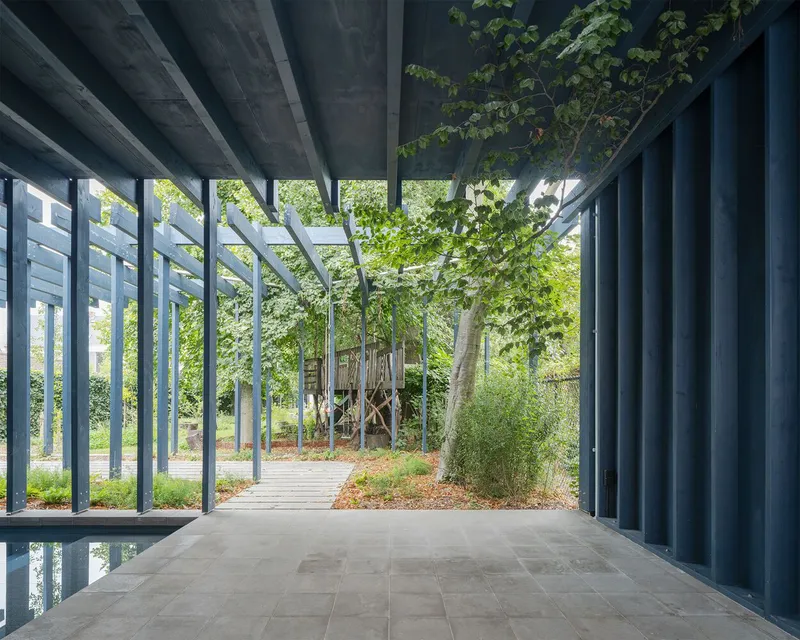
The most striking quality of the pavilion is its management of light. Vertical dark metal fins along the poolside terrace act as brise-soleil, breaking direct sunlight into parallel bars that slide across the decking and water surface as the day progresses. Behind these fins, green foliage provides a second layer of dappled shadow. The light inside the covered areas is never flat; it is always arriving through something.
From the pool terrace, the vertical batten screen creates a similar effect in a different register: it frames the green landscape as a series of narrow vertical slices rather than a single panoramic view. This compression forces you to look more carefully and gives the modest garden a sense of depth it might not otherwise possess.
The Interior Condition
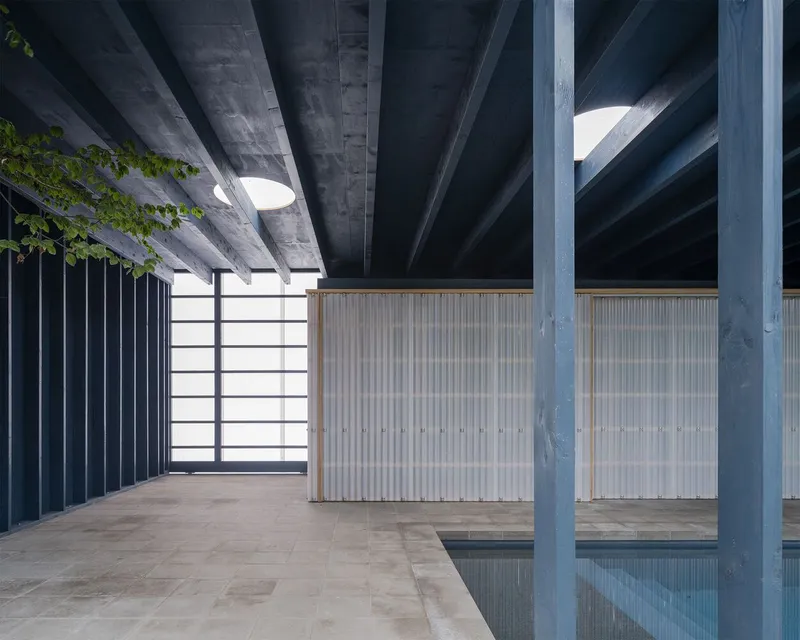
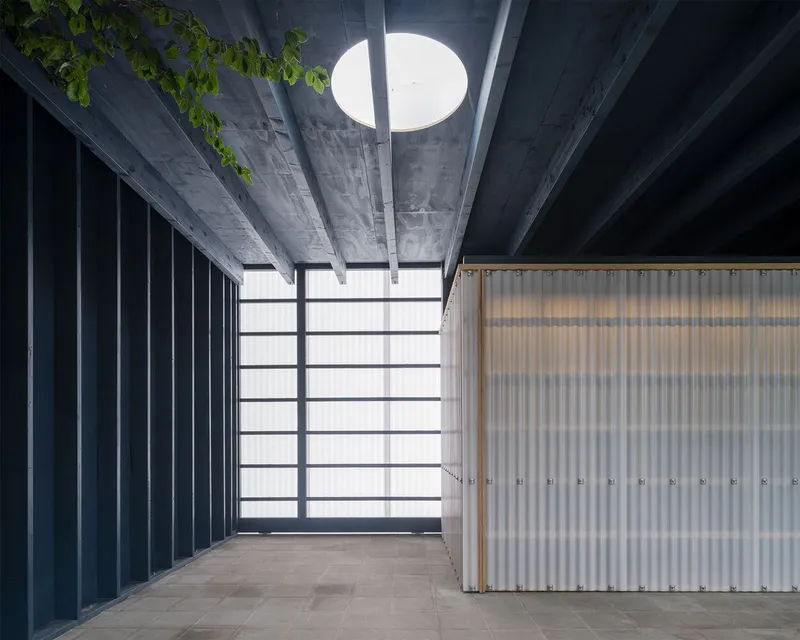
Where the pavilion does achieve full enclosure, the interior maintains the raw material palette of the exterior. Exposed timber structure and corrugated wall panels surround a reflecting pool, keeping the presence of water at the center of the spatial experience even when you are not swimming. The circular skylight in the courtyard section punches a controlled aperture overhead, casting a moving disc of light across exposed concrete beams and corrugated metal walls. It is a small, potent moment that elevates utility into something contemplative.
Why This Project Matters
Pool pavilions are a project type that architecture culture tends to either ignore or inflate into vanity objects. The Ge(LUIF)el Pavilion avoids both traps. It takes the brief seriously, designing a structure that genuinely improves the experience of being in a garden and beside a pool, without pretending to be something grander than it is. Every material choice, from the corrugated panels to the slender steel columns, serves a clear purpose while contributing to a coherent spatial atmosphere.
Atelier Janda Vanderghote demonstrates here that architectural intelligence is not a question of scale. A small garden structure can carry as much tectonic rigor and spatial subtlety as a public building, provided the architects care enough to make every joint, every rhythm, and every threshold count. The pavilion does not compete with the landscape; it teaches you how to see it.
Ge(LUIF)el Pool Pavilion by Atelier Janda Vanderghote, Geluveld, Belgium. Photography by Johnny Umans.
About the Studio
Share Your Own Work on uni.xyz
If projects like this are the kind of work you want to make, uni.xyz is a place to publish your own, find collaborators, and enter design competitions.




Popular Articles
Popular articles from the community


The Ocean Hive: Sustainable Architecture for a Self-Sufficient Civilization at Sea
The Ocean Hive imagines sustainable architecture at sea, where modular habitats, algae, wave power and ocean waste sustain a growing colony.

Co-Life: Senior Housing Design That Reconnects Older Adults With the City
Co-Life reimagines senior housing design through healing gardens, shared streets, workshops, and a sustainable community across generations.

Hill & Cross Opera: Sculptural Opera House Architecture Shaped by Tallinn’s Landscape and Identity
Hill & Cross Opera reimagines opera house architecture in Tallinn through its sculptural hill, civic plaza, glass wave and a luminous cross.

The Musturak Paradise: Senior Living Architecture for a Connected Future in Temara, Morocco
The Musturak Paradise reimagines senior living architecture in Temara via private homes, social spaces, culture, community, and shared care.


Similar Reads
You might also enjoy these articles


Hodi-Mandai Geram
Project Function: Preservation and revitalization of the Intangible heritage and socio-spatial identity of the Hodi by Housing, Cultural Memory Center, Sacred Grove, landscape, local tourism economy


Olio Towers: A Mid-Rise for Performers That Fuses Housing, Rehearsal, and Stage
Located blocks from Houston's Theater District, this modular tower stacks living units around a central performance atrium.

Oasis: Modular Green Housing Carved into Dhaka's Urban Fabric
A shortlisted Plugin Housing entry reclaims unauthorized settlements in Dhaka with stepped concrete volumes, green roofs, and ventilation-driven design.

Black Hole: A Floating Megastructure for the Post-Physical Era
Emiliano Mazzarotto envisions a spherical, self-scaling arena where e-sports, digital hotels, and holographic stadiums replace traditional public space.


Explore Swimming Pool Competitions
Discover active competitions in this discipline



Challenge to reimagine the Iron Throne


Photograph architecture without architects


Illustrate the lost glory of Angkor Wat - Render Challenge


Design challenge to reuse E-waste
Comments (0)
Please login or sign up to add comments
No comments yet. Be the first to comment!