
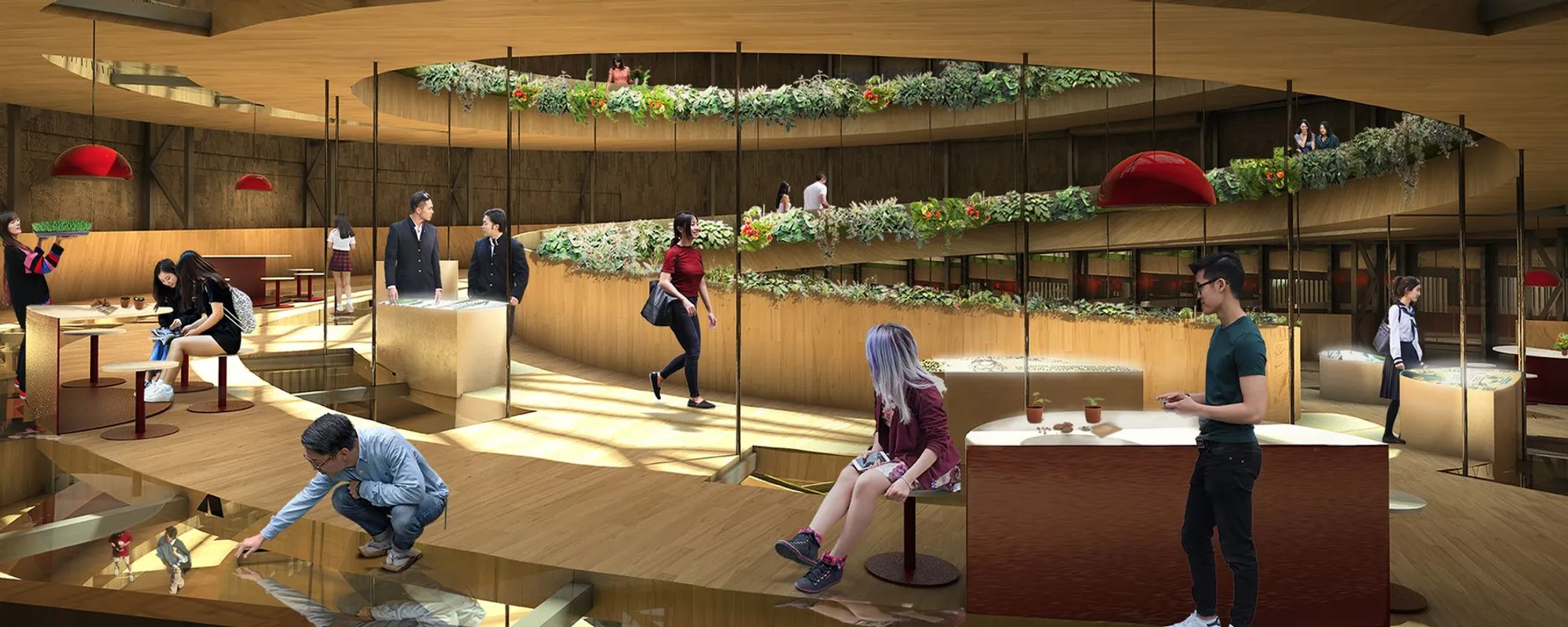
Germinated Seed: A Vertical Ecosystem Rooted in Hong Kong's Urban Core
A seed bank shaped like its subject, stacking agriculture, education, and community inside a metallic dome among tower blocks.


Drop a seed-shaped dome between Hong Kong's residential towers and something unexpected happens: the city exhales. Germinated Seed is a five-level seed bank that doubles as a public agricultural hub, wrapping composting systems, aeroponic planters, workshops, and a seed library inside a metallic shell. The building's radial plan and spiraling ramp pull visitors upward through layers of food production, education, and social exchange, treating vertical circulation as a narrative device rather than a logistical afterthought.
Designed by Audrey Bayle, the project won the Seed Bank competition on uni.xyz. The brief asked entrants to reimagine what a seed bank could be, and Bayle responded with a building that refuses to separate preservation from participation. Set within Hong Kong's dense urban fabric, the design addresses food security, biodiversity loss, and the urban heat island effect in a single, sculptural form.
Spiraling Upward Through Planted Terraces
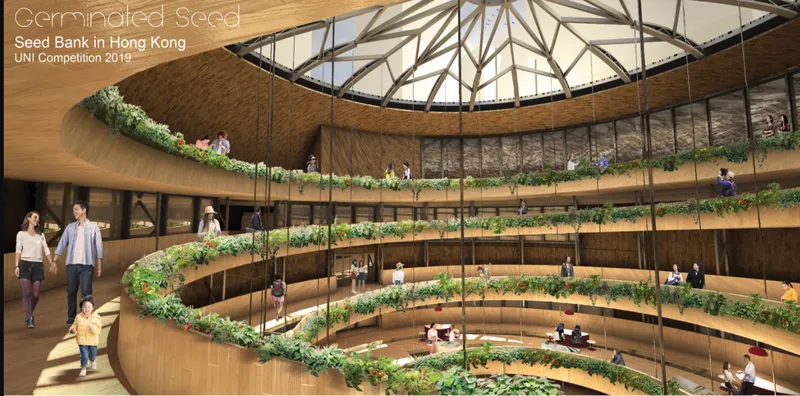
The interior atrium is the project's centerpiece. A continuous spiraling ramp connects all five levels, lined with planted terraces that blur the line between corridor and cultivation. Overhead, a radial glazed skylight floods the central void with daylight, giving the space the quality of a greenhouse rather than an institutional lobby. Visitors encounter agriculture at every turn: aeroponic planters suspended in the void, communal farming areas integrated into the floor plates, and spontaneous vegetation left to colonize structural elements.
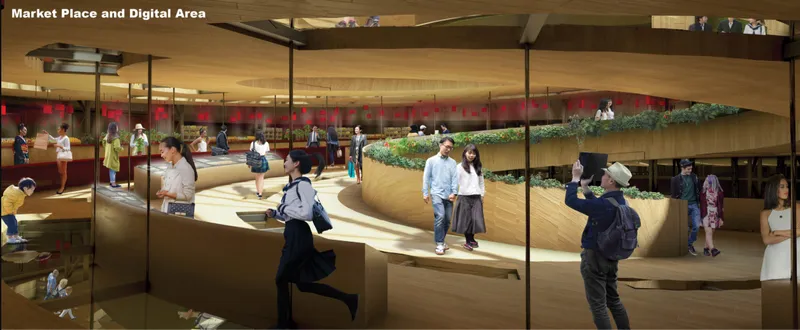
At the lower levels, an open market floor organizes itself around curving timber benches and planted terraces beneath exposed columns. Natural light washes across the space, reinforcing the connection between commerce and cultivation. Marketplaces and public zones blend education and economy here, with the architecture positioning local food production as a civic act rather than a private hobby.
A Section That Reads Like a Manifesto
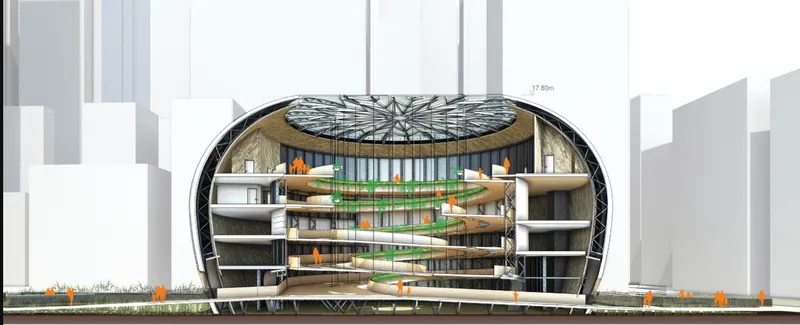
The section drawing reveals the logic behind the dome's soft profile. Spiral circulation ramps wrap around a central radial skylight, creating an open core that allows natural airflow through the entire building. This passive ventilation strategy works alongside a double-skin façade that regulates temperature and prevents heat accumulation on the cladding surface, directly counteracting the urban heat island effect that plagues Hong Kong's dense neighborhoods.
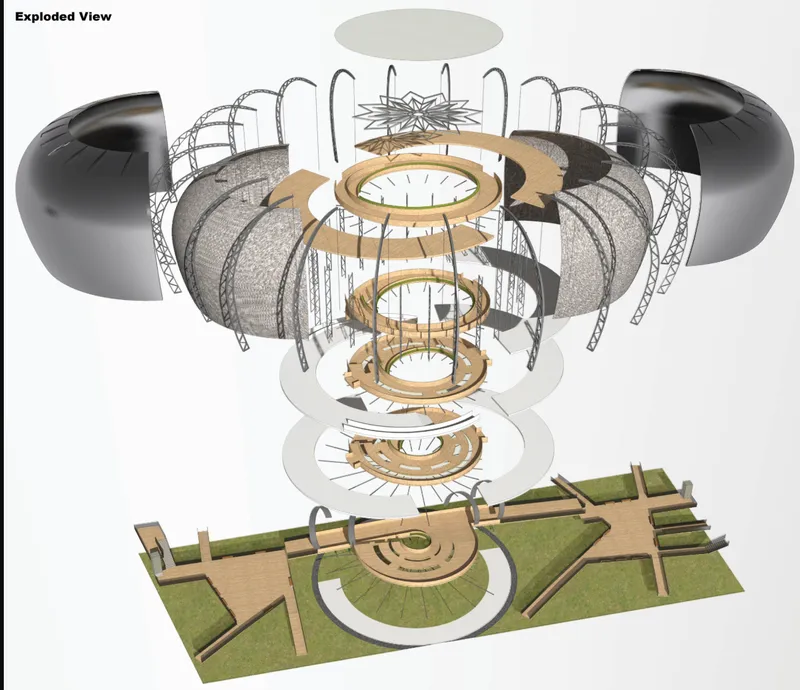
The exploded axonometric clarifies the programmatic stacking. Each circular floor plate carries a distinct function: composting, recycling, and wastewater systems at the base support circular material flows; workshops, digital labs, and repair stations occupy the middle tiers, empowering citizens with hands-on skills; seed libraries, auditoriums, and reading rooms crown the upper levels. Mechanical systems optimized for seed storage conditions sit discreetly within the technical layers, while rainwater harvesting infrastructure is woven into the building's skin. The drawing makes clear that every square meter serves double duty.
Metal Shell, Wooden Heart
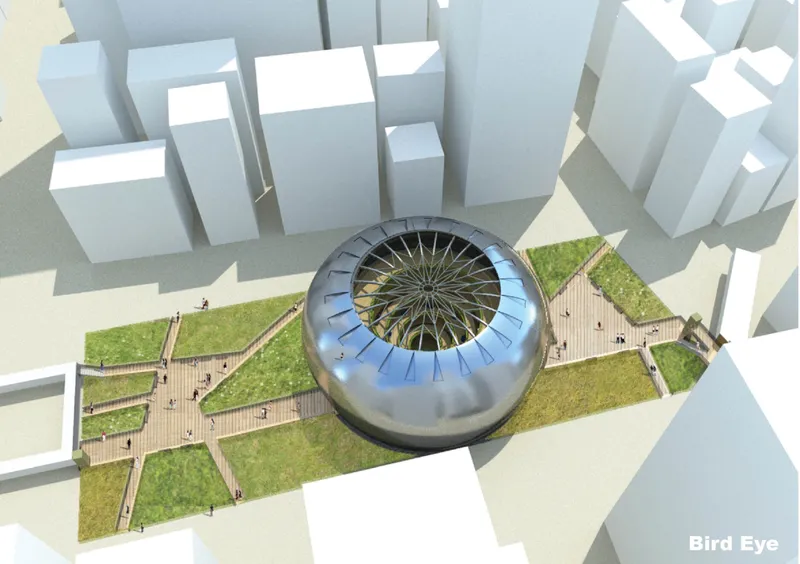
From above, the metallic dome reads as a deliberate counterpoint to the surrounding glass and concrete towers. Its radial skylight cuts a geometric pattern into the reflective surface, signaling the life inside. A landscaped plaza mediates between the dome and the city, extending the building's agricultural program into the public realm with planted beds, timber decks, and gathering spaces. The aerial view confirms the scale: this is not a pavilion or a kiosk, but a civic building that holds its ground among residential high-rises.
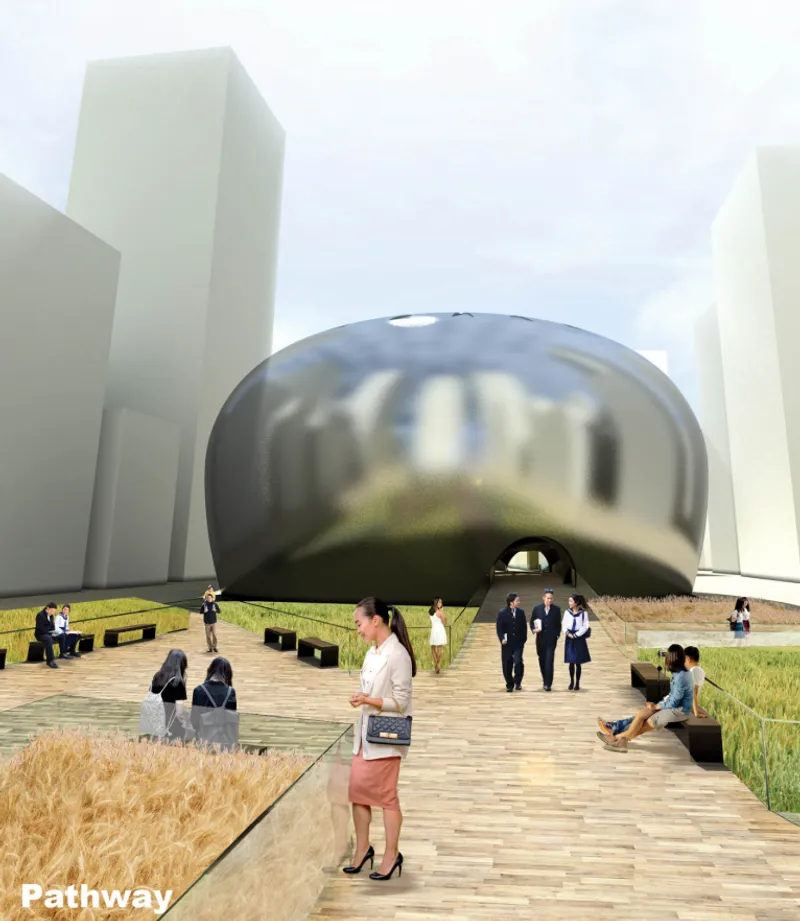
At ground level, the material duality becomes tangible. The reflective metal shell protects a warm, timber-lined interior, echoing the biological logic of its namesake: a hard outer coat guarding a living embryo. People gather on the timber deck, surrounded by planted beds that spill out from the building's perimeter. The form is symbolic, yes, but it is also functional. The cladding acts as a natural insulator, the curvature sheds rainwater toward collection systems, and the open plan at grade invites foot traffic from all directions. It is architecture that earns its metaphor.
Why This Project Matters
Seed banks are typically utilitarian vaults, hidden from public view and designed for longevity rather than engagement. Bayle's proposal inverts that logic entirely. By making preservation visible, participatory, and embedded in daily urban life, Germinated Seed argues that biodiversity is not something to lock away but something to build a community around. The integration of markets, workshops, and urban agriculture into the same structure as a seed library creates feedback loops between education, production, and conservation.
The project's real strength lies in its refusal to treat sustainability as an add-on. Rainwater harvesting, passive ventilation, double-skin façades, composting systems, and pesticide-free planting are not features bolted onto a conventional building; they are the building. In a city where available land is measured in precious square meters, stacking a vertical ecosystem inside a single sculptural form is both a practical answer and a provocation. It asks whether architecture can function as infrastructure for a food system, and it answers convincingly.
View the Full Project
About the Designers
Designer: Audrey Bayle
Enter a Design Competition on uni.xyz
uni.xyz runs architecture and design competitions year-round that reward proposals with spatial conviction and real site intelligence.
Project credits: Germinated Seed by Audrey Bayle Seed Bank (uni.xyz).



Popular Articles
Popular articles from the community


Hill & Cross Opera: Sculptural Opera House Architecture Shaped by Tallinn’s Landscape and Identity
Hill & Cross Opera reimagines opera house architecture in Tallinn through its sculptural hill, civic plaza, glass wave and a luminous cross.

Conexión: Biophilic Design Reimagines High-Rise Living in Hong Kong
Conexión reimagines high-rise living in Hong Kong through biophilic design, green facades, shared spaces, daylight, water and nature within.

Co-life: Sustainable Architecture for Age-Friendly Community Living
Co-life reimagines sustainable architecture for seniors through courtyards, rammed earth, shared gardens, and spaces designed for belonging.

The Musturak Paradise: Senior Living Architecture for a Connected Future in Temara, Morocco
The Musturak Paradise reimagines senior living architecture in Temara via private homes, social spaces, culture, community, and shared care.

Similar Reads
You might also enjoy these articles

Bao Huynh Watercolor Atelier: A Serene Art Retreat in Hội An
Bao Huynh Watercolor Atelier in Hội An blends multifunctional art spaces, sustainable design, local materials, and family-friendly living in a serene environment.

Atelier Macri Concept Store Interior Design by CASE-REAL
Atelier Macri store features a "ko" counter, walnut wood details, cork displays, blending retail, gallery, and seamless customer experiences.

Manuel Vargas Izquierdo Stadium and High-Performance Sports Center: Architectural Excellence in Jalpa de Méndez
The Manuel Vargas Izquierdo Stadium blends sustainable design, inclusive sports facilities, and cultural-inspired architecture, revitalizing Jalpa de Méndez’s public spaces.

KAKR Buluh Awar Hall: Revitalizing Community and Ecology Through Bamboo Architecture
Community built bamboo hall revitalizes Buluh Awar village, empowering youth, restoring ecology, celebrating vernacular craftsmanship through sustainable architecture and culture.

Comments (0)
Please login or sign up to add comments
No comments yet. Be the first to comment!