
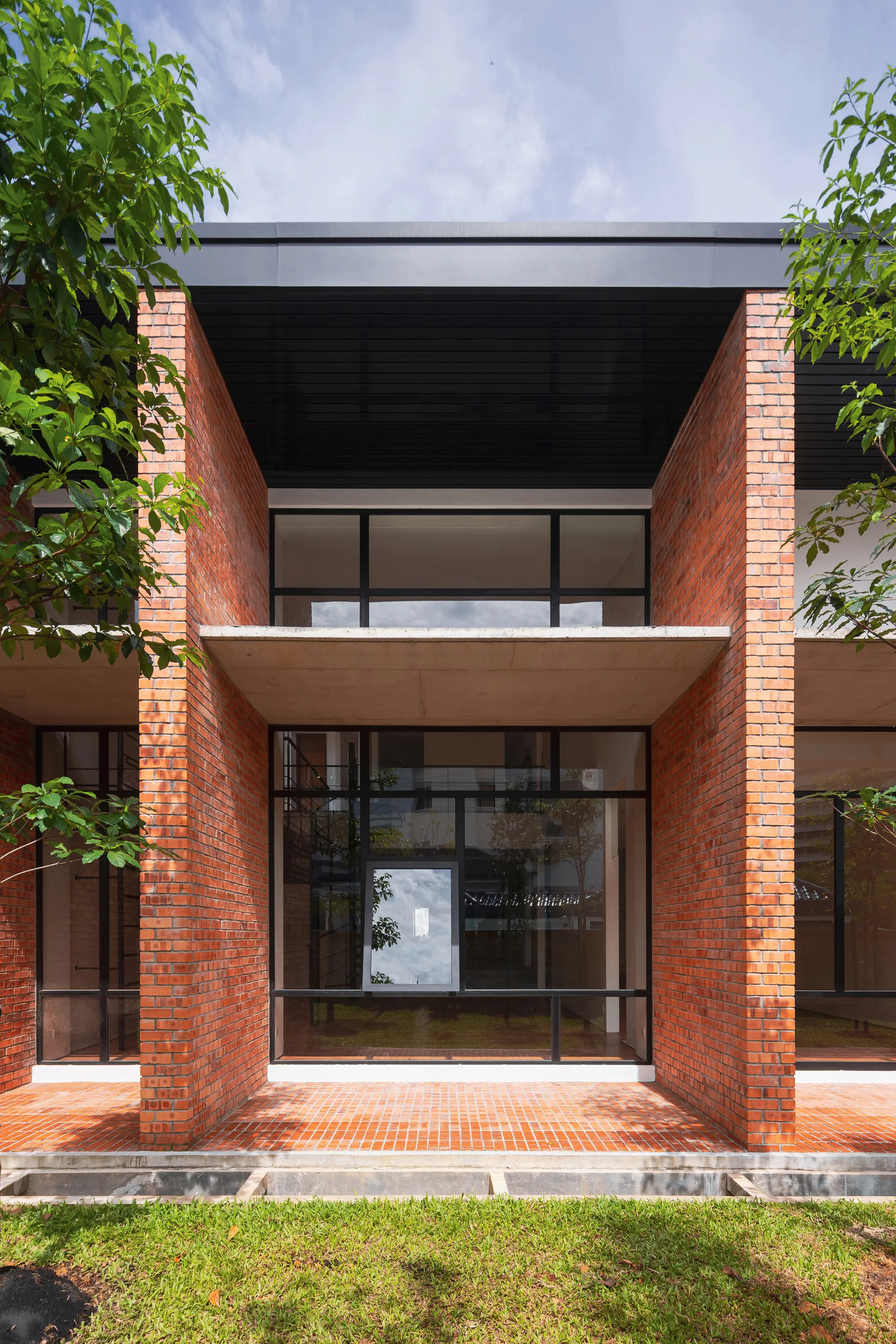
Gibert & Tan Transform a 40-Year-Old Kuala Lumpur House into a Law Firm That Breathes
In Damansara Heights, brickwork and pocket gardens turn a residential relic into a passively cooled office for attorneys.


The legal profession trades on permanence, on precedent, on the weight of tradition made tangible. So when a Kuala Lumpur law firm chose to set up shop not in a glass tower but inside a partially demolished house in the leafy residential enclave of Damansara Heights, the brief became more interesting than most corporate fitouts ever get. Gibert and Tan took that 40-year-old structure, expanded it by half its original volume, and wrapped everything in a continuous brick skin that makes new and old indistinguishable from each other.
What makes 181Chambers worth studying is not just the adaptive reuse or the material honesty, though both are executed with real conviction. It is the way the architects weaponize brick's thermal mass and a series of pocket gardens to keep a 633-square-meter office cool in equatorial Malaysia without leaning heavily on mechanical air conditioning. The building reads as monolithic from the street, almost fortress-like, yet opens generously on its flanks to light, air, and greenery. That tension between civic solidity and domestic comfort defines every decision here.
A Monolith on a Residential Street
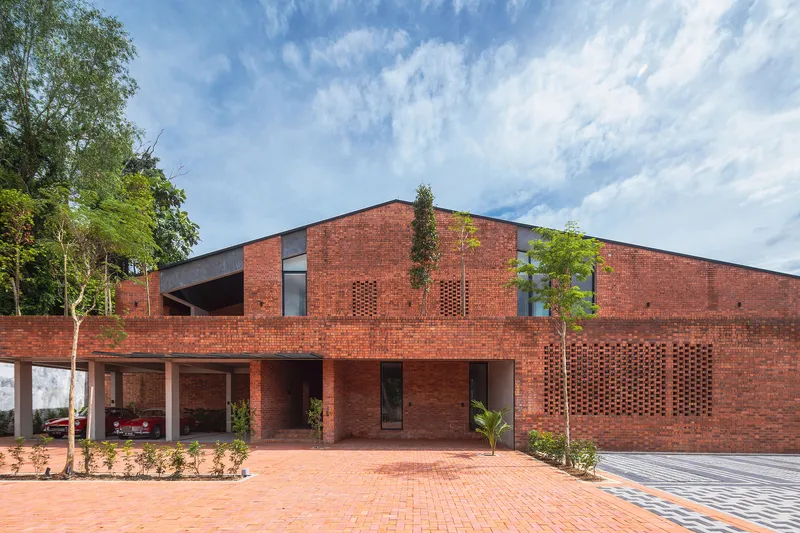
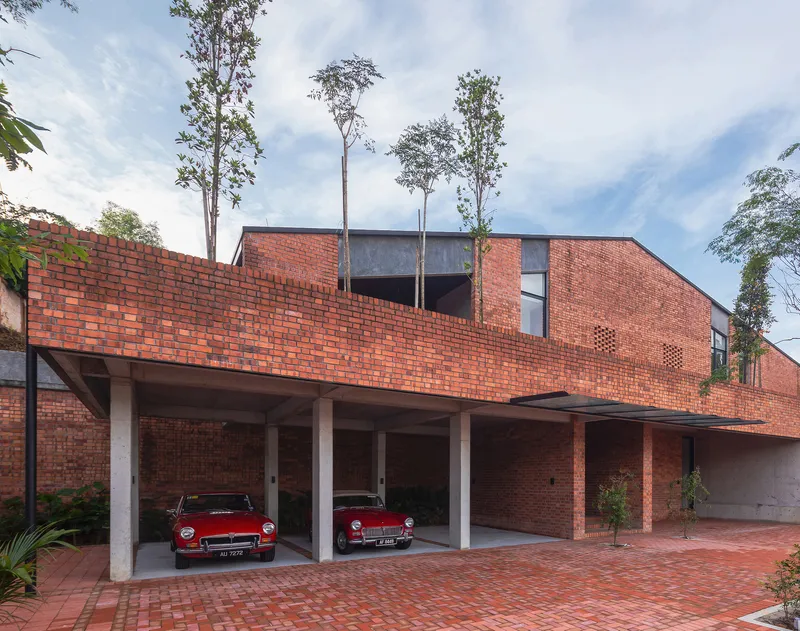
From the front, 181Chambers presents itself as a stack of red brick columns and deep overhangs, more civic institution than converted bungalow. The perforated ventilation panels set into the facade hint at what is happening behind the surface: air is being invited in, modulated, put to work. Large trees retained on site soften the composition and anchor the building in its neighborhood context, preventing it from reading as an interloper.
The decision to use brick as the unifying material across both existing and new portions is critical. It collapses the timeline. You cannot tell where the old house ends and the addition begins, which is precisely the point. For a law firm built on tradition, the seamlessness communicates stability without resorting to pastiche.
Brick Courtyards and Pocket Gardens

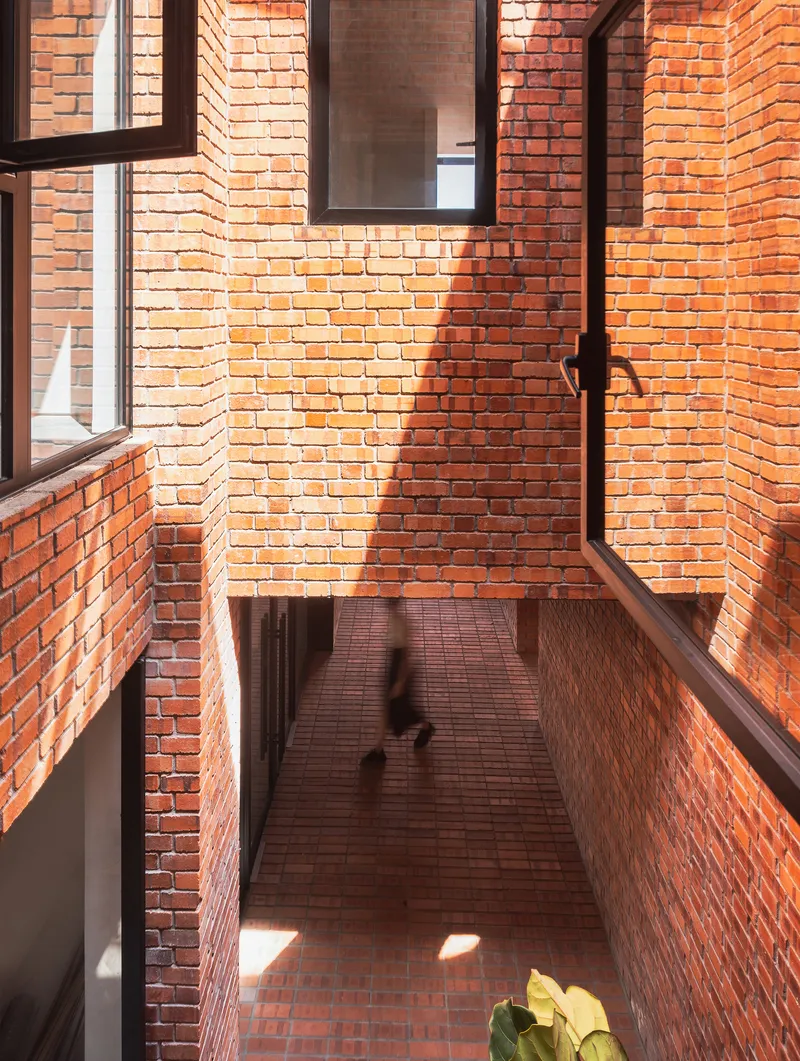
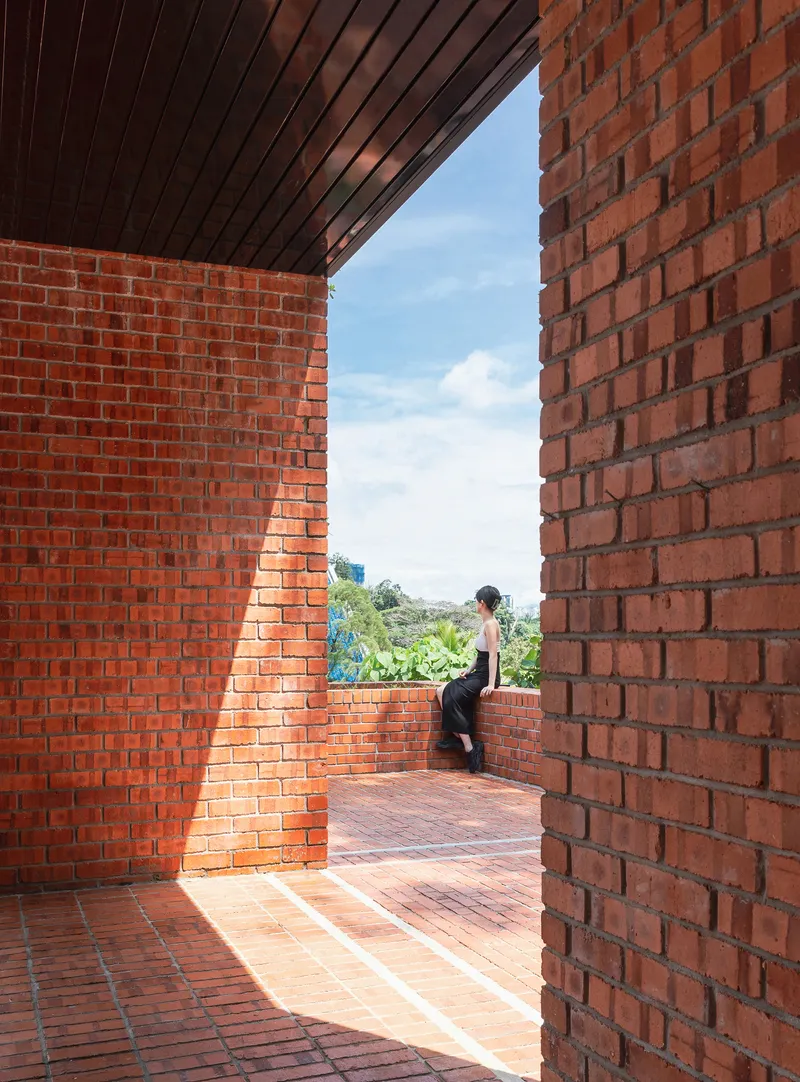
The pocket gardens flanking both sides of the building are not decorative afterthoughts. They are the engine of the passive climate strategy. Large glazed surfaces open onto these gardens, enabling cross ventilation through the interiors and flooding workspaces with natural daylight. A frangipani tree in one enclosed courtyard casts angular shadows across brick paving, creating a meditative pause in what is otherwise a professional environment.
Viewed from above, the courtyards become social condensers. People move through dappled light, pausing at thresholds framed by deep brick reveals. The effect is closer to a tropical cloister than a typical office atrium, and it works because the architects treated landscape and building as a single organism rather than figure and ground.
Deep Overhangs and Passive Cooling
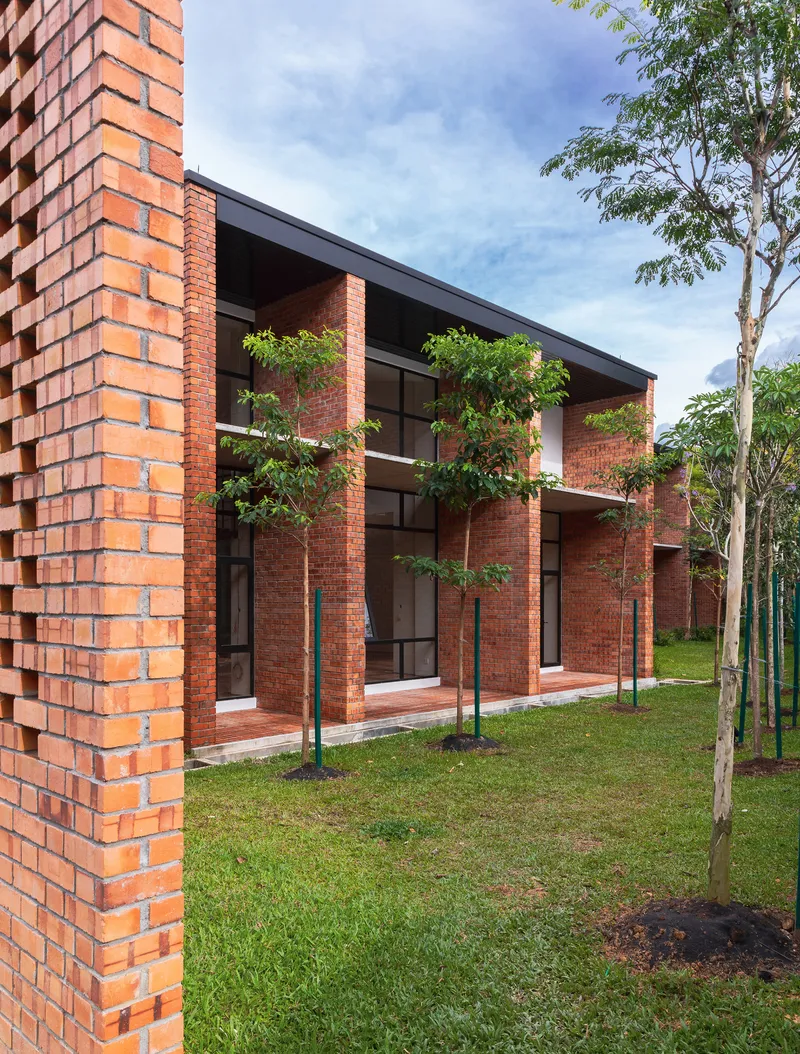
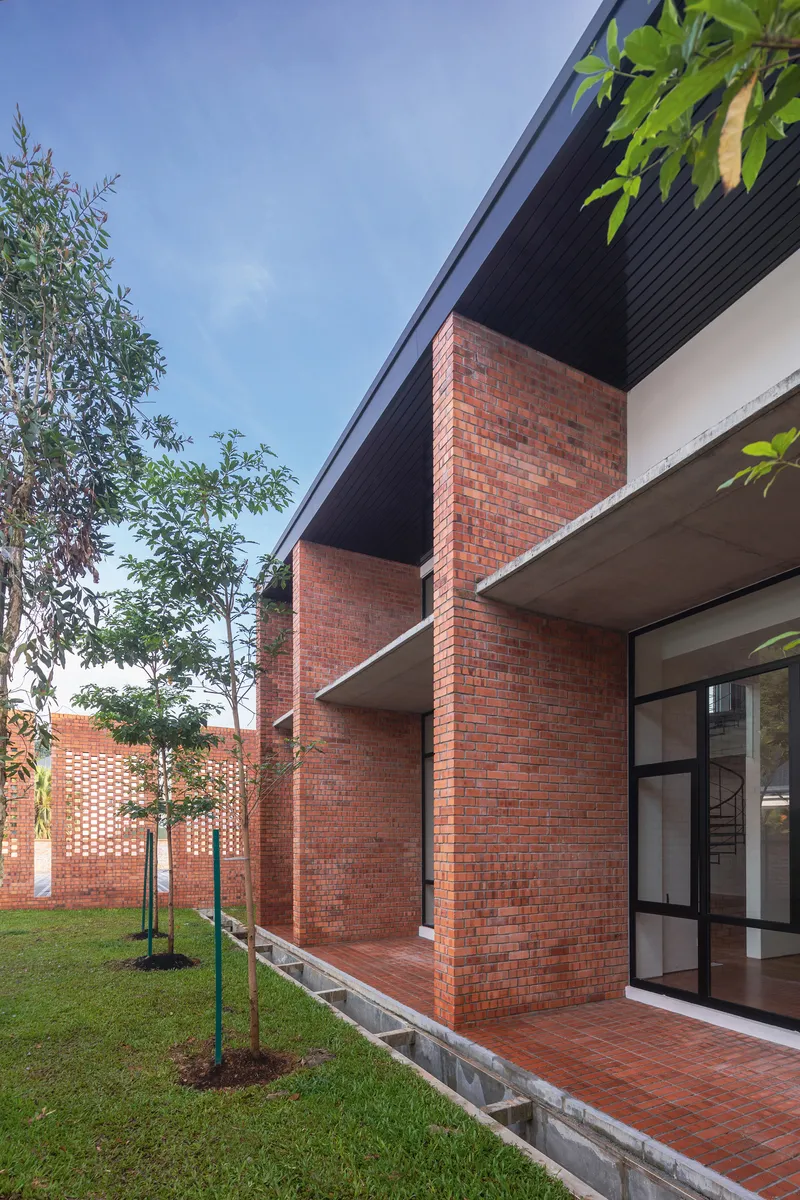
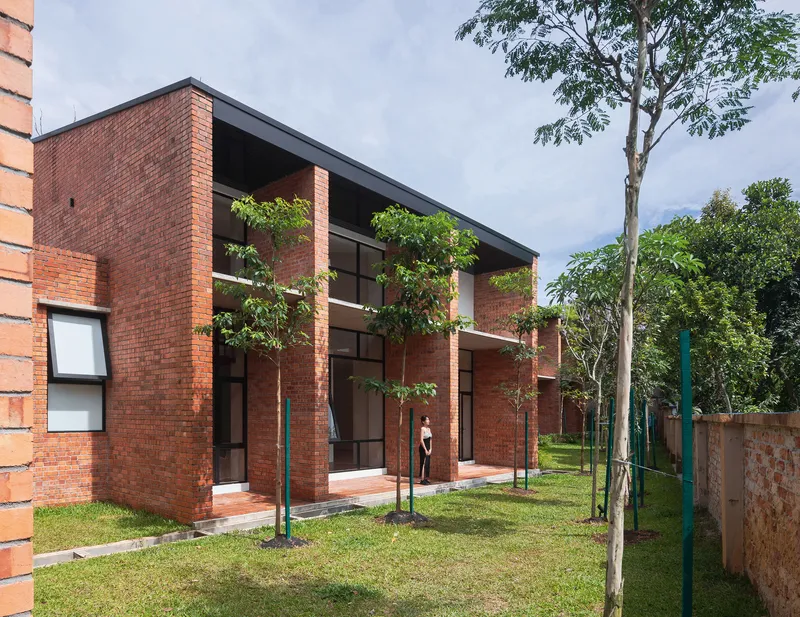
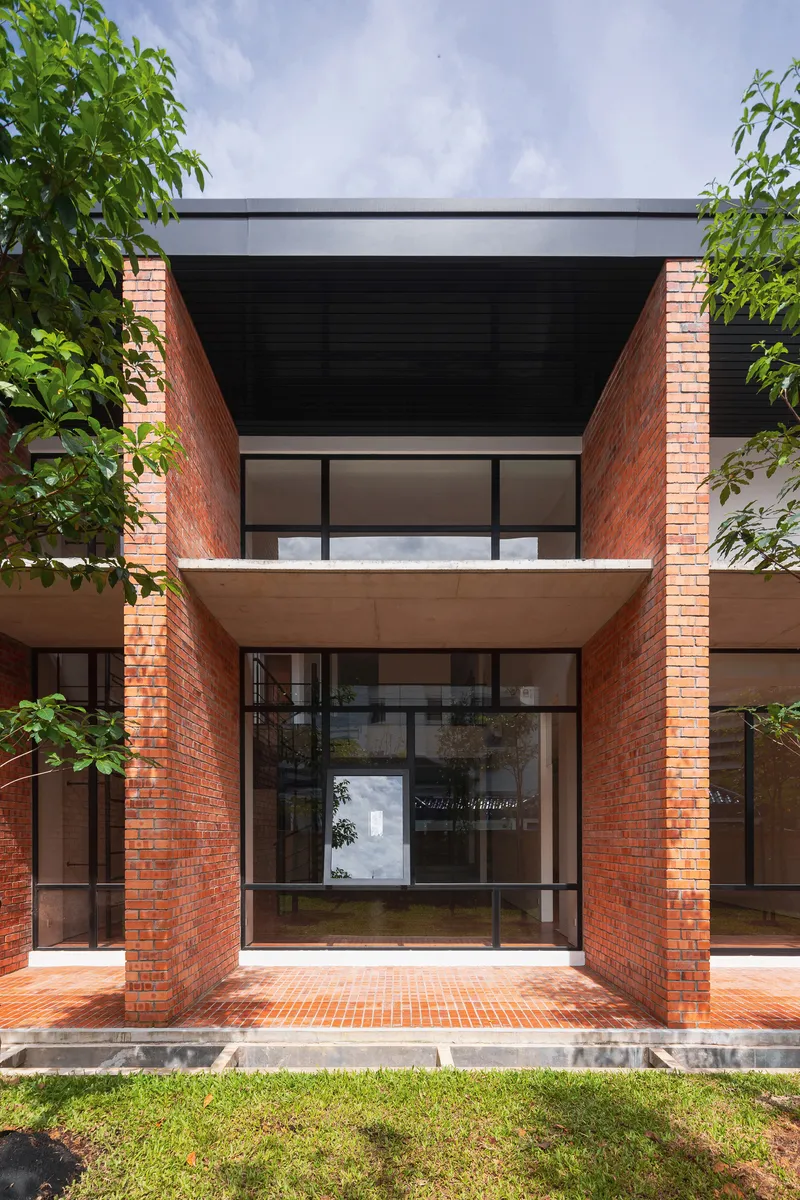
Kuala Lumpur sits roughly three degrees north of the equator. Direct sun on glass is not a design choice; it is a liability. Gibert & Tan address this with large wall protrusions that shade the glazed openings on the building's flanks, keeping solar gain in check without sacrificing transparency. The rear facade, with its tall windows framed between brick piers, demonstrates how generous glazing can coexist with serious shading when the wall section is thick enough.
Brick's thermal mass does the rest of the heavy lifting. It absorbs heat during the day and releases it slowly, moderating interior temperatures and reducing reliance on air conditioning. In a region where mechanical cooling accounts for a staggering share of energy consumption, this approach is pragmatic, not ideological.
Interior Spaces: Library, Stair, and Light
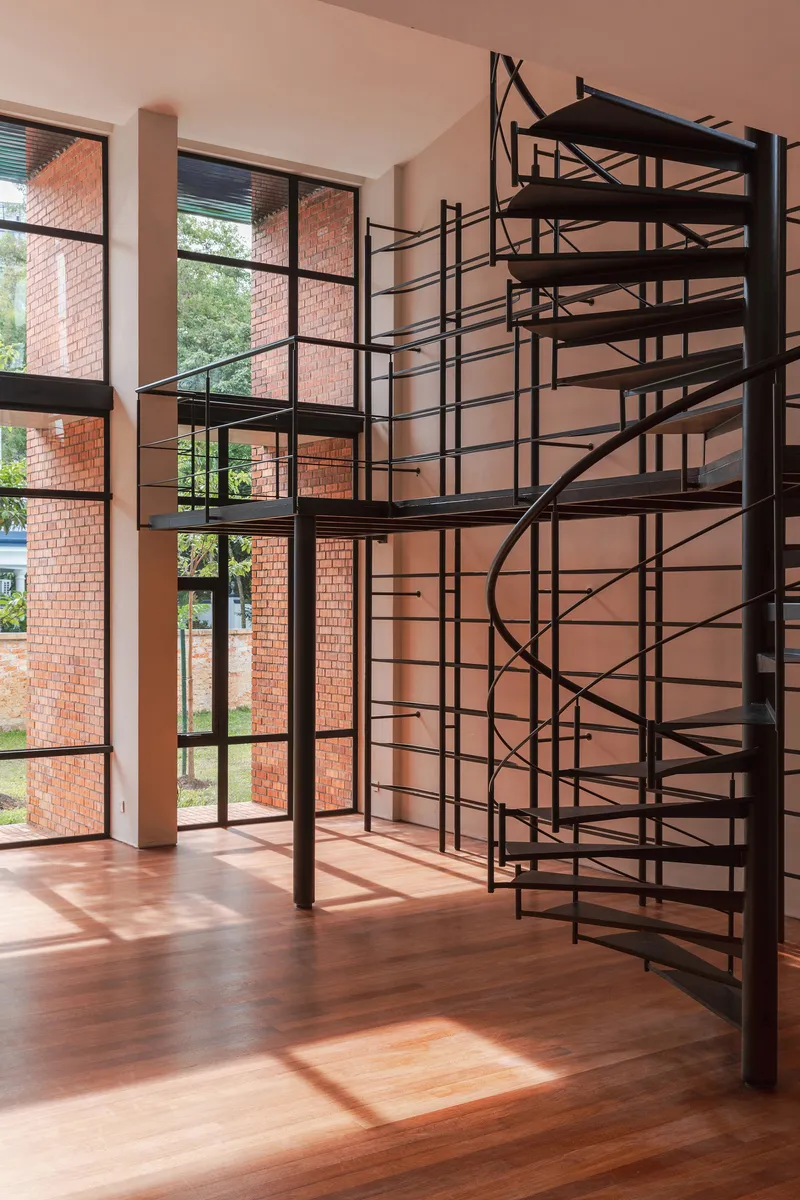
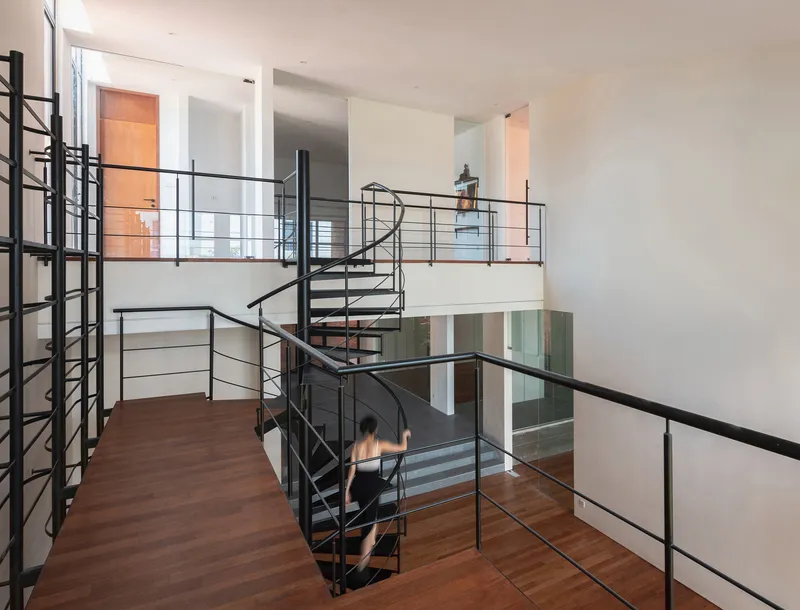
The library is positioned as the first element visitors encounter, a deliberate statement about the firm's intellectual identity. Beyond it, the interiors maintain a sober, minimalist palette: custom-made prefabricated polished concrete floor plates, woodwork curated by Studio Supereka, and a black steel spiral staircase that threads through the building's multiple levels. That staircase, photographed against floor-to-ceiling windows overlooking a brick courtyard, is one of the project's most striking moments, a piece of industrial craft set against warm, textured masonry.
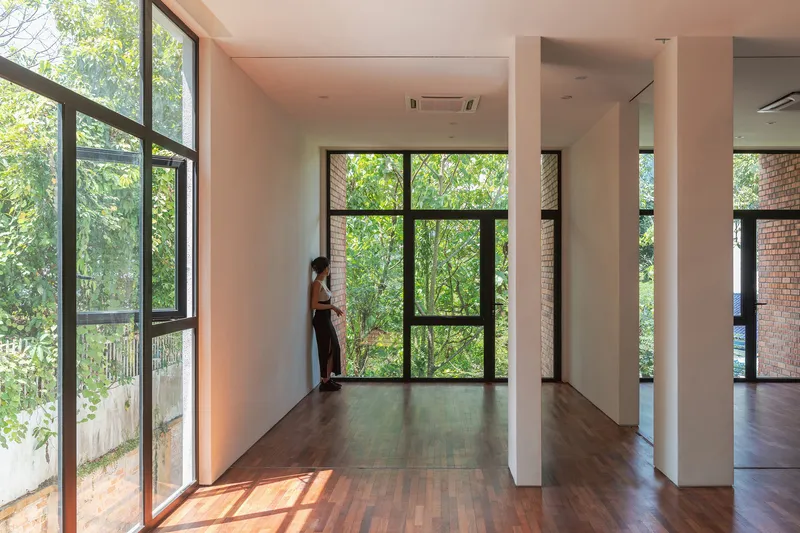
Double-height spaces amplify the sense of openness, with black-framed windows pulling mature foliage into the interior view. The design avoids the closed-door hierarchy of conventional law offices, offering instead a gradient from communal lounges and a café to private meeting rooms and individual attorney offices. One-third of the building is allocated to multi-purpose rooms for sole practitioners, acknowledging that legal work today oscillates between collaboration and deep focus.
Brick Texture and Material Detailing
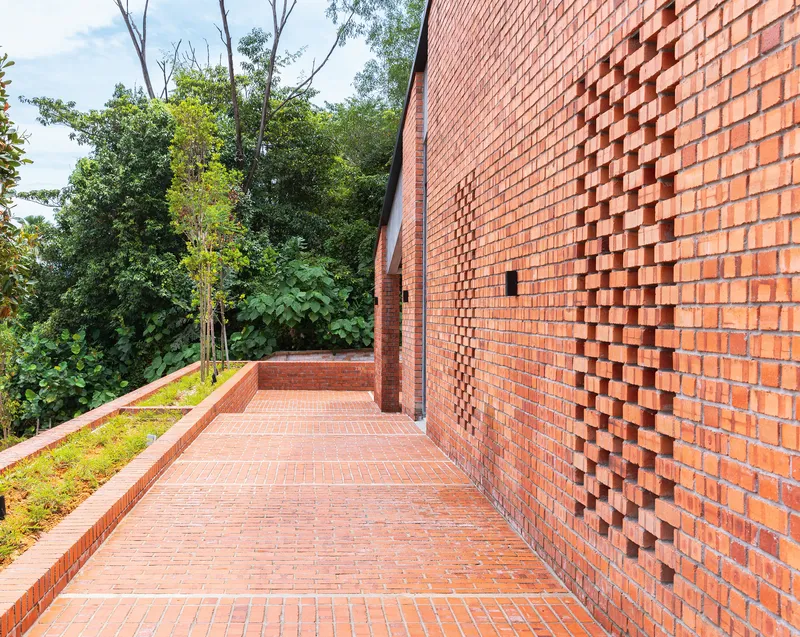
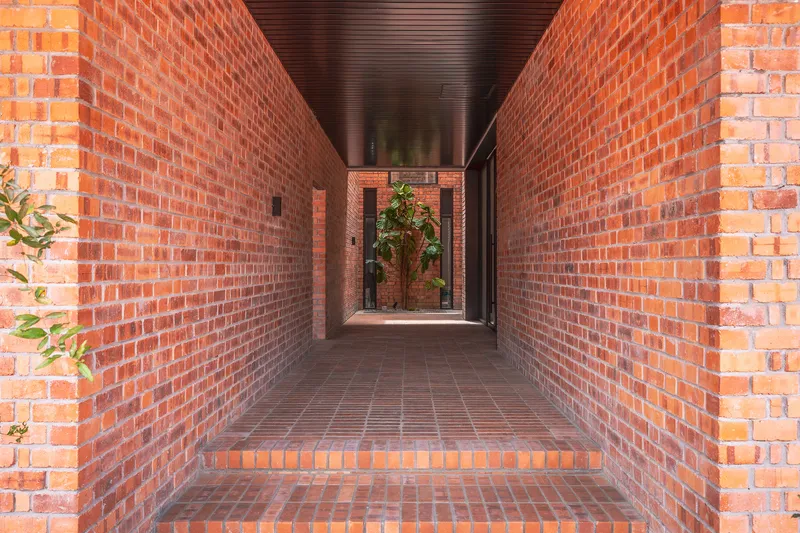
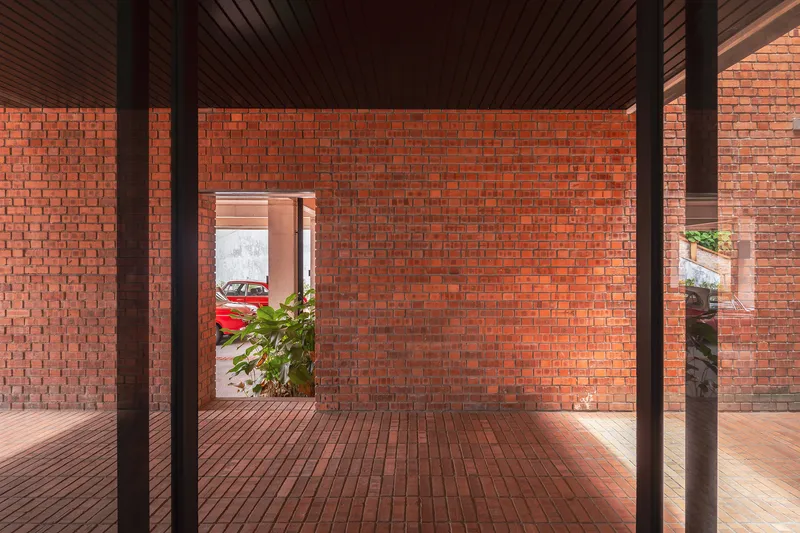
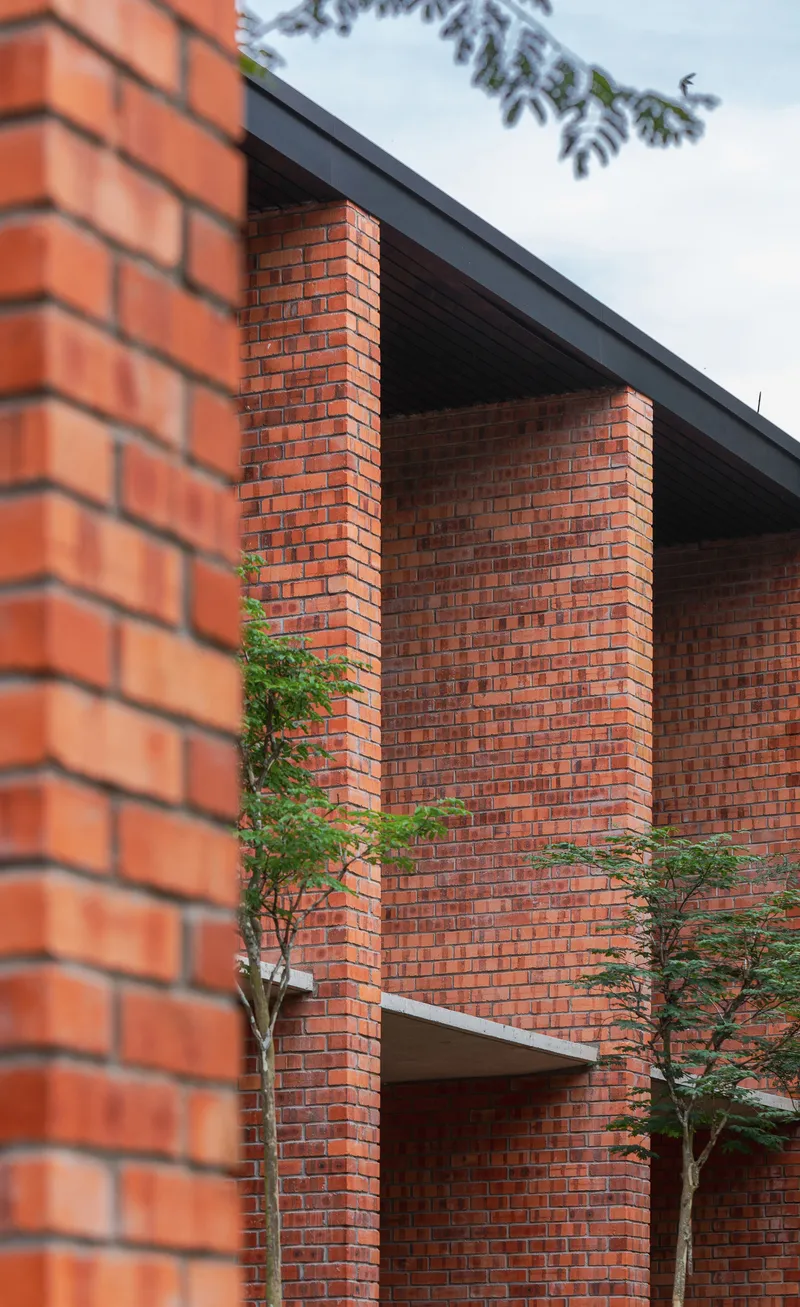
The projecting brick wall patterns on the terrace level are worth a closer look. These textured surfaces are not structural; they are atmospheric, creating relief and shadow play that shifts throughout the day. Combined with the red brick paving underfoot, they produce an environment saturated in a single material family, varied only by orientation, bond pattern, and light.
Inside, the original timber columns and slatted ceilings of the old house have been retained and exposed, providing a counterpoint to the new brickwork. This dialogue between found and introduced materials gives the building biographical depth. A narrow brick corridor terminating at a planted courtyard captures the project's spatial logic in miniature: compression, release, green.
Plans and Drawings
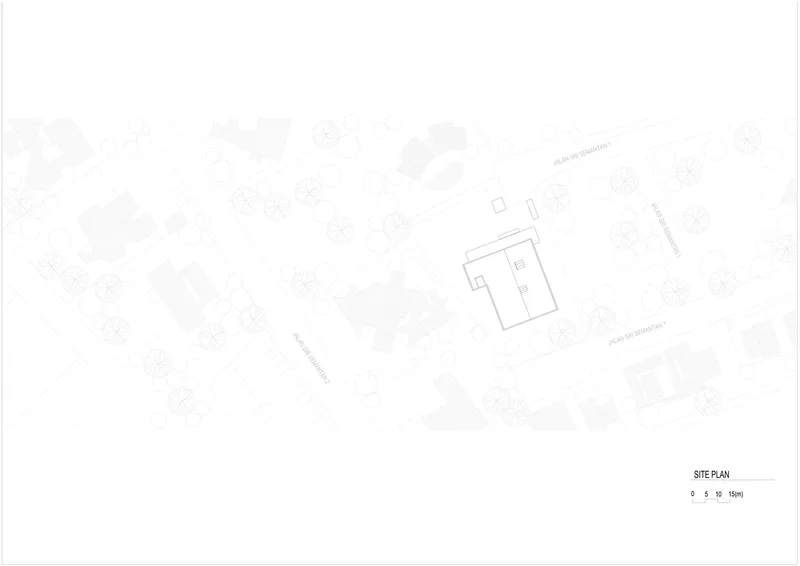
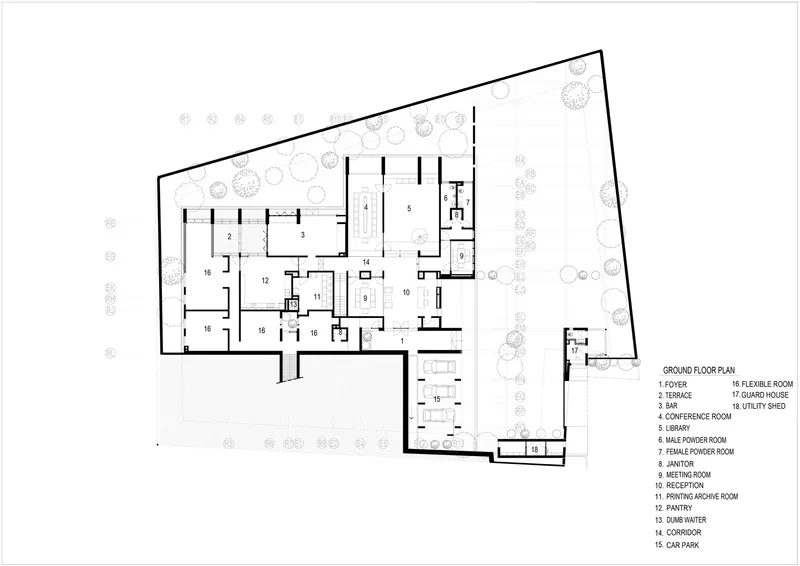
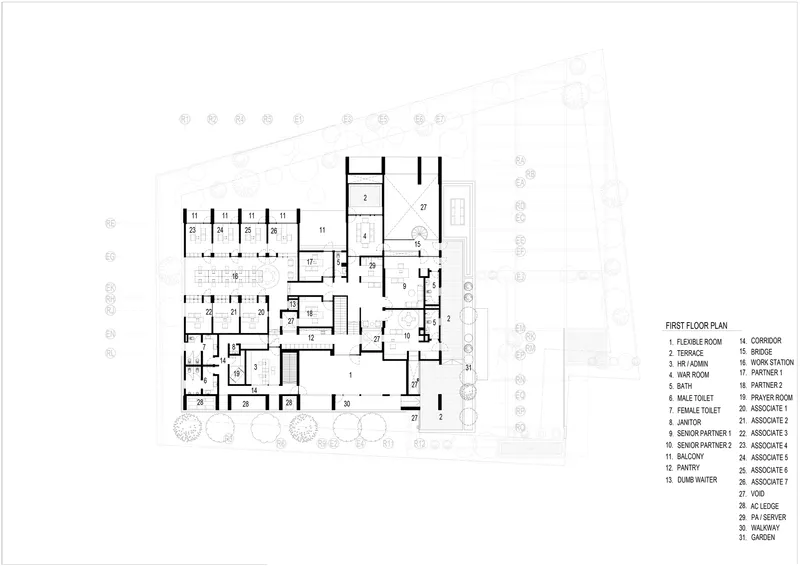
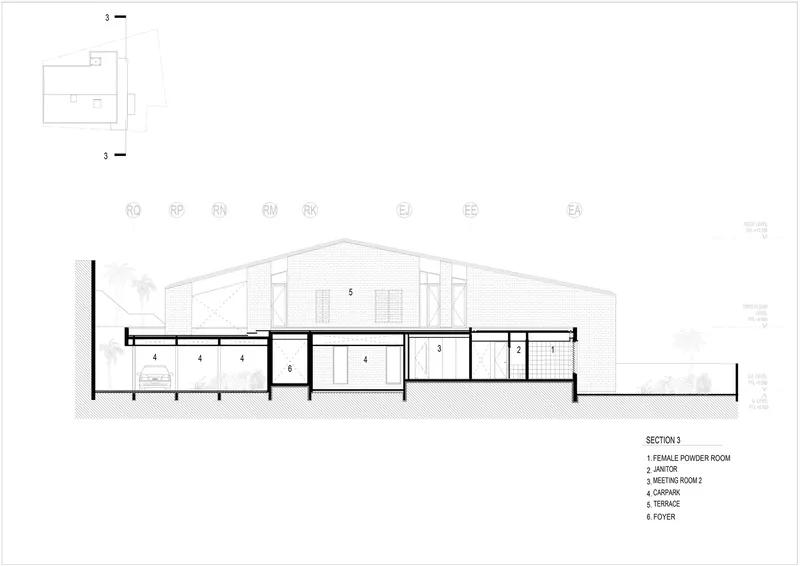
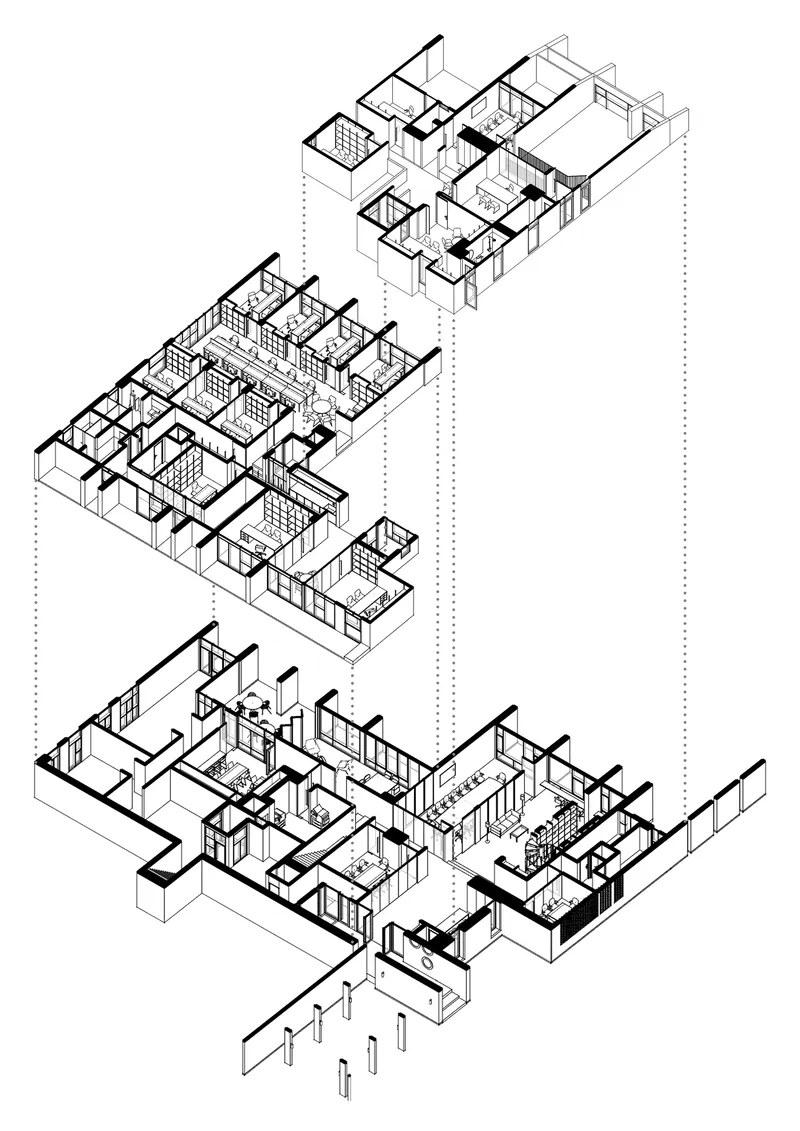
The ground floor plan reveals how the program wraps around the pocket gardens: foyer, terrace, library, conference room, and meeting spaces fan out from a central spine, each room touching landscape at least once. The first floor stacks private offices above, keeping the ground level social and porous. The exploded axonometric makes the three-level spatial relationship legible, showing how staircases and voids knit the floors together vertically.
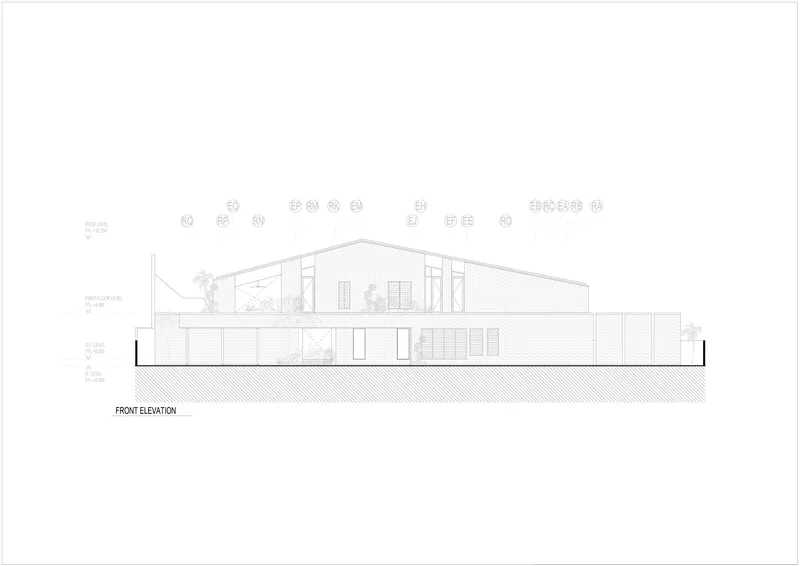
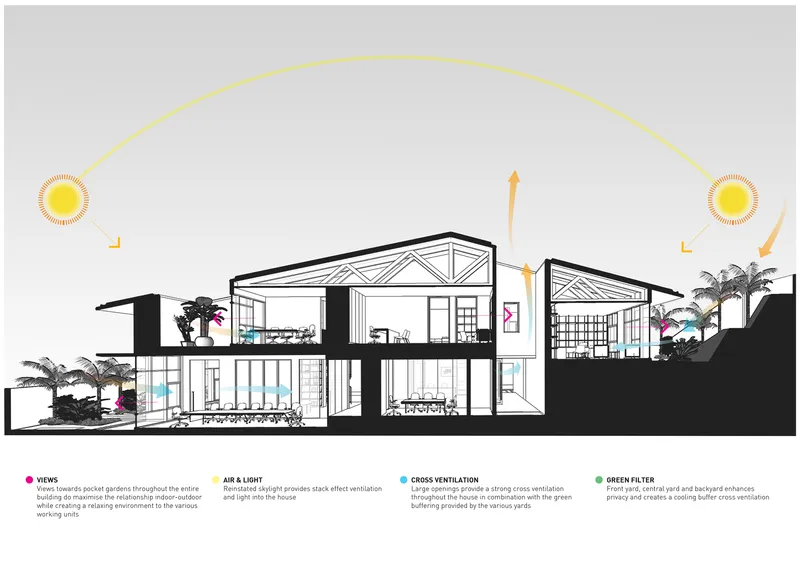
The environmental section diagram is particularly instructive. It maps the solar path and airflow arrows through the double-height spaces, illustrating how rising hot air is vented at the roof while cooler air is drawn in through the garden-facing openings. This is not speculative; it is a straightforward stack-effect strategy executed within a domestic-scale building. The front elevation confirms the gabled profile, grounding the project's civic ambitions in a residential silhouette that does not antagonize its neighbors.
Why This Project Matters
181Chambers is a compact rebuttal to two defaults in Southeast Asian commercial architecture: the sealed glass box and the wholesale demolition of aging structures. By retaining a 40-year-old house, expanding it intelligently, and wrapping both in a continuous brick envelope, Gibert & Tan prove that adaptive reuse in the tropics can be climatically smart, not just sentimental. The passive cooling strategy alone makes the project worth replicating across the region.
More broadly, the project reframes what a law office can feel like. The library as threshold, the courtyard as meeting room, the rooftop terrace as event space: these are not perks bolted onto a conventional plan, but consequences of treating the building as a house first and an office second. In a profession defined by precedent, that inversion is its own quiet argument for change.
181Chambers Office by Gibert & Tan, Damansara Heights, Kuala Lumpur, Malaysia. 633 m², completed 2022. Photography by Pixelaw Photography.
About the Studio
Share Your Own Work on uni.xyz
If projects like this are the kind of work you want to make, uni.xyz is a place to publish your own, find collaborators, and enter design competitions.



Popular Articles
Popular articles from the community


Hill & Cross Opera: Sculptural Opera House Architecture Shaped by Tallinn’s Landscape and Identity
Hill & Cross Opera reimagines opera house architecture in Tallinn through its sculptural hill, civic plaza, glass wave and a luminous cross.

Conexión: Biophilic Design Reimagines High-Rise Living in Hong Kong
Conexión reimagines high-rise living in Hong Kong through biophilic design, green facades, shared spaces, daylight, water and nature within.

The Ocean Hive: Sustainable Architecture for a Self-Sufficient Civilization at Sea
The Ocean Hive imagines sustainable architecture at sea, where modular habitats, algae, wave power and ocean waste sustain a growing colony.

Co-Life: Senior Housing Design That Reconnects Older Adults With the City
Co-Life reimagines senior housing design through healing gardens, shared streets, workshops, and a sustainable community across generations.


Similar Reads
You might also enjoy these articles

Bao Huynh Watercolor Atelier: A Serene Art Retreat in Hội An
Bao Huynh Watercolor Atelier in Hội An blends multifunctional art spaces, sustainable design, local materials, and family-friendly living in a serene environment.

Atelier Macri Concept Store Interior Design by CASE-REAL
Atelier Macri store features a "ko" counter, walnut wood details, cork displays, blending retail, gallery, and seamless customer experiences.

Manuel Vargas Izquierdo Stadium and High-Performance Sports Center: Architectural Excellence in Jalpa de Méndez
The Manuel Vargas Izquierdo Stadium blends sustainable design, inclusive sports facilities, and cultural-inspired architecture, revitalizing Jalpa de Méndez’s public spaces.

KAKR Buluh Awar Hall: Revitalizing Community and Ecology Through Bamboo Architecture
Community built bamboo hall revitalizes Buluh Awar village, empowering youth, restoring ecology, celebrating vernacular craftsmanship through sustainable architecture and culture.


Comments (0)
Please login or sign up to add comments
No comments yet. Be the first to comment!