

Gløde: A Fireplace Shelter Glowing in Norwegian Birch
MA/CO builds a 24 square metre timber pavilion in Norway where charred shingles, raw framing, and a sunken fire pit make architecture radiate warmth.


The Norwegian verb gløde means to glow from within, and that single word carries the entire architectural proposition of this 24 square metre shelter by MA/CO (Matières Communes). Set in a mountain clearing surrounded by birch forest and wildflower meadows, the pavilion exists to house one elemental act: gathering around fire. Everything about the structure, from its charred shingle walls to its sunken pit at the centre, is calibrated to make that act feel both primal and precise.
What makes Gløde genuinely interesting is not its smallness or its Scandinavian setting, both of which invite easy romanticising. It is the way the building treats timber as a spectrum of conditions rather than a uniform material. Rough stone at the base, charred shingles on the gable ends, fresh sawn framing exposed diagonally, smooth planed benches for sitting: each surface corresponds to a different distance from the body. The building reads its own materiality as a gradient from landscape to skin.
Landscape as Threshold


Approaching Gløde is already part of the experience. From a distance, the pavilion registers as little more than a dark geometric mark in a clearing, its corrugated metal roof catching light somewhere between the birch trunks and the overcast sky. The surrounding landscape of wildflower meadows and forested mountain slopes does not frame the building so much as absorb it. You arrive on foot, through terrain, and the act of walking uphill to the shelter becomes a slow calibration of attention.
The distant view of two figures seated on a hillside overlooking the valley reinforces this reading. The shelter is not a destination that terminates movement; it is a waypoint in a larger relationship between body and terrain. MA/CO seems to understand that hospitality architecture in a landscape this expansive needs to resist the temptation to compete.
A Facade of Many Skins
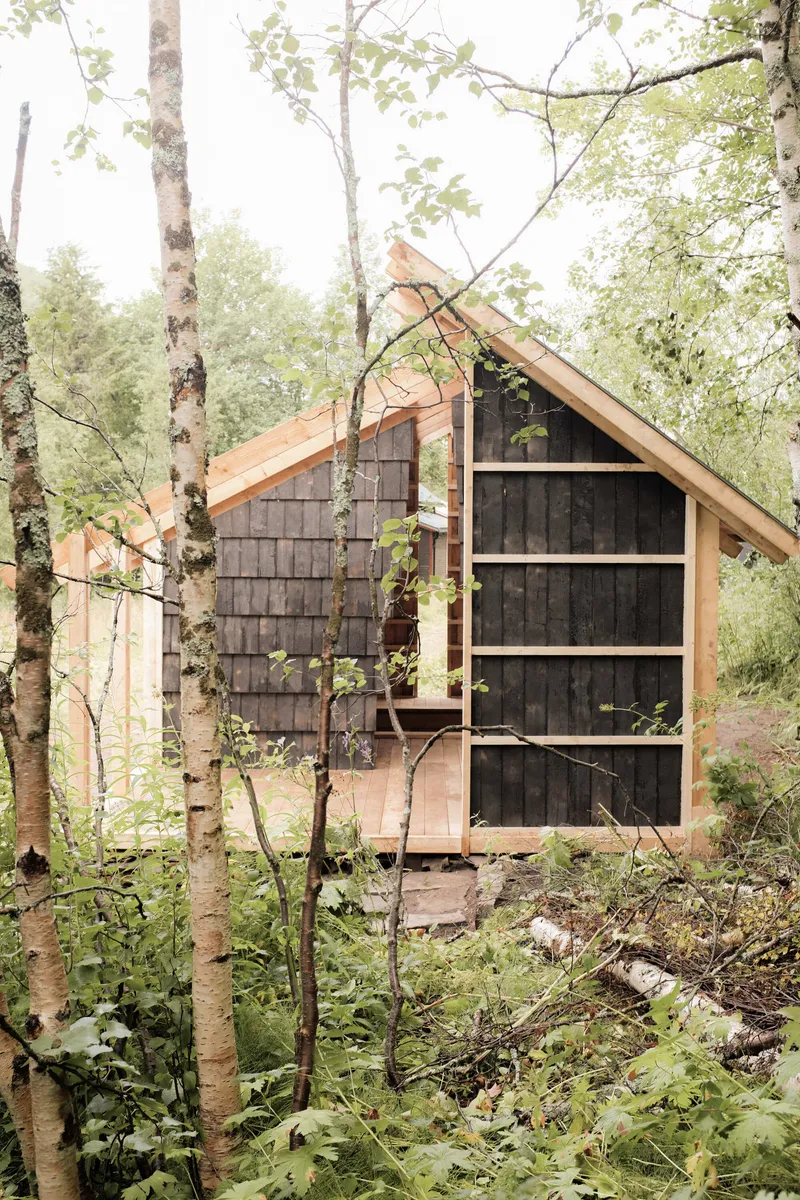
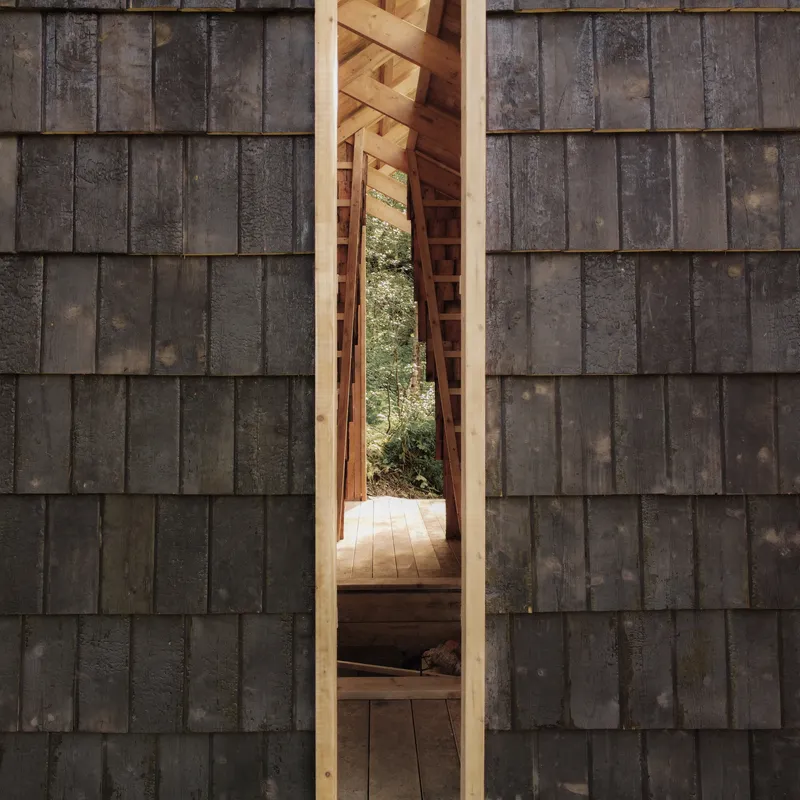
The gable end reveals the building's most striking material decision: dark charred shingles covering the wall plane, interrupted by a large glazed opening that turns the interior into a lantern after dark. A narrow vertical slit cut through the shingled surface frames a single birch trunk, collapsing the distance between wall and forest into a few centimetres of depth. The fresh timber lining this slit contrasts sharply with the blackened exterior, making the cut feel almost surgical.
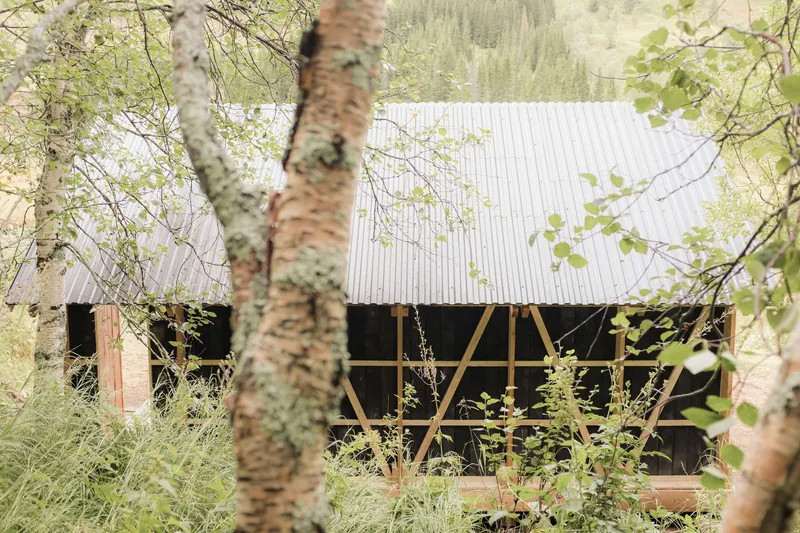
On the long elevations, the logic shifts. Diagonal timber bracing is left fully exposed beneath the corrugated roof, creating a screen condition that filters views of the surrounding birch. The structure is not hidden; it is the ornament. This honesty in framing gives the pavilion a tectonic clarity that belies its modest scale.
The Corrugated Canopy

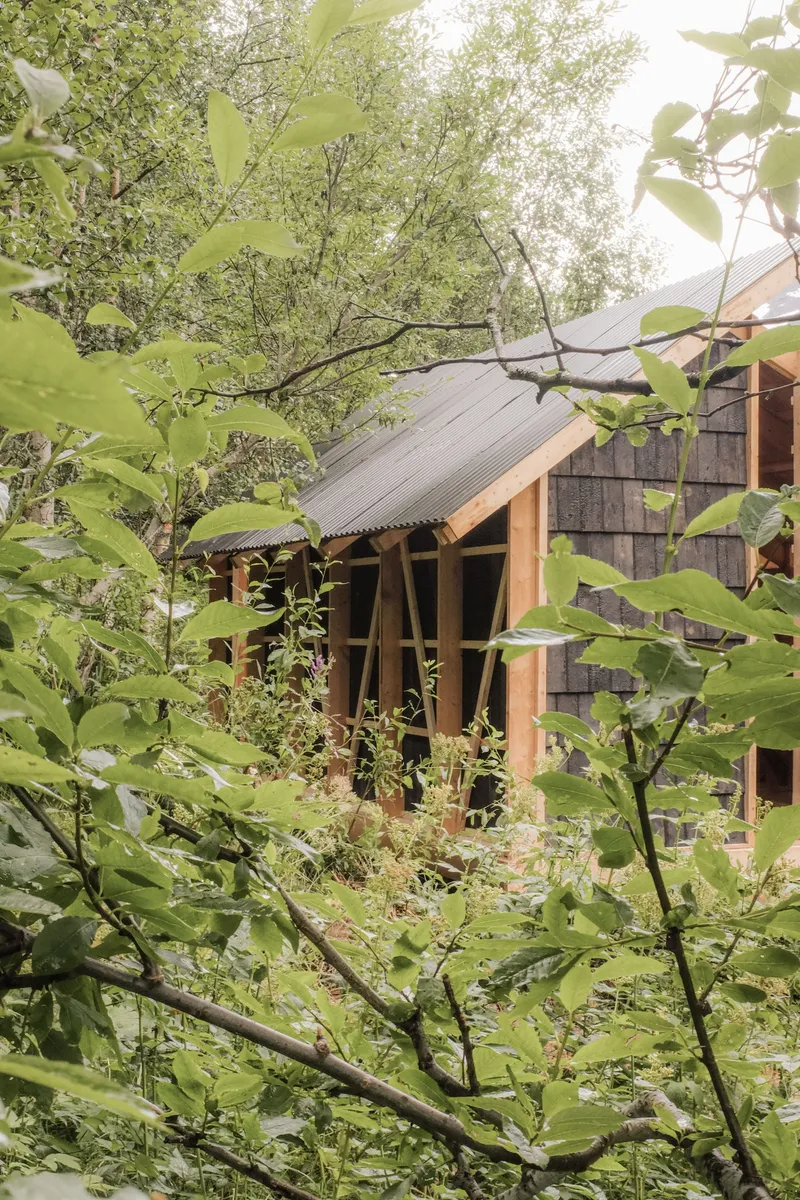

The corrugated metal roof is the one industrial element in an otherwise handcrafted assembly, and it earns its place. Its simple gable profile gives the shelter an archetypal legibility: this is a house shape, a fire shape, a thing with a peak. In different light conditions and seasons, the metal surface shifts between dull silver and near-black, alternately blending with the overcast sky and standing sharply against spring foliage.
The stone base anchors the pavilion to the cleared ground, establishing a mineral datum from which the timber construction rises. This transition from stone to wood to metal reads vertically as a shift from earth to air, grounding the lightweight structure without making it feel heavy.
Fire at the Centre

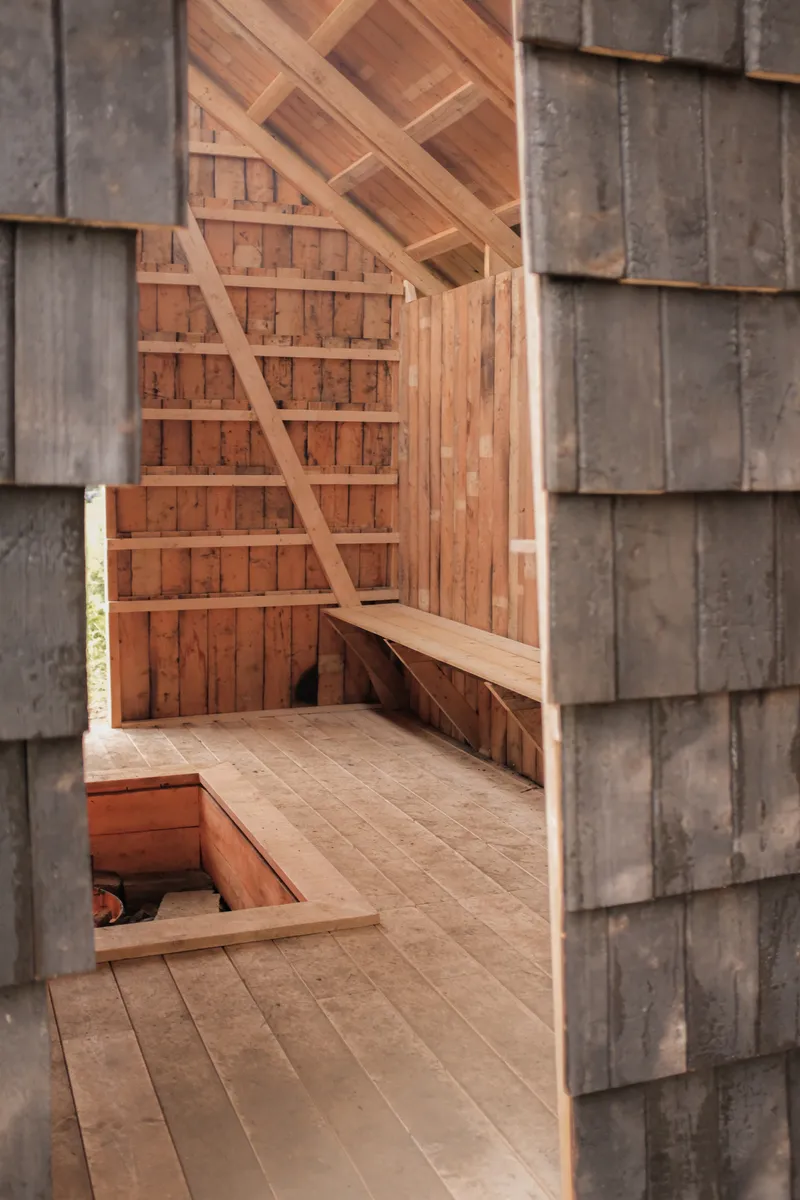

The interior is organised entirely around the sunken fire pit. Built-in timber benches ring the perimeter, and the exposed rafter ceiling rises to a ridge that channels smoke and warmth upward. The diagonal bracing visible from outside reappears inside as a rhythmic presence that subdivides the volume without enclosing it. Everything converges on the low opening of the pit, which draws the eye downward and the body inward.
There is something deliberately sauna-like in the proportions: the low benches, the warm enclosure, the heat source at the core. MA/CO blurs the line between fireplace shelter and bathing ritual, treating the programme not as a single function but as a condition of thermal intimacy. Sitting here with a fire lit, the timber surfaces would absorb and re-radiate heat, and the building would begin to do what its name promises: glow.
Craft in the Details


The open timber doors, the narrow vertical slot framing a single birch trunk, the upward view of ceiling beams meeting at the ridge: these moments confirm that Gløde was built with real care. The joinery is clean but not precious. You can see saw marks and natural grain variation. The ceiling structure in particular, with its regular spacing of rafters converging on the ridge beam, gives the small interior a surprising sense of height and directionality.
A person seated beside the fire pit, visible through the opened doors, completes the spatial diagram. The building is sized for a small group, not a crowd. Its hospitality is intimate, conversational, measured against the human body at rest.
Seasonal Presence

Photographs taken across different moments show the shelter responding to its surroundings with quiet adaptability. Pink wildflowers in summer soften the base; bare birch trunks in early spring expose the full silhouette of the diagonal bracing. The screened walls allow the seasons to pass through the building rather than being kept at bay. This permeability is essential: Gløde is not insulated architecture. It is shelter in the oldest sense, a roof and a fire, with the weather always legible just beyond the frame.
Plans and Drawings


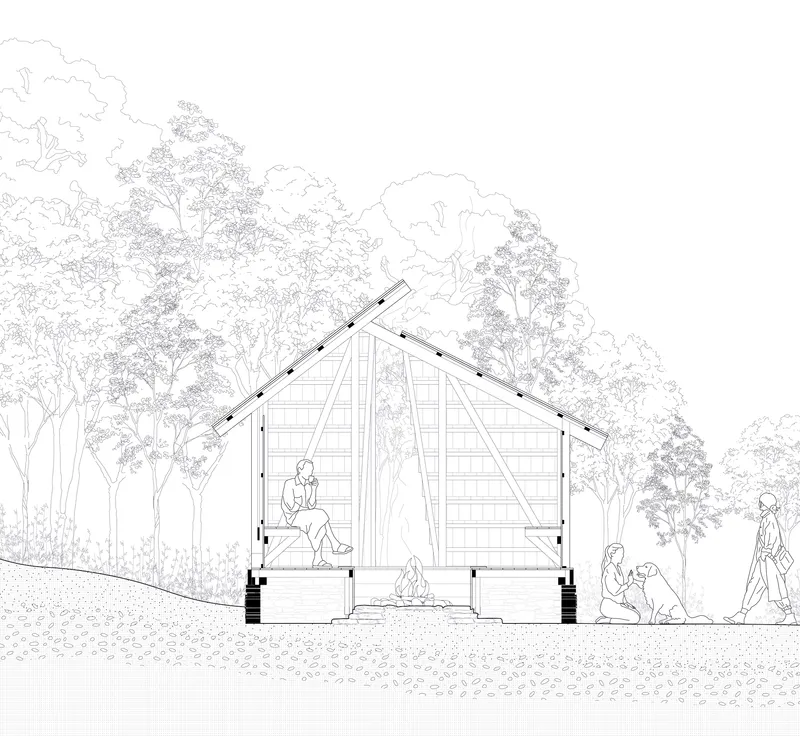
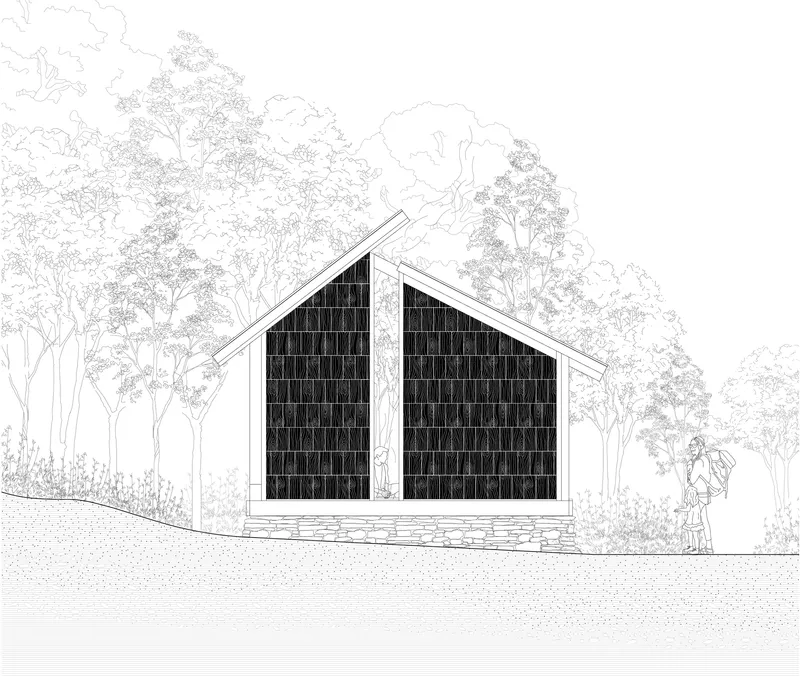

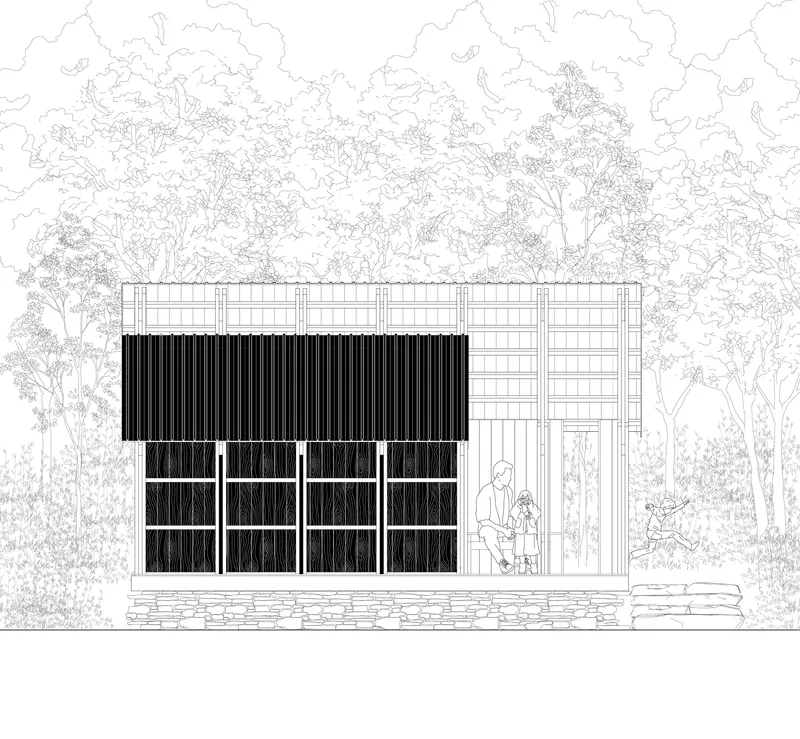
The exploded axonometric is perhaps the most revealing drawing. It breaks the building into its constituent layers: stone foundation, timber floor platform, wall frames with diagonal bracing, shingle cladding panels, and the corrugated roof shell. Each layer is a distinct material and structural logic, stacked and nested together into a compact assembly. The floor plan, drawn with surrounding trees mapped to scale, reinforces the pavilion's identity as an object placed within a specific grove rather than on an abstract site.
The elevation and section drawings demonstrate the formal discipline at work. Every facade resolves differently: shingles on the gable, open bracing on the long side, a gridded panel system on another. The section confirms the centrality of the fire pit and reveals the generous ceiling height relative to the compact footprint. A figure with a dog, drawn casually into the section, is a nice reminder that this is a place for warmth, not a monument.
Why This Project Matters
In a moment when hospitality architecture often defaults to either luxury minimalism or nostalgic rusticism, Gløde offers a third path. It is rigorously designed but unapologetically rough. It treats fire not as an amenity but as the programme itself, and it organises every material and spatial decision around the simple proposition that warmth can be architectural. At 24 square metres, the building proves that ambition in architecture is not a function of scale.
MA/CO's achievement here is in resisting the temptation to over-design. The shelter is legible, buildable, and deeply specific to its site without being precious. It belongs to its clearing the way a campfire belongs to a ring of stones: not because it grew there, but because someone chose the spot with care and built exactly enough. That restraint, in the end, is what lets the building glow.
Fireplace Shelter, Gløde by MA/CO (Matières Communes), Norway. 24 m², completed 2025. Photography by Mathieu Maupas and Léo Grebot.
About the Studio
Share Your Own Work on uni.xyz
If projects like this are the kind of work you want to make, uni.xyz is a place to publish your own, find collaborators, and enter design competitions.


Popular Articles
Popular articles from the community


Singing Woman: An Opera House That Performs Before the Curtain Rises
Ovidiu Cristian Pavel's conceptual opera house translates Estonia's choral identity into a sculpted waterfront landmark facing the Baltic Sea.


Cube Design Draws an Ecological Corridor Between Two Shenzhen Hills with the Nankai Building
Beside Shenzhen's container docks, the Nankai Building pairs stacked balconies with a climbing green screen to connect two hillsides across its height.

Aquadapt: An Underwater Habitat That Rewrites Its Rooms by the Hour
Curved modules ring the seabed while one shell shifts from breakfast room to cinema, farm and football pitch as residents' needs change.

Opera on the Sea: Driftwood Logic Shapes a Timber Opera House on Estonia's Coast
Trevor Orgill's opera house translates the entangled drift of floating timber into a civic building where wood, water, and music converge.

Similar Reads
You might also enjoy these articles

LAVA Architecten Gives Vocational Education a Sawtooth-Roofed Face on a Mechelen School Campus
In Mechelen, Belgium, a 2,053 m² STEM school on a 6×6 m grid turns workshops and classrooms into rooms that can be rearranged as teaching changes.

KEMA Studio Turns a Derelict Marvila Attic into a 60 m² Lighthouse Apartment Above Lisbon
In Lisbon's Marvila district, a rebuilt roof, four skylights and two plywood volumes turn an unlivable attic into a bright home facing the Tagus.

Pixel Gardens: One Repeated Module Stacked Into a Terraced Social Housing Tower for Famagusta
Salem Bader's shortlisted housing tower builds a vertical neighbourhood from one repeated module, offsetting units to carve terraces, light and air.

Bao Huynh Watercolor Atelier: A Serene Art Retreat in Hội An
Bao Huynh Watercolor Atelier in Hội An blends multifunctional art spaces, sustainable design, local materials, and family-friendly living in a serene environment.

Explore Charred Timber Competitions
Discover active competitions in this discipline

Challenge to design a portable theatre

Challenge to design a portable music platform

Challenge to design an open learning module for the elderly

Challenge to design mud housing for contemporary communities
Comments (0)
Please login or sign up to add comments
No comments yet. Be the first to comment!