

gmp Architects Build Three Bremerhaven Schools from a Single Replicable Design Process
A German port city tests whether standardized planning can produce distinct schools without sacrificing architectural identity.


Building one school well is hard enough. Building three at once, under the same design framework, without producing interchangeable boxes requires an unusual degree of discipline and self-awareness from the architect. In Bremerhaven, gmp Architects completed just such a project in 2025, delivering three new schools through what the firm calls an Integrated Process: a single planning methodology applied across all three sites simultaneously. The ambition is less about formal spectacle and more about proving that public-sector construction can be both efficient and architecturally considered.
What makes the project genuinely interesting is the tension between sameness and specificity. The schools share a material palette, a structural logic, and a common approach to circulation and daylighting, yet each responds to its own site, its own neighborhood geometry, and its own programmatic demands. The result is a family of buildings that read as siblings rather than clones. For cities facing tight budgets and urgent demand for school places, Bremerhaven offers a credible template.
Brick as Binding Material
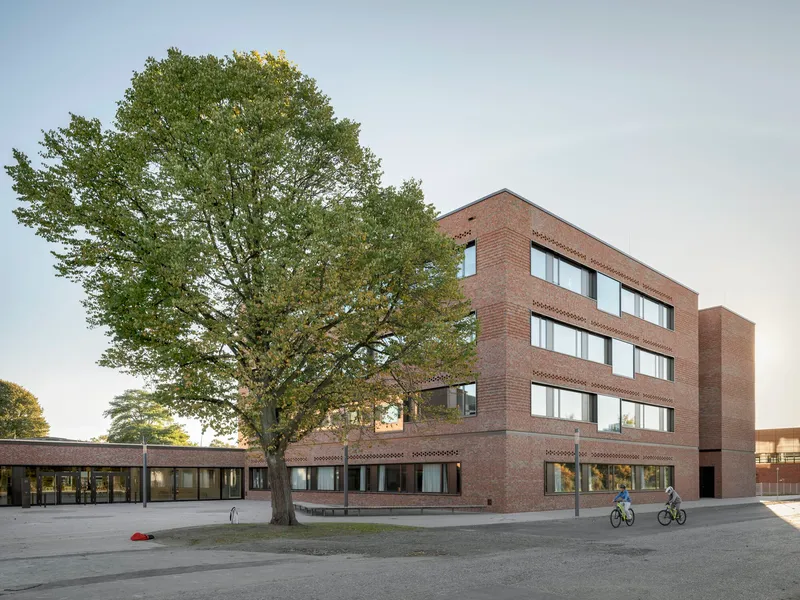
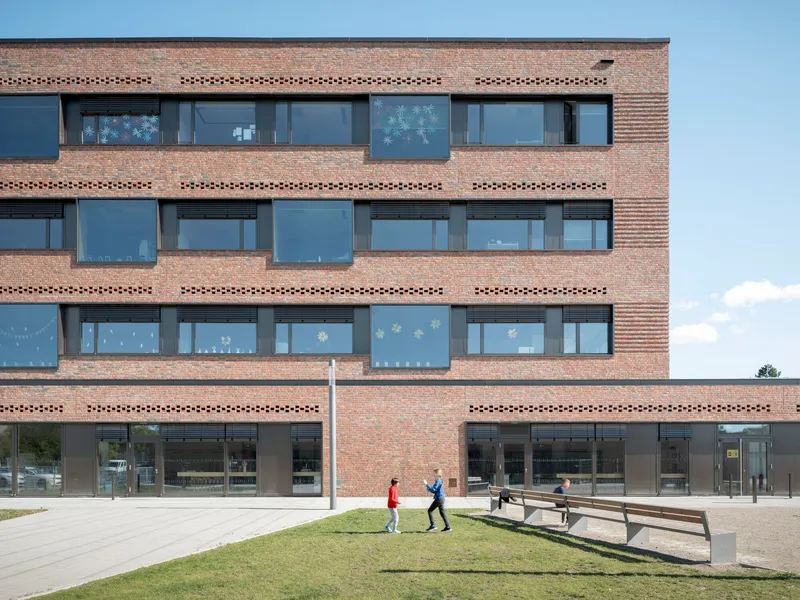
All three schools are clad in brick, a decision that roots them firmly in Bremerhaven's North German building tradition. But gmp avoids the trap of conservative pastiche. Perforated horizontal bands wrap the facades, creating a rhythm of solid and void that lets light filter into corridors while giving the elevations a graphic quality visible from a distance. The proportions are generous without being monumental. A mature tree in one forecourt and open lawn in another suggest that landscape was considered from the start, not added as afterthought.
The brick detailing is precise but not fussy. Stretcher courses run uninterrupted across long elevations, and the perforations read as deliberate pattern rather than decorative appliqué. Against a gray sky, the warm tones of the brickwork hold their own. It is a material choice that will age well, which matters enormously for public buildings expected to serve for decades.
Foyers That Earn Their Height
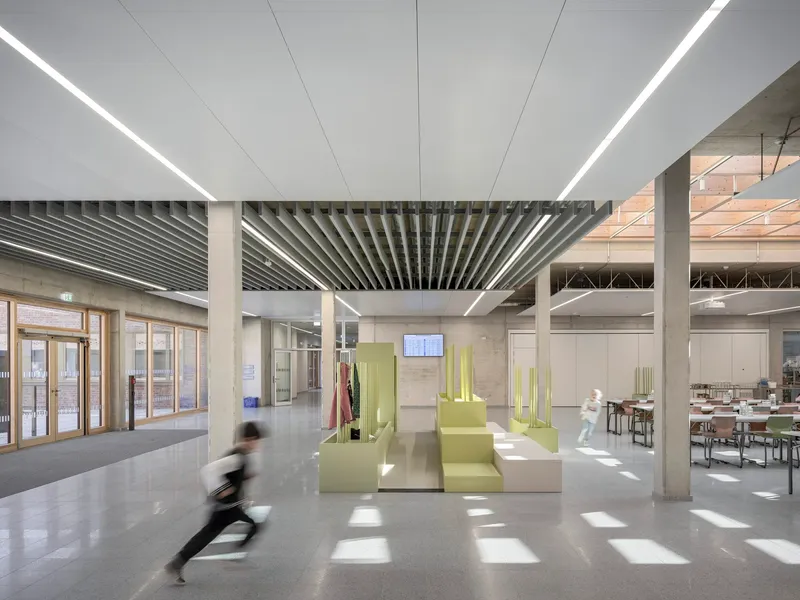
The double-height foyer captured in one image is the kind of space that could easily feel wasteful in a school context, a concession to grandeur over program. Here it works because the volume is activated. Linear timber ceiling baffles modulate acoustics and break down the scale. Concrete columns punctuate the space without interrupting sightlines, and sunlight cuts across the floor in a way that suggests the orientation was calculated rather than lucky.
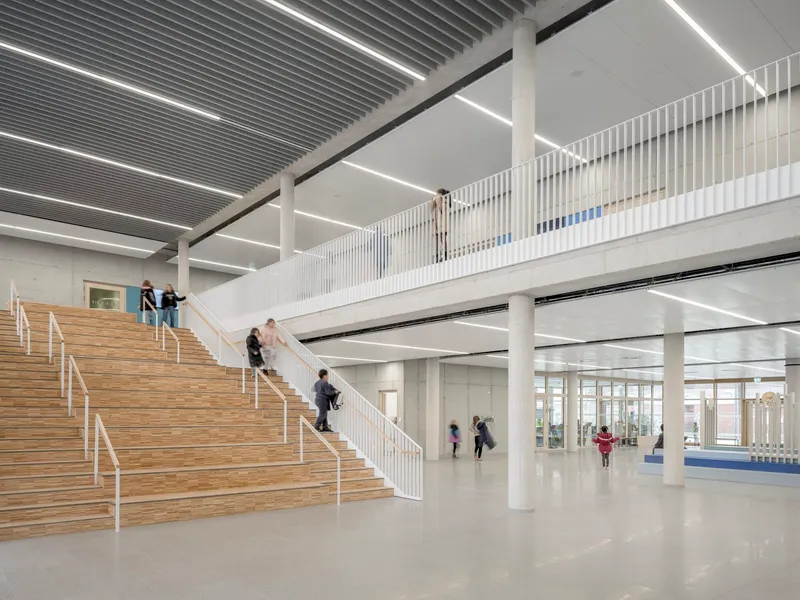
The tiered timber staircase in the atrium performs double duty as vertical circulation and informal seating. Children move across levels freely, and the openness between floors gives teachers passive supervision without surveillance architecture. It is a social space dressed as infrastructure: the kind of move that separates competent school design from merely adequate building.
Classrooms Tuned for Light and Calm
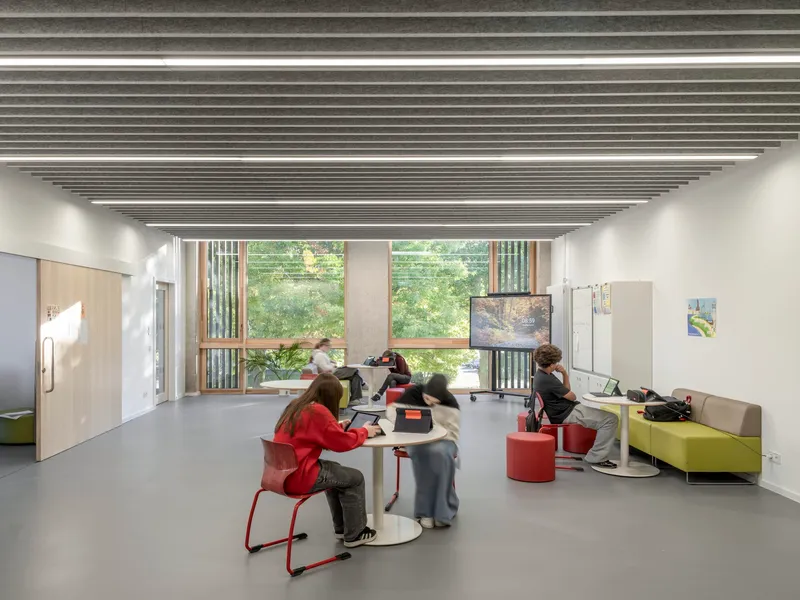
Inside the classrooms, the ceiling baffles return at a tighter pitch, controlling reverberation in rooms that will be filled with the noise of young children. The palette stays restrained: exposed concrete structure, timber slats, neutral floors. Greenery presses against the windows, and the framing is low enough that seated children can see out. These are not showcase rooms, they are workrooms, and gmp treats them with the same material seriousness as the public spaces.
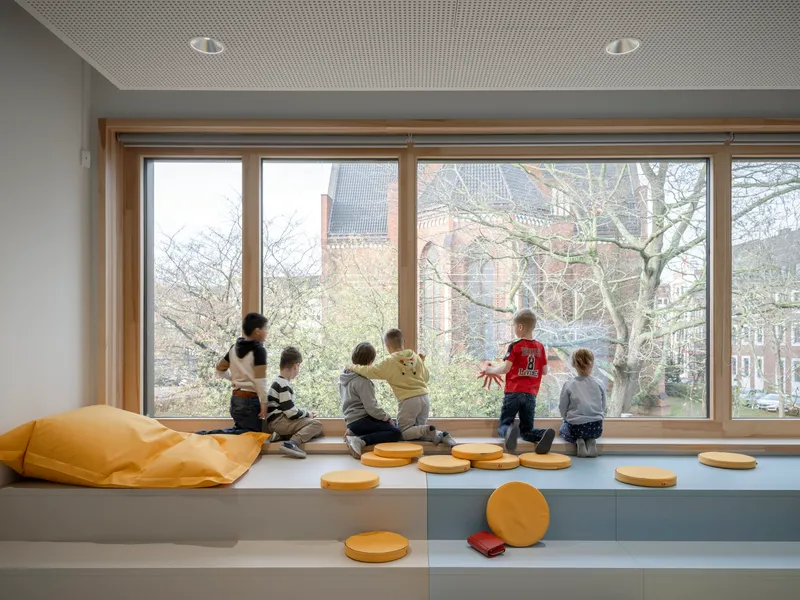
A window bench in one classroom places children directly against the glass, turning the view outward into bare branches and neighboring brick buildings into a kind of ambient pedagogy. It is a small gesture, but it signals an understanding that architecture can shape attention. The bench also solves a practical problem: it gives a classroom extra seating without extra furniture, a useful trick when floor area is finite.
Three Sites, One Logic
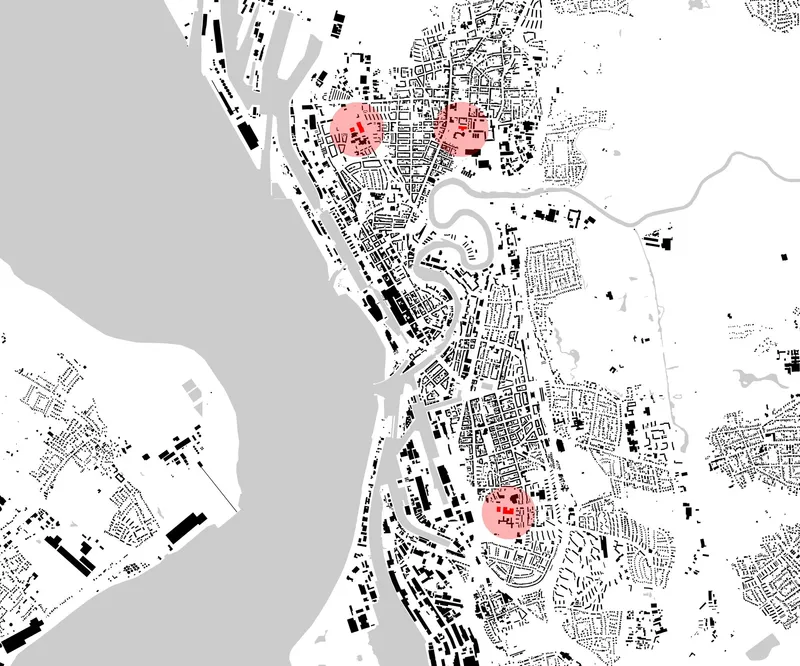
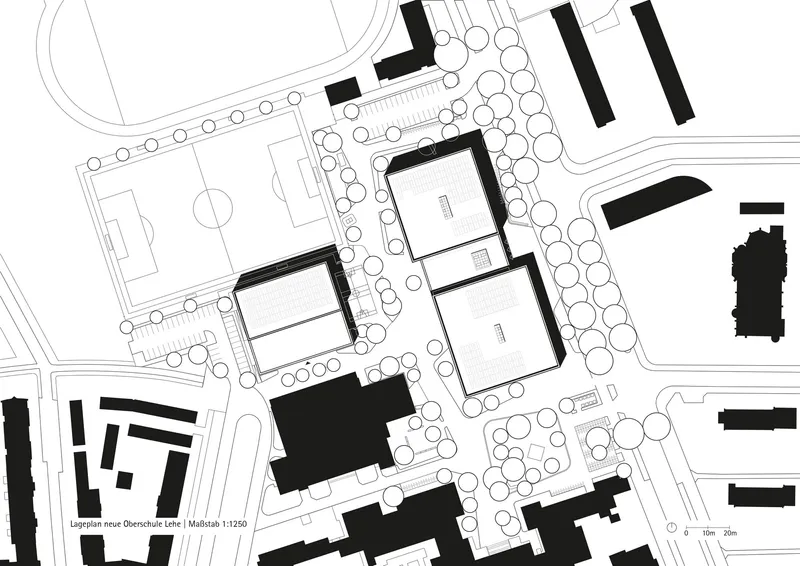
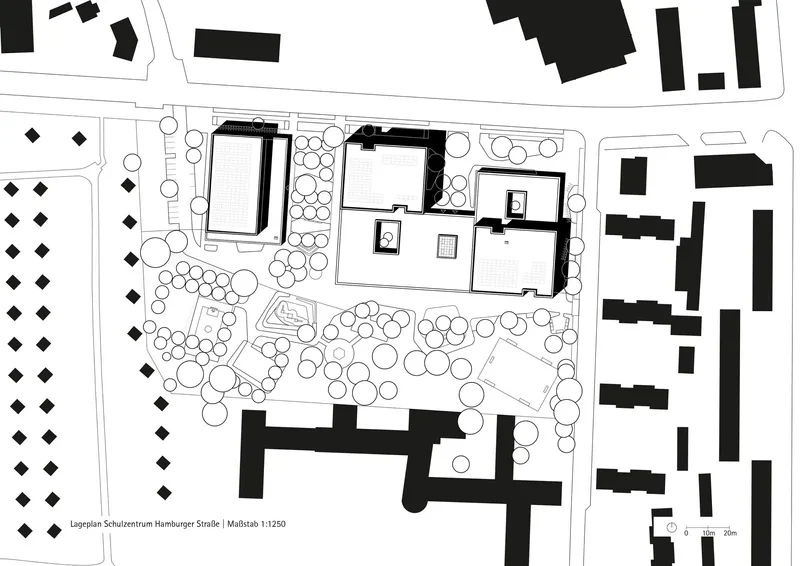
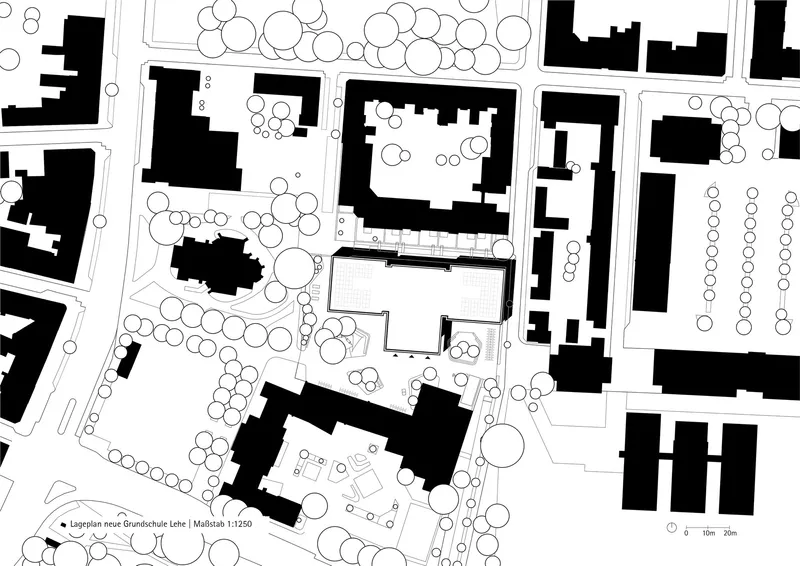
The urban and site plan drawings reveal the strategic dimension of the project. Each school occupies a different parcel within Bremerhaven's broader street network and waterfront fabric. One sits within a tight urban block, another clusters courtyard volumes among existing structures, and a third arranges its mass around a planted central court. The consistency lies not in footprint geometry but in organizational principle: every scheme uses courtyards or open spaces as the social heart, with classrooms arranged along the perimeter for daylight access.
This is where the Integrated Process earns its keep. By fixing certain parameters early, structural grid, facade system, core typology, the architects freed themselves to respond to site conditions without reinventing the wheel each time. The pink-highlighted development area in the urban plan drawing shows how much of the city this initiative touches. It is urban strategy operating at building scale.
Plans and Drawings
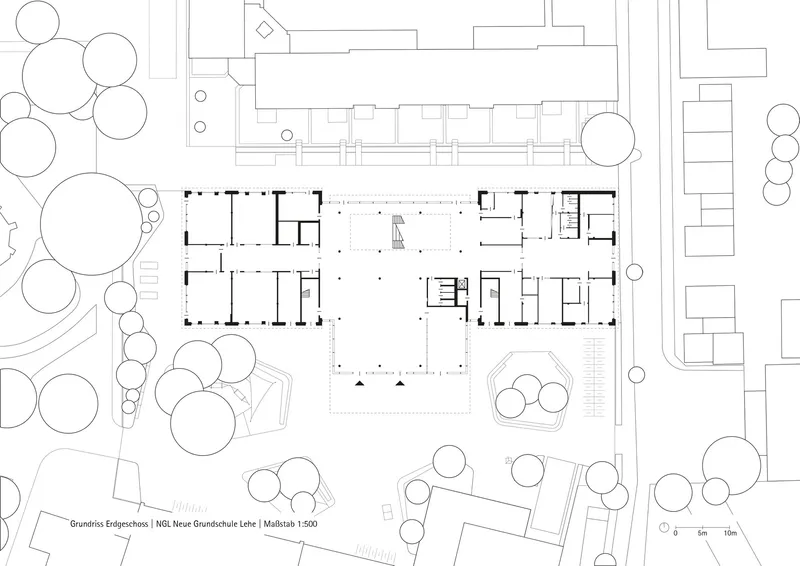
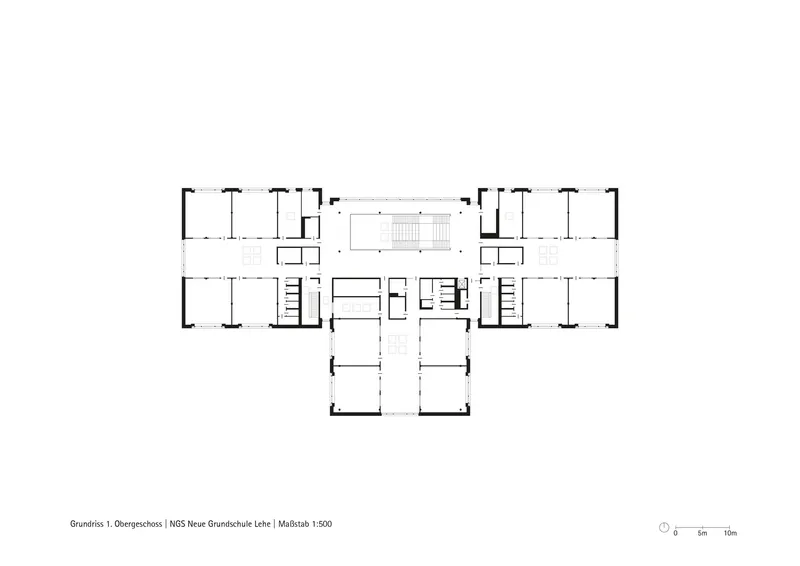
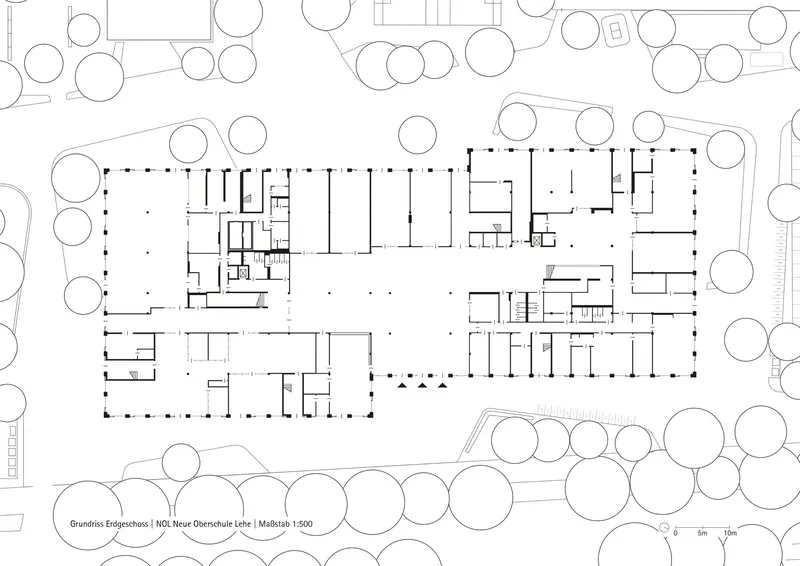
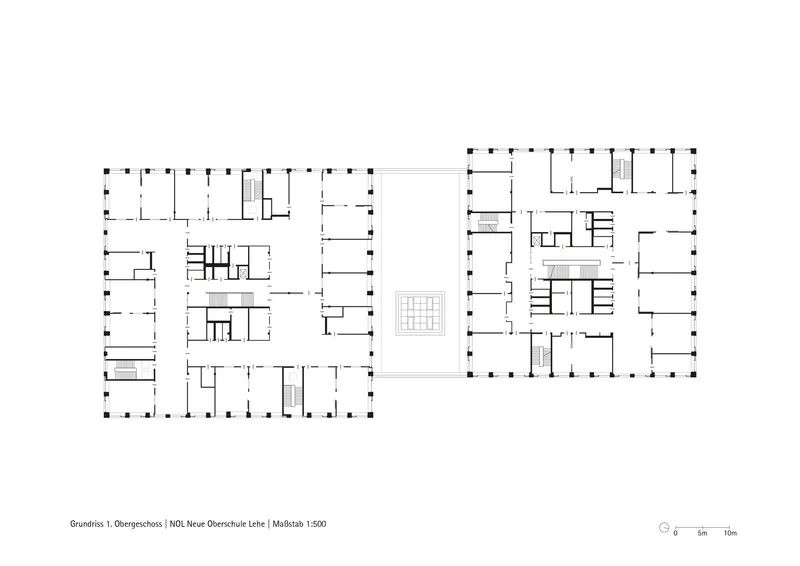
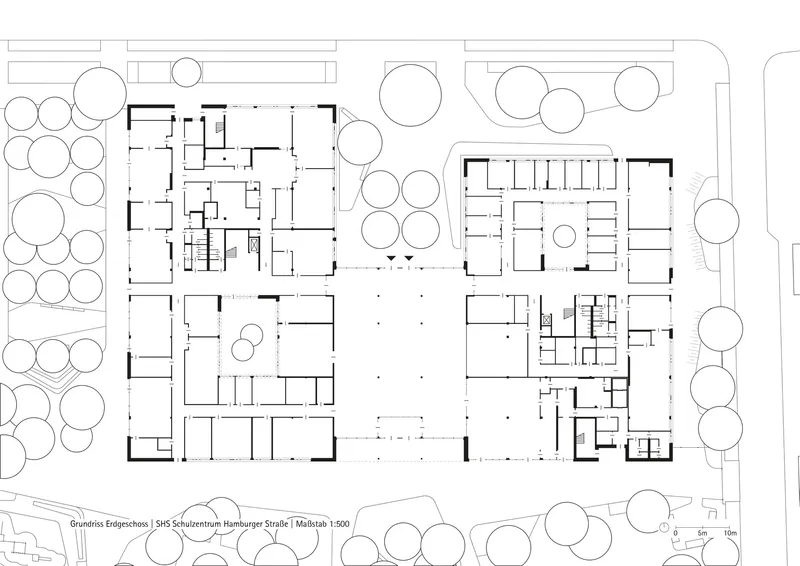
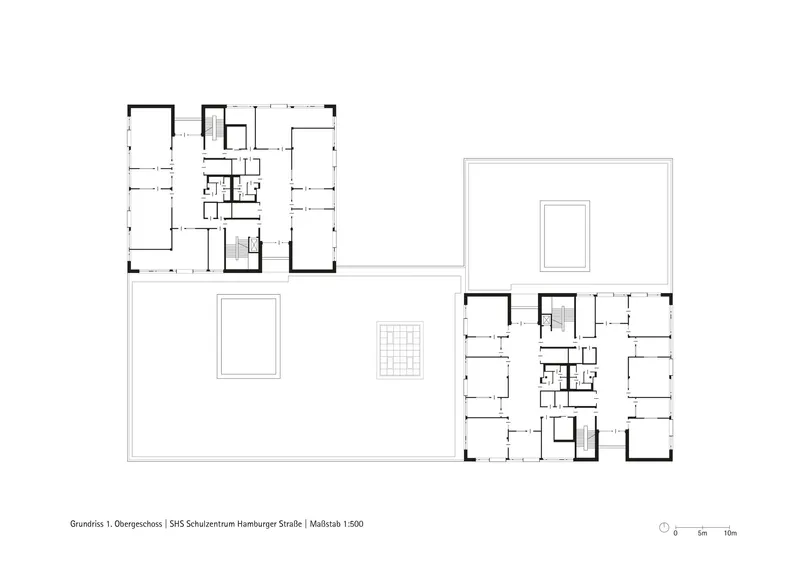
Laid out side by side, the floor plans confirm the family resemblance. Symmetrical wing layouts with central stairs and service cores recur across sites, though proportions shift. One building is L-shaped with central open spaces; another pairs two rectangular volumes connected by a terrace with grid paving. The courtyard configurations vary from inward-looking enclosures to more porous arrangements that let the landscape flow through.
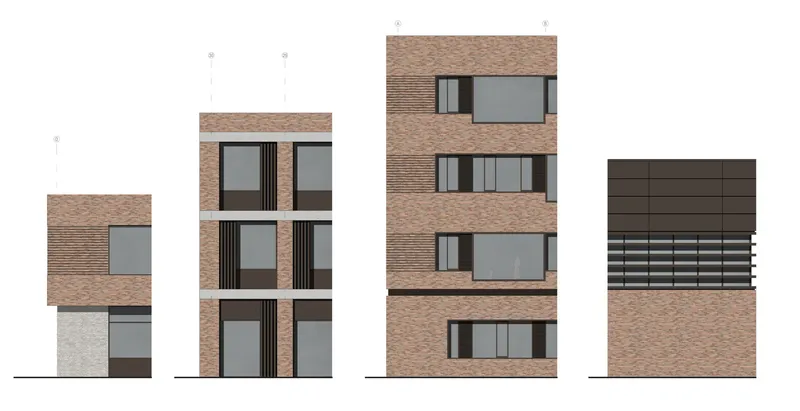
The elevation drawing is especially telling. Four facade variations share the same brick cladding system but vary their window arrangements, proving that standardization need not produce uniformity. The openings are tuned to interior function: larger glazing for common spaces, smaller punched windows for classrooms, and the perforated bands threading through all versions as a unifying motif. It is a catalog of permutations within constraint, exactly the kind of drawing that makes a replicable process legible.
Why This Project Matters
The school-building crisis across European cities is not primarily a design problem. It is a procurement problem, a budget problem, and a timeline problem. What gmp demonstrates in Bremerhaven is that architecture can address all three without retreating into prefab anonymity. By treating the design process itself as a scalable product, the firm delivered three distinct buildings at reduced cost and compressed schedule. That is a meaningful contribution to public infrastructure, not just to architectural discourse.
The risk of this approach is blandness, and gmp largely avoids it. The brick facades are handsome, the interiors are spatially rich, and the site strategies show genuine sensitivity to context. If the project has a weakness, it is that the interiors rely heavily on a limited material vocabulary that could feel repetitive across all three schools. But for a first iteration of a replicable public process, Bremerhaven sets a high bar. Other cities, and other architects, should be paying attention.
Three Schools, One Process, Bremerhaven, Germany. Architect: gmp Architects. Completed 2025. Photography by Marcus Bredt.
About the Studio
Share Your Own Work on uni.xyz
If projects like this are the kind of work you want to make, uni.xyz is a place to publish your own, find collaborators, and enter design competitions.


Popular Articles
Popular articles from the community


Singing Woman: An Opera House That Performs Before the Curtain Rises
Ovidiu Cristian Pavel's conceptual opera house translates Estonia's choral identity into a sculpted waterfront landmark facing the Baltic Sea.
Faces of the Soviet Avant-Garde: Turning Moscow's Street Names into an Open-Air Museum
A network of sculptural installations across a Moscow residential district transforms forgotten architect names into spatial encounters with cultural memor

Tsunami Convergenics: Turning Catastrophic Ocean Forces into Underwater Housing Infrastructure
A speculative underwater settlement off the coast of Onagawa, Japan, treats tsunamis and typhoons as energy sources rather than threats.

Opera by the Sea Estonia: Three Shells Dissolving Architecture into Tallinn's Coastline
A winning opera house proposal replaces monumental form with interconnected shells that blur the boundary between building, park and Baltic Sea.

Similar Reads
You might also enjoy these articles

Pixel Gardens: One Repeated Module Stacked Into a Terraced Social Housing Tower for Famagusta
Salem Bader's shortlisted housing tower builds a vertical neighbourhood from one repeated module, offsetting units to carve terraces, light and air.

Bao Huynh Watercolor Atelier: A Serene Art Retreat in Hội An
Bao Huynh Watercolor Atelier in Hội An blends multifunctional art spaces, sustainable design, local materials, and family-friendly living in a serene environment.

Atelier Macri Concept Store Interior Design by CASE-REAL
Atelier Macri store features a "ko" counter, walnut wood details, cork displays, blending retail, gallery, and seamless customer experiences.

Manuel Vargas Izquierdo Stadium and High-Performance Sports Center: Architectural Excellence in Jalpa de Méndez
The Manuel Vargas Izquierdo Stadium blends sustainable design, inclusive sports facilities, and cultural-inspired architecture, revitalizing Jalpa de Méndez’s public spaces.


Comments (0)
Please login or sign up to add comments
No comments yet. Be the first to comment!