

Go Bridge: A Cycling-Inspired Bridge That Refuses to Stop Moving
Two circular platforms at water level keep public life alive even as the bridge opens for maritime traffic in Copenhagen.


What if a bridge never stopped being useful, even when it was open? Go Bridge proposes exactly that: a pedestrian and cycling bridge whose two circular public platforms, positioned at water level, remain active and occupied while the movable passage lifts to let boats through. It is infrastructure that refuses to pause, designed around the conviction that a bridge should be a destination, not just a line between two banks.
Designed by Kareem Elhadary and Nada Adel, Go Bridge is set within a cycling-oriented urban context inspired by cities like Copenhagen, where the bicycle defines the rhythm of daily life. The project treats the bicycle not only as a mode of transport but as the literal generator of architectural form, translating its geometry into a free-curved pathway, two wheel-like gathering nodes, and a stabilizing structural frame.
Anatomy of a Bicycle, Scaled to a River Crossing
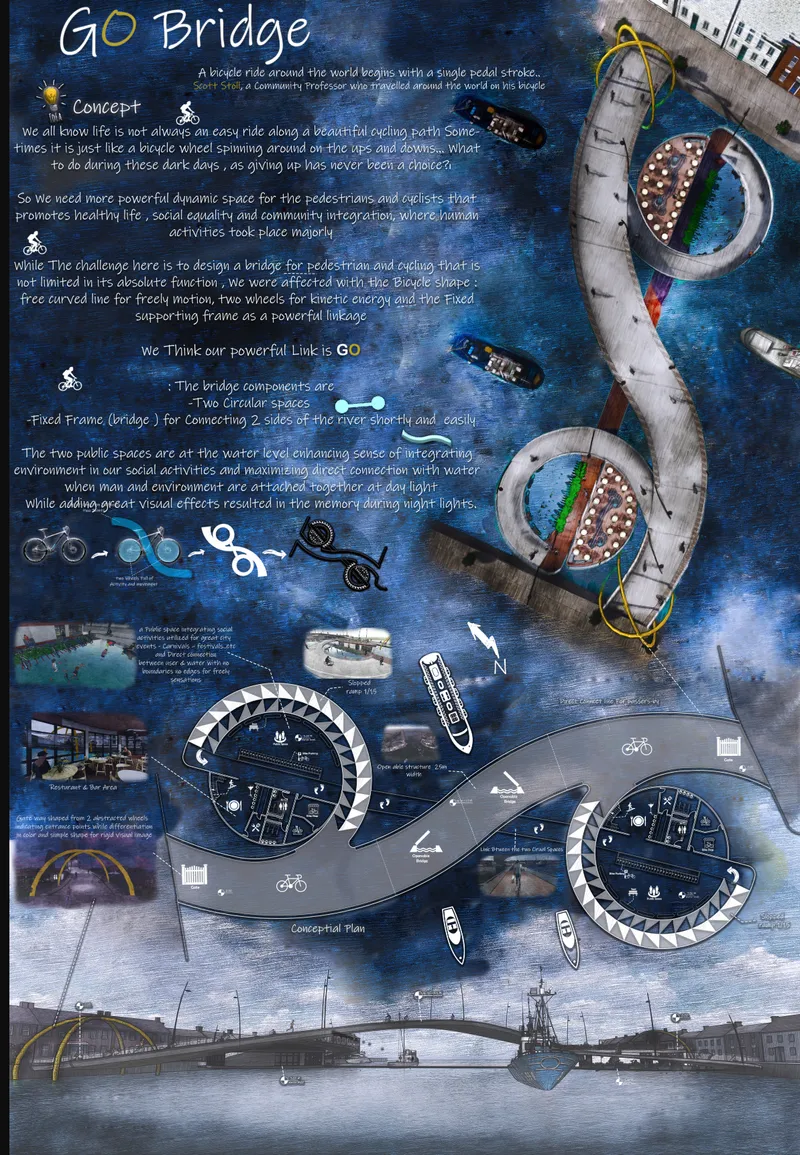
The aerial plan reveals the three-part logic borrowed directly from the bicycle. A free-curved line traces the bridge deck, embodying fluid, uninterrupted movement across the water. Two circular platforms, analogous to wheels, anchor each end of the crossing at water level, functioning as kinetic nodes of social energy. Between them, a fixed structural frame provides the rigid backbone that holds the composition together. None of these elements is decorative; each one maps a specific bicycle component onto an architectural role, giving the bridge a legibility that connects its form to its cultural context.
Circular Platforms That Turn Infrastructure into Public Life
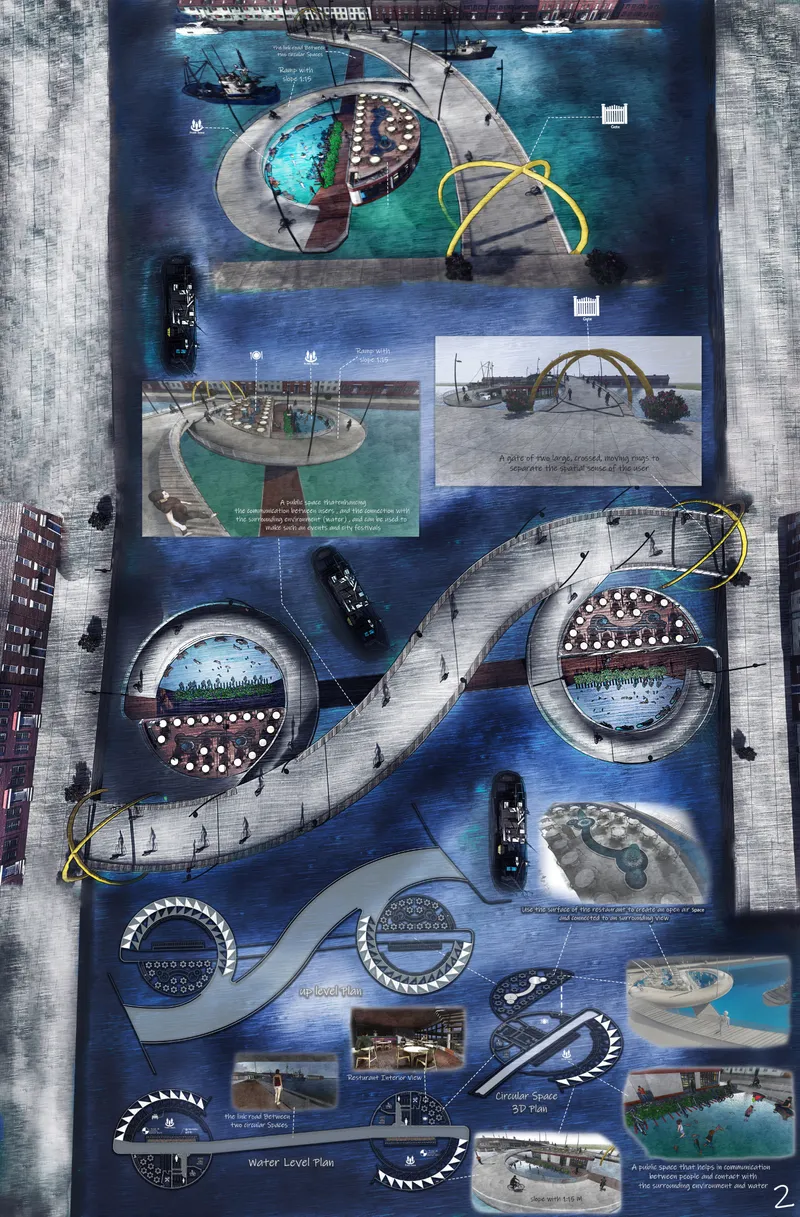
The composite board details the two circular public spaces that define Go Bridge's most provocative move. Rather than treating the bridge purely as passage, the designers sink social programme down to water level: informal gatherings, small cultural events, quiet moments of reflection where users sit in direct contact with the river. When the movable span lifts for maritime traffic, these platforms keep operating independently, ensuring the bridge never empties out.
This separation between the continuous activity zones and the opening mechanism is the project's structural and conceptual hinge. Conventional swing or bascule bridges create dead time; Go Bridge eliminates it. The result is a piece of infrastructure that actively strengthens the relationship between people, movement, and environment rather than periodically severing it.
A Tilted Tower and the Sensory Weight of Water
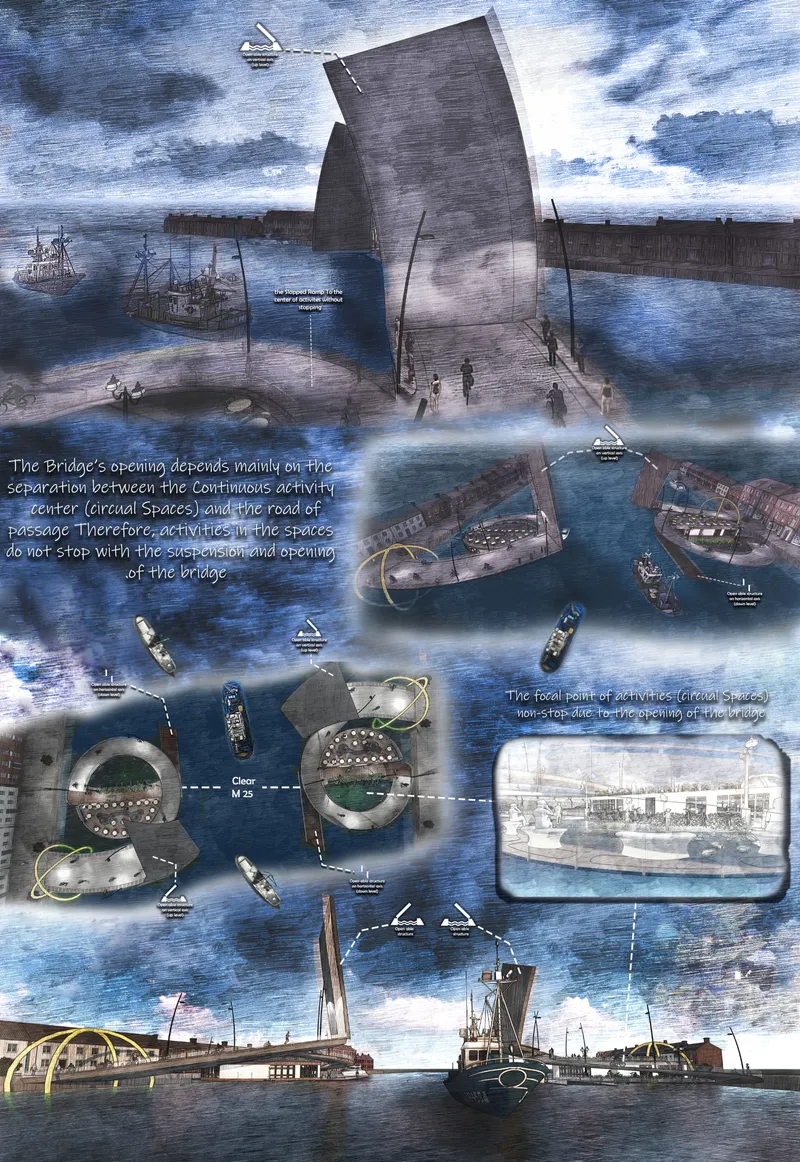
The perspective rendering shows Go Bridge in its most visceral register. A tilted concrete tower anchors the span while pedestrians and cyclists share the deck at a scale that feels intimate rather than monumental. Boats pass beneath, confirming the bridge's functional clearance, but the eye is drawn to the water level, where the proximity between human bodies and the river surface creates a sensory richness: visual reflections, the sound of current, the smell of open water. At night, lighting transforms the structure into a glowing urban landmark mirrored on the river's surface.
By pulling users down toward the water rather than elevating them above it, the designers invert a typical bridge experience. The crossing becomes slower, more attentive, more ecological in spirit. It is a deliberate calibration that encourages pedestrians and cyclists to engage with the environment rather than simply traverse it.
Why This Project Matters
Go Bridge challenges the assumption that a bridge's value is measured in the speed at which people cross it. By embedding public programme at water level and maintaining activity even during bridge openings, Elhadary and Adel propose a model where infrastructure and social life are not competing interests but symbiotic ones. The bicycle metaphor is more than a formal gimmick; it ties the bridge's identity to the culture of the city it serves, making cycling visible not just on the road but in the very shape of the skyline.
In an era when cities worldwide are rethinking their relationship to waterways, this project offers a clear provocation: stop designing bridges as connectors and start designing them as places. The continuous activity platform is a small idea with large implications, suggesting that the next generation of urban infrastructure can be measured not by throughput but by the quality of life it sustains.
View the Full Project
About the Designers
Designers: Kareem Elhadary, Nada Adel
Enter a Design Competition on uni.xyz
uni.xyz runs architecture and design competitions year-round that reward proposals with spatial conviction and real site intelligence.
Project credits: Go Bridge by Kareem Elhadary, Nada Adel.


Popular Articles
Popular articles from the community


Cloaked Colonization: A Mobile Underwater Habitat That Moves Like a Fish
Micah Abaya's shortlisted EHC Pacific entry reimagines ocean settlement as a dispersed network of self-sustaining architectural organisms.
Extended Shell: Retrofitting Kolkata's Balconies as Living Urban Thresholds
A modular retrofit system recovers the social and environmental intelligence of Kolkata's historic verandas for contemporary Park Street residents.

Singing Woman: An Opera House That Performs Before the Curtain Rises
Ovidiu Cristian Pavel's conceptual opera house translates Estonia's choral identity into a sculpted waterfront landmark facing the Baltic Sea.

Opera on the Sea: Driftwood Logic Shapes a Timber Opera House on Estonia's Coast
Trevor Orgill's opera house translates the entangled drift of floating timber into a civic building where wood, water, and music converge.

Similar Reads
You might also enjoy these articles

Play: Fragments of Their World: Remembered Architecture Rebuilt as a Modular Playground for Refugee Camps
Tom Gardner abstracts domes, arches and towers from the homelands of displaced families into a kit of child-scaled play parts for camp settlements.
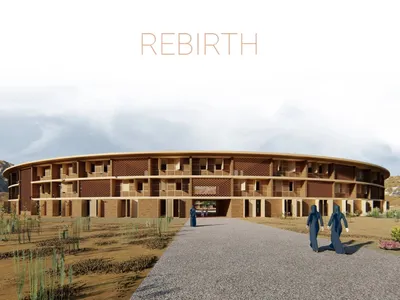
REBIRTH: A Circular Settlement Where Afghan Widows and Their Children Rebuild Life Together
A shortlisted Resile entry turns the circle into a protective ring of timber and brick, gathering homes, classrooms and gardens around a shared landscape.
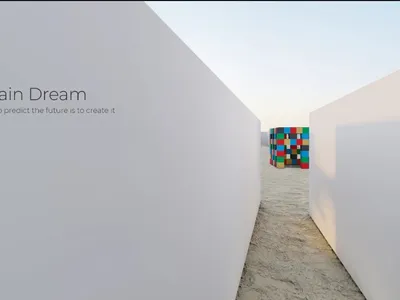
The Main Dream: A Recycled Plastic Kit That Lets Refugee Children Build Their Own Playground
Thirty-centimetre interlocking cubes that connect on three axes turn play into construction, letting children author the spaces they occupy.

Lunar Spiral: A Fibonacci-Driven Moon Settlement Rising from Shackleton Crater
Golden-spiral geometry organises buried infrastructure and orbiting habitable spheres into a lunar base designed to grow as life on the Moon expands.

Comments (0)
Please login or sign up to add comments
No comments yet. Be the first to comment!