
Ervin Garip and Banu Garip Reclaim Istanbul's Golden Horn Waterfront as a 30,000 m² Sports Park
Beneath Istanbul's highway bridges and along a neglected coastline, a new public landscape stitches the city back to its historic harbor.


Waterfronts are where cities reveal their priorities. For decades, Istanbul's Golden Horn, the horn-shaped inlet that defines the northern edge of the historic peninsula, was a casualty of industrial decline and infrastructural indifference. Motorway bridges sliced across the water, their concrete piers landing on shorelines that had once anchored Byzantine trade. The space beneath and beside them became residual: parking, weeds, dead air. Ervin Garip and Banu Garip, working with landscape collaborators MY Landscape, won the Istanbul Golden Horn Coasts Urban Design Competition with a proposal that treats this 230,000 square meter corridor not as a problem to be screened off but as a civic resource to be activated. The built result, a 30,000 m² sports park and public space along the Balat-Eyüpsultan coastline, opened in 2023.
What makes the project genuinely interesting is its willingness to work with, rather than against, the infrastructure that scarred the site. The twin highway bridges overhead become canopy, shelter, and spatial frame. Basketball courts, soccer fields, a skatepark, promenades, and planted beds are threaded between massive concrete piers, converting liabilities into assets. It is not a polite park grafted onto a leftover strip. It is a full-throated argument that even the toughest urban conditions can host public life, if the design is specific enough.
Playing Under the Highway
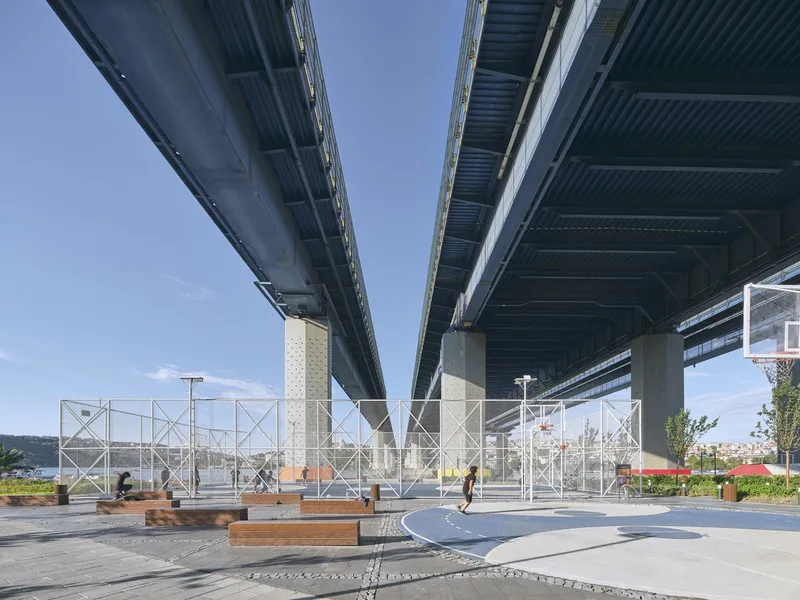
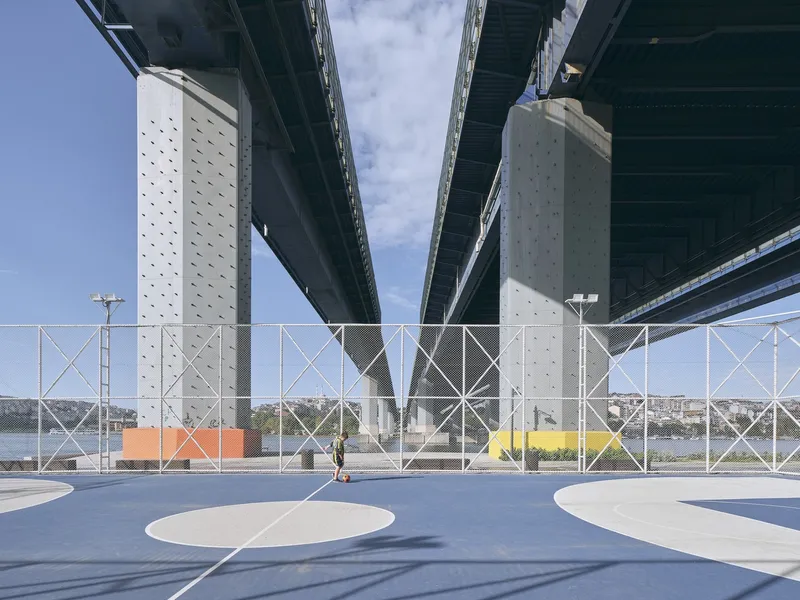
The most striking move is the placement of regulation sports courts directly beneath the highway bridge deck. Basketball and multi-sport surfaces sit between the colossal concrete piers, enclosed by metal mesh fencing that doubles as a visual filter, letting light and air pass while defining the court edges. The bridge above provides shade and rain protection, creating a year-round playing environment in a city where summer sun and winter drizzle can both discourage outdoor activity.
Crisp white court markings on fresh surfacing make the athletic zones feel intentional, not improvised. There is no apology in the design for the heavy infrastructure overhead. The piers become part of the spatial rhythm, almost like columns in a vast outdoor hall. It is a pragmatic reading of the site that yields something unexpectedly generous.
A Coastline Reclaimed for Football and Water
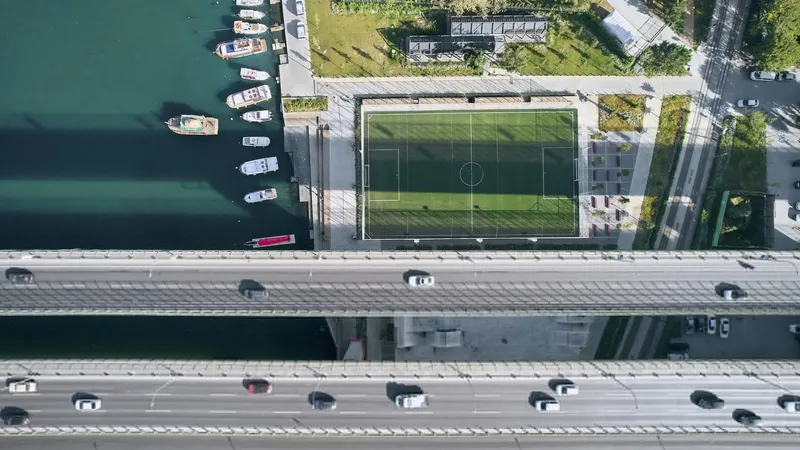
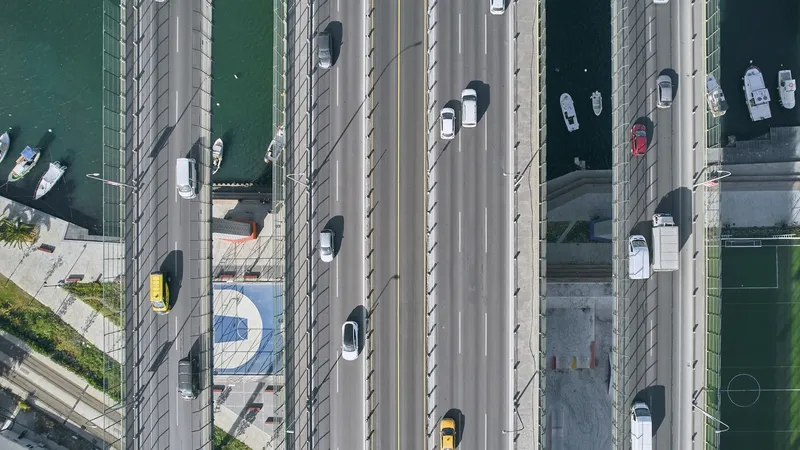
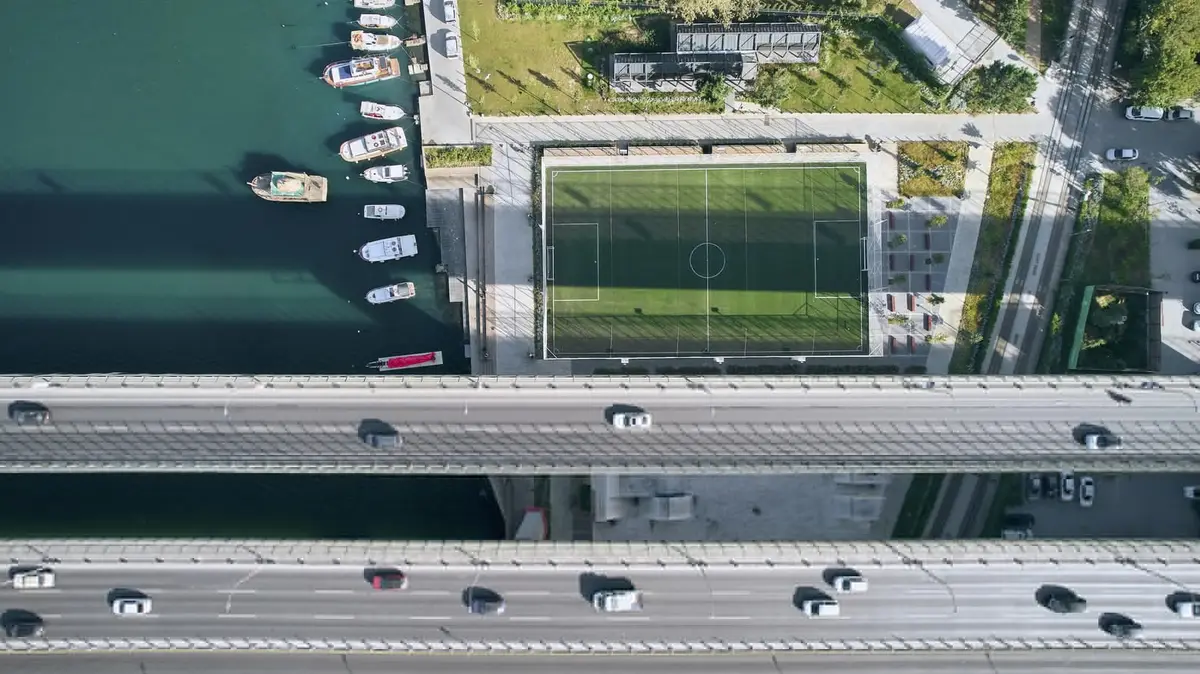
Seen from the air, the project's ambition becomes clear. A full-size soccer field occupies the strip between the bridge deck and the waterfront, its artificial turf a sharp green rectangle pressed against the Golden Horn. Boats bob at floating docks just meters away. The juxtaposition is almost absurd: competitive sport, maritime activity, and major highway infrastructure layered on top of one another in a single frame.
The marina zone, with its concrete floating docks and orderly moored vessels, reads as a parallel layer of public programming. Where the sports fields serve runners and ball players, the waterfront edge serves a different constituency. The Garips' strategy is accumulative: stack enough distinct activities along the same corridor and the space never feels dead, regardless of the hour or season.
Landscape as Infrastructure
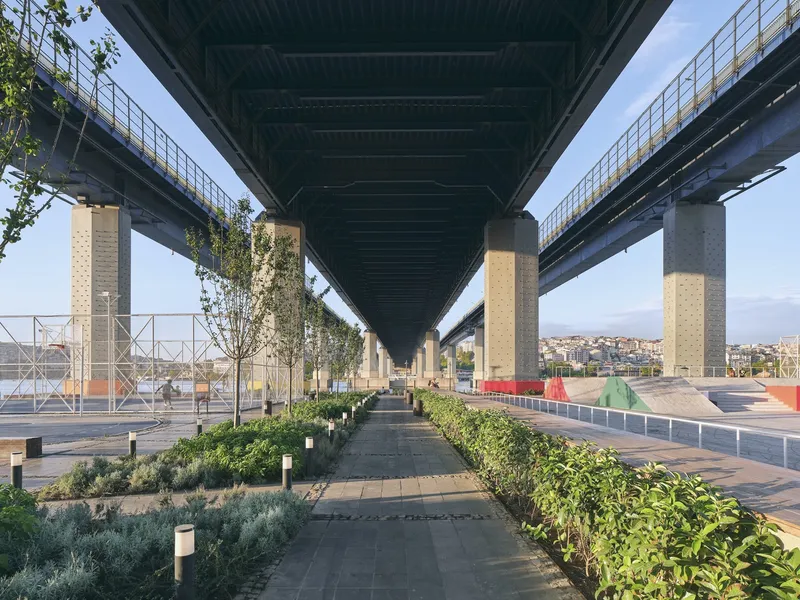
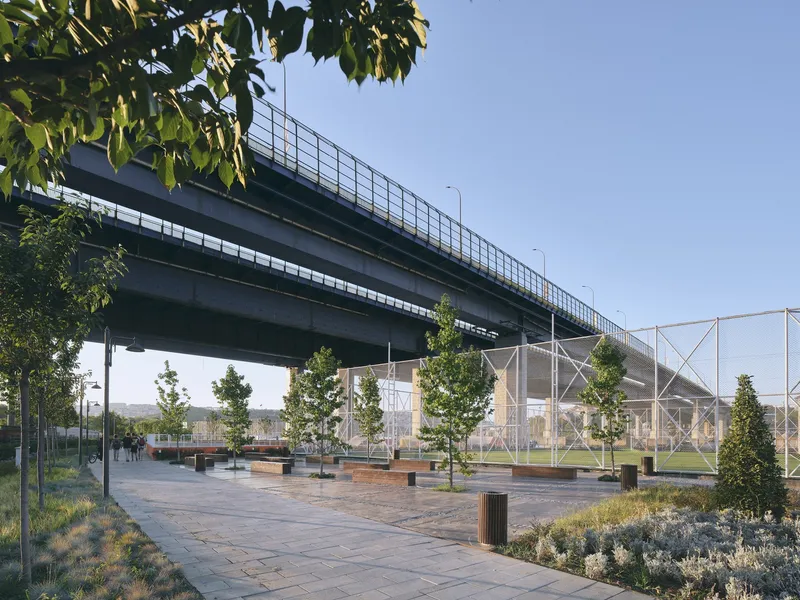
Between the sports courts, paved pedestrian paths run beneath the bridges, flanked by planted beds of shrubs and young trees. The planting strategy is deliberately modest in scale. These are not mature shade trees hauled in for instant effect; they are young specimens that will grow into the space over time, softening the concrete overhead and building ecological value incrementally. Gravel, paving, and soil alternate underfoot, establishing different textures for different speeds of movement.
A dusk photograph reveals how the space performs at the end of the day. Warm light from the planted beds and mesh enclosures creates pockets of intimacy beneath the bridge, turning what could be a forbidding underpass into an inviting public room. The lighting design, subtle and ground-level rather than flooding, suggests the architects understood that this space needs to feel safe at night to truly function as a democratic amenity.
Pavilions and Waterfront Edges
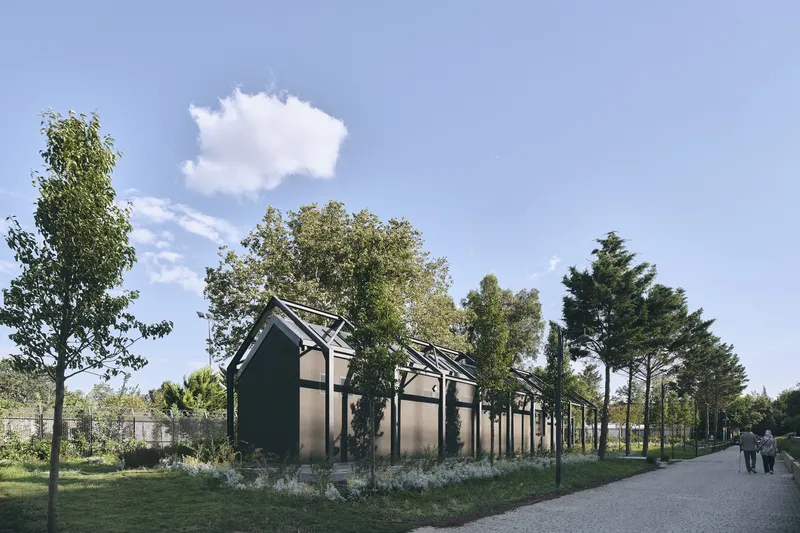
Away from the bridges, the design language shifts. Black gabled pavilion structures with open steel frames punctuate a gravel landscape threaded with planting. Their pitched silhouettes are an almost vernacular gesture, a nod to the domestic rooflines of the Balat neighborhood uphill. Open on all sides, they function as shelters, event frames, or simply as markers that orient pedestrians along the promenade. The steel framing keeps them transparent: you see through them rather than around them.
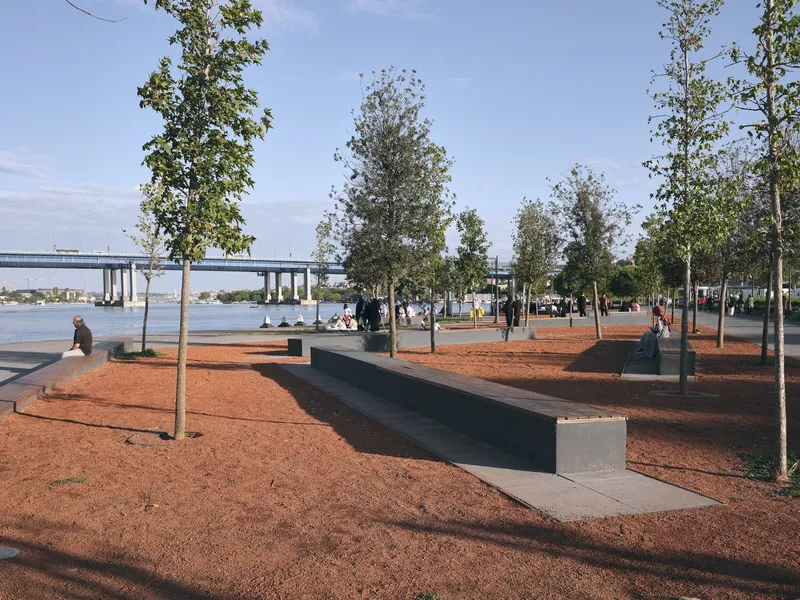
At the water's edge, a broad plaza surfaced in red gravel offers a generous gathering space with concrete benches and newly planted trees overlooking the Golden Horn. This is the project at its most civic, a space with no assigned program beyond sitting, looking, and being present at the junction of city and water. The red gravel is a small but effective material decision, giving the ground plane enough color to feel designed without competing with the panorama of bridge, water, and skyline beyond.
Why This Project Matters
Cities around the world are grappling with the legacy of mid-twentieth-century infrastructure, highways and bridges that prioritized vehicular throughput at the expense of public life. The fashionable response has been to bury or demolish: cap the freeway, tear down the overpass. Istanbul's Golden Horn Waterfront Sports Park proposes a less expensive and more architecturally honest alternative. Rather than erasing the infrastructure, the Garips colonize the space it creates. The result is a public landscape that is structurally sheltered, functionally dense, and visually unlike anything a blank-slate park could produce.
For a city as spatially contested as Istanbul, where open recreational land in historic districts is vanishingly scarce, this project delivers something tangible: 30,000 square meters of courts, paths, plazas, and waterfront access on land that was essentially abandoned. It is a reminder that the most compelling public spaces are often not designed on virgin sites but carved from the gaps that negligence leaves behind. Ervin Garip and Banu Garip, working with MY Landscape, have turned one of Istanbul's most overlooked corridors into one of its most generous.
Golden Horn Waterfront Sports Park and Public Space, Istanbul, Turkey. Architects: Ervin Garip and Banu Garip. Landscape collaboration: MY Landscape. Area: 30,000 m² (built); 230,000 m² (competition area). Year: 2023. Photography: Egemen Karakaya.
About the Studio
Share Your Own Work on uni.xyz
If projects like this are the kind of work you want to make, uni.xyz is a place to publish your own, find collaborators, and enter design competitions.


Popular Articles
Popular articles from the community


Co-life: Sustainable Architecture for Age-Friendly Community Living
Co-life reimagines sustainable architecture for seniors through courtyards, rammed earth, shared gardens, and spaces designed for belonging.

ALGAL REALM: A Bio-Integrated Lunar Habitat Design for Life Beyond Earth
ALGAL REALM reimagines lunar habitat design with algae-powered life support, 3D-printed regolith, and vertical living for a lunar future.

Hill & Cross Opera: Sculptural Opera House Architecture Shaped by Tallinn’s Landscape and Identity
Hill & Cross Opera reimagines opera house architecture in Tallinn through its sculptural hill, civic plaza, glass wave and a luminous cross.

Play: Fragments of Their World
Familiar architecture becomes modular playground design, creating safe spaces where displaced children can learn, connect, imagine and play.

Similar Reads
You might also enjoy these articles


Hodi-Mandai Geram
Project Function: Preservation and revitalization of the Intangible heritage and socio-spatial identity of the Hodi by Housing, Cultural Memory Center, Sacred Grove, landscape, local tourism economy


Olio Towers: A Mid-Rise for Performers That Fuses Housing, Rehearsal, and Stage
Located blocks from Houston's Theater District, this modular tower stacks living units around a central performance atrium.

Oasis: Modular Green Housing Carved into Dhaka's Urban Fabric
A shortlisted Plugin Housing entry reclaims unauthorized settlements in Dhaka with stepped concrete volumes, green roofs, and ventilation-driven design.

Black Hole: A Floating Megastructure for the Post-Physical Era
Emiliano Mazzarotto envisions a spherical, self-scaling arena where e-sports, digital hotels, and holographic stadiums replace traditional public space.

Explore Architecture Competitions
Discover active competitions in this discipline

Challenge to reimagine the Iron Throne

Photograph architecture without architects

Illustrate the lost glory of Angkor Wat - Render Challenge

Design challenge to reuse E-waste
Comments (0)
Please login or sign up to add comments
No comments yet. Be the first to comment!