

Grande Nef de l'Île-des-Vannes Renovation by Chatillon Architectes
Historic modernist sports hall renovated into an Olympic-ready, energy-efficient cultural venue, preserving parabolic concrete arches, translucent facade, and community legacy.


The renovation of the Grande Nef de l'Île-des-Vannes by Chatillon Architectes marks a significant milestone in the adaptive reuse of modernist sports architecture in France. Located in L'Île-Saint-Denis, just north of Paris, this iconic structure has been carefully restored and transformed into a contemporary, high-performance sports and cultural venue, while preserving its historic identity and architectural expression.

Originally completed in 1971 and designed by Anatole Kopp, Lucien Metrich, and Pierre Chazanoff, the Grande Nef was conceived as a monumental multi-purpose hall. Defined by its parabolic concrete arches, sweeping roofline, and translucent polycarbonate facade, the building quickly became one of Paris’s largest indoor venues, capable of hosting up to 5,000 spectators. Beyond international sporting events, it welcomed legendary music performances and served as an important political gathering space, embedding the structure deeply within the city’s cultural memory.
After decades of intensive use, the building fell into disrepair and was ultimately closed in 2018 due to structural deterioration, poor energy performance, and limited accessibility. Recognized in 2007 as a “20th Century Heritage” site and later listed as a Historic Monument by the French Ministry of Culture, the Grande Nef demanded a renovation strategy that balanced conservation, technical upgrading, and future adaptability.


Adaptive Reuse for Olympic and Community Legacy
Commissioned as part of the Paris 2024 Olympic and Paralympic Games infrastructure, the renovation led by Chatillon Architectes repositions the Grande Nef as both an Olympic training facility and a long-term asset for the local community of Saint-Ouen-sur-Seine. Over a two-year construction period, the architects implemented contemporary architectural solutions while respecting the building’s original engineering logic and spatial ambition.
Spanning 3,000 square meters, the vast interior hall measures 98 meters in length, 51 meters in width, and rises 26 meters high. Its structural system, two inclined concrete arches connected by tension rods and stabilized by facade posts, creates a dramatic, column-free interior that departs from conventional rationalist typologies. This expressive spatial quality has been carefully preserved and enhanced through the renovation.

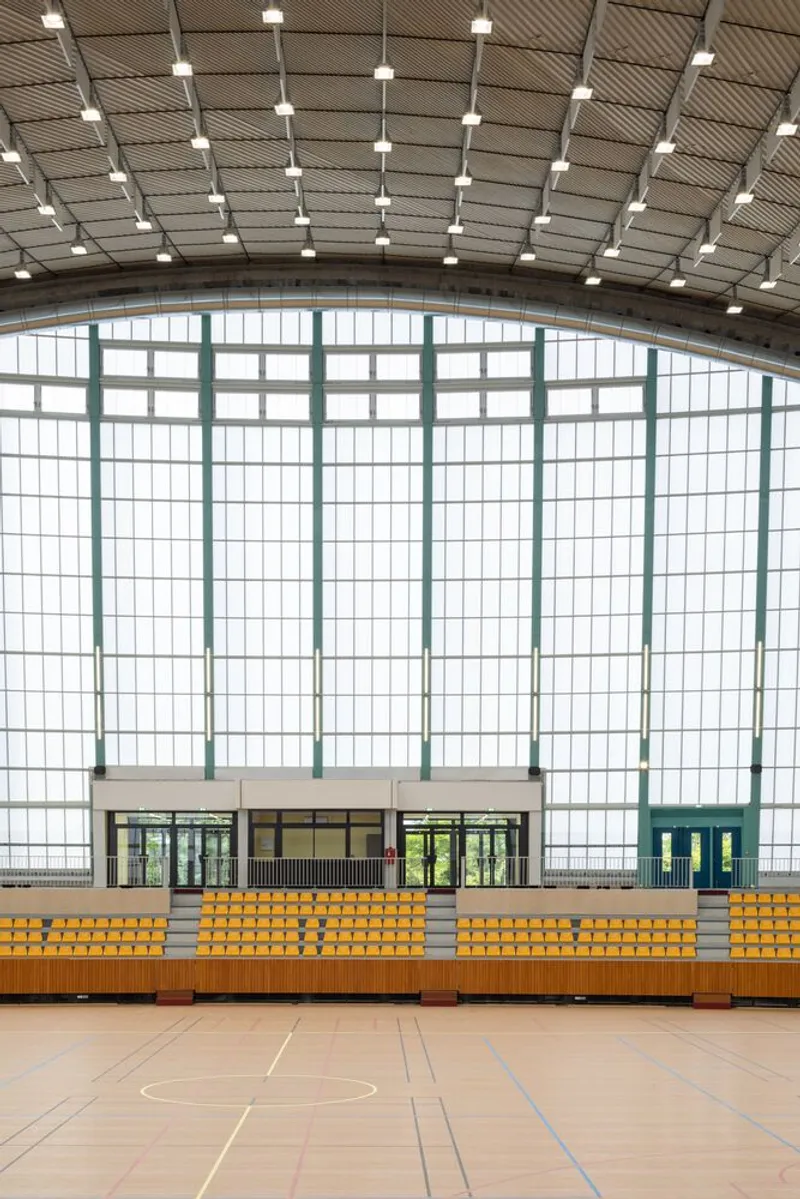
Structural Restoration and Energy Performance Upgrades
A major component of the project involved the repair and reinforcement of the original concrete structure, ensuring long-term durability and safety. Thermal and acoustic performance were significantly improved through a comprehensive overhaul of the building envelope. The iconic translucent facade, one of the most innovative features of the original 1970s design, has been reimagined using a double-skin insulated polycarbonate system, supplied by Danpal. This upgrade improves energy efficiency while maintaining the building’s distinctive daylighting quality and visual transparency.
The roof was retrofitted with a new synthetic membrane, enhancing insulation, acoustic comfort, and thermal stability. Internally, the architects introduced acoustic wood paneling, a state-of-the-art sports floor, and high-efficiency LED lighting, replacing the original fixtures while respecting their spatial rhythm. New seating in a bold yellow hue references the color palette of the building’s original interior, reinforcing continuity between past and present.


Accessibility, Comfort, and Contemporary Use
Ensuring universal accessibility was a central objective of the renovation. Site regrading, the introduction of ramps and elevators, and upgraded circulation systems allow the Grande Nef to accommodate athletes and visitors of all abilities, supporting both Olympic and Paralympic use. HVAC systems were discreetly integrated beneath the existing arches, improving indoor comfort without compromising the architectural clarity of the space.
Today, the renovated Grande Nef can host 1,500 seated spectators and up to 4,500 standing guests, making it a flexible venue for sports training, competitions, and large-scale cultural events. Its sculptural roof, often compared to the inverted hull of a boat, continues to reference the surrounding river landscape, reinforcing the building’s strong relationship with its site at the southern tip of Île-Saint-Denis.

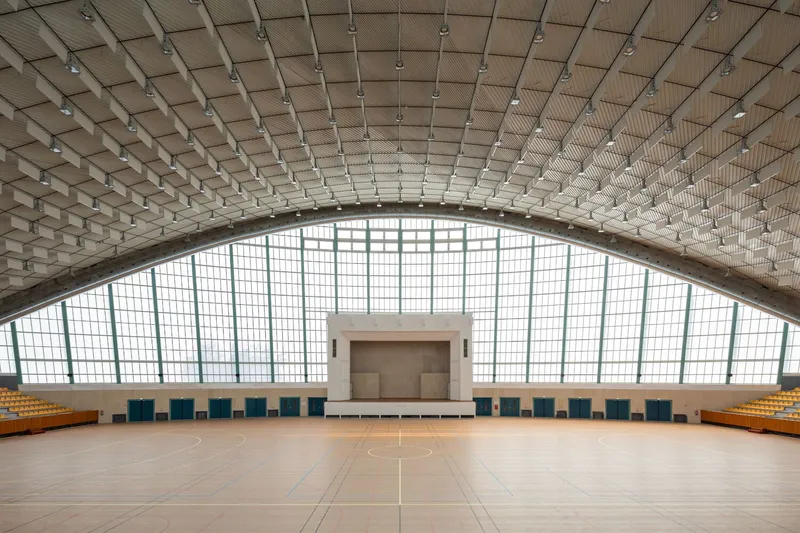
Preserving Heritage While Shaping the Future
For Chatillon Architectes, the project exemplifies a design philosophy centered on architectural heritage preservation through transformation. By combining careful restoration with contemporary technical systems, the renovation reactivates a major work of 20th-century French architecture for a new generation of users. Following the Olympic Games, the Grande Nef will be returned to the municipality, ensuring its continued role as a public sports and community facility.
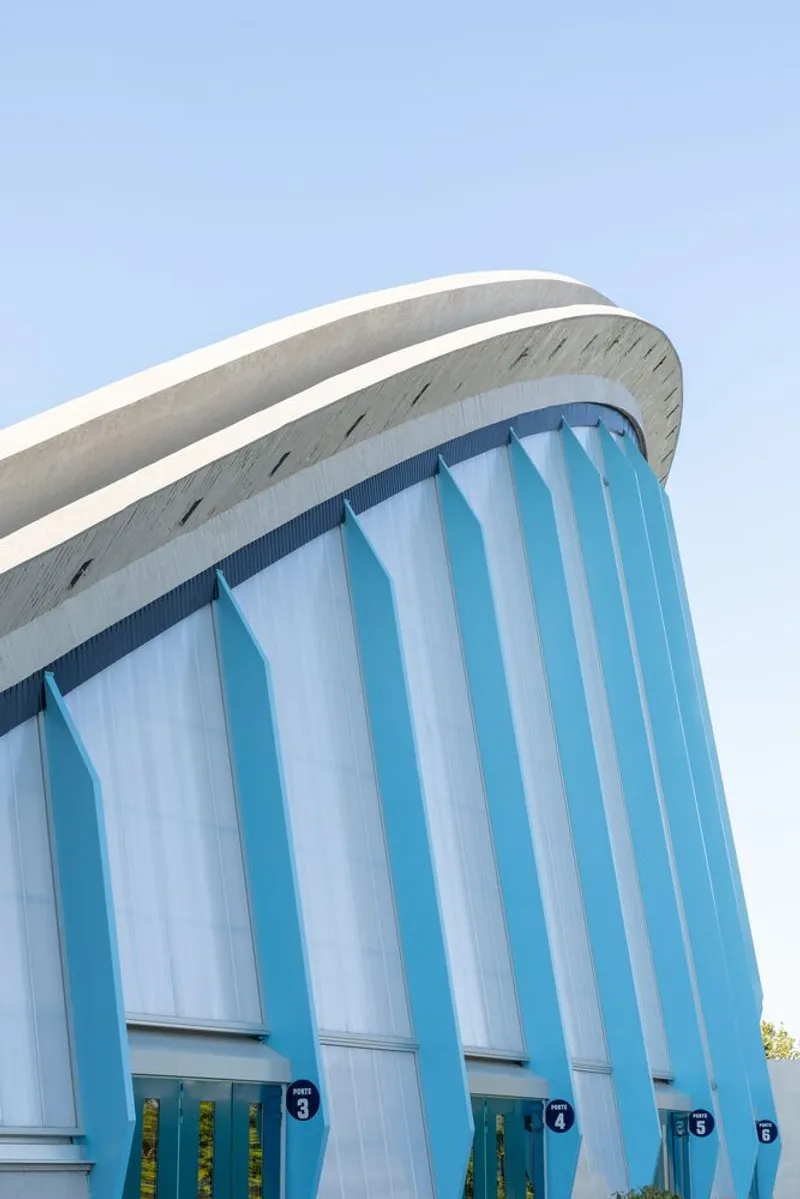
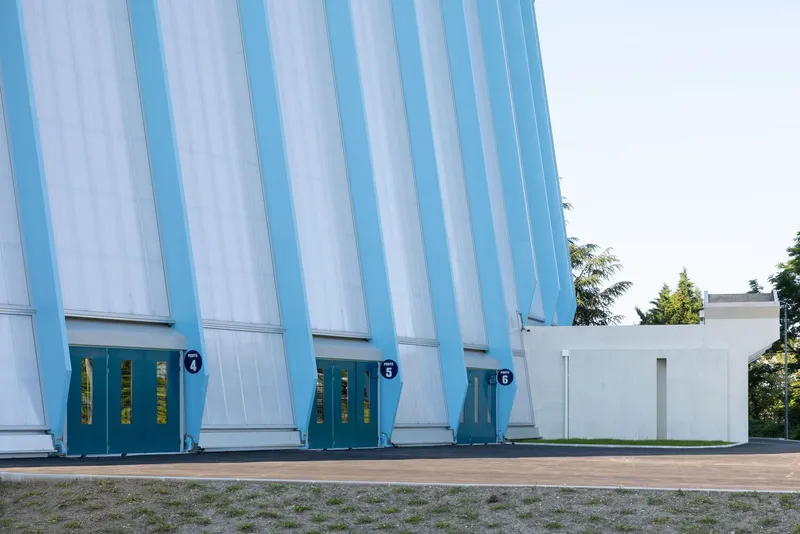
All photographs are works of Antoine Mercusot for Chatillon Architectes


Popular Articles
Popular articles from the community


Faces of the Soviet Avant-Garde: Turning Moscow's Street Names into an Open-Air Museum
A network of sculptural installations across a Moscow residential district transforms forgotten architect names into spatial encounters with cultural memor

Singing Woman: An Opera House That Performs Before the Curtain Rises
Ovidiu Cristian Pavel's conceptual opera house translates Estonia's choral identity into a sculpted waterfront landmark facing the Baltic Sea.

Extended Shell: Retrofitting Kolkata's Balconies as Living Urban Thresholds
A modular retrofit system recovers the social and environmental intelligence of Kolkata's historic verandas for contemporary Park Street residents.

Temporary Home for Dogs: A Reversed Zoo Rethinks Animal Shelter Architecture
In Bucharest, a sinuous corridor and freed landscape flip the logic of containment, designing a shelter that works to make itself unnecessary.

Similar Reads
You might also enjoy these articles


Hodi-Mandai Geram
Project Function: Preservation and revitalization of the Intangible heritage and socio-spatial identity of the Hodi by Housing, Cultural Memory Center, Sacred Grove, landscape, local tourism economy


Olio Towers: A Mid-Rise for Performers That Fuses Housing, Rehearsal, and Stage
Located blocks from Houston's Theater District, this modular tower stacks living units around a central performance atrium.

Oasis: Modular Green Housing Carved into Dhaka's Urban Fabric
A shortlisted Plugin Housing entry reclaims unauthorized settlements in Dhaka with stepped concrete volumes, green roofs, and ventilation-driven design.

Black Hole: A Floating Megastructure for the Post-Physical Era
Emiliano Mazzarotto envisions a spherical, self-scaling arena where e-sports, digital hotels, and holographic stadiums replace traditional public space.

Explore French Cultural Renovation Competitions
Discover active competitions in this discipline

Challenge to reimagine the Iron Throne

Photograph architecture without architects

Illustrate the lost glory of Angkor Wat - Render Challenge

Bring back Drive In's
Comments (0)
Please login or sign up to add comments
No comments yet. Be the first to comment!