
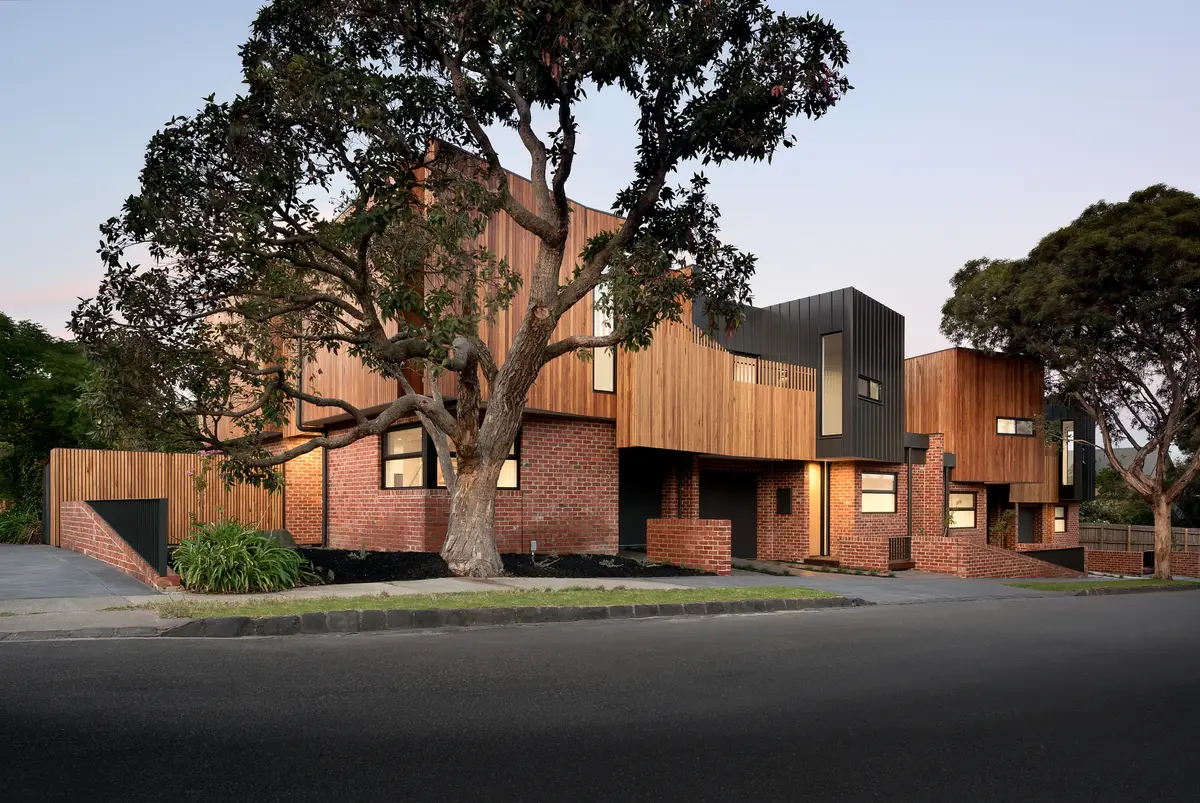
Green Sheep Collective Threads Light Through Four Melbourne Townhouses with Central Courtyards
In Alphington, a medium-density housing project uses passive solar strategy and recycled materials to rethink the suburban infill model.


Medium-density housing in Australian suburbs tends to follow a depressingly familiar script: maximize the building footprint, minimize the garden, orient rooms wherever they happen to fall, and slap a brick veneer on the street face. Green Sheep Collective, working with builder Elyte Focus, rejected every part of that formula for this row of four townhouses in Melbourne's Alphington. The result is a project that treats orientation, light, and ventilation as non-negotiable design drivers rather than afterthoughts.
The core challenge was straightforward but difficult: the four sites run north-south, which means rooms along the southern half of each plan risk receiving almost no direct sun. Green Sheep Collective's answer was to break each plan apart with internal courtyards, pulling northern light down into the center of every dwelling and enabling cross-ventilation to every room. It is a simple move executed with real discipline, and it elevates the entire project from spec housing to genuinely considered architecture.
A Layered Streetscape


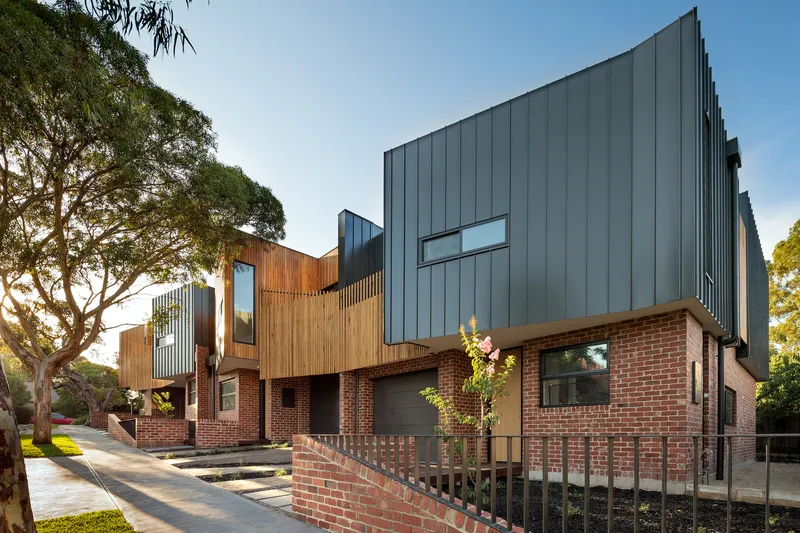
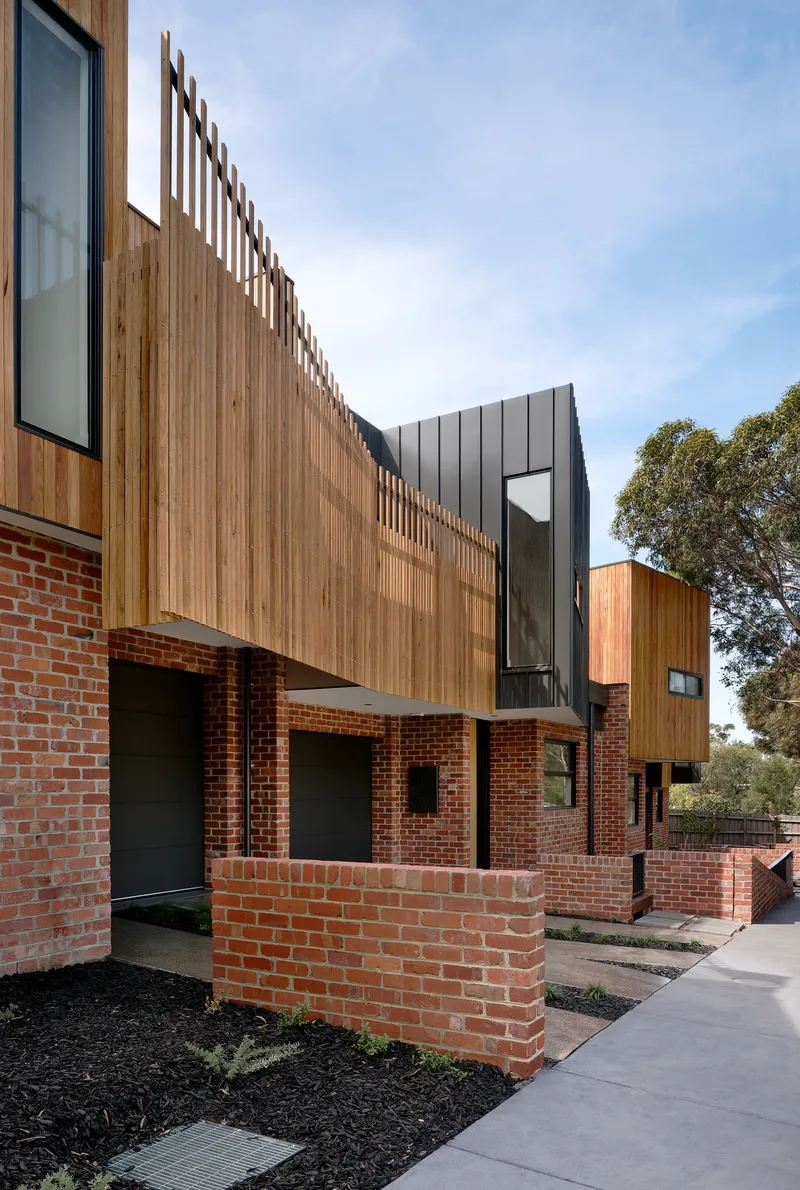
From the street, the townhouses read as a single composed facade rather than four repetitive units. Recycled red brick forms a solid base, topped by vertical ash timber cladding and dark standing-seam metal volumes that step and stagger against one another. Mature eucalyptus trees filter the afternoon light and soften the roofline. The layering is genuinely effective: brick grounds the building in its suburban context, timber warms the mid-level, and the charcoal metal upper volumes recede against the sky.
Staggered brick fences at ground level create a rhythm of semi-private thresholds along the footpath. Vehicular access and parking have been deliberately compressed, pushed to the edges so that more of the street frontage can be given over to landscaping and planted beds. It is a quiet act of generosity toward the public realm that most speculative housing never bothers with.
Dusk Presence
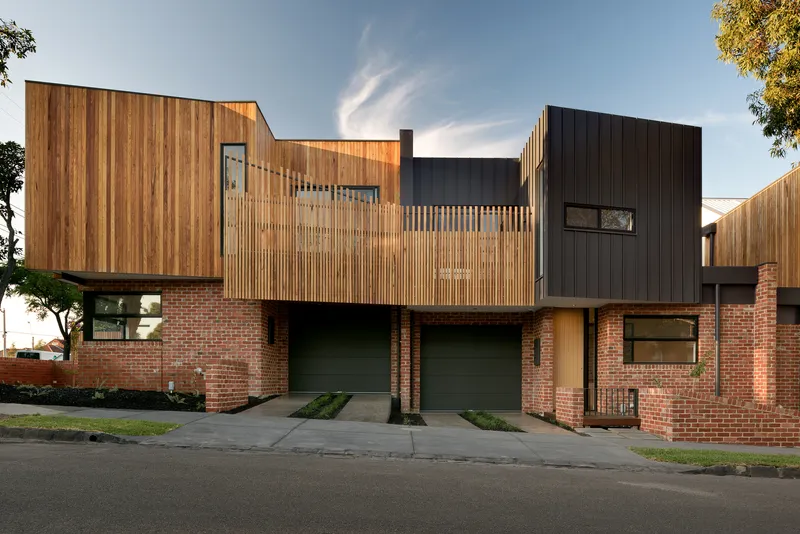
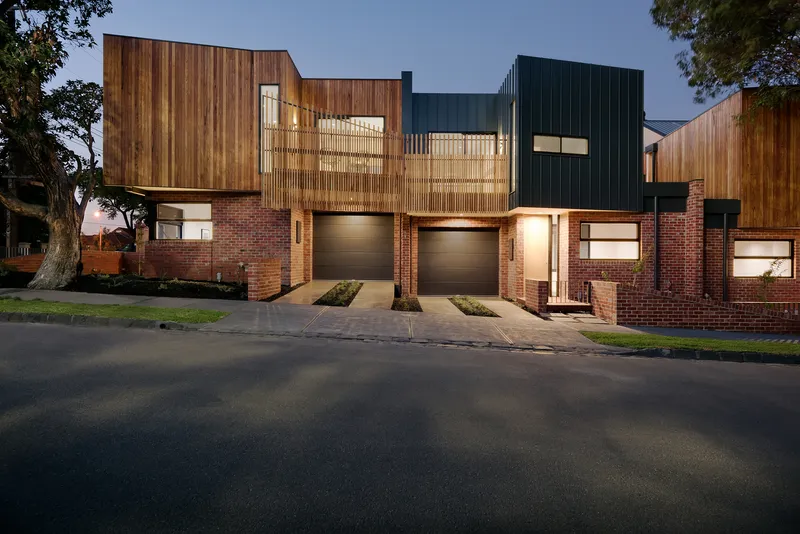

At twilight the project reveals its organizational logic most clearly. Warm light spills from the windows and garage openings, illuminating the depth between each material layer. The brick piers that frame the garages take on a monumental quality when side-lit, and the timber screening reads as a translucent filter between domestic life and the street. Red brick at the base becomes almost ochre under low sun, while the dark metal volumes above disappear into the evening sky.
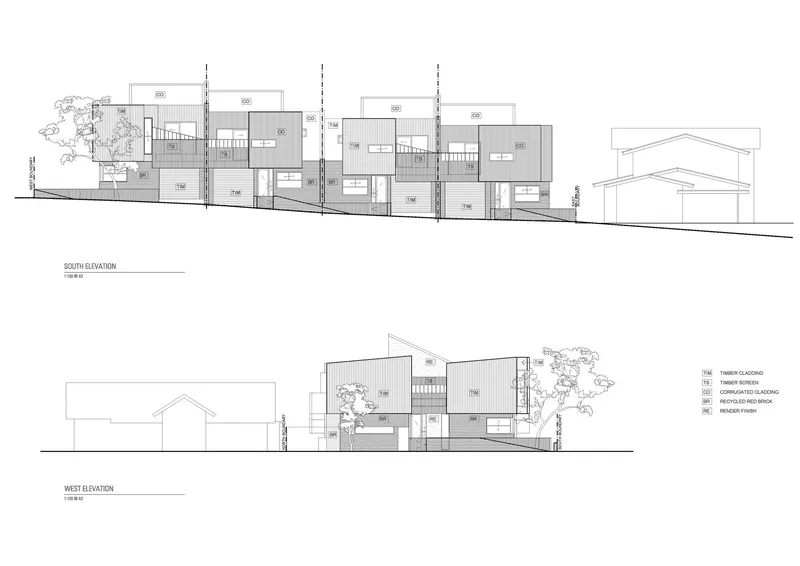
The dusk images also show how the rooflines shift from unit to unit. Those raked forms are not decorative; they house clerestory windows that drive the stack-effect ventilation strategy. Warm air rises to the operable clerestories and exits, pulling cooler air through the lower openings and courtyards. Form follows thermodynamics.
Courtyards as Climate Machines
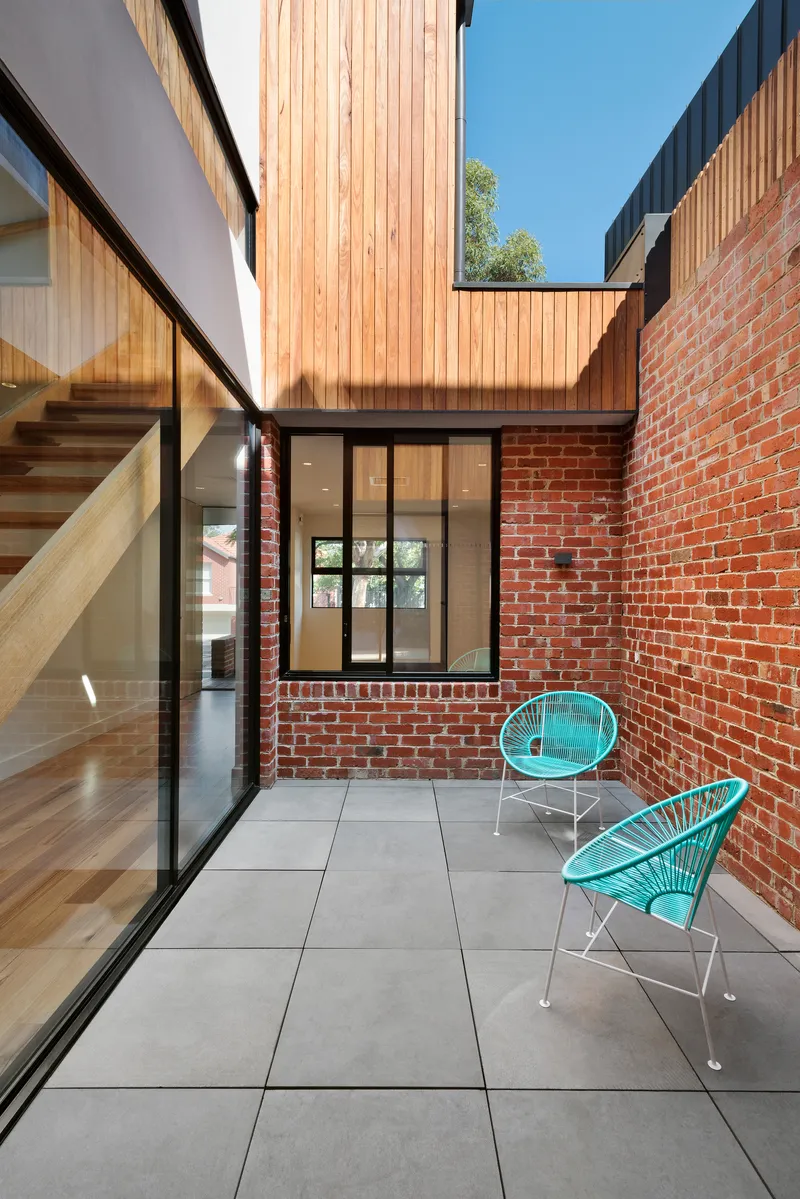
The internal courtyards are the engine of the whole design. Positioned roughly at the center of each plan, they split the dwelling into a northern living zone and a southern service or bedroom zone. Sunlight enters vertically through these voids, reaching rooms that would otherwise sit in shadow. Overhead timber slat screens filter the harshest summer sun while still admitting enough light to make the courtyard feel open rather than enclosed.
Practically, these courtyards also function as the cross-ventilation path for every room in the house. Air moves from the north-facing backyard through the living spaces, across the courtyard, and out through the southern rooms, a continuous circuit that reduces reliance on mechanical cooling. It is a strategy borrowed from tropical and Middle Eastern housing traditions, adapted here for Melbourne's temperate but increasingly warm climate. The result is energy ratings of up to seven stars.
Interior Warmth
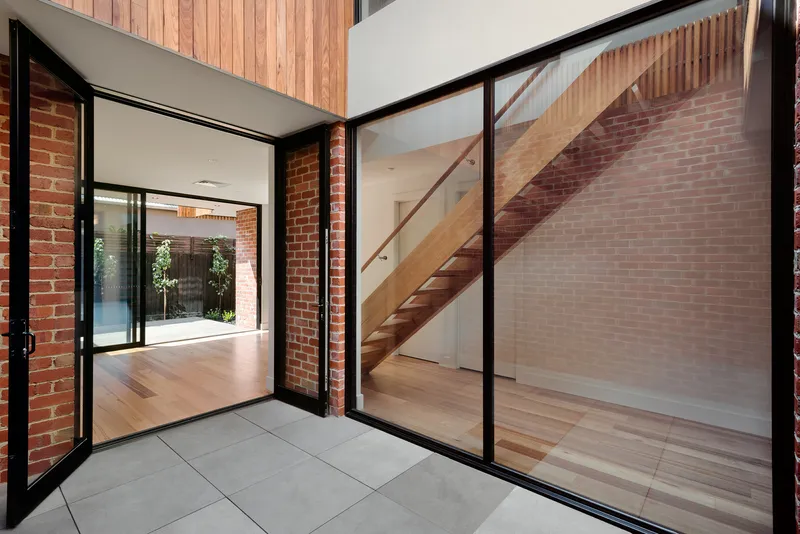
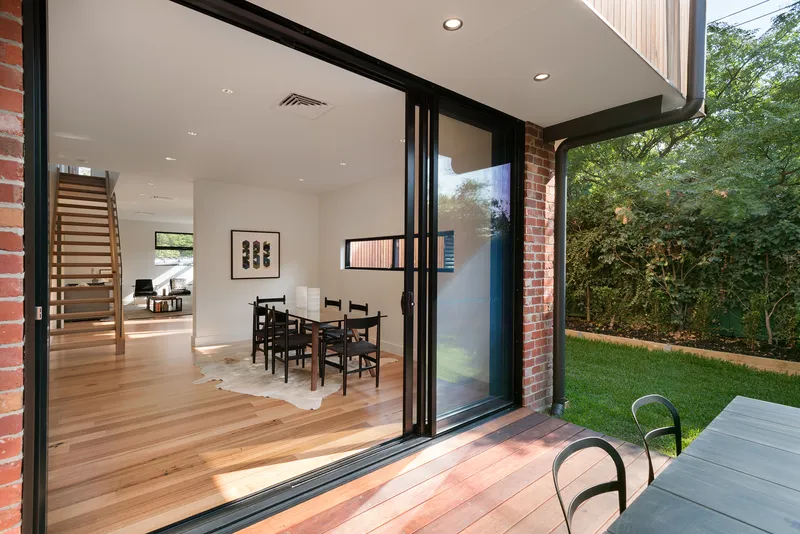

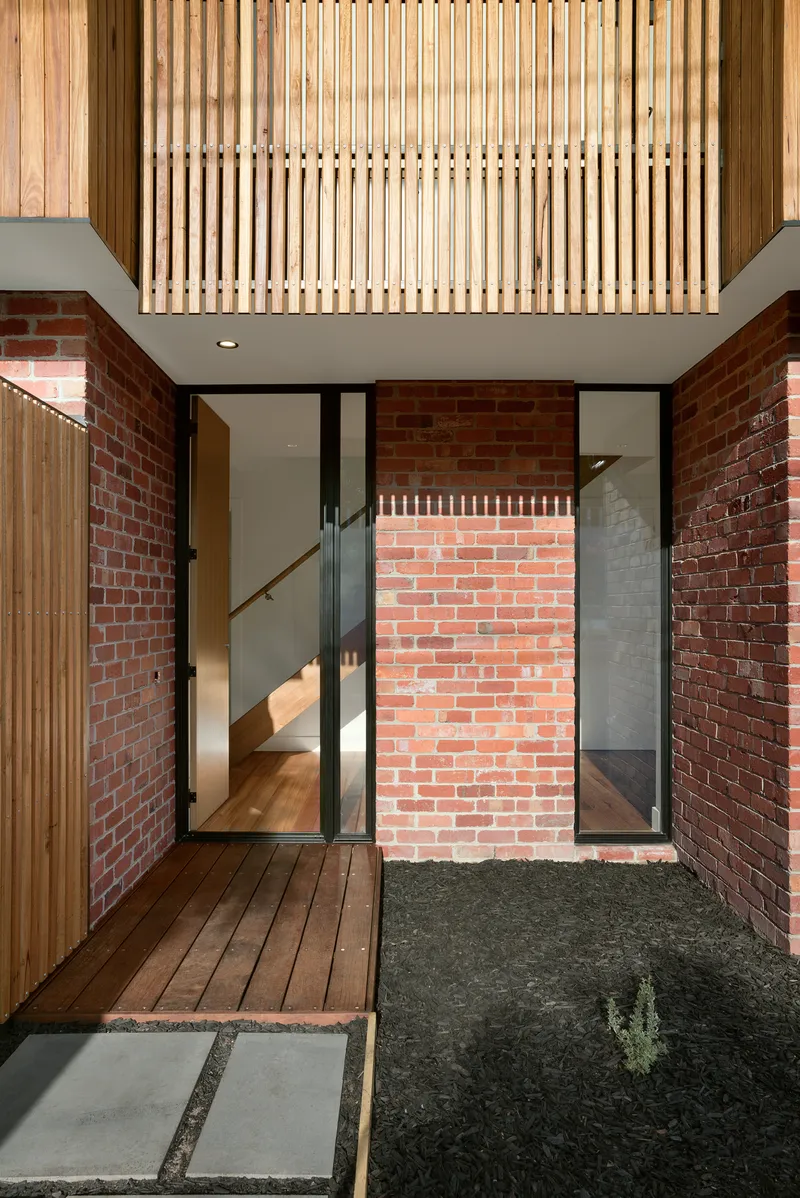
Inside, the material palette stays restrained. Victorian Ash flooring runs through the living areas, its honey tones complementing the exposed recycled brick walls. Black-framed glazing separates interior from exterior with minimal visual weight, and the entry sequence draws you from the brick-walled threshold through a glass door into the stair hall beyond. The contrast between rough brick and precise steel framing gives the interiors a texture that painted plasterboard alone could never deliver.
Living rooms open directly onto rear lawns through full-height sliding glass doors, collapsing the distinction between indoor and outdoor space. Upper-level balconies are screened with the same vertical ash battens used on the street facade, providing privacy without blocking airflow. The architects noted that because the end users were unknown at design stage, every material choice had to be durable, low-maintenance, and flexible enough to suit a range of inhabitants. Sustainably sourced ash and recycled brick meet all three criteria.
Private Rooms and Considered Details
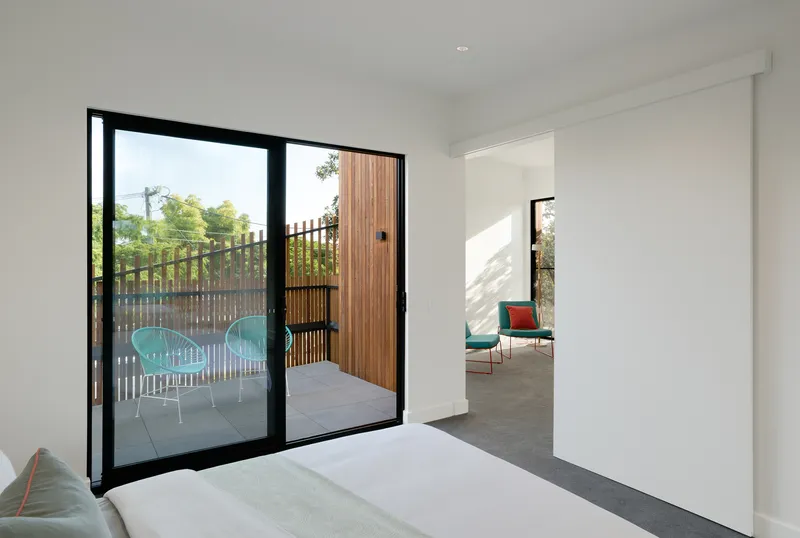

The bedrooms continue the open-air logic of the rest of the house. Black-framed glass doors fold back to connect the sleeping space to a screened terrace, essentially extending the room outdoors in warmer months. The turquoise wire chairs are a playful touch against the warm timber and grey brick.
In the bathroom, a hexagonal tile gradient wall transitions from light at the top to dark at the base, catching skylight from above. It is one of the few moments where the project permits itself a decorative gesture, and it works precisely because the surrounding finishes are so disciplined. Skylights here are not just aesthetic; they continue the strategy of bringing natural light into zones that conventional plans would leave windowless.
Plans and Drawings
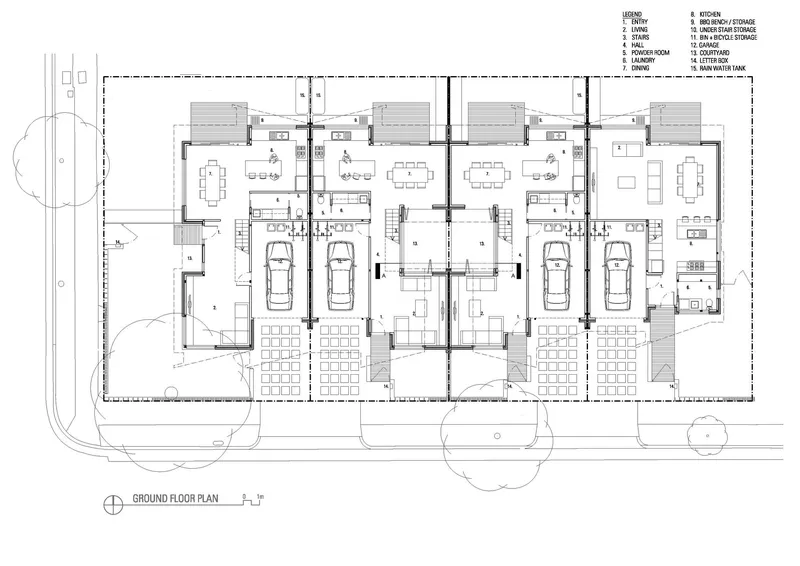

The ground floor plans reveal the courtyard strategy in section: garages and entries sit at the street edge, living and dining spaces occupy the middle band, and north-facing rear yards stretch behind. The courtyards slot in between, delineating program zones and separating circulation from habitable space. On the first floor, bedrooms flank the void of the courtyard below, each with access to a screened balcony or terrace.
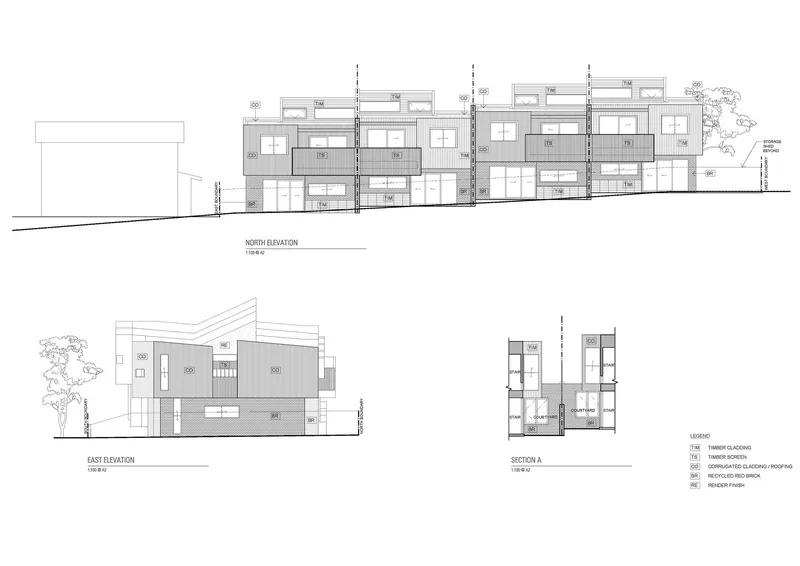
The elevation and section drawings show how the staggered rooflines accommodate clerestory windows at varying heights. The raking roof forms are not uniform across the four units; they shift to avoid monotony and to optimize the angle of incoming north light for each specific room below. The structural system avoids steel entirely, relying instead on timber and brick, an approach that earned the project a commendation for Excellence in Use of Lightweight Materials. Rainwater tanks sit beneath the landscape, feeding toilets and garden irrigation, while permeable paving across the site manages stormwater at source.
Why This Project Matters
Alphington Townhouses matters because it proves that passive design strategies and genuine environmental ambition are not incompatible with speculative medium-density housing. Green Sheep Collective did not have the luxury of a known client with a specific brief; they had to design for durability, flexibility, and performance simultaneously. The courtyard-driven plan, the steel-free structure, the recycled brick, the locally sourced ash: each decision reinforces the others, producing a project that is more than the sum of its sustainable parts.
Melbourne's inner suburbs are being densified rapidly, and most of what gets built is indifferent at best. These four townhouses demonstrate that orientation, cross-ventilation, and material honesty can be standard practice rather than luxury upgrades. The lessons here are transferable to hundreds of similar sites across Australia's cities. The question is whether developers and planners will pay attention.
Alphington Townhouses by Green Sheep Collective with Elyte Focus. Located in Alphington, Melbourne, Australia. 778 m². Completed in 2017. Photography by Emma Cross.
About the Studio
Share Your Own Work on uni.xyz
If projects like this are the kind of work you want to make, uni.xyz is a place to publish your own, find collaborators, and enter design competitions.


Popular Articles
Popular articles from the community


Lunar Spiral: Space Architecture Shaped by the Mathematics of the Universe
Lunar Spiral reimagines space architecture through Fibonacci geometry, lunar regolith, levitating habitats, and self-sustaining Moon living.

Co-Life: Senior Housing Design That Reconnects Older Adults With the City
Co-Life reimagines senior housing design through healing gardens, shared streets, workshops, and a sustainable community across generations.

Hill & Cross Opera: Sculptural Opera House Architecture Shaped by Tallinn’s Landscape and Identity
Hill & Cross Opera reimagines opera house architecture in Tallinn through its sculptural hill, civic plaza, glass wave and a luminous cross.

The Musturak Paradise: Senior Living Architecture for a Connected Future in Temara, Morocco
The Musturak Paradise reimagines senior living architecture in Temara via private homes, social spaces, culture, community, and shared care.

Similar Reads
You might also enjoy these articles

Bao Huynh Watercolor Atelier: A Serene Art Retreat in Hội An
Bao Huynh Watercolor Atelier in Hội An blends multifunctional art spaces, sustainable design, local materials, and family-friendly living in a serene environment.

Atelier Macri Concept Store Interior Design by CASE-REAL
Atelier Macri store features a "ko" counter, walnut wood details, cork displays, blending retail, gallery, and seamless customer experiences.

Manuel Vargas Izquierdo Stadium and High-Performance Sports Center: Architectural Excellence in Jalpa de Méndez
The Manuel Vargas Izquierdo Stadium blends sustainable design, inclusive sports facilities, and cultural-inspired architecture, revitalizing Jalpa de Méndez’s public spaces.

KAKR Buluh Awar Hall: Revitalizing Community and Ecology Through Bamboo Architecture
Community built bamboo hall revitalizes Buluh Awar village, empowering youth, restoring ecology, celebrating vernacular craftsmanship through sustainable architecture and culture.

Explore Town Planning Competitions
Discover active competitions in this discipline

Challenge to reimagine the Iron Throne

Photograph architecture without architects

Illustrate the lost glory of Angkor Wat - Render Challenge

Design challenge to reuse E-waste
Comments (0)
Please login or sign up to add comments
No comments yet. Be the first to comment!