
Greenhill's STEM Center Turns Classrooms Inside Out
Bohlin Cywinski Jackson designs a courtyard-driven STEM building in north Dallas that treats landscape as pedagogy and brick as climate armor.


Independent schools across the United States have been racing to brand themselves as STEM destinations, and the architectural results are often interchangeable: slick labs wrapped in curtain wall, a token maker space, maybe a green roof for good measure. Greenhill School's Rosa O. Valdes STEM and Innovation Center in Addison, Texas, sidesteps that formula. Designed by Bohlin Cywinski Jackson and completed in 2024, the building treats its courtyard landscapes not as decoration but as working extensions of the curriculum, while a sawtooth roofline and perforated brick walls negotiate the brutal north Dallas sun with genuine material intelligence.
What makes the project worth studying is how seriously it takes the relationship between thermal performance and pedagogical openness. Every classroom faces a planted courtyard, every corridor doubles as informal workspace, and the building's heaviest material, its buff-colored brick shell, does the most delicate work: modulating light, channeling breezes, and grounding a campus that could otherwise drift into generic transparency. The result is a STEM facility that actually feels like a place rather than a brand exercise.
A Sawtooth Silhouette Against the Texas Sky
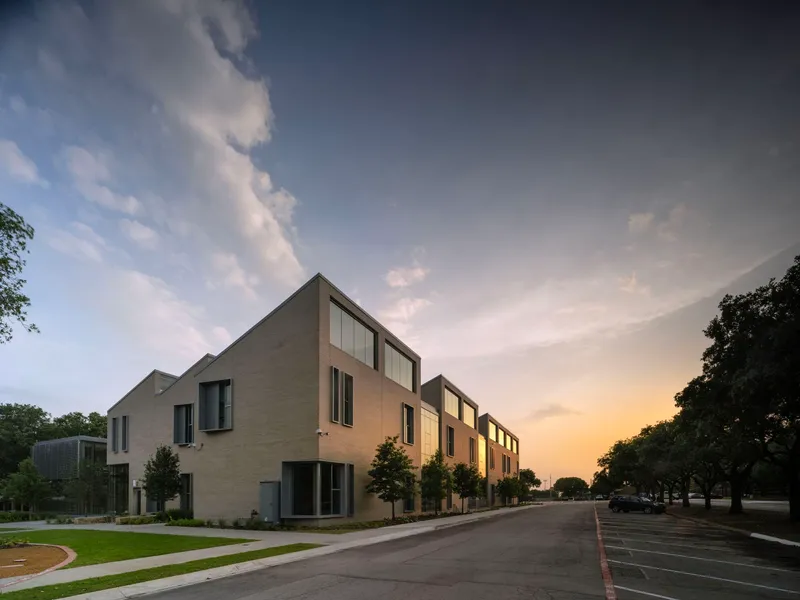
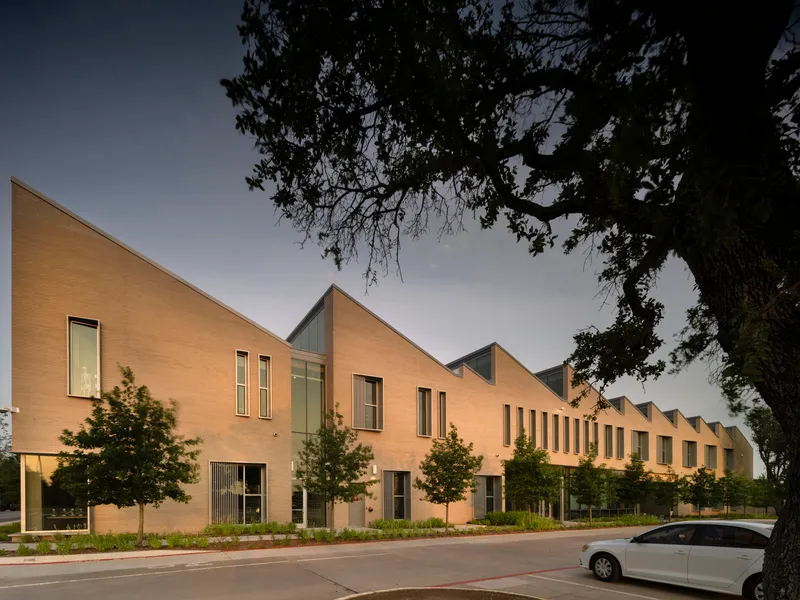
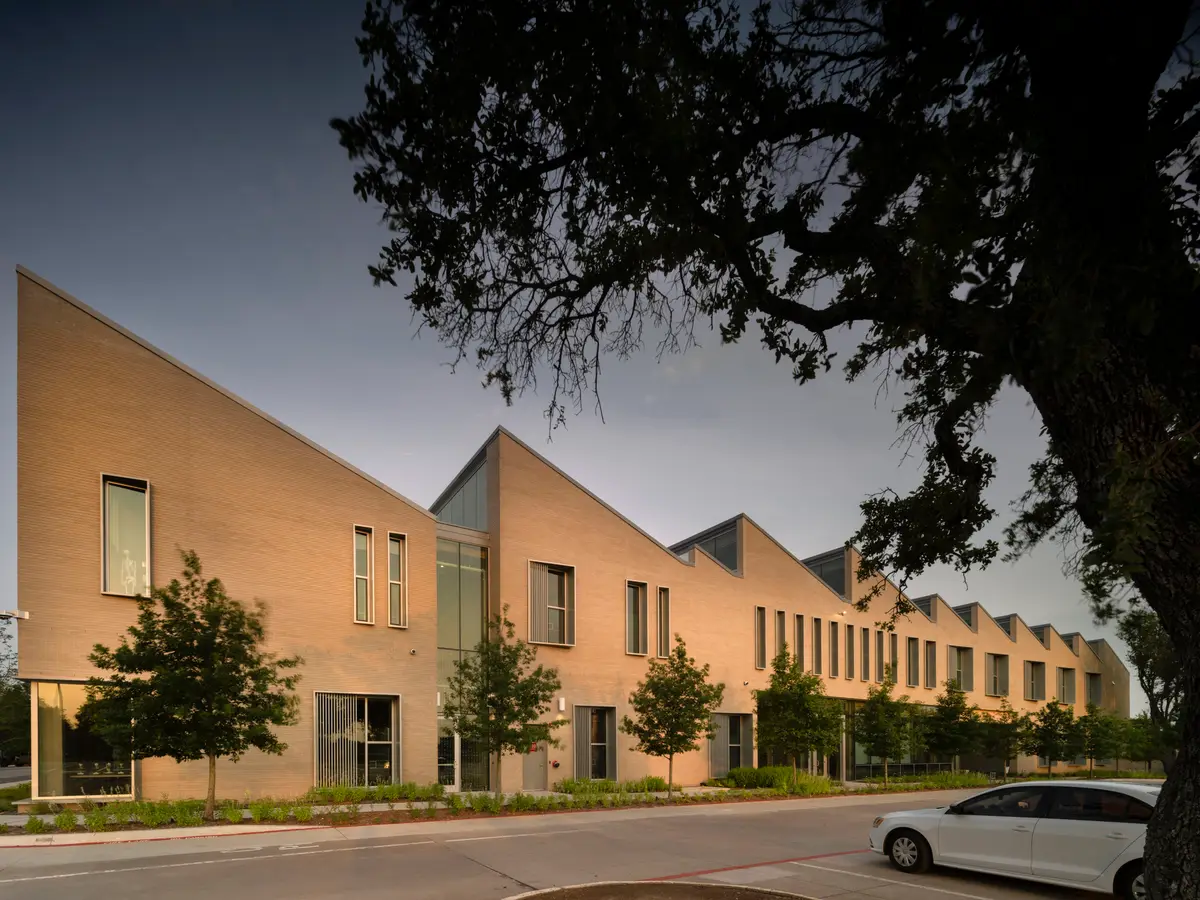
From the street, the building reads as a long bar of buff brick punctuated by repeating sawtooth roof peaks. It is an industrial profile repurposed for education, and it works precisely because it does not try to be precious. The sawtooth form is not a stylistic flourish; each north-facing clerestory pours diffused light deep into the labs and classrooms below, reducing the need for electric lighting during the school day.
At dusk the bronze horizontal louvers flanking the entrance glow warmly, and the planted beds beneath mature oak trees soften the transition from parking lot to learning environment. The facade's proportions are generous without being monumental. A student arriving at this door understands they are entering something purposeful, not something that is trying to impress them.
Courtyards as Outdoor Classrooms

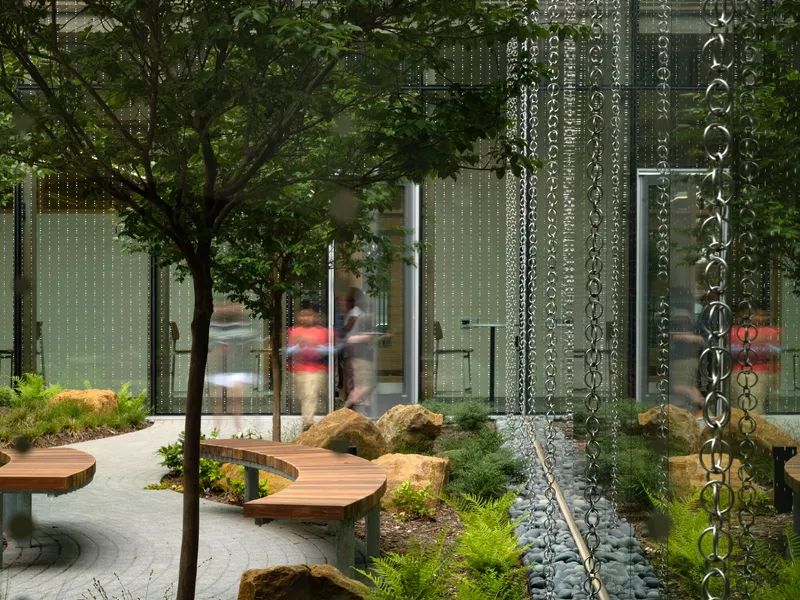
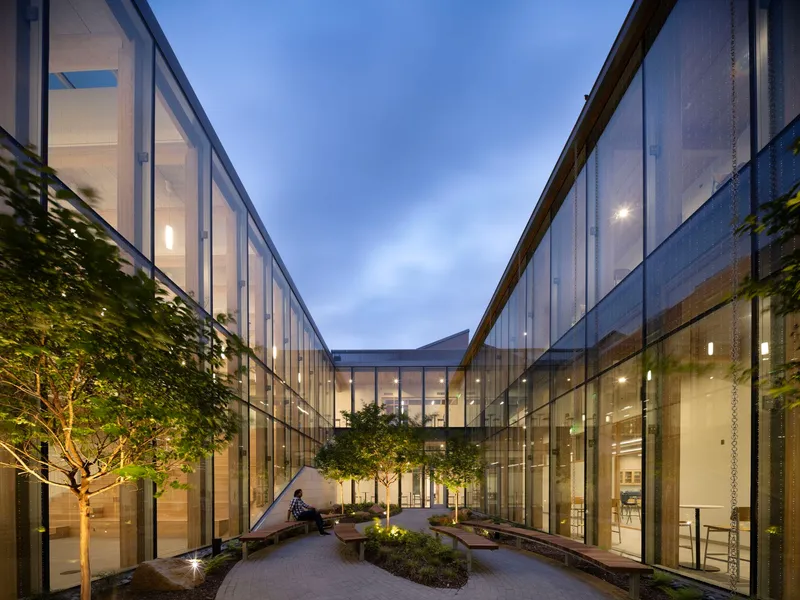
The plan organizes classrooms around a generous central courtyard, and the decision pays off in nearly every interior view. Under the colonnade, students sit at benches shaded by the sawtooth overhang, occupying a zone that is neither fully inside nor fully out. Decorative chain rain curtains channel stormwater into planted beds filled with boulders, turning a drainage detail into a visible science lesson.
A second enclosed courtyard uses mesh-clad facades and native planting to create a quieter microclimate at the building's heart. Trees planted here will mature over years, gradually changing the quality of dappled light that reaches the classrooms. It is the kind of long-game landscape thinking that most school projects skip in favor of instant polish.
Timber Structure and the Warmth of Learning
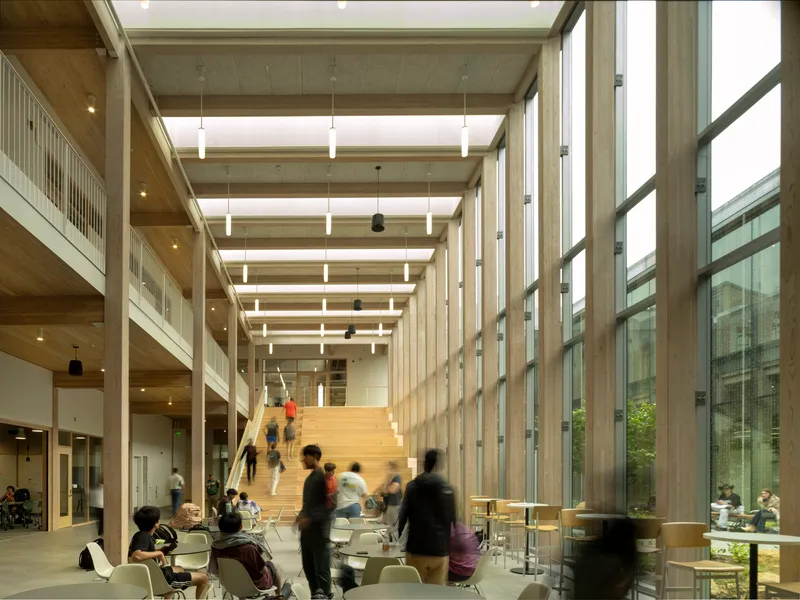
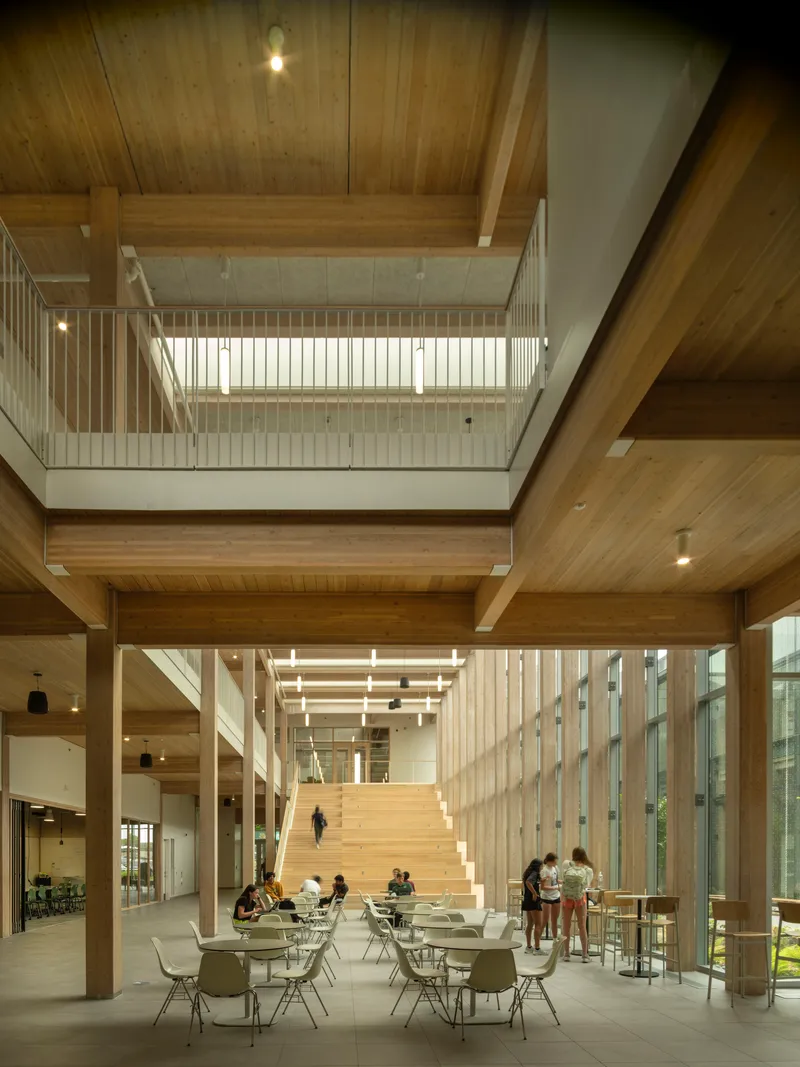
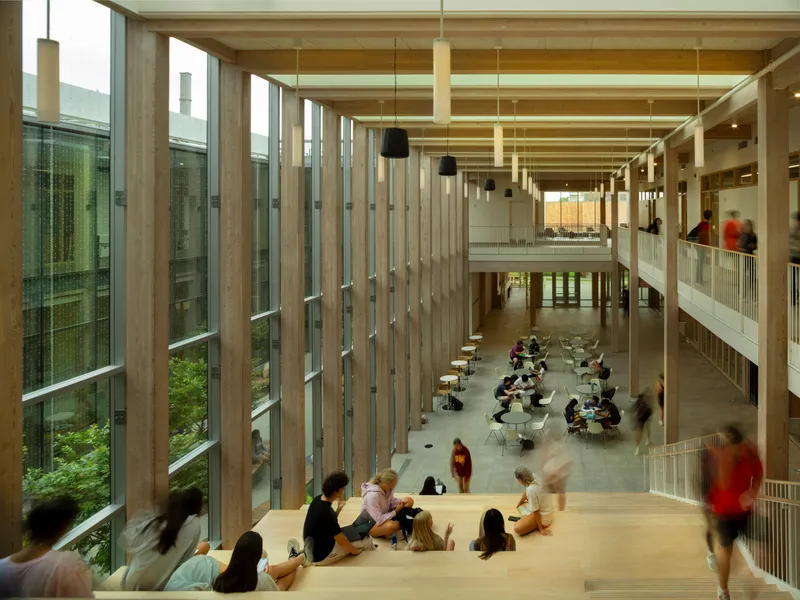
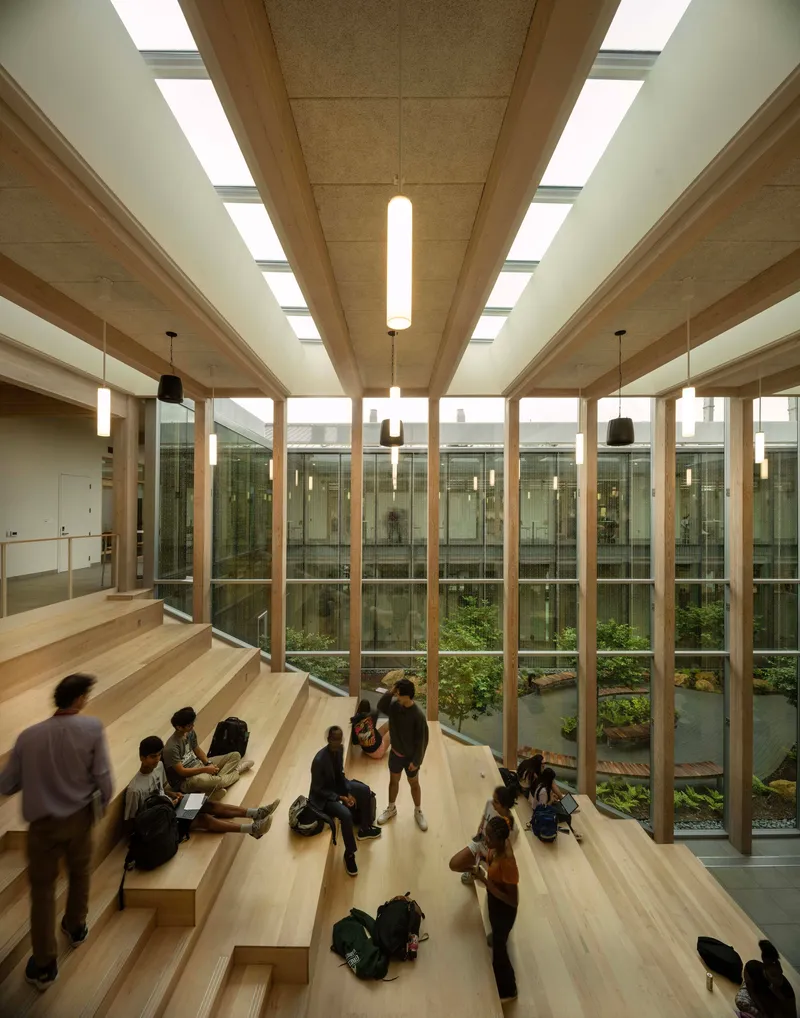
Step inside and the material register shifts from brick to timber. The triple-height atrium is defined by exposed glulam beams that span the full width, with clerestory windows at the ridge flooding the volume with even, north light. A wide timber staircase anchors the space, serving simultaneously as circulation, bleacher seating, and informal gathering zone. Students sit on its steps with laptops open, proving the architects' bet that generous stairs generate community.
From the upper balcony, a screen of timber columns filters views down into the lobby below. The columns are structural, but they also create a sense of enclosure without walls, letting sound and sightlines pass through while maintaining a sense of distinct territory on each level. It is a subtle move that keeps the atrium feeling alive without becoming chaotic.
Labs, Workshops, and the Glazed Corridor
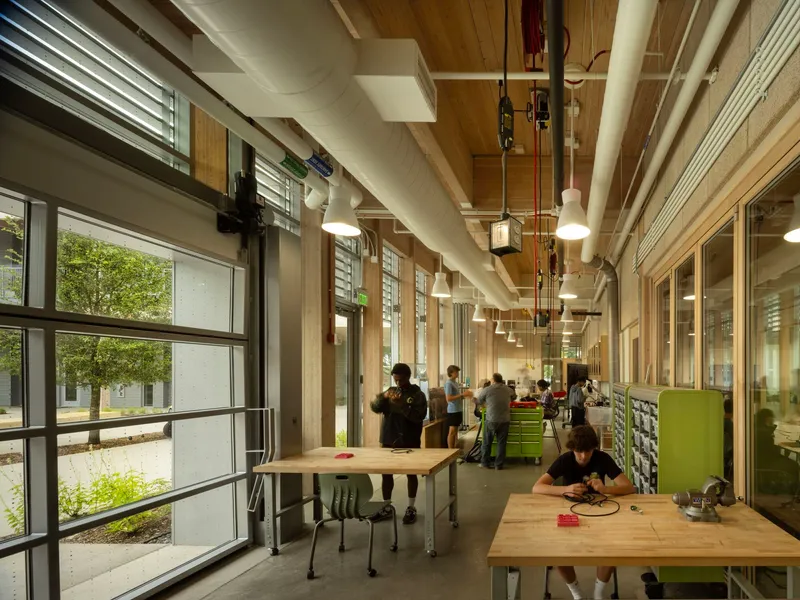

The workshop corridor is perhaps the building's most revealing space. Workbenches line one side, a fully glazed wall to the courtyard lines the other, and an exposed timber ceiling with pendant lights runs the length. Red conduit and visible MEP lines are left intentionally exposed, consistent with a building that wants students to understand how things are assembled.
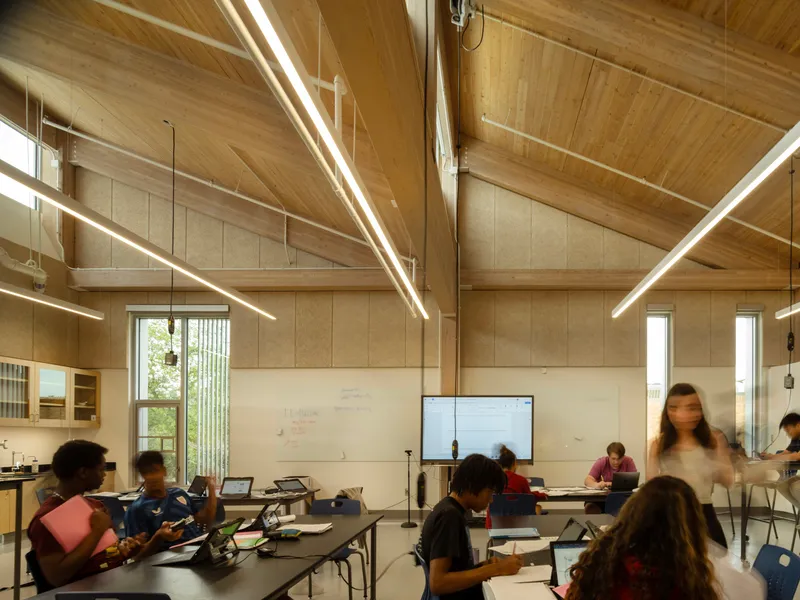
Classrooms vary in character. Some feature vaulted timber ceilings with linear pendant lights, creating focused acoustics for seminar work. Others are configured as open presentation spaces behind glass walls, visible to passersby in the corridor. The message is consistent: learning here is not hidden behind closed doors. It is on display, and that visibility is itself a teaching strategy.
Light, Brick, and Material Detail
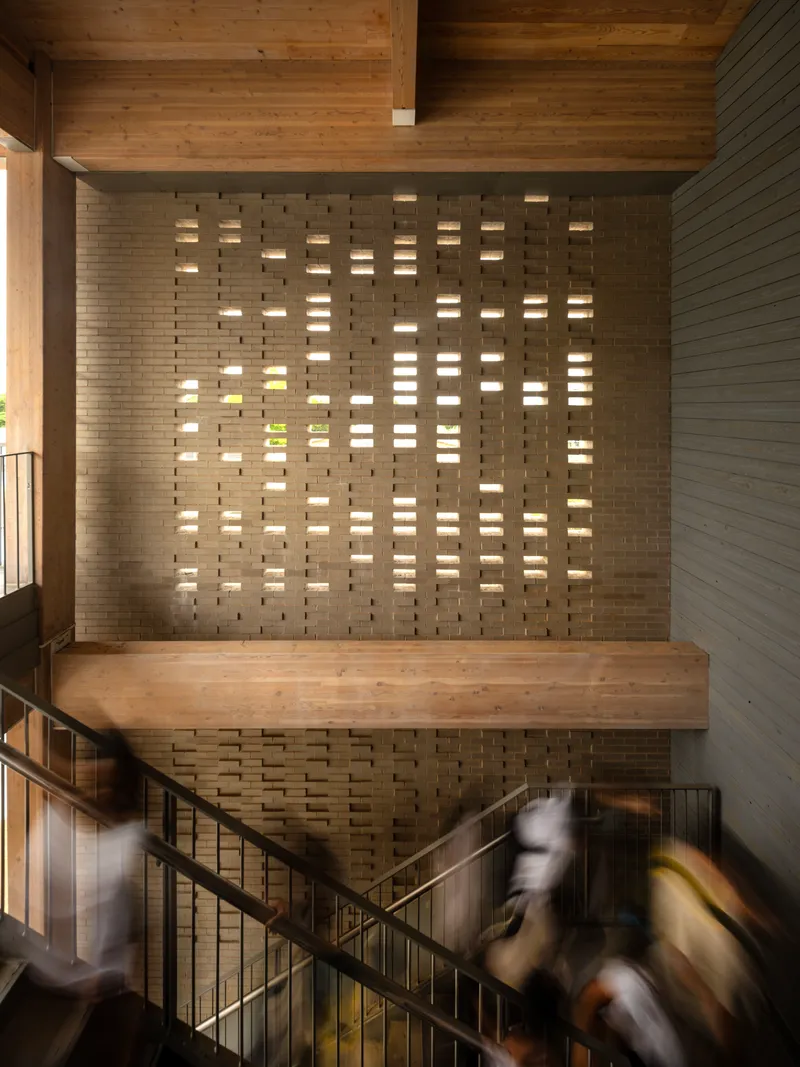

A perforated brick stair wall deserves special attention. Light filters through circular openings as students descend the steps, casting shifting patterns across the masonry surface throughout the day. It is a low-tech environmental effect with high sensory payoff, and it gives the stairwell a character that no amount of LED programming could replicate.
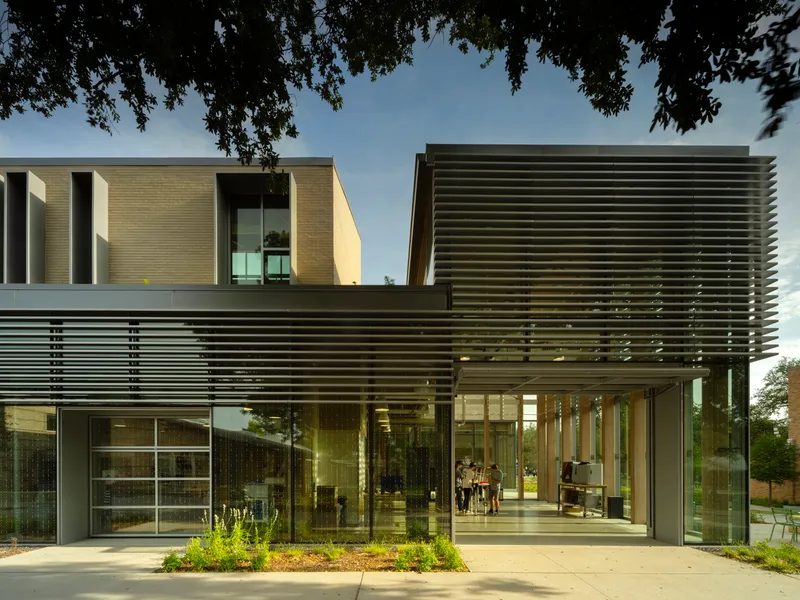
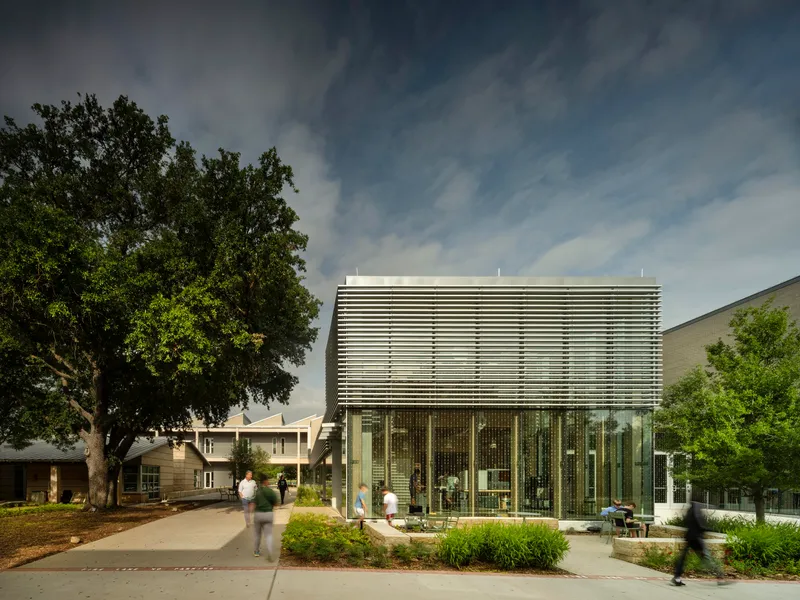
Elsewhere, a glass box pavilion with horizontal sunshade louvers mediates between the campus landscape and the building interior. Study rooms feature red-painted conduit running openly along the glass wall, a detail that reads as both honest and slightly playful. The architects clearly trust that young people do not need their infrastructure hidden to feel comfortable.
Where Inside Meets Outside
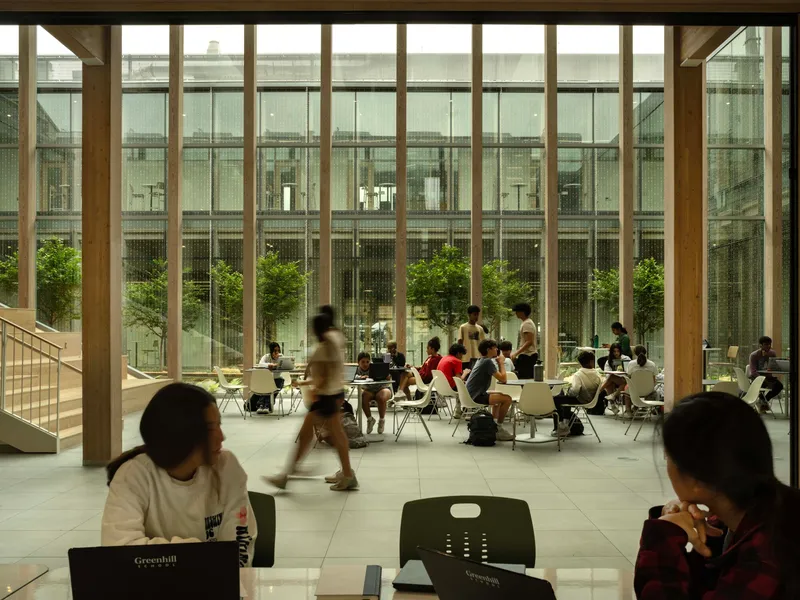
The dining hall may be the most pleasant room in the building. Tall timber-framed windows look out onto a planted courtyard, and students study at long tables bathed in filtered green light. Angled timber benches in an adjacent seating area face the same courtyard through full-height glazing, creating a gradient from active dining to quiet contemplation in just a few steps.
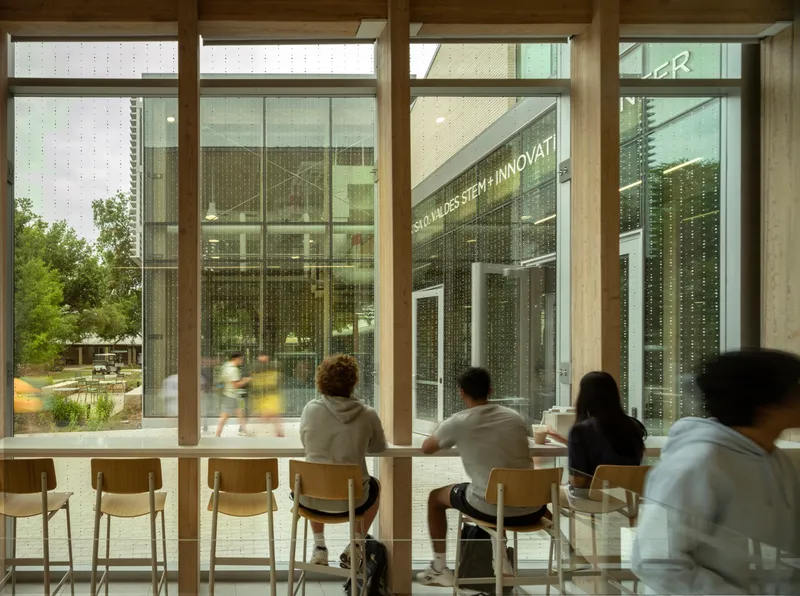
A timber-framed window counter at the courtyard edge lets occupants sit in dappled sunlight while remaining technically indoors. These threshold spaces, not quite room and not quite garden, are where the building is at its best. They acknowledge that students learn as much in the spaces between classes as they do within them.
Campus Presence After Dark

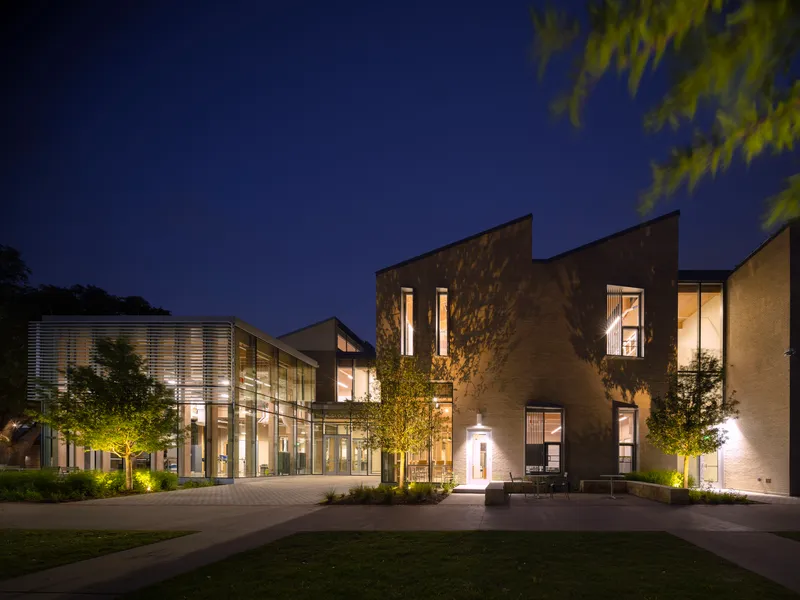
At night the building reveals its internal logic from the outside. The glass-walled wing glows against the angular stone volumes, and the courtyard trees are backlit by the warm interiors beyond. The plaza between old campus and new building becomes a social space in its own right, animated by the light spilling from every corridor.
The nighttime views also clarify the massing strategy. Solid brick volumes anchor the composition at its ends while the transparent middle section acts as a lantern. It is a classic BCJ move, one the firm has deployed from Pixar to Apple, but here it serves an educational community rather than a tech campus, and the warmth of the timber interior gives it a different emotional register.
Plans and Drawings
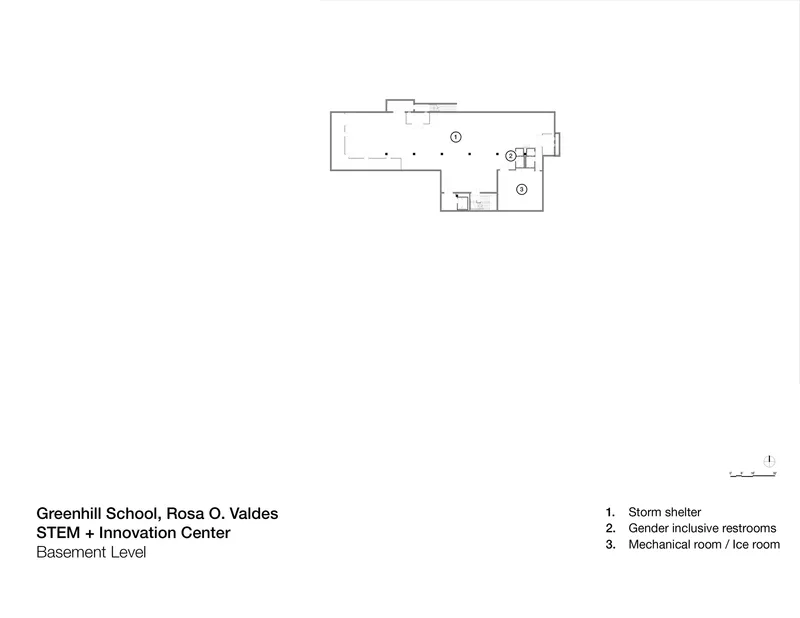

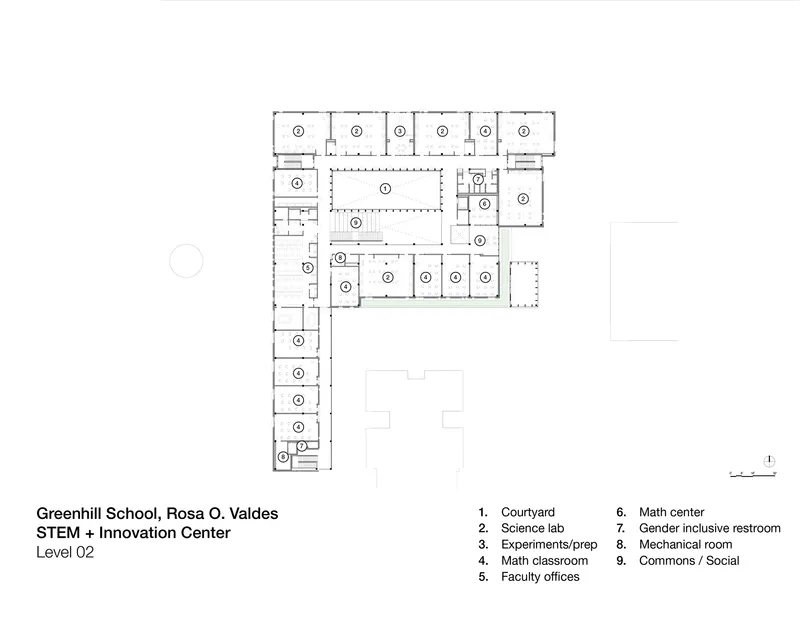

The floor plans confirm what the photographs suggest: the courtyard is genuinely central, not an afterthought carved from leftover footprint. Classrooms wrap three sides of the court at ground level, while science labs and upper-level classrooms occupy the second floor with direct sightlines down into the planted space below. The basement plan reveals a storm shelter tucked beneath the labs, a pragmatic nod to Texas weather that the building's serene exterior never hints at.
The east-west section is the most informative drawing. It shows the sawtooth roof in profile, the stormwater collection systems feeding a teaching garden, and the full three-story atrium in relation to the lower courtyard grade. Stormwater is not just managed here; it is choreographed into visibility so students can trace a raindrop from roof to cistern to garden. That integration of infrastructure and curriculum is what separates this project from most school buildings claiming a sustainability agenda.
Why This Project Matters
The Rosa O. Valdes STEM and Innovation Center matters because it refuses the false choice between environmental performance and spatial generosity. The sawtooth roofline, the perforated brick, the courtyard orientation: these are not aesthetic gestures. They are climate strategies that happen to produce beautiful spaces. In a region where summer temperatures regularly exceed 100°F, that alignment of form and performance is not optional; it is survival.
More broadly, the project offers a counterargument to the idea that STEM architecture must look futuristic. Greenhill's new building is made of brick, timber, and glass, materials with centuries of precedent. Its innovation lies in how those materials are organized, detailed, and oriented to make the act of learning visible, comfortable, and connected to the landscape. If more schools took this approach, we would have fewer flashy science wings and more buildings that actually teach something.
Greenhill School, Rosa O. Valdes STEM and Innovation Center by Bohlin Cywinski Jackson. Lead architects: Daniel Lee, AIA; Tom Kirk; Margaret Sledge. Addison, United States. Completed 2024. Photography by Nic Lehoux.
About the Studio
Share Your Own Work on uni.xyz
If projects like this are the kind of work you want to make, uni.xyz is a place to publish your own, find collaborators, and enter design competitions.


Popular Articles
Popular articles from the community


Singing Woman: An Opera House That Performs Before the Curtain Rises
Ovidiu Cristian Pavel's conceptual opera house translates Estonia's choral identity into a sculpted waterfront landmark facing the Baltic Sea.


Cube Design Draws an Ecological Corridor Between Two Shenzhen Hills with the Nankai Building
Beside Shenzhen's container docks, the Nankai Building pairs stacked balconies with a climbing green screen to connect two hillsides across its height.

Aquadapt: An Underwater Habitat That Rewrites Its Rooms by the Hour
Curved modules ring the seabed while one shell shifts from breakfast room to cinema, farm and football pitch as residents' needs change.

FCC Arquitectura Expands a Portuguese Granite House with a Board-Marked Concrete Wing
In Portugal, JV House pairs a cleaned-up whitewashed and granite dwelling with a timber-shuttered concrete extension, courtyards and a garden pool.

Similar Reads
You might also enjoy these articles

LAVA Architecten Gives Vocational Education a Sawtooth-Roofed Face on a Mechelen School Campus
In Mechelen, Belgium, a 2,053 m² STEM school on a 6×6 m grid turns workshops and classrooms into rooms that can be rearranged as teaching changes.

KEMA Studio Turns a Derelict Marvila Attic into a 60 m² Lighthouse Apartment Above Lisbon
In Lisbon's Marvila district, a rebuilt roof, four skylights and two plywood volumes turn an unlivable attic into a bright home facing the Tagus.

Pixel Gardens: One Repeated Module Stacked Into a Terraced Social Housing Tower for Famagusta
Salem Bader's shortlisted housing tower builds a vertical neighbourhood from one repeated module, offsetting units to carve terraces, light and air.

Bao Huynh Watercolor Atelier: A Serene Art Retreat in Hội An
Bao Huynh Watercolor Atelier in Hội An blends multifunctional art spaces, sustainable design, local materials, and family-friendly living in a serene environment.


Comments (0)
Please login or sign up to add comments
No comments yet. Be the first to comment!