
gru.a Distills Domestic Life into a 50-Square-Meter Glass and Brick Shelter in the Brazilian Mountains
Abrigo Alto pairs ceramic masonry with timber structure and full-height glazing on a forested slope in Rio de Janeiro's Vale das Videiras.


How little architecture does a dwelling actually need? gru.a, the studio led by Pedro Varella and Caio Calafate, answers that question with Abrigo Alto, one of three buildings designed for a compound in Vale das Videiras, a lush valley in the mountainous region of Rio de Janeiro. Completed in 2021, the shelter compresses sleeping, living, bathing, and cooking into just 30 square meters of enclosed floor area, expanded by a generous deck to a total footprint of 50 square meters. It is not a cabin in the conventional sense. It is a minimal dwelling unit that takes the logic of a pavilion and gives it just enough enclosure to function year-round.
What makes the project worth studying is its disciplined material palette and the way structure generates space rather than merely supporting it. Timber pillars and solid wood beams work on a grid of 3-meter and 5-meter spans, alternating support between columns and ceramic brick masonry walls. The result is a building that reads as open or enclosed depending on where you stand, with the structural rhythm doing the work that partitions would handle in a less considered plan. Roof eaves extend up to 1.80 meters, shading the glass walls and creating a transitional zone between the forest and the interior that is neither fully outside nor fully in.
A Clearing on the Slope
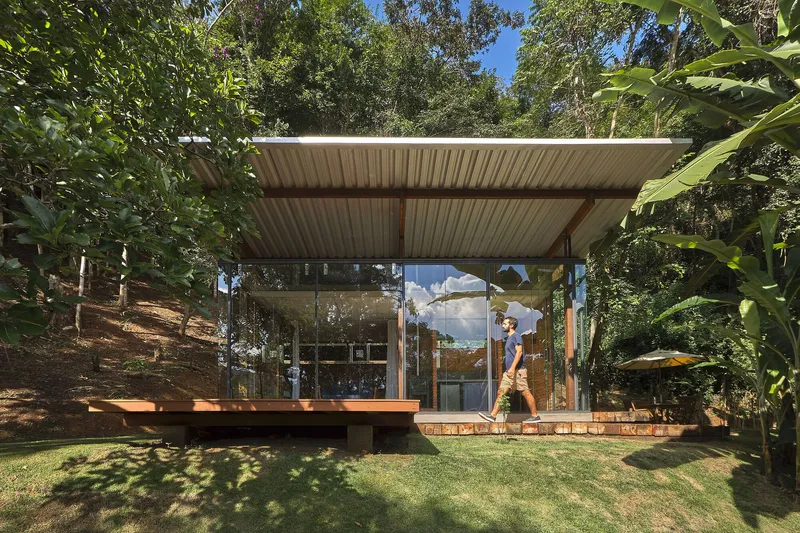
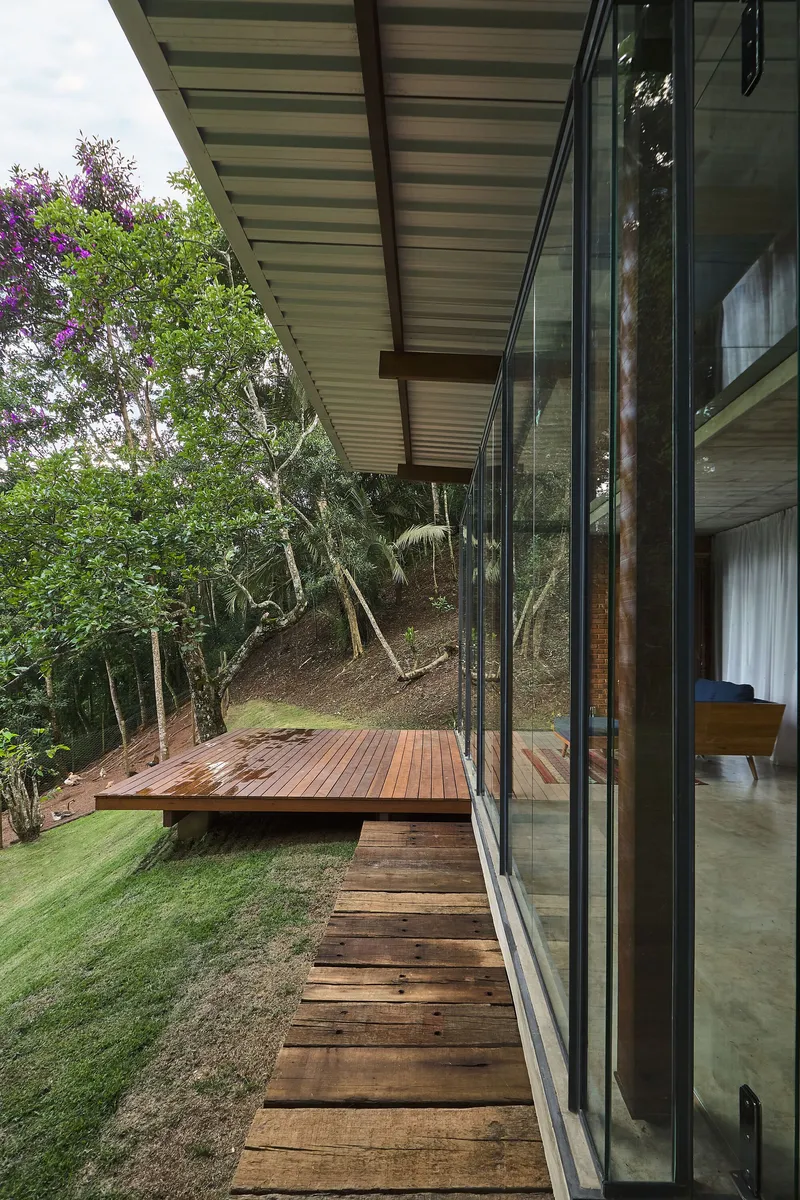
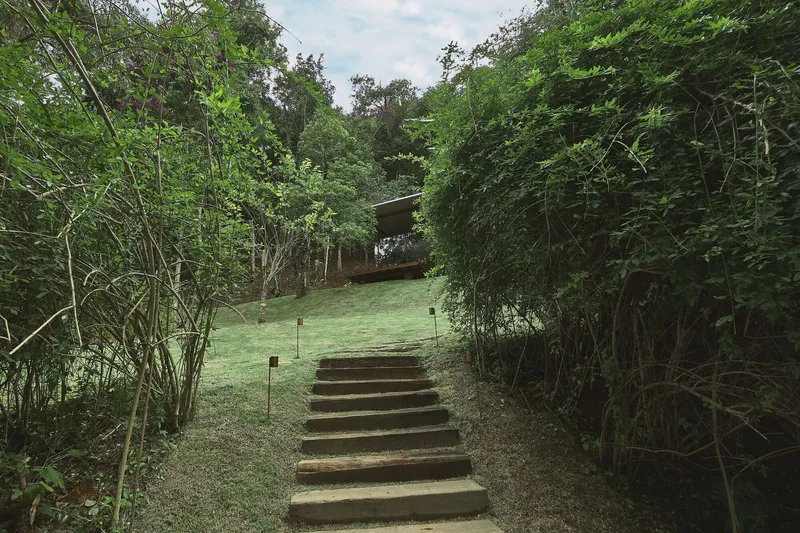
The site is a sloped clearing in dense subtropical forest. Abrigo Alto sits partway up the hillside, accessed by a gravel-and-timber staircase that climbs through the vegetation. The building's flat roof and horizontal proportions let it disappear into the canopy line rather than punctuating it. A corrugated trapezoidal metal roof panel, thermoacoustic in specification, caps the structure with a clean, almost industrial edge that contrasts sharply with the organic disorder of the jungle around it.
The approach sequence matters. You climb through greenery before arriving at the deck level, so the building reveals itself incrementally. By the time you step onto the timber platform, the valley view has already opened up behind the glass wall. The architects understood that the journey to the shelter is part of the shelter's experience.
Brick, Timber, and the Logic of Enclosure
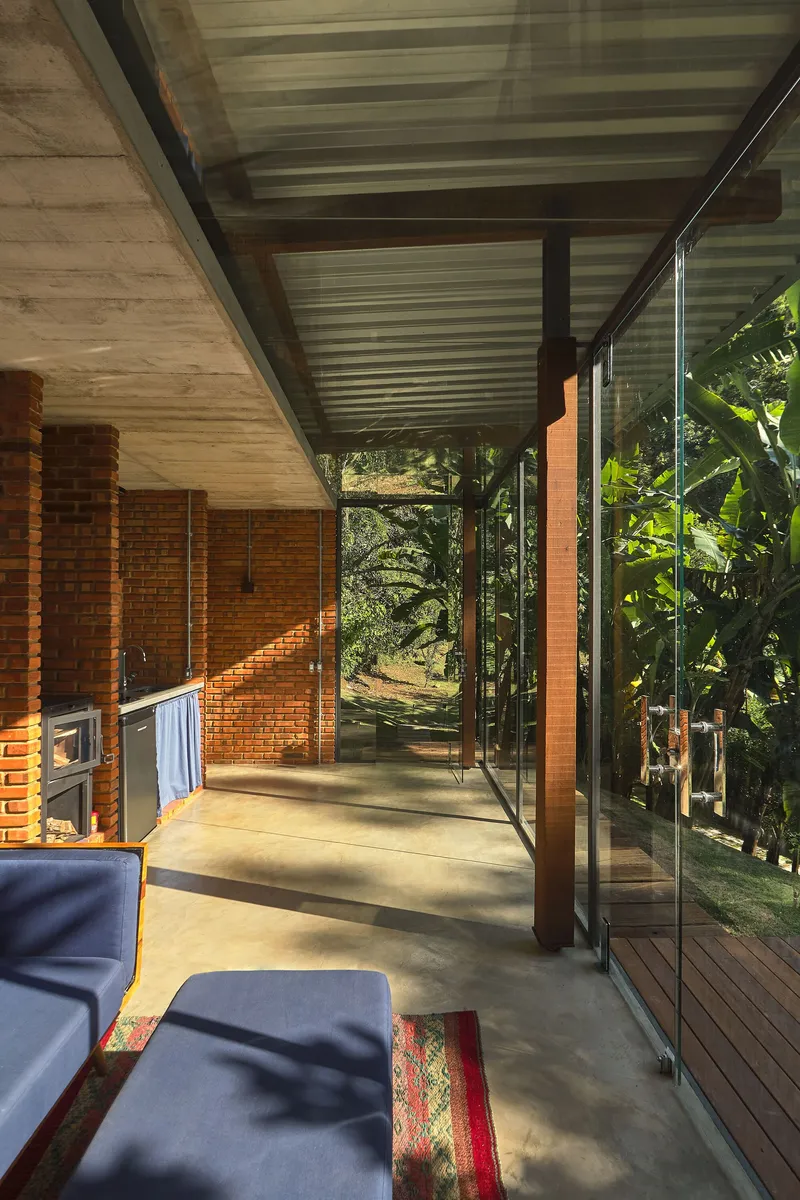

Ceramic brick masonry does double duty here. It provides thermal mass and privacy where needed, particularly around the bathroom and the sleeping area, while also carrying structural loads that free the timber columns to stand as slender markers of the open zones. A perforated brick wall along one corridor filters light and air without fully closing off the view, a move that keeps the interior connected to the forest even in the most enclosed passage.
The fireplace embedded in a full-height brick wall anchors the living space. It is the one element that signals permanence in a building otherwise designed to feel provisional and light. gru.a treats the masonry as the warm, grounded counterpoint to the transparency of the glass walls, and the contrast is effective precisely because it is so direct.
Living Between Glass and Canopy
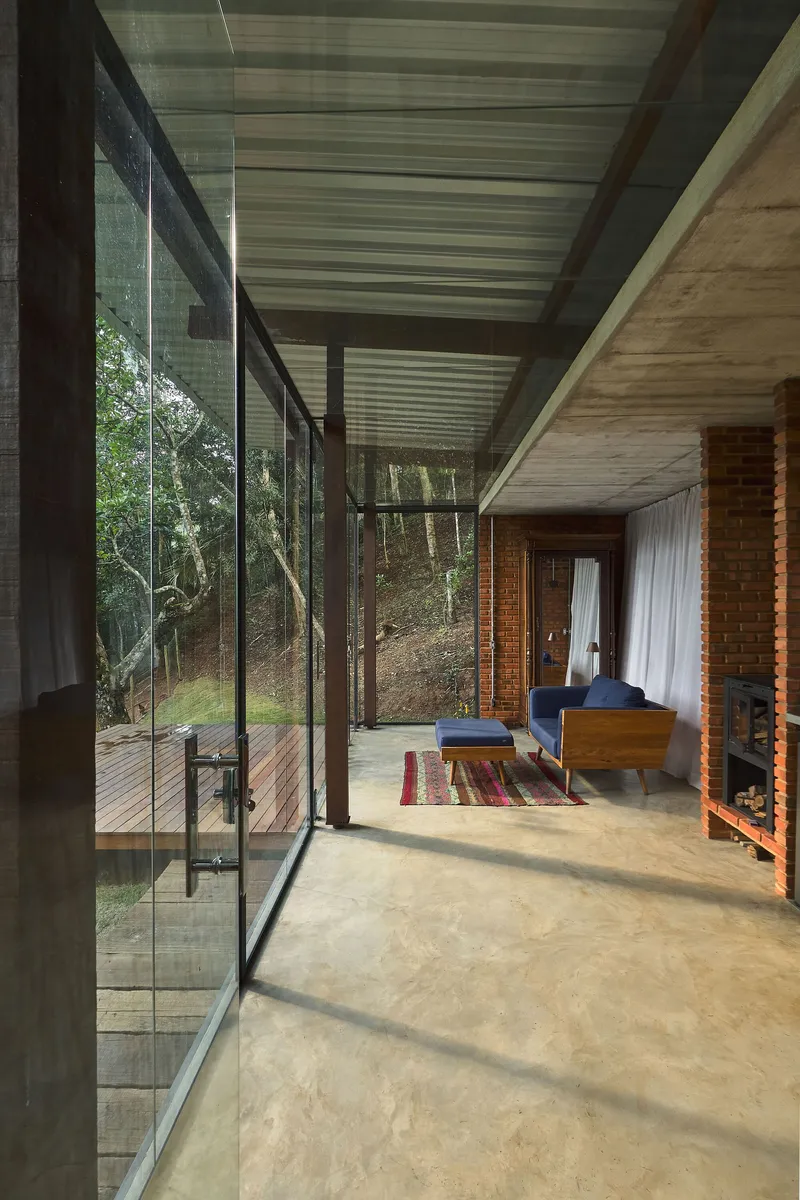
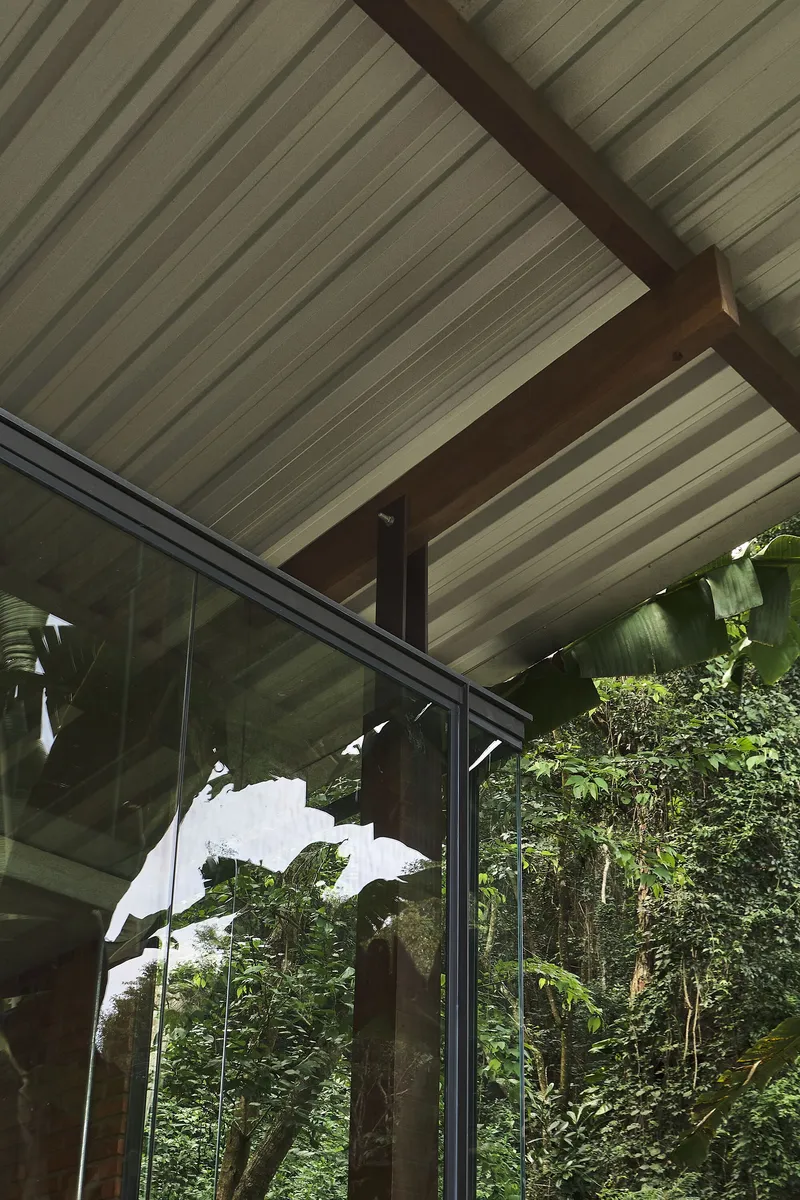
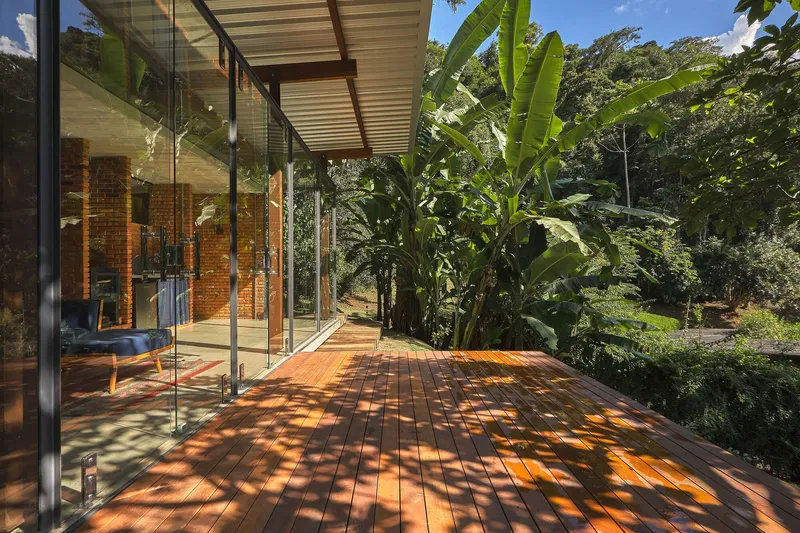
The full-extension glass wall facing the valley is the building's defining gesture. Floor-to-ceiling glazing dissolves the boundary between the living room and the front deck, turning the compact interior into something that feels expansive. The slatted wood ceiling and exposed timber beams run continuously from inside to outside, reinforcing the spatial continuity. Overhead, the deep eaves keep rain and direct sun off the glass, so the wall can remain open in most weather without overheating the interior.
A thin reinforced concrete slab sits beneath the roof panels over the bedroom and bathroom zones, creating a double-layer insulation system. It is a pragmatic detail that solves a real problem: trapezoidal metal roofing radiates heat and amplifies rain noise. The concrete slab intercepts both, giving the sleeping area a quieter, more tempered environment without adding visual bulk.
Dusk and the Lantern Effect
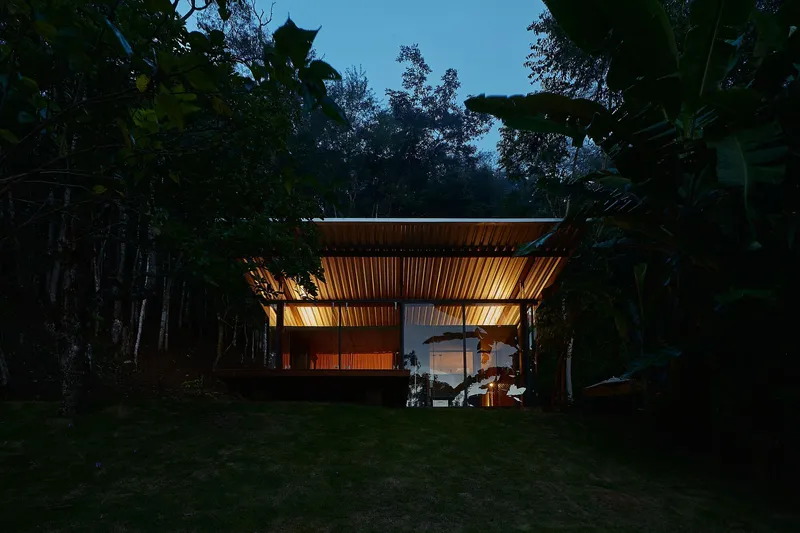
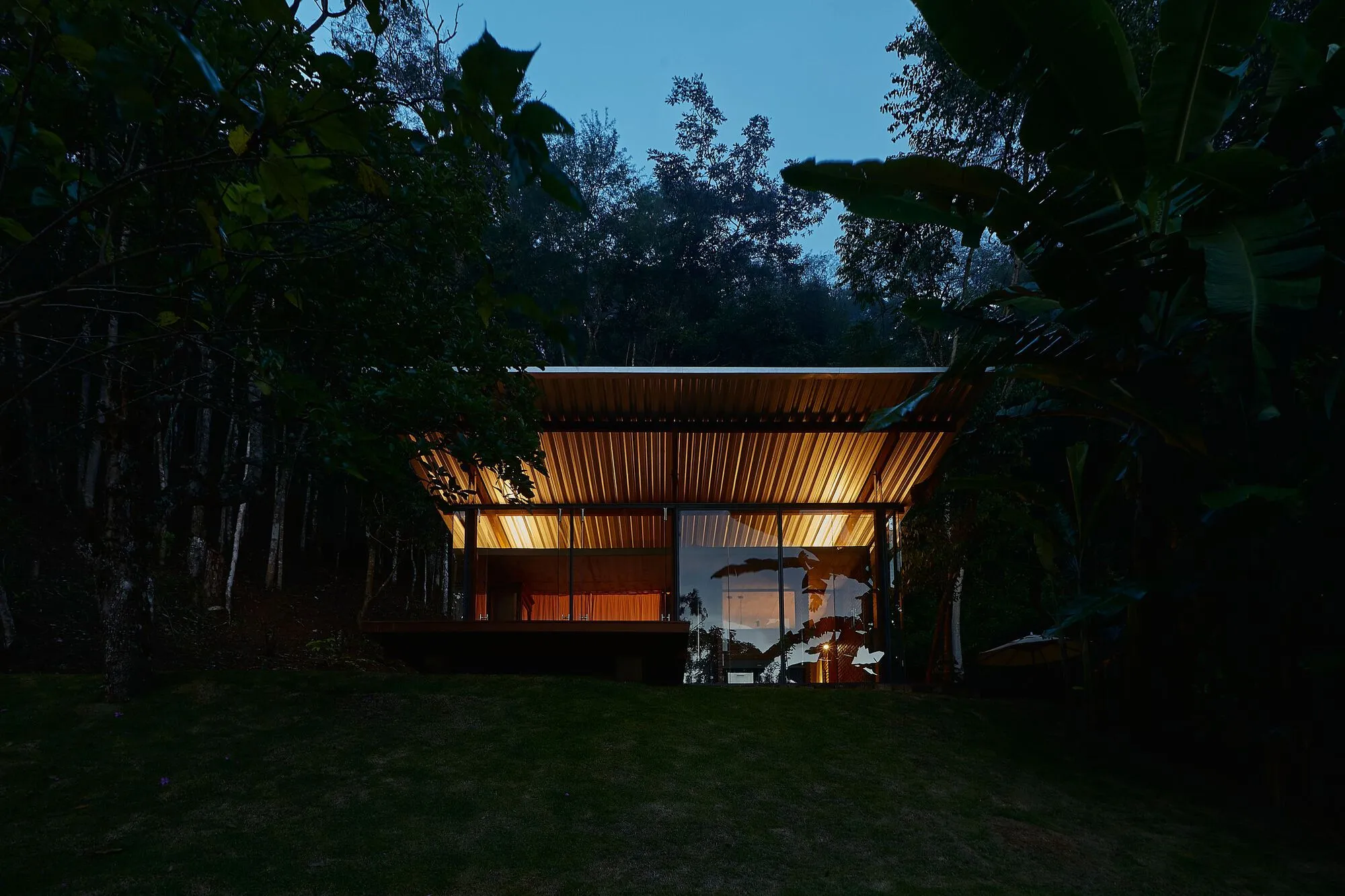
At night, the building inverts. The horizontal timber slat screens that shade the interior during the day become luminous planes, turning Abrigo Alto into a lantern on the hillside. The flat roof hovers as a dark line, and the warm glow from within reveals the structural grid in silhouette. It is a familiar trick in pavilion architecture, but it works here because the proportions are right: the building is just wide and low enough to register as a band of light rather than a point source.
Plans and Drawings

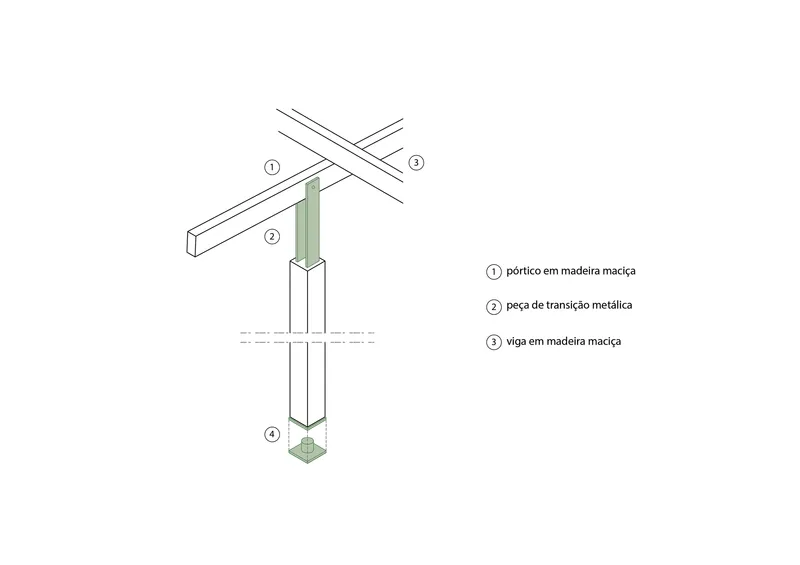
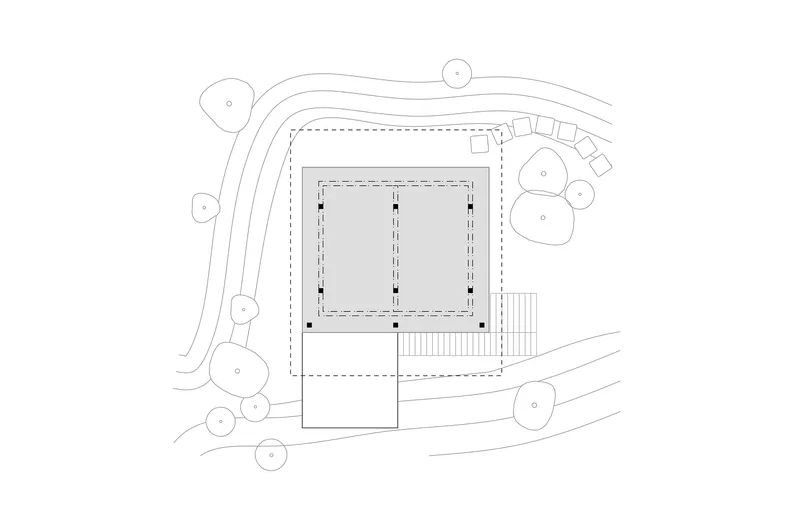
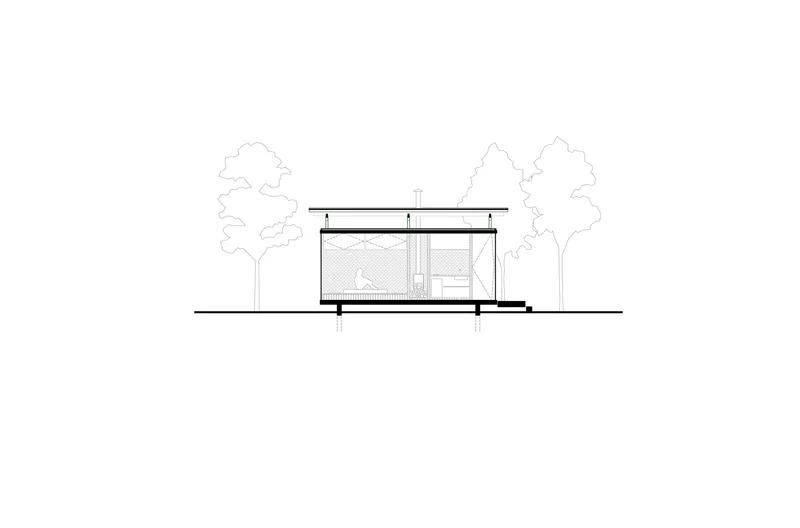
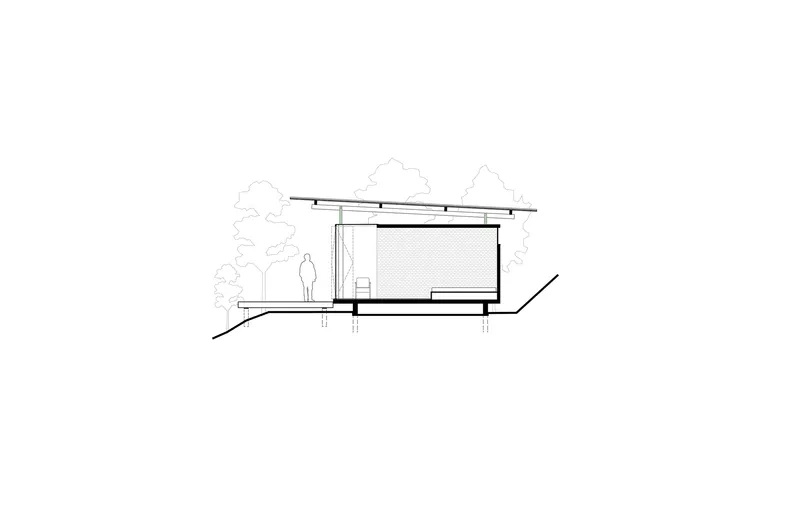
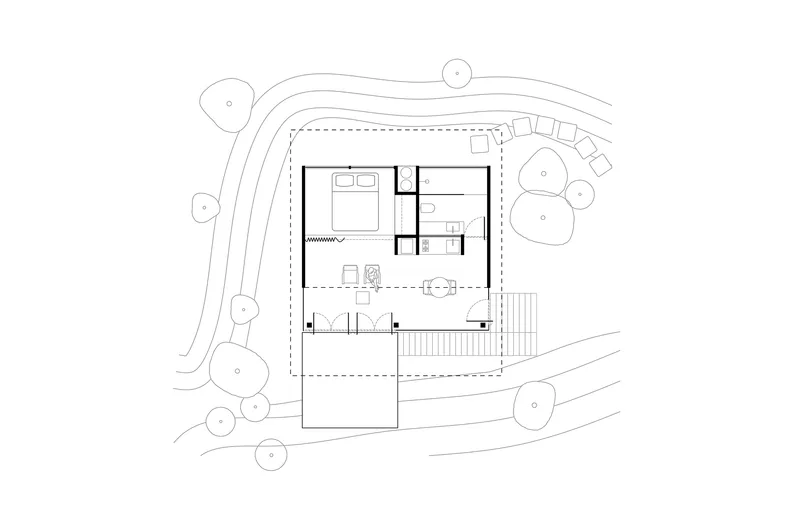
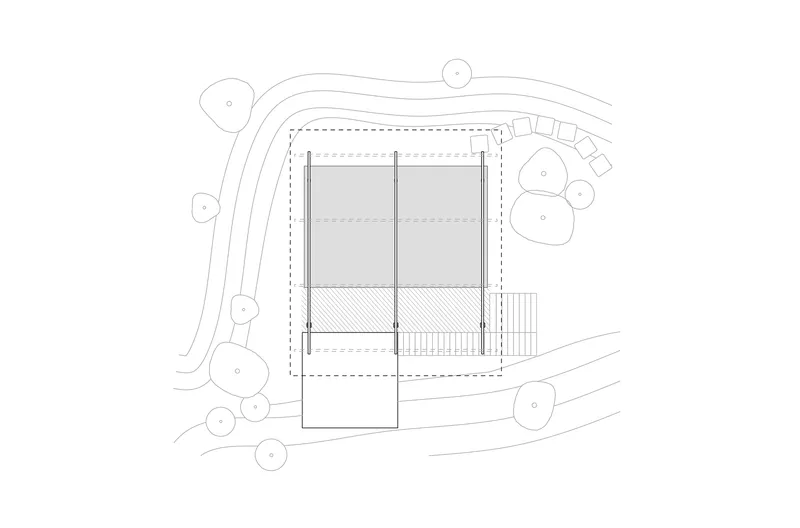
The axonometric drawings reveal the building's construction logic with clarity. Timber columns receive solid wood beams through a metal transition piece, a detail that keeps the joinery clean and the load paths legible. The structural plan shows the column grid that defines the roof perimeter, while the sections illustrate how the single-story volume sits on the slope, its floor plate hovering just above grade on the downhill side. The site plan locates Abrigo Alto within the compound's network of curving pathways and tree canopies, making visible the larger landscape strategy that connects all three buildings on the property.
Why This Project Matters
Abrigo Alto belongs to a growing lineage of Latin American projects that treat the minimal dwelling not as a constraint but as a design brief with its own dignity. By limiting the program to essentials and investing the freed-up budget in material quality and spatial generosity, gru.a demonstrates that 30 square meters of enclosed space can feel genuinely luxurious when the deck, the eaves, and the landscape are treated as extensions of the interior. The building does not apologize for its size.
More importantly, the project offers a replicable construction system. The three buildings in the Vale das Videiras compound share the same structural modules, material palette, and spatial logic, which means the thinking is scalable. In a moment when architecture often celebrates singularity, gru.a makes a quiet case for the value of systematic design: build a kit of parts that works, then deploy it across a site with variations tuned to topography and program. That is a harder problem than designing one striking object, and a more useful one.
Abrigo Alto by gru.a (Pedro Varella and Caio Calafate), located in Araras, Vale das Videiras, Rio de Janeiro, Brazil. 50 m², completed in 2021. Photography by Rafael Salim.
About the Studio
Share Your Own Work on uni.xyz
If projects like this are the kind of work you want to make, uni.xyz is a place to publish your own, find collaborators, and enter design competitions.




Popular Articles
Popular articles from the community

EW PARK: Sustainable Architecture Reimagines the Future of Urban Parking
EW PARK reimagines city parking as a modular wooden tower combining automation, solar energy, electric mobility, and adaptable urban design.

Co-Life: Senior Housing Design That Reconnects Older Adults With the City
Co-Life reimagines senior housing design through healing gardens, shared streets, workshops, and a sustainable community across generations.

Co-life: Sustainable Architecture for Age-Friendly Community Living
Co-life reimagines sustainable architecture for seniors through courtyards, rammed earth, shared gardens, and spaces designed for belonging.

The Earth Pod: 3D Printed Homes for Resilient Refugee Communities
The Earth Pod reimagines refugee housing through 3D printed homes made from clay, combining resilience, self-sufficiency, and rapid shelter.


Similar Reads
You might also enjoy these articles

Bao Huynh Watercolor Atelier: A Serene Art Retreat in Hội An
Bao Huynh Watercolor Atelier in Hội An blends multifunctional art spaces, sustainable design, local materials, and family-friendly living in a serene environment.

Atelier Macri Concept Store Interior Design by CASE-REAL
Atelier Macri store features a "ko" counter, walnut wood details, cork displays, blending retail, gallery, and seamless customer experiences.

Manuel Vargas Izquierdo Stadium and High-Performance Sports Center: Architectural Excellence in Jalpa de Méndez
The Manuel Vargas Izquierdo Stadium blends sustainable design, inclusive sports facilities, and cultural-inspired architecture, revitalizing Jalpa de Méndez’s public spaces.

KAKR Buluh Awar Hall: Revitalizing Community and Ecology Through Bamboo Architecture
Community built bamboo hall revitalizes Buluh Awar village, empowering youth, restoring ecology, celebrating vernacular craftsmanship through sustainable architecture and culture.

Explore Architecture Competitions
Discover active competitions in this discipline


Challenge to design a portable theatre

Challenge to design a portable music platform


Challenge to design an open learning module for the elderly


Challenge to reimagine the Iron Throne
Comments (0)
Please login or sign up to add comments
No comments yet. Be the first to comment!