

Gustavo Utrabo Suspends a Fabric Threshold Between the Trees of a São Paulo Park
Fourteen wooden props and white cloth create a waypoint on the winding paths of Praça Adolpho Bloch in Jardim America, Brazil.


There is a genre of architectural installation that treats the outdoors as a gallery, placing objects in nature and hoping the contrast does the talking. Estúdio Gustavo Utrabo's "Ways To Go Back Home" does something more interesting: it treats the existing landscape as the dominant structure and inserts itself as a lightweight guest. Sited along a curving path in Praça Adolpho Bloch, São Paulo, the 2022 installation uses fourteen wooden props and stretched white fabric to form a translucent pavilion that borrows its ceiling from the canopy above and its walls from the shadows of the branches around it.
What makes the project worth examining is the specificity of its means. The props are lashed together with rope at their apexes, forming tripod frames. Concrete counterweights hang from steel cables to tension the fabric. The whole assembly reads less like a building and more like a navigational instrument, something calibrated to a particular bend in the path, a particular group of trees. It is an architecture of calibration rather than imposition, and the photographs, by Pedro Kok and Gustavo Utrabo himself, capture that register precisely.
Arriving Through the Canopy
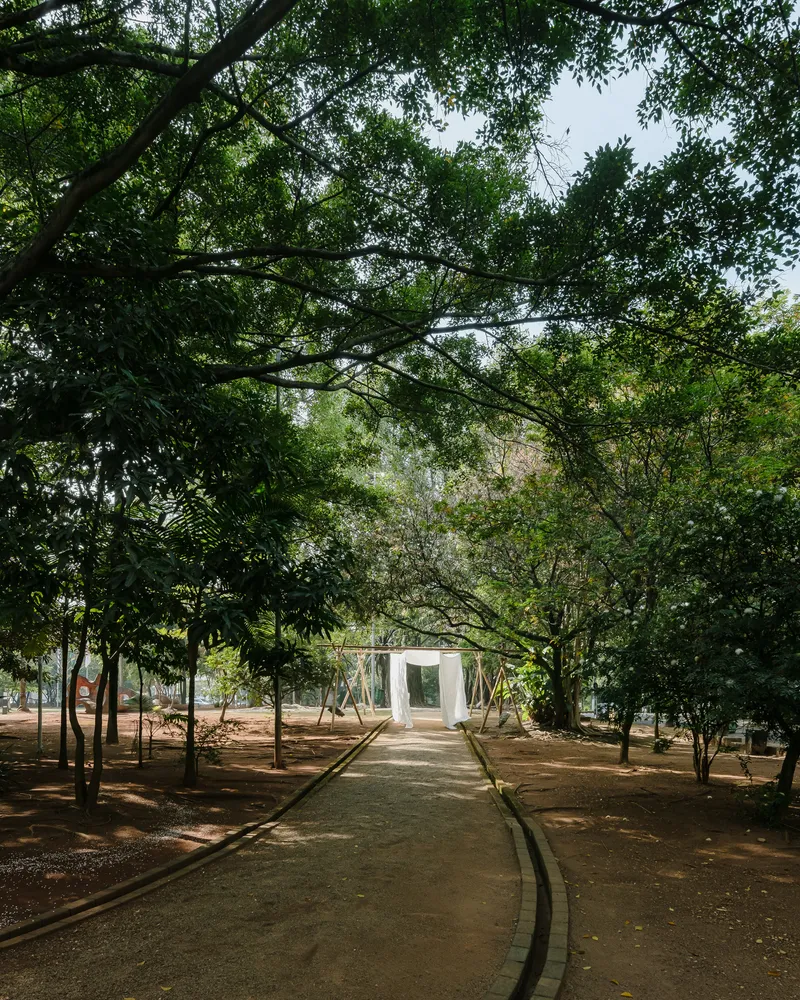

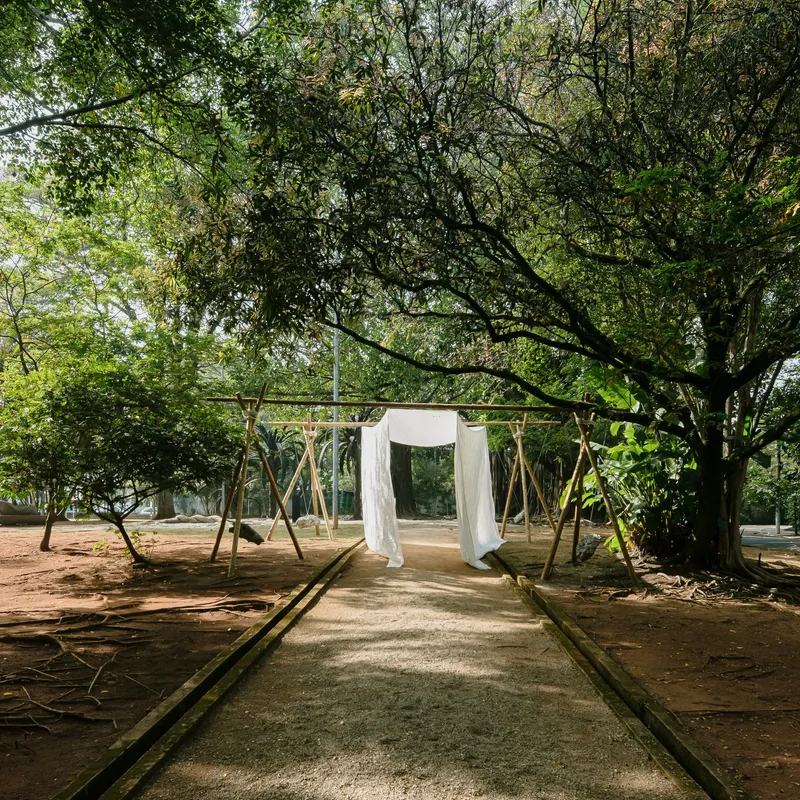
The installation announces itself gradually. From a distance, through the grove of mature trees, it registers as a pale cubic volume, almost indistinguishable from a shaft of light on the ground. The approach is choreographed by the existing path, which curves past exposed banyan roots and dense understory before opening to the clearing. The white fabric does not compete with the foliage; it absorbs its shadows, becoming a secondary surface on which the forest projects itself.
Utrabo understood that the site's real architecture is the canopy. The tall, voluminous treetops create a dappled interior condition at ground level, a room without walls. The installation merely gives that room a momentary threshold, a place where arrival and departure are made tangible.
A Structural Logic of Lashing and Tension
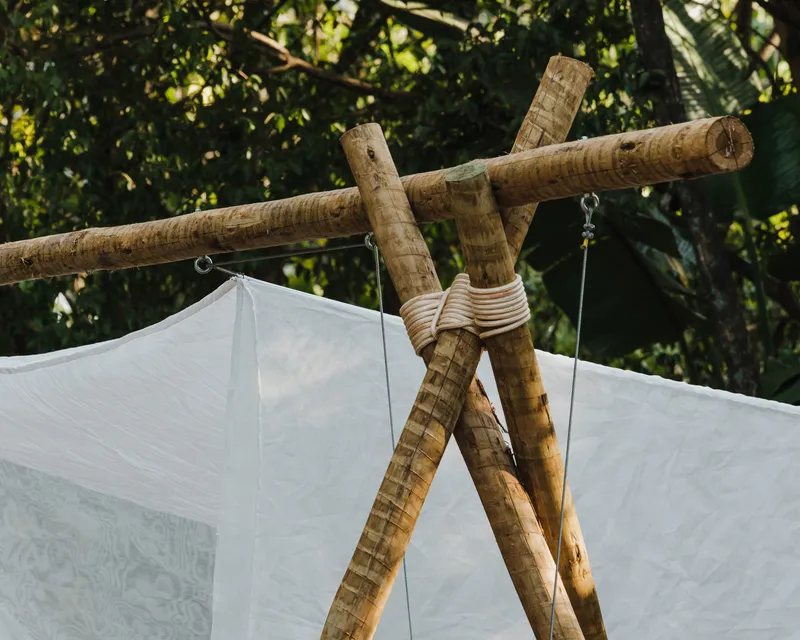


The joints are the project's most telling detail. Bamboo poles are bound at their tops with simple rope lashing, forming triangulated tripods that lean against gravity rather than fighting it. There are no metal brackets, no bolts at the primary connections. The logic is closer to scaffolding or tent-making than to conventional construction, and that is exactly the point. The installation is meant to be reversible, to leave the park as it found it.
The tripod configuration gives the structure lateral stability without requiring foundations. Each frame stands independently, and the fabric spans between them like a membrane stretched across a series of easels. The result is both structurally legible and visually light: you can read every force path from the ground.
Counterweights and Cables

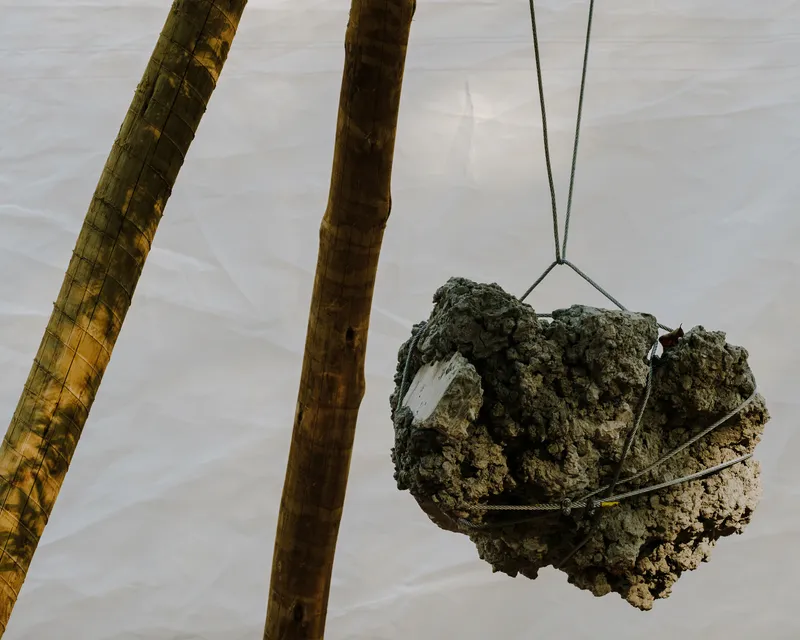
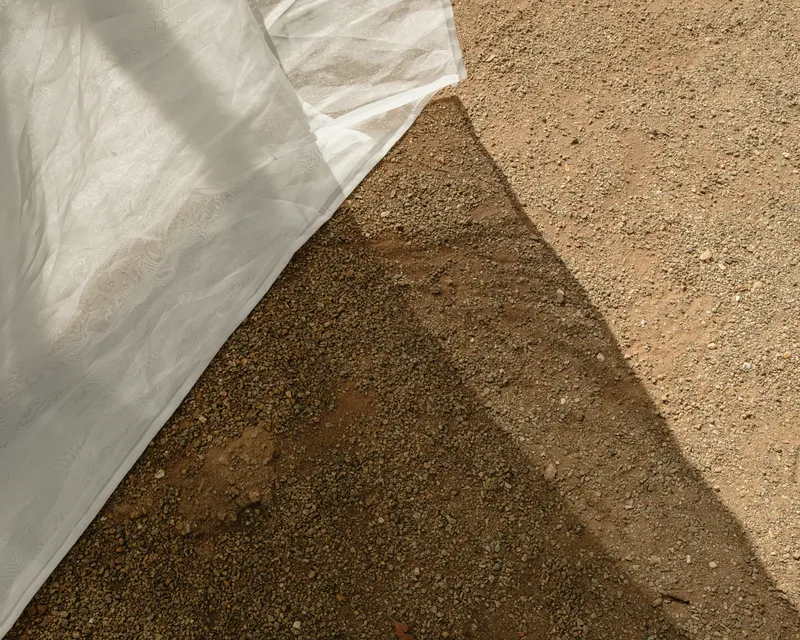
Rough concrete blocks, suspended by steel cables between bamboo poles, act as counterweights to keep the fabric taut. It is a disarmingly honest mechanism. Where a conventional pavilion might hide its tensioning hardware in sleeves or channels, Utrabo leaves the blocks exposed, hanging at eye level against the white backdrop. They function as both structural devices and sculptural markers, small monuments to the fact that architecture is always negotiating with gravity.
The sand surface beneath the canopy picks up the shadow of the triangular formwork, creating a drawing on the ground that shifts with the sun. These incidental patterns are not designed so much as permitted, the result of a system open enough to register the conditions around it.
Fabric as Filter


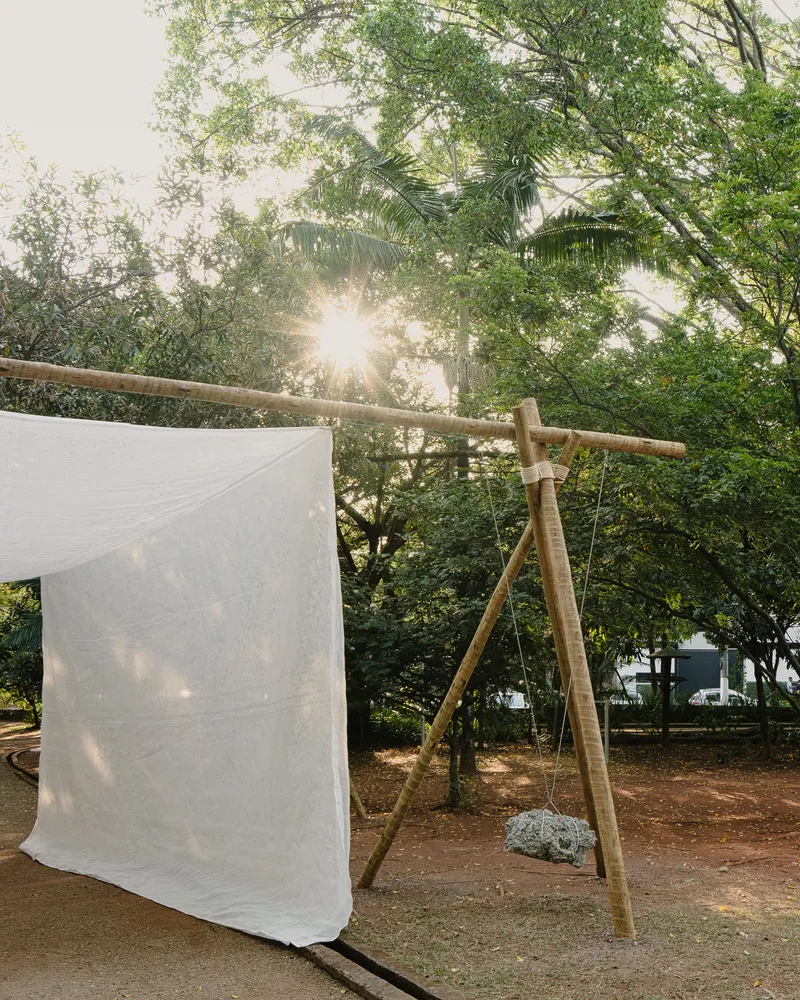
The white fabric works overtime in this project. It is wall, ceiling, and projection screen simultaneously. In afternoon light, tree branch shadows are cast onto its surface with a sharpness that makes them almost photographic. At dusk, the material glows softly against the darkening grove, reversing the figure-ground relationship: the pavilion becomes the light source, the trees become the enclosure.
The translucency of the cloth matters. It never fully separates inside from outside. Figures on the other side of the fabric are visible as silhouettes, and breezes register as gentle ripples across its surface. The installation does not enclose space so much as thicken it, adding a layer of mediation between the visitor and the forest.
Interior Thresholds

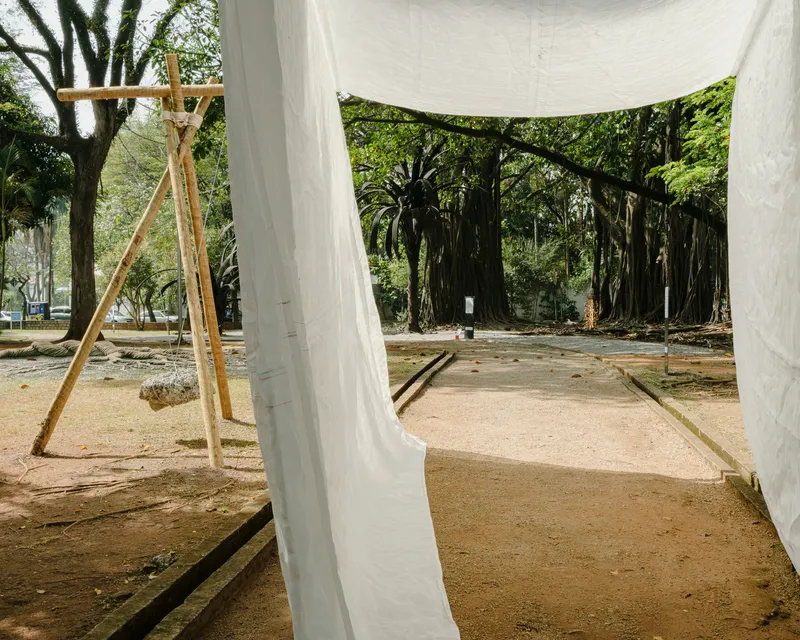

Standing inside the pavilion and looking out, the bamboo frame and fabric edges act as a viewfinder. One image is particularly striking: the interior frames an arched opening formed by two converging tree trunks, creating a doorway that is entirely natural but reads, through the installation's framing, as deliberate architecture. Utrabo is not building a destination; he is building a way of looking.
The sand platform extends the interior condition beyond the fabric boundary, softening the transition between sheltered and exposed ground. Where bamboo poles meet banana leaves against the white ceiling, the collision of cultivated structure and wild growth is made visible and specific. These are not abstract gestures about nature and artifice; they are precise spatial encounters.
The Fabric and the Forest in Dialogue

Seen from a distance in the park clearing, the pavilion has the proportions of a small chapel or a roadside shrine. Its white surfaces and triangulated frame recall vernacular tent structures, but the precision of its placement, at a specific curve in the path, beneath a specific group of trees, elevates it from generic object to site-specific instrument. The dappled light passing through the canopy above creates a constantly shifting pattern on the fabric, so the installation never looks the same twice.
Plans and Drawings
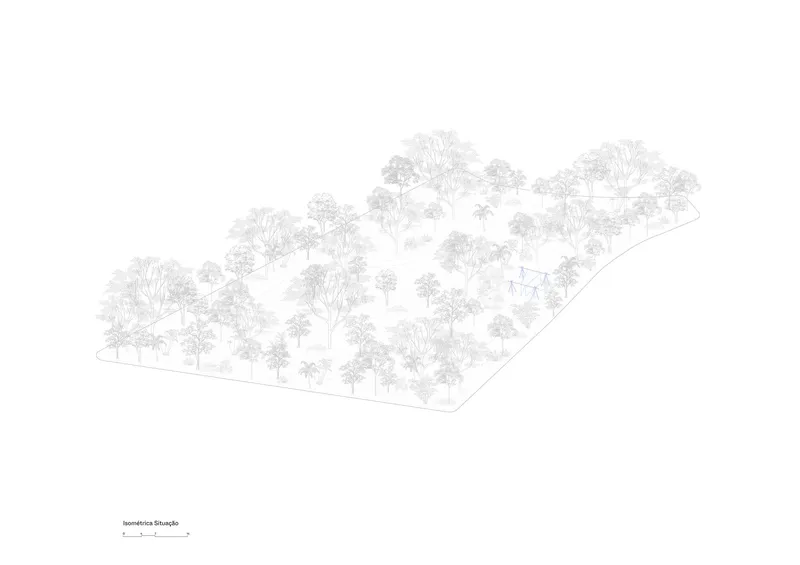


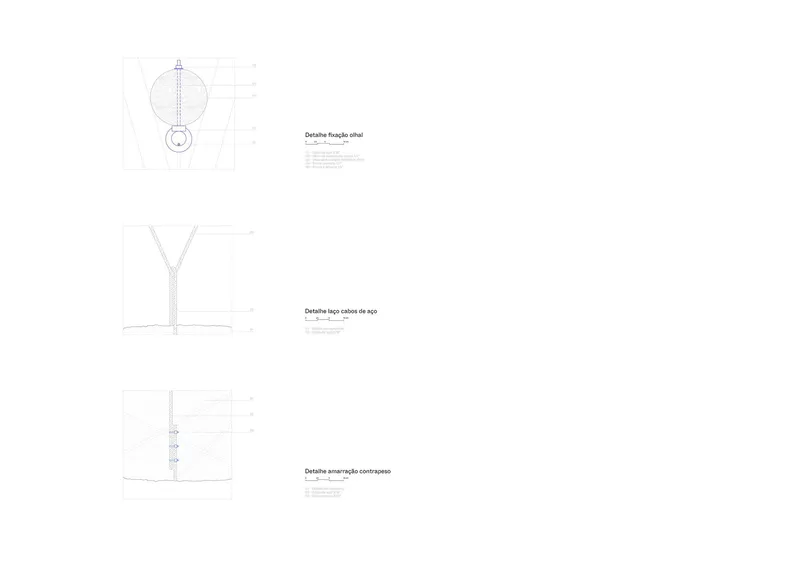
The drawings reveal what the photographs only hint at: the precise relationship between the installation and the surrounding trees. The axonometric views show the pavilion as a small clearing within a dense scatter of trunks, and the plan drawings depict the tripod structures connected by cable systems strung between canopy layers. The elevation drawings make clear how the A-frame geometry mirrors the upward taper of the surrounding trees, creating a formal sympathy between structure and site.
The technical detail drawings of the connection points are worth studying. They show how timber columns meet cable assemblies at discrete nodes, each one resolved with a minimum of hardware. The system is designed to be assembled and disassembled without specialized tools, reinforcing the installation's status as a temporary guest in a permanent landscape.
Why This Project Matters
Temporary installations often mistake ephemerality for license, treating lightness of construction as permission for looseness of thought. "Ways To Go Back Home" is the opposite: a tightly resolved system in which every element, from the rope lashing to the concrete counterweights, has a legible purpose. The project demonstrates that an installation can be both structurally rigorous and atmospherically generous, that precision and poetry are not competing ambitions.
More broadly, the project makes a case for architecture as a form of attention. Gustavo Utrabo did not design a pavilion and then look for a place to put it. He read a specific landscape, identified a moment along a path where the canopy, the ground, and the movement of people converged, and built the minimum structure necessary to make that convergence visible. The title suggests homecoming, and the installation delivers on the promise: it turns a walk through a park into an act of recognition, a way of seeing what was already there.
Ways To Go Back Home Installation by Estúdio Gustavo Utrabo, lead architect Gustavo Utrabo. Praça Adolpho Bloch, Jardim America, São Paulo, Brazil. Completed 2022. Photography by Pedro Kok and Gustavo Utrabo.
About the Studio
Share Your Own Work on uni.xyz
If projects like this are the kind of work you want to make, uni.xyz is a place to publish your own, find collaborators, and enter design competitions.


Popular Articles
Popular articles from the community


Temporary Home for Dogs: A Reversed Zoo Rethinks Animal Shelter Architecture
In Bucharest, a sinuous corridor and freed landscape flip the logic of containment, designing a shelter that works to make itself unnecessary.

Manzana Morphosis: Stretching Barcelona's Grid into a Living Landscape for 2050
A radical reworking of the Eixample manzana turns density into a tool for generous public space, vertical ecology, and environmental performance.

Tsunami Convergenics: Turning Catastrophic Ocean Forces into Underwater Housing Infrastructure
A speculative underwater settlement off the coast of Onagawa, Japan, treats tsunamis and typhoons as energy sources rather than threats.

Singing Woman: An Opera House That Performs Before the Curtain Rises
Ovidiu Cristian Pavel's conceptual opera house translates Estonia's choral identity into a sculpted waterfront landmark facing the Baltic Sea.

Similar Reads
You might also enjoy these articles

Pixel Gardens: One Repeated Module Stacked Into a Terraced Social Housing Tower for Famagusta
Salem Bader's shortlisted housing tower builds a vertical neighbourhood from one repeated module, offsetting units to carve terraces, light and air.

Bao Huynh Watercolor Atelier: A Serene Art Retreat in Hội An
Bao Huynh Watercolor Atelier in Hội An blends multifunctional art spaces, sustainable design, local materials, and family-friendly living in a serene environment.

Atelier Macri Concept Store Interior Design by CASE-REAL
Atelier Macri store features a "ko" counter, walnut wood details, cork displays, blending retail, gallery, and seamless customer experiences.

Manuel Vargas Izquierdo Stadium and High-Performance Sports Center: Architectural Excellence in Jalpa de Méndez
The Manuel Vargas Izquierdo Stadium blends sustainable design, inclusive sports facilities, and cultural-inspired architecture, revitalizing Jalpa de Méndez’s public spaces.

Explore Installations Competitions
Discover active competitions in this discipline

Challenge to design a portable theatre

Challenge to design a portable music platform

Challenge to design an open learning module for the elderly

Challenge to design mud housing for contemporary communities
Comments (0)
Please login or sign up to add comments
No comments yet. Be the first to comment!