
haascookzemmrich Wraps a Fairy Tale in Timber and Brick at the Rapunzel Visitor Centre
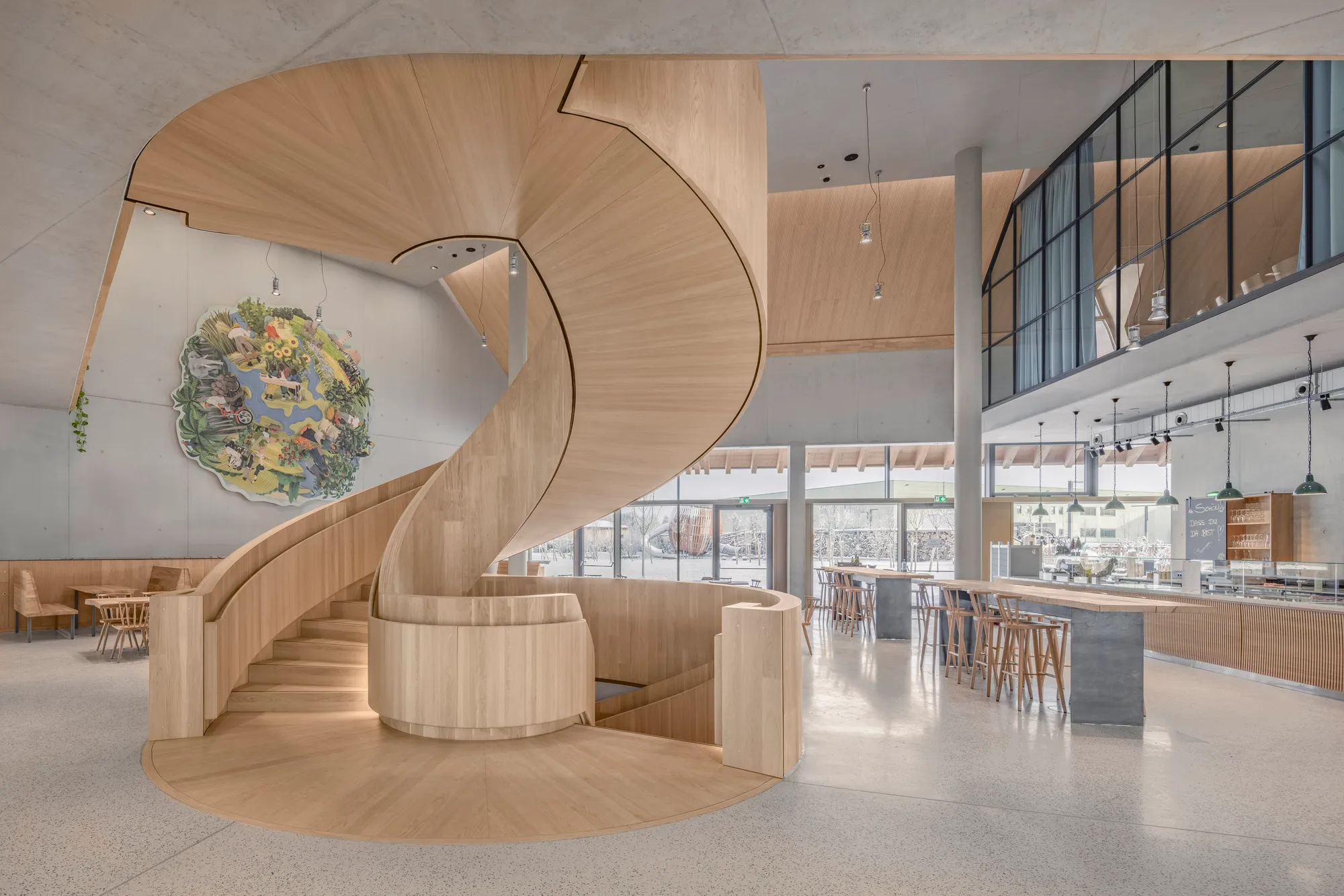
A five-story walk-in sculpture in rural Bavaria houses a bakery, roastery, and 14.5-meter timber spiral staircase inspired by Rapunzel's braid.


Corporate visitor centers rarely earn the label "building sculpture," but the Rapunzel Visitor Centre in Legau, Bavaria, designed by haascookzemmrich STUDIO 2050, is difficult to categorize any other way. Rising from a rural Allgäu landscape as a Y-shaped mass wrapped in playfully offset shingles and textured engobe brick, the 7,560 square meter complex is at once a brand flagship for organic food company Rapunzel Naturkost and a piece of inhabitable topography, its roofs planted and walkable, its courtyard threaded with curving garden paths that extend the surrounding countryside right over the building itself.
What makes the project genuinely remarkable, though, is the commitment to material logic. Every design decision, from the 12-tonne self-supporting timber spiral staircase at the core to the foam glass gravel insulation underfoot, filters through a Cradle to Cradle lens. Nearly every craft business involved in construction sits within a short drive of the site. The building was completed in 2022 after three years of construction, and it functions as bakery, organic market, coffee roastery, training center, yoga studio, and exhibition space across five floors, all connected by that singular helical stair.
A Roofscape That Becomes Landscape
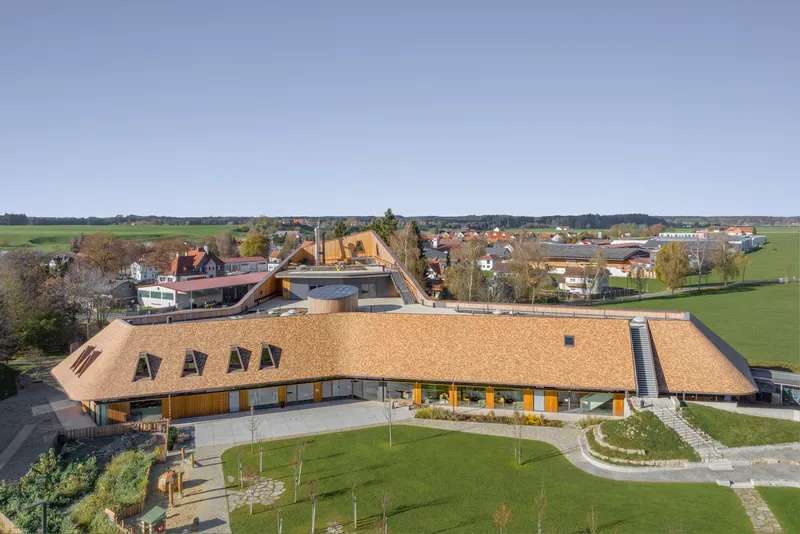
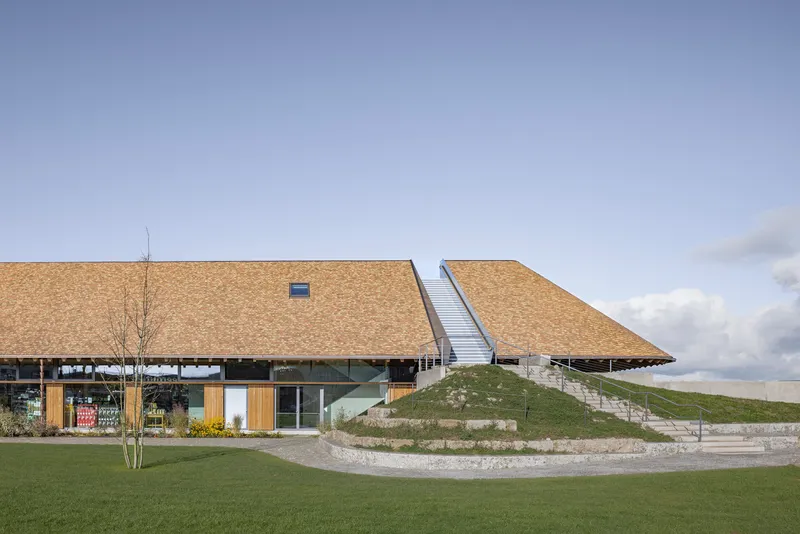
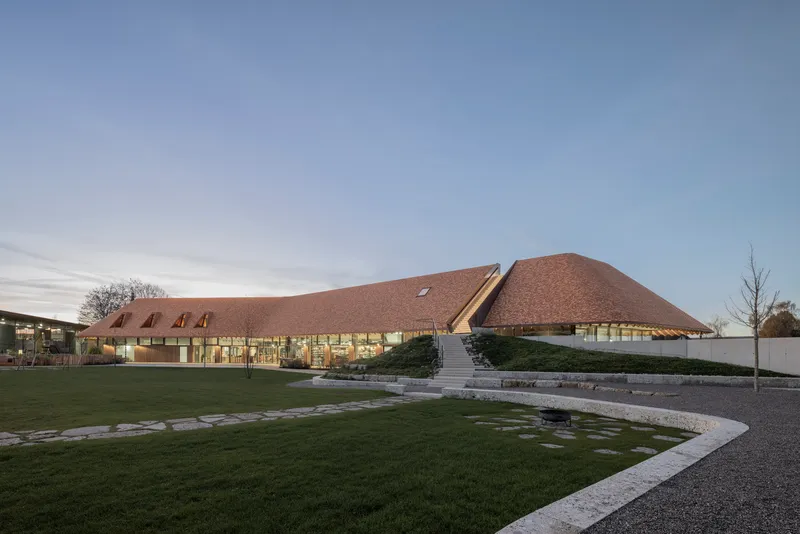
From the air, the building reads as a cluster of oversized, shingle-clad barns dropped into the Bavarian village fabric. Dormers puncture the undulating roof, and a planted green layer connects the two main volumes so that the boundary between architecture and garden dissolves. The northern high point, dubbed the Rapunzel Tower, serves as the address-forming element, visible from surrounding streets and fields. The large floating roof wraps around the visitor center like a band, its cantilever providing passive shading that reduces the need for mechanical cooling.
A roof terrace at the top offers views toward the Alps, completing the idea that the building is not a box to enter but a terrain to climb. This is landscape strategy as architectural strategy: the fairy tale garden surrounding the house extends physically onto the roof, making the section as important as the plan.
Two Skins: Shingle and Brick
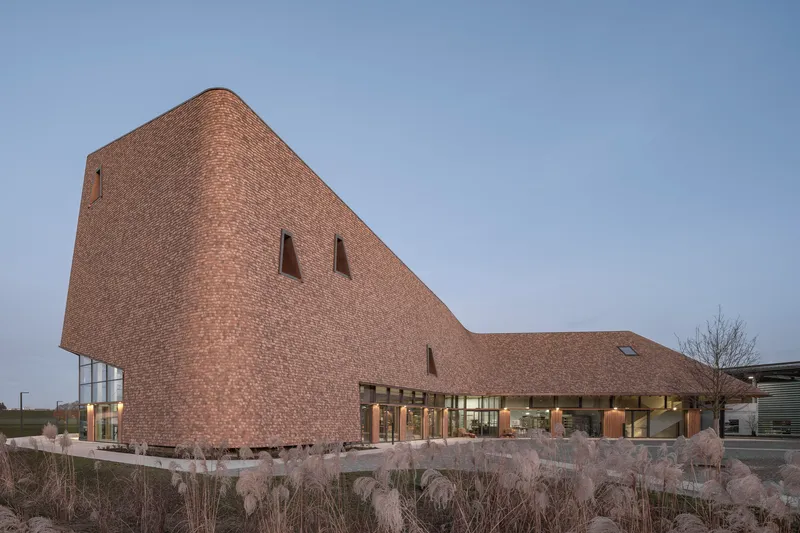
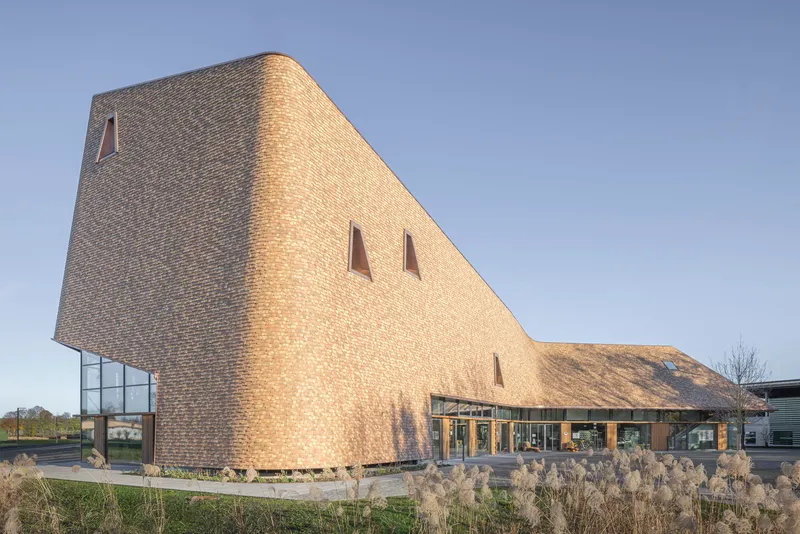
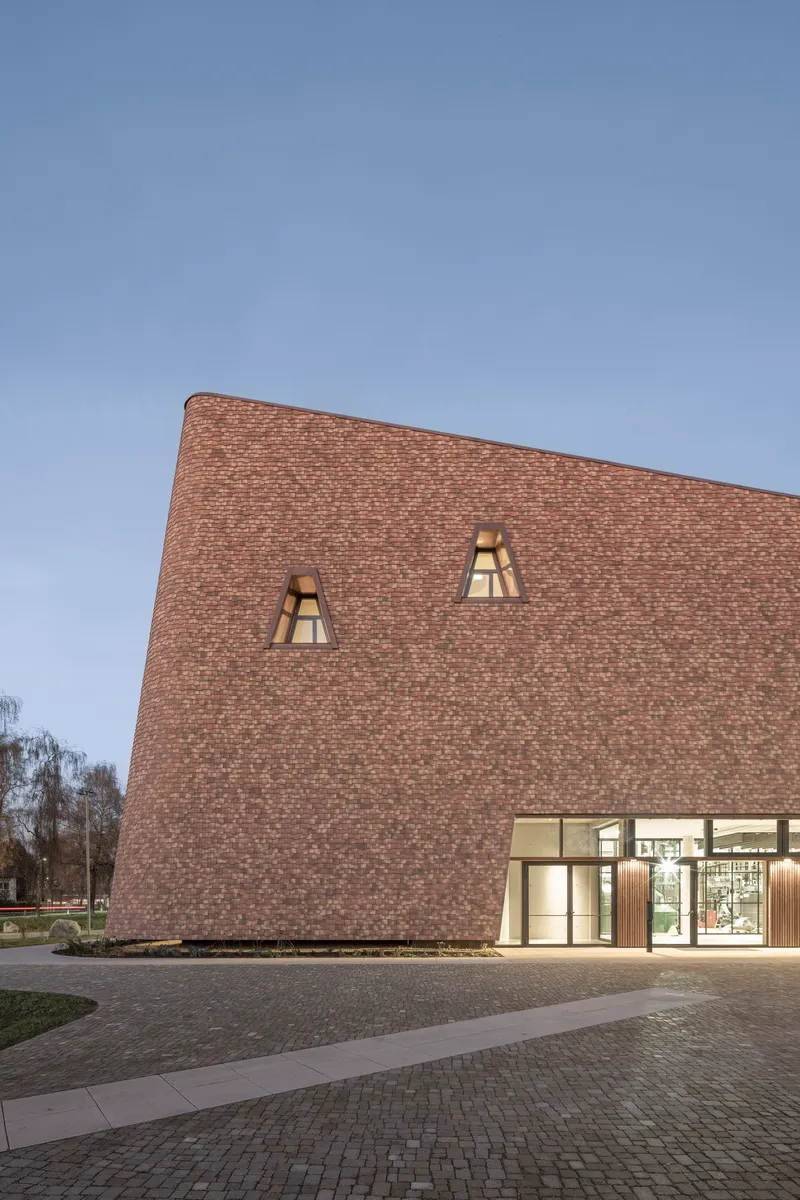
The exterior splits into two distinct material characters. The upper volumes are clad in light-colored roof tiles arranged in playfully offset rows, their surface catching raking light and creating a scaled, almost textile quality. Below and alongside, faceted walls of engobe brick sourced from old Swiss kilns present a warmer, earthier tone. Trapezoidal and triangular window openings are cut into both surfaces, their splayed reveals giving depth to what could otherwise be flat planes.
The contrast is deliberate. The shingles reference vernacular Allgäu construction while the brick anchors the base with weight and warmth. At dusk, illuminated windows turn the brick volume into a lantern, and the glazed ground floor recedes, making the upper mass appear to float. All materials, colors, and coatings are mineral-based, consistent with the studio's commitment to biological material cycles.
The Ground Floor as Public Stage
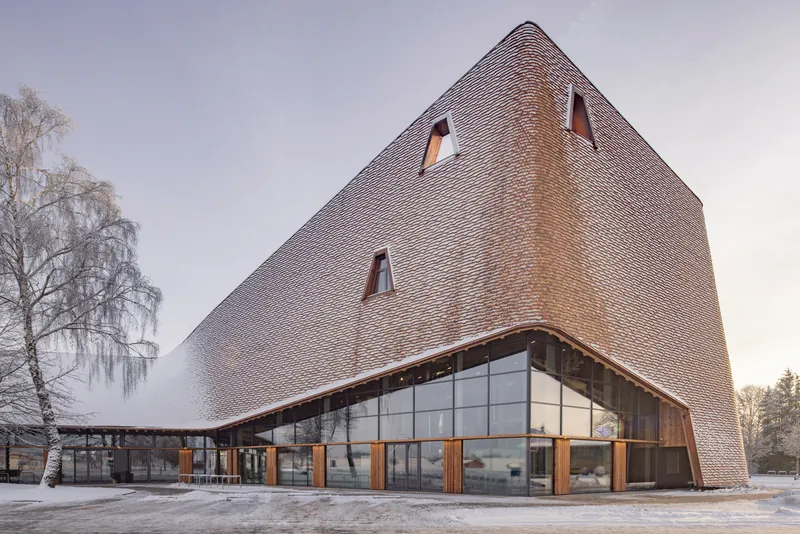
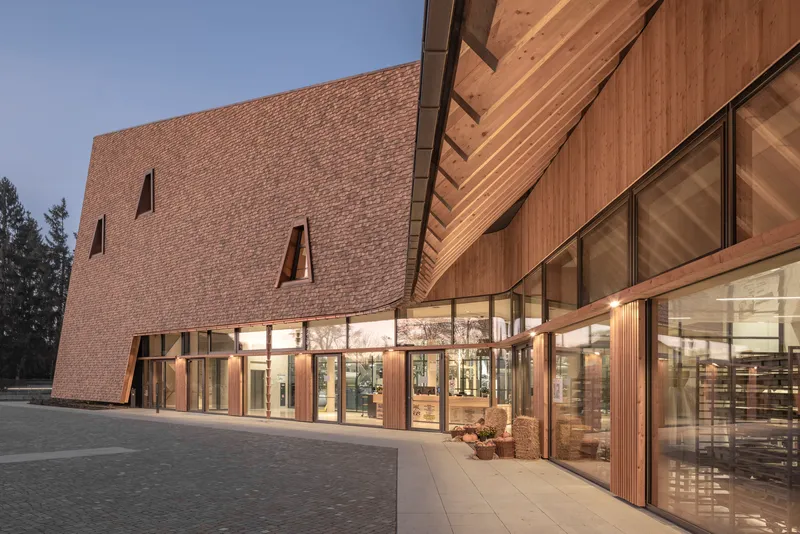
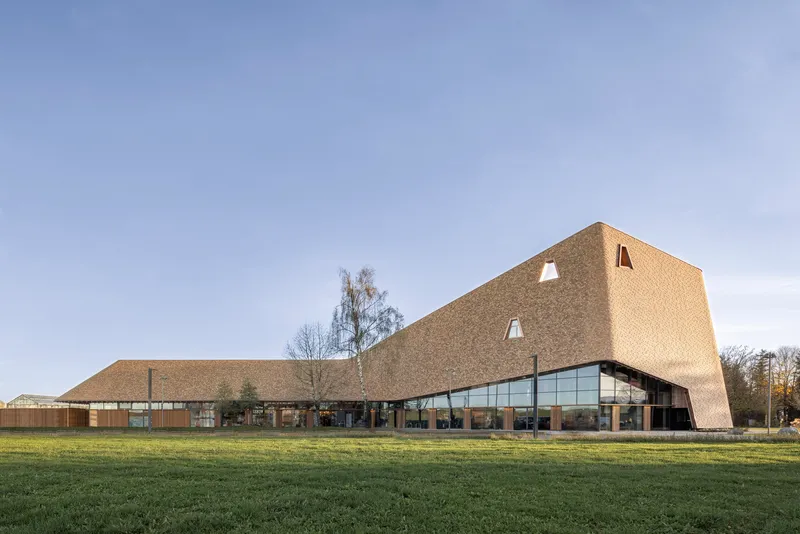
Two equal entrances feed visitors into the building through a glazed ground floor that reads as an open vitrine. The glass facade pulls daylight deep into the plan, and the tilted shingled volume overhead creates a sense of sheltered compression at the threshold before the interior opens up. Timber cladding at the entrance soffit warms the transition, while a birch tree visible through the glass in winter anchors the seasonal connection between inside and outside.
Programmatically, this level houses the bakery and organic market, the building's most public functions. Visitors can observe the coffee roastery in action, watch bread being baked, and browse products before ascending. It is a smart inversion of the typical museum sequence: commerce and production come first, and the exhibition and contemplative spaces sit above.
The Braid: A 14.5-Meter Timber Spiral
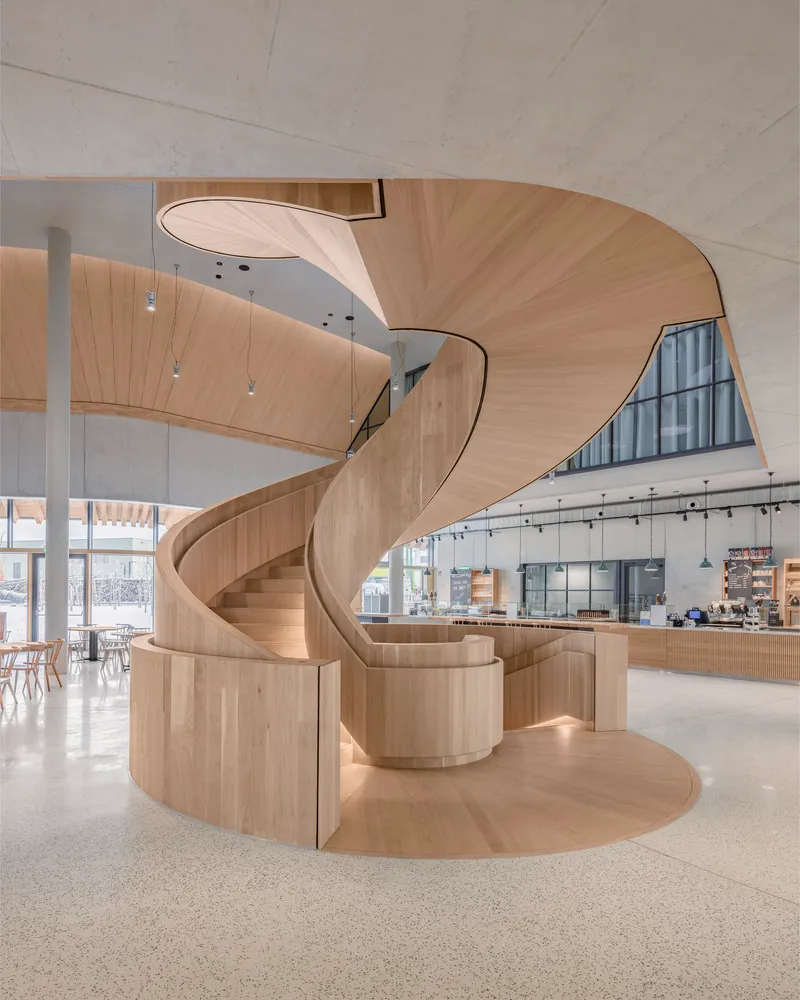
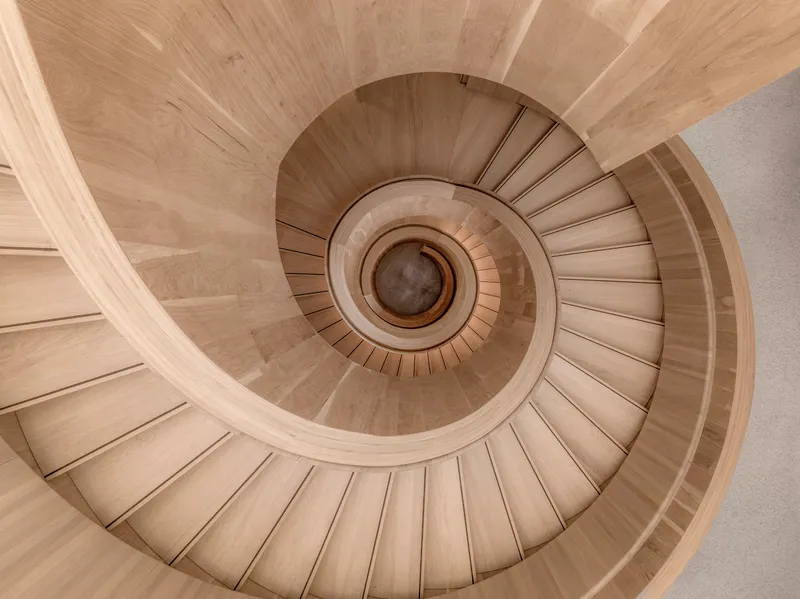
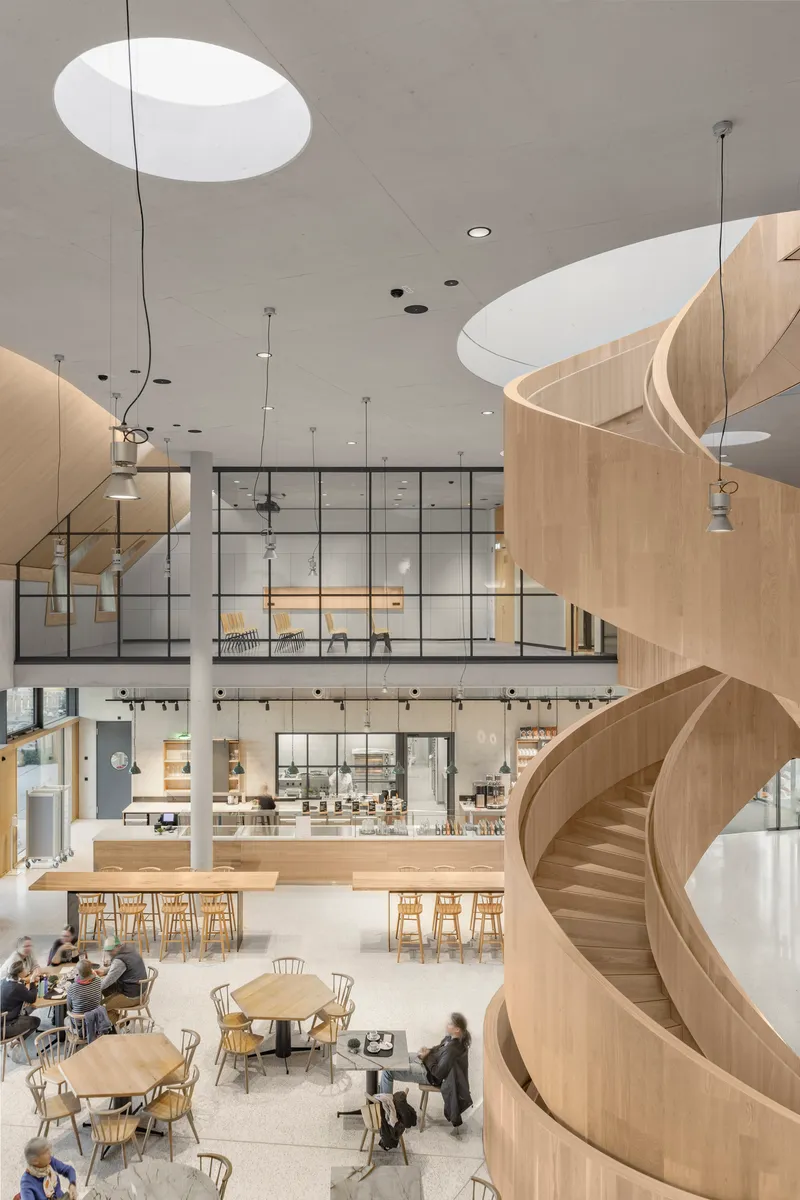
The building's signature element is its triple-spiral staircase, a 12-tonne, 14.5-meter-high structure built entirely of timber with no steel reinforcement. The stair's stringers, made of curved laminated veneer lumber at 15 centimeters thick, double as the balustrade and the primary load-bearing element. Platforms of oak and spruce veneer layers, oriented in alternating directions, connect rigidly to the concrete core via slotted sheet connections. The result is a self-supporting helix that connects every level from the wine cellar to the roof terrace.
The engineering is hidden in the craft. Individual segments of up to eight stages were prefabricated: veneers glued to molds, then shaped with CNC milling before assembly on site. Viewed from below, the spiral reads as pure geometry, its pale timber treads winding around a central void capped by circular skylights. It is explicitly inspired by Rapunzel's braid from the Brothers Grimm tale published in 1812, and the metaphor works because the structure itself is genuinely braided: three intertwined runs, each legible, each dependent on the others.
Interior Atmosphere: Concrete, Timber, Light
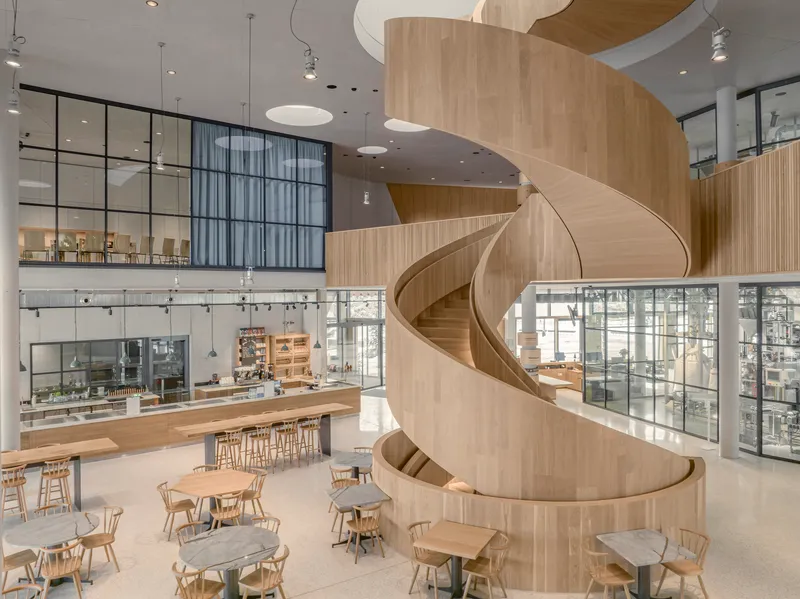
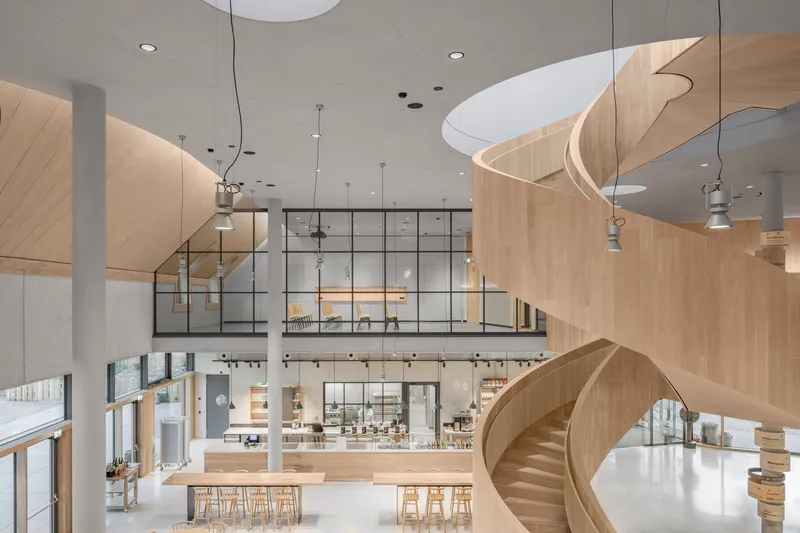
Inside, the palette narrows to exposed concrete, pale timber, and glass. The double-height atrium around the staircase serves as the building's social heart, with café seating tucked beneath the spiraling treads. Steel-framed glazing at the mezzanine level creates transparency between floors, allowing views across the atrium and out to the courtyard. Mechanical air conditioning is largely dispensed with; the building relies instead on natural ventilation, staggered roof windows, and the site's microclimate.
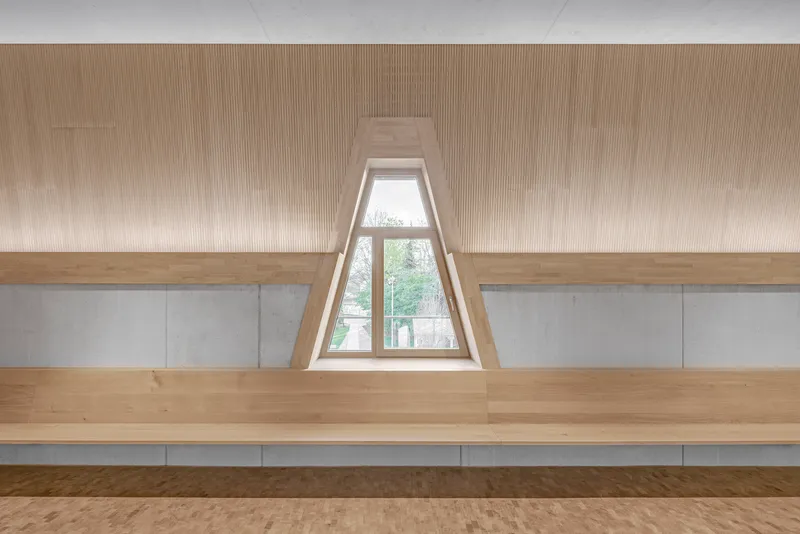
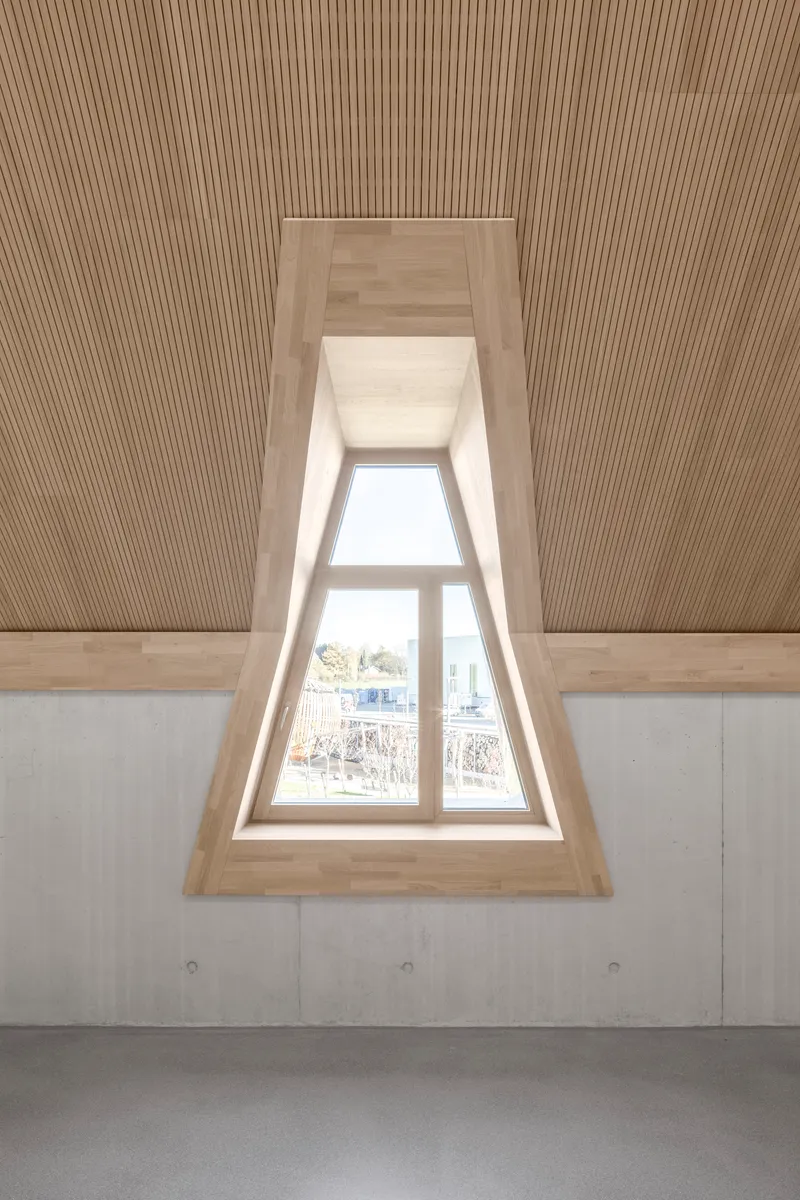
Triangular dormer windows, lined in timber, push recessed seats into the roof thickness. These reading-nook-like alcoves frame specific views of the surrounding trees and garden, turning window openings into inhabitable thresholds. The ribbed timber ceiling overhead unifies the upper rooms, while bare concrete walls below accept the character of the structure honestly. Building services are reduced to a necessary minimum, and the project achieves KfW Efficiency House 40 standard.
Gathering Rooms Under the Roof
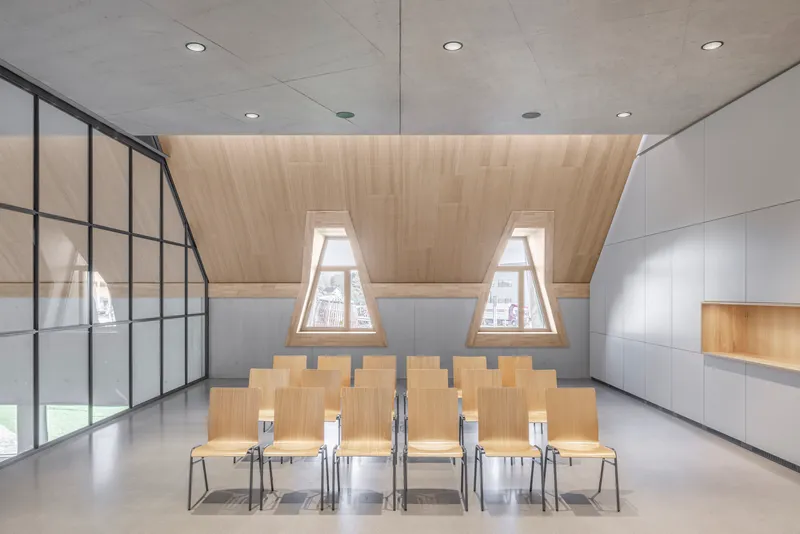
The upper floors house training rooms and a yoga studio beneath ribbed timber ceilings that follow the slope of the roof. Rows of plywood chairs in the assembly room recall a modest village hall more than a corporate conference center, and the triangular dormers provide both daylight and acoustic variety by breaking the ceiling plane. It is a space that refuses to be generic.
These rooms demonstrate the building's quieter ambition: to be a daily workplace and community space, not just a showpiece for visiting tourists. The detail of a recessed triangular window framing a cluster of trees, with a simple timber bench set into the concrete reveal, captures that balance between spectacle and utility. The fairy tale narrative never overwhelms the functional program.
Courtyard and Winter Character
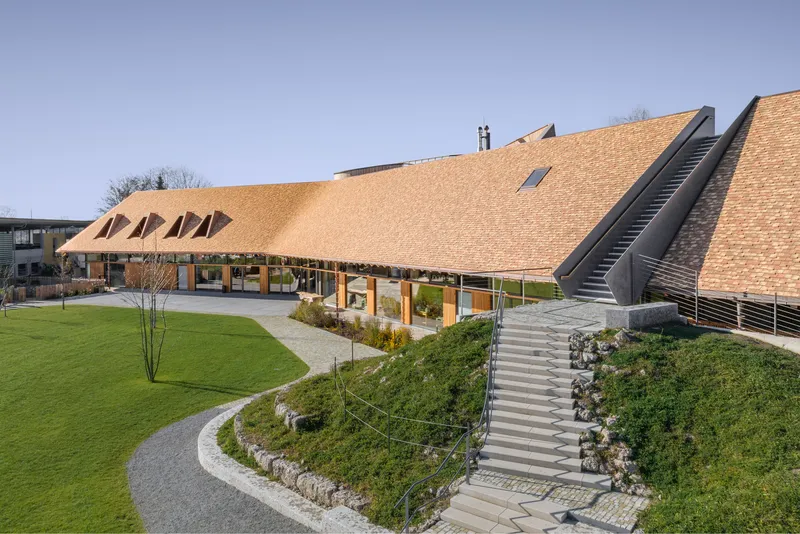
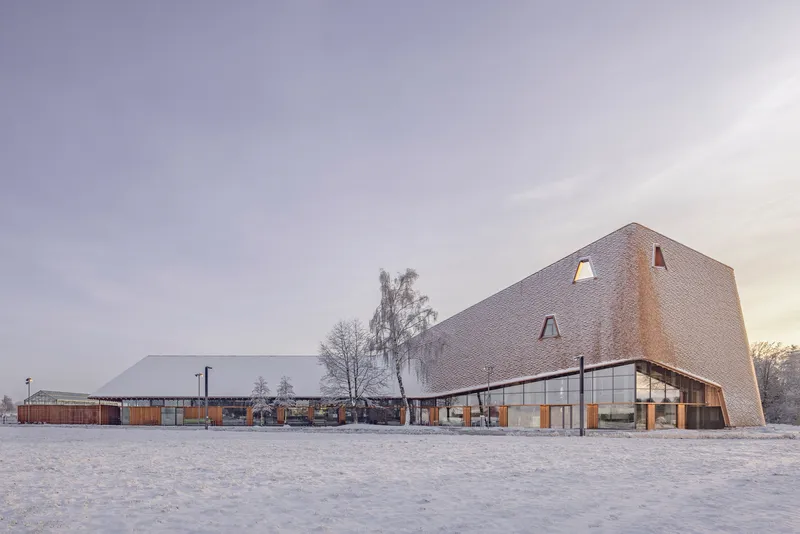
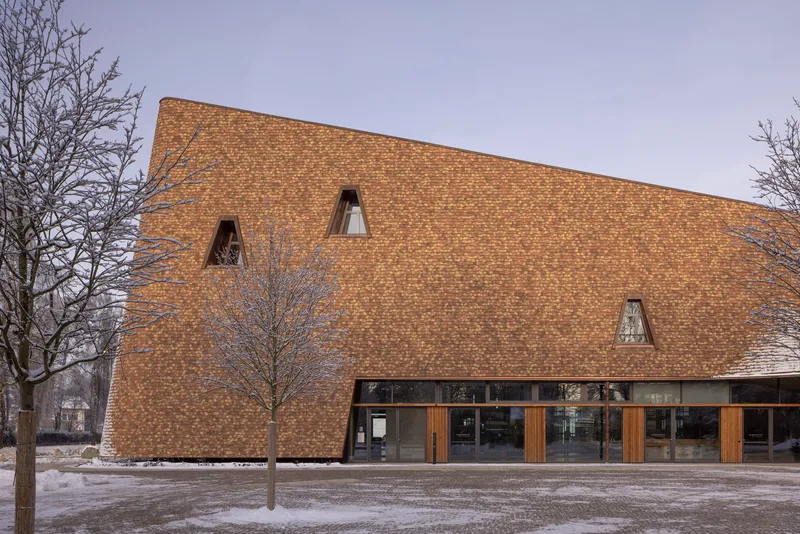
The courtyard at the center of the Y-shaped plan acts as an outdoor room, its curved paths and wide steps leading visitors toward the planted roofs above. In summer it is a garden; in winter, with snow covering the plaza and bare trees silhouetted against the brick facades, it becomes something starker and more sculptural. The building looks equally convincing in both seasons, which is a real test of material honesty. Copper downpipes shaped as interlocking pots, one of several subtle fairy tale details, catch meltwater and rain alike.
The courtyard also reveals the building's local supply chain in physical terms. The gravel underfoot came from a neighboring quarry. The timber framing the entrances was milled by a carpenter ten minutes away. The glass was fabricated seventeen minutes down the road. This hyper-local sourcing is not a marketing footnote; it is a design constraint that shaped the palette, the detailing, and ultimately the character of the building.
Plans and Drawings
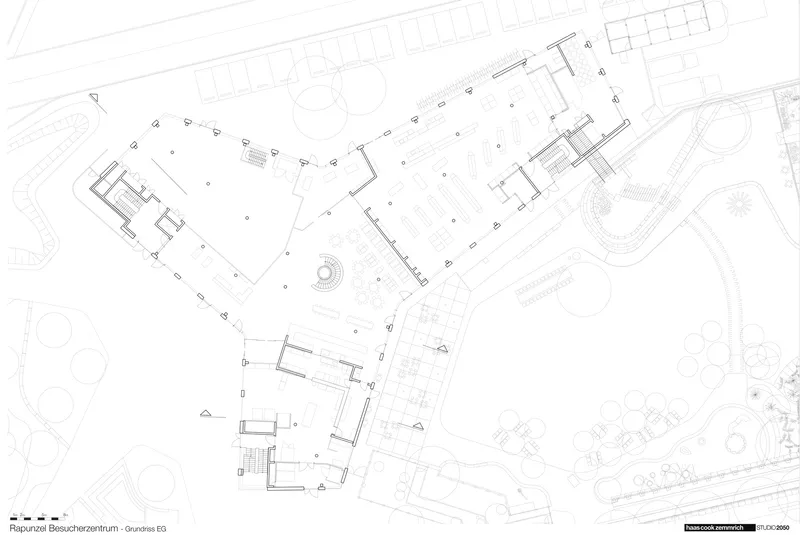
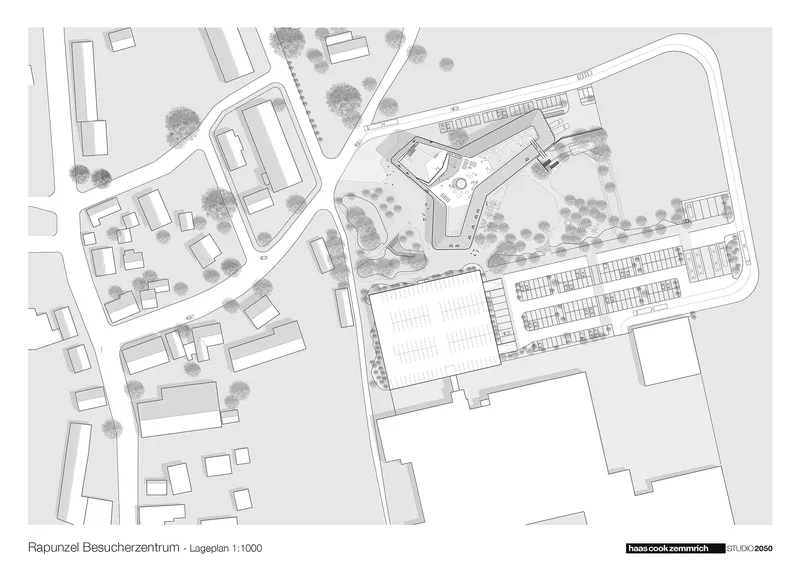
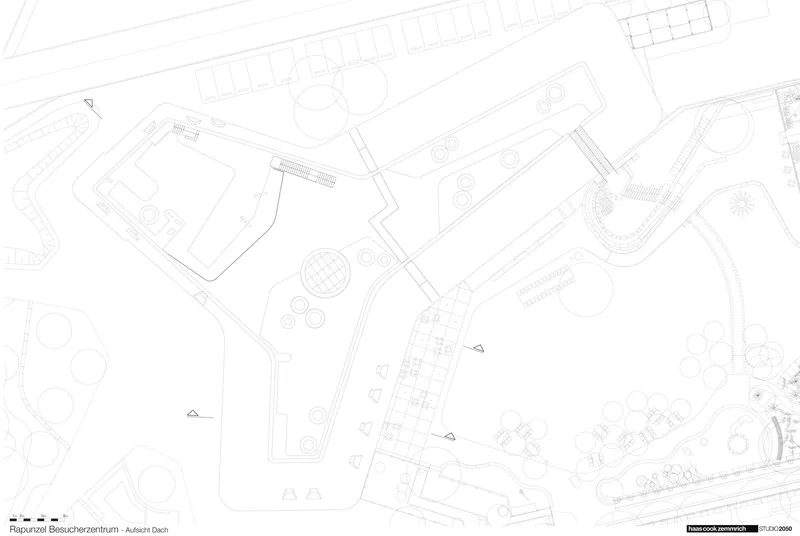
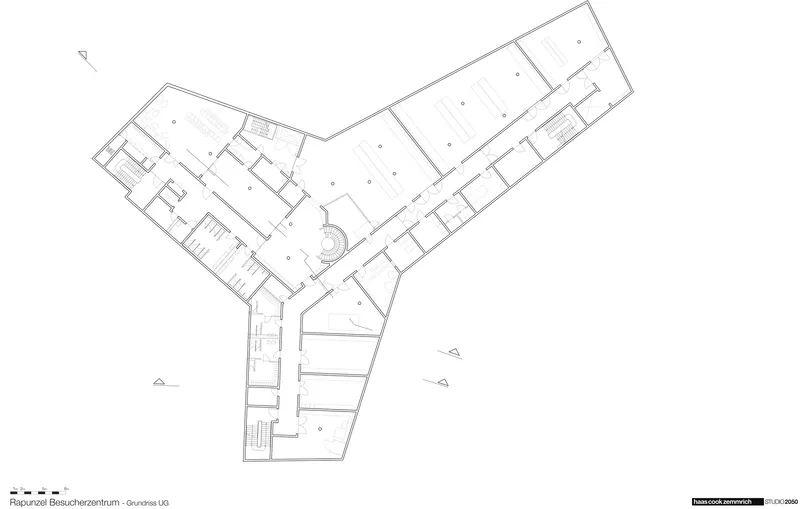
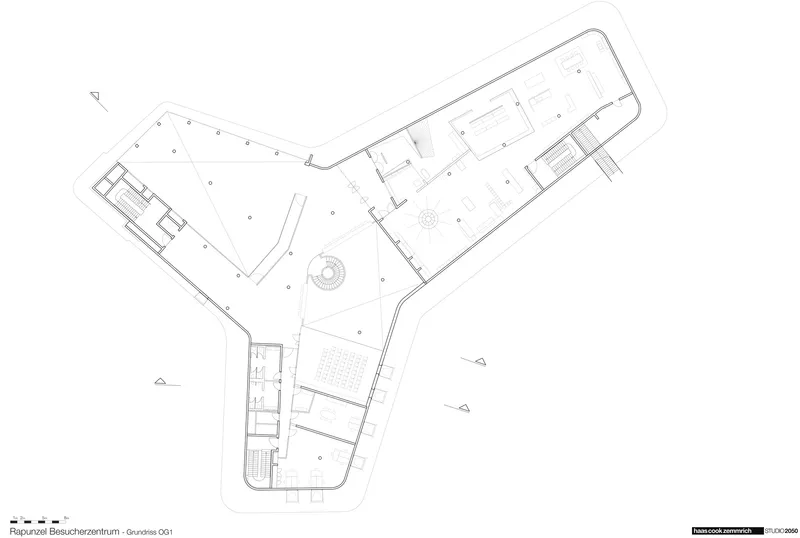
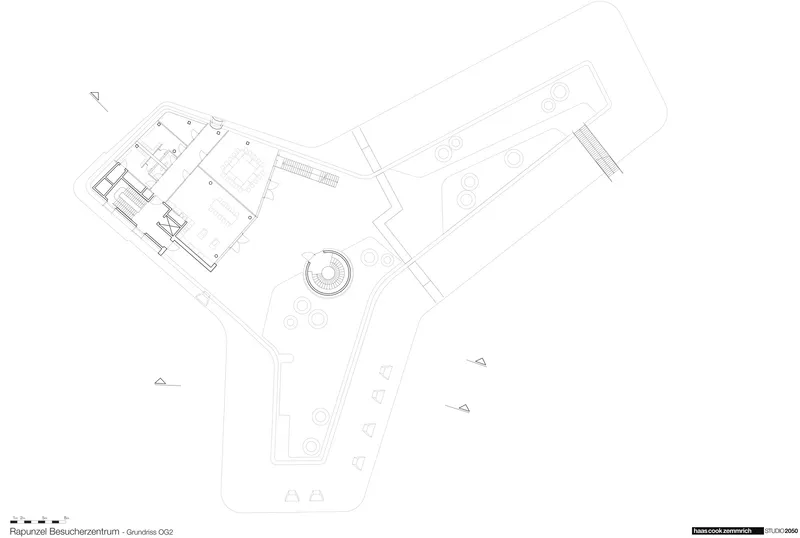
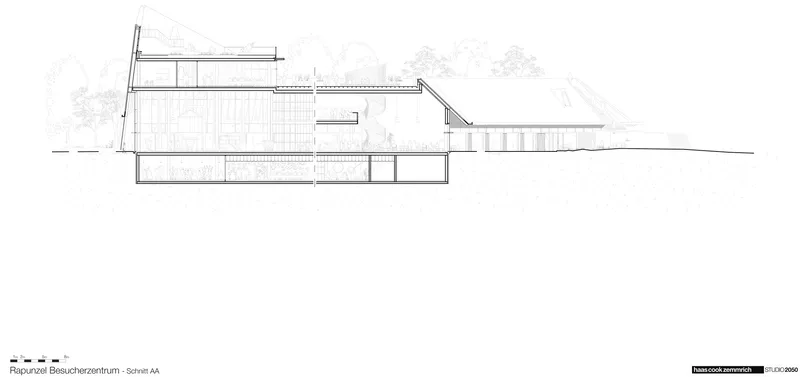
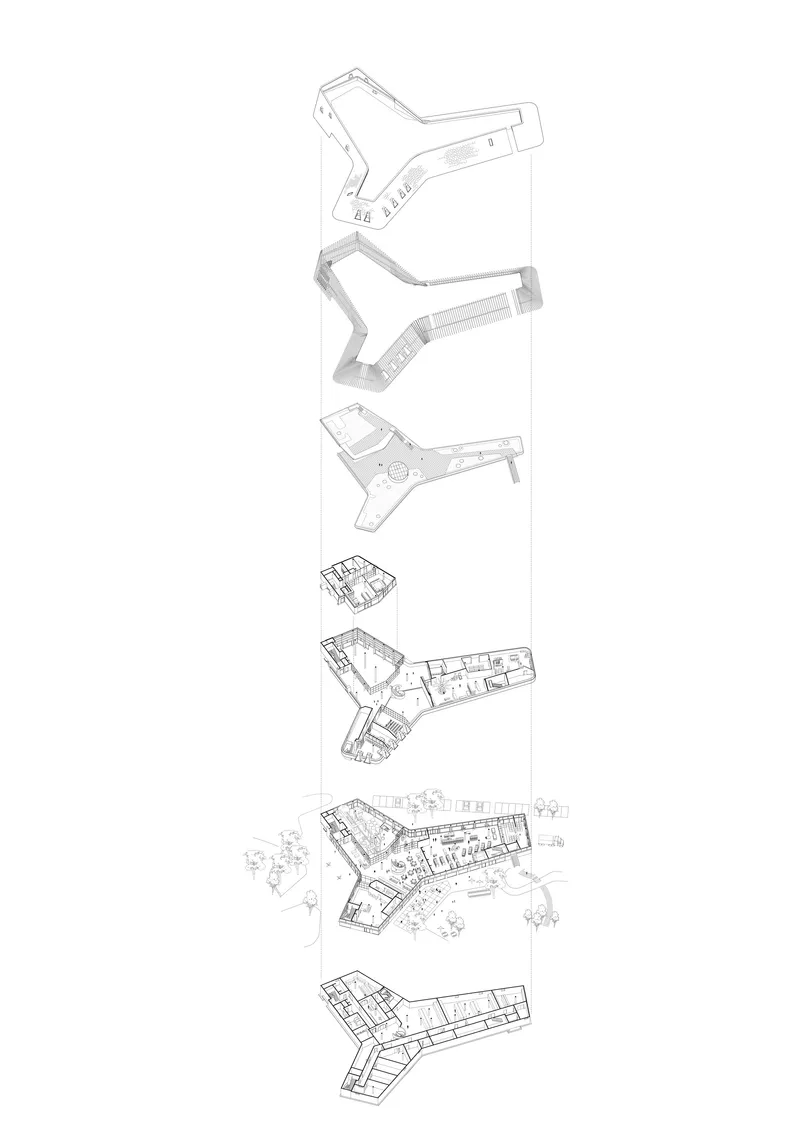
The drawings confirm what the photographs suggest: the Y-shaped plan radiates three wings from a central core containing the spiral staircase. Two circular landscape elements occupy the courtyard between the wings, reinforcing the garden-as-architecture idea. The section reveals how the sloped roofs create varied ceiling heights across the five floors, with the tallest point at the northern tower. The exploded axonometric is especially revealing, showing seven stacked floor plates and the way each level shifts slightly in footprint, producing the faceted exterior geometry.
The site plans place the building within Legau's village fabric, showing its relationship to adjacent streets, parking, and the broader Rapunzel Naturkost campus. The complex is clearly scaled to be a civic presence in a small town, not a corporate campus isolated from its context. The landscape strategy, visible in the drawings as a web of paths and plantings extending well beyond the building footprint, integrates the visitor center into the existing settlement pattern.
Why This Project Matters
The Rapunzel Visitor Centre makes a case that corporate architecture in rural settings can be both ambitious and grounded. haascookzemmrich STUDIO 2050 avoided the temptation to drop a sleek glass pavilion into the Bavarian countryside and instead built something that engages local craft traditions, natural materials, and passive climate strategies without sacrificing spatial invention. The triple-spiral timber staircase alone would justify attention, but the project's real strength is how that singular gesture integrates into a building that also works as a bakery, a market, a roastery, and a community training center.
At a moment when sustainability rhetoric often outpaces material reality, this building is notably specific. Foam glass gravel instead of styrofoam. Curved laminated veneer lumber instead of steel. Local craftspeople instead of distant fabricators. The fairy tale framing could easily have tipped into kitsch, but the architecture holds it in check: every narrative element, from the braided stair to the interlocking-pot downpipes, has a structural or functional rationale. That discipline is what turns a brand exercise into a building worth studying.
Rapunzel Visitor Centre by haascookzemmrich STUDIO 2050, Legau, Germany. 7,560 m². Completed 2022. Photography by Markus Guhl Architekturfotografie.
About the Studio
Share Your Own Work on uni.xyz
If projects like this are the kind of work you want to make, uni.xyz is a place to publish your own, find collaborators, and enter design competitions.


Popular Articles
Popular articles from the community


The Ocean Hive: Sustainable Architecture for a Self-Sufficient Civilization at Sea
The Ocean Hive imagines sustainable architecture at sea, where modular habitats, algae, wave power and ocean waste sustain a growing colony.

The Musturak Paradise: Senior Living Architecture for a Connected Future in Temara, Morocco
The Musturak Paradise reimagines senior living architecture in Temara via private homes, social spaces, culture, community, and shared care.

Hill & Cross Opera: Sculptural Opera House Architecture Shaped by Tallinn’s Landscape and Identity
Hill & Cross Opera reimagines opera house architecture in Tallinn through its sculptural hill, civic plaza, glass wave and a luminous cross.

Play: Fragments of Their World
Familiar architecture becomes modular playground design, creating safe spaces where displaced children can learn, connect, imagine and play.

Similar Reads
You might also enjoy these articles

Bao Huynh Watercolor Atelier: A Serene Art Retreat in Hội An
Bao Huynh Watercolor Atelier in Hội An blends multifunctional art spaces, sustainable design, local materials, and family-friendly living in a serene environment.

Atelier Macri Concept Store Interior Design by CASE-REAL
Atelier Macri store features a "ko" counter, walnut wood details, cork displays, blending retail, gallery, and seamless customer experiences.

Manuel Vargas Izquierdo Stadium and High-Performance Sports Center: Architectural Excellence in Jalpa de Méndez
The Manuel Vargas Izquierdo Stadium blends sustainable design, inclusive sports facilities, and cultural-inspired architecture, revitalizing Jalpa de Méndez’s public spaces.

KAKR Buluh Awar Hall: Revitalizing Community and Ecology Through Bamboo Architecture
Community built bamboo hall revitalizes Buluh Awar village, empowering youth, restoring ecology, celebrating vernacular craftsmanship through sustainable architecture and culture.

Explore Landscape Design Competitions
Discover active competitions in this discipline



Challenge to reimagine the Iron Throne


Photograph architecture without architects


Illustrate the lost glory of Angkor Wat - Render Challenge


Design challenge to reuse E-waste
Comments (0)
Please login or sign up to add comments
No comments yet. Be the first to comment!