
Habitat Selenite: A Forest Wellness Lodge in Quebec
NatureHumaine designed a 1,296 sq ft wellness retreat in Quebec''s Eastern Townships with an inverted roof, skylights, sauna, and spa in a white cube.


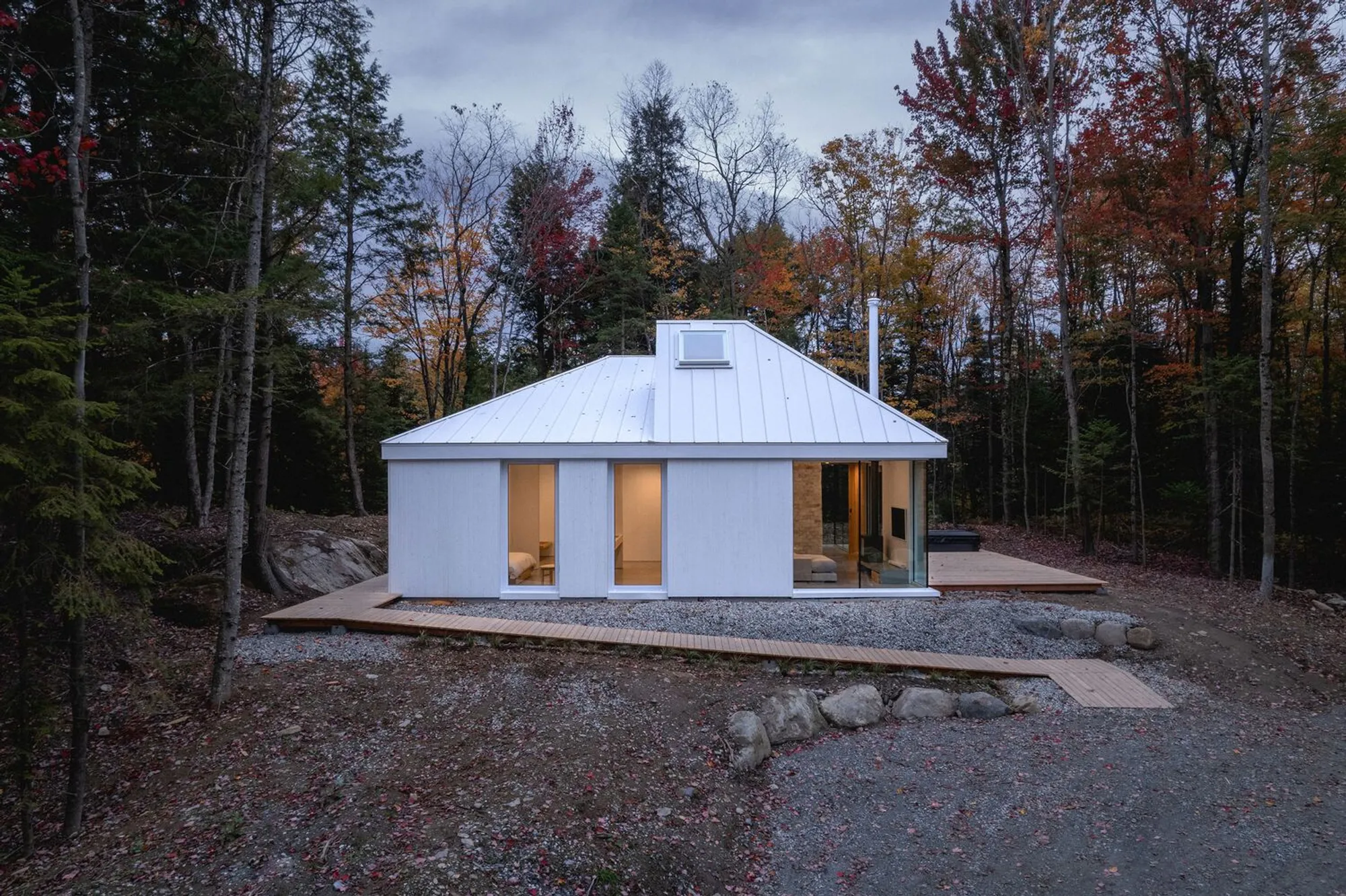
In Eastman, Quebec, deep in the Eastern Townships, a white cube sits in a forest clearing. Habitat Selenite, designed by NatureHumaine, is a 1,296 sq ft wellness lodge named after selenite, a translucent crystal associated with calm. The name is not decoration. It describes the building: a compact, luminous volume that catches forest light through skylights cut into an inverted roof.
The clients wanted a retreat that combined spa, sauna, and living space in a single accessible building. They wanted it to disappear into the forest in summer and glow from within in winter. NatureHumaine delivered both by wrapping the entire programme in a monochrome white shell with a roof that folds inward to pull light down into every room.
The Roof: Inverted Slopes and Skylights
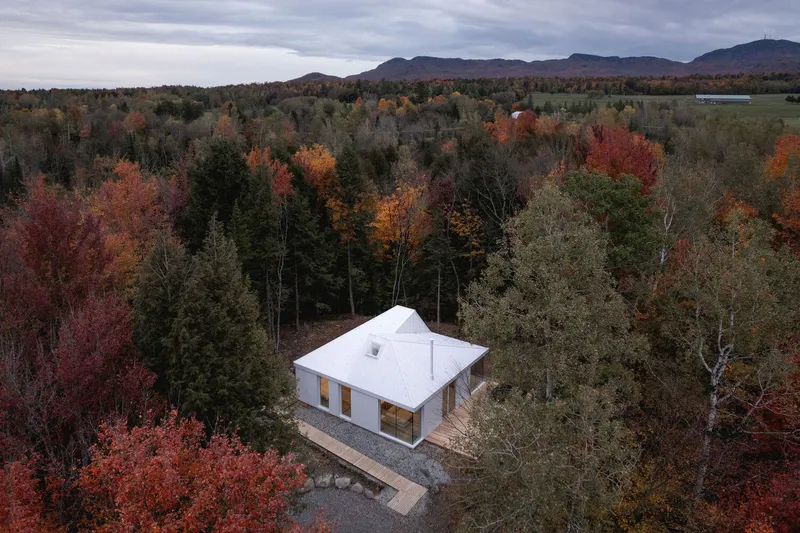
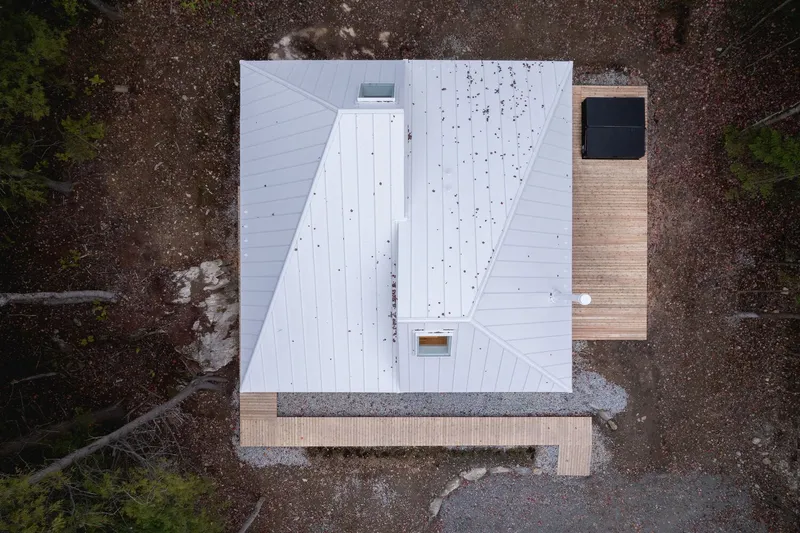
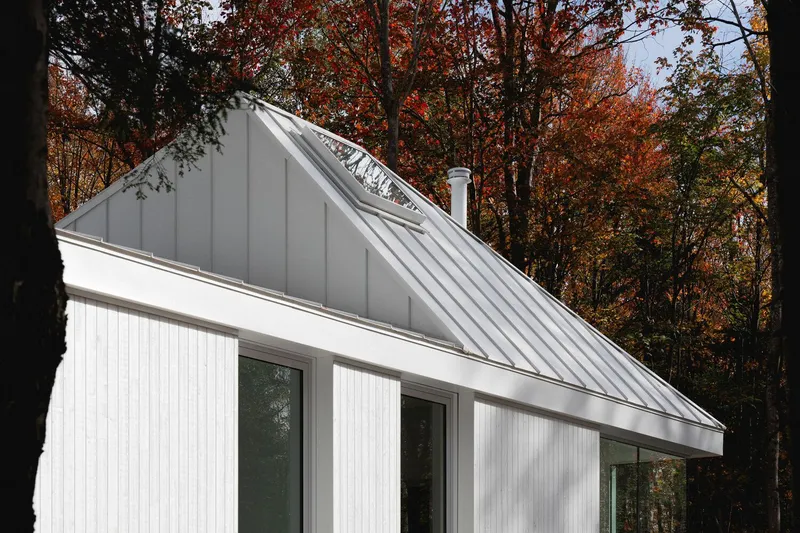
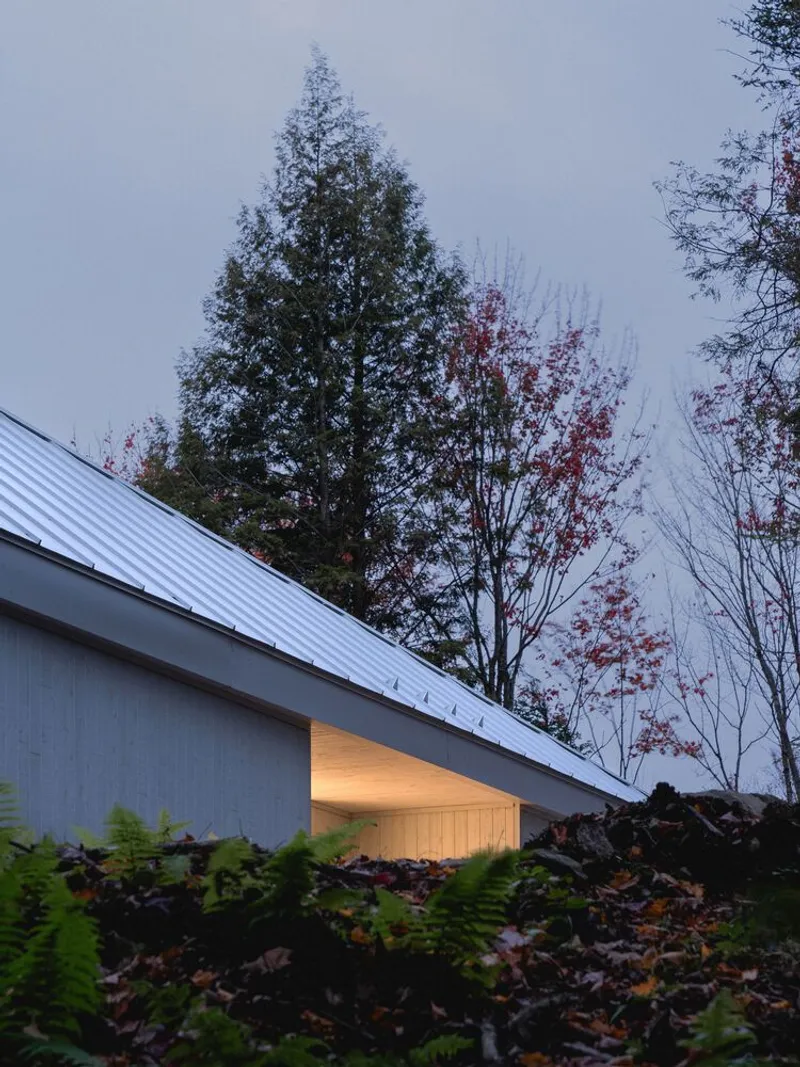
The roof is the project. A conventional pitched roof rises to a ridge and sheds water outward. NatureHumaine inverted that: the roof slopes inward from the perimeter to a central valley, creating two low peaks at opposite corners and a valley between them. Square skylights are cut into the slopes, bringing zenithal light into the kitchen, corridor, and bathroom.
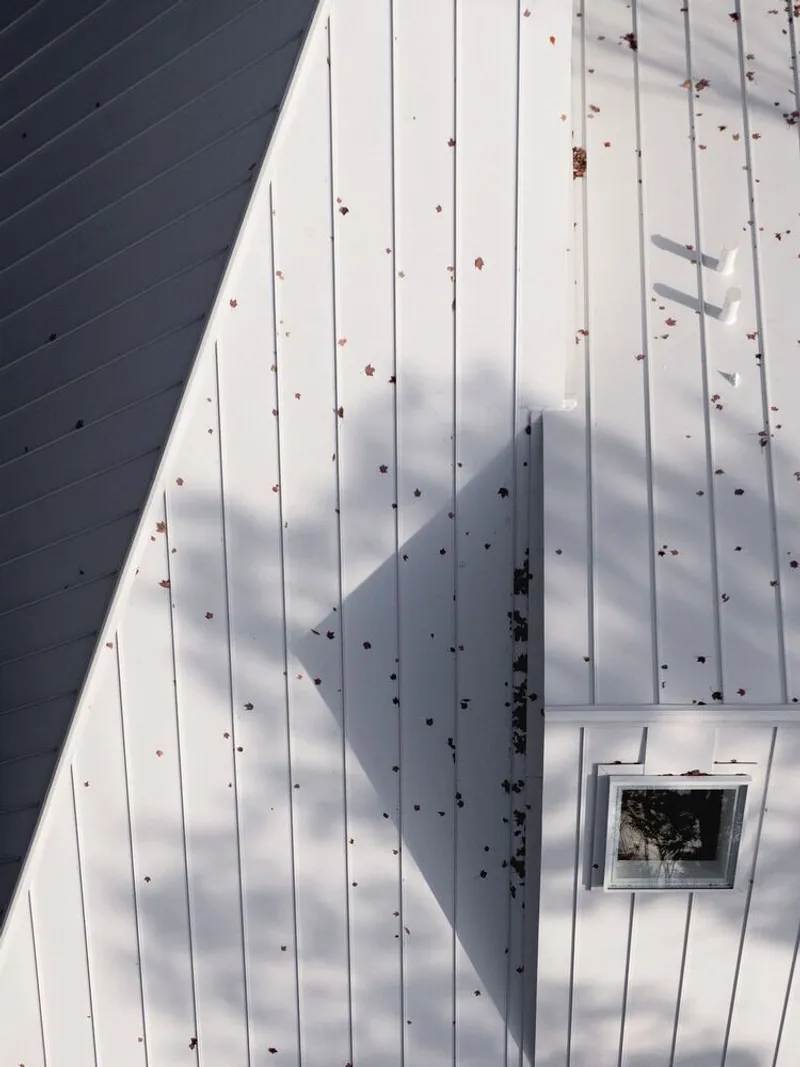
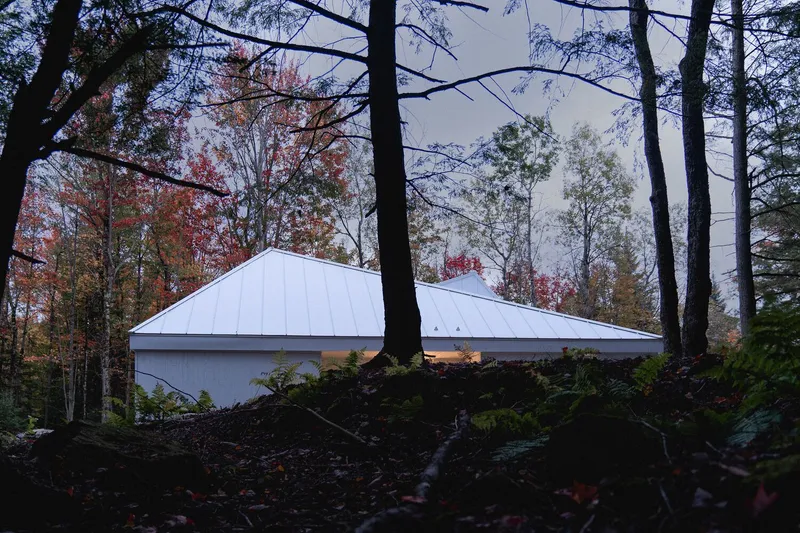
From outside, the twin peaks give the house a crystalline silhouette that changes with the angle of approach. From the air, the white standing-seam metal reads as a faceted mineral set into the autumn canopy. The inverted geometry is not ornamental. It reduces the building's volume at the centre, where height is least needed, and raises it at the perimeter, where the living spaces are.
In the Forest: Autumn and Dusk
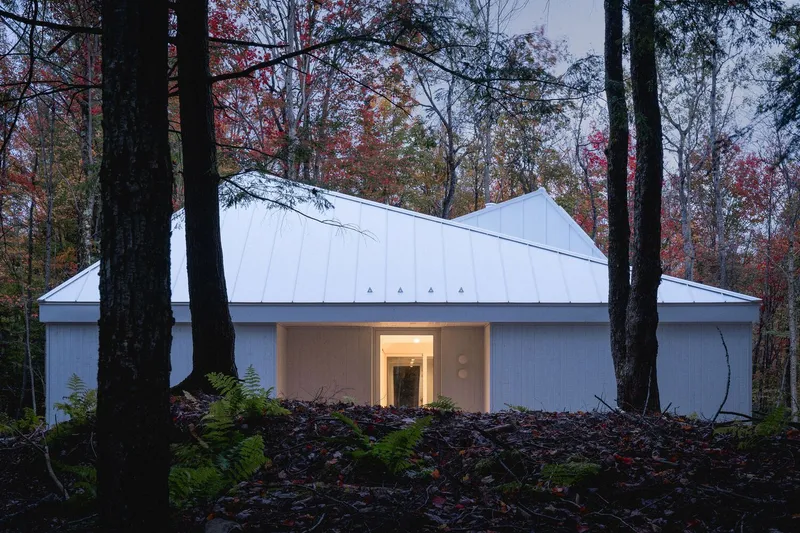
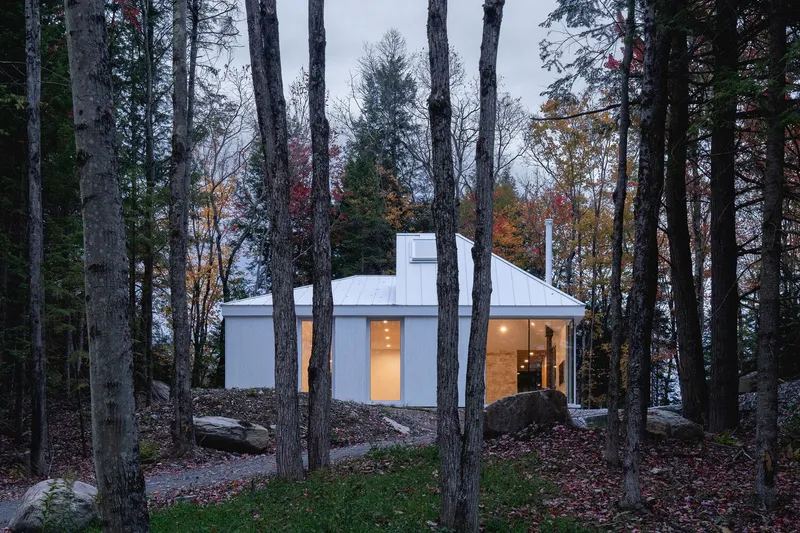
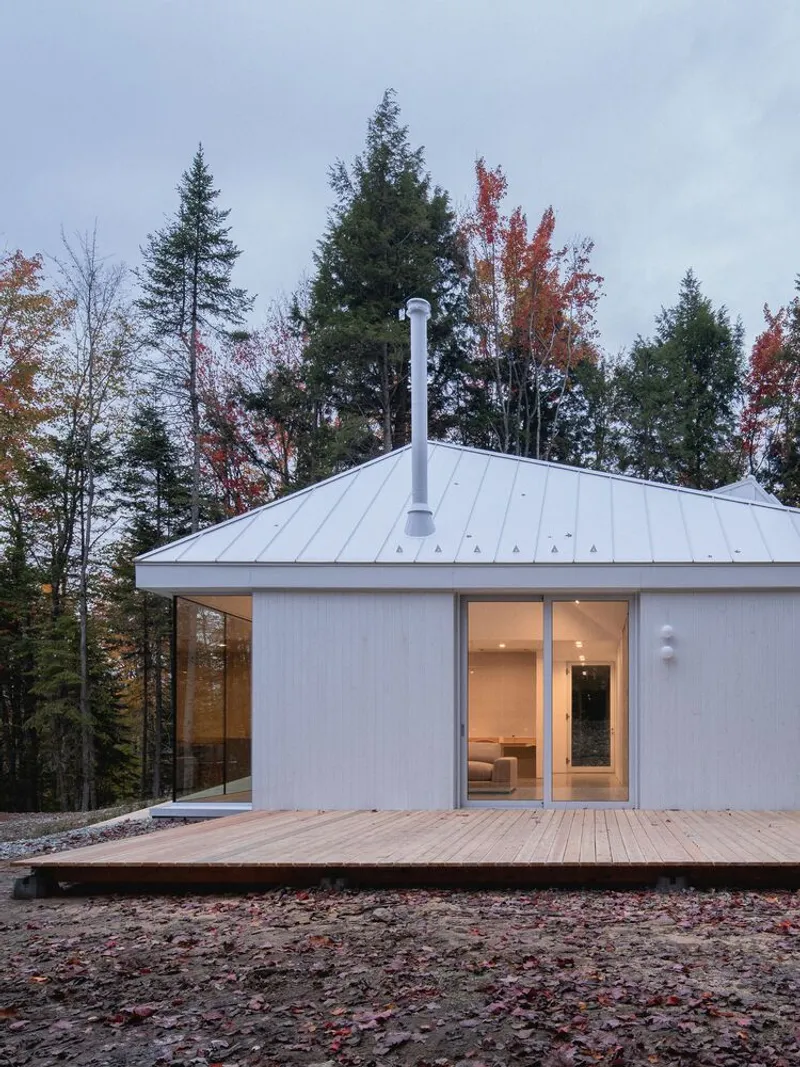
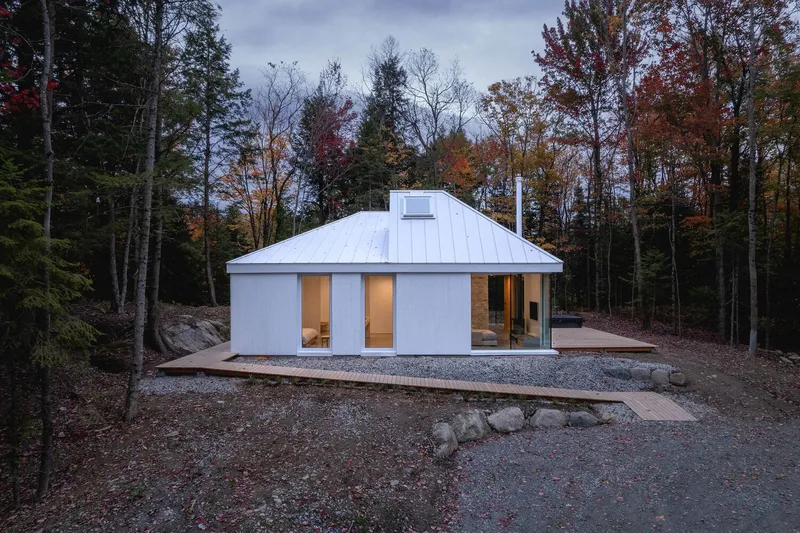
The house sits on a gravel clearing with timber decks on two sides. The white cladding is vertical board-and-batten in metal, chosen because it weathers without maintenance and reflects the colour of the sky. In autumn, the white shell becomes a foil for the red and orange canopy. At dusk, it glows. The narrow horizontal windows at the base of the walls emit a warm band of light that floats the volume above the forest floor.
The approach is through trees. You see the house in fragments: a white corner, a lit window, a roof edge. The building reveals itself slowly, which is exactly right for a retreat. You decompress before you arrive.
Entry and Corridor
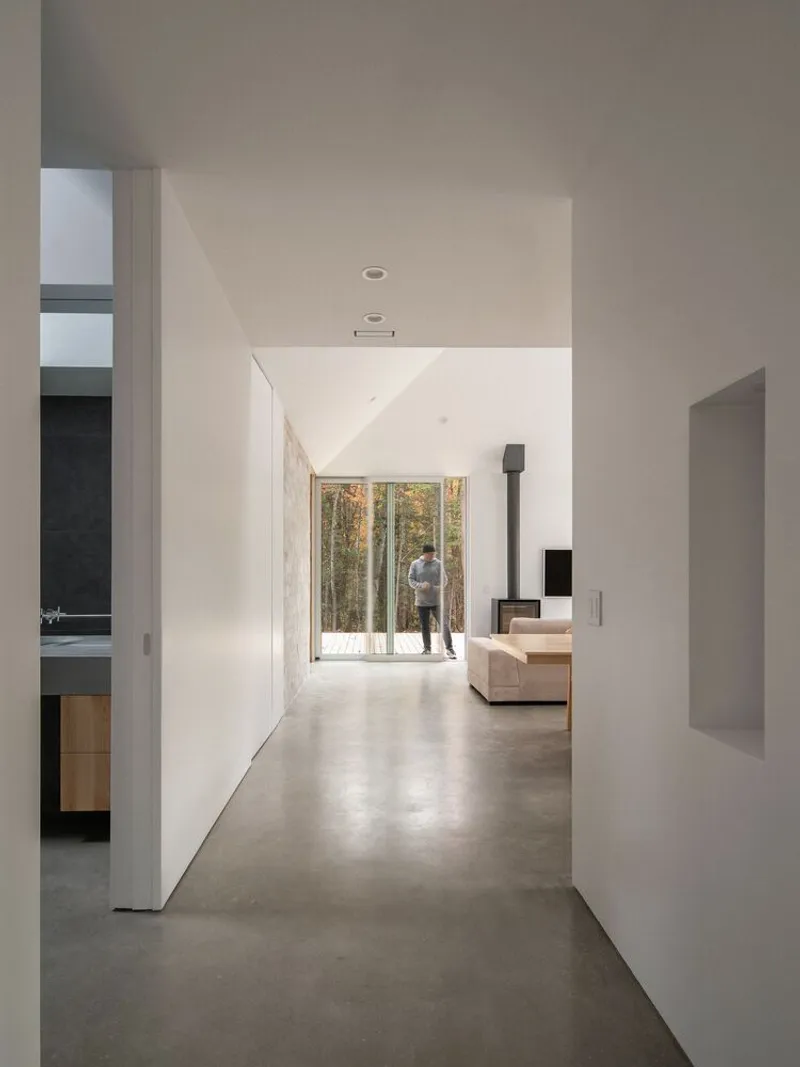
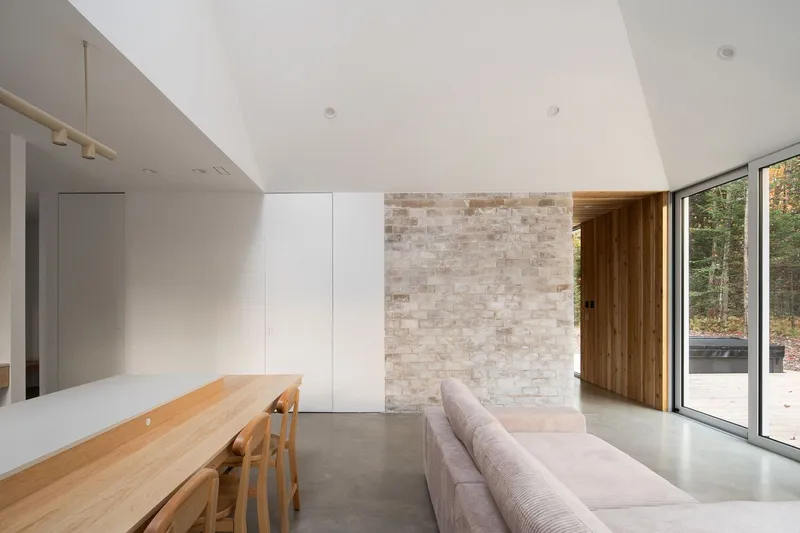
The front door opens into a narrow white corridor with polished concrete floors. The corridor is deliberately compressed: low ceiling, no windows, white on white. At the far end, the living room opens up with the stone wall, the wood stove, and full-height glass to the forest. The sequence is calibrated. You move from tight to open, from enclosed to transparent, from arrival to rest.
Living Room: Stone, Glass, Fire
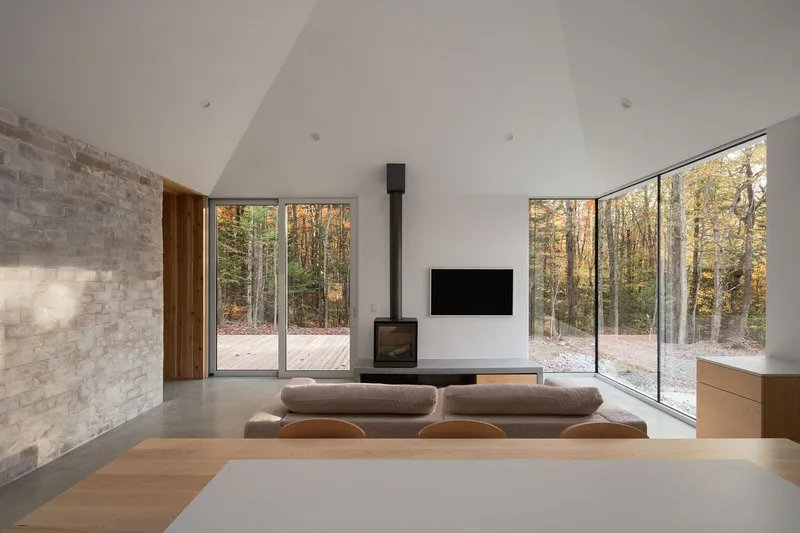
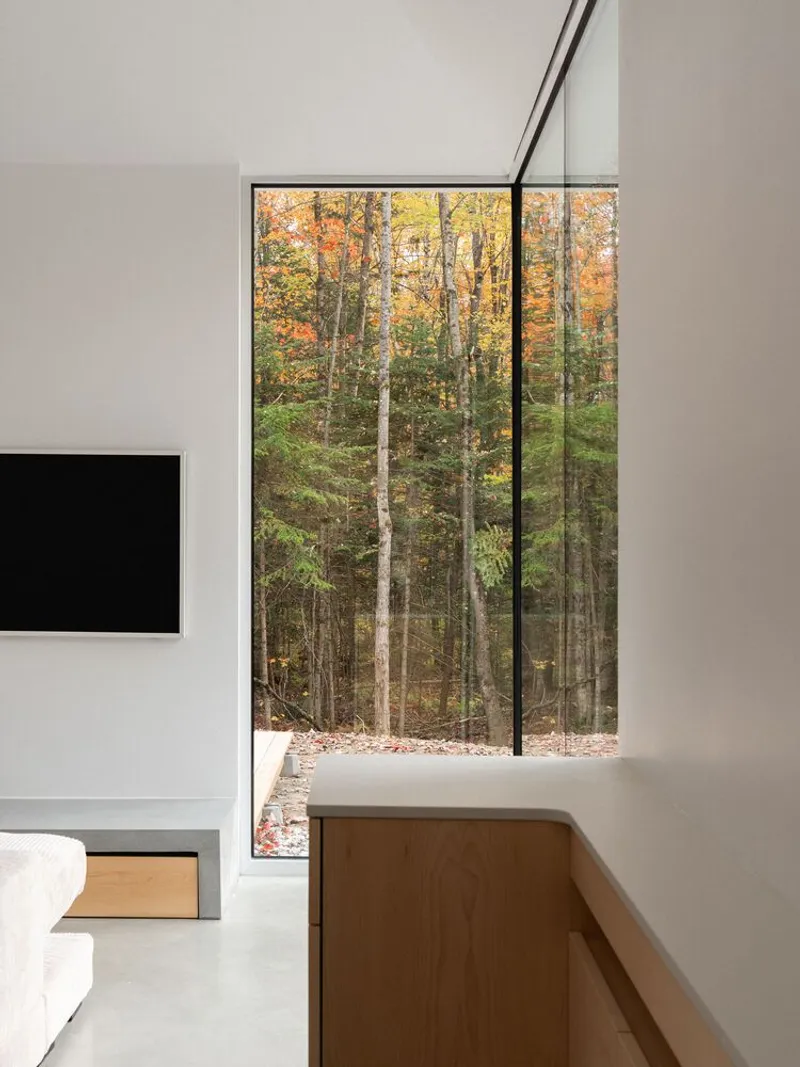
The living room is the heart of the plan. A natural stone wall, rough and warm, runs the full width. A black wood stove sits in front of a white partition. Floor cushions replace a conventional sofa. The floor is polished concrete, continuous from the entry. Two walls are full-height glass, framing the forest on two sides. In autumn, the room is surrounded by colour. In winter, by snow. The stone wall anchors the space against all that transparency.
Kitchen: Skylight and Oak
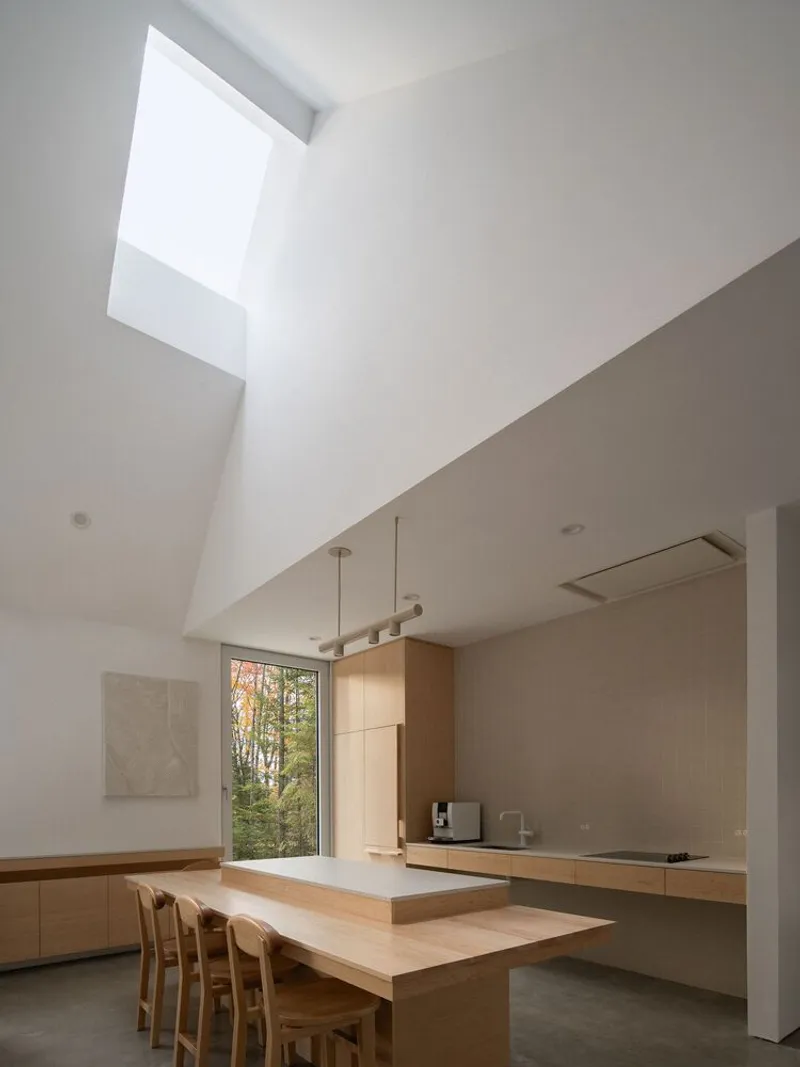
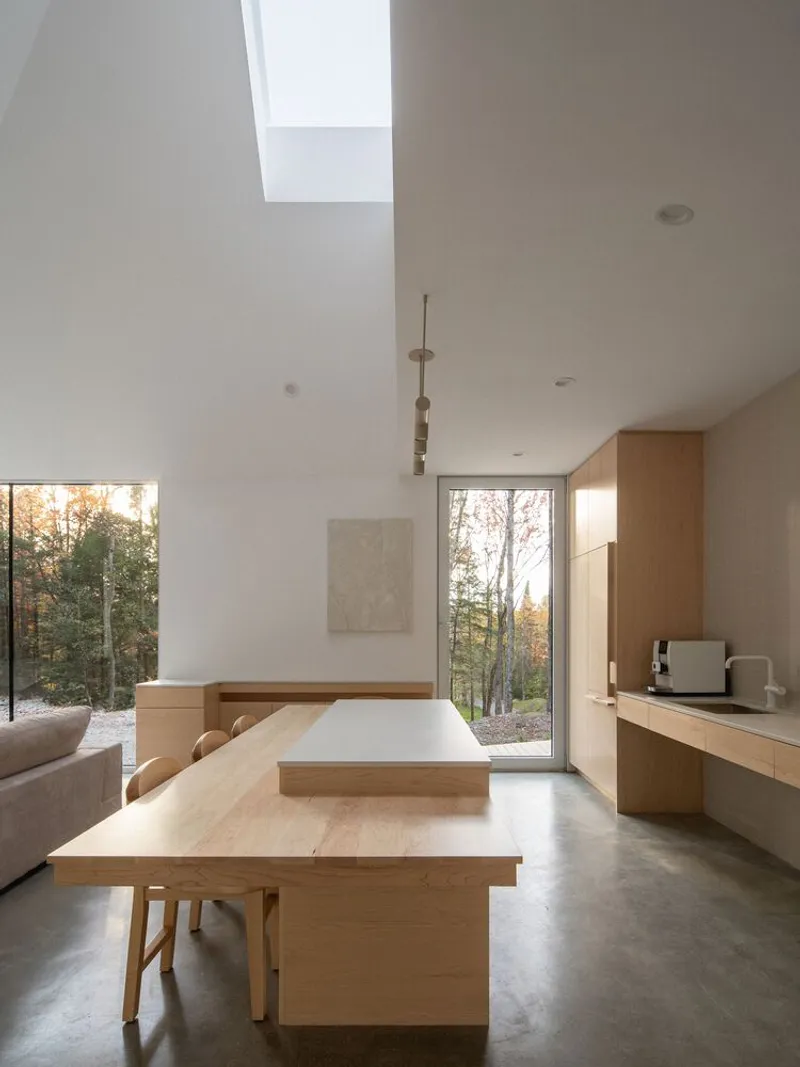
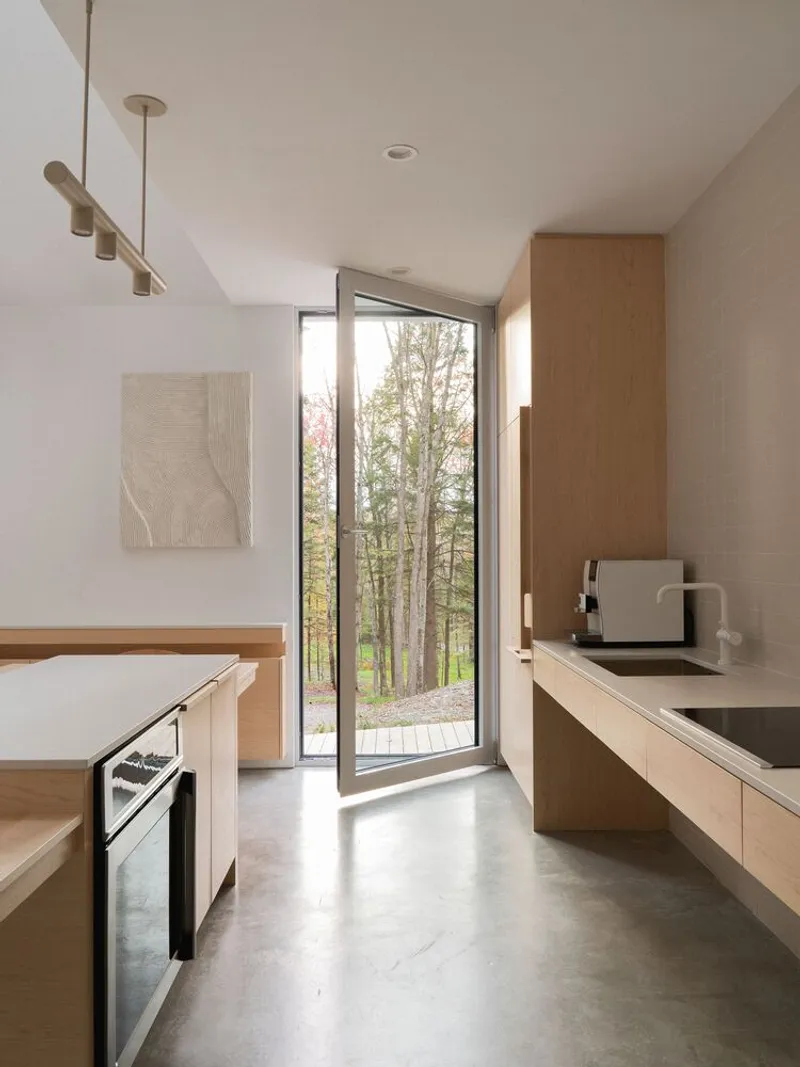
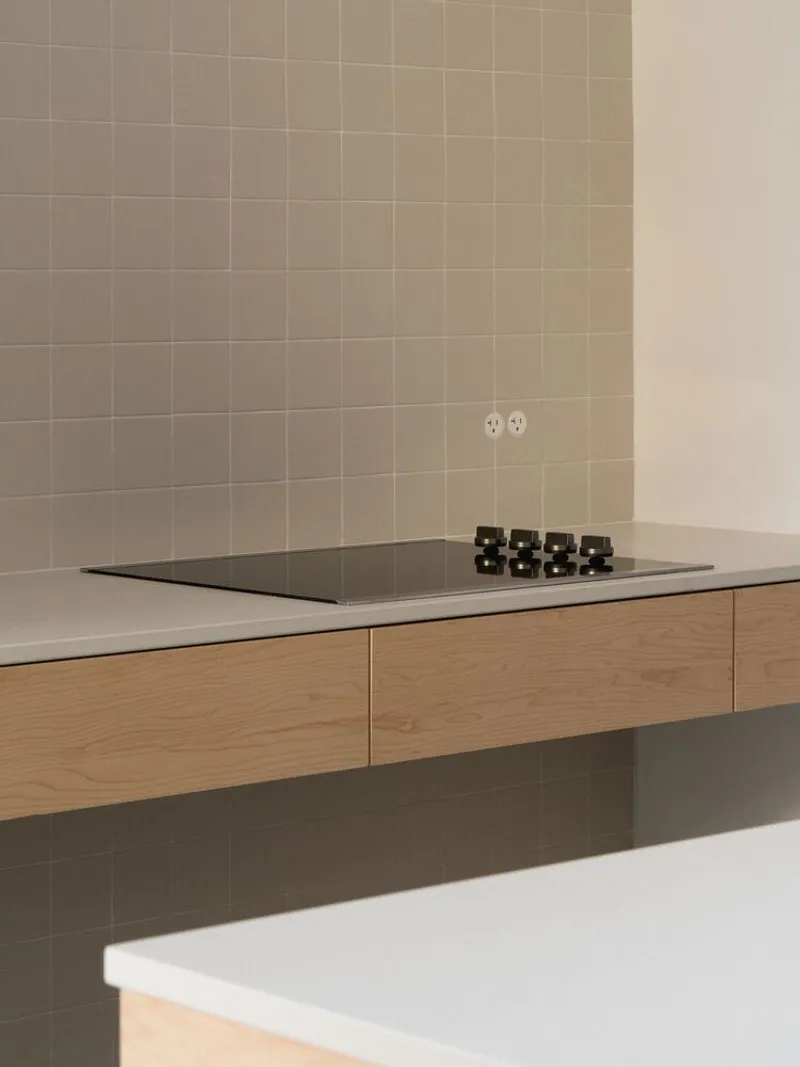
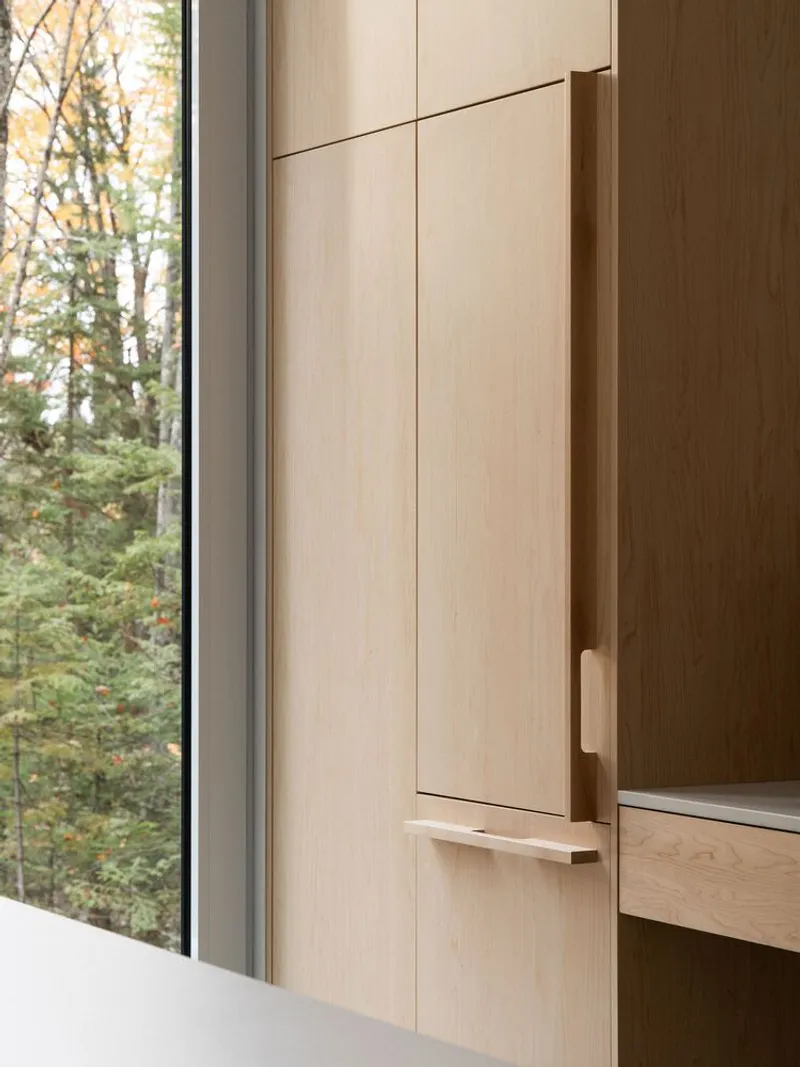
The kitchen occupies the corner below one of the twin roof peaks. A square skylight opens the ceiling to the sky, and a pendant light hangs from the double-height void. The island and all cabinetry are in pale oak with brass handles. The backsplash is small beige square tiles. The material palette is deliberately quiet: oak, white, concrete, and the occasional espresso cup.
Bedrooms and Bathrooms
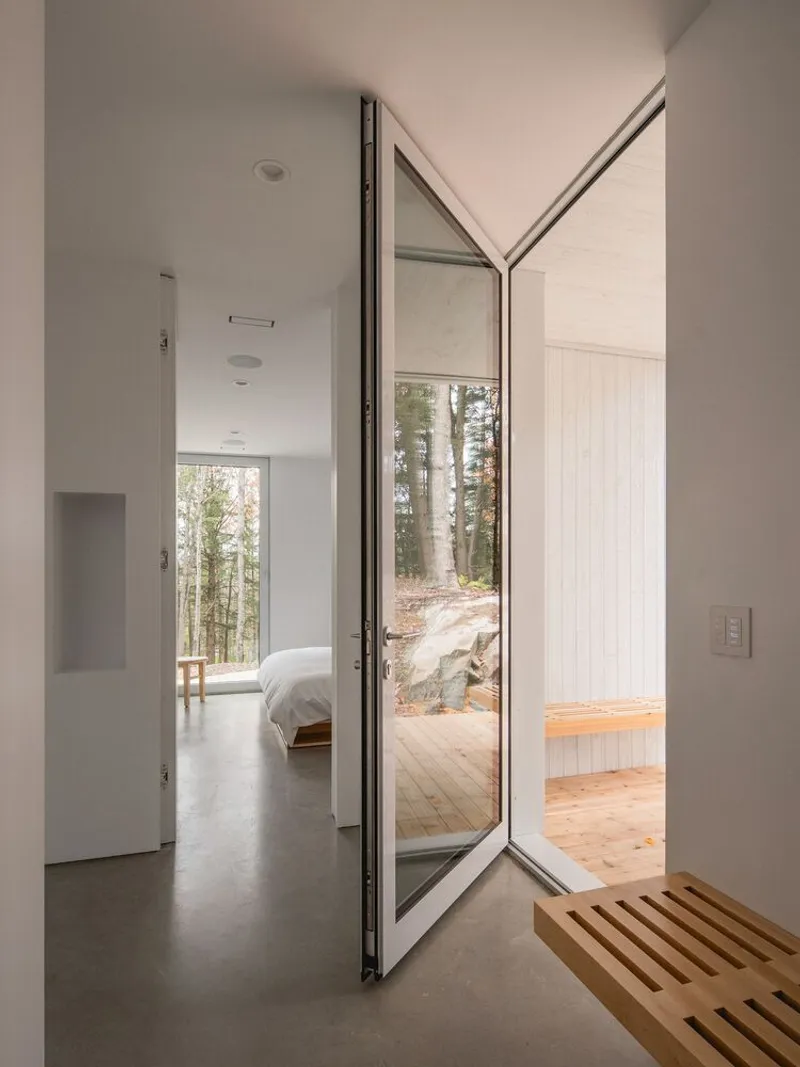
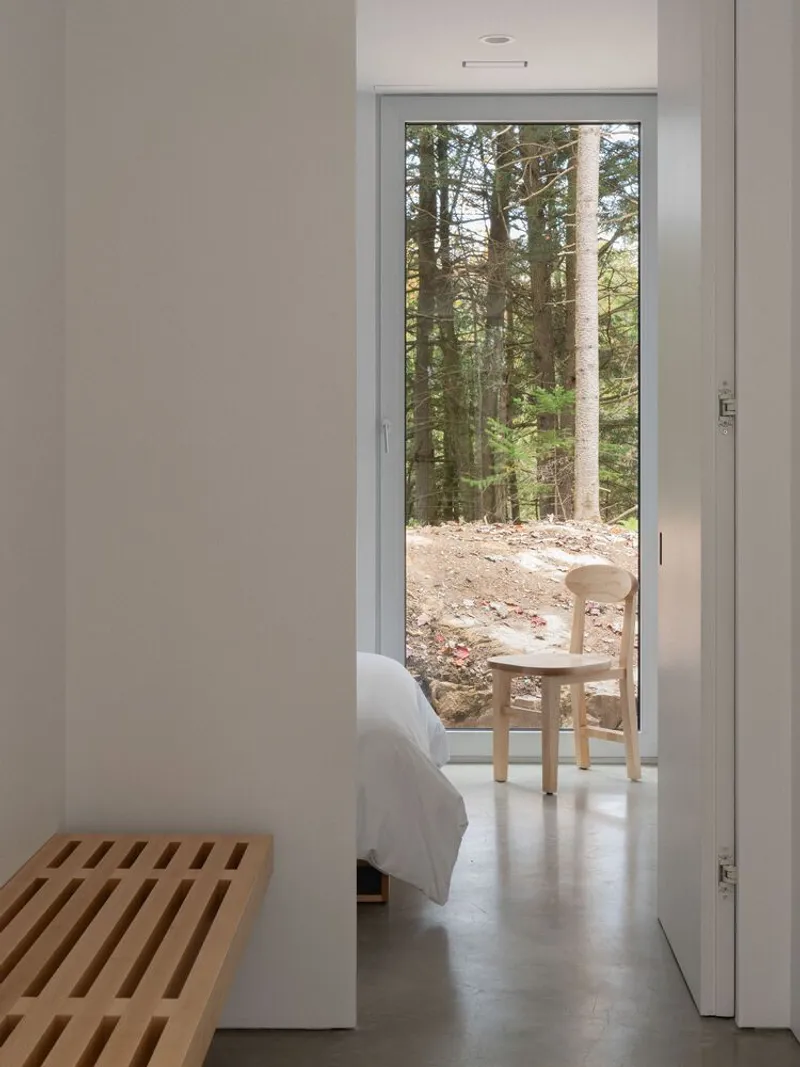
Two bedrooms sit in the northern corners. Both have floor-to-ceiling glass on the forest side and white walls on the corridor side. A pivot door connects one bedroom to the corridor, a detail that gives the threshold more presence than a standard hinged door. The furnishing is minimal: white bedding, a wooden stool, an oak cabinet. The forest is the decoration.
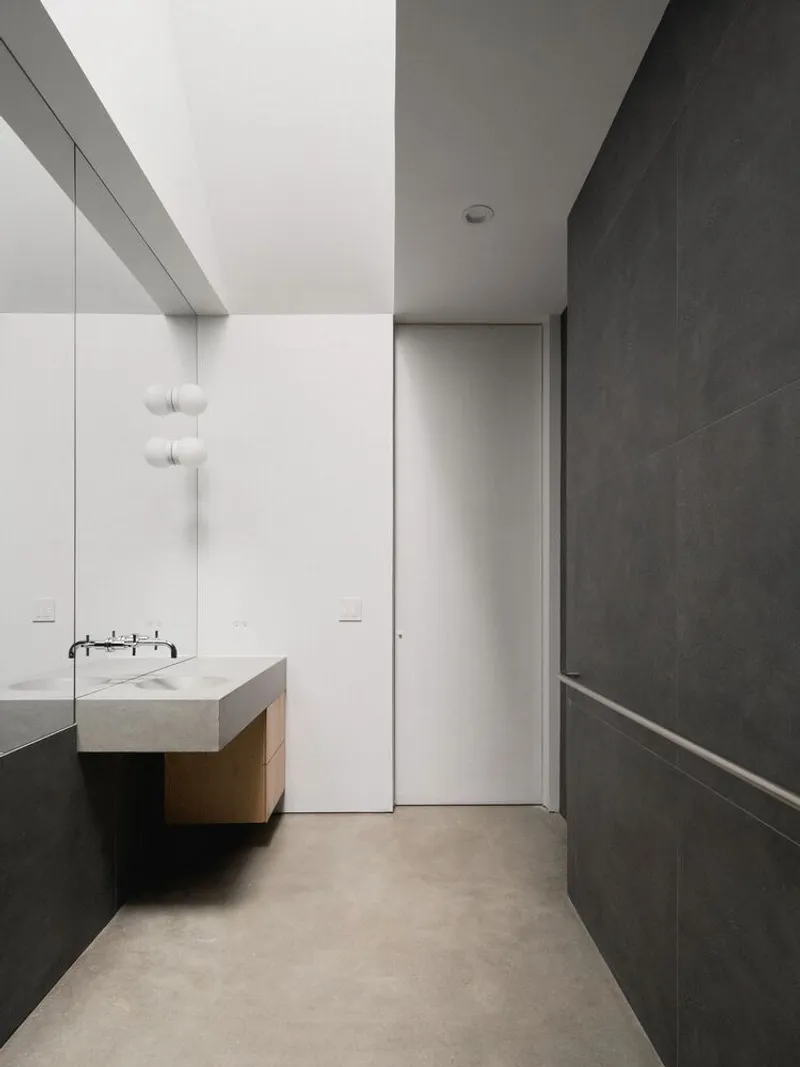
The bathroom is the moodiest room. Dark grey stone covers the walls. A white wall-mounted basin sits on an oak vanity. The ceiling angles down following the inverted roof slope, creating a compressed, cave-like quality. After the brightness of the living spaces, this room is a deliberate shift in register.
The Wellness Wing: Sauna, Spa, Salt Room
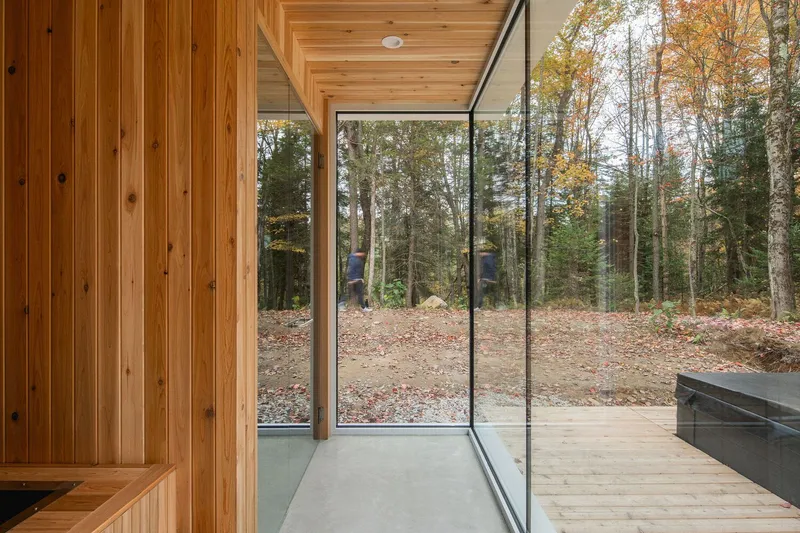
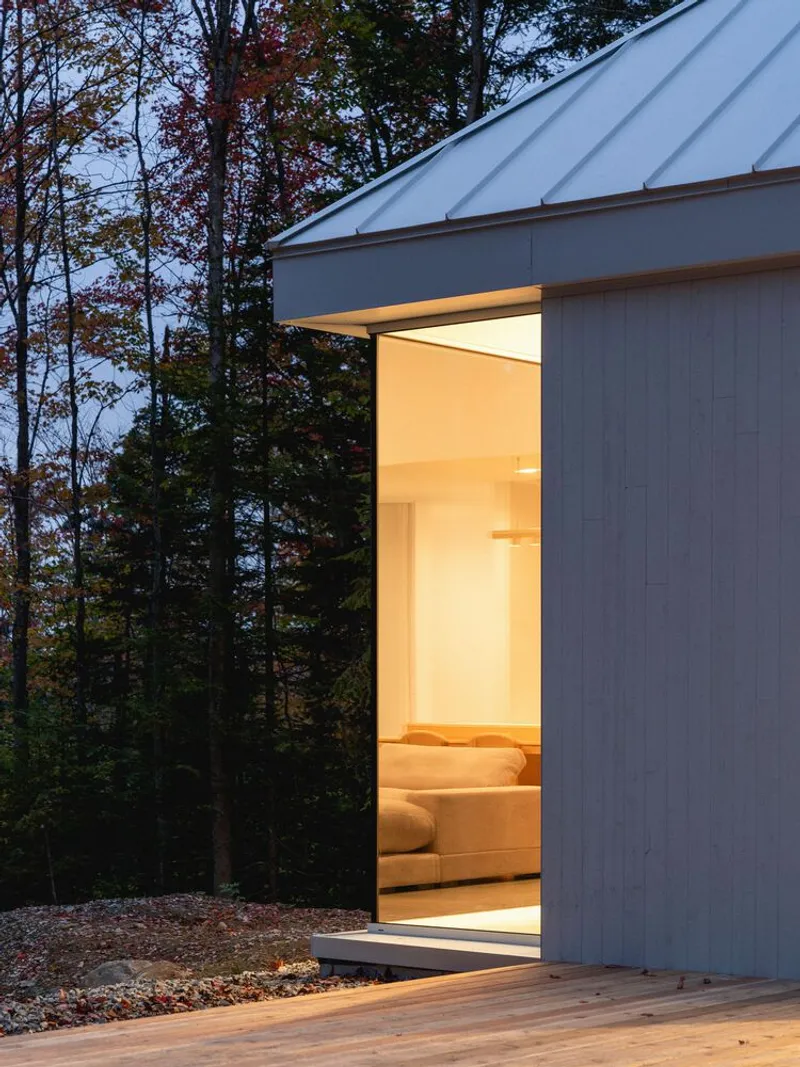
The eastern half of the plan is given over to wellness. A cedar-lined sauna opens through a floor-to-ceiling glass corner onto the forest. A cold bath, a shower-hammam, and a salt room complete the sequence. The spa sits on the terrace outside, visible on the floor plan as a freestanding element on the timber deck. The entire wellness circuit, from sauna to cold plunge to salt room, can be completed without leaving the building or without stepping outside, depending on the season and the mood.
The cedar cladding in the sauna is the only warm timber surface in the interior. Everything else is white, grey, oak, or stone. The cedar reads as an event: you enter a different material world when you enter the spa zone.
Skylights: Framing the Canopy
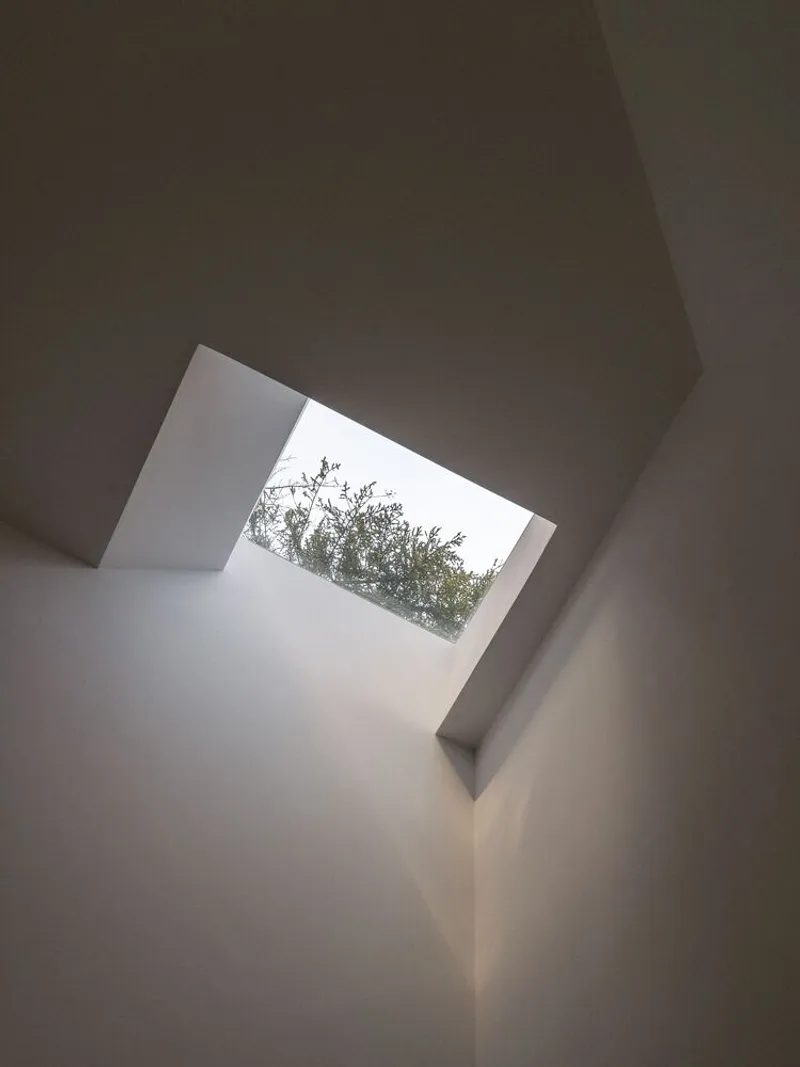
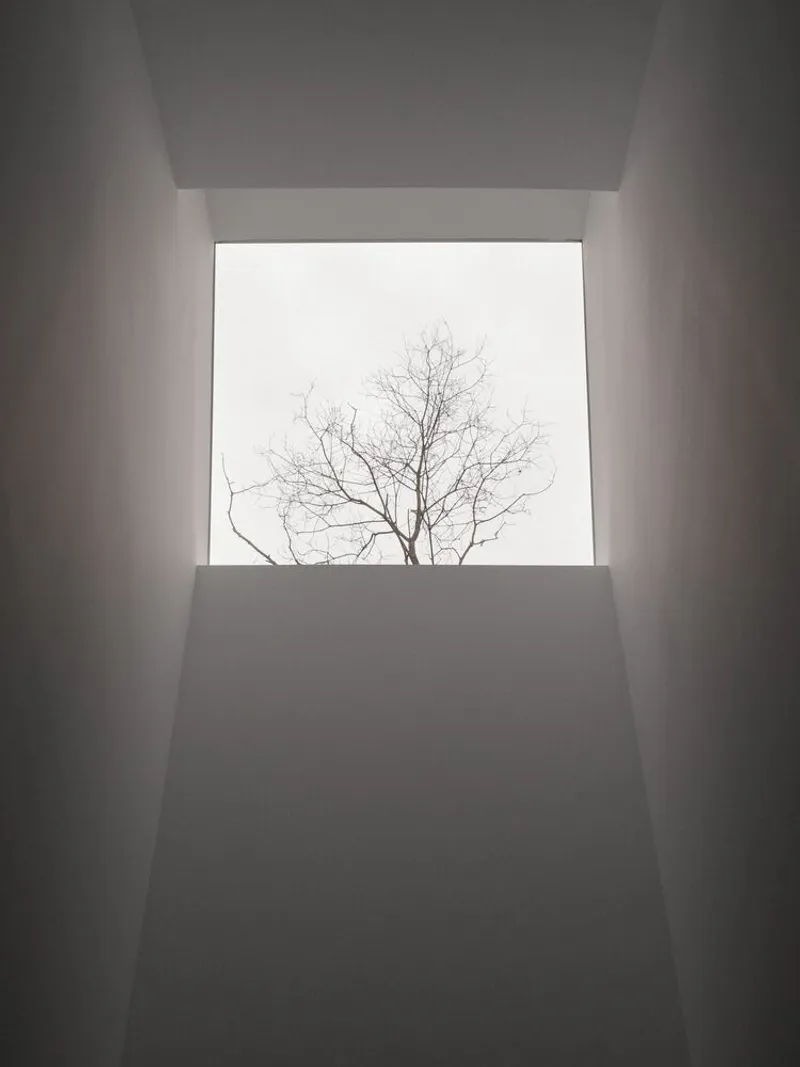
The skylights are square openings cut into the inverted roof slopes. From below, they frame the tree canopy in summer and bare branches in winter. The white plaster shafts act as light funnels, bouncing diffuse daylight deep into the plan. They eliminate the need for artificial light during the day and give each room its own piece of sky.
Night and Dusk
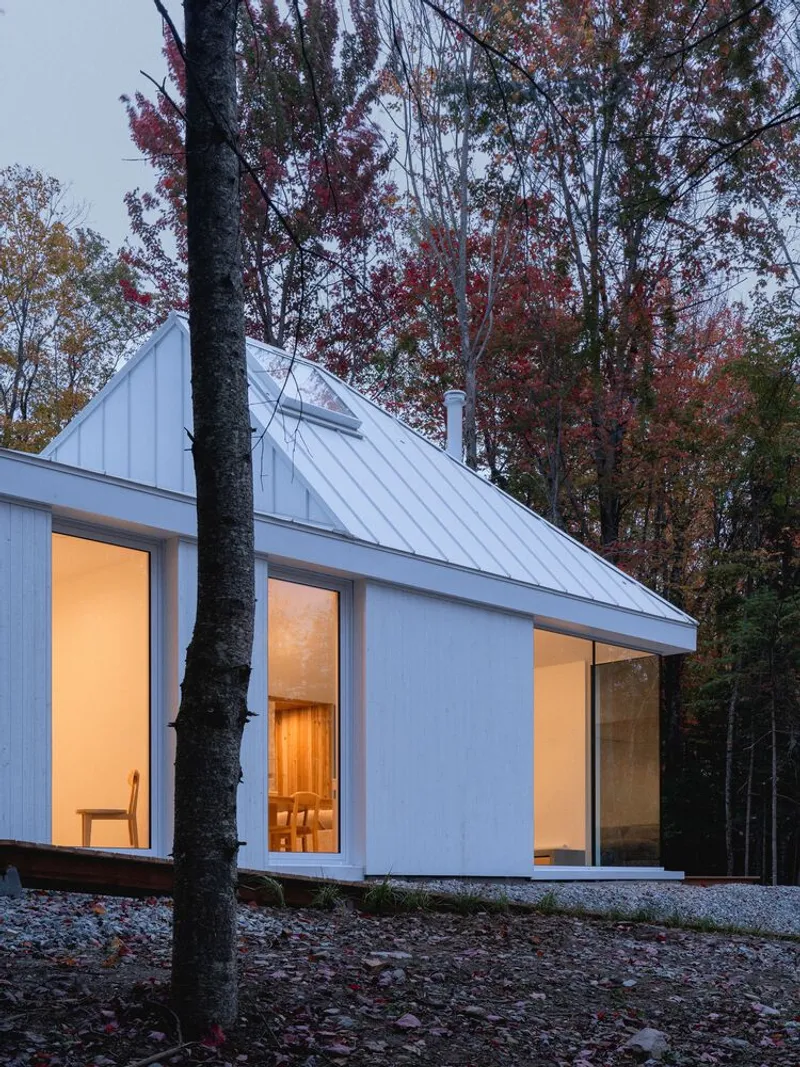
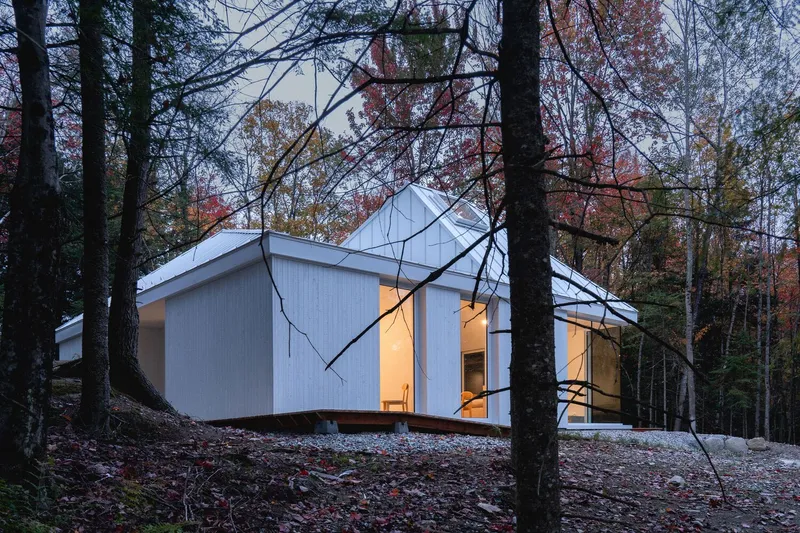
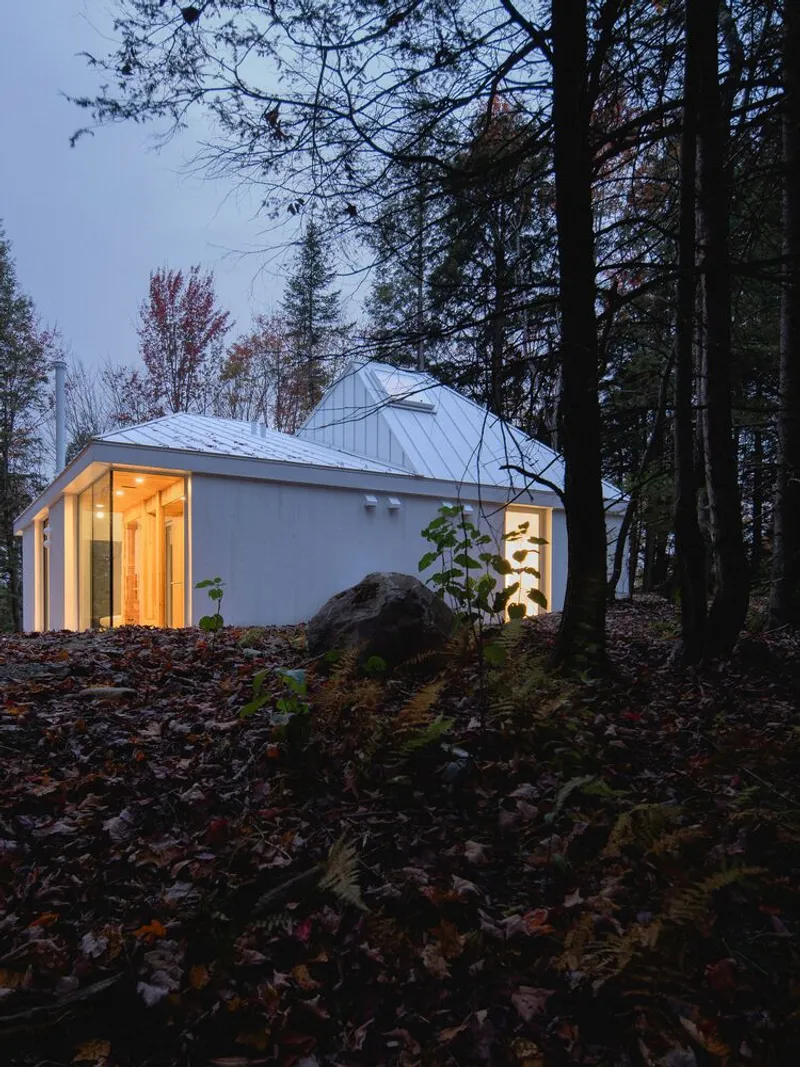
The best photographs are taken at dusk. The white shell catches the last grey light while the interior glows warm through the glass. The house becomes a lantern in the forest. At night, the narrow horizontal windows at the base emit a band of light that makes the volume appear to float. The twin roof peaks are silhouetted against the sky. This is a building designed to be seen from outside as much as lived in from within.
Drawings
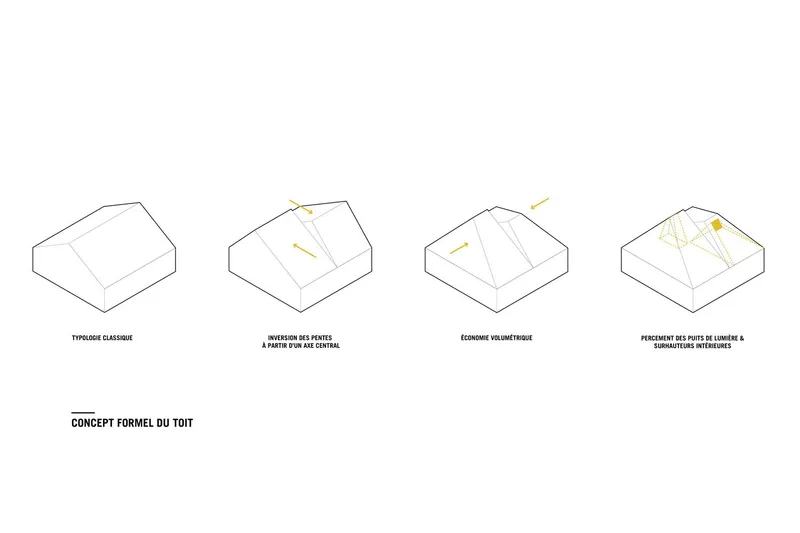
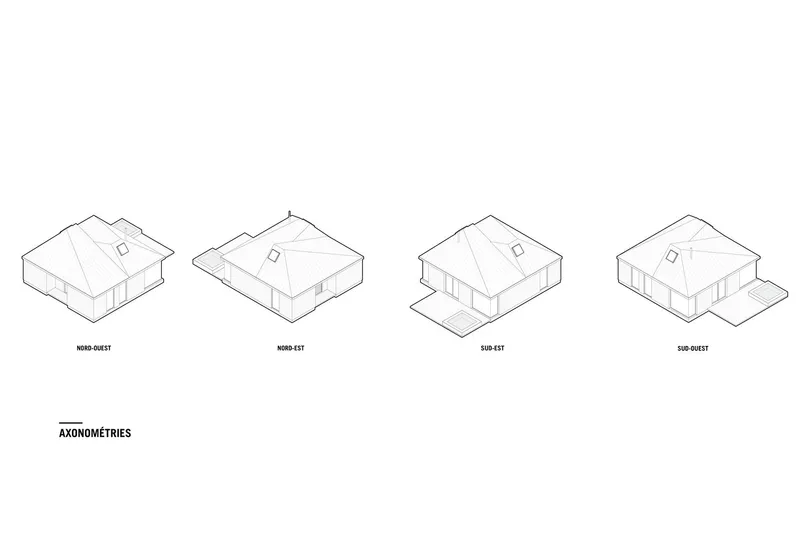
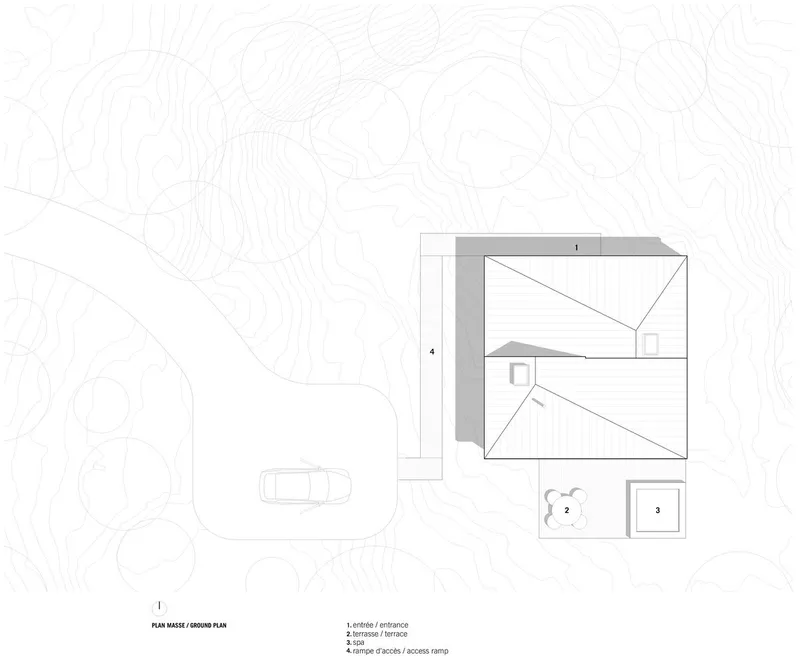
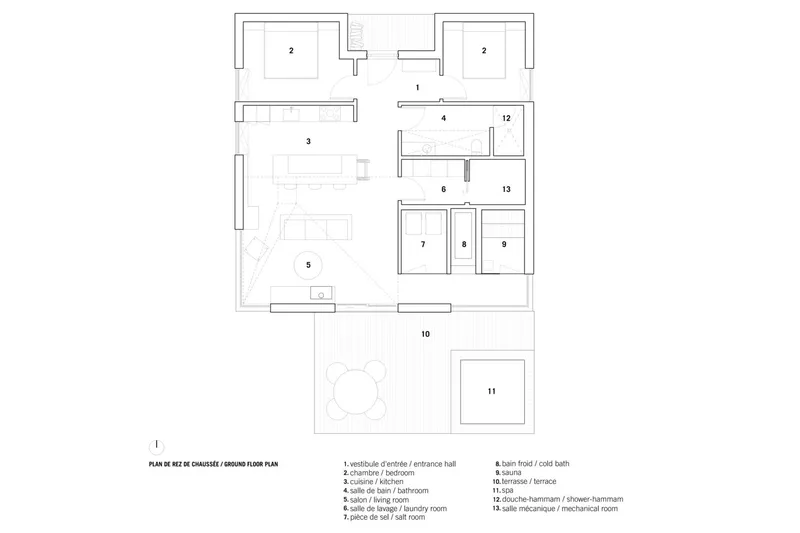
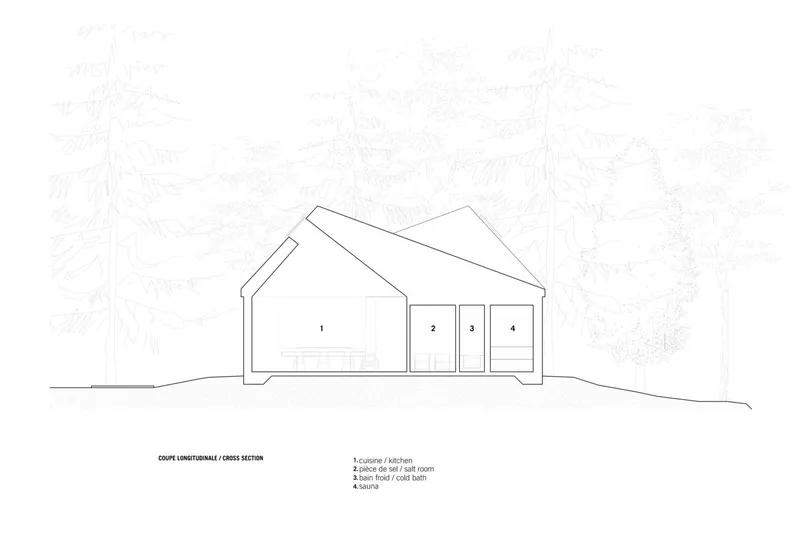
The roof concept diagram shows the design process: from a classic hip roof, the slopes are inverted from a central axis, the volume is reduced for economy, and skylights are punched through for interior light and height. The axonometrics show all four orientations. The floor plan reveals a compact single-storey layout: entrance hall, two bedrooms, kitchen, living room, bathroom, laundry, salt room, cold bath, sauna, terrace, outdoor spa, shower-hammam, and mechanical room. The cross section shows the twin inverted peaks and how the skylights bring light into the deepest parts of the plan.
Why This Project Matters
Wellness retreats in the forest are not new. What makes Habitat Selenite worth studying is how much programme NatureHumaine fit into 1,296 square feet without the building feeling dense. Two bedrooms, a full kitchen, a living room, a sauna, a cold bath, a salt room, a hammam, and an outdoor spa, all on one level, all accessible, all lit from above. The inverted roof is the move that makes it work: it reduces volume where height is wasted and opens it where light is needed.
If you are designing a compact retreat, a wellness building, or any single-storey house that needs to feel larger than its footprint, this project shows how roof geometry and skylight placement can do the work that square footage cannot.
About the Studio
Share Your Own Work on uni.xyz
If you are working on forest retreats, wellness architecture, or compact residential design, uni.xyz is a place to publish your work and connect with a global design community.
Project credits: Habitat Selenite by NatureHumaine. Eastman, Quebec, Canada. Photographs: Raphael Thibodeau.


Popular Articles
Popular articles from the community


The Earth Pod: 3D Printed Homes for Resilient Refugee Communities
The Earth Pod reimagines refugee housing through 3D printed homes made from clay, combining resilience, self-sufficiency, and rapid shelter.

Hill & Cross Opera: Sculptural Opera House Architecture Shaped by Tallinn’s Landscape and Identity
Hill & Cross Opera reimagines opera house architecture in Tallinn through its sculptural hill, civic plaza, glass wave and a luminous cross.

Conexión: Biophilic Design Reimagines High-Rise Living in Hong Kong
Conexión reimagines high-rise living in Hong Kong through biophilic design, green facades, shared spaces, daylight, water and nature within.

The Musturak Paradise: Senior Living Architecture for a Connected Future in Temara, Morocco
The Musturak Paradise reimagines senior living architecture in Temara via private homes, social spaces, culture, community, and shared care.

Similar Reads
You might also enjoy these articles


Hodi-Mandai Geram
Project Function: Preservation and revitalization of the Intangible heritage and socio-spatial identity of the Hodi by Housing, Cultural Memory Center, Sacred Grove, landscape, local tourism economy


Olio Towers: A Mid-Rise for Performers That Fuses Housing, Rehearsal, and Stage
Located blocks from Houston's Theater District, this modular tower stacks living units around a central performance atrium.

Oasis: Modular Green Housing Carved into Dhaka's Urban Fabric
A shortlisted Plugin Housing entry reclaims unauthorized settlements in Dhaka with stepped concrete volumes, green roofs, and ventilation-driven design.

Black Hole: A Floating Megastructure for the Post-Physical Era
Emiliano Mazzarotto envisions a spherical, self-scaling arena where e-sports, digital hotels, and holographic stadiums replace traditional public space.


Explore Quebec Retreats Competitions
Discover active competitions in this discipline



Challenge to reimagine the Iron Throne


Photograph architecture without architects


Illustrate the lost glory of Angkor Wat - Render Challenge


Design challenge to reuse E-waste
Comments (0)
Please login or sign up to add comments
No comments yet. Be the first to comment!