
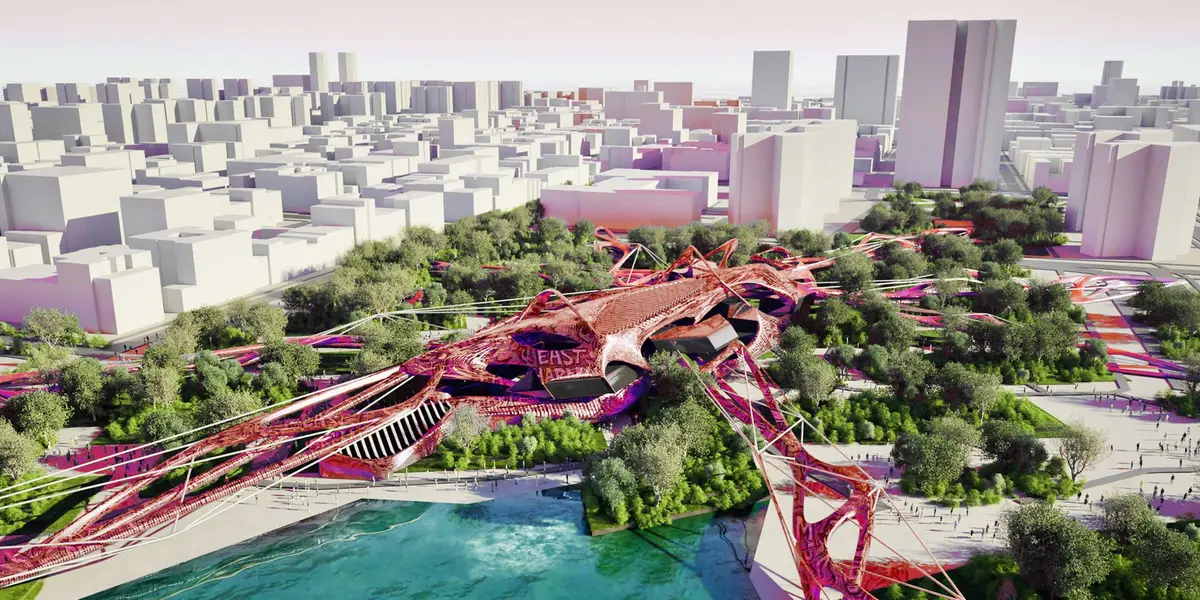
Harlem Ustopia: Synthetic Regrowth on the Ruins of Public Housing
A regenerative urban network in East Harlem transforms demolished public housing sites into layered ecosystems of memory, ecology, and modular living.


What grows back when an entire neighborhood's housing is demolished by government policy? Harlem Ustopia answers with something between architecture and organism: a branching structural network that rises from the void left by razed public housing in East Harlem, layering parks, pedestrian bridges, modular residences, and autonomous infrastructure into a single living system. The project refuses nostalgia. Instead of replicating what was lost, it proposes synthetic regrowth, a framework where technology, ecology, and collective memory fuse into new modes of urban resilience.
Designed by Miguelangel Murillo and Kevin Negrete, the project won the Peak competition. It is rooted in a specific history of displacement: the demolition programs that erased project housing across East Harlem, leaving both physical and emotional voids in the urban fabric. Murillo and Negrete treat those scars not as sites of absence but as fertile ground for a radically new kind of community infrastructure.
From Void to Network: Mapping the Logic of Regrowth
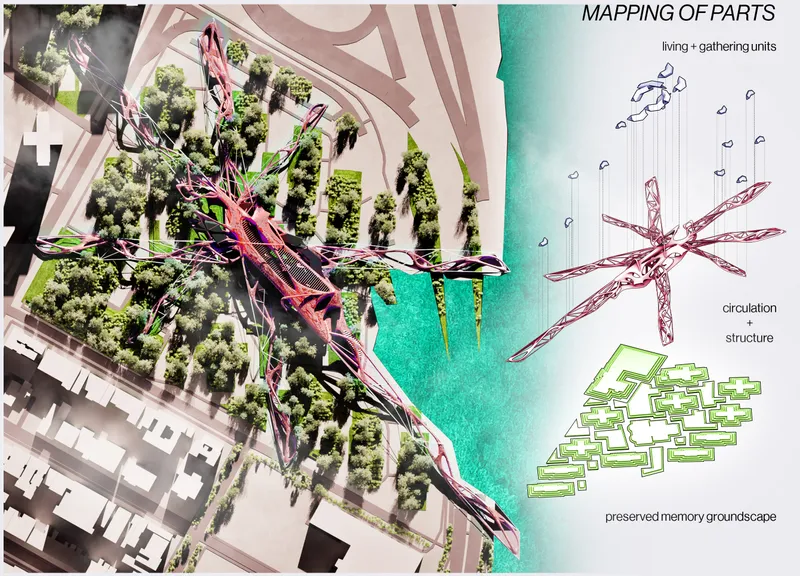
The aerial rendering reveals the project's spatial logic in diagrammatic clarity. Angular structural arms extend outward from anchor points across the demolished site, branching like roots reclaiming earth. The designers frame their evolution in three stages: Targeted Community, the dense neighborhood that once existed; Erased Community, leveled by policy and neglect; and Community Regrowth, the interconnected web that now fills the gap. Accompanying diagrams on the right side of the image make the mapping explicit, charting the transition from void to anchors to growth. These anchors function as community hubs and preserved memory nodes, while the branching structure ties them into a cohesive urban fabric.
The groundscape is deliberately preserved as a layer of collective memory. New circulatory and living systems are layered above it, vertically organizing the program: public parks and accessible plazas at ground level, semi-public bridges and shared courtyards at mid-level, and private modular housing units suspended within the upper structure. By literalizing the process of regrowth, the architecture turns trauma into terrain for regeneration.
A Lattice Canopy Over Streets That Remember
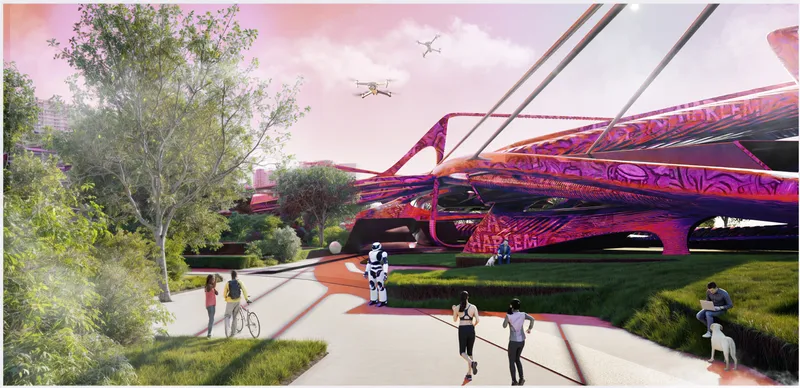
At street level, the experience shifts from diagram to atmosphere. Pedestrians and cyclists move along a generous pathway beneath an elevated pink lattice structure that filters light and frames the sky. Drones hover above, hinting at the autonomous maintenance systems woven through the project's infrastructure. Yet the scene reads as deeply human: shaded pathways, green canopies, and open plazas invite interaction and continuity. The atmosphere oscillates between futuristic and familiar, a quality the designers describe as Harlem rising from its own DNA.
Each element in the section reflects what Murillo and Negrete call Harlem's cultural rhythm: improvisational, adaptive, self-sustaining. The lattice is not decorative. It is the visible skeleton of the branching network, the mid-level layer where semi-public bridges and pedestrian paths connect fragments of the neighborhood's memory. The modular housing units above remain adaptable to residents' changing needs, suspended within a system designed to evolve rather than calcify.
Fluid Ribs and the Interior of a Living Structure
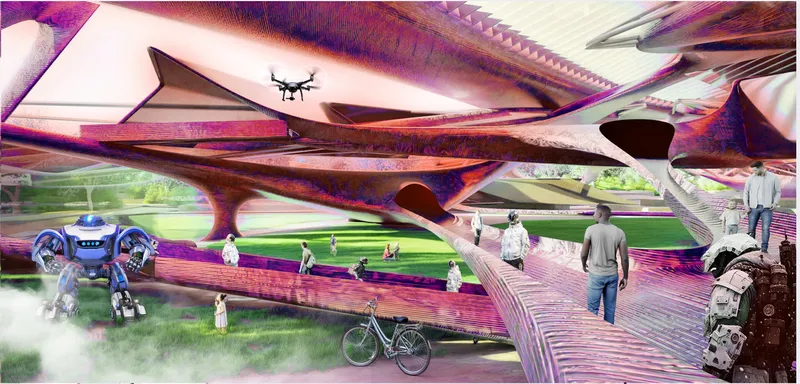
The interior view is the project's most compelling image. Fluid structural ribs arc overhead, supporting a canopy above a wide promenade where people walk alongside a sleek futuristic vehicle. The ribs function simultaneously as structure, shade device, and circulatory channel. Robotic maintenance systems and autonomous vehicles are integrated into the architecture rather than bolted on as afterthoughts. The result is an ecosystem of motion and life, a self-renewing organism that continuously evolves with its community.
What stands out here is the scale of the public realm. The promenade is generous enough to feel urban without being monumental. The rib structure creates a rhythm of light and shadow that recalls both natural canopies and the steel frameworks of infrastructure. It is a space where technology serves social encounter rather than replacing it, and where the architecture's futurism is tempered by its attentiveness to the human body moving through space.
Why This Project Matters
Harlem Ustopia takes on one of the hardest problems in urban design: how to build on sites defined by institutional violence without either erasing that history or becoming paralyzed by it. Murillo and Negrete's answer is neither memorial nor tabula rasa. Their synthetic regrowth model preserves the groundscape as a record of what was lost while layering new programs, ecologies, and technologies above it. The three-tiered vertical organization, from public park to semi-public bridge to private modular unit, distributes agency across scales and gives residents genuine spatial ownership.
As a winner of the Peak competition, the project signals a generation of designers willing to treat speculative technology not as spectacle but as social infrastructure. Drones and autonomous vehicles are present, but they serve the architecture rather than defining it. The real innovation here is the spatial framework itself: a branching, adaptive network that can grow, contract, and reconfigure as East Harlem's needs evolve. It is a convincing argument that regenerative design, when grounded in specific histories of displacement, can produce architecture that learns, grows, and remembers.
View the Full Project
About the Designers
Designers: Miguelangel Murillo, Kevin Negrete
Enter a Design Competition on uni.xyz
uni.xyz runs architecture and design competitions year-round that reward proposals with spatial conviction and real site intelligence.
Project credits: Harlem Ustopia by Miguelangel Murillo, Kevin Negrete Peak (uni.xyz).


Popular Articles
Popular articles from the community


David Ortega Stacks a Two-Story Mexico City Penthouse Around a Steel Stair and a Pergola-Shaded Roof Terrace
In Colonia Roma, a 300 m² penthouse uses oak joinery, a planted steel stair and a slatted roof pergola to make a new-build apartment feel like a house.

Jaramillo Van Sluys Arquitectura and Urbanismo Turn a Demolished Registry Lot in Quito into an Orchard Plaza
In Quito's Centro Histórico, a 2,800 m² plaza exposes the San Agustín convent wall and redraws its lost Augustinian orchard in volcanic stone.

Juan García Correa, John González and Claudia Rueda Sink a Circular Amphitheater into a Manizales Engineering Building
On the La Nubia campus in Manizales, Colombia, the S1 Building folds labs and offices into a hillside of ramped lawns that double as a campus route.

longwave studio Reorganizes a 112 m² Tainan Apartment Around the Daily Routines of a Family and Two Cats
In Tainan, Taiwan, birch plywood, rust-red furniture and a freestanding plaster wall link arrival, storage, work and family life in one apartment.

Similar Reads
You might also enjoy these articles


Aquadapt: An Underwater Habitat That Rewrites Its Rooms by the Hour
Curved modules ring the seabed while one shell shifts from breakfast room to cinema, farm and football pitch as residents' needs change.

Play: Fragments of Their World: Remembered Architecture Rebuilt as a Modular Playground for Refugee Camps
Tom Gardner abstracts domes, arches and towers from the homelands of displaced families into a kit of child-scaled play parts for camp settlements.
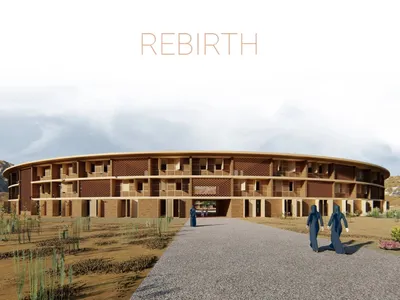
REBIRTH: A Circular Settlement Where Afghan Widows and Their Children Rebuild Life Together
A shortlisted Resile entry turns the circle into a protective ring of timber and brick, gathering homes, classrooms and gardens around a shared landscape.
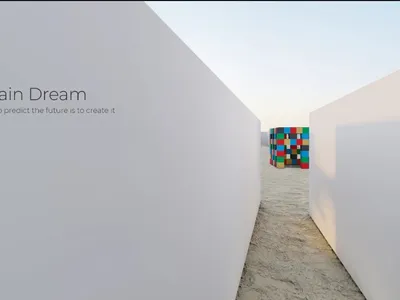
The Main Dream: A Recycled Plastic Kit That Lets Refugee Children Build Their Own Playground
Thirty-centimetre interlocking cubes that connect on three axes turn play into construction, letting children author the spaces they occupy.


Comments (0)
Please login or sign up to add comments
No comments yet. Be the first to comment!